
Pyruvate Oxidation or Oxidative Decarboxylation if oxygen is
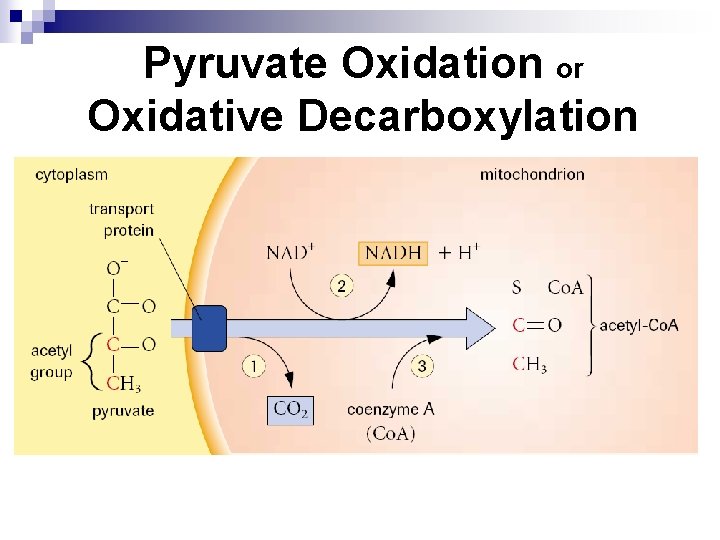
Pyruvate Oxidation or Oxidative Decarboxylation (if oxygen is present…) The following occurs for each pyruvate: 1. CO 2 removed. 2. NAD+ reduced to NADH and the 2 carbon compound becomes acetic acid. 3. Coenzyme A (Co. A) attaches to acetic acid to form acetyl-Co. A.
Pyruvate Oxidation or Oxidative Decarboxylation
Pyruvate Oxidation or Oxidative Decarboxylation Energy Yield & Products: 2 NADH 2 acetyl-Co. A 2 CO 2 (released as waste)
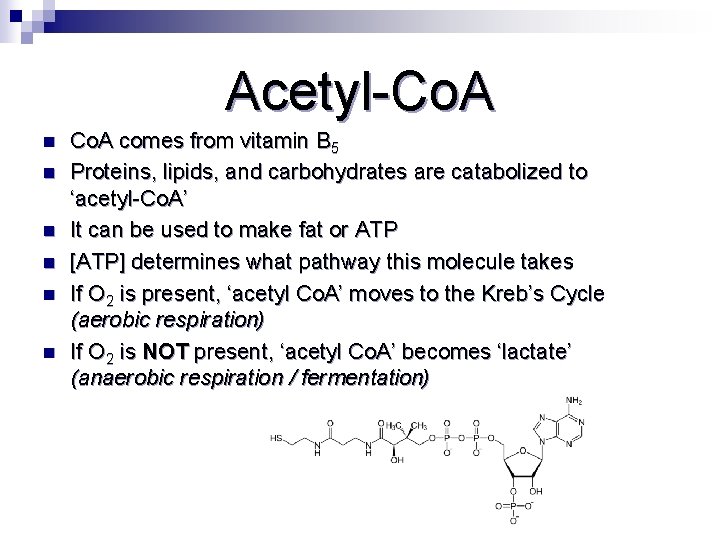
Acetyl-Co. A n n n Co. A comes from vitamin B 5 Proteins, lipids, and carbohydrates are catabolized to ‘acetyl-Co. A’ It can be used to make fat or ATP [ATP] determines what pathway this molecule takes If O 2 is present, ‘acetyl Co. A’ moves to the Kreb’s Cycle (aerobic respiration) If O 2 is NOT present, ‘acetyl Co. A’ becomes ‘lactate’ (anaerobic respiration / fermentation)
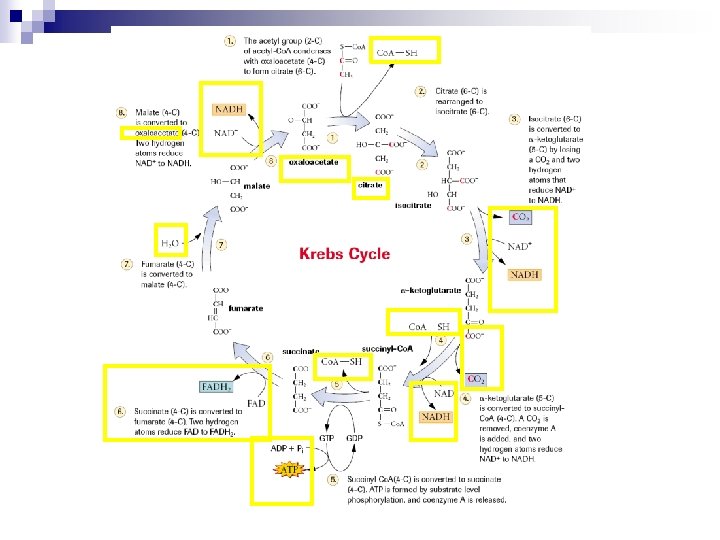
Krebs cycle - overview 8 step process, with each step catalyzed by a specific enzyme n It is a ‘cycle’ because oxaloacetate is the product of step 8, and the reactant in step 1 n REMEMBER: Two acetyl-Co. A molecules enter, so the Krebs Cycle must happen TWICE for every one molecule of glucose that begins glycolysis n
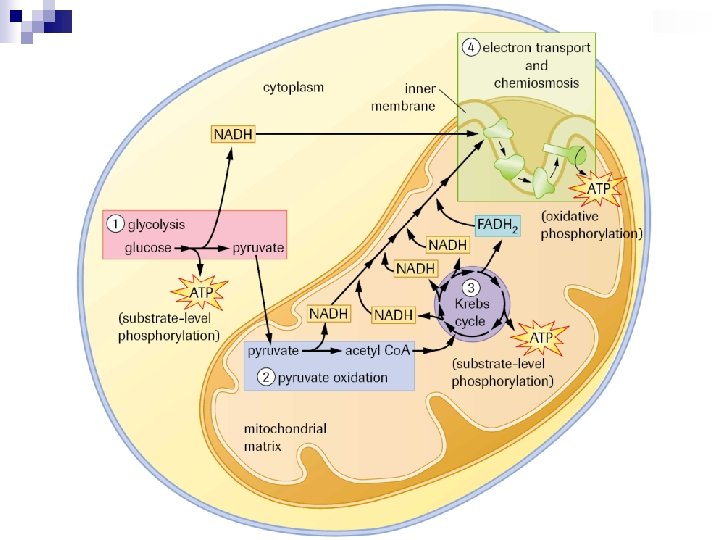
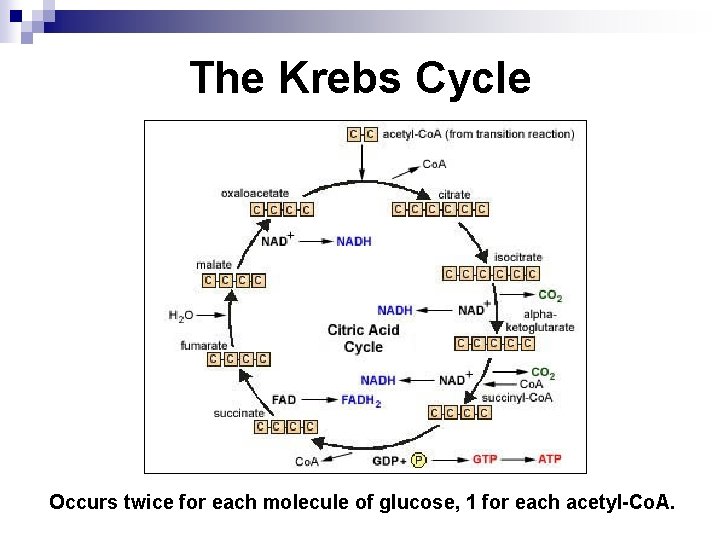
The Krebs Cycle Occurs twice for each molecule of glucose, 1 for each acetyl-Co. A.
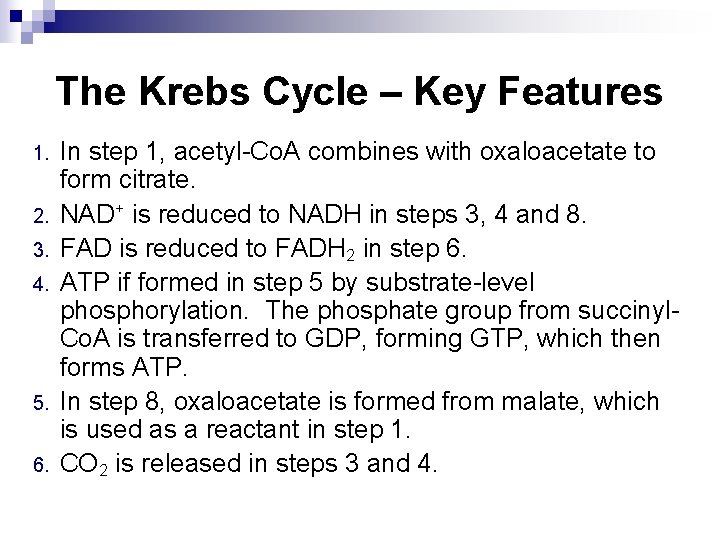
The Krebs Cycle – Key Features 1. 2. 3. 4. 5. 6. In step 1, acetyl-Co. A combines with oxaloacetate to form citrate. NAD+ is reduced to NADH in steps 3, 4 and 8. FAD is reduced to FADH 2 in step 6. ATP if formed in step 5 by substrate-level phosphorylation. The phosphate group from succinyl. Co. A is transferred to GDP, forming GTP, which then forms ATP. In step 8, oxaloacetate is formed from malate, which is used as a reactant in step 1. CO 2 is released in steps 3 and 4.
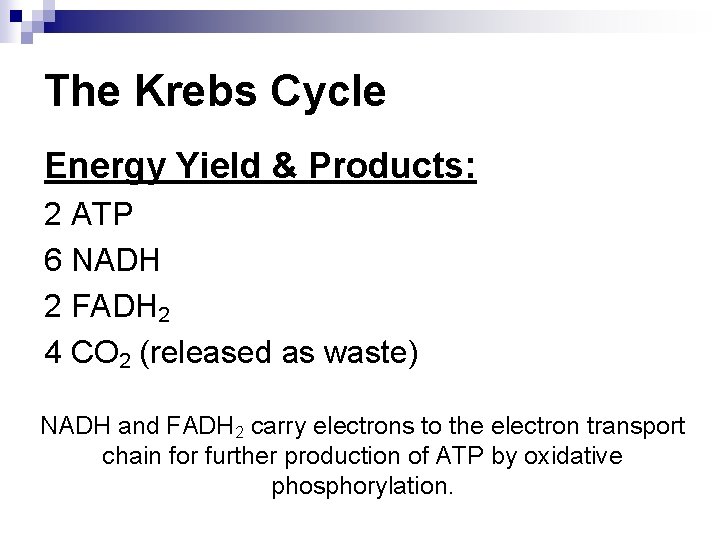
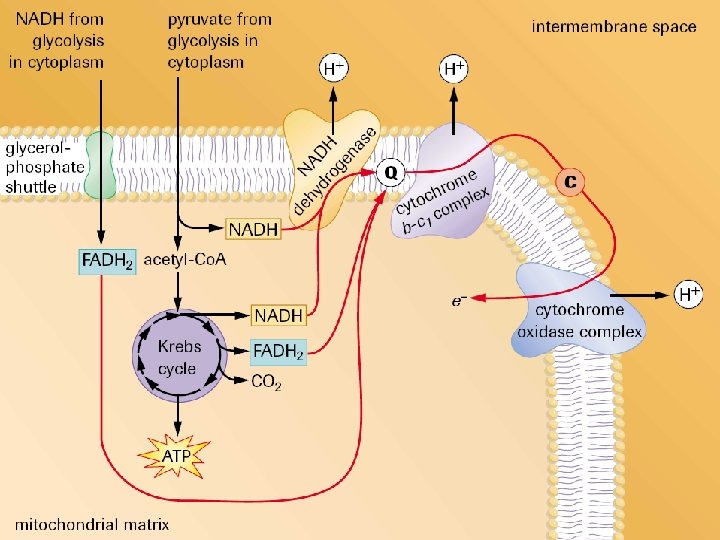
The Krebs Cycle Energy Yield & Products: 2 ATP 6 NADH 2 FADH 2 4 CO 2 (released as waste) NADH and FADH 2 carry electrons to the electron transport chain for further production of ATP by oxidative phosphorylation.
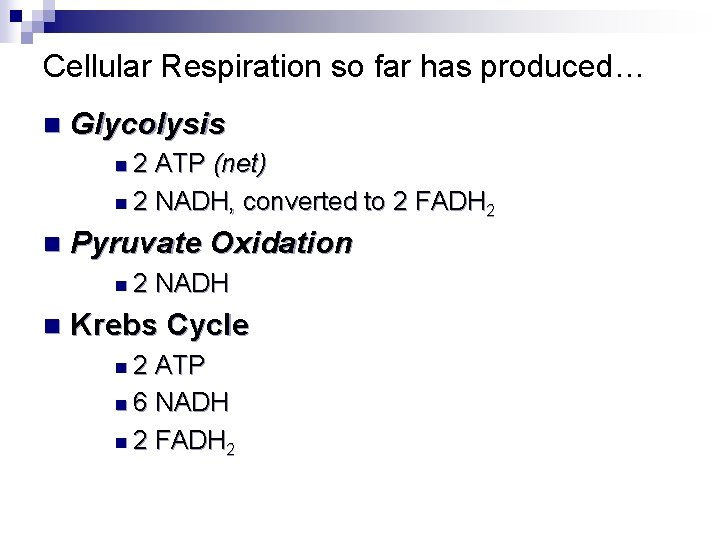
Cellular Respiration so far has produced… n Glycolysis n 2 ATP (net) n 2 NADH, converted to 2 FADH 2 n Pyruvate Oxidation n 2 n NADH Krebs Cycle n 2 ATP n 6 NADH n 2 FADH 2
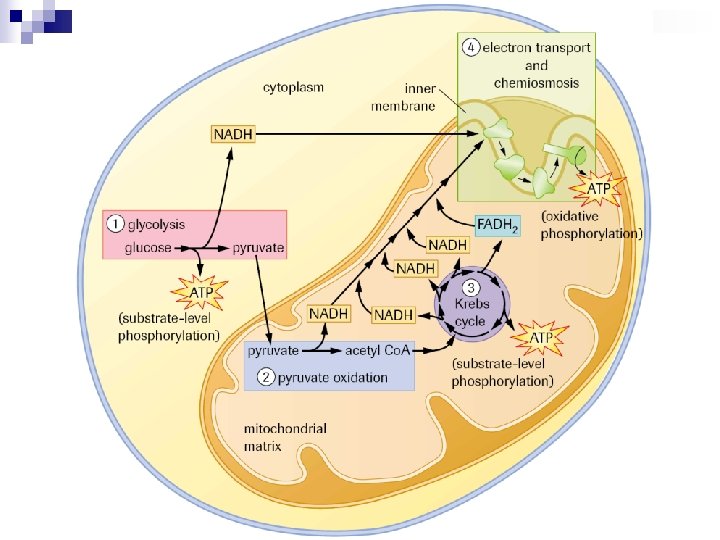
E. T. C. - Structure n n A series of electron acceptors (proteins) are embedded in the inner mitochondrial membrane These proteins are arranged in order of increasing electronegativity. The weakest attractor of electrons (NADH dehydrogenase) is at the start of the chain and the strongest (cytochrome oxidase) is at the end. Since the mitochondrial membrane is highly folded, there are multiple copies of the ETC across the membrane
Electron Transport Chain - Overview n n n NADH and FADH 2 transfer electrons to proteins in the inner mitochondrial membrane The weakest electron attractors are at the start, and the strongest are at the end Each component is REDUCED, and then subsequently OXIDIZED Oxygen (highly electronegative) oxidizes the last ETC component The energy released, moves H+ atoms (i. e. protons) across mitochondrial membrane
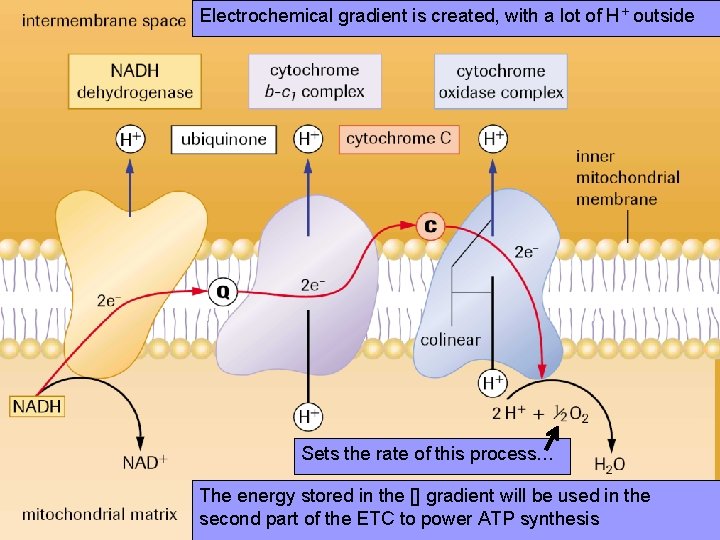
Electrochemical gradient is created, with a lot of H+ outside Sets the rate of this process… The energy stored in the [] gradient will be used in the second part of the ETC to power ATP synthesis
- Slides: 16