
PYRAMID WAVEFRONT SENSOR PERFORMANCE WITH LASER GUIDE STARS
![Noise prop. coeff. [nm / slope rms] SENSITIVITY WITH 2 D EXTENDED SOURCES AO](https://slidetodoc.com/presentation_image_h2/b3c0fbd38516505c4c567be1a7f11a5f/image-4.jpg "Noise prop. coeff. [nm / slope rms] SENSITIVITY WITH 2 D EXTENDED SOURCES AO")
- Slides: 16
PYRAMID WAVEFRONT SENSOR PERFORMANCE WITH LASER GUIDE STARS F. Quirós-Pacheco 1, E. Pinna 1, A. Puglisi 1, G. Agapito 1 L Busoni 1, S. Rabien 2, S. Esposito 1 1 INAF – Arcetri 2 MPE – Garching
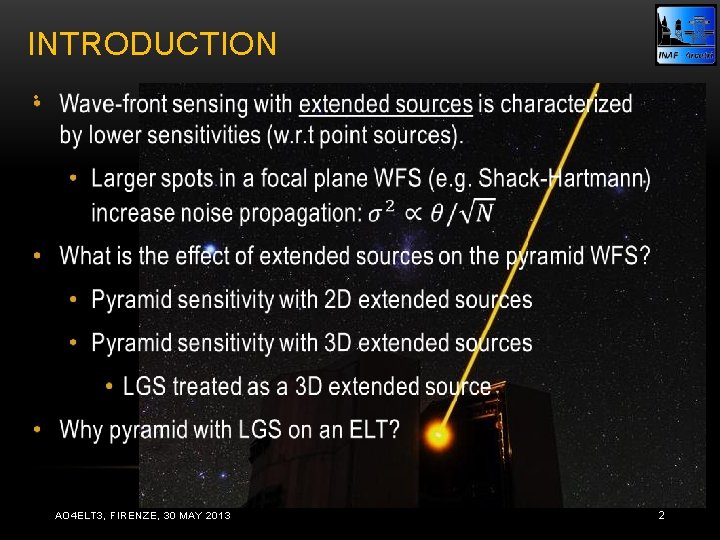
INTRODUCTION • AO 4 ELT 3, FIRENZE, 30 MAY 2013 2
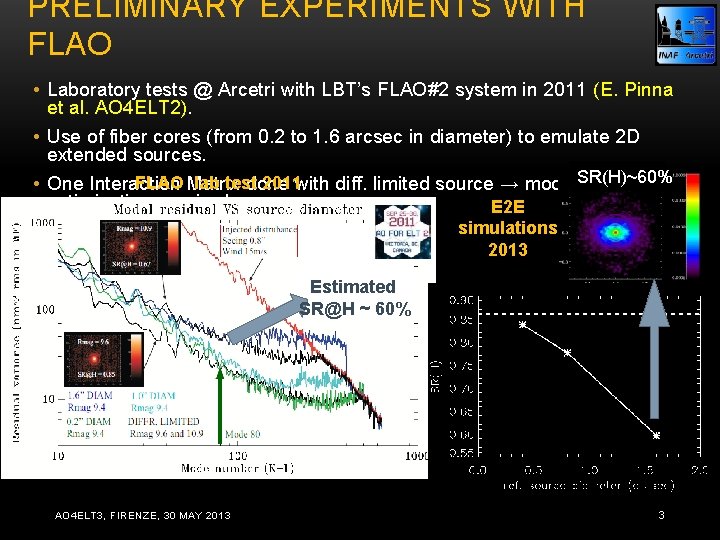
PRELIMINARY EXPERIMENTS WITH FLAO • Laboratory tests @ Arcetri with LBT’s FLAO#2 system in 2011 (E. Pinna et al. AO 4 ELT 2). • Use of fiber cores (from 0. 2 to 1. 6 arcsec in diameter) to emulate 2 D extended sources. FLAO Matrix lab test 2011 with diff. limited source → modal. SR(H)~60% • One Interaction done gain optimization required. E 2 E simulations 2013 Estimated SR@H ~ 60% AO 4 ELT 3, FIRENZE, 30 MAY 2013 3
Noise prop. coeff. [nm / slope rms] SENSITIVITY WITH 2 D EXTENDED SOURCES AO 4 ELT 3, FIRENZE, 30 MAY 2013 4
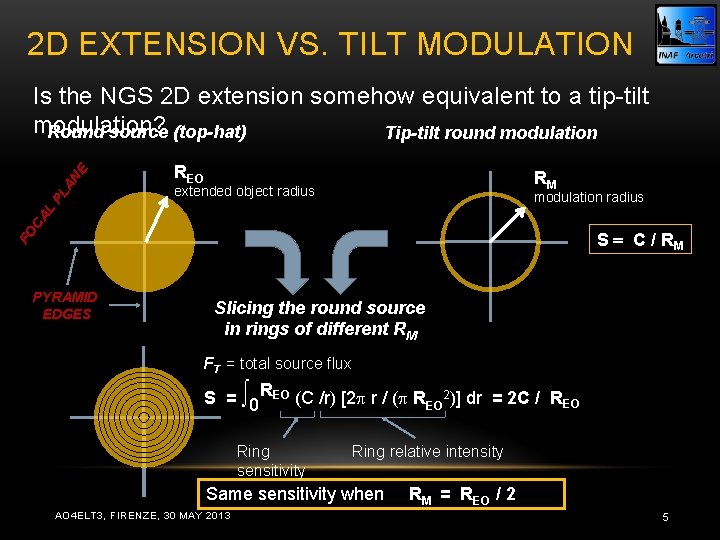
2 D EXTENSION VS. TILT MODULATION REO RM extended object radius modulation radius CA L PL A NE Is the NGS 2 D extension somehow equivalent to a tip-tilt modulation? Round source (top-hat) Tip-tilt round modulation FO S = C / RM PYRAMID EDGES Slicing the round source in rings of different RM FT = total source flux S = ∫ 0 REO (C /r) [2 p r / (p REO 2)] dr = 2 C / REO Ring sensitivity Ring relative intensity Same sensitivity when AO 4 ELT 3, FIRENZE, 30 MAY 2013 RM = REO / 2 5
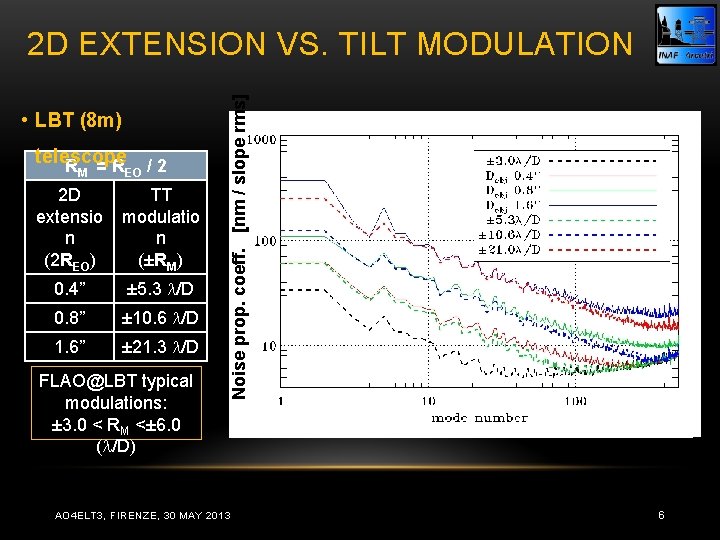
• LBT (8 m) telescope RM = REO / 2 2 D extensio n (2 REO) TT modulatio n (±RM) 0. 4” ± 5. 3 /D 0. 8” ± 10. 6 /D 1. 6” ± 21. 3 /D FLAO@LBT typical modulations: ± 3. 0 < RM <± 6. 0 ( /D) Noise prop. coeff. [nm / slope rms] 2 D EXTENSION VS. TILT MODULATION AO 4 ELT 3, FIRENZE, 30 MAY 2013 6
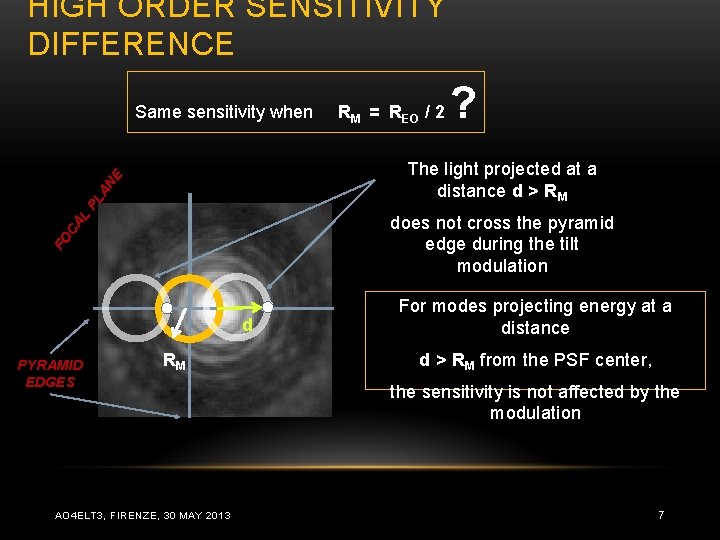
HIGH ORDER SENSITIVITY DIFFERENCE Same sensitivity when ? PL A NE The light projected at a distance d > RM FO CA L does not cross the pyramid edge during the tilt modulation d PYRAMID EDGES RM = REO / 2 RM AO 4 ELT 3, FIRENZE, 30 MAY 2013 For modes projecting energy at a distance d > RM from the PSF center, the sensitivity is not affected by the modulation 7
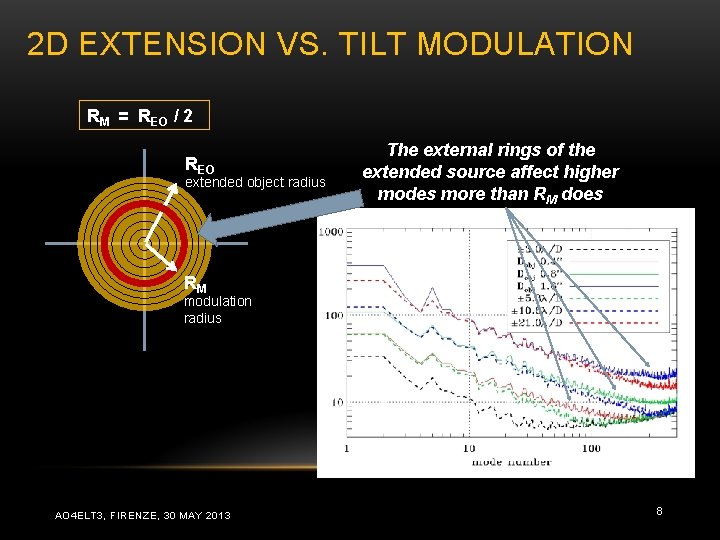
2 D EXTENSION VS. TILT MODULATION RM = REO / 2 REO extended object radius The external rings of the extended source affect higher modes more than RM does RM modulation radius AO 4 ELT 3, FIRENZE, 30 MAY 2013 8
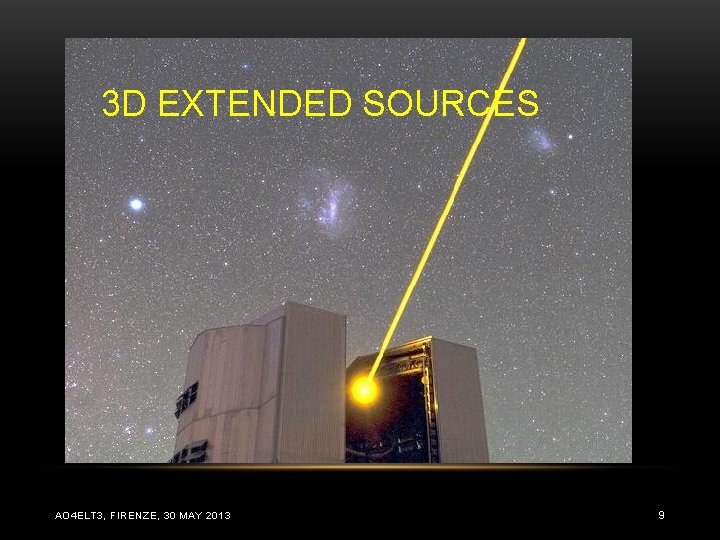
3 D EXTENDED SOURCES AO 4 ELT 3, FIRENZE, 30 MAY 2013 9
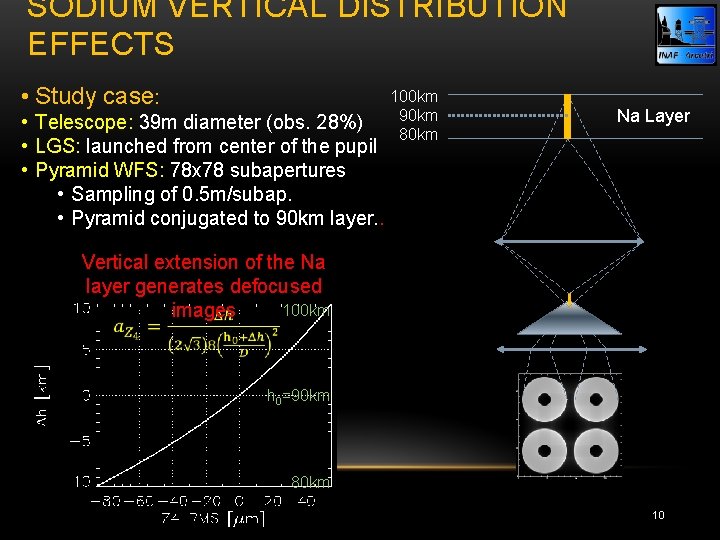
SODIUM VERTICAL DISTRIBUTION EFFECTS • Study case: • Telescope: 39 m diameter (obs. 28%) • LGS: launched from center of the pupil • Pyramid WFS: 78 x 78 subapertures • Sampling of 0. 5 m/subap. • Pyramid conjugated to 90 km layer. . 100 km 90 km 80 km Na Layer Vertical extension of the Na layer generates defocused 100 km images h 0=90 km 80 km AO 4 ELT 3, FIRENZE, 30 MAY 2013 10
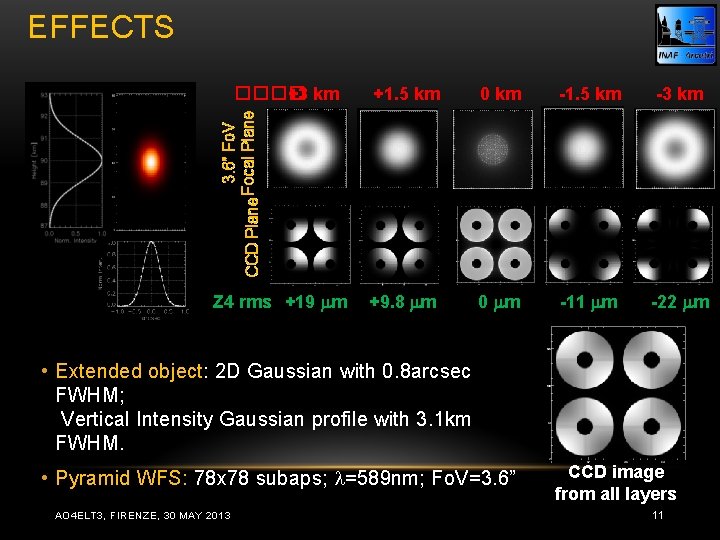
EFFECTS +1. 5 km 0 km -1. 5 km -3 km +9. 8 m 0 m -11 m -22 m 3. 6” Fo. V CCD Plane Focal Plane ���� +3 km Z 4 rms +19 m • Extended object: 2 D Gaussian with 0. 8 arcsec FWHM; Vertical Intensity Gaussian profile with 3. 1 km FWHM. • Pyramid WFS: 78 x 78 subaps; =589 nm; Fo. V=3. 6” AO 4 ELT 3, FIRENZE, 30 MAY 2013 CCD image from all layers 11
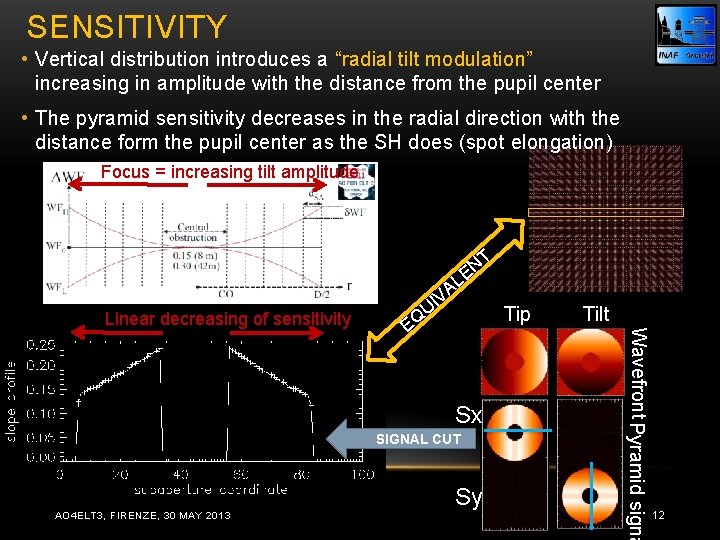
SENSITIVITY • Vertical distribution introduces a “radial tilt modulation” increasing in amplitude with the distance from the pupil center • The pyramid sensitivity decreases in the radial direction with the distance form the pupil center as the SH does (spot elongation) Focus = increasing tilt amplitude T N E L A V EQ Sx SIGNAL CUT AO 4 ELT 3, FIRENZE, 30 MAY 2013 Sy Tip Tilt Wavefront Pyramid signa Linear decreasing of sensitivity UI 12
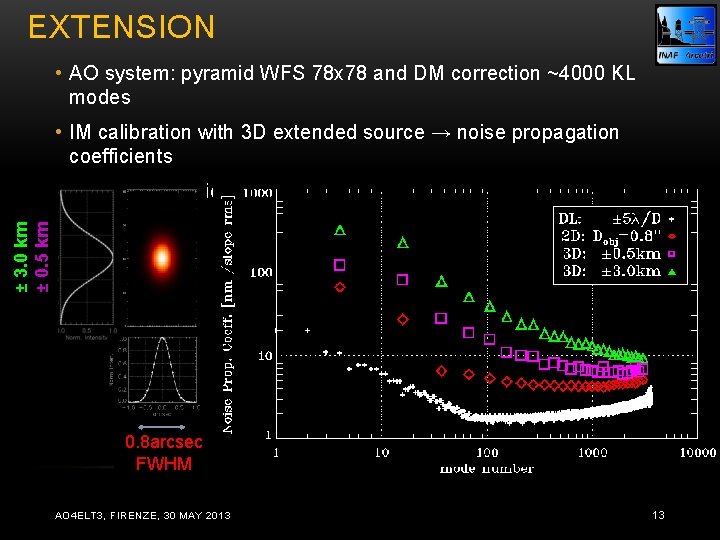
EXTENSION • AO system: pyramid WFS 78 x 78 and DM correction ~4000 KL modes ± 3. 0 km ± 0. 5 km • IM calibration with 3 D extended source → noise propagation coefficients • Vertical extension: a) 90± 3 km b) 90± 0. 5 km (aka LGS with refocusing) 0. 8 arcsec FWHM AO 4 ELT 3, FIRENZE, 30 MAY 2013 13
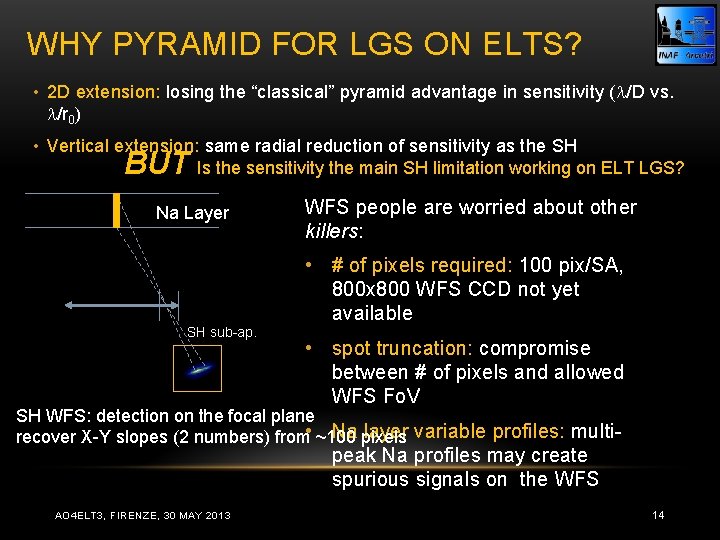
WHY PYRAMID FOR LGS ON ELTS? • 2 D extension: losing the “classical” pyramid advantage in sensitivity ( /D vs. /r 0) • Vertical extension: same radial reduction of sensitivity as the SH Is the sensitivity the main SH limitation working on ELT LGS? BUT Na Layer SH sub-ap. WFS people are worried about other killers: • # of pixels required: 100 pix/SA, 800 x 800 WFS CCD not yet available • spot truncation: compromise between # of pixels and allowed WFS Fo. V SH WFS: detection on the focal plane Na pixels layer variable profiles: multirecover X-Y slopes (2 numbers) from • ~100 peak Na profiles may create spurious signals on the WFS AO 4 ELT 3, FIRENZE, 30 MAY 2013 14
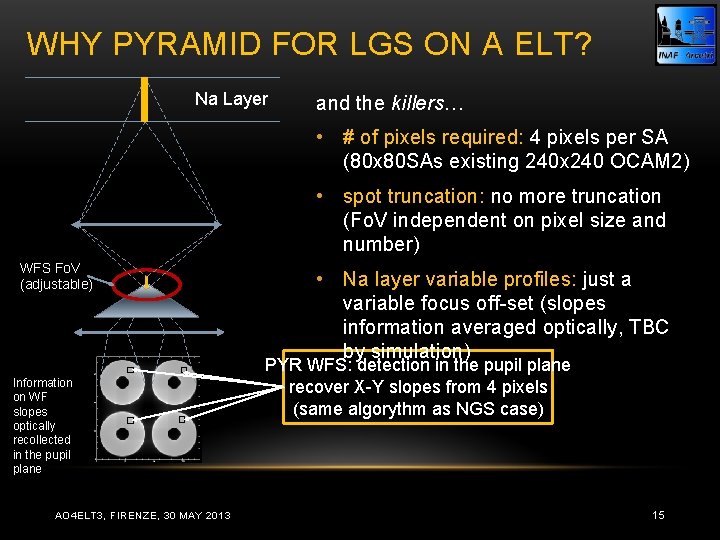
WHY PYRAMID FOR LGS ON A ELT? Na Layer and the killers… • # of pixels required: 4 pixels per SA (80 x 80 SAs existing 240 x 240 OCAM 2) • spot truncation: no more truncation (Fo. V independent on pixel size and number) WFS Fo. V (adjustable) Information on WF slopes optically recollected in the pupil plane AO 4 ELT 3, FIRENZE, 30 MAY 2013 • Na layer variable profiles: just a variable focus off-set (slopes information averaged optically, TBC by simulation) PYR WFS: detection in the pupil plane recover X-Y slopes from 4 pixels (same algorythm as NGS case) 15
FUTURE WORK • Concept: pupil edge lunch of the LGS • Simulations: • Closed loop performance with 3 D (more GPUs!) • Multi peak distribution impact (focus offset only? ) • Lab experiment: PEACE bench (Arcetri - ESO GMT) already equipped with pyramid WFS and Na lamp • Vertical extension simulated by defocus on ALPAO DM • Phasing segmented mirror with Na source. . . then on-sky experiment? AO 4 ELT 3, FIRENZE, 30 MAY 2013 16