
Pygmalion Act II Part 2 Act III Part
- Slides: 31
Pygmalion Act II (Part 2) & Act III (Part 1): Quiz & Class Discussion LIT. & LIFE I. III. IV. Stage directions Discussion as battle of will Education Comedy of manners
I. Stage Directions Characters: Higgins vs. the Others i. LIT. & LIFE What does the stage description on pp. 26 -26 reveal more about Higgins?
1. Which of the following is NOT in Higgins’ lab? 1. 2. 3. 4. a dessert dish a grand piano a life-size image of half a human head Some paintings
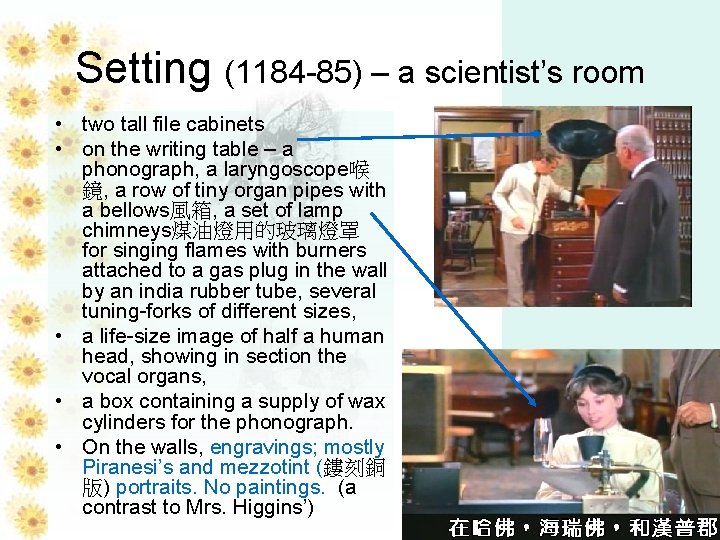
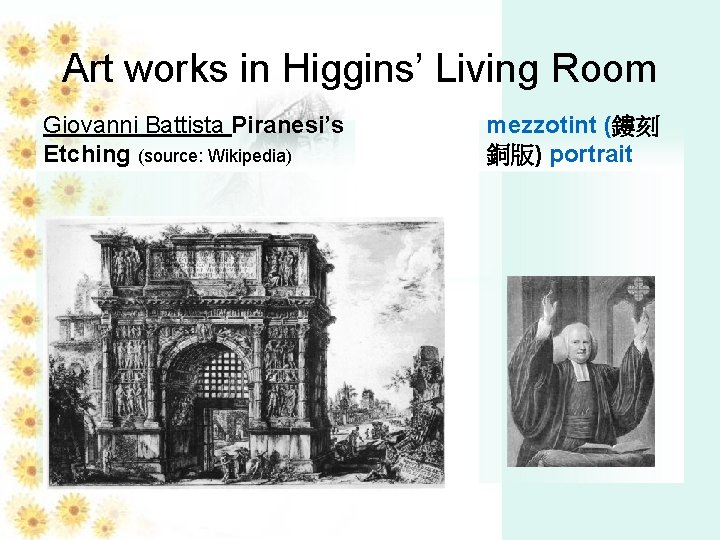
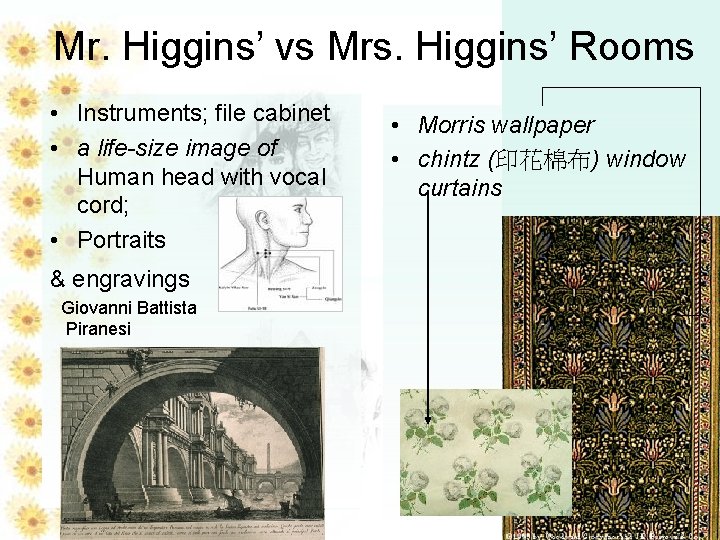
Setting (1184 -85) – a scientist’s room • two tall file cabinets • on the writing table – a phonograph, a laryngoscope喉 鏡, a row of tiny organ pipes with a bellows風箱, a set of lamp chimneys煤油燈用的玻璃燈罩 for singing flames with burners attached to a gas plug in the wall by an india rubber tube, several tuning-forks of different sizes, • a life-size image of half a human head, showing in section the vocal organs, • a box containing a supply of wax cylinders for the phonograph. • On the walls, engravings; mostly Piranesi’s and mezzotint (鏤刻銅 版) portraits. No paintings. (a contrast to Mrs. Higgins’)
Art works in Higgins’ Living Room Giovanni Battista Piranesi’s Etching (source: Wikipedia) mezzotint (鏤刻 銅版) portrait
Mr. Higgins’ vs Mrs. Higgins’ Rooms • Instruments; file cabinet • a life-size image of Human head with vocal cord; • Portraits & engravings Giovanni Battista Piranesi • Morris wallpaper • chintz (印花棉布) window curtains
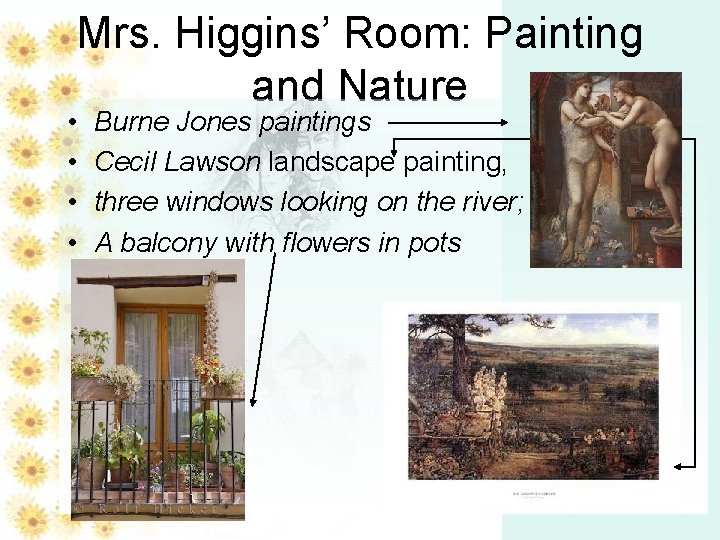
Mrs. Higgins’ Room: Painting and Nature • • Burne Jones paintings Cecil Lawson landscape painting, three windows looking on the river; A balcony with flowers in pots
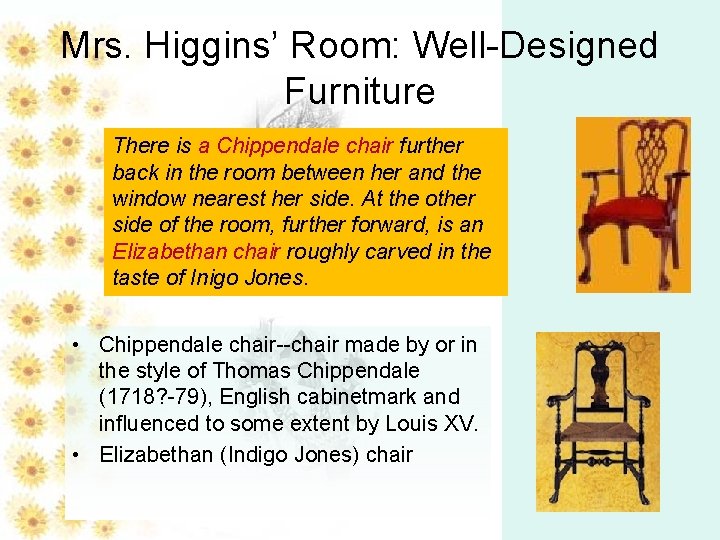
Mrs. Higgins’ Room: Well-Designed Furniture There is a Chippendale chair further back in the room between her and the window nearest her side. At the other side of the room, further forward, is an Elizabethan chair roughly carved in the taste of Inigo Jones. • Chippendale chair--chair made by or in the style of Thomas Chippendale (1718? -79), English cabinetmark and influenced to some extent by Louis XV. • Elizabethan (Indigo Jones) chair
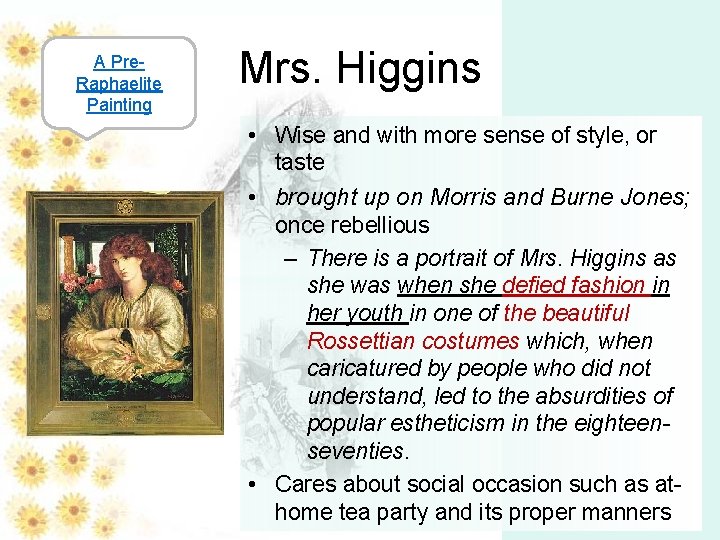
A Pre. Raphaelite Painting Mrs. Higgins • Wise and with more sense of style, or taste • brought up on Morris and Burne Jones; once rebellious – There is a portrait of Mrs. Higgins as she was when she defied fashion in her youth in one of the beautiful Rossettian costumes which, when caricatured by people who did not understand, led to the absurdities of popular estheticism in the eighteenseventies. • Cares about social occasion such as athome tea party and its proper manners
Stage Direction Higgins • Well-off, a lot of furniture, etchings but not paintings • Scientific: a lot of machines in his drawing room. • Childish: described as “babylike” twice; sweets – like a very impetuous baby "taking notice" eagerly and loudly; [upon seeing Eliza] baby-like, making an intolerable grievance of it – “a robust, vital, appetizing sort of man of forty or thereabouts” “a professional-looking black frock-coat” – “heartily, even violently interested in everything that can be studied as a scientific subject” “careless about himself and other people, including their feelings. – “so entirely frank and void of malice that he remains likeable even in his least reasonable moments. • * GBS’s bias for Higgins.
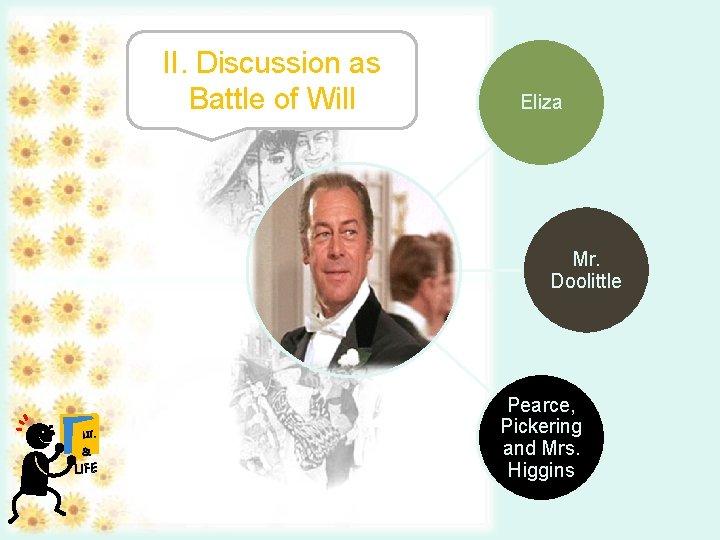
II. Discussion as Battle of Will Eliza Mr. Doolittle LIT. & LIFE Pearce, Pickering and Mrs. Higgins
2. Which of the following is wrong about the first dialogue in Act II about Eliza’s education? 1. Eliza thought that Higgins cared about the money she paid. 2. Higgins is interested because of the bet Pickering places. 3. Higgins tries to persuade her with a rhetoric description of the future, as well as with chocolate, taxi, gold and diamond. 4. When Higgins finally clarifies the possible future for Eliza, he is all clear and reasonable.
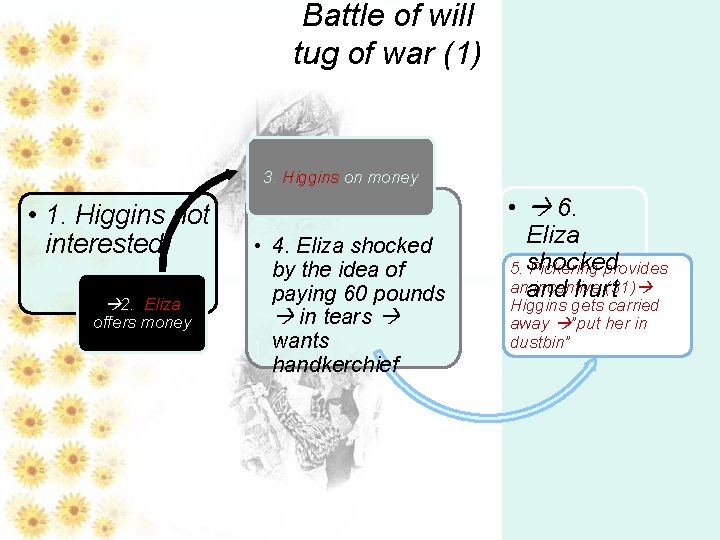
Battle of will tug of war (1) 3. Higgins on money • 1. Higgins not interested 2. Eliza offers money • 4. Eliza shocked by the idea of paying 60 pounds in tears wants handkerchief • 6. Eliza 5. shocked Pickering provides anand incentive hurt(31) Higgins gets carried away ”put her in dustbin”
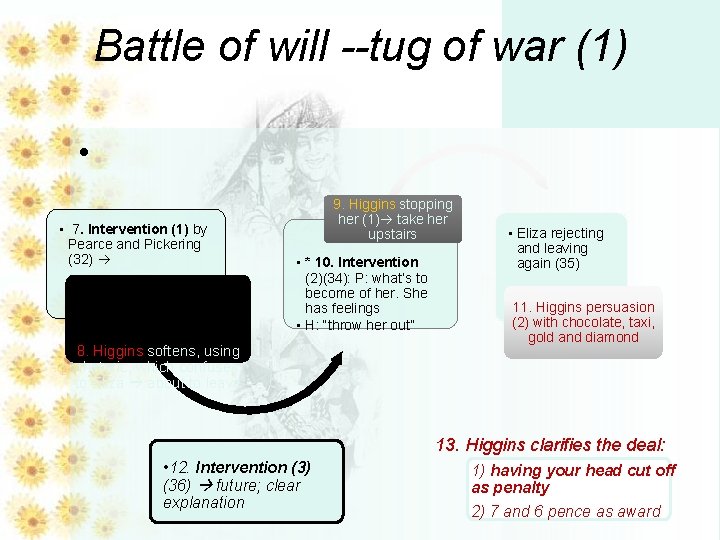
Battle of will --tug of war (1) • • 7. Intervention (1) by Pearce and Pickering (32) 9. Higgins stopping her (1) take her upstairs • * 10. Intervention (2)(34): P: what’s to become of her. She has feelings • H: “throw her out” 8. Higgins softens, using rhetoric, which confuses to Eliza about to leave • Eliza rejecting and leaving again (35) 11. Higgins persuasion (2) with chocolate, taxi, gold and diamond 13. Higgins clarifies the deal: • 12. Intervention (3) (36) future; clear explanation 1) having your head cut off as penalty 2) 7 and 6 pence as award
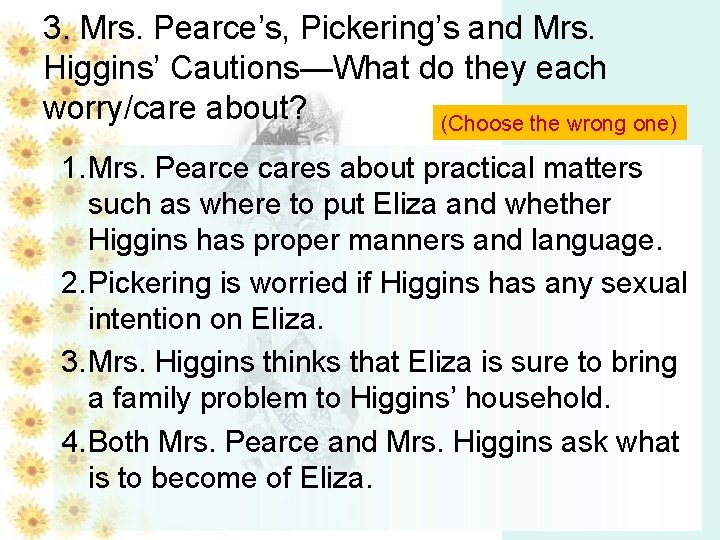
3. Mrs. Pearce’s, Pickering’s and Mrs. Higgins’ Cautions—What do they each worry/care about? (Choose the wrong one) 1. Mrs. Pearce cares about practical matters such as where to put Eliza and whether Higgins has proper manners and language. 2. Pickering is worried if Higgins has any sexual intention on Eliza. 3. Mrs. Higgins thinks that Eliza is sure to bring a family problem to Higgins’ household. 4. Both Mrs. Pearce and Mrs. Higgins ask what is to become of Eliza.
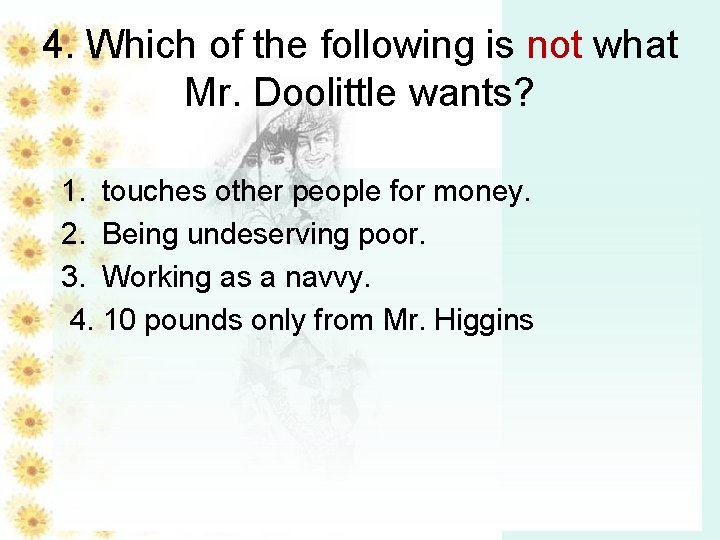
4. Which of the following is not what Mr. Doolittle wants? 1. touches other people for money. 2. Being undeserving poor. 3. Working as a navvy. 4. 10 pounds only from Mr. Higgins
III. Eliza’s Education LIT. & LIFE (2+6) Eliza’s Education: What has she achieved in the first part of Act 3 (the at -home party), and where does she fall short?
4. What are Eliza’s First Responses to being cleaned and dressed up? (Choose the wrong one) 1. She now knows why rich people can take a bath everyday. 2. She will go back to tell the other girls in her neighborhood what hot water bath is like. 3. She does not dare to look at the mirror. 4. She finds wearing a night gown a waste of money.
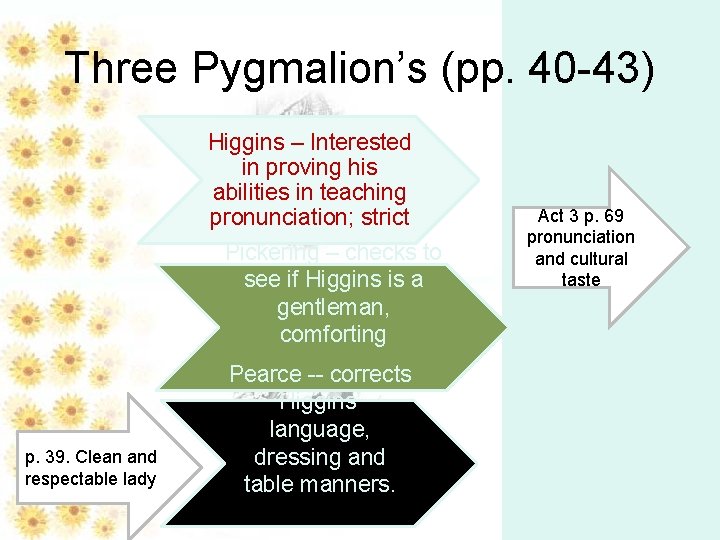
Three Pygmalion’s (pp. 40 -43) Higgins – Interested in proving his abilities in teaching pronunciation; strict Pickering – checks to see if Higgins is a gentleman, comforting p. 39. Clean and respectable lady Pearce -- corrects Higgins’ language, dressing and table manners. Act 3 p. 69 pronunciation and cultural taste
IV. The Comical: The Play as a Comedy of Manners (1+5) Act 2 and 3: Comedy of Manners: What are the comical elements in these two acts? LIT. & LIFE
6. Which of the following proves Higgins rude? (Choose the wrong one) 1. He sits on the table. 2. He thinks that we are all savages. 3. He does not show interest in talking with the Eynsford Hills. 4. He looks at Freddy much as if he were a pickpocket.
Higgins: His Frankness • (61) – – What one really thinks--not decent ; – HIGGINS What they think they ought to think is bad enough, Lord knows; but what they really think would break up the whole show. Do you suppose it would be really agreeable if I were to come out now with what I really think? – MISS EYNSFORD HILL [gaily] Is it so very cynical? – HIGGINS. Cynical! Who the dickens said it was cynical? I mean it wouldn't be decent. – MRS EYNSFORD HILL [seriously] Oh! I'm sure you don't mean that, Mr. Higgins. we're all savages, more or less. We're supposed to be civilized and cultured—to know all about poetry and philosophy and art and science, and so on; but how many of us know even the meanings of these names? – “We” not civilized; – We can be pretentious in small talks, while not really knowing the subjects (e. g. of poetry, science, medicine, etc. )
11/9 Class Discussion Questions Before class: script, contact list & Discussion Notes • (3+4) Act 2: Language and Rhetoric –What are the rhetorical skills used by Mr. Doolittle? Why are his statements funny? Choose 2 of his ideas and 1 of Higgins and discuss how you agree and/or disagree with them. • (1+5) Act 2 and 3: Comedy of Manners: What are the comical elements in these two acts? • (2+6) Eliza’s Education: What has she achieved in the first part of Act 3 (the at-home party), and where does she fall short? • Act 3 Higgins and Pickering vs. Mrs. Higgins
Higgins’ “Epigrams” • Woman (41)-- I find that the moment I let a woman make friends with me, she becomes jealous, exacting, suspicious, and a damned nuisance. I find that the moment I let myself make friends with a woman, I become selfish and tyrannical. Women upset everything. When you let them into your life, you find that the woman is driving at one thing and youre driving at another. • (re. Eliza’s education) • (31) -- What is life but a series of inspired follies? The difficulty is to find them to do. Never lose a chance: it doesn’t come every day. I shall make a duchess of this draggle-tailed guttersnipe. • 36 -- …do any of us understand what we are doing? If we did, would we ever do it? • 42 -- Take care of the pence and the pounds will take care of themselves is as true of personal habits as of money. read it in its context
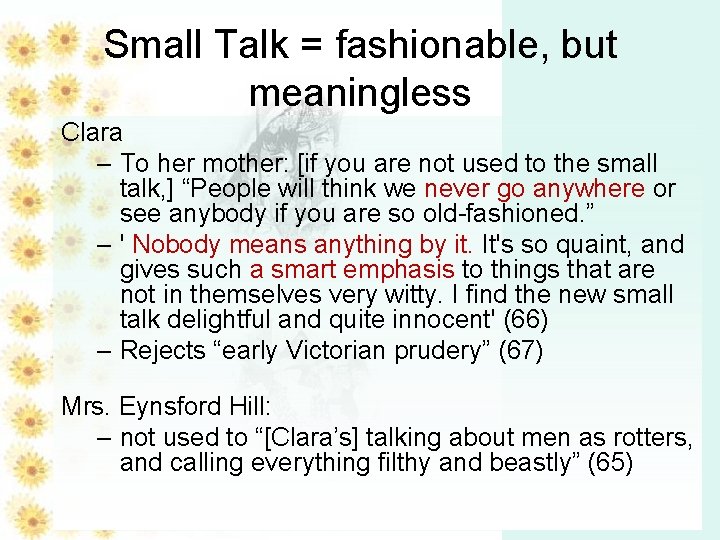
Small Talk = fashionable, but meaningless Clara – To her mother: [if you are not used to the small talk, ] “People will think we never go anywhere or see anybody if you are so old-fashioned. ” – ' Nobody means anything by it. It's so quaint, and gives such a smart emphasis to things that are not in themselves very witty. I find the new small talk delightful and quite innocent' (66) – Rejects “early Victorian prudery” (67) Mrs. Eynsford Hill: – not used to “[Clara’s] talking about men as rotters, and calling everything filthy and beastly” (65)
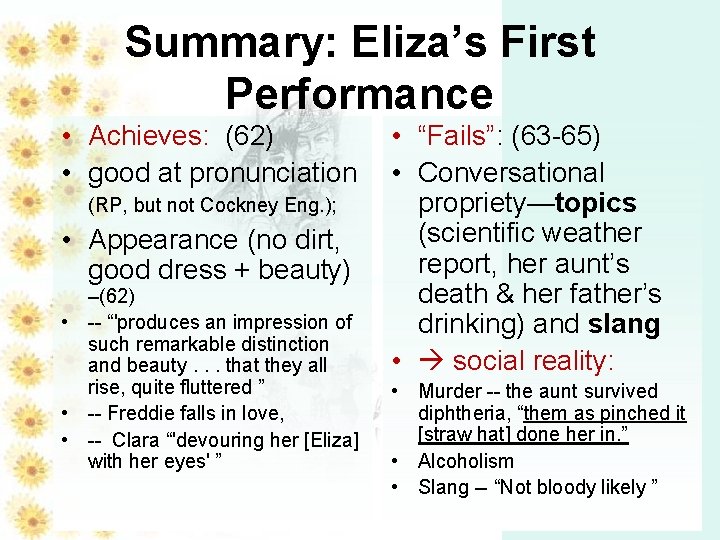
Summary: Eliza’s First Performance • Achieves: (62) • good at pronunciation (RP, but not Cockney Eng. ); • Appearance (no dirt, good dress + beauty) –(62) • -- “'produces an impression of such remarkable distinction and beauty. . . that they all rise, quite fluttered ” • -- Freddie falls in love, • -- Clara “'devouring her [Eliza] with her eyes' ” • “Fails”: (63 -65) • Conversational propriety—topics (scientific weather report, her aunt’s death & her father’s drinking) and slang • social reality: • Murder -- the aunt survived diphtheria, “them as pinched it [straw hat] done her in. ” • Alcoholism • Slang -- “Not bloody likely ”
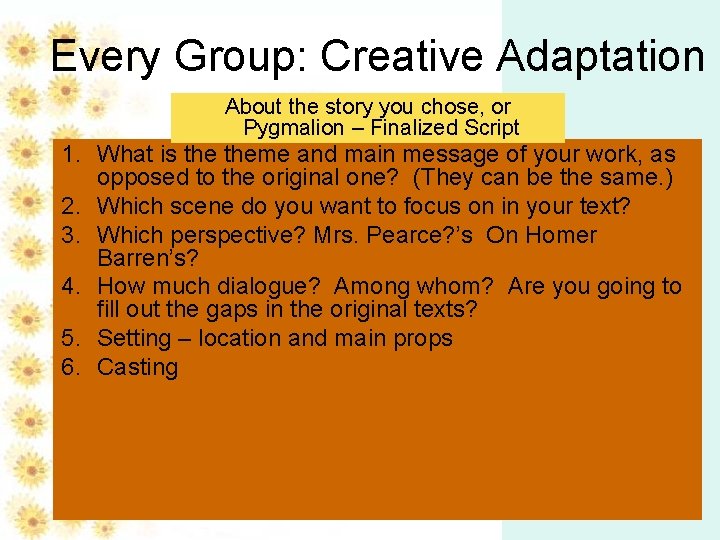
Every Group: Creative Adaptation About the story you chose, or Pygmalion – Finalized Script 1. What is theme and main message of your work, as opposed to the original one? (They can be the same. ) 2. Which scene do you want to focus on in your text? 3. Which perspective? Mrs. Pearce? ’s On Homer Barren’s? 4. How much dialogue? Among whom? Are you going to fill out the gaps in the original texts? 5. Setting – location and main props 6. Casting
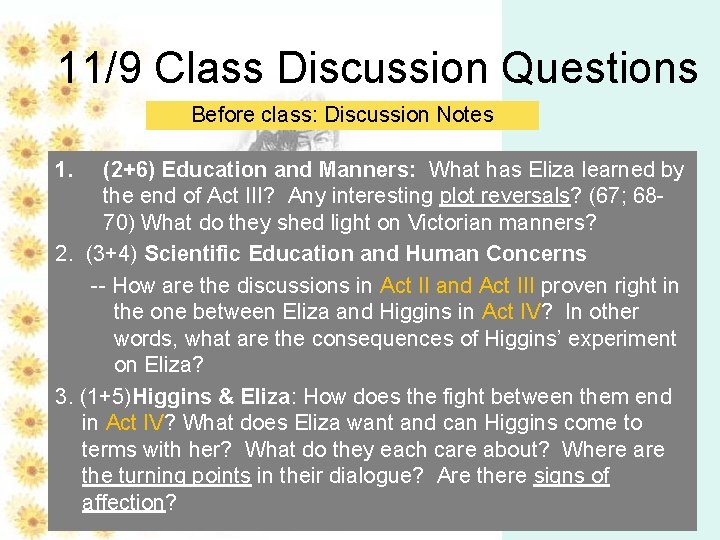
11/9 Class Discussion Questions Before class: Discussion Notes 1. (2+6) Education and Manners: What has Eliza learned by the end of Act III? Any interesting plot reversals? (67; 6870) What do they shed light on Victorian manners? 2. (3+4) Scientific Education and Human Concerns -- How are the discussions in Act II and Act III proven right in the one between Eliza and Higgins in Act IV? In other words, what are the consequences of Higgins’ experiment on Eliza? 3. (1+5)Higgins & Eliza: How does the fight between them end in Act IV? What does Eliza want and can Higgins come to terms with her? What do they each care about? Where are the turning points in their dialogue? Are there signs of affection?
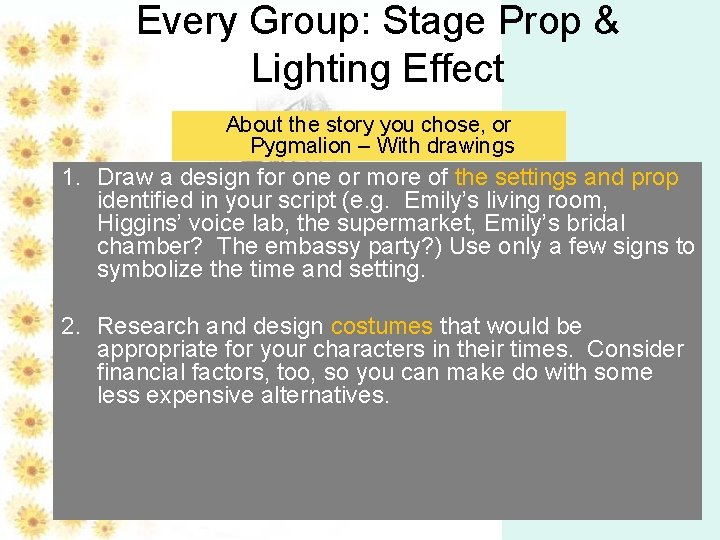
Every Group: Stage Prop & Lighting Effect About the story you chose, or Pygmalion – With drawings 1. Draw a design for one or more of the settings and prop identified in your script (e. g. Emily’s living room, Higgins’ voice lab, the supermarket, Emily’s bridal chamber? The embassy party? ) Use only a few signs to symbolize the time and setting. 2. Research and design costumes that would be appropriate for your characters in their times. Consider financial factors, too, so you can make do with some less expensive alternatives.
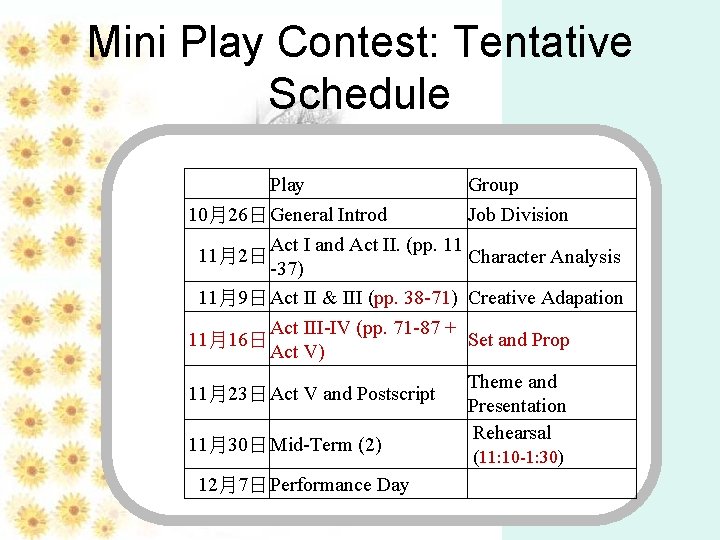
Mini Play Contest: Tentative Schedule Play Group 10月26日General Introd Job Division Act I and Act II. (pp. 11 11月2日 Character Analysis -37) 11月9日Act II & III (pp. 38 -71) Creative Adapation Act III-IV (pp. 71 -87 + 11月16日 Set and Prop Act V) Theme and 11月23日Act V and Postscript Presentation Rehearsal 11月30日Mid-Term (2) (11: 10 -1: 30) 12月7日Performance Day
LIT. & LIFE