
Puzzle 2 what does the following program print
- Slides: 27
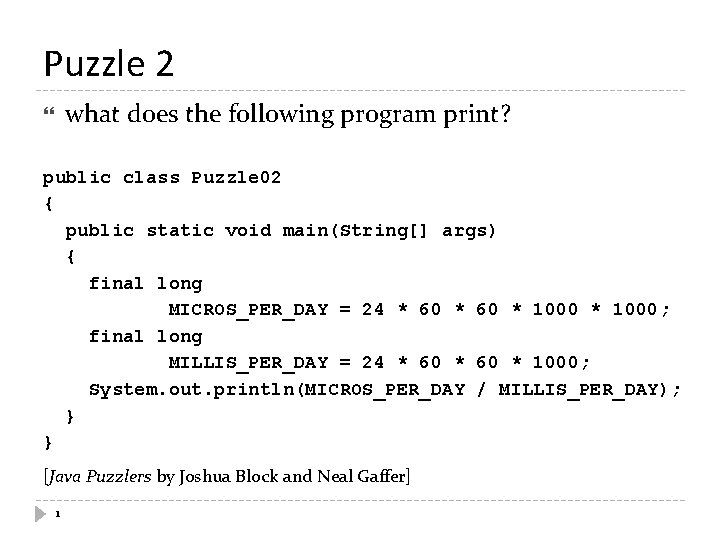
Puzzle 2 what does the following program print? public class Puzzle 02 { public static void main(String[] args) { final long MICROS_PER_DAY = 24 * 60 * 1000; final long MILLIS_PER_DAY = 24 * 60 * 1000; System. out. println(MICROS_PER_DAY / MILLIS_PER_DAY); } } [Java Puzzlers by Joshua Block and Neal Gaffer] 1
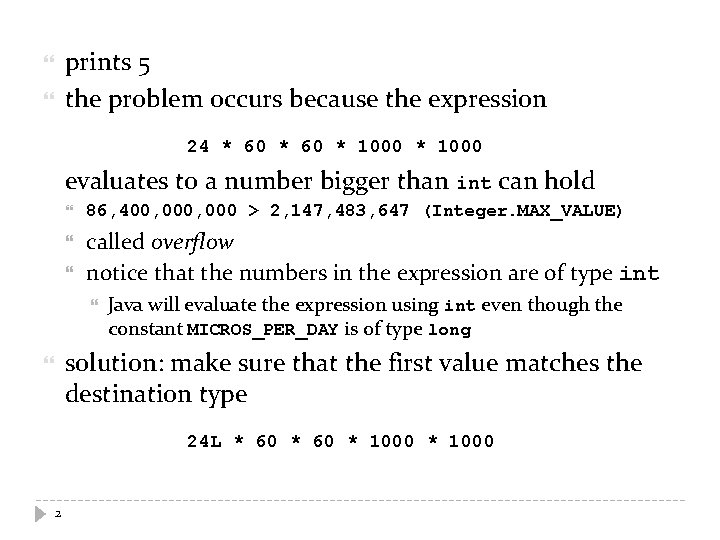
prints 5 the problem occurs because the expression 24 * 60 * 1000 evaluates to a number bigger than int can hold 86, 400, 000 > 2, 147, 483, 647 (Integer. MAX_VALUE) called overflow notice that the numbers in the expression are of type int Java will evaluate the expression using int even though the constant MICROS_PER_DAY is of type long solution: make sure that the first value matches the destination type 24 L * 60 * 1000 2
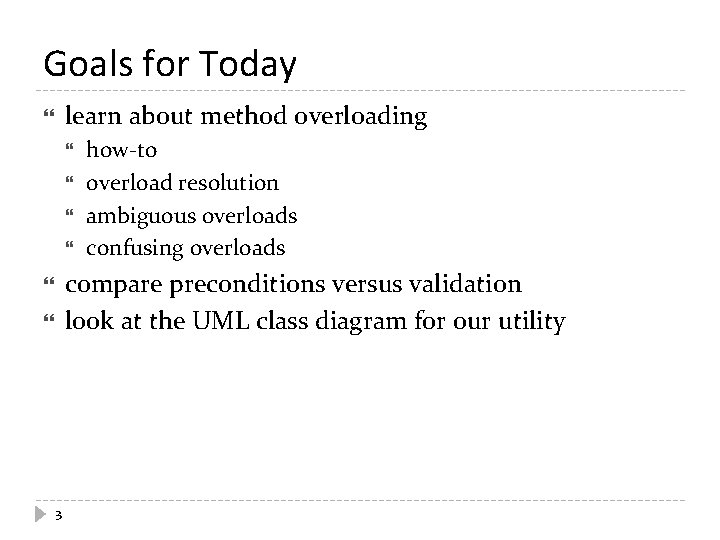
Goals for Today learn about method overloading how-to overload resolution ambiguous overloads confusing overloads compare preconditions versus validation look at the UML class diagram for our utility 3
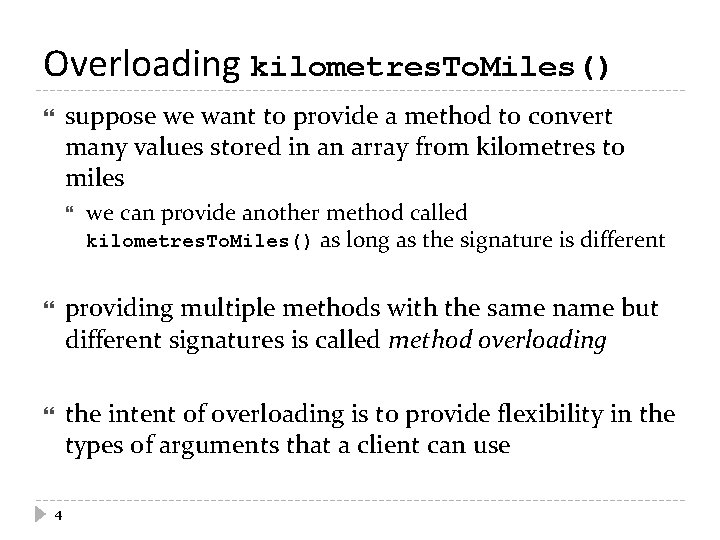
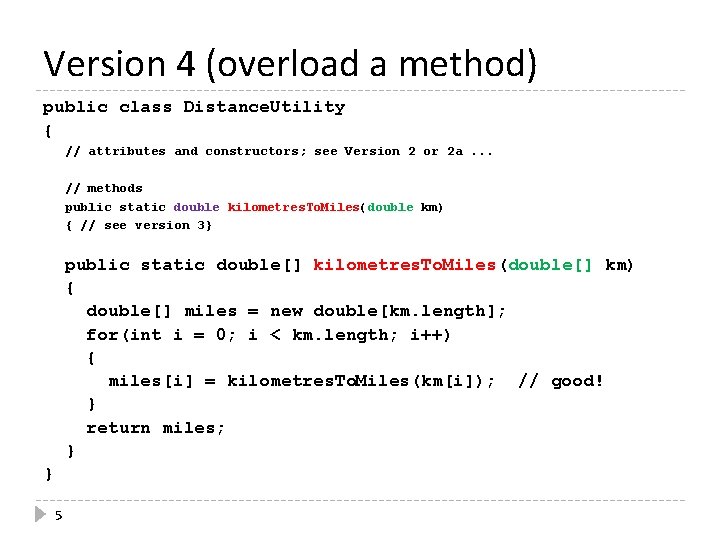
Overloading kilometres. To. Miles() suppose we want to provide a method to convert many values stored in an array from kilometres to miles we can provide another method called kilometres. To. Miles() as long as the signature is different providing multiple methods with the same name but different signatures is called method overloading the intent of overloading is to provide flexibility in the types of arguments that a client can use 4
Version 4 (overload a method) public class Distance. Utility { // attributes and constructors; see Version 2 or 2 a. . . // methods public static double kilometres. To. Miles(double km) { // see version 3} public static double[] kilometres. To. Miles(double[] km) { double[] miles = new double[km. length]; for(int i = 0; i < km. length; i++) { miles[i] = kilometres. To. Miles(km[i]); // good! } return miles; } } 5
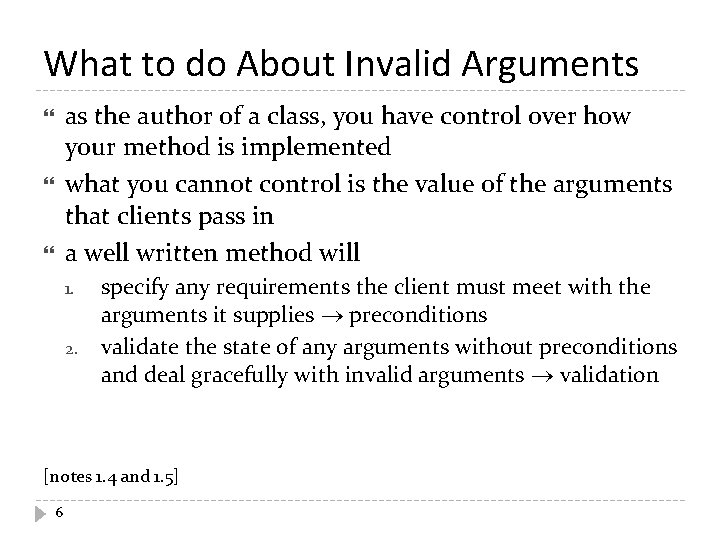
What to do About Invalid Arguments as the author of a class, you have control over how your method is implemented what you cannot control is the value of the arguments that clients pass in a well written method will 1. 2. specify any requirements the client must meet with the arguments it supplies preconditions validate the state of any arguments without preconditions and deal gracefully with invalid arguments validation [notes 1. 4 and 1. 5] 6
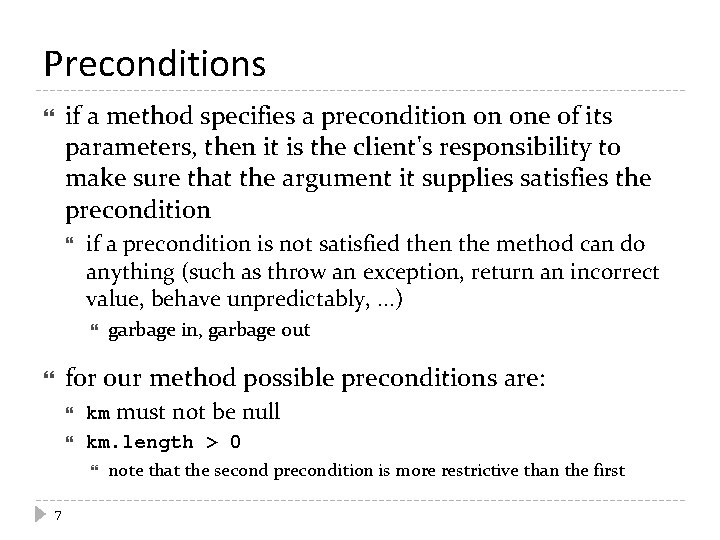
Preconditions if a method specifies a precondition on one of its parameters, then it is the client's responsibility to make sure that the argument it supplies satisfies the precondition if a precondition is not satisfied then the method can do anything (such as throw an exception, return an incorrect value, behave unpredictably, . . . ) garbage in, garbage out for our method possible preconditions are: km must not be null km. length > 0 7 note that the second precondition is more restrictive than the first
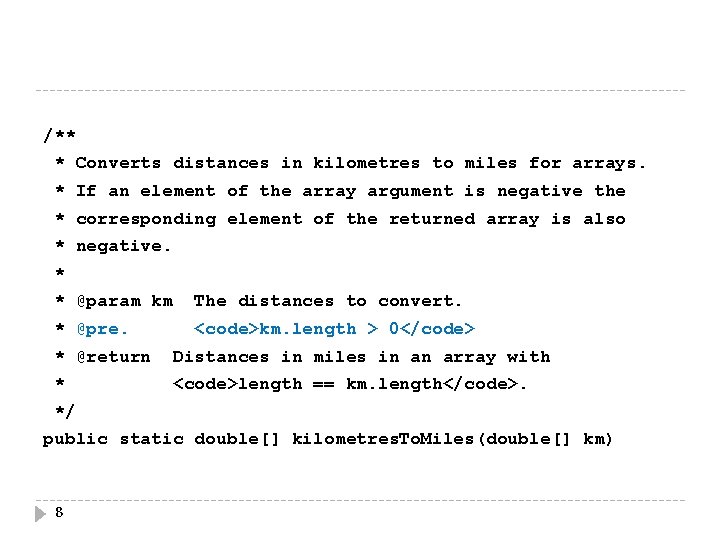
/** * Converts distances in kilometres to miles for arrays. * If an element of the array argument is negative the * corresponding element of the returned array is also * negative. * * @param km The distances to convert. * @pre. <code>km. length > 0</code> * @return Distances in miles in an array with * <code>length == km. length</code>. */ public static double[] kilometres. To. Miles(double[] km) 8
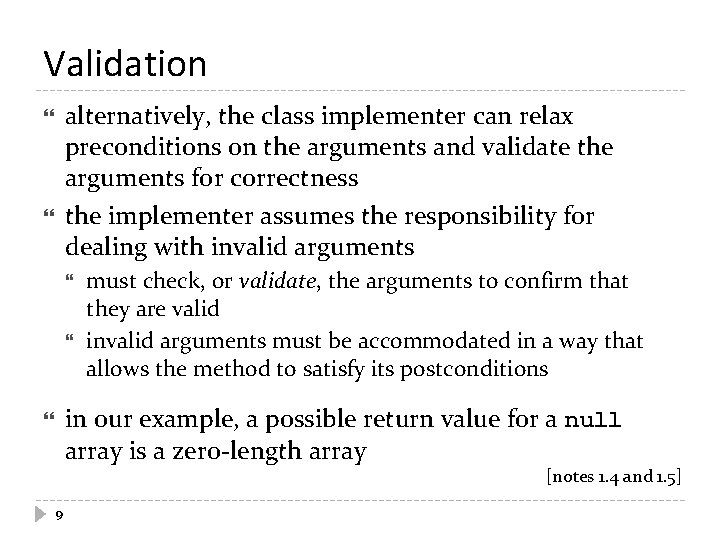
Validation alternatively, the class implementer can relax preconditions on the arguments and validate the arguments for correctness the implementer assumes the responsibility for dealing with invalid arguments must check, or validate, the arguments to confirm that they are valid invalid arguments must be accommodated in a way that allows the method to satisfy its postconditions in our example, a possible return value for a null array is a zero-length array [notes 1. 4 and 1. 5] 9
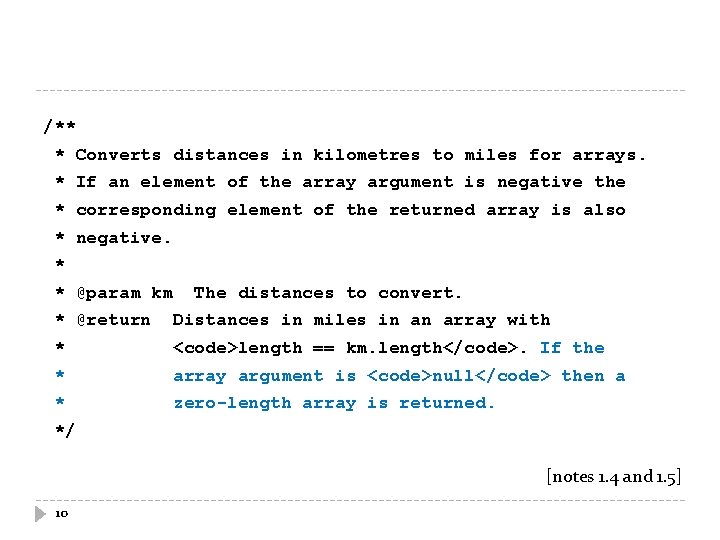
/** * Converts distances in kilometres to miles for arrays. * If an element of the array argument is negative the * corresponding element of the returned array is also * negative. * * @param km The distances to convert. * @return Distances in miles in an array with * <code>length == km. length</code>. If the * array argument is <code>null</code> then a * zero-length array is returned. */ [notes 1. 4 and 1. 5] 10
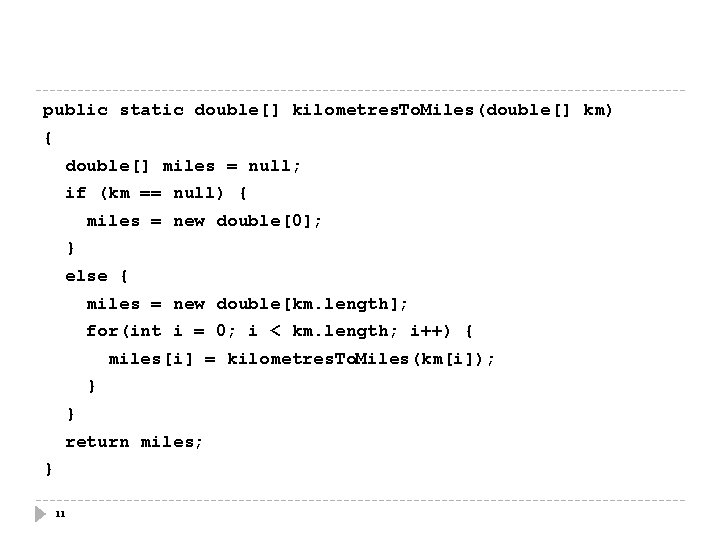
public static double[] kilometres. To. Miles(double[] km) { double[] miles = null; if (km == null) { miles = new double[0]; } else { miles = new double[km. length]; for(int i = 0; i < km. length; i++) { miles[i] = kilometres. To. Miles(km[i]); } } return miles; } 11
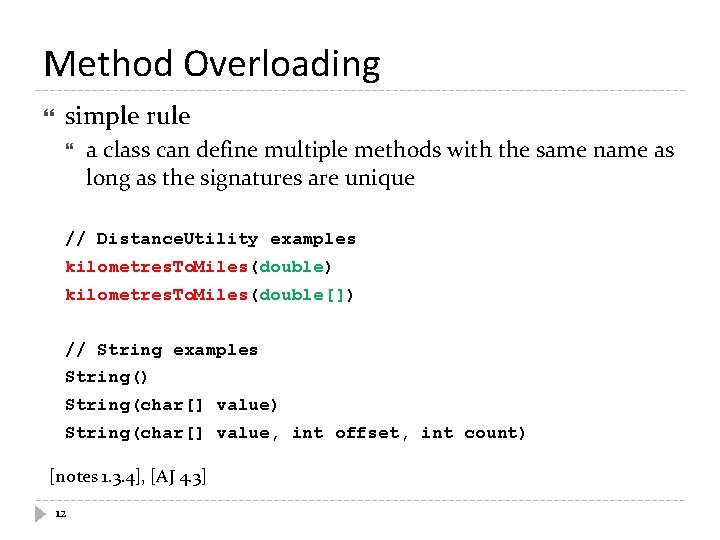
Method Overloading simple rule a class can define multiple methods with the same name as long as the signatures are unique // Distance. Utility examples kilometres. To. Miles(double) kilometres. To. Miles(double[]) // String examples String() String(char[] value, int offset, int count) [notes 1. 3. 4], [AJ 4. 3] 12
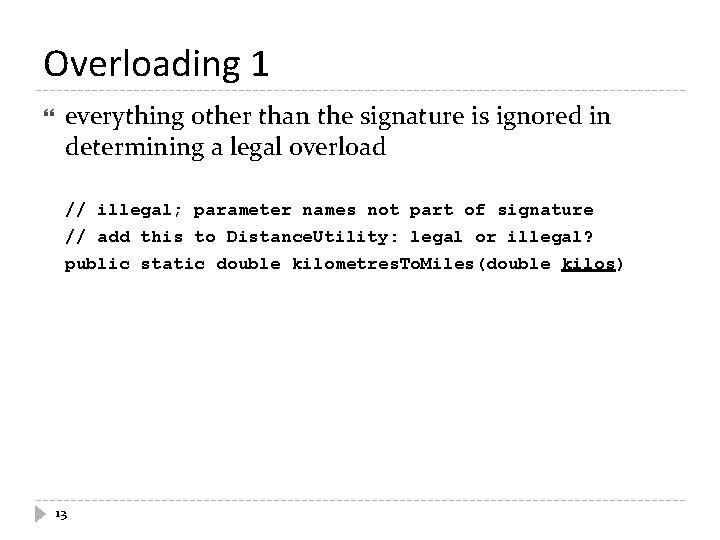
Overloading 1 everything other than the signature is ignored in determining a legal overload // illegal; parameter names not part of signature // add this to Distance. Utility: legal or illegal? public static double kilometres. To. Miles(double kilos) 13
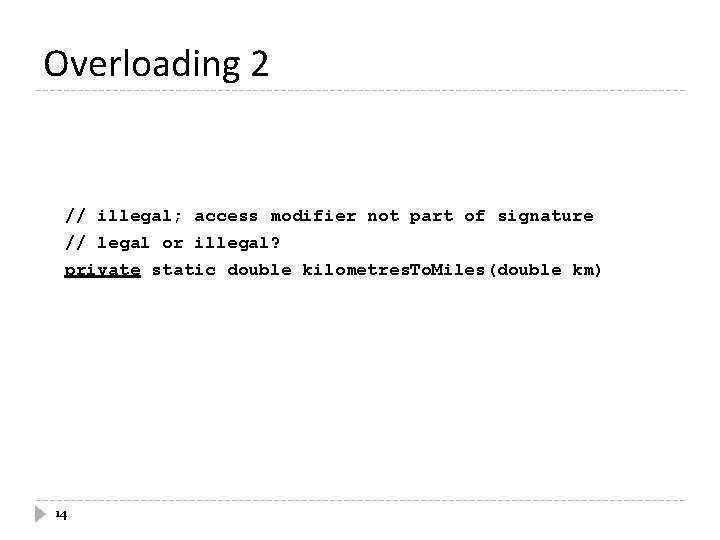
Overloading 2 // illegal; access modifier not part of signature // legal or illegal? private static double kilometres. To. Miles(double km) 14
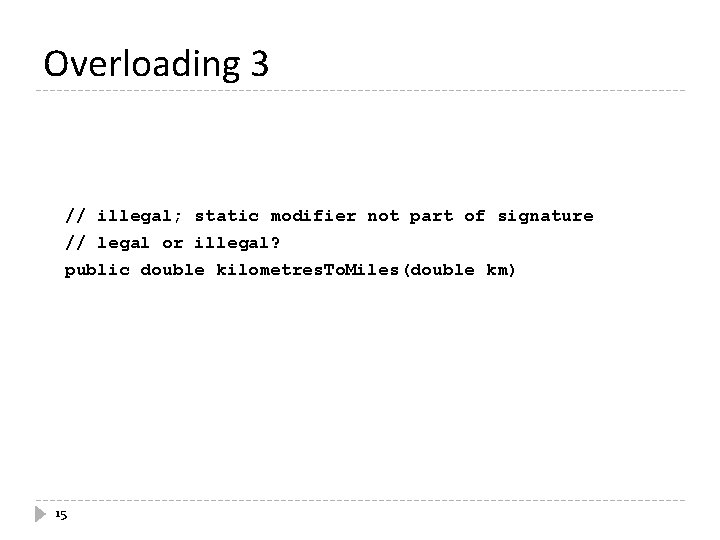
Overloading 3 // illegal; static modifier not part of signature // legal or illegal? public double kilometres. To. Miles(double km) 15
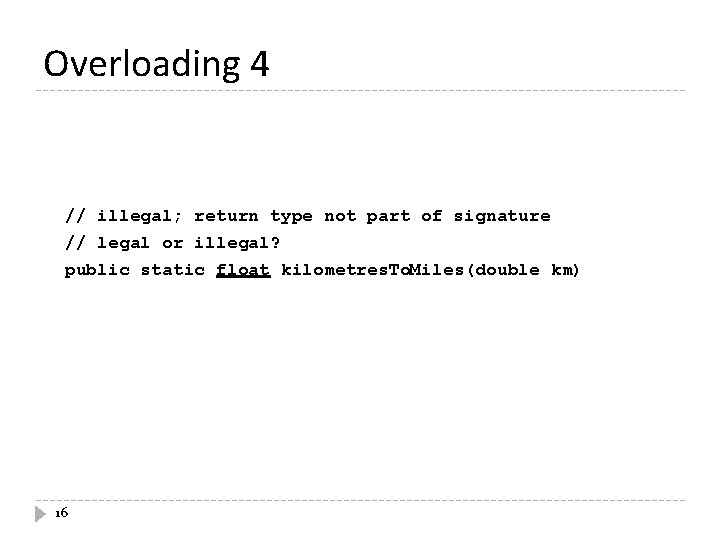
Overloading 4 // illegal; return type not part of signature // legal or illegal? public static float kilometres. To. Miles(double km) 16
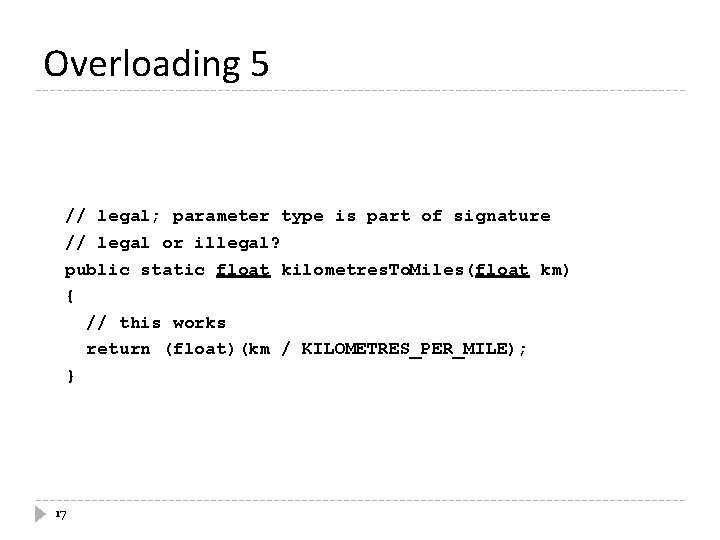
Overloading 5 // legal; parameter type is part of signature // legal or illegal? public static float kilometres. To. Miles(float km) { // this works return (float)(km / KILOMETRES_PER_MILE); } 17
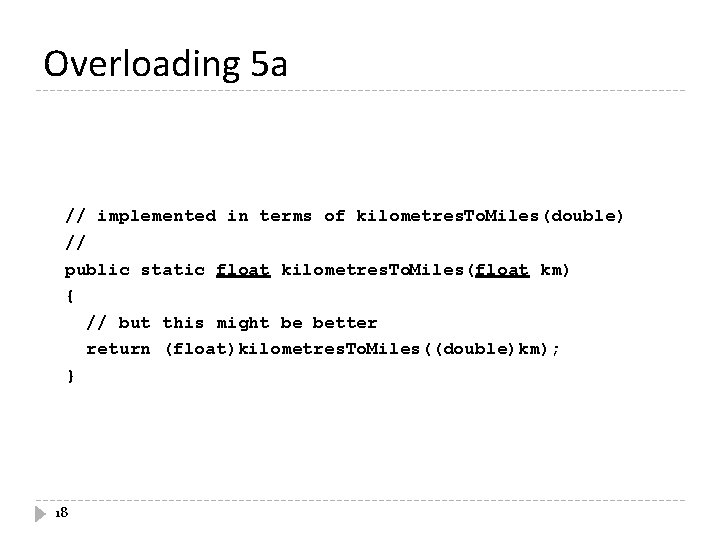
Overloading 5 a // implemented in terms of kilometres. To. Miles(double) // public static float kilometres. To. Miles(float km) { // but this might be better return (float)kilometres. To. Miles((double)km); } 18
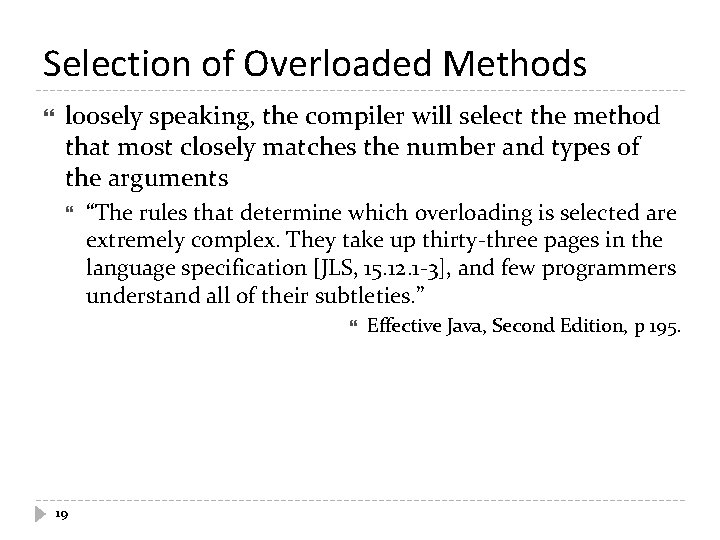
Selection of Overloaded Methods loosely speaking, the compiler will select the method that most closely matches the number and types of the arguments “The rules that determine which overloading is selected are extremely complex. They take up thirty-three pages in the language specification [JLS, 15. 12. 1 -3], and few programmers understand all of their subtleties. ” 19 Effective Java, Second Edition, p 195.
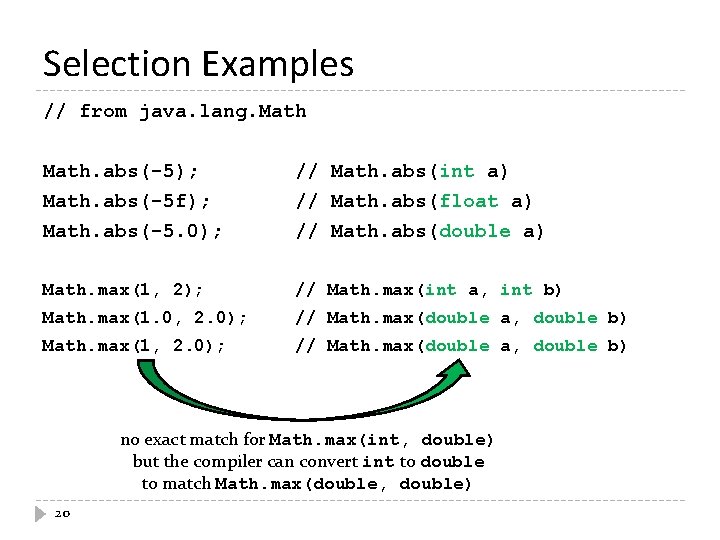
Selection Examples // from java. lang. Math. abs(-5); Math. abs(-5 f); // Math. abs(int a) // Math. abs(float a) Math. abs(-5. 0); // Math. abs(double a) Math. max(1, 2); // Math. max(int a, int b) Math. max(1. 0, 2. 0); // Math. max(double a, double b) Math. max(1, 2. 0); // Math. max(double a, double b) no exact match for Math. max(int, double) but the compiler can convert int to double to match Math. max(double, double) 20
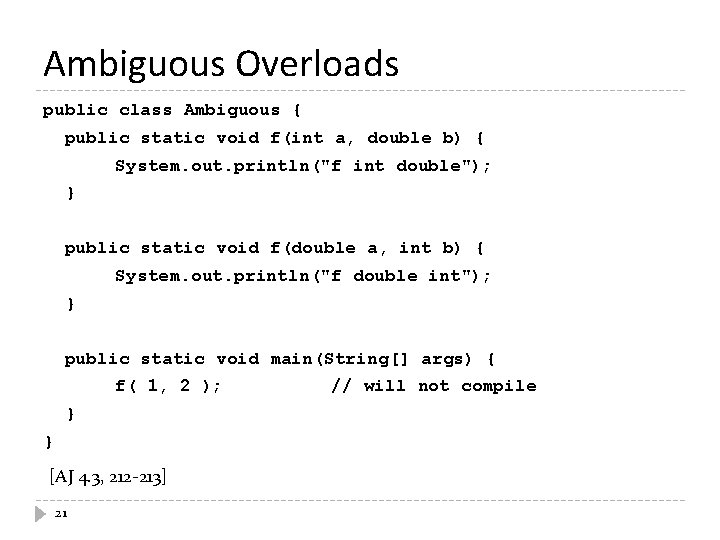
Ambiguous Overloads public class Ambiguous { public static void f(int a, double b) { System. out. println("f int double"); } public static void f(double a, int b) { System. out. println("f double int"); } public static void main(String[] args) { f( 1, 2 ); } } [AJ 4. 3, 212 -213] 21 // will not compile
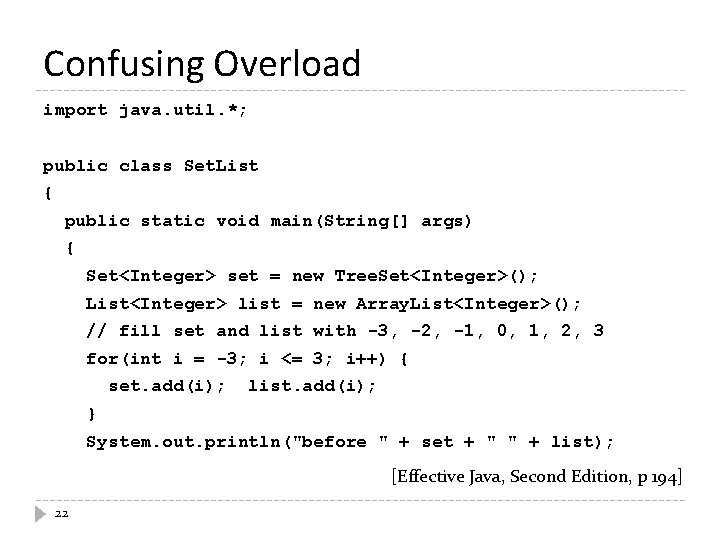
Confusing Overload import java. util. *; public class Set. List { public static void main(String[] args) { Set<Integer> set = new Tree. Set<Integer>(); List<Integer> list = new Array. List<Integer>(); // fill set and list with -3, -2, -1, 0, 1, 2, 3 for(int i = -3; i <= 3; i++) { set. add(i); list. add(i); } System. out. println("before " + set + " " + list); [Effective Java, Second Edition, p 194] 22
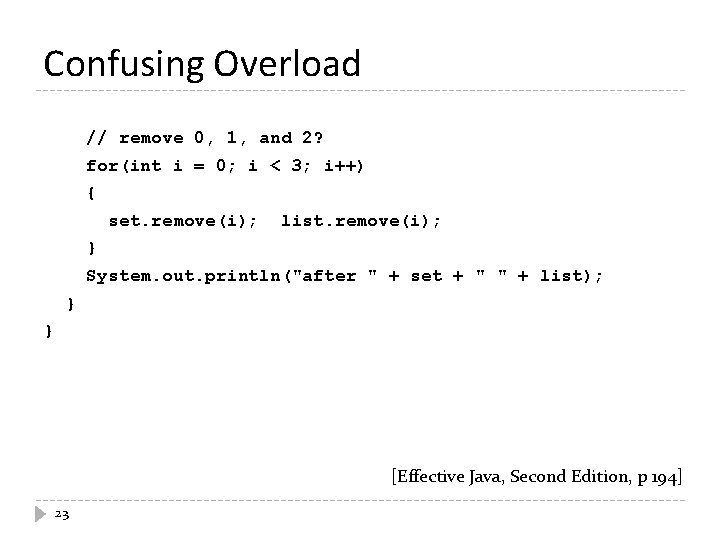
Confusing Overload // remove 0, 1, and 2? for(int i = 0; i < 3; i++) { set. remove(i); list. remove(i); } System. out. println("after " + set + " " + list); } } [Effective Java, Second Edition, p 194] 23
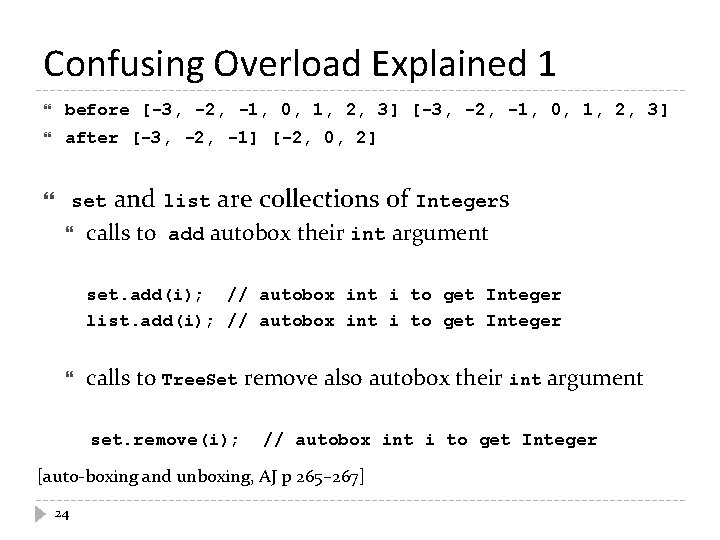
Confusing Overload Explained 1 before [-3, -2, -1, 0, 1, 2, 3] after [-3, -2, -1] [-2, 0, 2] set and list are collections of Integers calls to add autobox their int argument set. add(i); // autobox int i to get Integer list. add(i); // autobox int i to get Integer calls to Tree. Set remove also autobox their int argument set. remove(i); // autobox int i to get Integer [auto-boxing and unboxing, AJ p 265– 267] 24
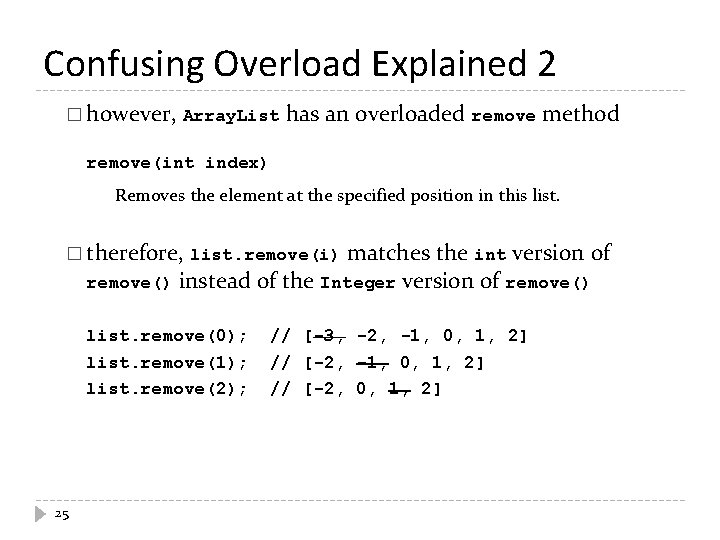
Confusing Overload Explained 2 � however, Array. List has an overloaded remove method remove(int index) Removes the element at the specified position in this list. � therefore, list. remove(i) matches the int version of remove() instead of the Integer version of remove() list. remove(0); list. remove(1); list. remove(2); 25 // [-3, -2, -1, 0, 1, 2] // [-2, 0, 1, 2]
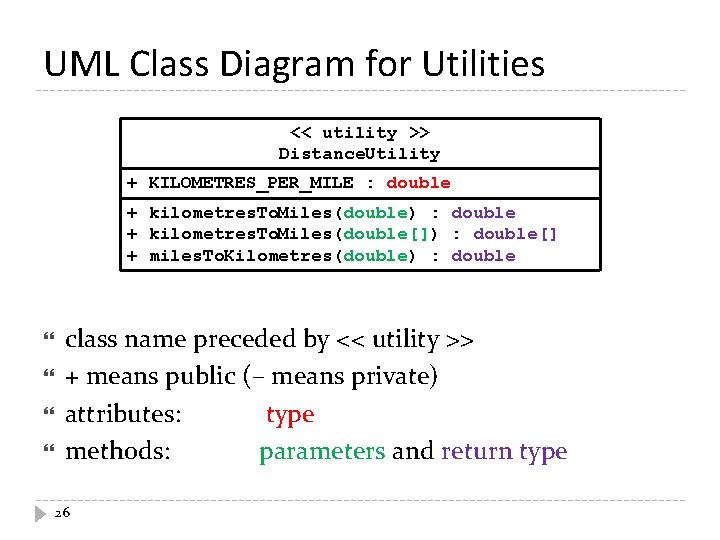
UML Class Diagram for Utilities << utility >> Distance. Utility + KILOMETRES_PER_MILE : double + kilometres. To. Miles(double) : double + kilometres. To. Miles(double[]) : double[] + miles. To. Kilometres(double) : double class name preceded by << utility >> + means public (– means private) attributes: type methods: parameters and return type 26
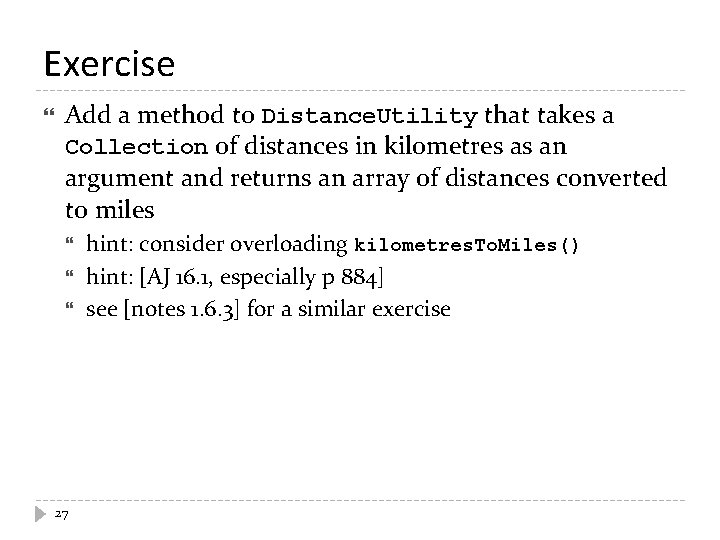
Exercise Add a method to Distance. Utility that takes a Collection of distances in kilometres as an argument and returns an array of distances converted to miles 27 hint: consider overloading kilometres. To. Miles() hint: [AJ 16. 1, especially p 884] see [notes 1. 6. 3] for a similar exercise