
Put Savings to Work SELECT SAVINGS OPTIONS THAT




- Slides: 22
Put Savings to Work SELECT SAVINGS OPTIONS THAT WORK FOR YOU 1 © 2012 National Endowment for Financial Education | Lesson 4 -1 Put Savings to Work
What Does it Mean to be Wealthy? 2 © 2012 National Endowment for Financial Education | Lesson 4 -1 Put Savings to Work
Preview Today we will answer these questions: • What is the difference between saving and investing? • What are the different ways I can invest money? • How do I get started with investing? Use what you learn today to weigh the risks and rewards of investing. 3 © 2012 National Endowment for Financial Education | Lesson 4 -1 Put Savings to Work
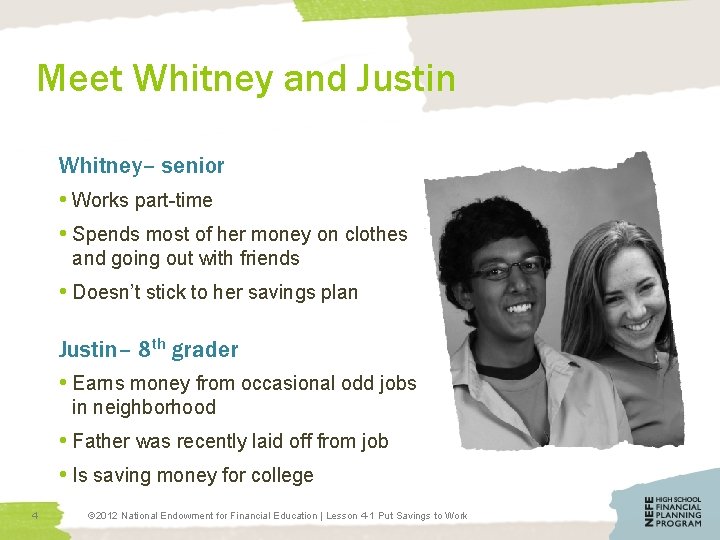
Meet Whitney and Justin Whitney– senior • Works part-time • Spends most of her money on clothes and going out with friends • Doesn’t stick to her savings plan Justin– 8 th grader • Earns money from occasional odd jobs in neighborhood • Father was recently laid off from job • Is saving money for college 4 © 2012 National Endowment for Financial Education | Lesson 4 -1 Put Savings to Work
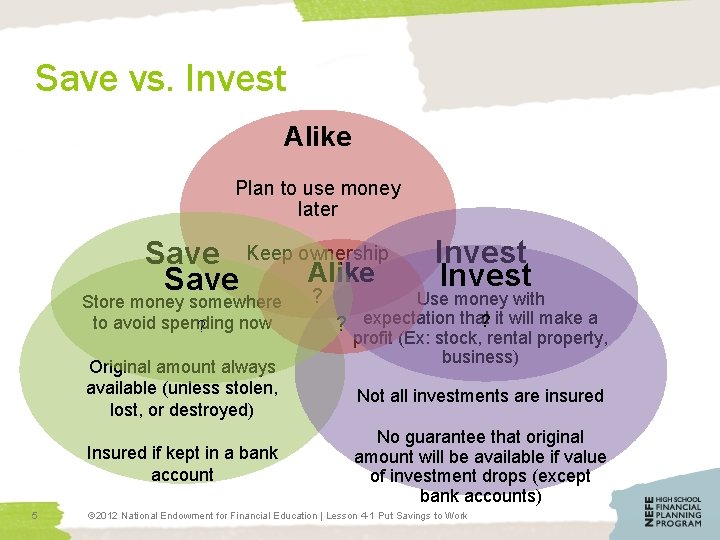
Save vs. Invest Alike Plan to use money later Save Keep ownership Alike Save ? Store money somewhere to avoid spending now ? Original amount always available (unless stolen, lost, or destroyed) Insured if kept in a bank account 5 Invest Use money with ? ? expectation that it will make a profit (Ex: stock, rental property, business) Not all investments are insured No guarantee that original amount will be available if value of investment drops (except bank accounts) © 2012 National Endowment for Financial Education | Lesson 4 -1 Put Savings to Work
Millionaire Myth #1 – True or False? Millionaires usually work in sports, entertainment or lead gigantic Fortune 500 companies. 8 Athletes and entertainers are notorious for squandering their money until they’re broke. Actually, half of all millionaires are selfemployed or own a business. Source: Thomas J. Stanley, Ph. D. and William D. Danko, Ph. D. The Millionaire Next Door: The Surprising Secrets of America's Wealthy, 1996 6 © 2012 National Endowment for Financial Education | Lesson 4 -1 Put Savings to Work
Millionaire Myth #2 – True or False? Millionaires made their fortunes the easy way— inheriting it. 8 Only 20 percent of millionaires inherited part of their money. And half of those inherited less than 10 percent of their assets. 1 8 In fact, 76 percent of millionaires said “smart investing” is one of the top three factors contributing to their financial success. The other two critical elements are hard work and education. 2 1 Thomas J. Stanley, Ph. D. and William D. Danko, Ph. D. The Millionaire Next Door: The Surprising Secrets of America's Wealthy, 1996 2 Spectrem Group, 2012 7 Affluent Market Insight © 2012 National Endowment for Financial Education | Lesson 4 -1 Put Savings to Work www. millionairecorner. com/article/smart-investing
Millionaire Myth #3 – True or False? Millionaires spend a lot of time managing their finances and trading stocks. 8 Most spend less than six minutes per day on finances. 1 They’re too busy making more money to invest! And they invest for the long-term. About 75 percent buy and hold stocks more than five years. Nearly 40 percent hold them 10 years or more. 2 1 Ric Edelman, Ordinary People, Extraordinary Wealth: The 8 Secrets of How 5, 000 Ordinary Americans Became Successful Investors--and How You Can Too, 2000 2 Chuck Carlson, 8 Steps to 7 Figures: The Investment Strategies of Everyday Millionaires and How You Can Become Wealthy Too, 2001 8 © 2012 National Endowment for Financial Education | Lesson 4 -1 Put Savings to Work
Millionaire Myth #4 – True or False? Millionaires spend tons of money on cars, boats, and other luxury items. 8 Wealth is not what you make—it’s what you keep. True millionaires focus on acquiring assets that will make them money, such as real estate, investments, and their businesses. That’s why so many drive Fords and Toyotas. Source: Thomas J. Stanley, Ph. D. and William D. Danko, Ph. D. The Millionaire Next Door: The Surprising Secrets of America's Wealthy, 1996 9 © 2012 National Endowment for Financial Education | Lesson 4 -1 Put Savings to Work
Millionaire Myth #5 – True or False? Millionaires never have to worry about having enough money. 8 Nearly 42 percent of millionaires still don’t feel wealthy. They say they’d need investing assets of $7. 5 million to feel truly wealthy and stop worrying. The more you have, the more you seem to need to feel financially secure. Source: Fidelity, Millionaire Outlook, March 2011 www. fidelity. com/inside-fidelity/individual-investing/millionaire-outlook-2011 10 © 2012 National Endowment for Financial Education | Lesson 4 -1 Put Savings to Work
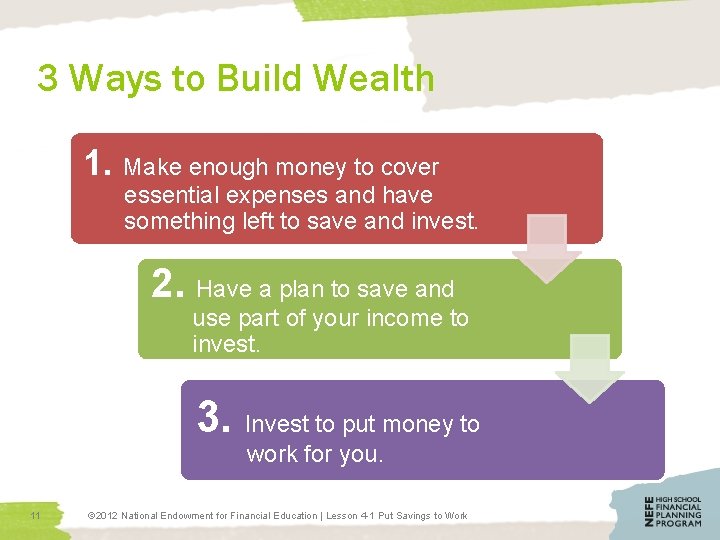
3 Ways to Build Wealth 1. Make enough money to cover essential expenses and have something left to save and invest. 2. Have a plan to save and use part of your income to invest. 3. Invest to put money to work for you. 11 © 2012 National Endowment for Financial Education | Lesson 4 -1 Put Savings to Work
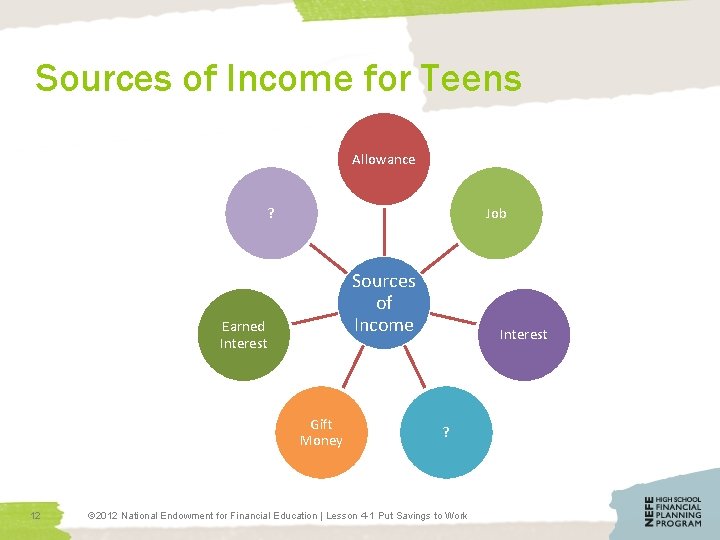
Sources of Income for Teens Allowance ? Job Sources of Income Earned Interest Gift Money 12 Interest ? © 2012 National Endowment for Financial Education | Lesson 4 -1 Put Savings to Work
Windfalls What are your windfalls? Use unexpected increases in cash to save and invest. 13 © 2012 National Endowment for Financial Education | Lesson 4 -1 Put Savings to Work
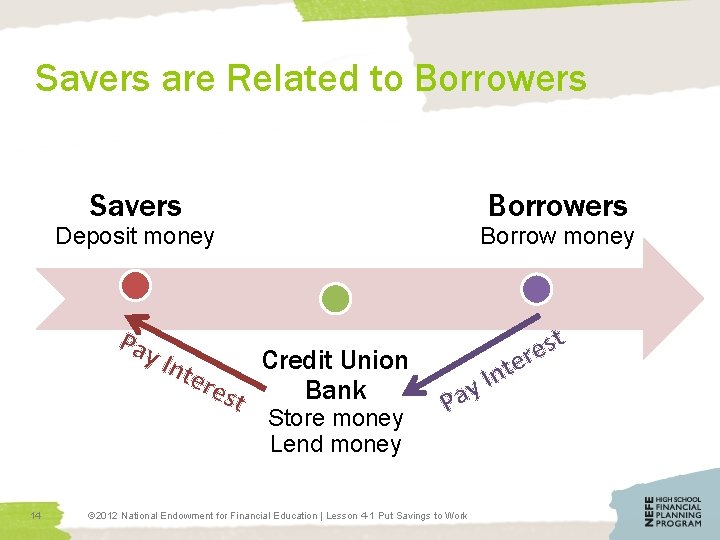
Savers are Related to Borrowers Savers Borrow money Deposit money Pay Int Credit Union ere Bank st Store money Lend money 14 Pa t n I y © 2012 National Endowment for Financial Education | Lesson 4 -1 Put Savings to Work t s e er
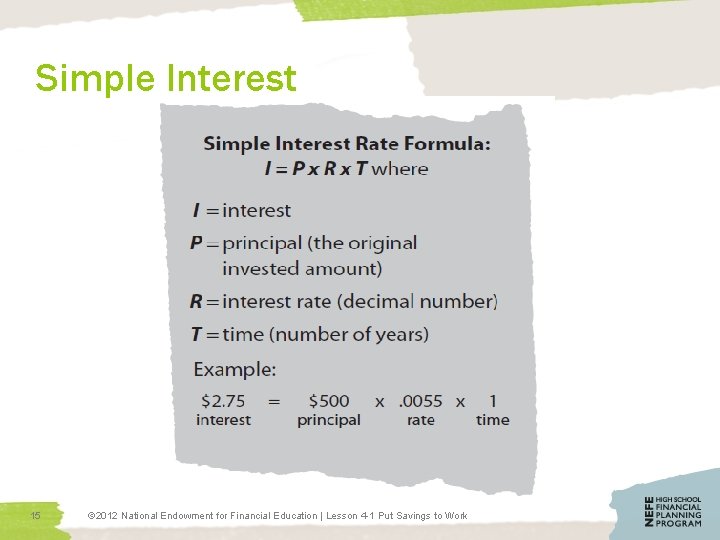
Simple Interest 15 © 2012 National Endowment for Financial Education | Lesson 4 -1 Put Savings to Work
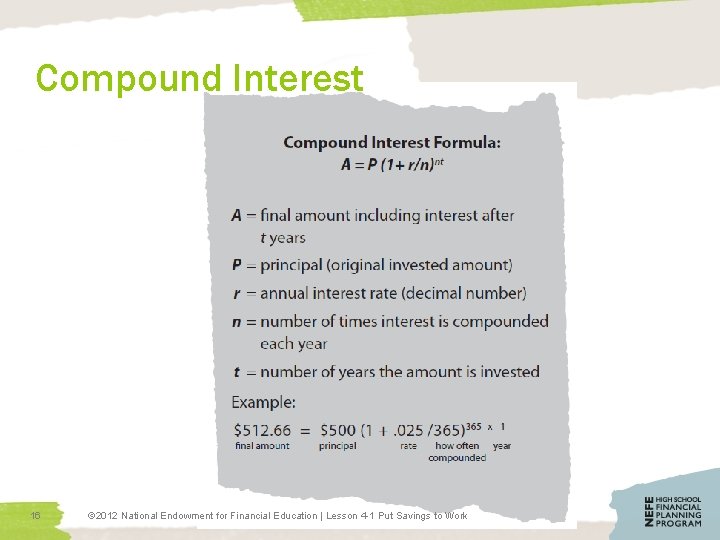
Compound Interest 16 © 2012 National Endowment for Financial Education | Lesson 4 -1 Put Savings to Work
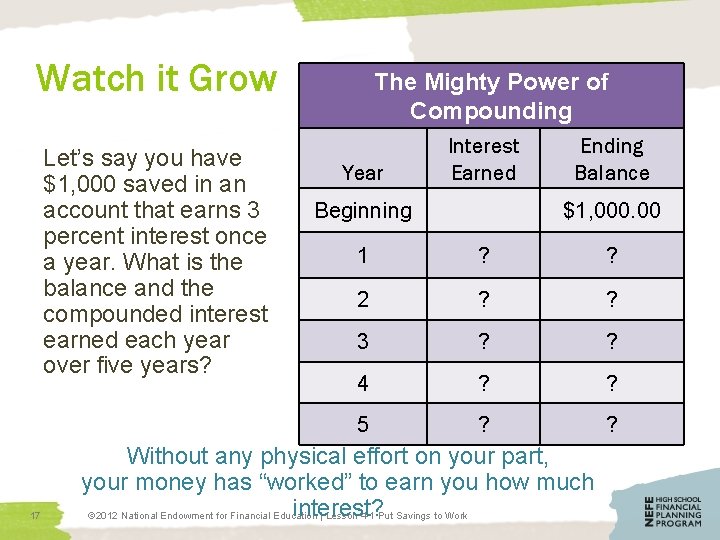
Watch it Grow Let’s say you have $1, 000 saved in an account that earns 3 percent interest once a year. What is the balance and the compounded interest earned each year over five years? 17 The Mighty Power of Compounding Year Interest Earned Beginning Ending Balance $1, 000. 00 1 $30. 00 ? $1, 030. 00 ? 2 $30. 90 ? $1, 060. 90 ? 3 $31. 83 ? $1, 092. 73 ? 4 $32. 78 ? $1, 125. 51 ? 5 $33. 77 ? $11, 59. 28 ? Without any physical effort on your part, your money has “worked” to earn you how much interest? © 2012 National Endowment for Financial Education | Lesson 4 -1 Put Savings to Work
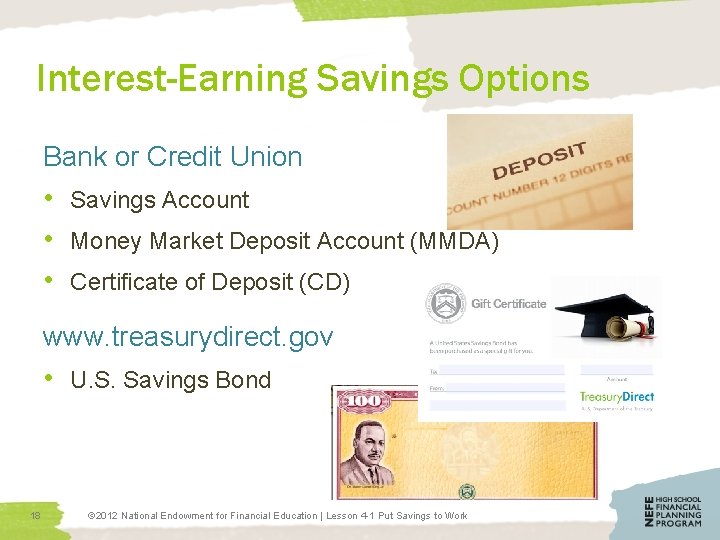
Interest-Earning Savings Options Bank or Credit Union • Savings Account • Money Market Deposit Account (MMDA) • Certificate of Deposit (CD) www. treasurydirect. gov • U. S. Savings Bond 18 © 2012 National Endowment for Financial Education | Lesson 4 -1 Put Savings to Work
Challenge Assignment 4 -A It Pays to Shop Around Use the DECIDE steps to compare and select savings options that fit your current situation. 19 © 2012 National Endowment for Financial Education | Lesson 4 -1 Put Savings to Work
Reflection For one of the quotes below, write a oneparagraph response that explains what it means to you. Wealth is not what you make—it’s what you keep. Wealth is what you accumulate—not what you make. 20 © 2012 National Endowment for Financial Education | Lesson 4 -1 Put Savings to Work