
Put It On My Tab an emerging technology
Put It On My Tab an emerging technology proposal Script Start the presentation Reflection References Online Presentation View narrated presentation online without Reflection or References
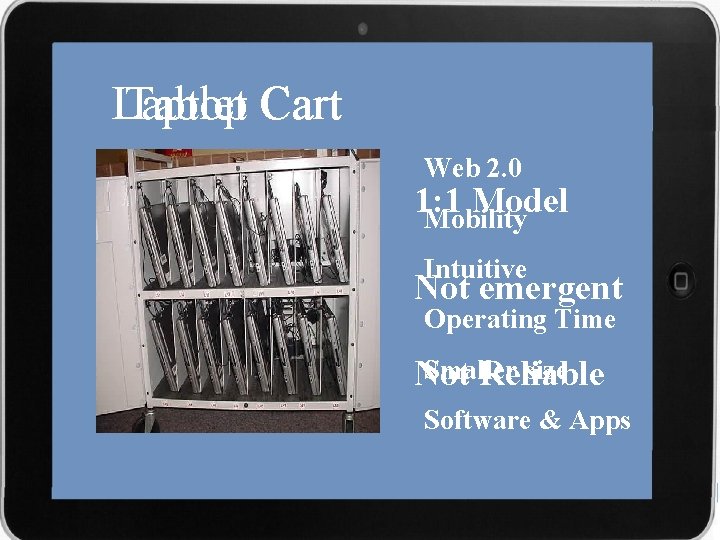
Laptop Tablet Cart Web 2. 0 1: 1 Model Mobility Intuitive Not emergent Operating Time Smaller size Not Reliable Software & Apps
Emerging Instructional Strategies Authentic learning experiences Collaboration Differentiation Student-directed learning © 2013 Microsoft Corporation. All rights reserved.
Aaryn Schmuhl: “Our system views technology as tools that give students the power to create demonstrations of mastery. Technology today is not about a device, or software package, or even a particular project. Technology is about connecting and creating and demonstrating mastery. ” Schmuhl, A. (2013). Email interview.
Instructional Technology Services Department: “Instructional Technology supports the uses of technology as a means to … accelerate the documented benefits of research-based instructional strategies. ” Blanton (2013)
Yelland : “when such technologies are embedded in the curriculum, young children can not only experience concepts that were previously well beyond that expected of them, but they can deploy sophisticated strategies and work collaboratively with others in new and dynamic ways. ” Yelland (2005)
All grades, ages 5 – 12 Software & apps Management cart
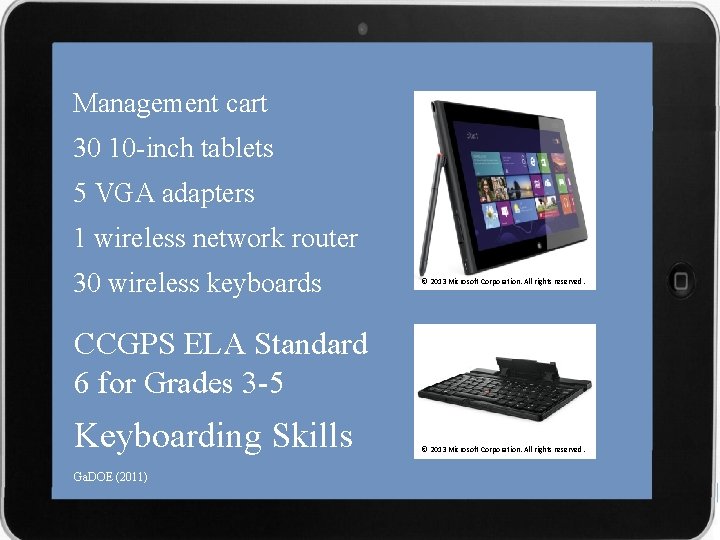
Management cart 30 10 -inch tablets 5 VGA adapters 1 wireless network router 30 wireless keyboards © 2013 Microsoft Corporation. All rights reserved. CCGPS ELA Standard 6 for Grades 3 -5 Keyboarding Skills Ga. DOE (2011) © 2013 Microsoft Corporation. All rights reserved.
Technical Support Application Specialist Initial configuration Ongoing maintenance Instructional Technology Specialist Training Developing Strategies Media Specialist First Responder
Current Limitation s No wireless access • SPLOST Conservative policies • Profiles Digital Citizenship Initiative
Projected Costs No training costs $25, 179. 75 18, 732. 90 3, 710. 40 1, 927. 16 549. 99 259. 30 Tablets Keyboards Cart Wireless Router VGA Adapters
Sources of Funding Title 1 Funds PTO Partners-In-Education Ga. Do. E and/or Local Content Area Grants from Professional Organizations AASL GLMA Ga. Ed. Tech Consortium

Other Online Sources of Funding Digital. Wish. com Emerging. Ed. Tech. com Instructional Technology Council e. School. News. com Mimeo. com US Do. E Technology Grants
Tablets & Standards Common Core Georgia Performance Standards Progressive Skill Strands
Tablets & Standards Language Arts, Standard 6 • K, 1 st, 2 nd …digital tools publish…collaboration • 3 rd …keyboard skills • 4 th & 5 th …proficiency Ga. DOE (2011)
Tablets & Standards Language Arts, Standard 8 • 3 rd …information … digital sources • 4 th …categorize… list sources • 5 th …summarize/ paraphrase Ga. DOE (2011)
Differentation Resources Response Assessment
Collaboration Google. Docs e. Pals Blogs
Research. Based Strategy Instructional technology integration 1834 titles Instructional technology effectiveness 607 titles Positive
Touch Tablet Surprises Cooperation Collaboration Digital Citizenship Connection to the real world Shifflet, Toledo, & Mattoon (2012)
Research. Based Strategy “…be creative, solve problems, think and make decisions. ” NAEYC and the Fred Rogers Center (2012) “…literacies of 21 st-century technologies. ” International Reading Association (2009)
Effective Research. Based Practices “variety of platforms playful experimentation assistive technology devices language-translation software geometry software… NAEYC (2012)
Effective Research. Based Practices interactive games digital tools for investigation editing software connect with other children…globally document their progress (digitally)” NAEYC (2012)
Implementatio n Plan Identify desired apps Survey teachers Collaborate on lesson plans Catalog the equipment Configure the tablets
Implementatio n Plan Standard Operating Procedure Check-out procedures Set-up Tablet R & R Return/check-in procedures
Implementatio n Plan Conduct initial lessons Feedback/Revision Classroom lesson Recruit next group Repeat the process
Change Mediation “One of the most common and serious mistakes… is to presume that once an innovation has been introduced an initial training has been completed, the intended users will put the innovation into practice. A second serious mistake is to assume that all users of the implementation will react in similar ways. ” Hord, et al. (1987)
Change Mediation D-n-CMC Divide Motivate Collaborate Conquer
Summary Emerging instructional technologies Interactive and collaborative Knowledge is fluid Communities of co-learners Knowledge creators

Summary Put It On My Tab
Return to the start slide Continue to the: Reflection References
Reflectio n Selecting and Evaluating Emerging Technologies The first thing I learned is that there is a constantly growing world of emerging instructional technologies and strategies to be explored. (It was difficult to choose which to explore. ) This proliferation is due to the interactive and collaborative nature of today’s digital communication platforms. I am also starting to see how important it is to teach students with a similar model. Knowledge is fluid, changing by the moment, defined now by authentic, global, robust communities of co-learners, rather than by a limited group of ivory tower, theoretical thinkers. We have to instill a confidence in our students that they can work individually, or with others, to be knowledge creators rather than simply knowledge receivers. These digital tablets, along with all of the other devices that are finding their way into the learning process, are truly making content, knowledge, expression, and assessment accessible to all learners.
Reflection Professional Practice Though I initially rolled my eyes at the requirement to address change mitigation, as I read through the materials about CBAM and a couple of other strategies, I was glad that requirement was included. I have long been of the mindset, “Just suck it up and do what is required, ” and I have had little patience for people who did not take that approach. I had not taken the time to learn why people are resistant, but more importantly, how there are differences in the way people react to change. I realize now, if you take individual doubts and concerns into consideration, address those issues with reassurance, then help to establish an internal motivation, and a confidence that assistance will ensue; you can reduce that resistance to change. I think I am a kinder and gentler agent of change, as a result of this study. Start
Return to the start slide Continue to: References
References/Sources Blanton, B. (2013). Instructional technology. Henry County Schools. Retrieved from: http: //schoolwires. henry. k 12. ga. us/Page/424 Ga. DOE (2011). K-12 ELA CCGPS Educator Resource. Atlanta: Georgia Department of Education. Retrieved from: https: //www. georgiastandards. org/Common-Core/Documents/ CCGPS_ELA_K-12_Educator. Resource. Document. pdf Hord, S. M. ; Rutherford, W. L. ; Huling-Austin, L. ; Gene E. Hall, G. E. (1987). Taking charge of change. Alexandria, VA: Association for Supervision and Curriculum Development. International Reading Association (2009). New literacies and 21 st-century technologies: A position statement of the International Reading Association. Newark, DE: Author. Retrieved from: http: //www. reading. org/Libraries/position-statements-and-resolutions/ps 1067_New. Literacies 21 st. Century. pdf NAEYC (2012). Effective classroom practice: School-age children. Technology and young children. Washington, DC: NAEYC Retrieved from: http: //www. naeyc. org/content/technology-and-young-children/school-agechildren NAEYC & Fred Rogers Center for Early Learning and Children’s Media (2012). Technology and Interactive Media as Tools in Early Childhood Programs Serving Children from Birth through Age 8. Joint position statement. Washington, DC: NAEYC; Latrobe, PA: Fred Rogers Center at Saint Vincent College. Retrieved from: http: //www. naeyc. org/files/naeyc/file/positions/PS_technology_WEB 2. pdf Shifflet, R. ; Toledo, C. ; Mattoon, C. (2012). Touch tablet surprises: A preschool teacher’s story. Young Children. Washington, DC: NAEYC. Retrieved from: http: //www. naeyc. org/yc/files/yc/Touch%20 Tablet%20 Suprises. pdf Yelland, N. 2005. The Future Is Now: A Review of the Literature on the Use of Computers in Early Childhood Education (1994– 2004). AACE Journal 13 (3): 201– 32.
Online Sources Referred to but not quoted AASL http: //www. ala. org/aasl/awards/beyond-words Digital Wish http: //www. digitalwish. com/dw/digitalwish/grants Emerging. Ed. Tech http: //www. emergingedtech. com/2012/02/7 -online-resources-for-finding-grants-foreducators/ e. Pals http: //www. epals. com e. School. News http: //www. eschoolnews. com/funding/ Georgia Library Media Association http: //www. glma-inc. org/grants-and-awards/ GAEd. Tech Consortium http: //www. gaetc. org/domain/82 Google. Docs http: //docs. google. com Instructional Technology Council http: //www. itcnetwork. org/resources/grant-opportunities. html Mimeo http: //news. mimio. com/free-educational-fundingguides? jadid=17014316076&jk=education%20 technology%20 grant&jk. Id=gc: a 8 a 8 ae 4 cd 3 b 61 d 7 f 5013 b 6 c 11 a 616 5 f 96: t 1_b_: k_education%20 technology%20 grant: pl_&jp=&js=1&jsid=25957&jt=1&gclid=CJyup 4 Owqrg. CFUlp 7 Ao d. Bnw. Atw US Do. E http: //www. ed. gov/edblogs/technology/grants/ Image Permissions Microsoft Visuals © 2013 Microsoft Corporation. All rights reserved. http: //www. microsoftstore. com/store/msusa/en_US/Display. Terms. Of. Use. And. Sale. Page/Theme. ID. 33363200 /
- Slides: 37