
Pushdown Automata Section 7 1 like NFA but
Pushdown Automata [Section 7. 1] - like NFA- but also has a stack - transition takes the current state, the current input symbol, and the top-of-the-stack symbol(which is removed from the stack) and returns a state and a string to place in the stack - the automaton starts in the initial state, reading the first symbol on the tape, and having a special initial symbol on the stack - automaton accepts a string x if, after reading all of x, it can get to an accepting state (the stack content does not matter) - if the stack is empty, the automaton is stuck
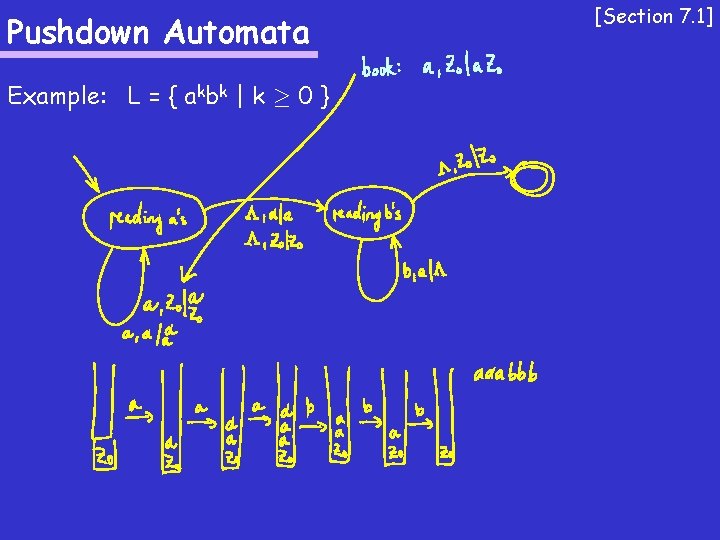
Pushdown Automata Example: L = { akbk | k ¸ 0 } [Section 7. 1]
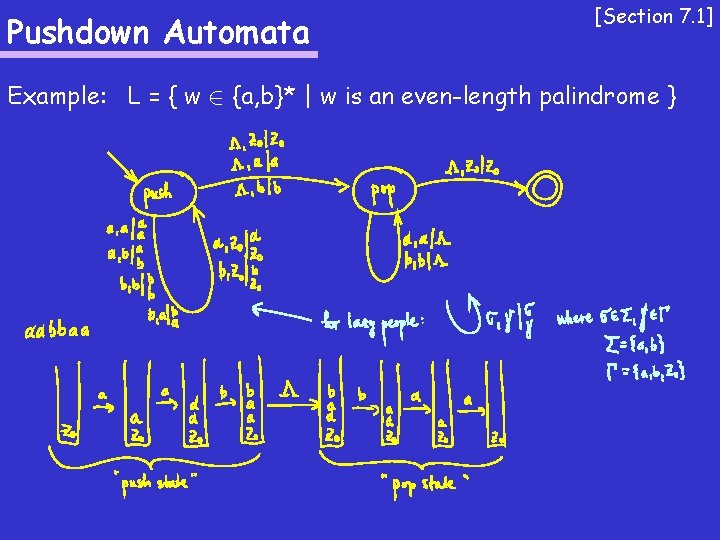
Pushdown Automata [Section 7. 1] Example: L = { w 2 {a, b}* | w is an even-length palindrome }
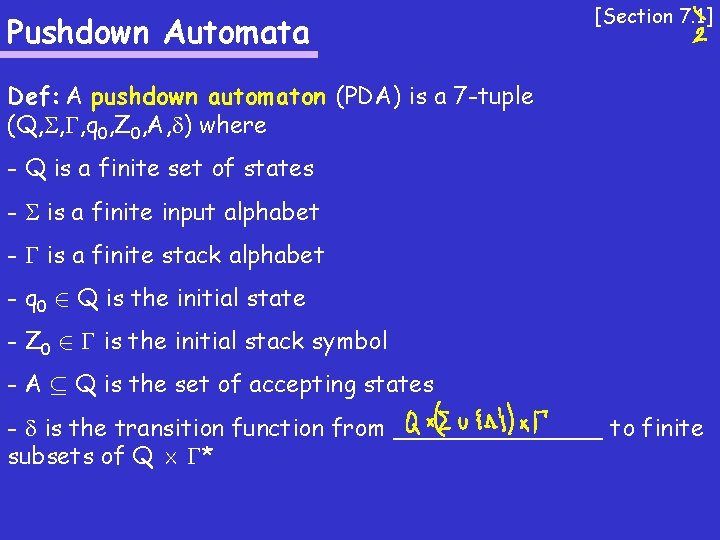
Pushdown Automata [Section 7. 1] Def: A pushdown automaton (PDA) is a 7 -tuple (Q, , , q 0, Z 0, A, ) where - Q is a finite set of states - is a finite input alphabet - is a finite stack alphabet - q 0 2 Q is the initial state - Z 0 2 is the initial stack symbol - A µ Q is the set of accepting states - is the transition function from _______ to finite subsets of Q £ *
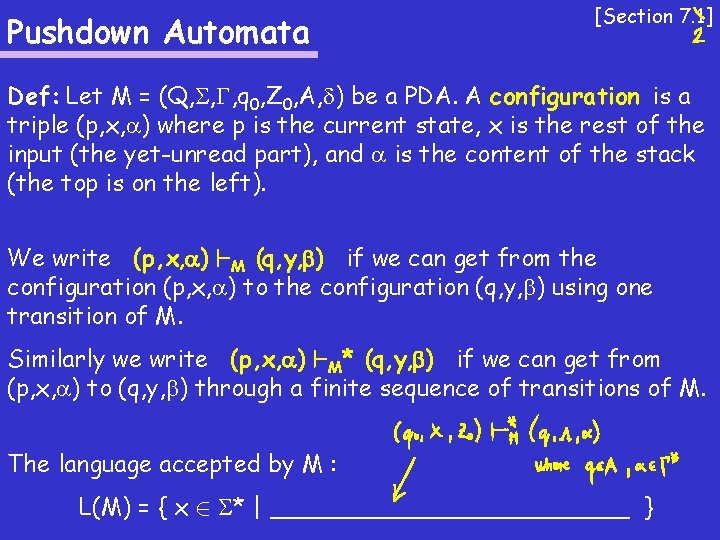
Pushdown Automata [Section 7. 1] Def: Let M = (Q, , , q 0, Z 0, A, ) be a PDA. A configuration is a triple (p, x, ) where p is the current state, x is the rest of the input (the yet-unread part), and is the content of the stack (the top is on the left). We write (p, x, ) `M (q, y, ) if we can get from the configuration (p, x, ) to the configuration (q, y, ) using one transition of M. Similarly we write (p, x, ) `M* (q, y, ) if we can get from (p, x, ) to (q, y, ) through a finite sequence of transitions of M. The language accepted by M : L(M) = { x 2 * | ____________ }
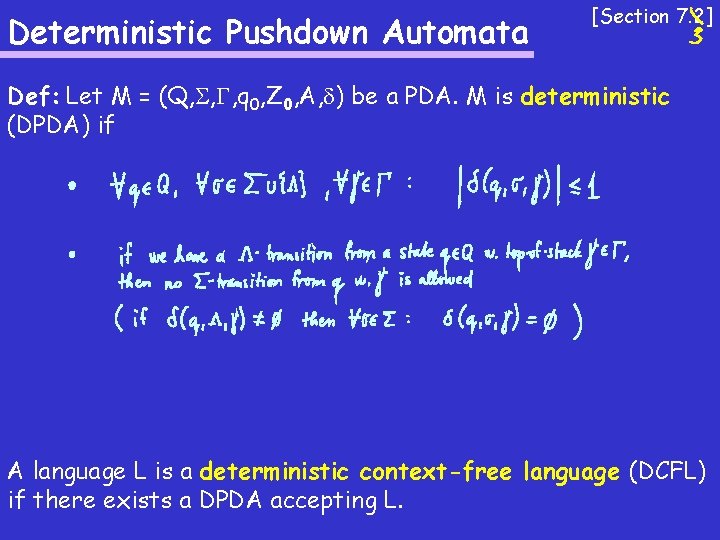
Deterministic Pushdown Automata [Section 7. 2] Def: Let M = (Q, , , q 0, Z 0, A, ) be a PDA. M is deterministic (DPDA) if A language L is a deterministic context-free language (DCFL) if there exists a DPDA accepting L.
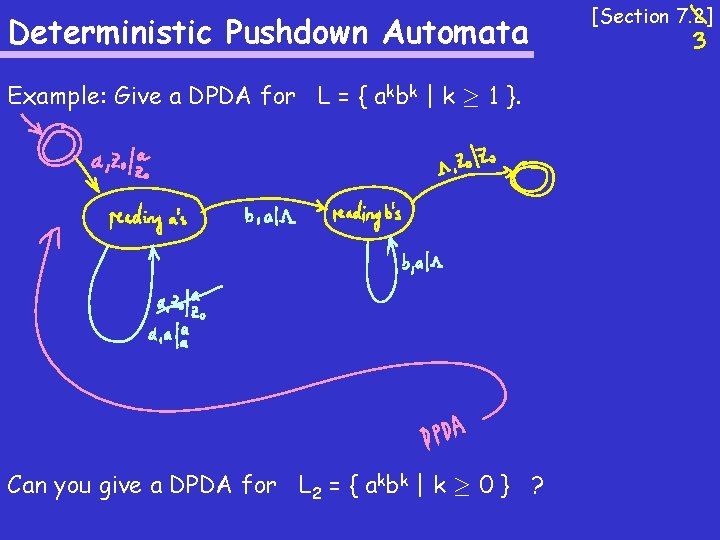
Deterministic Pushdown Automata Example: Give a DPDA for L = { akbk | k ¸ 1 }. Can you give a DPDA for L 2 = { akbk | k ¸ 0 } ? [Section 7. 2]

Determinism vs. Nondeterminism [Section 7. 2] For finite automata : For PDA : There exists a language which can be accepted by a PDA but not by a DPDA !
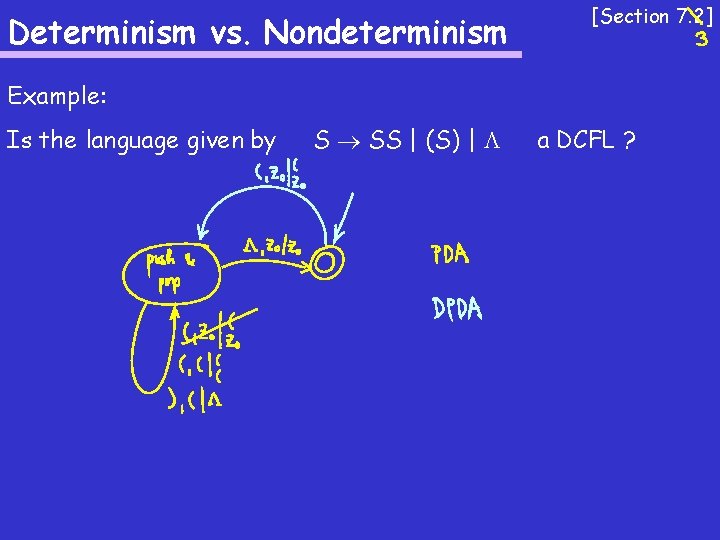
Determinism vs. Nondeterminism [Section 7. 2] Example: Is the language given by S SS | (S) | a DCFL ?
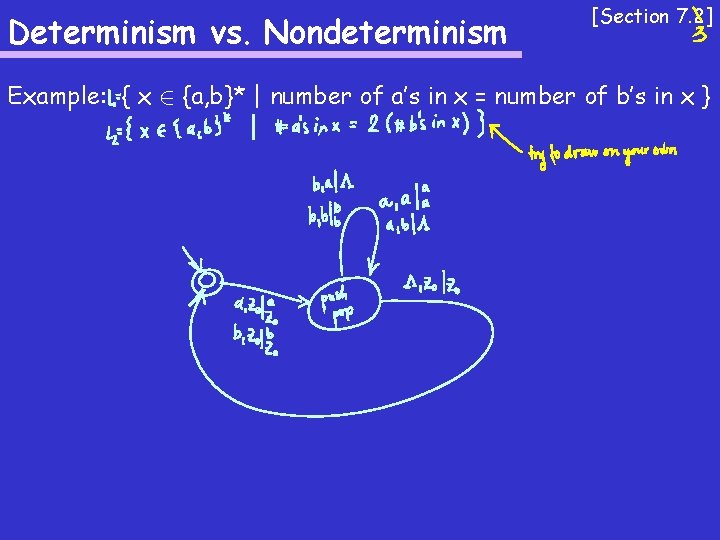
Determinism vs. Nondeterminism [Section 7. 2] Example: { x 2 {a, b}* | number of a’s in x = number of b’s in x }
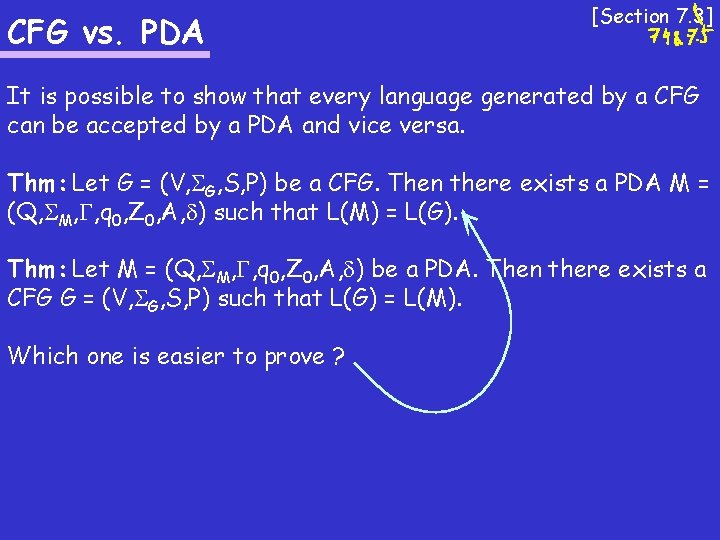
CFG vs. PDA [Section 7. 3] It is possible to show that every language generated by a CFG can be accepted by a PDA and vice versa. Thm: Let G = (V, G, S, P) be a CFG. Then there exists a PDA M = (Q, M, , q 0, Z 0, A, ) such that L(M) = L(G). Thm: Let M = (Q, M, , q 0, Z 0, A, ) be a PDA. Then there exists a CFG G = (V, G, S, P) such that L(G) = L(M). Which one is easier to prove ?
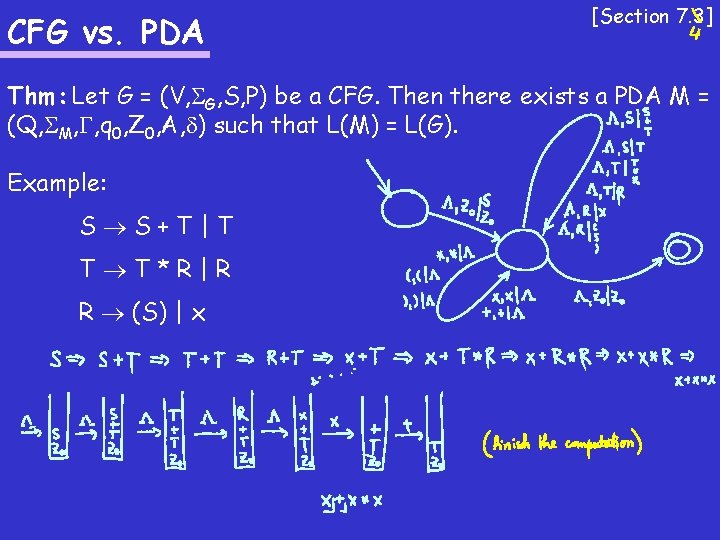
CFG vs. PDA [Section 7. 3] Thm: Let G = (V, G, S, P) be a CFG. Then there exists a PDA M = (Q, M, , q 0, Z 0, A, ) such that L(M) = L(G). Example: S S+T|T T T*R|R R (S) | x
- Slides: 12