
Pushback What about pure Insulin Resistance Syndromes The
Pushback • What about ‘pure’ Insulin Resistance Syndromes?
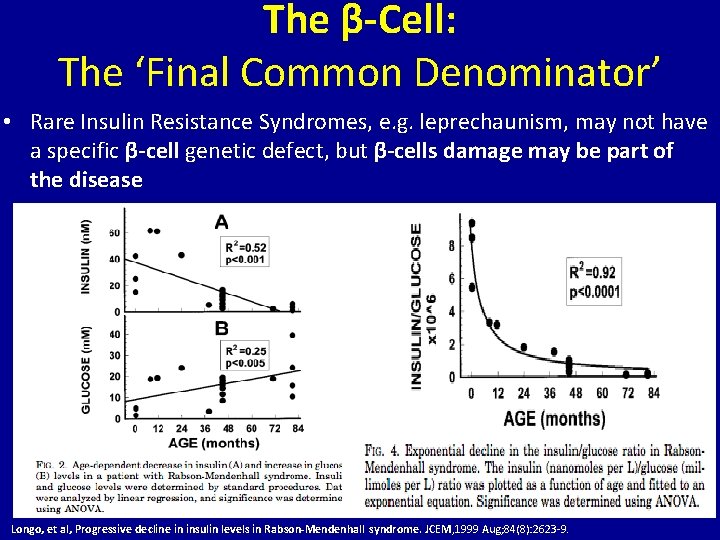
The β-Cell: The ‘Final Common Denominator’ • Rare Insulin Resistance Syndromes, e. g. leprechaunism, may not have a specific β-cell genetic defect, but β-cells damage may be part of the disease Longo, et al, Progressive decline in insulin levels in Rabson-Mendenhall syndrome. JCEM, 1999 Aug; 84(8): 2623 -9.
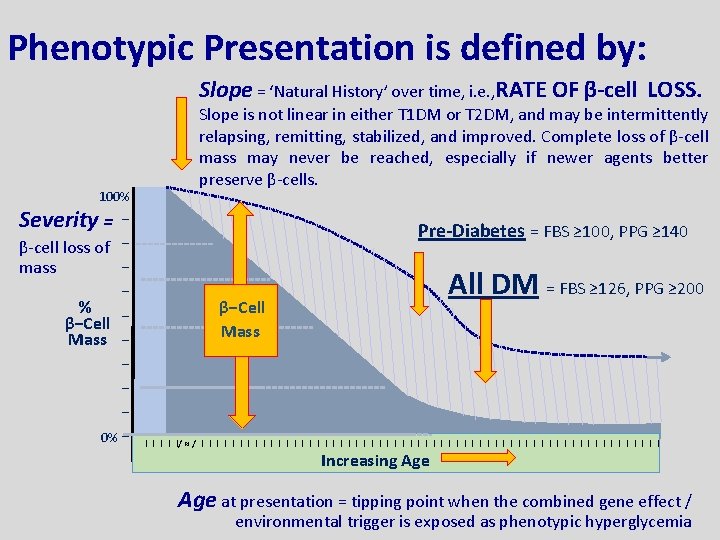
Phenotypic Presentation is defined by: Slope = ‘Natural History’ over time, i. e. , RATE OF β-cell LOSS. 100% Slope is not linear in either T 1 DM or T 2 DM, and may be intermittently relapsing, remitting, stabilized, and improved. Complete loss of β-cell mass may never be reached, especially if newer agents better preserve β-cells. Severity = − − β-cell loss of mass − − % β−Cell − Mass − − 0% − Pre-Diabetes = FBS ≥ 100, PPG ≥ 140 All DM = FBS ≥ 126, PPG ≥ 200 β−Cell Mass I I I/ ≈ / I I I I I I I I I I I I I I I Increasing Age at presentation = tipping point when the combined gene effect / environmental trigger is exposed as phenotypic hyperglycemia
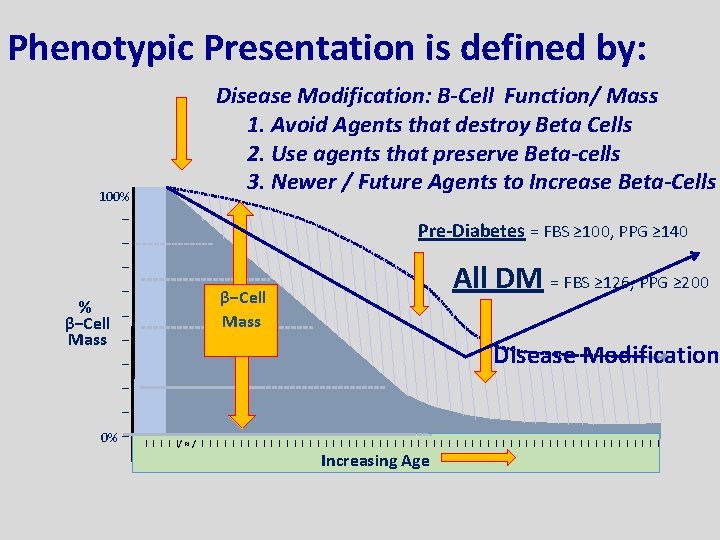
Phenotypic Presentation is defined by: 100% − − % β−Cell − Mass − − 0% − Disease Modification: B-Cell Function/ Mass 1. Avoid Agents that destroy Beta Cells 2. Use agents that preserve Beta-cells 3. Newer / Future Agents to Increase Beta-Cells Pre-Diabetes = FBS ≥ 100, PPG ≥ 140 All DM = FBS ≥ 126, PPG ≥ 200 β−Cell Mass Disease Modification I I I/ ≈ / I I I I I I I I I I I I I I I Increasing Age
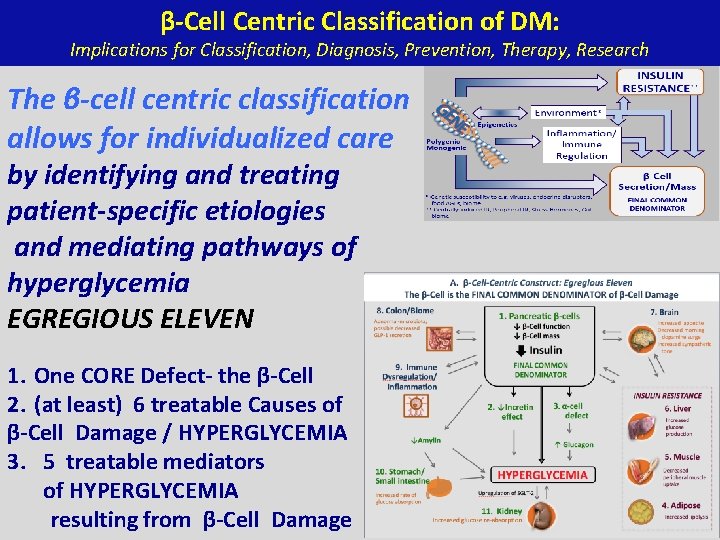
β-Cell Centric Classification of DM: Implications for Classification, Diagnosis, Prevention, Therapy, Research The β-cell centric classification allows for individualized care by identifying and treating patient-specific etiologies and mediating pathways of hyperglycemia EGREGIOUS ELEVEN 1. One CORE Defect- the β-Cell 2. (at least) 6 treatable Causes of β-Cell Damage / HYPERGLYCEMIA 3. 5 treatable mediators of HYPERGLYCEMIA resulting from β-Cell Damage
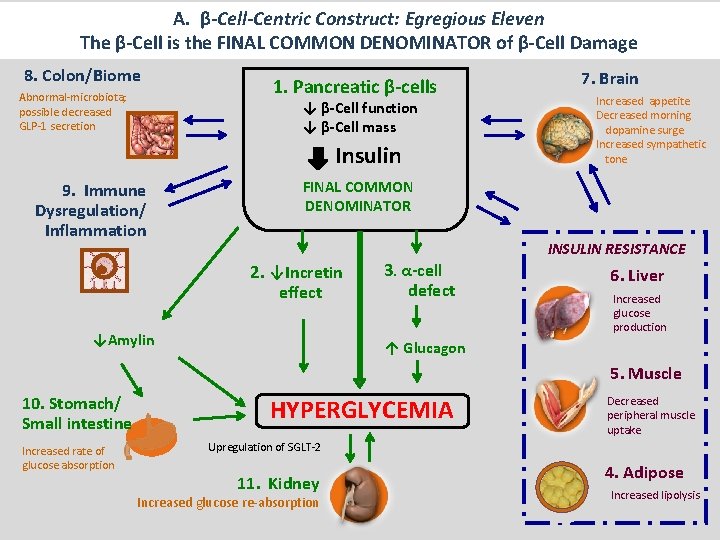
A. β-Cell-Centric Construct: Egregious Eleven The β-Cell is the FINAL COMMON DENOMINATOR of β-Cell Damage 8. Colon/Biome Abnormal-microbiota; possible decreased GLP-1 secretion 1. Pancreatic β-cells ↓ β-Cell function ↓ β-Cell mass Insulin 9. Immune Dysregulation/ Inflammation 7. Brain Increased appetite Decreased morning dopamine surge Increased sympathetic tone FINAL COMMON DENOMINATOR 2. ↓Incretin effect 3. α-cell defect INSULIN RESISTANCE 6. Liver Increased glucose production ↓Amylin ↑ Glucagon 5. Muscle 10. Stomach/ Small intestine Increased rate of glucose absorption HYPERGLYCEMIA Decreased peripheral muscle uptake Upregulation of SGLT-2 11. Kidney Increased glucose re-absorption 4. Adipose Increased lipolysis
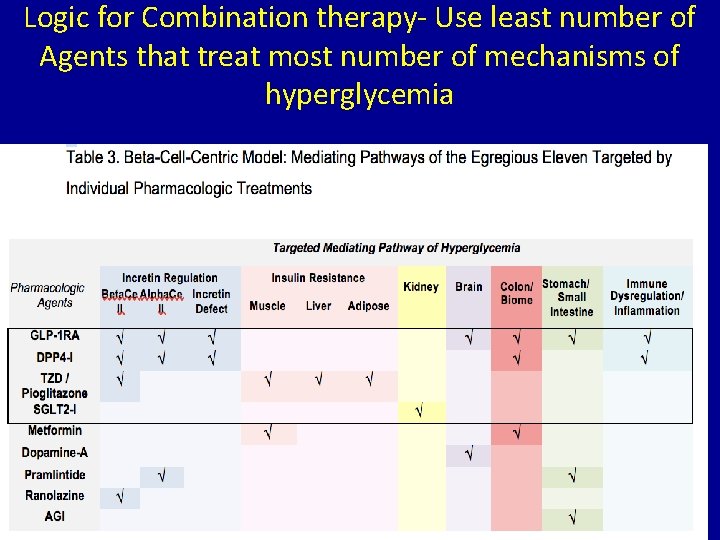
Logic for Combination therapy- Use least number of Agents that treat most number of mechanisms of hyperglycemia
- Slides: 7