
Push Messaging Chapter 12 What is push messaging



- Slides: 16
Push Messaging Chapter 12
What is “push messaging”? One specially interesting feature of WAP is the ability to push information to the mobile handset instead of relying on the traditional pull, or “requestresponse, ” model. With the push model, the information is sent to a client without the need for any previous user request. A good example of push model is paging. In a paging system, the mobile client does not actively pull information. Instead, it simply waits to receive a “push”-or a page, as it is more commonly known in that environment.
WAP Push Goals The WAP push specification has three key goals with respect to service developers: 1. Standard internet protocol and content types are cornerstones of 2. 3. WAP push. From the start, the main focus was to make things simple and easy to use from the internet world. The complexity of underlying mobile networks is completely hidden from the services utilizing WAP push. Because push service will be built to run on standard web servers and to use standard internet protocols, service developers should not be burdened with having to understand the mobile networks in detail. A simple, transport-independent protocol is required between the web service and the WAP push service connected to the mobile networks.
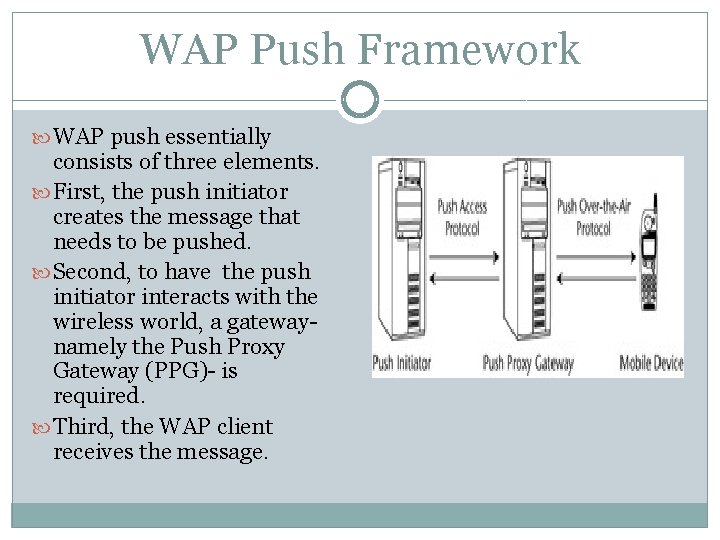
WAP Push Framework WAP push essentially consists of three elements. First, the push initiator creates the message that needs to be pushed. Second, to have the push initiator interacts with the wireless world, a gatewaynamely the Push Proxy Gateway (PPG)- is required. Third, the WAP client receives the message.
WAP Push Protocols WAP push defines two protocols: push Access Protocol (PAP) and Push Over-the-air (OTA) protocol. The push initiator and the push proxy gateway communicate using PAP. The push initiator uses PAP to submit push messages, and query the message status and WAP client capabilities. The push proxy gateway and the WAP client communicate using the push OTA protocol.
Push Access Protocol PAP is a simple, XML-based protocol that is independent of the underlying transport. Currently, the WAP push specification defines how PAP can be implemented over HTTP 1. 1; the WAP forum is also working on a binding to SMTP. Push Access Protocol Message Format A push access protocol push submission message takes the form of a MIME multipart/related document that may carry a maximum of three types of information. These three types of information include the following: 1. The push proxy gateway and push initiator control information. 2. The actual push message that is targeted to the WAP client. 3. Capabilities and preefrences information.
Push Access protocol Operations For facilitating WAP push service, PAP provides five basic operations for the Push Initiator and Push Proxy Gateway. Only the Push Submission and Result Notification operations must be supported by push proxy gateway implementation. Push Submission Delivery parameters, including whether the message should be sent before or after a defined time period and whether a delivery report is requested. The devise address to which the actual push message, which is contained in second entity of the PAP message, should be delivered. Information identifying the originator of the message. Push submission response An initial response to push submission, the push proxy gateway generates a push response message that includes the message ID, together with information about the push proxy gateway and a timespamp indicating when this response was created.
Push cancellation This operation cancels message based on their message IDs. Push cancellation response As a response to message cancellation, the push proxy gateway sends back a message to the push initiator with the message ID and a status code representing the outcome of the cancellation request. Push Status Query The push initiator can query the status of previously submitted messages based on their message IDs. Push status Query response It includes the message ID, possible recipient address to which this status applies, and the status code itself. Client capability query The push initiator uses this query to obtain information about the WAP client before submitting a message.
Client Capability Query Response The push proxy gateway uses these identifiers and selects a suitable set of capabilities to be returned to push initiator. Result Notification All messages submitted by the push initiator to the push proxy gateway will get a push submission response when they are accepted for processing. Result Notification Response The result Notification Response acknowledges receipt of the Result notification.
WAP Push Addressing WAP Client Addressing The Address format in WAP push is compatible with the e-mail address format defined in RFC 822. The WAP client address is composed from a client specifier and a push proxy gateway specifier. Application Addressing The push initiator can address a particular application in the WAP client by including an application ID in the X-WAP-Application-Id header in the push message.
Push Messaging Push Message Format Push message use a generic format for Internet text messages, as defined in RFC 822, but they can also accommodate binary message bodies. Message Headers- two types of headers exist: generic headers and WAP-specific headers. Message Body-the body of a push message can be any MIME-media type, such as a service indication
Push Proxy Gateway For WAP push, the push proxy gateway serves as the “glue” between the wired and the wireless world. In short, the push proxy gateway translates push initiator requests that are submitted using PAP into messages that are delivered using the Push OTA protocol to the WAP client. Push Submission Upon receiving a PAP message submitted by the Push Initiator, the push proxy gateway first validates the syntax of the PAP control information, the first entity in the PAP message, by comparing it with the document type definition(DTD). Message Delivery Depending on the control information in the push message, the push proxy gateway selects the appropriate method of delivery. It can choose from two methods: Unconfirmed push and Confirmed push.
Push Over-the-Air-protocol The push proxy gateway and WAP client communicate using the push over-the-air (OTA) protocol. This protocol is implemented on top of the wireless session protocol (WSP) and is responsible for transferring the content from the push proxy gateway over the wireless network of the WAP client. Push Connection Models Because the push OTA protocol relies on WSP services, it establishes push sessions to talk with the WAP client. These sessions can be connectionless or connection-oriented. Connectionless push uses the WSP S-unit-push service primitive. Connection-oriented push requires an established session between the WAP client and the push proxy gateway.
Session Initiation Application Request A special case arises when the WAP client does not have a session to be the push proxy gateway. When connection-oriented push is required, the push proxy gateway must establish a WSP session with the WAP client. However, the WAP architecture addresses only the traditional pull-type message transfer, in which a WAP client establishes a session with a server; it does not support session establishment from the server to the client.
Push Initiator Authentication and Trusted Content It verifies that it trusts the push proxy gateway. The client maintains a list of contact points for trusted push proxy gateway. 2. It verifies that the (trusted) push proxy gateway has authenticated the push initiator. The push OTA protocol carries an Authenticated flag that is set by the PPG to indicate that it authenticated the push initiator. 1.
THANK YOU