
Push and Pull Production Systems You say yes
- Slides: 35
Push and Pull Production Systems You say yes. I say no. You say stop. and I say go, go! – The Beatles © Wallace J. Hopp, Mark L. Spearman, 1996, 2000 http: //www. factory-physics. com 1
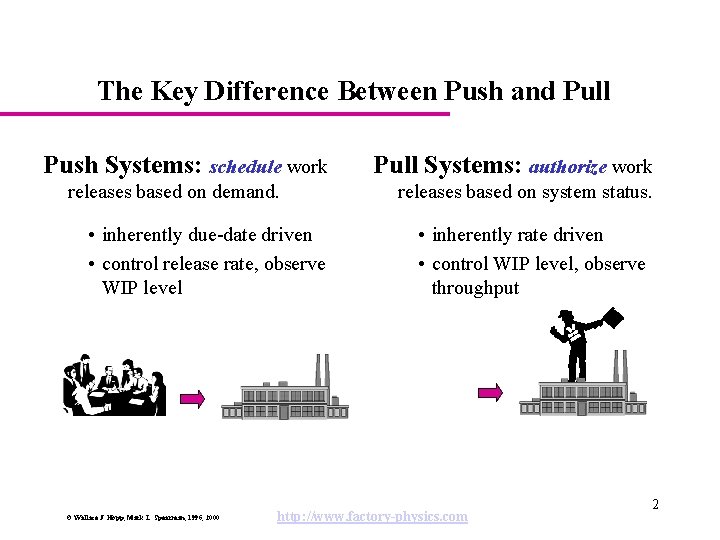
The Key Difference Between Push and Pull Push Systems: schedule work releases based on demand. • inherently due-date driven • control release rate, observe WIP level © Wallace J. Hopp, Mark L. Spearman, 1996, 2000 Pull Systems: authorize work releases based on system status. • inherently rate driven • control WIP level, observe throughput http: //www. factory-physics. com 2
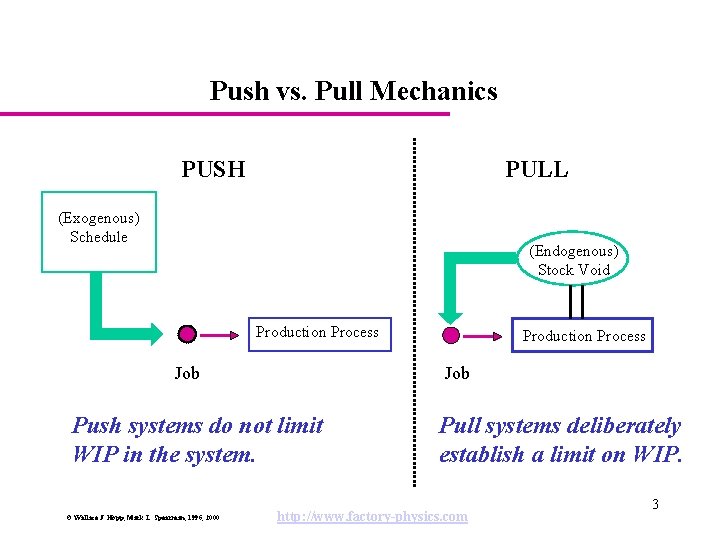
Push vs. Pull Mechanics PUSH PULL (Exogenous) Schedule (Endogenous) Stock Void Production Process Job Push systems do not limit WIP in the system. © Wallace J. Hopp, Mark L. Spearman, 1996, 2000 Production Process Pull systems deliberately establish a limit on WIP. http: //www. factory-physics. com 3
What Pull is Not! Make-to-Order: • MRP with firm orders on MPS is make-to-order. • But it does not limit WIP and is therefore a push system. Make-to-Stock: • Pull systems do replenish inventory voids. • But jobs can be associated with customer orders. Forecast Free: • Toyota’s classic system made cars to forecasts. • Use of takt times or production smoothing often involves production without firm orders (and hence forecasts). © Wallace J. Hopp, Mark L. Spearman, 1996, 2000 http: //www. factory-physics. com 4
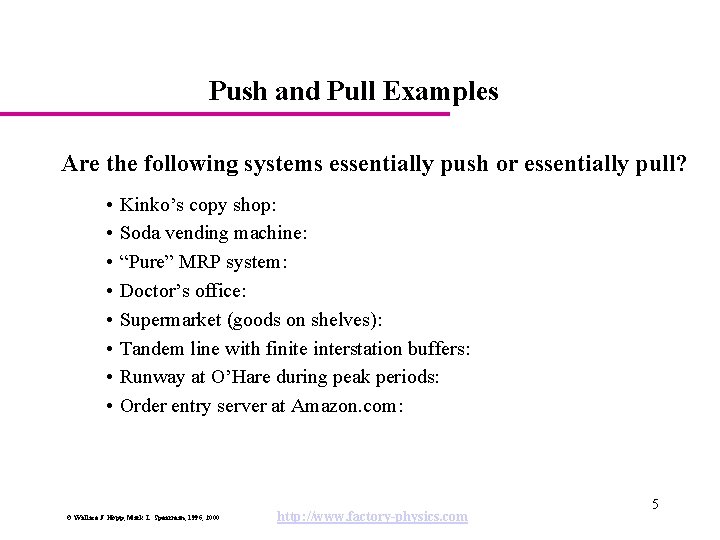
Push and Pull Examples Are the following systems essentially push or essentially pull? • Kinko’s copy shop: • Soda vending machine: • “Pure” MRP system: • Doctor’s office: • Supermarket (goods on shelves): • Tandem line with finite interstation buffers: • Runway at O’Hare during peak periods: • Order entry server at Amazon. com: © Wallace J. Hopp, Mark L. Spearman, 1996, 2000 http: //www. factory-physics. com 5
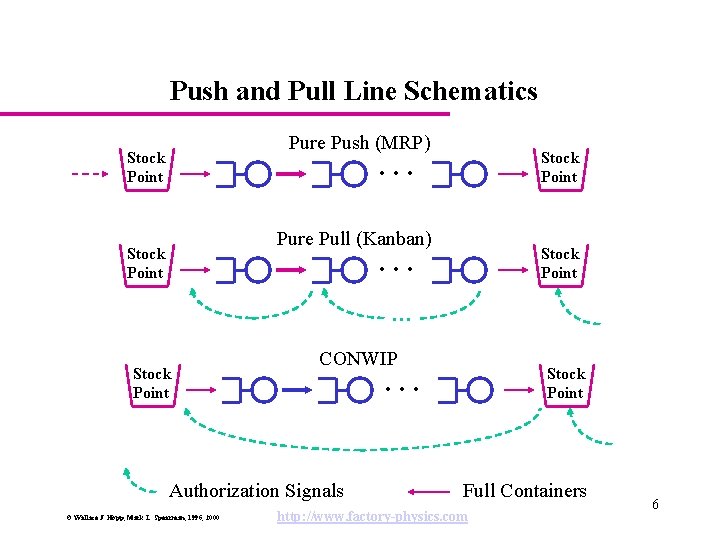
Push and Pull Line Schematics Pure Push (MRP) Stock Point . . . Pure Pull (Kanban) Stock Point . . . … Stock Point CONWIP Authorization Signals © Wallace J. Hopp, Mark L. Spearman, 1996, 2000 Stock Point . . . Full Containers http: //www. factory-physics. com 6
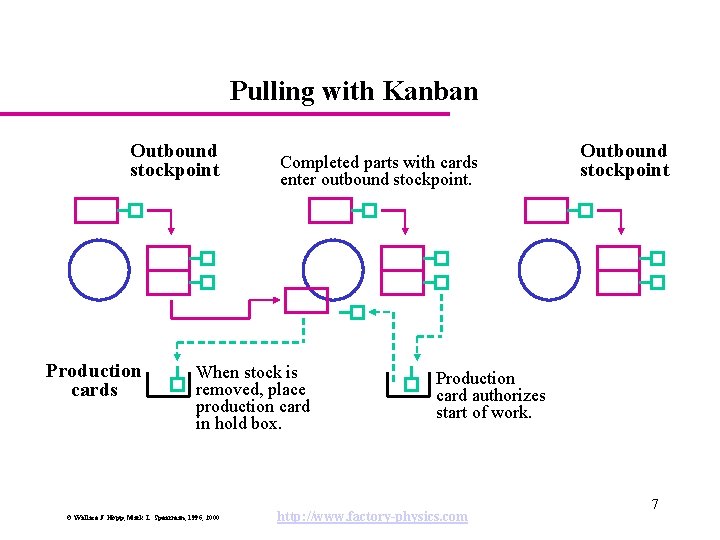
Pulling with Kanban Outbound stockpoint Production cards Completed parts with cards enter outbound stockpoint. When stock is removed, place production card in hold box. © Wallace J. Hopp, Mark L. Spearman, 1996, 2000 Outbound stockpoint Production card authorizes start of work. http: //www. factory-physics. com 7
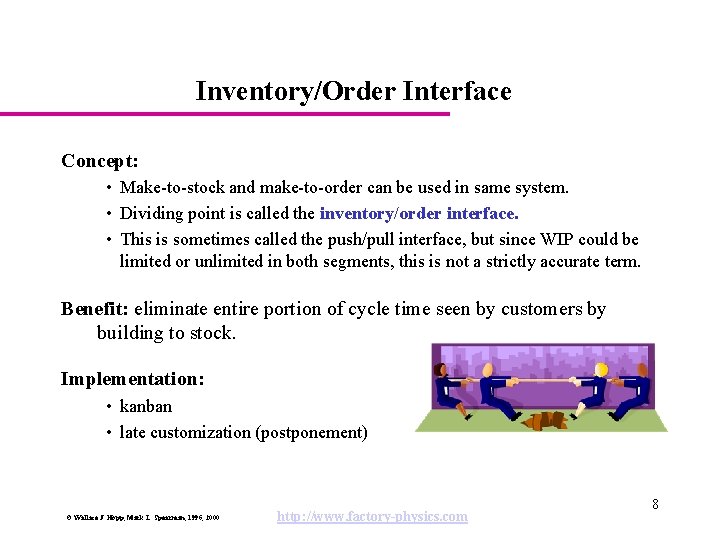
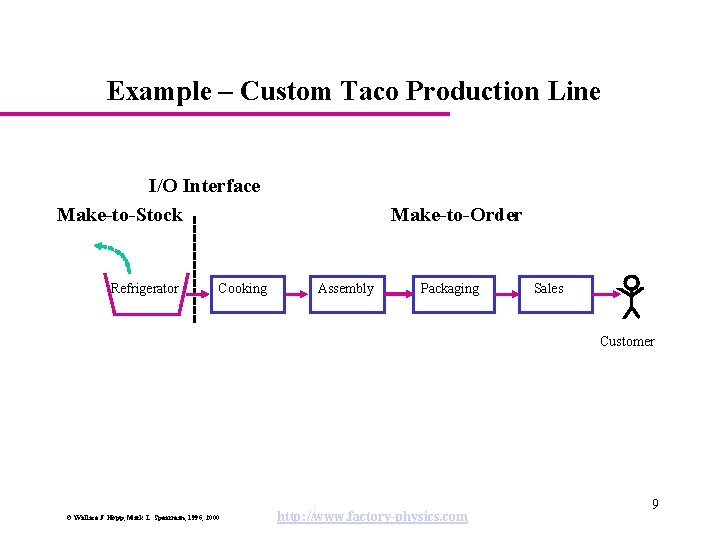
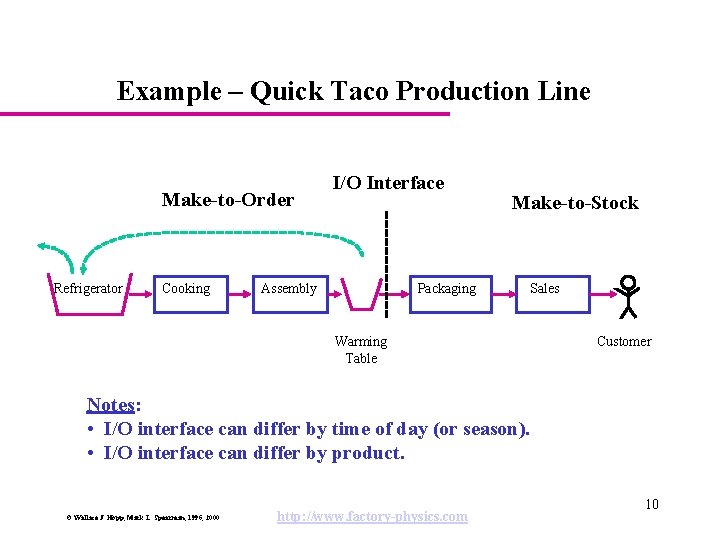
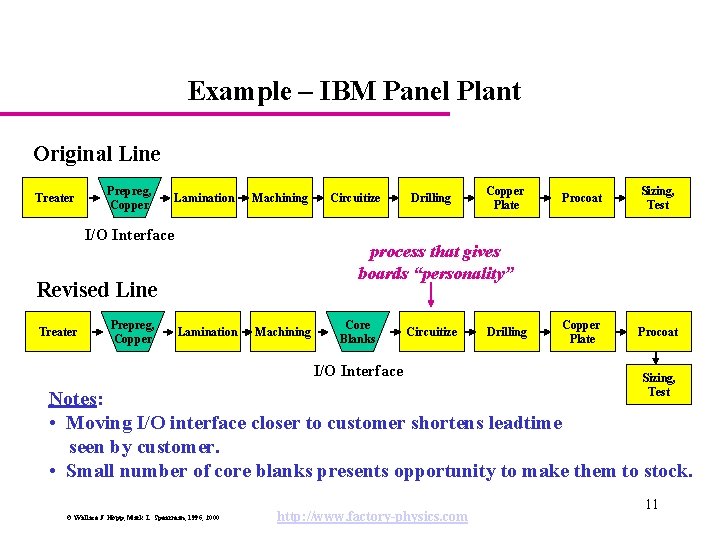
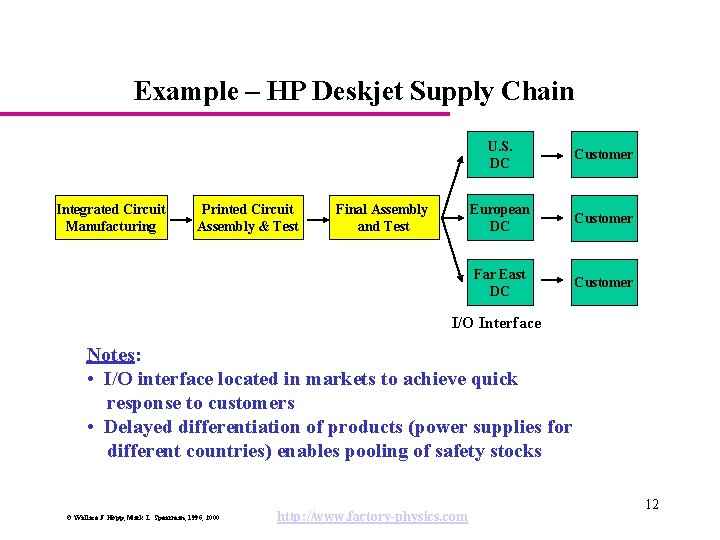
Inventory/Order Interface Concept: • Make-to-stock and make-to-order can be used in same system. • Dividing point is called the inventory/order interface. • This is sometimes called the push/pull interface, but since WIP could be limited or unlimited in both segments, this is not a strictly accurate term. Benefit: eliminate entire portion of cycle time seen by customers by building to stock. Implementation: • kanban • late customization (postponement) © Wallace J. Hopp, Mark L. Spearman, 1996, 2000 http: //www. factory-physics. com 8
Example – Custom Taco Production Line I/O Interface Make-to-Stock Refrigerator Cooking Make-to-Order Assembly Packaging Sales Customer © Wallace J. Hopp, Mark L. Spearman, 1996, 2000 http: //www. factory-physics. com 9
Example – Quick Taco Production Line Make-to-Order Refrigerator Cooking I/O Interface Assembly Make-to-Stock Packaging Warming Table Sales Customer Notes: • I/O interface can differ by time of day (or season). • I/O interface can differ by product. © Wallace J. Hopp, Mark L. Spearman, 1996, 2000 http: //www. factory-physics. com 10
Example – IBM Panel Plant Original Line Treater Prepreg, Copper Lamination Machining I/O Interface Prepreg, Copper Drilling Copper Plate Procoat Sizing, Test Copper Plate Procoat process that gives boards “personality” Revised Line Treater Circuitize Lamination Machining Core Blanks Circuitize I/O Interface Drilling Sizing, Test Notes: • Moving I/O interface closer to customer shortens leadtime seen by customer. • Small number of core blanks presents opportunity to make them to stock. © Wallace J. Hopp, Mark L. Spearman, 1996, 2000 http: //www. factory-physics. com 11
Example – HP Deskjet Supply Chain Integrated Circuit Manufacturing Printed Circuit Assembly & Test Final Assembly and Test U. S. DC Customer European DC Customer Far East DC Customer I/O Interface Notes: • I/O interface located in markets to achieve quick response to customers • Delayed differentiation of products (power supplies for different countries) enables pooling of safety stocks © Wallace J. Hopp, Mark L. Spearman, 1996, 2000 http: //www. factory-physics. com 12
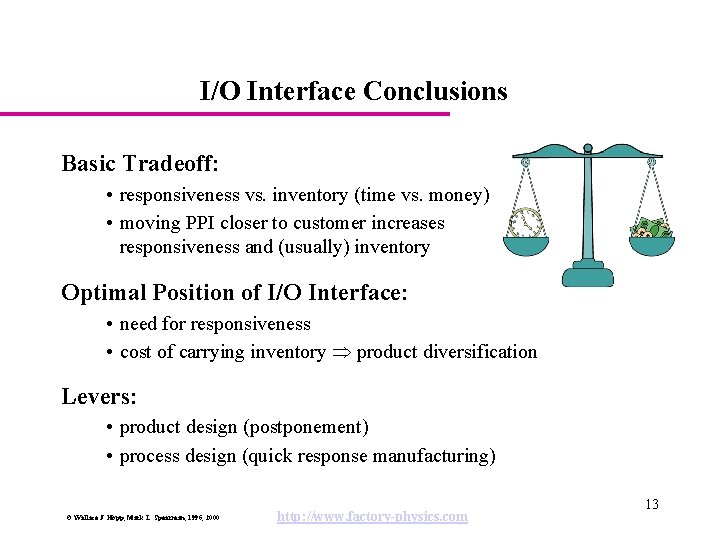
I/O Interface Conclusions Basic Tradeoff: • responsiveness vs. inventory (time vs. money) • moving PPI closer to customer increases responsiveness and (usually) inventory Optimal Position of I/O Interface: • need for responsiveness • cost of carrying inventory product diversification Levers: • product design (postponement) • process design (quick response manufacturing) © Wallace J. Hopp, Mark L. Spearman, 1996, 2000 http: //www. factory-physics. com 13
Advantages of Pull Systems Good Customer Service: Low Unit Cost: • short cycle times • steady, predictable output stream • low inventory • reduced space • little rework High External Quality: • high internal quality • pressure for good quality • promotion of good quality (e. g. , defect detection) © Wallace J. Hopp, Mark L. Spearman, 1996, 2000 Flexibility: • avoids committing jobs too early • encourages floating capacity http: //www. factory-physics. com 14
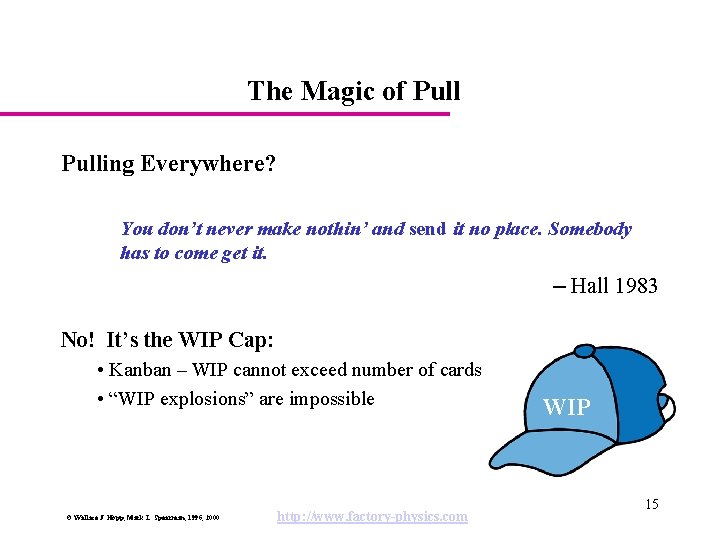
The Magic of Pulling Everywhere? You don’t never make nothin’ and send it no place. Somebody has to come get it. – Hall 1983 No! It’s the WIP Cap: • Kanban – WIP cannot exceed number of cards • “WIP explosions” are impossible © Wallace J. Hopp, Mark L. Spearman, 1996, 2000 http: //www. factory-physics. com WIP 15
Pull Benefits Achieved by WIP Cap Reduces Costs: • prevents WIP explosions • reduces average WIP • reduces engineering changes Improves Quality: Improves Customer Service: • reduces cycle time variability • pressure to reduce sources of process variability • promotes shorter lead times and better on-time performance • pressure for higher quality • improved defect detection Maintains Flexibility: • avoids early release (like air • improved communication traffic control) • less direct congestion • less reliance on forecasts • promotes floating capacity © Wallace J. Hopp, Mark L. Spearman, 1996, 2000 http: //www. factory-physics. com 16
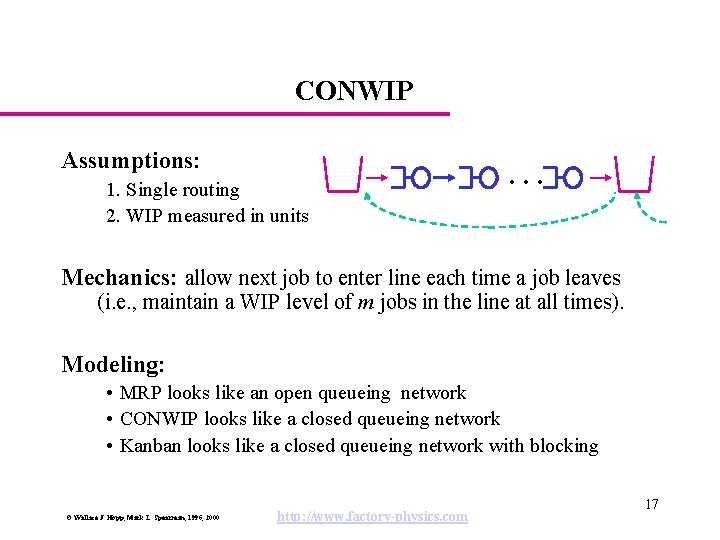
CONWIP Assumptions: 1. Single routing 2. WIP measured in units . . . Mechanics: allow next job to enter line each time a job leaves (i. e. , maintain a WIP level of m jobs in the line at all times). Modeling: • MRP looks like an open queueing network • CONWIP looks like a closed queueing network • Kanban looks like a closed queueing network with blocking © Wallace J. Hopp, Mark L. Spearman, 1996, 2000 http: //www. factory-physics. com 17
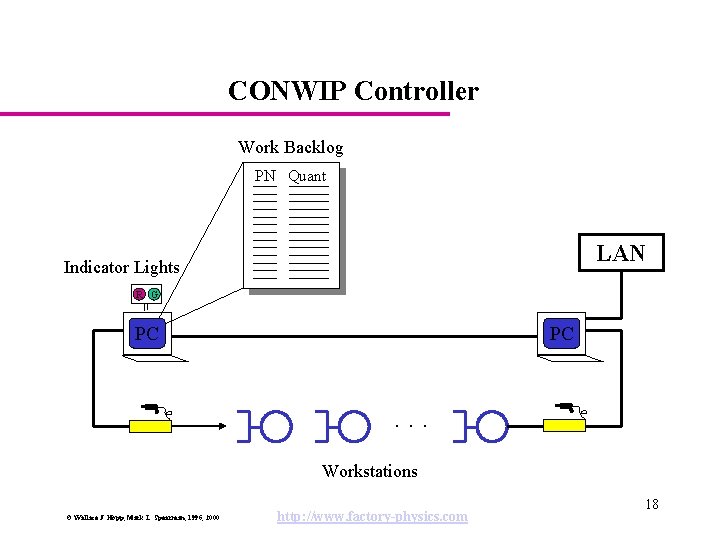
CONWIP Controller Work Backlog Indicator Lights PN –— –— –— –— Quant ––––– ––––– ––––– ––––– LAN R G PC PC . . . Workstations © Wallace J. Hopp, Mark L. Spearman, 1996, 2000 http: //www. factory-physics. com 18
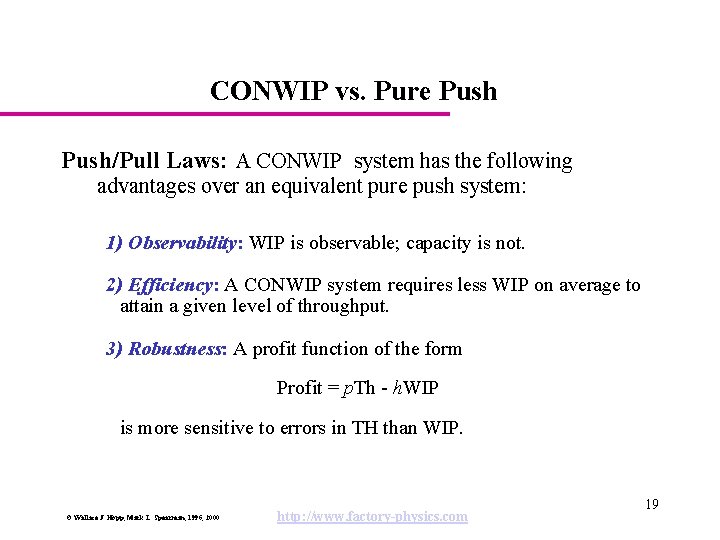
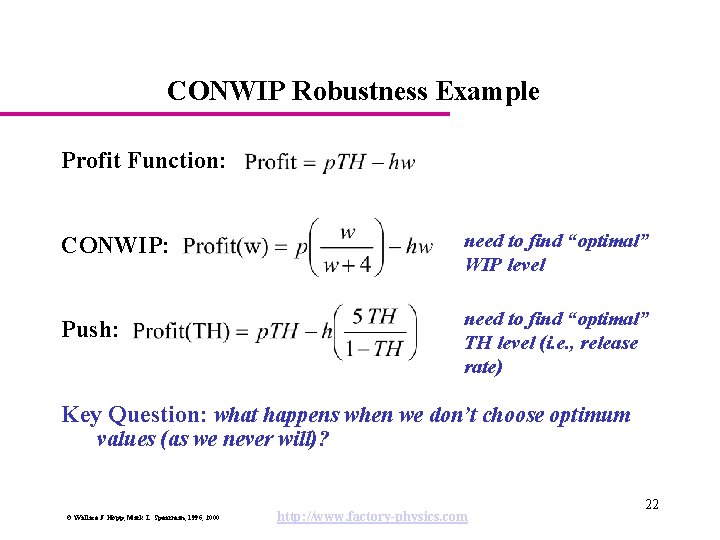
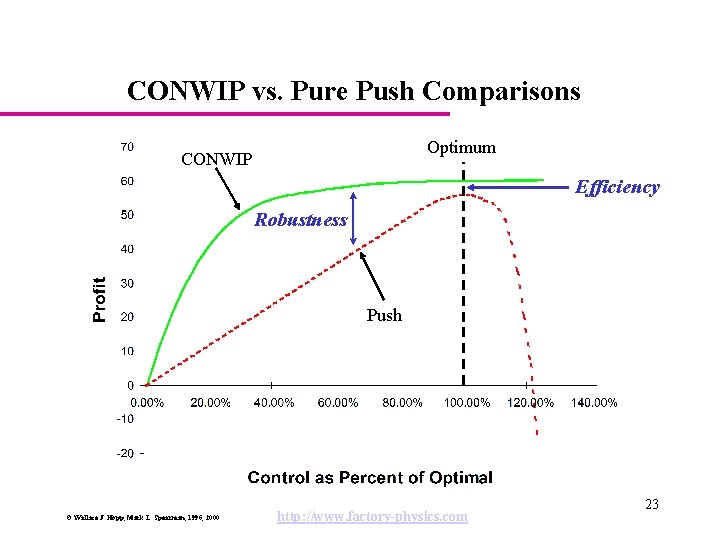
CONWIP vs. Pure Push/Pull Laws: A CONWIP system has the following advantages over an equivalent pure push system: 1) Observability: WIP is observable; capacity is not. 2) Efficiency: A CONWIP system requires less WIP on average to attain a given level of throughput. 3) Robustness: A profit function of the form Profit = p. Th - h. WIP is more sensitive to errors in TH than WIP. © Wallace J. Hopp, Mark L. Spearman, 1996, 2000 http: //www. factory-physics. com 19
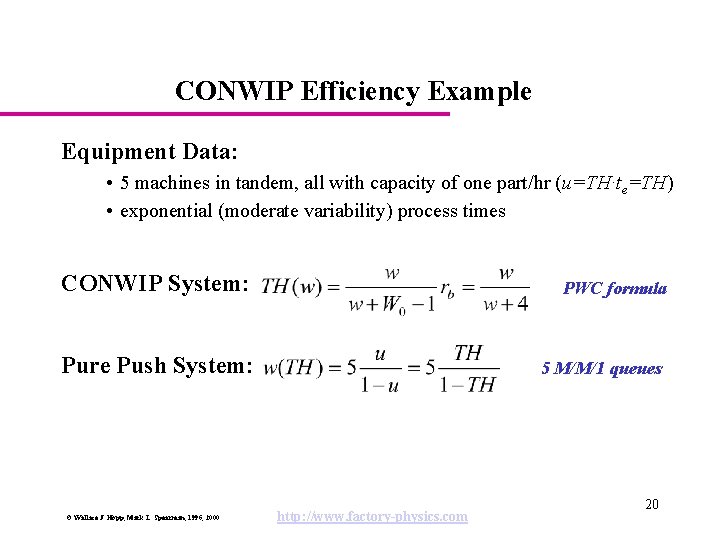
CONWIP Efficiency Example Equipment Data: • 5 machines in tandem, all with capacity of one part/hr (u=TH·te=TH) • exponential (moderate variability) process times CONWIP System: PWC formula Pure Push System: 5 M/M/1 queues © Wallace J. Hopp, Mark L. Spearman, 1996, 2000 http: //www. factory-physics. com 20
CONWIP Efficiency Example (cont. ) How much WIP is required for push to match TH attained by CONWIP system with WIP=w? © Wallace J. Hopp, Mark L. Spearman, 1996, 2000 http: //www. factory-physics. com 21
CONWIP Robustness Example Profit Function: CONWIP: need to find “optimal” WIP level Push: need to find “optimal” TH level (i. e. , release rate) Key Question: what happens when we don’t choose optimum values (as we never will)? © Wallace J. Hopp, Mark L. Spearman, 1996, 2000 http: //www. factory-physics. com 22
CONWIP vs. Pure Push Comparisons Optimum CONWIP Efficiency Robustness Push © Wallace J. Hopp, Mark L. Spearman, 1996, 2000 http: //www. factory-physics. com 23
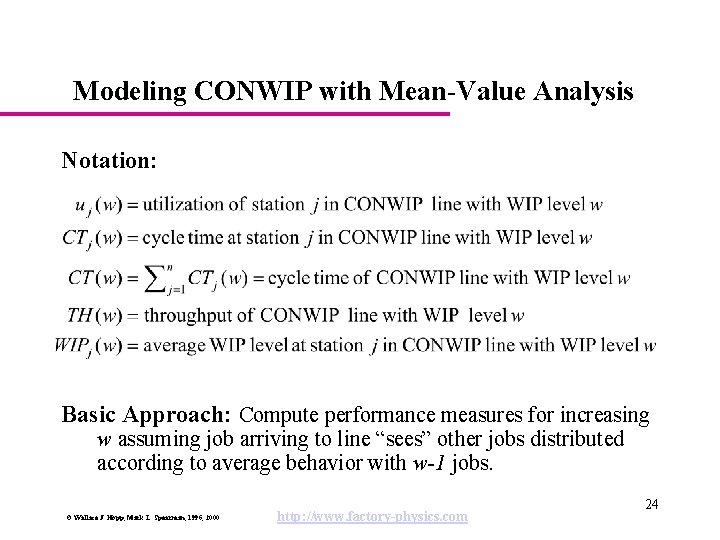
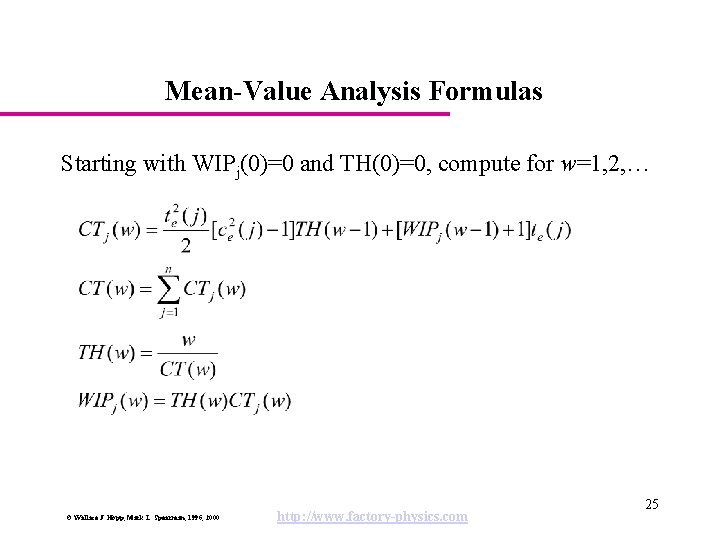
Modeling CONWIP with Mean-Value Analysis Notation: Basic Approach: Compute performance measures for increasing w assuming job arriving to line “sees” other jobs distributed according to average behavior with w-1 jobs. © Wallace J. Hopp, Mark L. Spearman, 1996, 2000 http: //www. factory-physics. com 24
Mean-Value Analysis Formulas Starting with WIPj(0)=0 and TH(0)=0, compute for w=1, 2, … © Wallace J. Hopp, Mark L. Spearman, 1996, 2000 http: //www. factory-physics. com 25
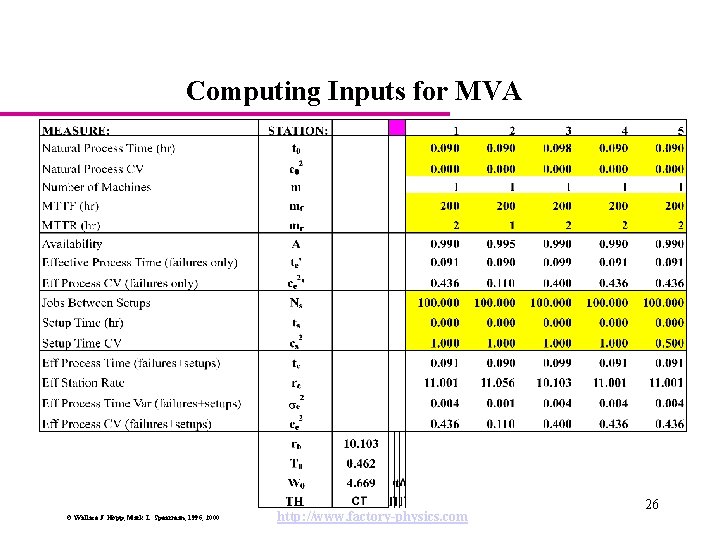
Computing Inputs for MVA © Wallace J. Hopp, Mark L. Spearman, 1996, 2000 http: //www. factory-physics. com 26
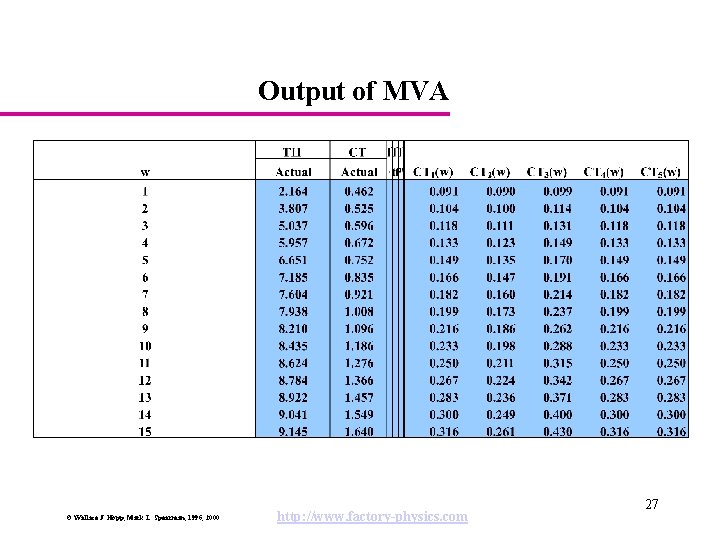
Output of MVA © Wallace J. Hopp, Mark L. Spearman, 1996, 2000 http: //www. factory-physics. com 27
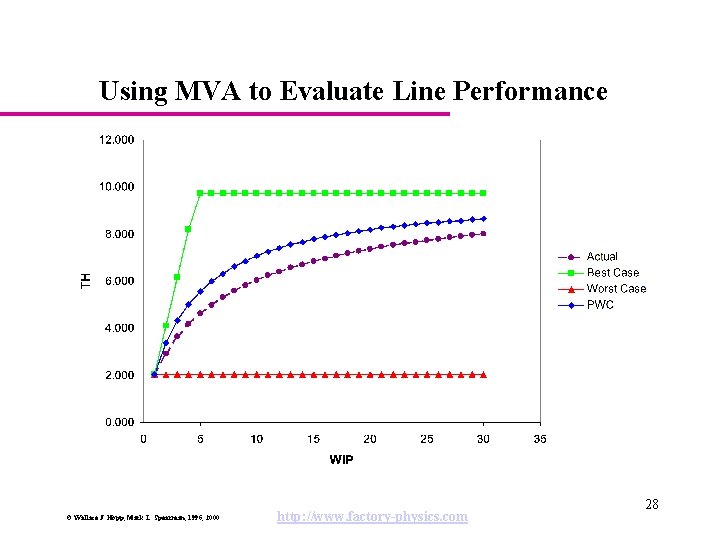
Using MVA to Evaluate Line Performance © Wallace J. Hopp, Mark L. Spearman, 1996, 2000 http: //www. factory-physics. com 28
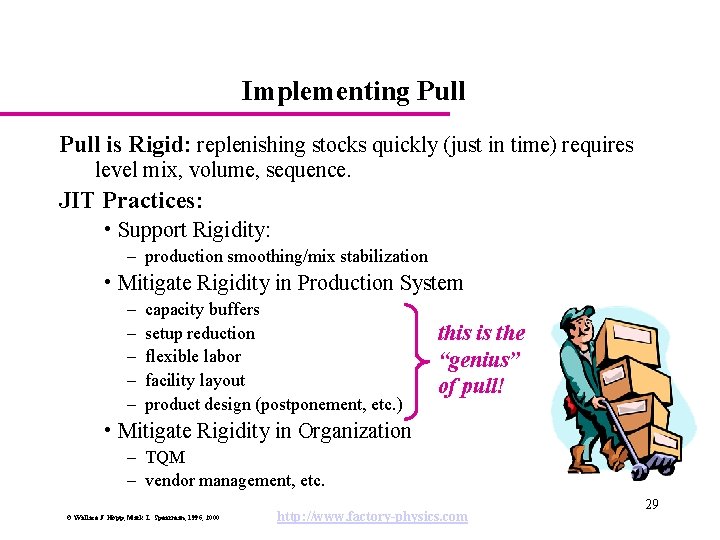
Implementing Pull is Rigid: replenishing stocks quickly (just in time) requires level mix, volume, sequence. JIT Practices: • Support Rigidity: – production smoothing/mix stabilization • Mitigate Rigidity in Production System – – – capacity buffers setup reduction flexible labor facility layout product design (postponement, etc. ) this is the “genius” of pull! • Mitigate Rigidity in Organization – TQM – vendor management, etc. © Wallace J. Hopp, Mark L. Spearman, 1996, 2000 http: //www. factory-physics. com 29
Capacity Buffers Motivation: facilitate rapid replenishments with minimal WIP Benefits: • Protection against quota shortfalls • Regular flow allows matching against customer demands • Can be more economical in long run than WIP buffers in push systems Techniques: • Planned underutilization (e. g. , use u = 75% in aggregate planning) • Two shifting: 4 – 8 – 4 – 8 • Schedule dummy jobs to allow quick response to hot jobs © Wallace J. Hopp, Mark L. Spearman, 1996, 2000 http: //www. factory-physics. com 30
Setup Reduction Motivation: Small lot sequences not feasible with large setups. Internal vs. External Setups: • External – performed while machine is still running • Internal – performed while machine is down Approach: 1. Separate the internal setup from the external setup. 2. Convert as much internal setup as possible to external setup. 3. Eliminate the adjustment process. 4. Abolish the setup itself (e. g. , uniform product design, combined production, parallel machines). © Wallace J. Hopp, Mark L. Spearman, 1996, 2000 http: //www. factory-physics. com 31
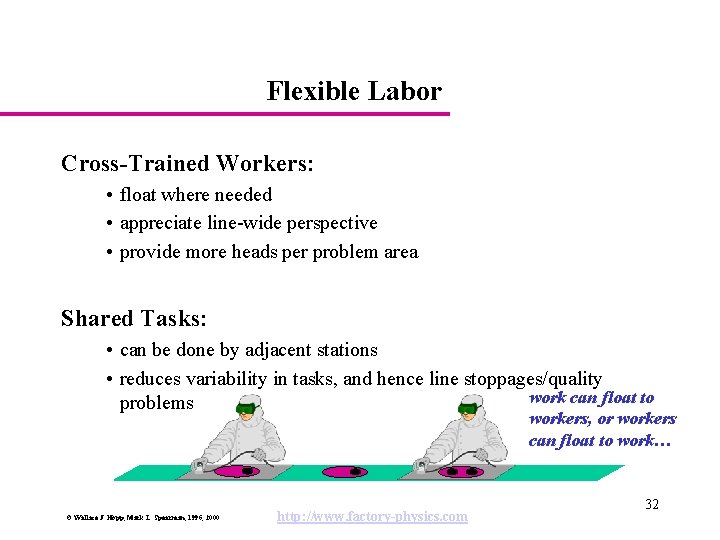
Flexible Labor Cross-Trained Workers: • float where needed • appreciate line-wide perspective • provide more heads per problem area Shared Tasks: • can be done by adjacent stations • reduces variability in tasks, and hence line stoppages/quality work can float to problems workers, or workers can float to work… © Wallace J. Hopp, Mark L. Spearman, 1996, 2000 http: //www. factory-physics. com 32
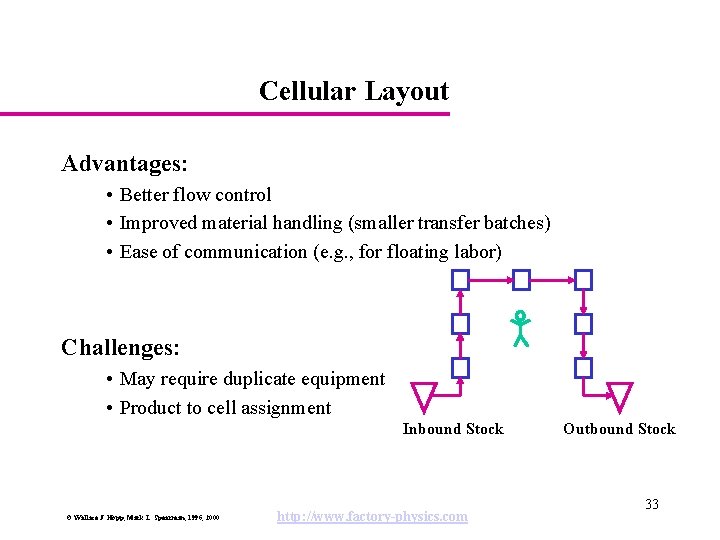
Cellular Layout Advantages: • Better flow control • Improved material handling (smaller transfer batches) • Ease of communication (e. g. , for floating labor) Challenges: • May require duplicate equipment • Product to cell assignment Inbound Stock © Wallace J. Hopp, Mark L. Spearman, 1996, 2000 http: //www. factory-physics. com Outbound Stock 33
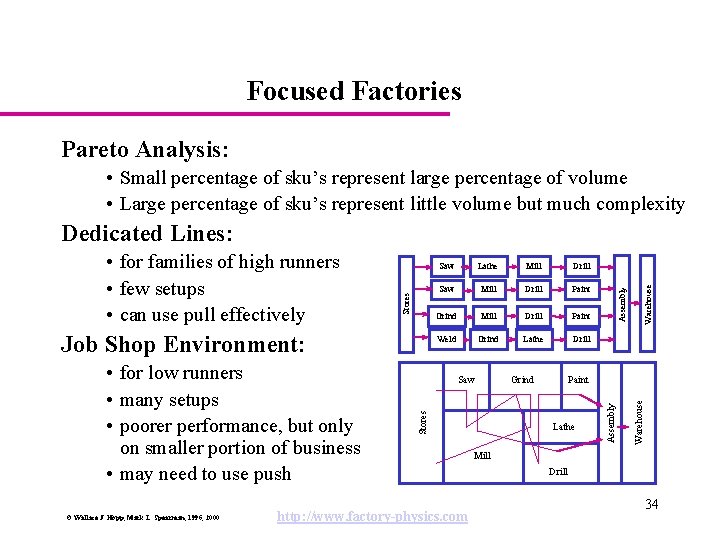
Focused Factories Pareto Analysis: • Small percentage of sku’s represent large percentage of volume • Large percentage of sku’s represent little volume but much complexity © Wallace J. Hopp, Mark L. Spearman, 1996, 2000 Saw Mill Drill Paint Grind Mill Drill Paint Weld Grind Lathe Drill Saw http: //www. factory-physics. com Grind Warehouse Drill Assembly Mill Stores • for low runners • many setups • poorer performance, but only on smaller portion of business • may need to use push Lathe Paint Lathe Warehouse Job Shop Environment: Saw Assembly • for families of high runners • few setups • can use pull effectively Stores Dedicated Lines: Mill Drill 34
Push/Pull Takeaways Magic of Pull: the WIP cap MTS/MTO Hybrids: locating the I/O interface Logistical Benefits of Pull: • observability • efficiency • robustness (this is the key one) Overcoming Rigidity of Pull: • capacity buffers • setup reduction • flexible labor • facility layout, etc. © Wallace J. Hopp, Mark L. Spearman, 1996, 2000 http: //www. factory-physics. com 35