
Pusan National University power PNU Multimedia Processing Chapter
- Slides: 62
Pusan National University power PNU 세계로 미래로 Multimedia Processing Chapter 9. Media Compression: Audio
세계로 미래로 power PNU Introduction Analog -> CD killed records/tapes Now, sophisticated distribution to various readers Ipod, i. Tunes, XM radio, … Also, Vo. IP Advanced Broadcasting & Communications Lab. 1
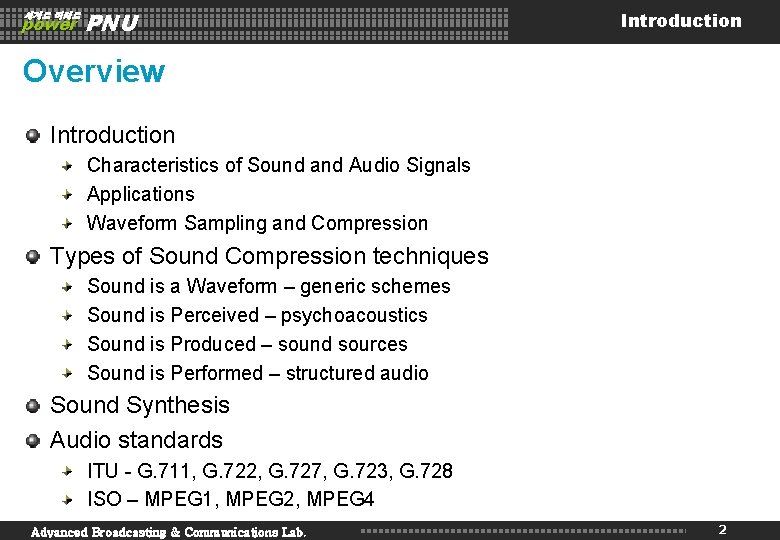
세계로 미래로 power PNU Introduction Overview Introduction Characteristics of Sound and Audio Signals Applications Waveform Sampling and Compression Types of Sound Compression techniques Sound is a Waveform – generic schemes Sound is Perceived – psychoacoustics Sound is Produced – sound sources Sound is Performed – structured audio Sound Synthesis Audio standards ITU - G. 711, G. 722, G. 727, G. 723, G. 728 ISO – MPEG 1, MPEG 2, MPEG 4 Advanced Broadcasting & Communications Lab. 2
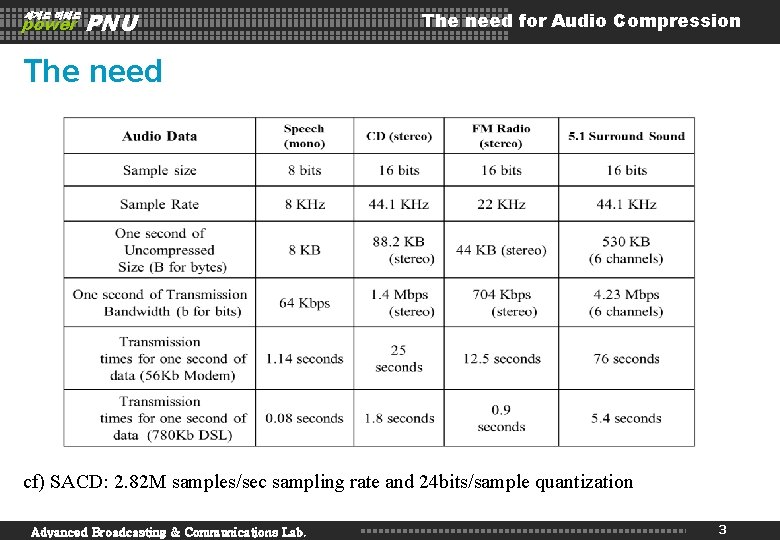
세계로 미래로 power PNU The need for Audio Compression The need cf) SACD: 2. 82 M samples/sec sampling rate and 24 bits/sample quantization Advanced Broadcasting & Communications Lab. 3
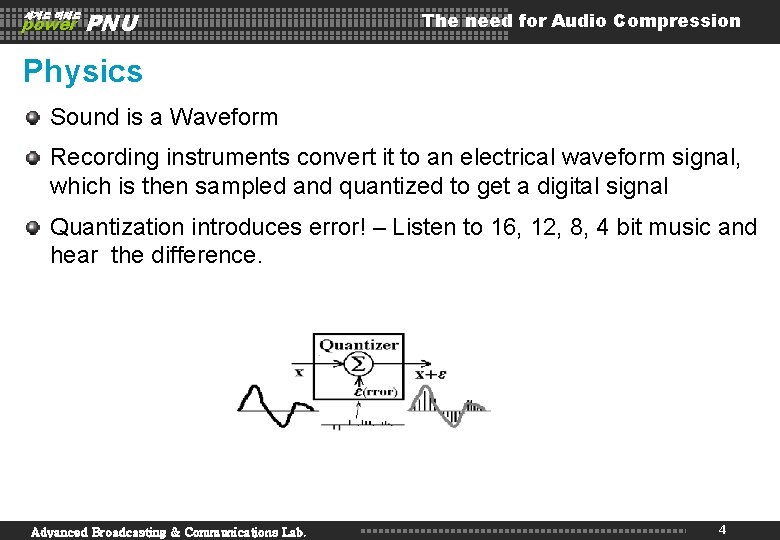
세계로 미래로 power PNU The need for Audio Compression Physics Sound is a Waveform Recording instruments convert it to an electrical waveform signal, which is then sampled and quantized to get a digital signal Quantization introduces error! – Listen to 16, 12, 8, 4 bit music and hear the difference. Advanced Broadcasting & Communications Lab. 4
세계로 미래로 power PNU Audio Compression Theory Issues Acceptable delay ~200 ms (voice) Audio is 1 -D signal sampled+quantized Should be easier than images, but… Less redundancy HAS (Human Audio System) ≠ HVS • Noise • Quality degradation • … Advanced Broadcasting & Communications Lab. 5
세계로 미래로 power PNU Audio Compression Theory HAS vs. HVS Sound is a 1 D signal with amplitude at time t – which leads us to believe that it should be simple to compress as compared to a 2 D image signal and 3 D video signals Is this true? Compression ratios attained for video and images are far greater than those attained for audio Consider human perception factors – human auditory system is more sensitive to quality degradation than the visual system. As a result, humans are more prone to compressed audio errors than compressed image and video errors Advanced Broadcasting & Communications Lab. 6
세계로 미래로 power PNU Audio Compression Theory Issues Goal: Maximize quality, minimize size Fidelity: difference with original Bit rate Complexity Encoder/Decoder Real time/Offline Advanced Broadcasting & Communications Lab. 7
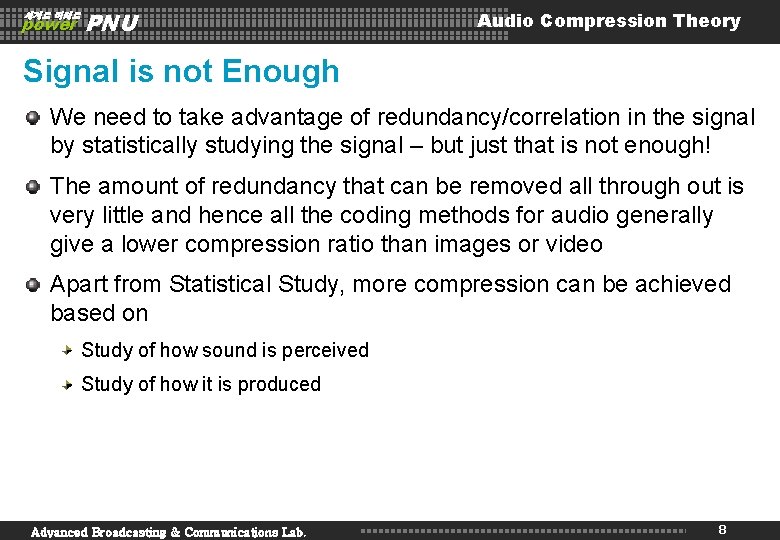
세계로 미래로 power PNU Audio Compression Theory Signal is not Enough We need to take advantage of redundancy/correlation in the signal by statistically studying the signal – but just that is not enough! The amount of redundancy that can be removed all through out is very little and hence all the coding methods for audio generally give a lower compression ratio than images or video Apart from Statistical Study, more compression can be achieved based on Study of how sound is perceived Study of how it is produced Advanced Broadcasting & Communications Lab. 8
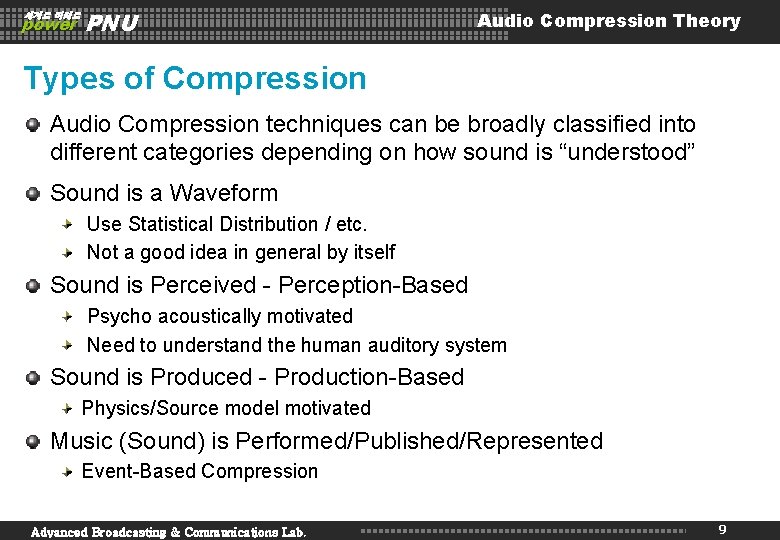
세계로 미래로 power PNU Audio Compression Theory Types of Compression Audio Compression techniques can be broadly classified into different categories depending on how sound is “understood” Sound is a Waveform Use Statistical Distribution / etc. Not a good idea in general by itself Sound is Perceived - Perception-Based Psycho acoustically motivated Need to understand the human auditory system Sound is Produced - Production-Based Physics/Source model motivated Music (Sound) is Performed/Published/Represented Event-Based Compression Advanced Broadcasting & Communications Lab. 9
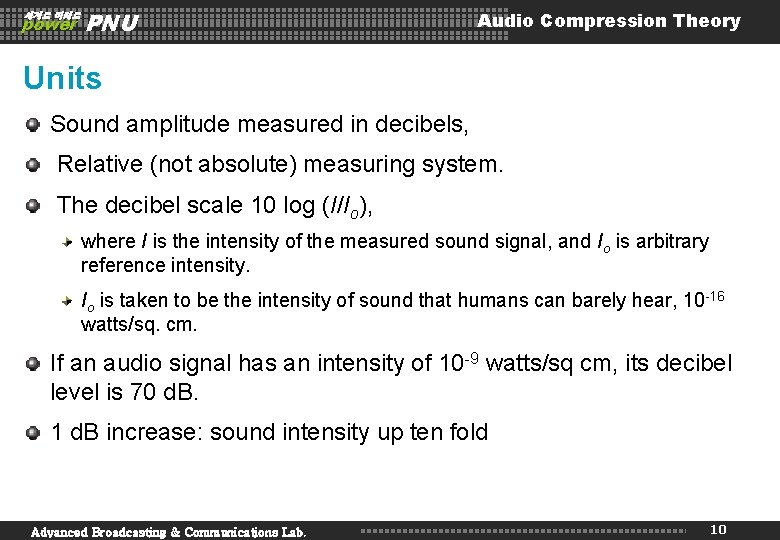
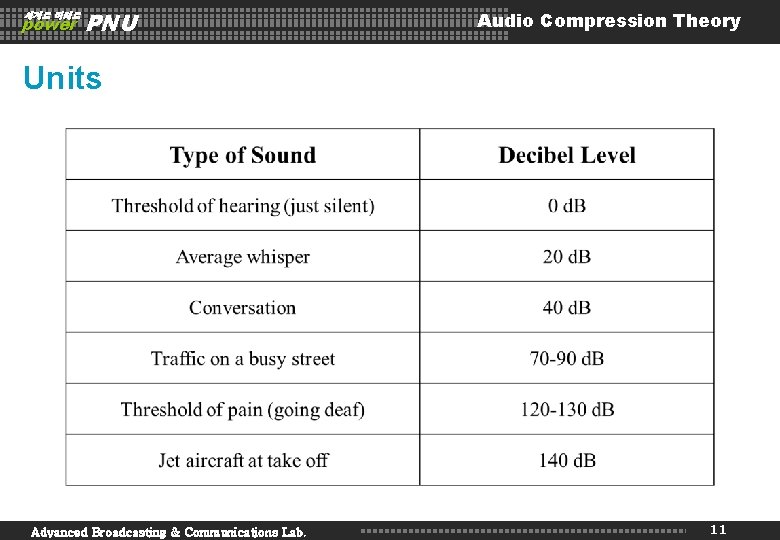
세계로 미래로 power PNU Audio Compression Theory Units Sound amplitude measured in decibels, Relative (not absolute) measuring system. The decibel scale 10 log (I/Io), where I is the intensity of the measured sound signal, and Io is arbitrary reference intensity. Io is taken to be the intensity of sound that humans can barely hear, 10 -16 watts/sq. cm. If an audio signal has an intensity of 10 -9 watts/sq cm, its decibel level is 70 d. B. 1 d. B increase: sound intensity up ten fold Advanced Broadcasting & Communications Lab. 10
세계로 미래로 power PNU Audio Compression Theory Units Advanced Broadcasting & Communications Lab. 11
세계로 미래로 power PNU Sound as Waveform Uses variants of PCM techniques produce a high data rates but can be reduced by exploiting statistical redundancy (information theory) Differential Pulse Code Modulation (DPCM) Get differences in PCM signals Entropy code differences Delta Modulation Like DPCM but only encodes differences using a single bit suggesting a delta increase or a delta decrease Good for signals that don’t change rapidly Adaptive Differential Pulse Code Modulation Sophisticated version of DPCM Advanced Broadcasting & Communications Lab. 12
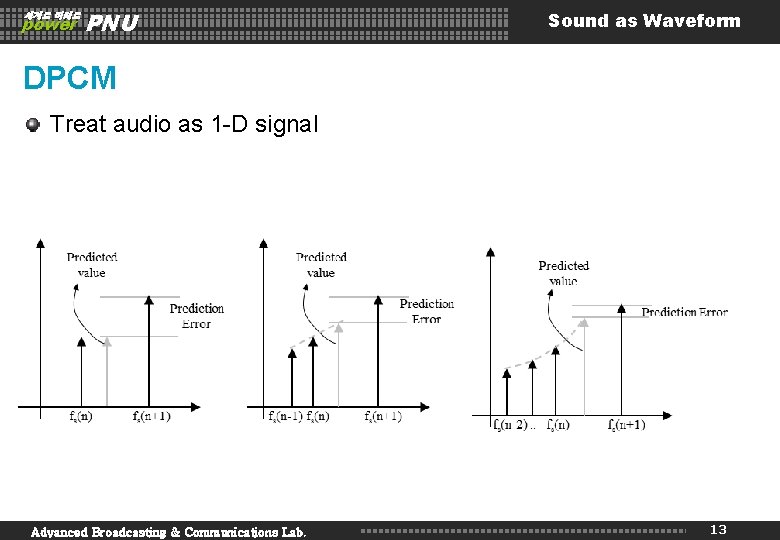
세계로 미래로 power PNU Sound as Waveform DPCM Treat audio as 1 -D signal Advanced Broadcasting & Communications Lab. 13
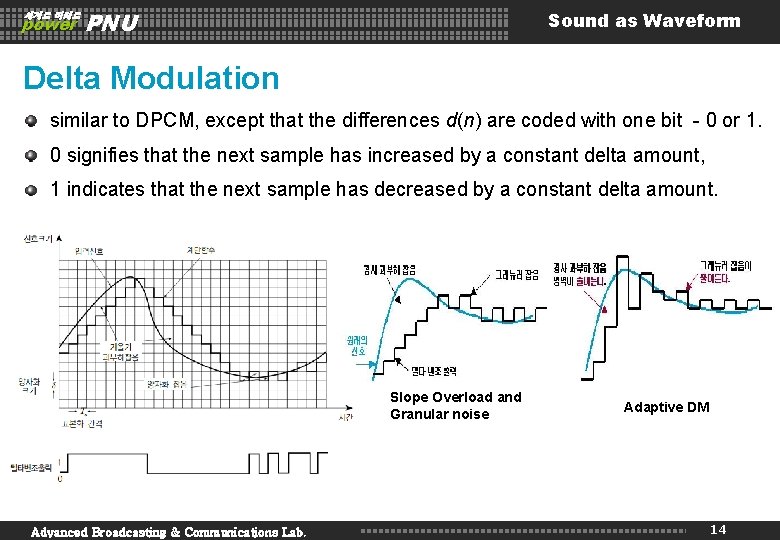
세계로 미래로 power PNU Sound as Waveform Delta Modulation similar to DPCM, except that the differences d(n) are coded with one bit - 0 or 1. 0 signifies that the next sample has increased by a constant delta amount, 1 indicates that the next sample has decreased by a constant delta amount. Slope Overload and Granular noise Advanced Broadcasting & Communications Lab. Adaptive DM 14
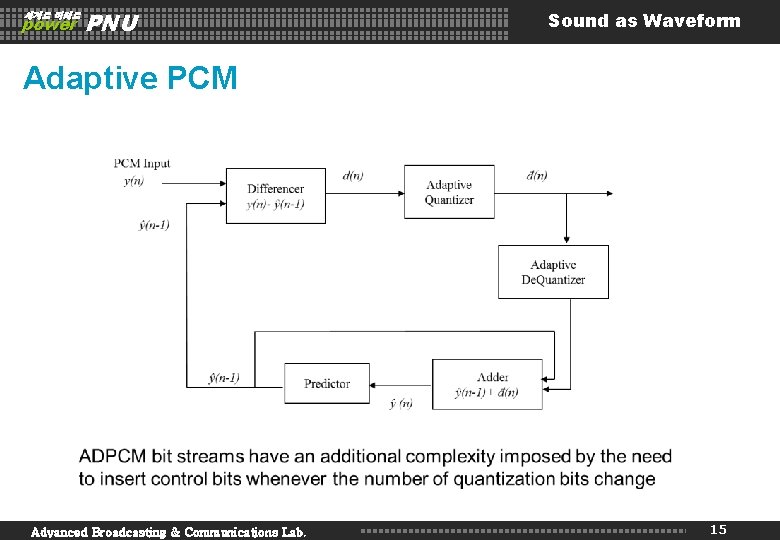
세계로 미래로 power PNU Sound as Waveform Adaptive PCM Advanced Broadcasting & Communications Lab. 15
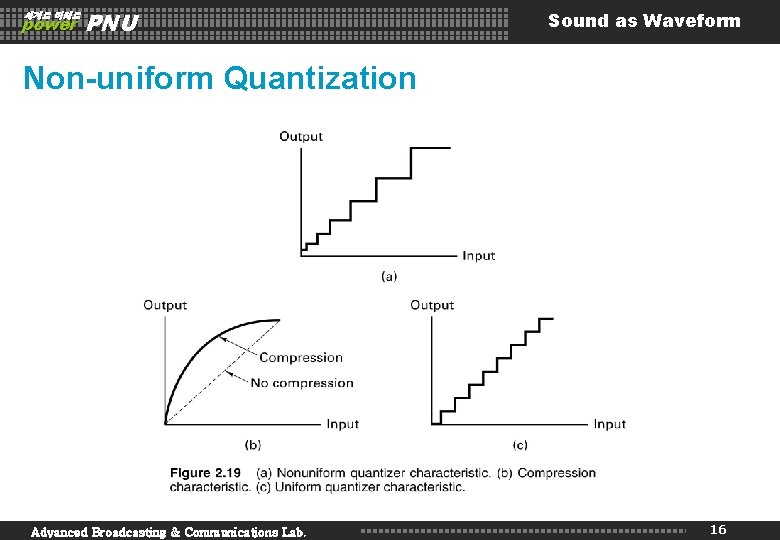
세계로 미래로 power PNU Sound as Waveform Non-uniform Quantization Advanced Broadcasting & Communications Lab. 16
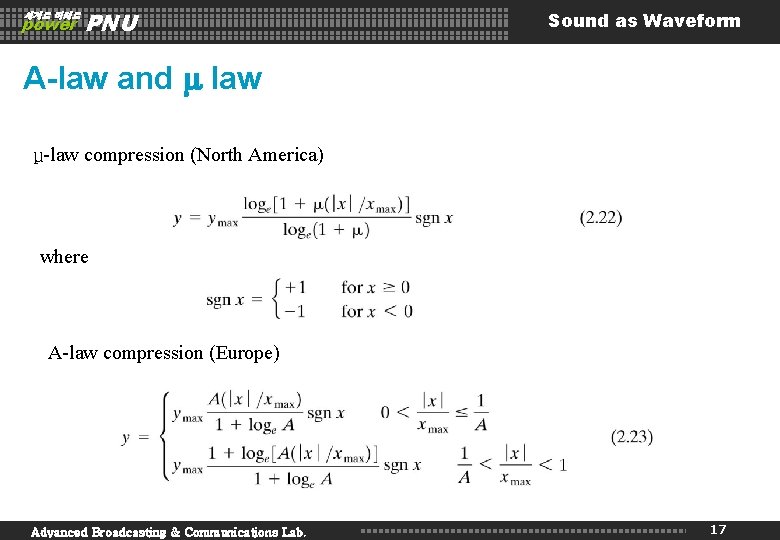
세계로 미래로 power PNU Sound as Waveform A-law and law μ-law compression (North America) where A-law compression (Europe) Advanced Broadcasting & Communications Lab. 17
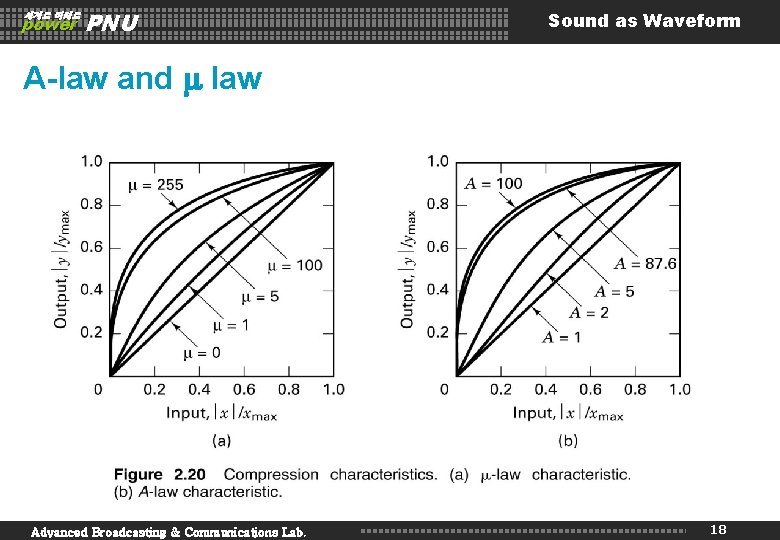
세계로 미래로 power PNU Sound as Waveform A-law and law Advanced Broadcasting & Communications Lab. 18
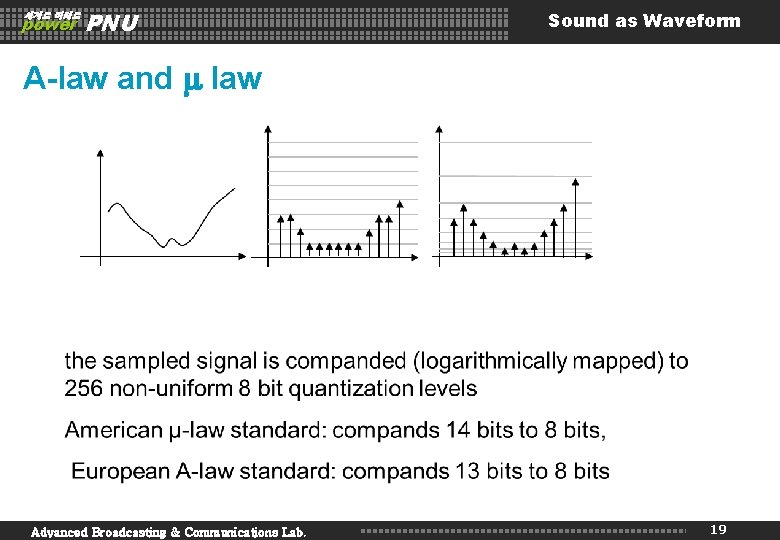
세계로 미래로 power PNU Sound as Waveform A-law and law Advanced Broadcasting & Communications Lab. 19
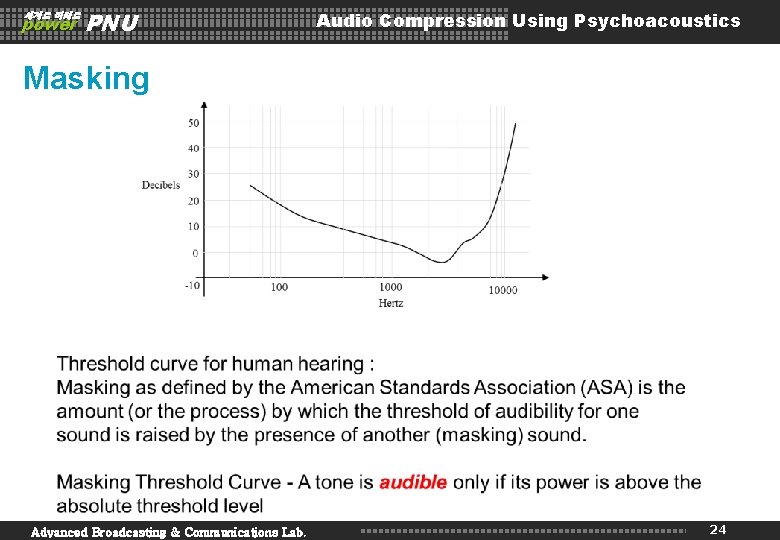
세계로 미래로 power PNU Audio Compression Using Psychoacoustics Perception of Sound Compression attained by variations of PCM coding techniques alone are not sufficient to attain data rates for modern applications (CD, Surround Sound etc) Perception of Sound additionally can help in compression by studying What frequencies we hear When do we hear them When do not hear them This branch of study – Psychoacoustics – deals with sound perception science. “Auditory Masking” is a perceptual weakness of the ear, which can be exploited in compression without compromising quality Advanced Broadcasting & Communications Lab. 20
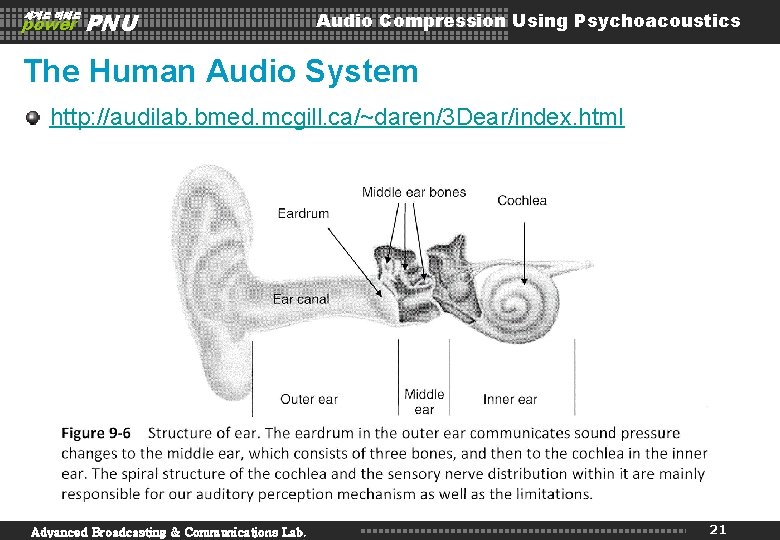
세계로 미래로 power PNU Audio Compression Using Psychoacoustics The Human Audio System http: //audilab. bmed. mcgill. ca/~daren/3 Dear/index. html Advanced Broadcasting & Communications Lab. 21
세계로 미래로 power PNU Audio Compression Using Psychoacoustics What can We Hear ? Frequency: 20 Hz to 20 KHz Dynamic range: ~120 decibels Time: events separated by more than 30 milliseconds can be resolved separately. The perception of simultaneous events (less than 30 milliseconds apart) is resolved in the frequency domain Advanced Broadcasting & Communications Lab. 22
세계로 미래로 power PNU Audio Compression Using Psychoacoustics Limitations The human auditory system, although very sensitive to quality, has a few limitations, which can be analyzed by looking at Time Domain Considerations Frequency Domain (Spectral) Consideration Masking or hiding – which can happen in the Amplitude, Time and Frequency Domains Time Domain Events longer than 0. 03 seconds are resolvable in time. Shorter events are perceived as features in frequency Frequency Domain 20 Hz. < Human Hearing < 20 KHz. “Pitch” is perception related to frequency. Human Pitch Resolution is about 40 - 4000 Hz. Advanced Broadcasting & Communications Lab. 23
세계로 미래로 power PNU Audio Compression Using Psychoacoustics Masking Advanced Broadcasting & Communications Lab. 24
세계로 미래로 power PNU Audio Compression Using Psychoacoustics Masking II Advanced Broadcasting & Communications Lab. 25
세계로 미래로 power PNU Audio Compression Using Psychoacoustics Masking III Advanced Broadcasting & Communications Lab. 26
세계로 미래로 power PNU Audio Compression Using Psychoacoustics Masking IV Advanced Broadcasting & Communications Lab. 27
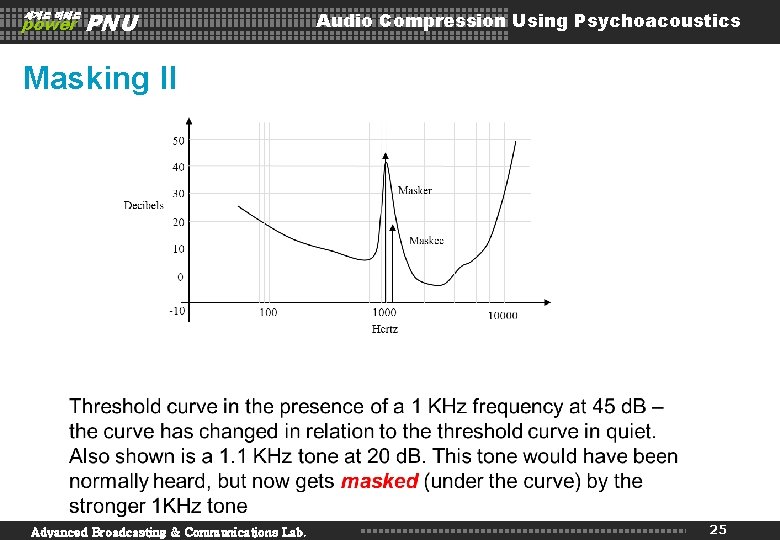
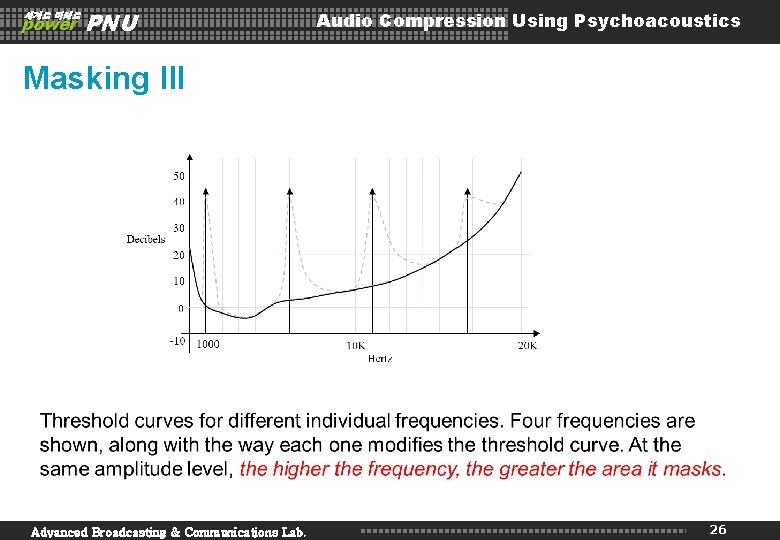
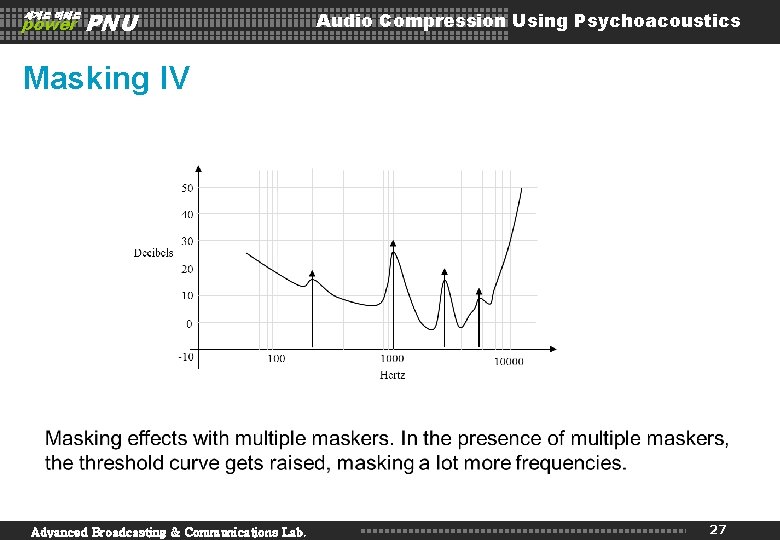
세계로 미래로 power PNU Audio Compression Using Psychoacoustics Masking V Amplitude Loud sounds ‘mask’ soft ones – eg Quantization Noise. Intuitively, a soft sound will not be heard if there is a competing loud sound. This happens because of gain controls within the ear – stapedes reflex, interaction (inhibition) in the cochlea and other mechanisms at higher levels Time A soft sound just before a louder sound is more likely to be heard than if it is just after In the time range of a few milliseconds, a soft event following a louder event tends to be grouped perceptually as part of that louder event If the soft event precedes the louder event, it might be heard as a separate event. Masking in Frequency Loud ‘neighbor’ frequency masks soft spectral components. Low sounds mask higher ones more than high masking low. Advanced Broadcasting & Communications Lab. 28
세계로 미래로 power PNU Audio Compression Using Psychoacoustics Masking Demo http: //www. cs. ubc. ca/~kvdoel/jass/masking. html Advanced Broadcasting & Communications Lab. 29
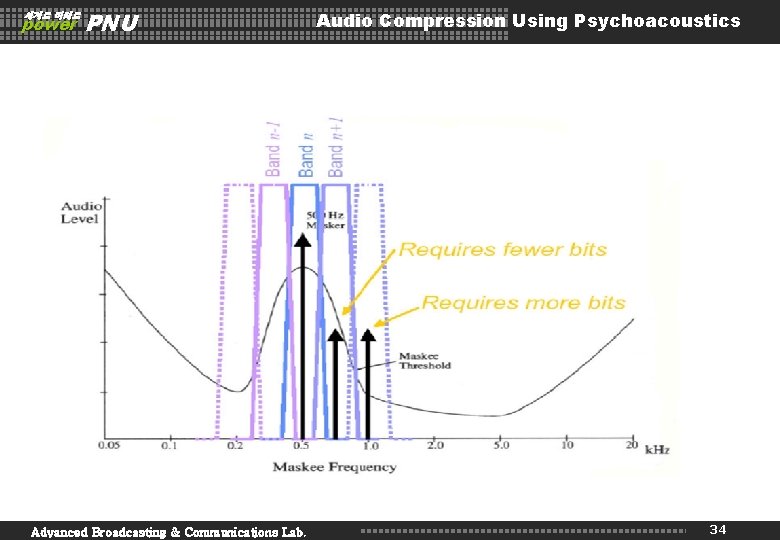
세계로 미래로 power PNU Audio Compression Using Psychoacoustics Perceptual Coding Perceptual coding tries to minimize the perceptual distortion in a transform coding scheme Basic concept: allocate more bits (more quantization levels, less error) to those channels that are most audible, fewer bits (more error) to those channels that are the least audible Needs to continuously analyze the signal to determine the current audibility threshold curve using a perceptual model Advanced Broadcasting & Communications Lab. 30
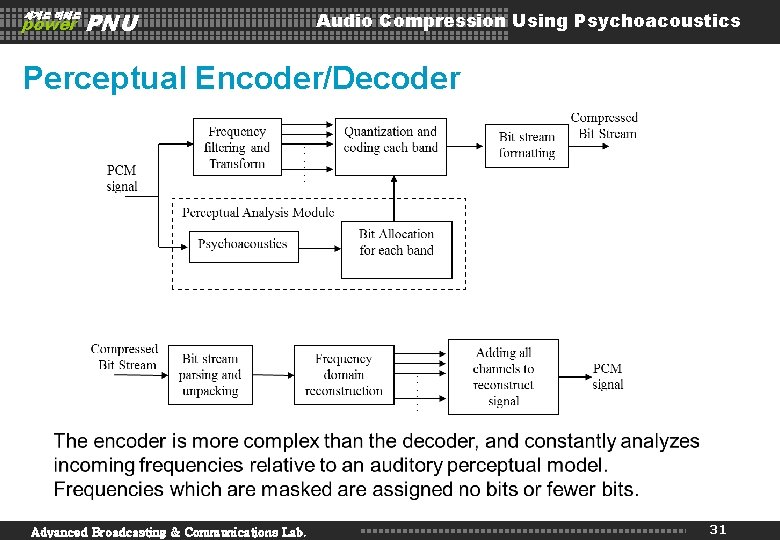
세계로 미래로 power PNU Audio Compression Using Psychoacoustics Perceptual Encoder/Decoder Advanced Broadcasting & Communications Lab. 31
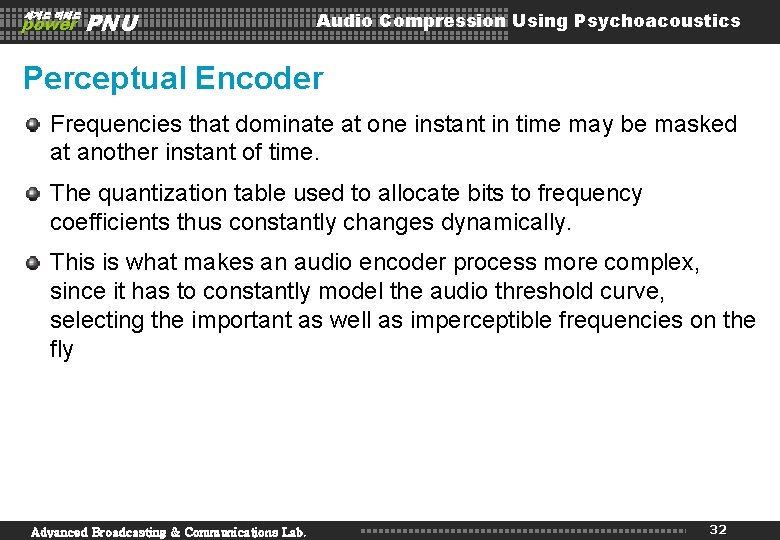
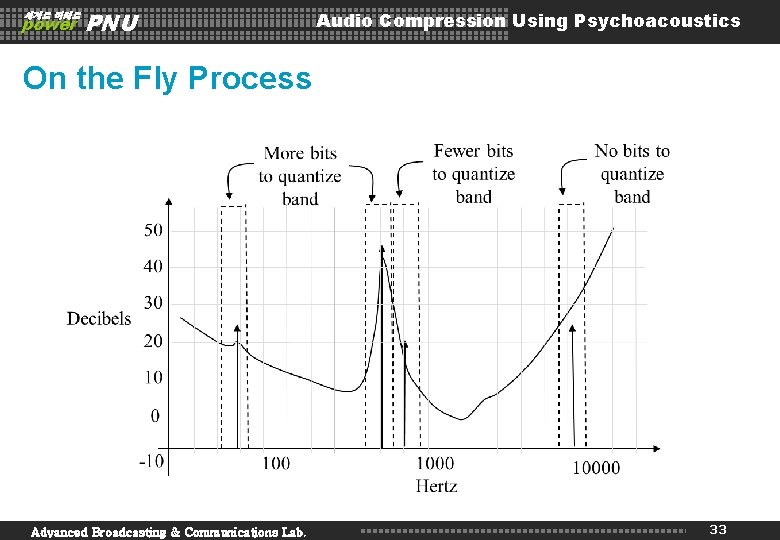
세계로 미래로 power PNU Audio Compression Using Psychoacoustics Perceptual Encoder Frequencies that dominate at one instant in time may be masked at another instant of time. The quantization table used to allocate bits to frequency coefficients thus constantly changes dynamically. This is what makes an audio encoder process more complex, since it has to constantly model the audio threshold curve, selecting the important as well as imperceptible frequencies on the fly Advanced Broadcasting & Communications Lab. 32
세계로 미래로 power PNU Audio Compression Using Psychoacoustics On the Fly Process Advanced Broadcasting & Communications Lab. 33
세계로 미래로 power PNU Advanced Broadcasting & Communications Lab. Audio Compression Using Psychoacoustics 34
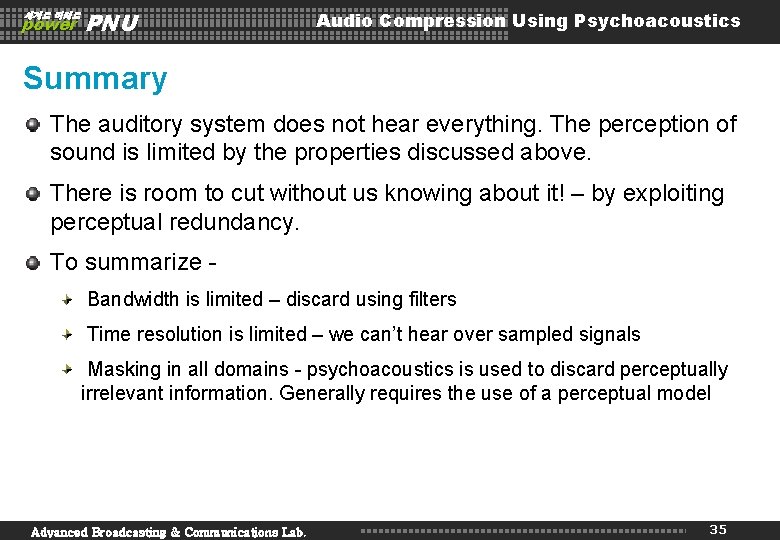
세계로 미래로 power PNU Audio Compression Using Psychoacoustics Summary The auditory system does not hear everything. The perception of sound is limited by the properties discussed above. There is room to cut without us knowing about it! – by exploiting perceptual redundancy. To summarize Bandwidth is limited – discard using filters Time resolution is limited – we can’t hear over sampled signals Masking in all domains - psychoacoustics is used to discard perceptually irrelevant information. Generally requires the use of a perceptual model Advanced Broadcasting & Communications Lab. 35
세계로 미래로 power PNU Model-Based Audio Compression Sound Production This is based on the assumption that a “perfect” model could provide the perfect compression. In other words, an analysis of frequencies (and variations) produced by the sound sources, yield properties of the signal it produces. A model of this sound production source is then built and the model parameters are adjusted according to sound it produces. For example, if the sound is human speech then a well parameterized vocal model can yield high quality compression Advantage - great at compression and maybe quality Drawbacks - signal sources must be assumed, known apriori, or identified. Complex when a sound scene has one or more widely different sources. Advanced Broadcasting & Communications Lab. 36
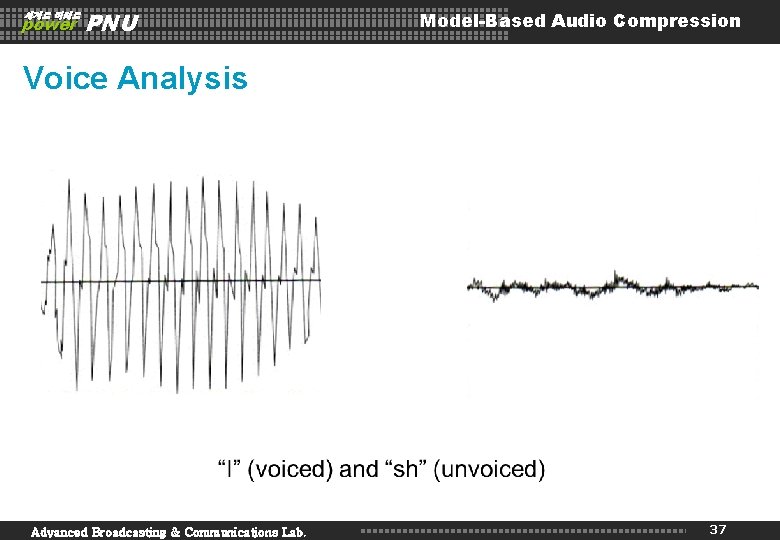
세계로 미래로 power PNU Model-Based Audio Compression Voice Analysis Advanced Broadcasting & Communications Lab. 37
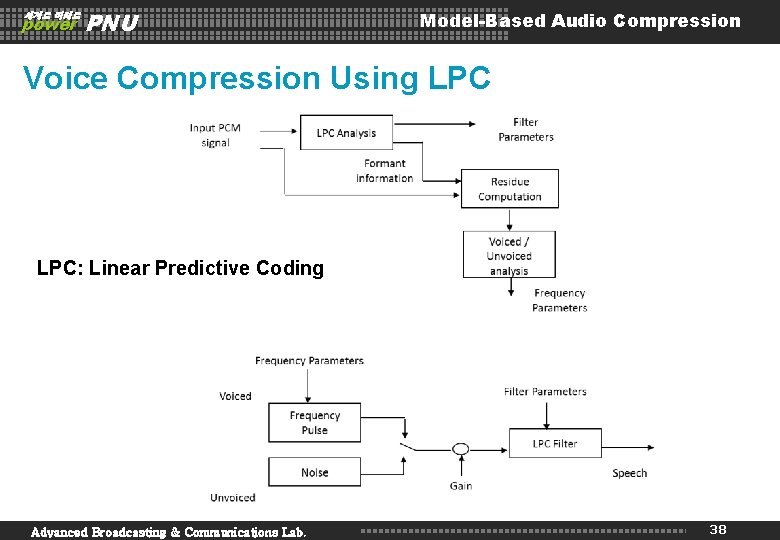
세계로 미래로 power PNU Model-Based Audio Compression Voice Compression Using LPC: Linear Predictive Coding Advanced Broadcasting & Communications Lab. 38
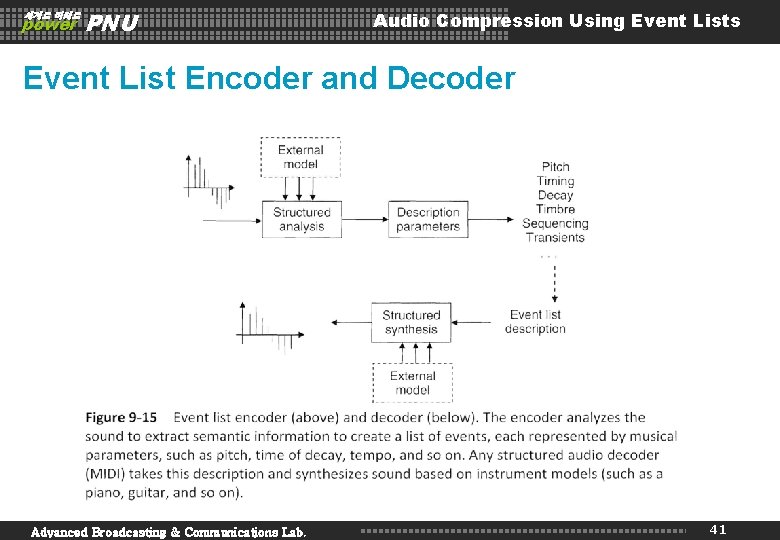
세계로 미래로 power PNU Audio Compression Using Event Lists Sound Performed/Published This sound is also known as event based audio or structured audio Description format that is made up of semantic information about the sounds it represents, and that makes use of high-level (algorithmic) models Event-list representation: sequence of control parameters that, taken alone, do not define the quality of a sound but instead specify the ordering and characteristics of parts of a sound with regards to some external model Advanced Broadcasting & Communications Lab. 39
세계로 미래로 power PNU Audio Compression Using Event Lists Event-List Representations Event-list representations are appropriate for soundtracks, piano, percussive instruments. Not good for violin, speech and singing Sequencers: allow the specification and modification of event sequences Advanced Broadcasting & Communications Lab. 40
세계로 미래로 power PNU Audio Compression Using Event Lists Event List Encoder and Decoder Advanced Broadcasting & Communications Lab. 41
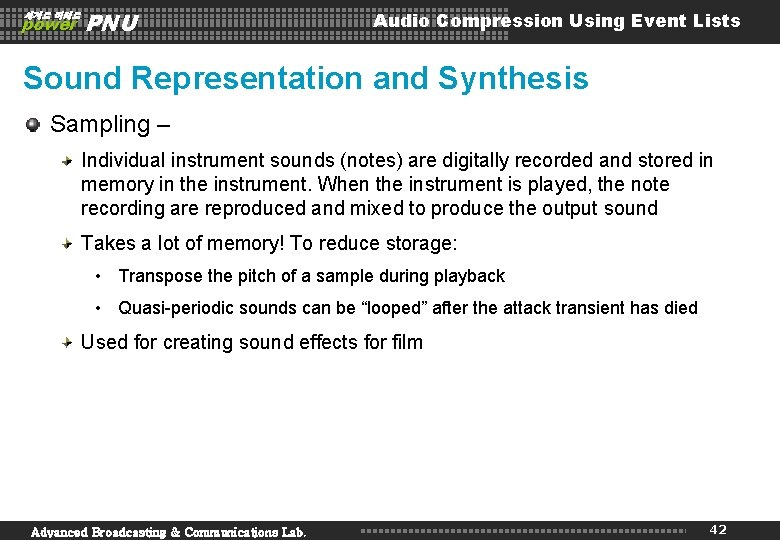
세계로 미래로 power PNU Audio Compression Using Event Lists Sound Representation and Synthesis Sampling – Individual instrument sounds (notes) are digitally recorded and stored in memory in the instrument. When the instrument is played, the note recording are reproduced and mixed to produce the output sound Takes a lot of memory! To reduce storage: • Transpose the pitch of a sample during playback • Quasi-periodic sounds can be “looped” after the attack transient has died Used for creating sound effects for film Advanced Broadcasting & Communications Lab. 42
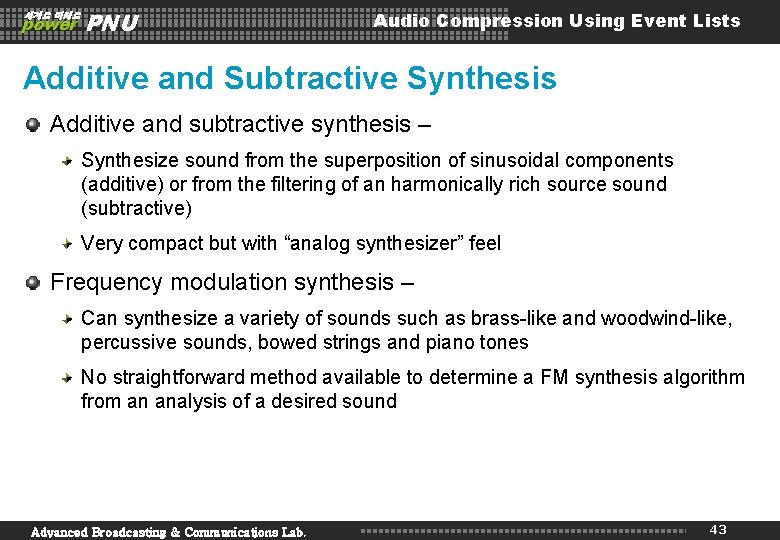
세계로 미래로 power PNU Audio Compression Using Event Lists Additive and Subtractive Synthesis Additive and subtractive synthesis – Synthesize sound from the superposition of sinusoidal components (additive) or from the filtering of an harmonically rich source sound (subtractive) Very compact but with “analog synthesizer” feel Frequency modulation synthesis – Can synthesize a variety of sounds such as brass-like and woodwind-like, percussive sounds, bowed strings and piano tones No straightforward method available to determine a FM synthesis algorithm from an analysis of a desired sound Advanced Broadcasting & Communications Lab. 43
세계로 미래로 power PNU Audio Coding Standards MPEG (Moving Picture Expert Group) family MPEG 1 - Layer 1, Layer 2, Layer 3 (MP 3) MPEG 2 - Back-compatible with MPEG 1, AAC (non-back-compatible) MPEG 4 – CELP (Code-Excited Linear Prediction) and AAC (Advanced Audio Coding) Dolby AC 3 ITU Speech Coding Standards ITU G. 711 ITU G. 722 ITU G. 726, G. 727 ITU G. 729, G. 723 ITU G. 728 Advanced Broadcasting & Communications Lab. 44
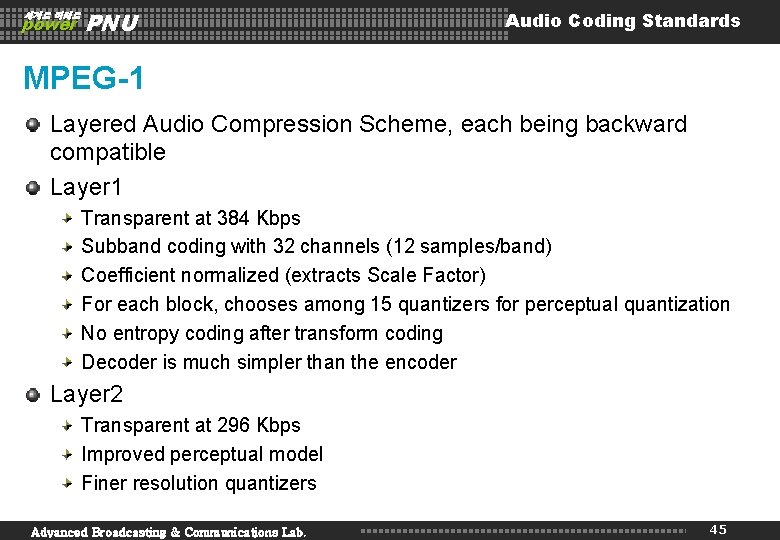
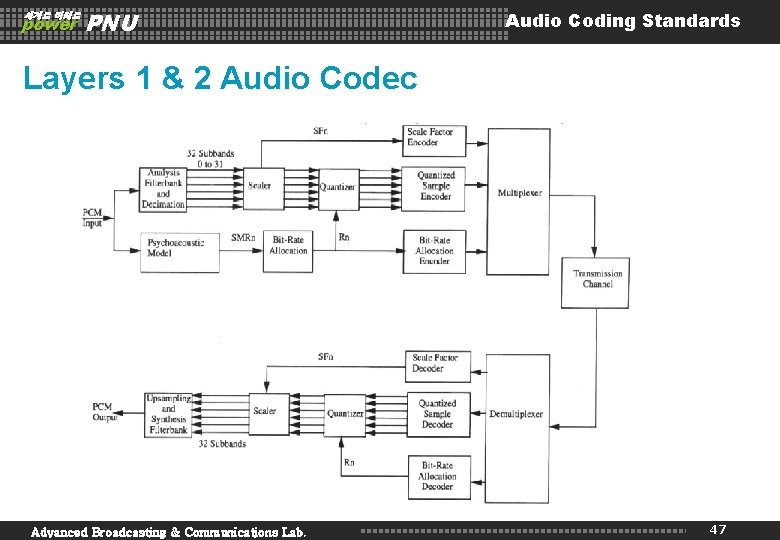
세계로 미래로 power PNU Audio Coding Standards MPEG-1 Layered Audio Compression Scheme, each being backward compatible Layer 1 Transparent at 384 Kbps Subband coding with 32 channels (12 samples/band) Coefficient normalized (extracts Scale Factor) For each block, chooses among 15 quantizers for perceptual quantization No entropy coding after transform coding Decoder is much simpler than the encoder Layer 2 Transparent at 296 Kbps Improved perceptual model Finer resolution quantizers Advanced Broadcasting & Communications Lab. 45
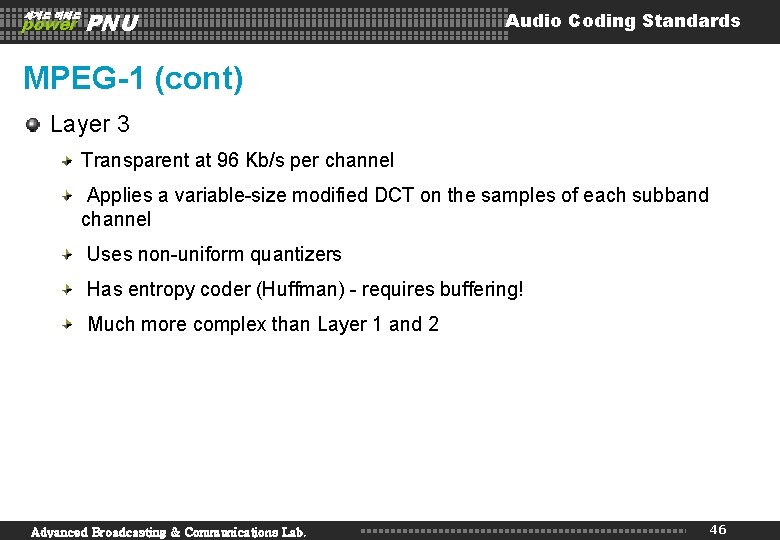
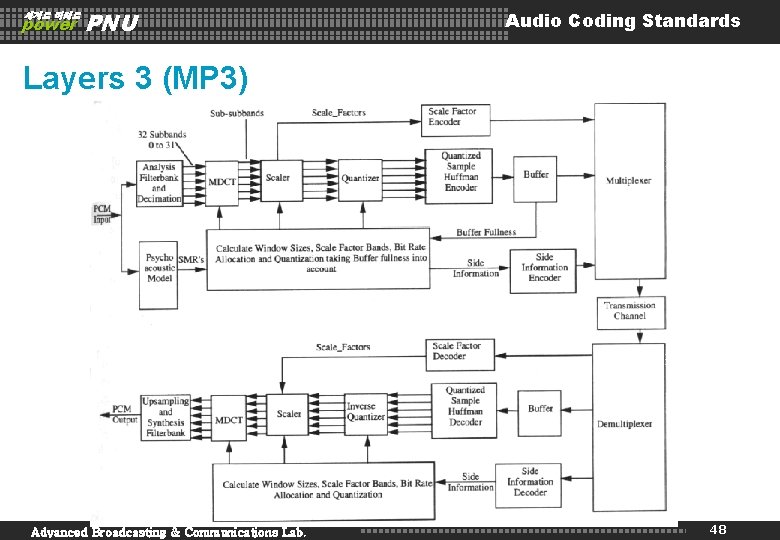
세계로 미래로 power PNU Audio Coding Standards MPEG-1 (cont) Layer 3 Transparent at 96 Kb/s per channel Applies a variable-size modified DCT on the samples of each subband channel Uses non-uniform quantizers Has entropy coder (Huffman) - requires buffering! Much more complex than Layer 1 and 2 Advanced Broadcasting & Communications Lab. 46
세계로 미래로 power PNU Audio Coding Standards Layers 1 & 2 Audio Codec Advanced Broadcasting & Communications Lab. 47
세계로 미래로 power PNU Audio Coding Standards Layers 3 (MP 3) Advanced Broadcasting & Communications Lab. 48
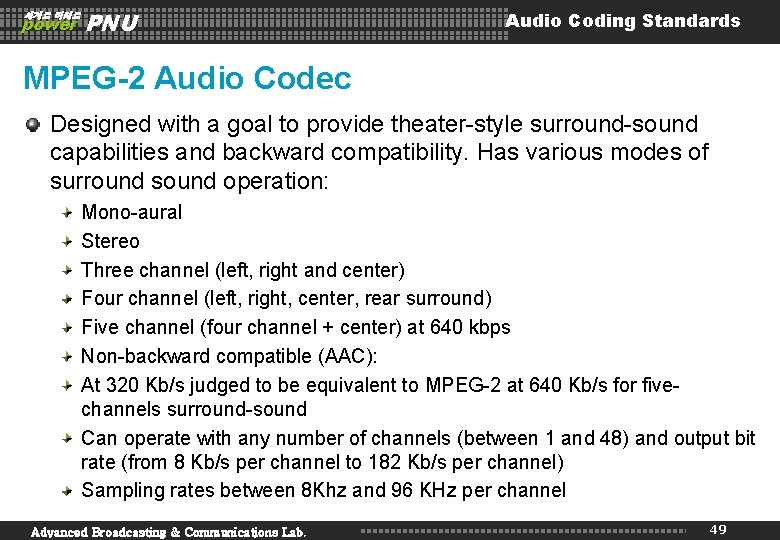
세계로 미래로 power PNU Audio Coding Standards MPEG-2 Audio Codec Designed with a goal to provide theater-style surround-sound capabilities and backward compatibility. Has various modes of surround sound operation: Mono-aural Stereo Three channel (left, right and center) Four channel (left, right, center, rear surround) Five channel (four channel + center) at 640 kbps Non-backward compatible (AAC): At 320 Kb/s judged to be equivalent to MPEG-2 at 640 Kb/s for fivechannels surround-sound Can operate with any number of channels (between 1 and 48) and output bit rate (from 8 Kb/s per channel to 182 Kb/s per channel) Sampling rates between 8 Khz and 96 KHz per channel Advanced Broadcasting & Communications Lab. 49
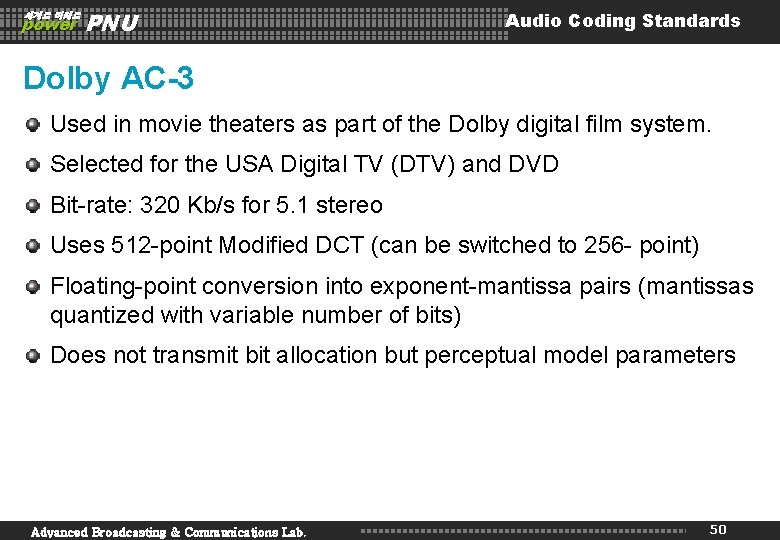
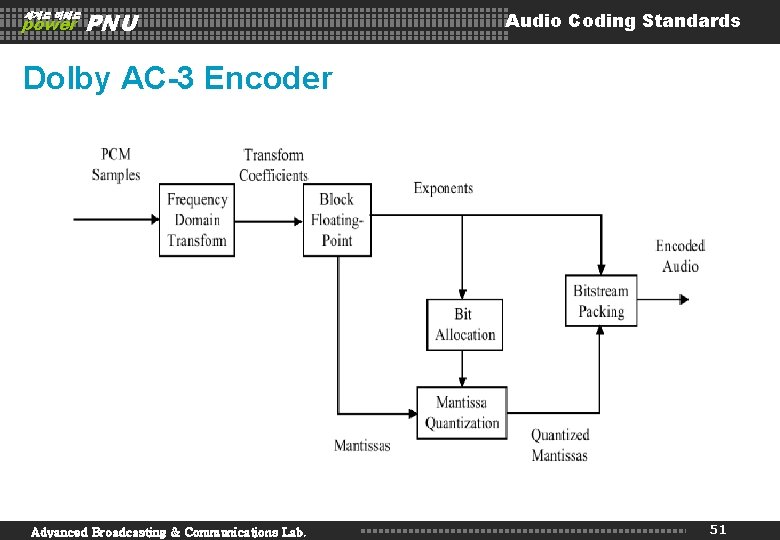
세계로 미래로 power PNU Audio Coding Standards Dolby AC-3 Used in movie theaters as part of the Dolby digital film system. Selected for the USA Digital TV (DTV) and DVD Bit-rate: 320 Kb/s for 5. 1 stereo Uses 512 -point Modified DCT (can be switched to 256 - point) Floating-point conversion into exponent-mantissa pairs (mantissas quantized with variable number of bits) Does not transmit bit allocation but perceptual model parameters Advanced Broadcasting & Communications Lab. 50
세계로 미래로 power PNU Audio Coding Standards Dolby AC-3 Encoder Advanced Broadcasting & Communications Lab. 51
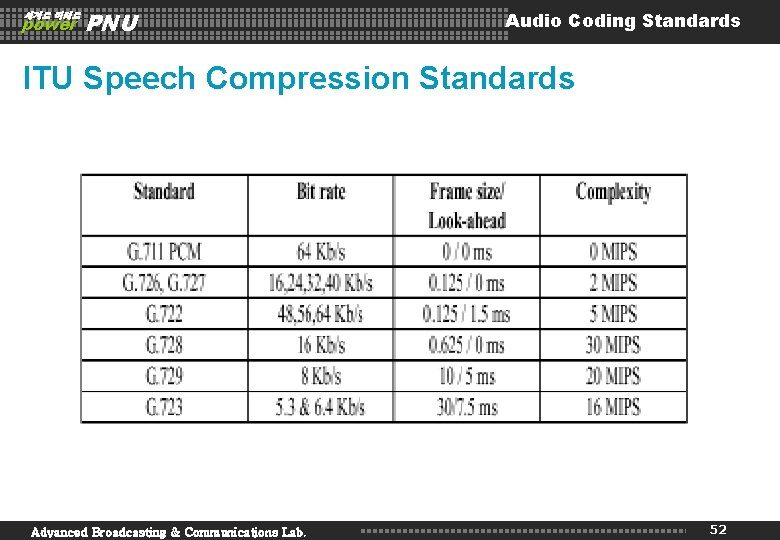
세계로 미래로 power PNU Audio Coding Standards ITU Speech Compression Standards Advanced Broadcasting & Communications Lab. 52
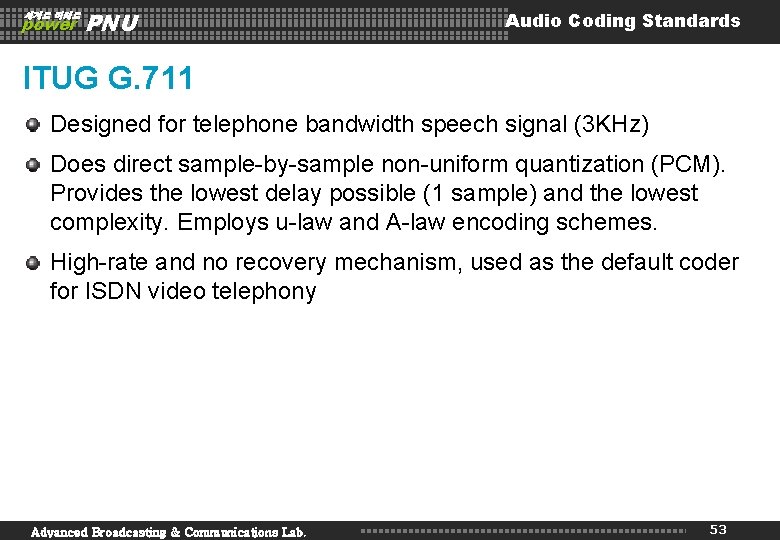
세계로 미래로 power PNU Audio Coding Standards ITUG G. 711 Designed for telephone bandwidth speech signal (3 KHz) Does direct sample-by-sample non-uniform quantization (PCM). Provides the lowest delay possible (1 sample) and the lowest complexity. Employs u-law and A-law encoding schemes. High-rate and no recovery mechanism, used as the default coder for ISDN video telephony Advanced Broadcasting & Communications Lab. 53
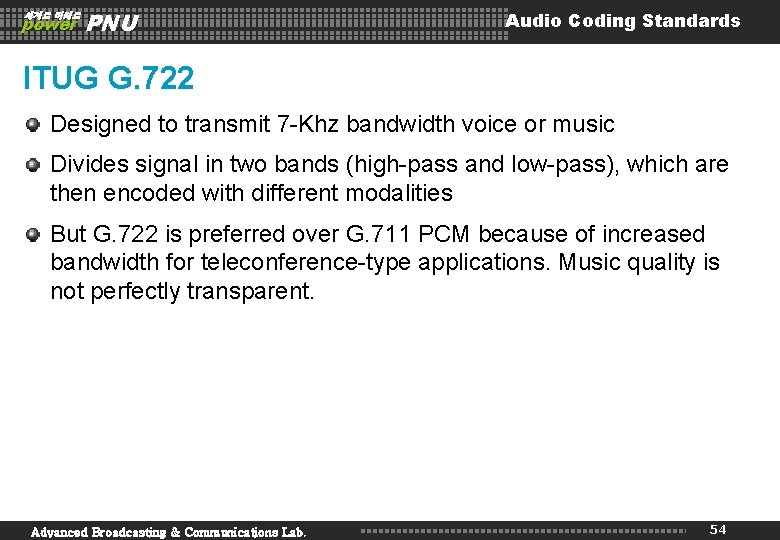
세계로 미래로 power PNU Audio Coding Standards ITUG G. 722 Designed to transmit 7 -Khz bandwidth voice or music Divides signal in two bands (high-pass and low-pass), which are then encoded with different modalities But G. 722 is preferred over G. 711 PCM because of increased bandwidth for teleconference-type applications. Music quality is not perfectly transparent. Advanced Broadcasting & Communications Lab. 54
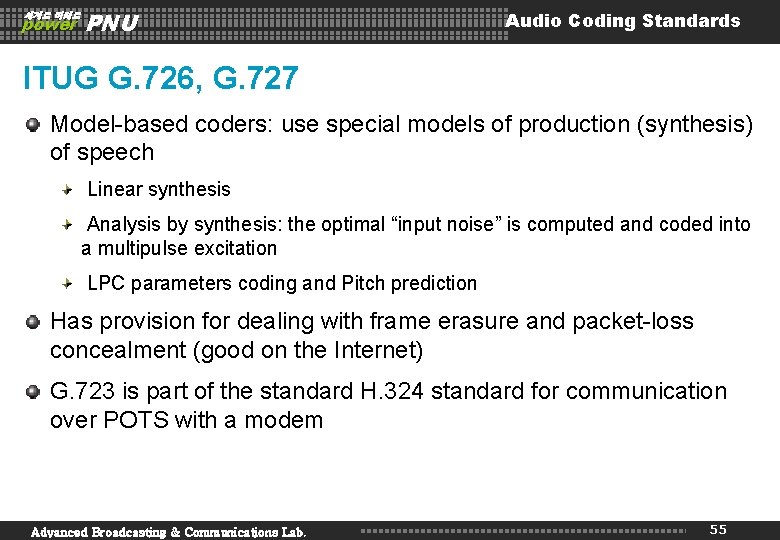
세계로 미래로 power PNU Audio Coding Standards ITUG G. 726, G. 727 Model-based coders: use special models of production (synthesis) of speech Linear synthesis Analysis by synthesis: the optimal “input noise” is computed and coded into a multipulse excitation LPC parameters coding and Pitch prediction Has provision for dealing with frame erasure and packet-loss concealment (good on the Internet) G. 723 is part of the standard H. 324 standard for communication over POTS with a modem Advanced Broadcasting & Communications Lab. 55
세계로 미래로 power PNU Audio Coding Standards ITUG G. 729, G. 723 Has ADPCM (Adaptive Differential PCM) codecs for telephone bandwidth speech. Can operate using 2, 3, 4 or 5 bits per sample Advanced Broadcasting & Communications Lab. 56
세계로 미래로 power PNU Audio Coding Standards ITUG G. 728 Hybrid between the lower bit-rate model-based coders (G. 723 and G. 729) and ADPCM coders Low-delay but fairly high complexity Considered equivalent in performance to 32 Kb/s G. 726 and G. 727 Suggested speech coder for low-bit rate (64 -128 Kb/s) ISDN video telephony Remarkably robust to random bit errors Advanced Broadcasting & Communications Lab. 57
세계로 미래로 power PNU Audio Coding Standards MIDI (Musical Instrument Digital Interface) is a system specification consisting of both hardware and software components that define interconnectivity and a communication protocol for electronic synthesizers, sequencers, rhythm machines, personal computers and other musical instruments Interconnectivity defines standard cabling scheme, connectors and input/output circuitry Communication protocol defines standard multibyte messages to control the instrument’s voice, send responses and status Advanced Broadcasting & Communications Lab. 58
세계로 미래로 power PNU Audio Coding Standards MIDI Communication MIDI messages are received and processed by a MIDI sequencer asynchronously (in real time) When the synthesizer receives a “note on” message it plays the note When it receives the corresponding “note off” it turns it off If MIDI data is stored as a data file, and/or edited using a sequencer, the tone form of “time stamping” for the MIDI message is required and is specified by the Standard MIDI file specifications. Advanced Broadcasting & Communications Lab. 59
세계로 미래로 power PNU Audio Coding Standards MIDI Files The MIDI communication protocol uses multibyte messages of two kinds: channel messages and system messages. Channel messages address one of the 16 possible channels Voice Messages are used to control the voice of the instrument Switch notes on/off Send key pressed messages Send control messages to control effects like vibrato, sustain and tremolo Pitch-wheel messages are used to change the pitch of all notes Channel key pressure provides a measure of force for the keys related to a specific channel (instrument) Advanced Broadcasting & Communications Lab. 60
세계로 미래로 power PNU Homework Prepare Final Advanced Broadcasting & Communications Lab. 61