
Purposeful Hourly Rounding Nurses and PCTs Santa Clara








- Slides: 52
Purposeful Hourly Rounding Nurses and PCT’s Santa Clara Kaiser Permanente
Agenda § Overview § Benefits of PHR § The 8 Behaviors of PHR – Video – Skills Practice 2 January 4, 2022 | © 2011 Kaiser Foundation Health Plan, Inc. For internal use only.
https: //youtu. be/Ue 1 b. YNR 9 y sc 3 January 4, 2022 | © 2011 Kaiser Foundation Health Plan, Inc. For internal use only.
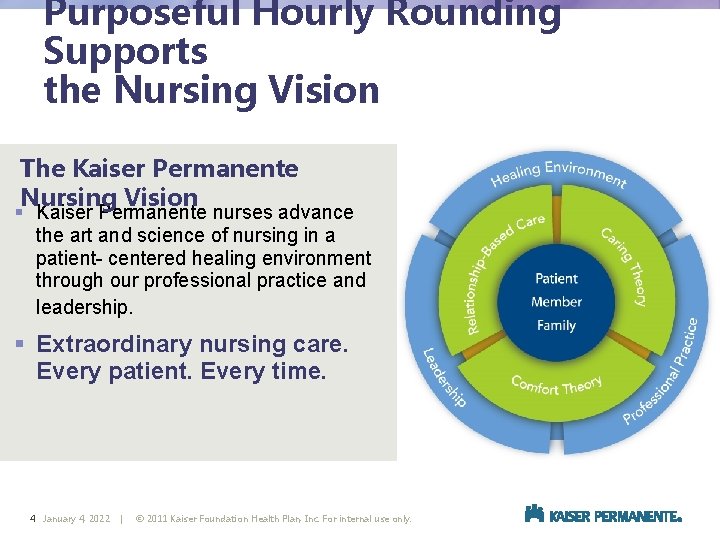
Purposeful Hourly Rounding Supports the Nursing Vision The Kaiser Permanente Nursing Vision § Kaiser Permanente nurses advance the art and science of nursing in a patient- centered healing environment through our professional practice and leadership. § Extraordinary nursing care. Every patient. Every time. 4 January 4, 2022 | © 2011 Kaiser Foundation Health Plan, Inc. For internal use only.
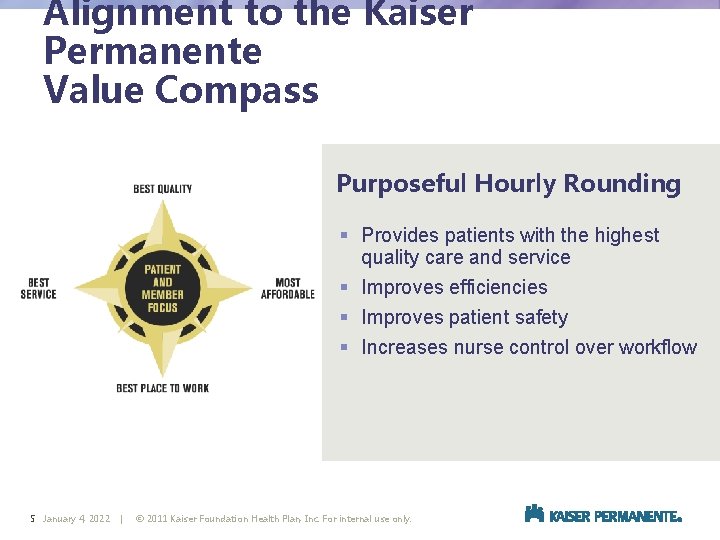
Alignment to the Kaiser Permanente Value Compass Purposeful Hourly Rounding § Provides patients with the highest quality care and service § Improves efficiencies § Improves patient safety § Increases nurse control over workflow 5 January 4, 2022 | © 2011 Kaiser Foundation Health Plan, Inc. For internal use only.
Video: “Reactive On–Demand Rounding” http: //kpnet. kp. org/qrrm/service 2/COE/hourly_rounding. html 6
Thoughts? • Did you notice the patient apologizing and how Michelle justified her business? • How both Michelle and Mr. Johnson were getting more frustrated? • Each time Michelle gave Mr. Johnson permission to interrupt her again if he needed anything. 7 January 4, 2022 | © 2011 Kaiser Foundation Health Plan, Inc. For internal use only.
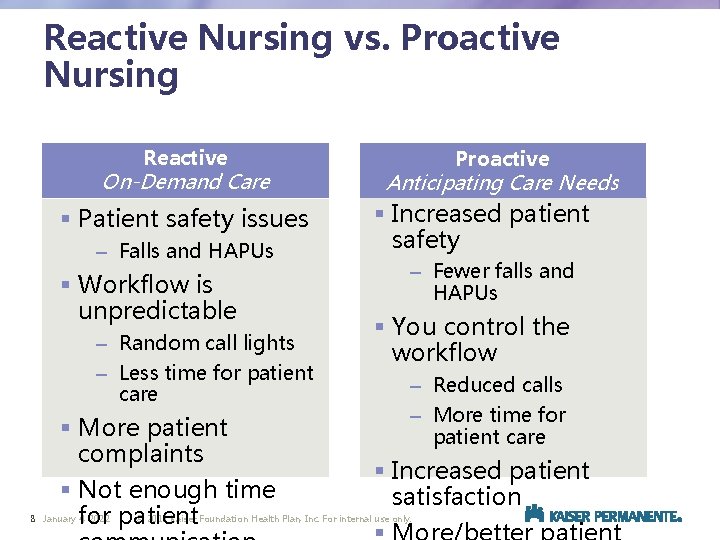
Reactive Nursing vs. Proactive Nursing Reactive On-Demand Care § Patient safety issues – Falls and HAPUs § Workflow is unpredictable – Random call lights – Less time for patient care § More patient complaints § Not enough time for patient 8 January 4, 2022 | Proactive Anticipating Care Needs § Increased patient safety – Fewer falls and HAPUs § You control the workflow – Reduced calls – More time for patient care § Increased patient satisfaction © 2011 Kaiser Foundation Health Plan, Inc. For internal use only.
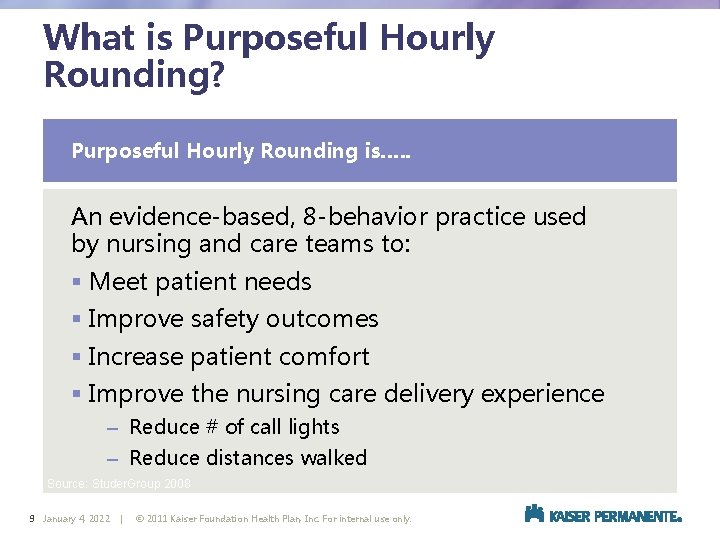
What is Purposeful Hourly Rounding? Purposeful Hourly Rounding is…. . An evidence-based, 8 -behavior practice used by nursing and care teams to: § Meet patient needs § Improve safety outcomes § Increase patient comfort § Improve the nursing care delivery experience – Reduce # of call lights – Reduce distances walked Source: Studer. Group 2008 9 January 4, 2022 | © 2011 Kaiser Foundation Health Plan, Inc. For internal use only.
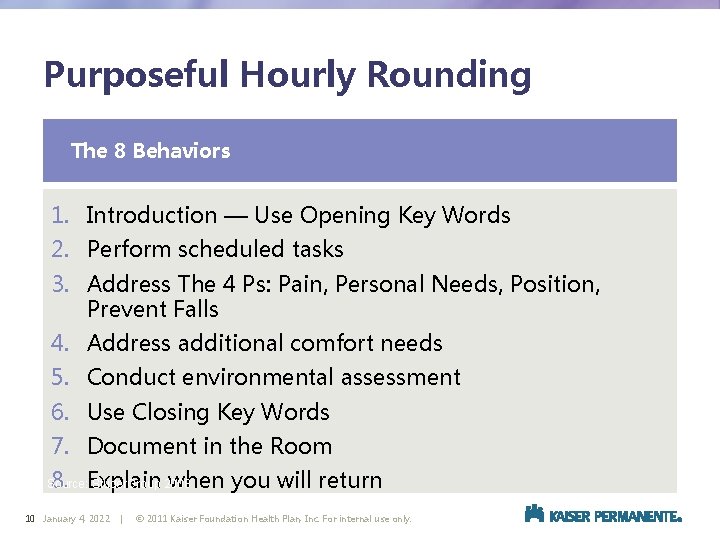
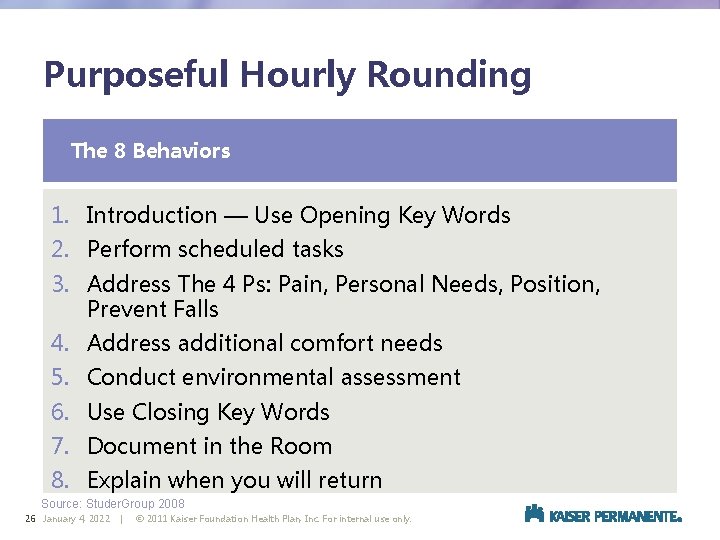
Purposeful Hourly Rounding The 8 Behaviors 1. Introduction — Use Opening Key Words 2. Perform scheduled tasks 3. Address The 4 Ps: Pain, Personal Needs, Position, Prevent Falls 4. Address additional comfort needs 5. Conduct environmental assessment 6. Use Closing Key Words 7. Document in the Room 8. Explain when you will return Source: Studer. Group 2008 10 January 4, 2022 | © 2011 Kaiser Foundation Health Plan, Inc. For internal use only.
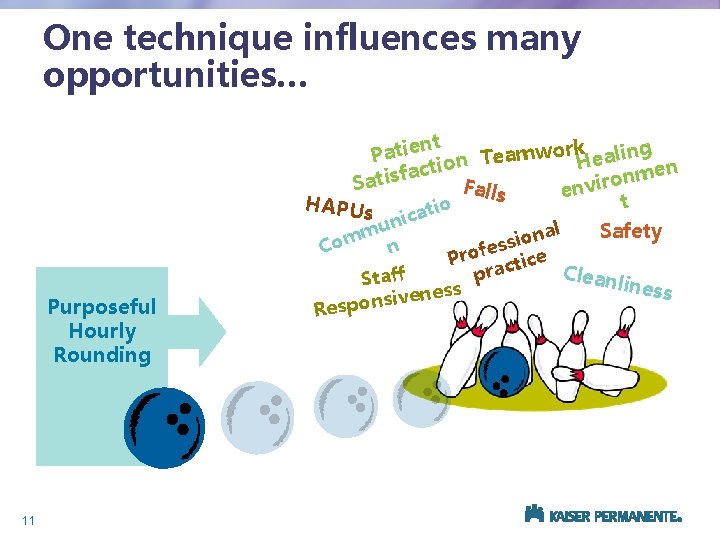
One technique influences many opportunities… Purposeful Hourly Rounding 11 nt Patie ion Teamwork. Healing ct en a f m s i n t o Sa Falls envir t HAPUs io t a c uni Safety al m n o m i s o s C n e Prof ctice Clean pra Staff liness s s e n e v nsi Respo
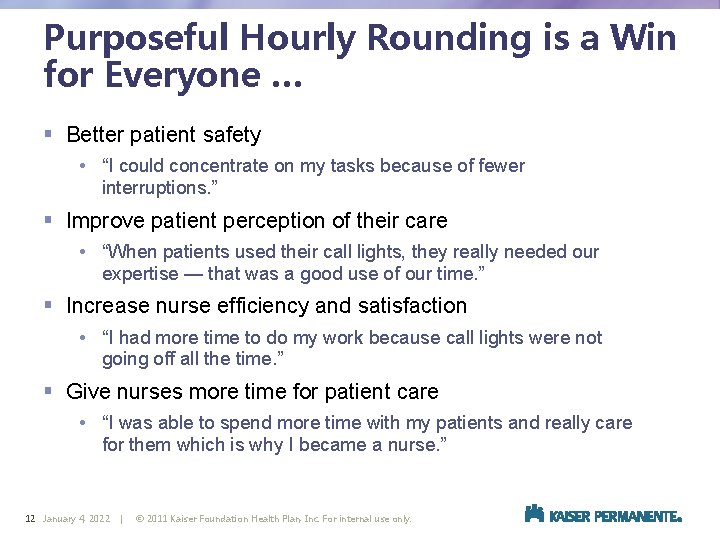
Purposeful Hourly Rounding is a Win for Everyone … § Better patient safety • “I could concentrate on my tasks because of fewer interruptions. ” § Improve patient perception of their care • “When patients used their call lights, they really needed our expertise — that was a good use of our time. ” § Increase nurse efficiency and satisfaction • “I had more time to do my work because call lights were not going off all the time. ” § Give nurses more time for patient care • “I was able to spend more time with my patients and really care for them which is why I became a nurse. ” 12 January 4, 2022 | © 2011 Kaiser Foundation Health Plan, Inc. For internal use only.
Benefits of Hourly Rounding
The Evidence-based Case for Purposeful Hourly Rounding THE BENEFITS: § § Better patient care Better control over nurse workflow Reduction of 1 mile of walking per 12 -hr shift 4 minutes saved per call light = Avg. of 326 hours per month saved for a 25 -30 bed unit § Improved HCAHPS scores – Patient Satisfaction § Rate Hospital and Willingness to Recommend – Nurse Communication, Staff Responsiveness, Pain Mgmt. 14 Alliance for Healthcare Research (2006) Study
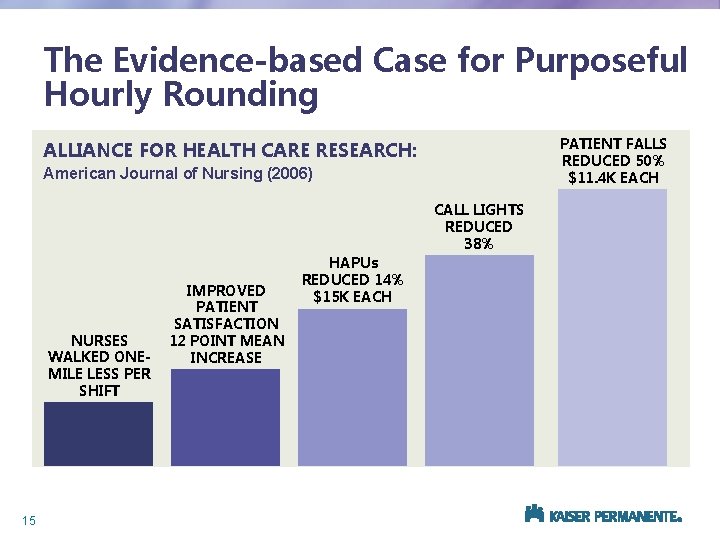
The Evidence-based Case for Purposeful Hourly Rounding PATIENT FALLS REDUCED 50% $11. 4 K EACH ALLIANCE FOR HEALTH CARE RESEARCH: American Journal of Nursing (2006) CALL LIGHTS REDUCED 38% NURSES WALKED ONEMILE LESS PER SHIFT 15 IMPROVED PATIENT SATISFACTION 12 POINT MEAN INCREASE HAPUs REDUCED 14% $15 K EACH
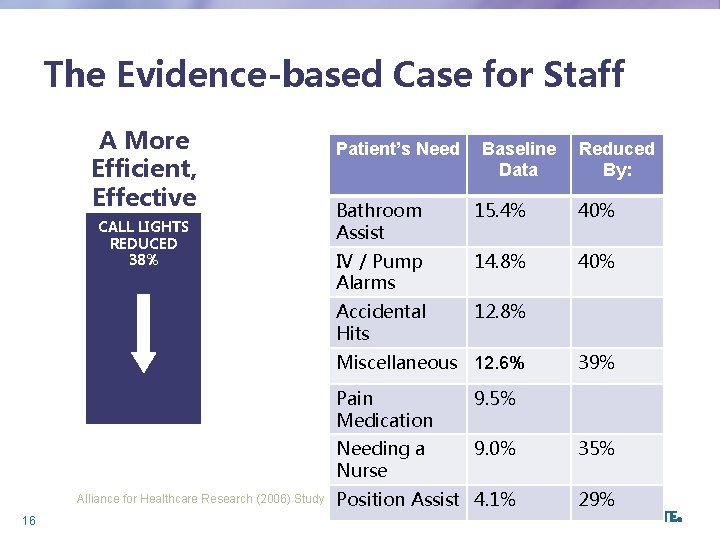
The Evidence-based Case for Staff A More Efficient, Effective CALL LIGHTS Shift REDUCED 38% Patient’s Need Baseline Data Bathroom Assist 15. 4% 40% IV / Pump Alarms 14. 8% 40% Accidental Hits 12. 8% Miscellaneous 12. 6% Alliance for Healthcare Research (2006) Study 16 Reduced By: 39% Pain Medication 9. 5% Needing a Nurse 9. 0% 35% Position Assist 4. 1% 29%
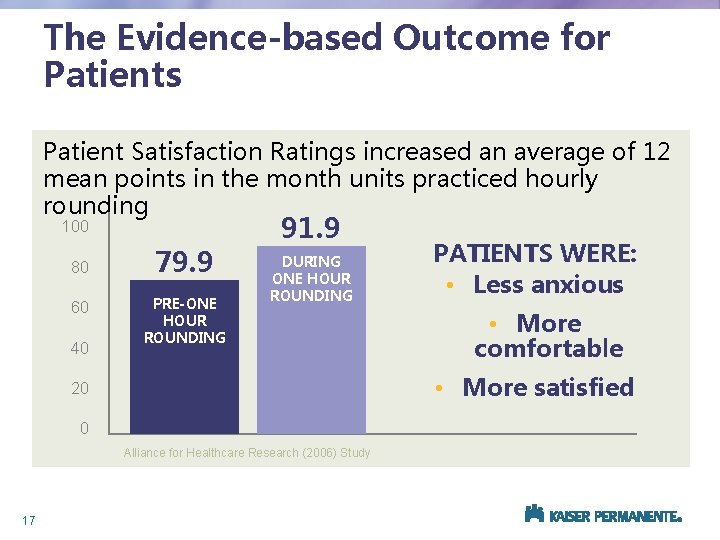
The Evidence-based Outcome for Patients Patient Satisfaction Ratings increased an average of 12 mean points in the month units practiced hourly rounding 100 80 60 40 79. 9 PRE-ONE HOUR ROUNDING 91. 9 DURING ONE HOUR ROUNDING • More comfortable • More satisfied 20 0 Alliance for Healthcare Research (2006) Study 17 PATIENTS WERE: • Less anxious
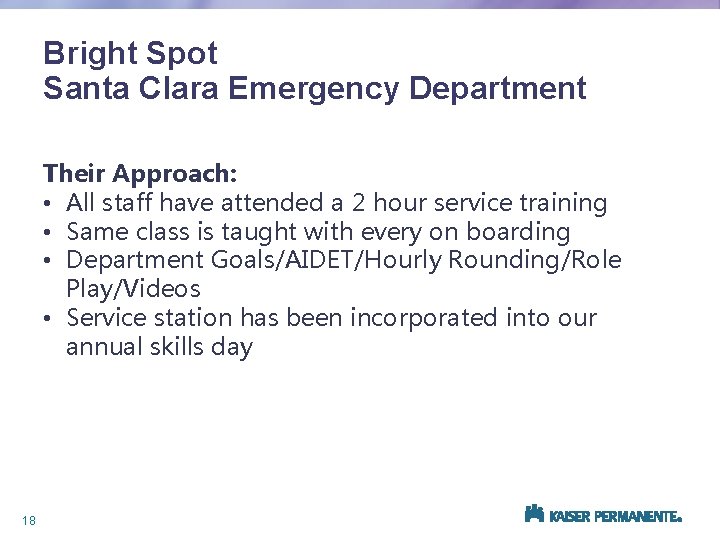
Bright Spot Santa Clara Emergency Department Their Approach: • All staff have attended a 2 hour service training • Same class is taught with every on boarding • Department Goals/AIDET/Hourly Rounding/Role Play/Videos • Service station has been incorporated into our annual skills day 18
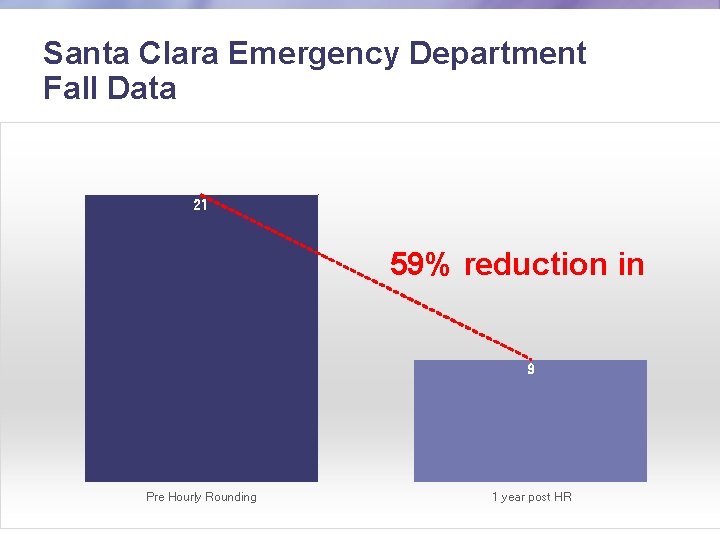
Santa Clara Emergency Department Fall Data 21 59% reduction in 9 Pre Hourly Rounding 19 1 year post HR
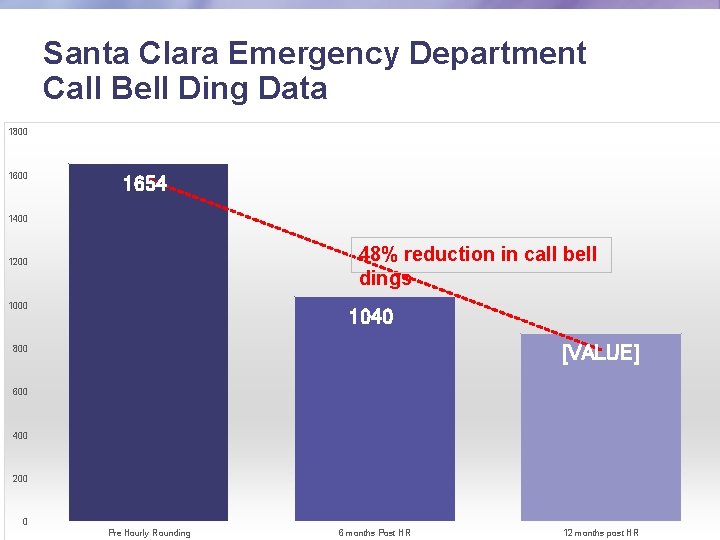
Santa Clara Emergency Department Call Bell Ding Data 1800 1654 1400 48% reduction in call bell dings 1200 1040 [VALUE] 800 600 400 20 0 Pre Hourly Rounding 6 months Post HR 12 months post HR
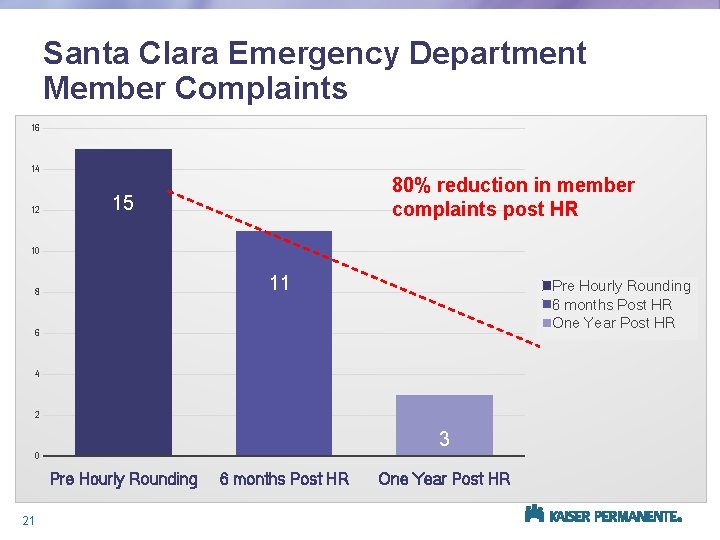
Santa Clara Emergency Department Member Complaints 16 14 12 80% reduction in member complaints post HR 15 10 11 8 Pre Hourly Rounding 6 months Post HR One Year Post HR 6 4 2 3 0 Pre Hourly Rounding 21 6 months Post HR One Year Post HR
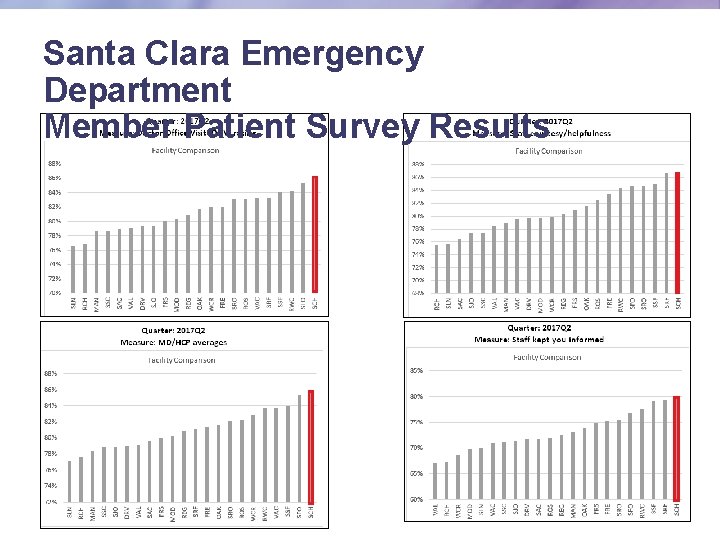
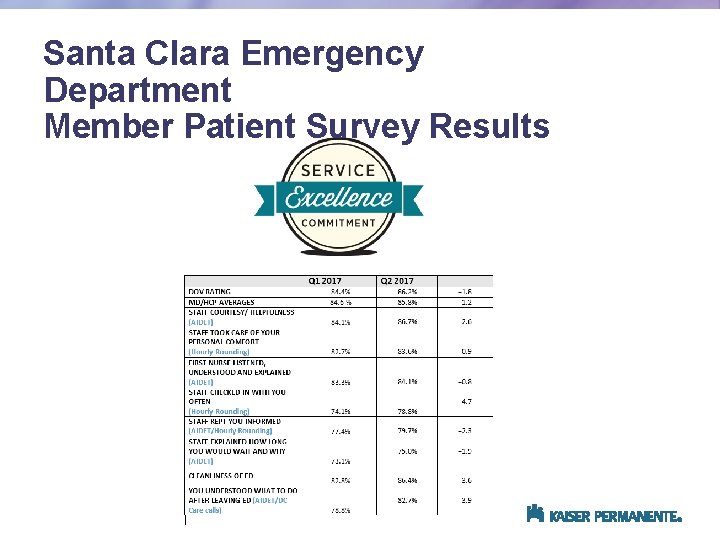
Santa Clara Emergency Department Member Patient Survey Results
Santa Clara Emergency Department Member Patient Survey Results
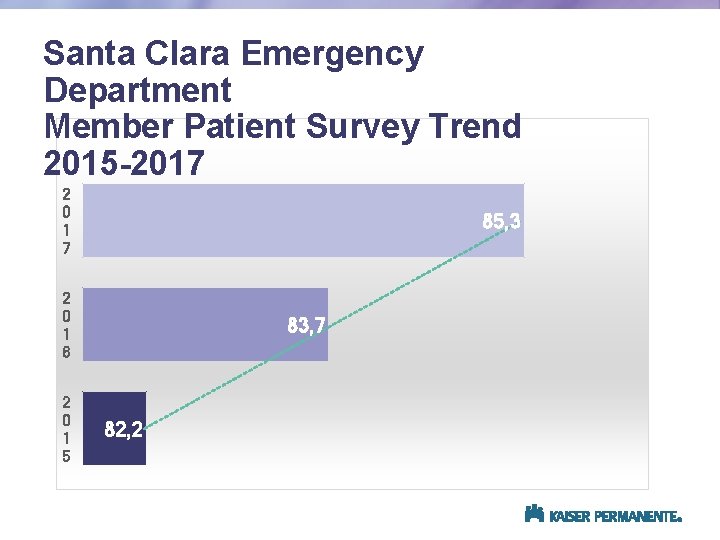
Santa Clara Emergency Department Member Patient Survey Trend 2015 -2017 2 0 1 7 85, 3 2 0 1 6 2 0 1 5 83, 7 82, 2
The 8 Behaviors of Purposeful Hourly Rounding
Purposeful Hourly Rounding The 8 Behaviors 1. Introduction — Use Opening Key Words 2. Perform scheduled tasks 3. Address The 4 Ps: Pain, Personal Needs, Position, Prevent Falls 4. Address additional comfort needs 5. Conduct environmental assessment 6. Use Closing Key Words 7. Document in the Room 8. Explain when you will return Source: Studer. Group 2008 26 January 4, 2022 | © 2011 Kaiser Foundation Health Plan, Inc. For internal use only.
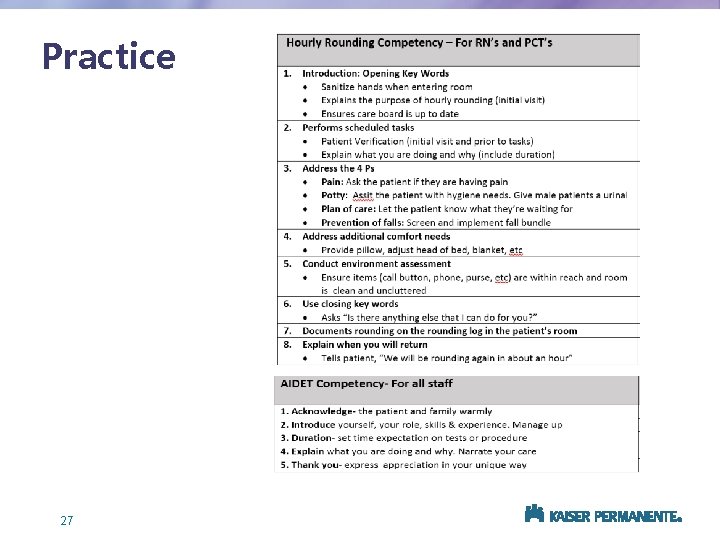
Practice. Tool 27
Video: “First Encounter: Setting Expectations” 28 http: //kpnet. kp. org/qrrm/service 2/COE/hourl y_rounding. html
Behavior 1: Introduction – Opening Key Words
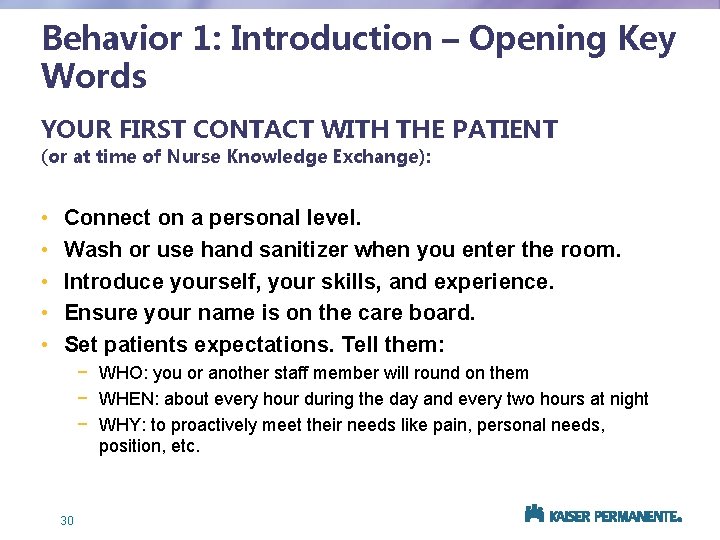
Behavior 1: Introduction – Opening Key Words YOUR FIRST CONTACT WITH THE PATIENT (or at time of Nurse Knowledge Exchange): • • • Connect on a personal level. Wash or use hand sanitizer when you enter the room. Introduce yourself, your skills, and experience. Ensure your name is on the care board. Set patients expectations. Tell them: − WHO: you or another staff member will round on them − WHEN: about every hour during the day and every two hours at night − WHY: to proactively meet their needs like pain, personal needs, position, etc. 30
Subsequent Ongoing Rounding EACH SUBSEQUENT TIME YOU ROUND ON THE PATIENT: • Re-connect with the patient • If interrupted during the round: − let the patient know when you will return, and − on the next visit apologize for the interruption. 31
Behavior 2: Perform Scheduled Tasks
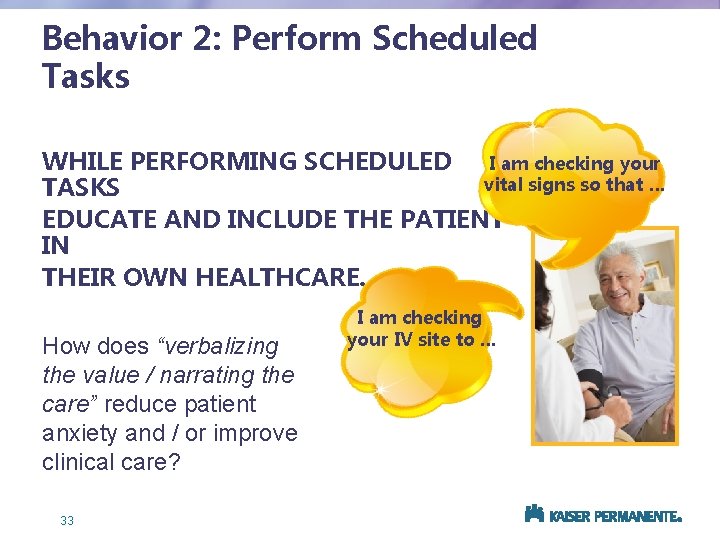
Behavior 2: Perform Scheduled Tasks I am checking your WHILE PERFORMING SCHEDULED vital signs so that … TASKS EDUCATE AND INCLUDE THE PATIENT IN THEIR OWN HEALTHCARE. How does “verbalizing the value / narrating the care” reduce patient anxiety and / or improve clinical care? 33 I am checking your IV site to …
Behavior 3: Introduction – Address the 4 P’s Pain, Personal Needs, Position and Prevent Falls
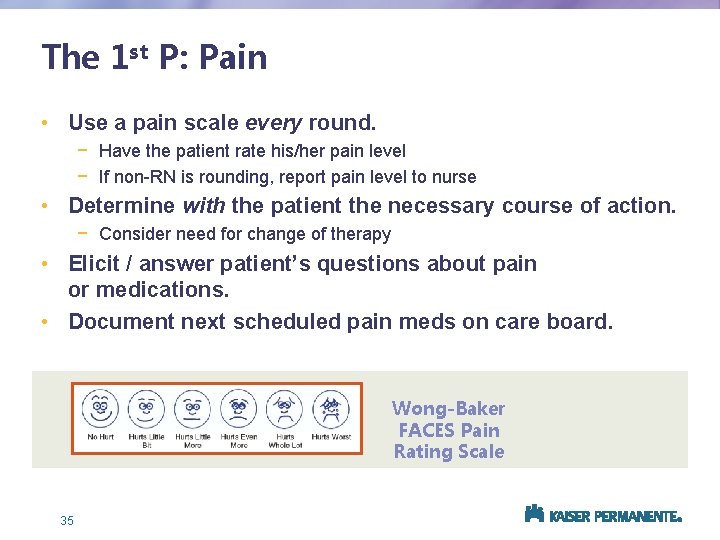
The 1 st P: Pain • Use a pain scale every round. − Have the patient rate his/her pain level − If non-RN is rounding, report pain level to nurse • Determine with the patient the necessary course of action. − Consider need for change of therapy • Elicit / answer patient’s questions about pain or medications. • Document next scheduled pain meds on care board. Wong-Baker FACES Pain Rating Scale 35
The 2 nd P: Personal Needs • Personal Needs is sometimes referred to as “Potty” • Assist the patient with any bathroom needs: − Help patient to and from the bathroom − Empty urinal / urine hat or Foley catheter • Assist the patient with hand washing & oral hygiene or any personal need that requires the patient to move around 36
The 3 rd P: Position • If patient is ambulatory, follow ambulation orders. • Educate the patient that frequent changes of position prevent skin breakdowns. − If patient is at risk, examine skin and evaluate. • Ask the patient if you can help them change positions. − Encourage patient to assist, if possible. • Offer to get or move pillows to make the patient more comfortable. 37
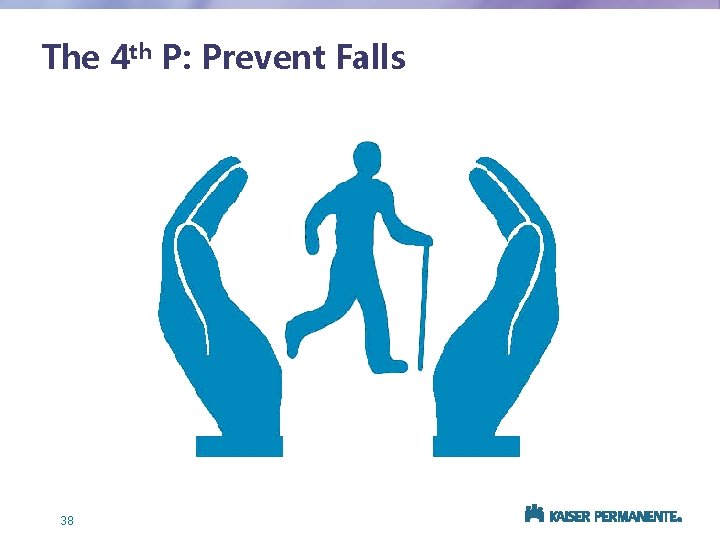
The 4 th P: Prevent Falls 38
Behavior 4: Address Additional Comfort Needs
Behavior 4: Address Additional Comfort Needs ELICIT PATIENT’S PERSPECTIVE & DEMONSTRATE EMPATHY • Ask: • “What else can I do to make you more comfortable? ” • Listen to the answer then respond with empathy. − Sit at the bedside at eye level − Use a healing touch − Empathize with feeling words • Pay attention to the patient’s nonverbal signals. − Facial expression, tone of voice, level of engagement, etc. 40
Behavior 5: Conduct Environmental Assessment
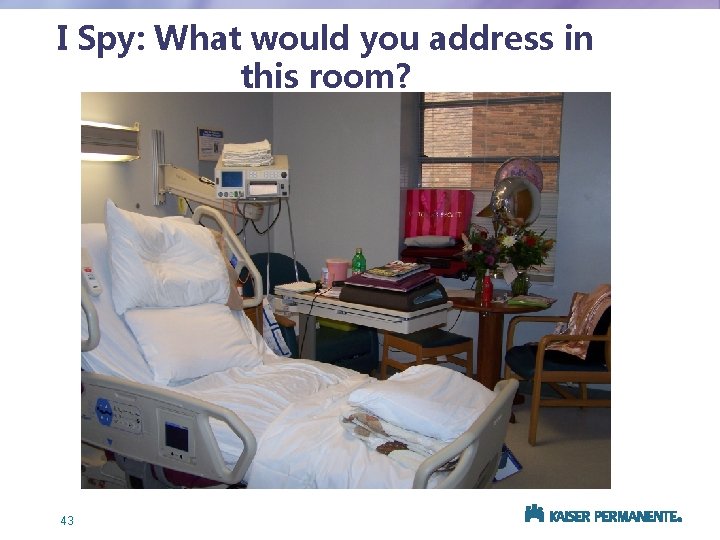
Behavior 5: Conduct Environmental Assessment • Keep items within safe reach of the patient: − − − Call Button Light switch and TV control Telephone, tissues and trash can Refilled water pitcher and cup Personal items (i. e. , magazine, book, calendar, photos, etc. ) • Ensure table top is clean • Unclutter / organize patient’s space • Ensure patient is comfortable & covered for personal privacy 42
I Spy: What would you address in this room? 43
Behavior 6: Closing Key Words
Behavior 6: Closing Key Words • Recap everything you did during the round. • Prior to leaving, ask: • “Is there anything else I can do for you? ” • Pay attention to your nonverbal communication. 45
Behavior 7: Document in the Room
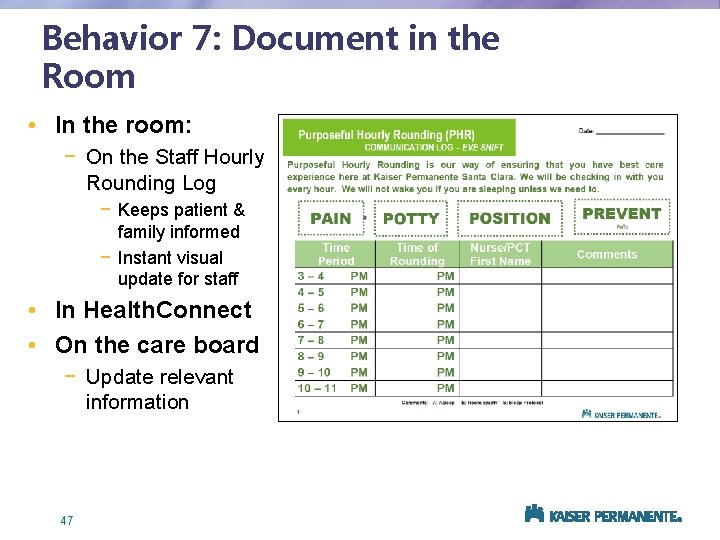
Behavior 7: Document in the Room • In the room: − On the Staff Hourly Rounding Log − Keeps patient & family informed − Instant visual update for staff • In Health. Connect • On the care board − Update relevant information 47
Behavior 8: Explain When you or others will return
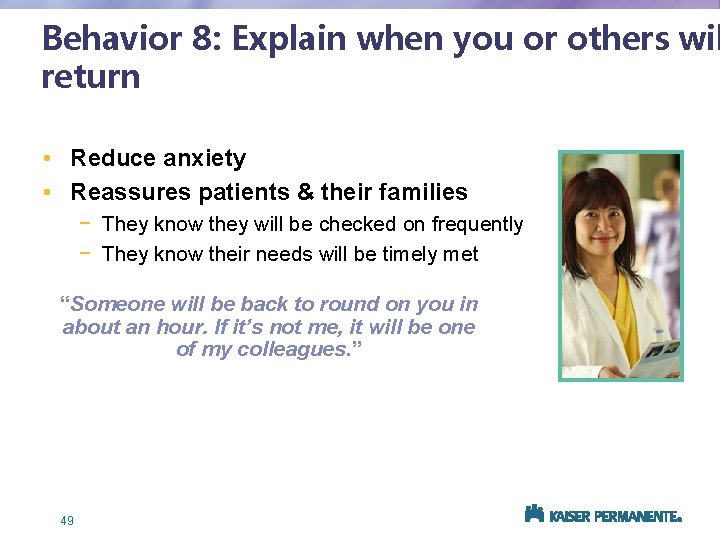
Behavior 8: Explain when you or others wil return • Reduce anxiety • Reassures patients & their families − They know they will be checked on frequently − They know their needs will be timely met “Someone will be back to round on you in about an hour. If it’s not me, it will be one of my colleagues. ” 49
YOUR TURN TO PRACTICE The 8 Behaviors 1. Introduction — Use Opening Key Words 2. Perform scheduled tasks 3. Address The 4 Ps: Pain, Personal Needs, Position, Prevent Falls 4. Address additional comfort needs 5. Conduct environmental assessment 6. Use Closing Key Words 7. Document in the Room 8. Explain when you will return Source: Studer. Group 2008 50 January 4, 2022 | © 2011 Kaiser Foundation Health Plan, Inc. For internal use only.
Summary and Expectations
Thank you for joining us today! 52