
Purpose What is your reason for asking this
- Slides: 16
Purpose • What is your reason for asking this question? What are you trying to discover? Refer to your Blue Science Fair Homework Packet page 1.
Hypothesis • A hypothesis is a statement that predicts how an experiment will turn out, and why it will happen that way, based on what you already know. What do you think that the answer to your research question will be? Remember, hypotheses don’t need to be correct---they just need to be informed guesses. Since you have researched the topic for your project, then your research should help you make a good hypothesis. Hypotheses are often written using an “If…, then…, because…” format. Refer to your Blue Science Fair Homework Packet page 3. Read Yellow Science Fair Planning Guide pages 6 -7.
Background Research • This is where you explain your background information that allows other people know how you came up with your hypothesis. Talk about what you learned. Use Blue packet page 2. Read Yellow Science Fair Planning Guide page 6.
Materials • List every item, including the quantity, that you used to do the experiment. Use bullet points ONLY. Refer to your Blue Science Fair Homework Packet page 4. Read Yellow Science Fair Planning Guide page 8.
Procedures • The procedure describes the experiment in a step-by-step sequence. It may help to think of the procedure as a recipe, which every step is clearly explained. How will your materials be used, and how and when will they be measured? If each step is carefully explained, another person should be able to follow the procedure of the experiment and get the same , or similar results. Refer to your Blue Science Fair Homework Packet page 4. Read Yellow Science Fair Planning Guide page 8.
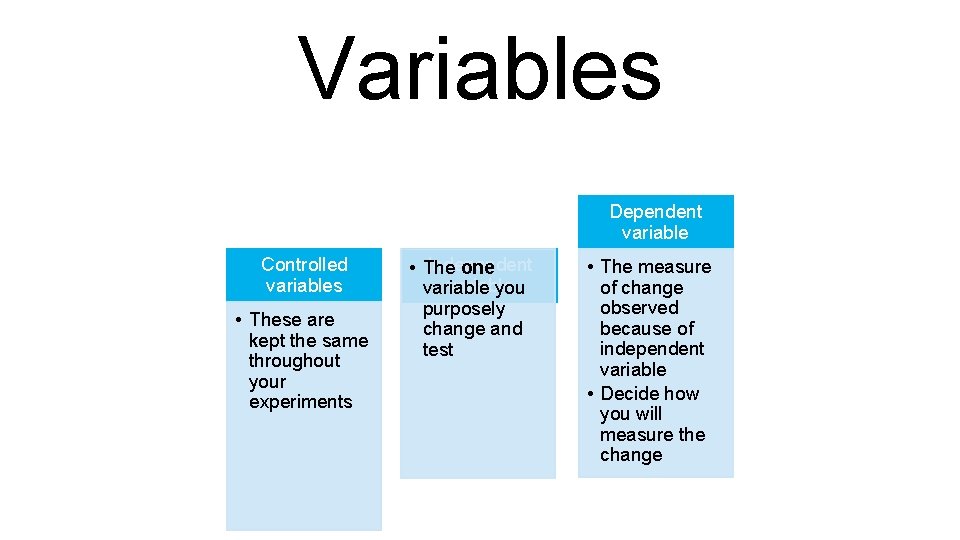
Variables Dependent variable Controlled variables • These are kept the same throughout your experiments Independent • The one variable you purposely change and test • The measure of change observed because of independent variable • Decide how you will measure the change
Results • Write down the results of the experiment. These should be detailed records of the results of your tests and observations. Refer to your Blue Science Fair Homework Packet page 5. Read Yellow Science Fair Planning Guide page 8.
Conclusion • According to your results, was your hypothesis proven or disproven? (Remember, it is okay for your hypothesis to be disproven!) Was there anything in the experiment that you would change if the hypothesis were retested? How could you change or expand this experiment if you were going to do it again? What did you learn from the experiment? How could this information be used to help people or make the world a better place? Refer to your Blue Science Fair Homework Packet page 6. Read Yellow Science Fair Planning Guide page 8.
Abstract • An abstract is a one-page summary of your project. It should state your research question, purpose, and hypothesis. It should include your procedures, but you do not need to be as precise as you were in the procedures section; describe your steps more generally. Your results and conclusion should also be included. The abstract is meant to give a quick explanation of your project to someone before examining your display board. Refer to Blue Science Fair Homework Packet page 7.
Books and Resources • List your 5 sources you used to research your topic using MLA format. Make sure your citations are in ABC order. Refer to the Bibliography Power. Point we went over in class.
Application • (OPTIONAL) The application is how the information or knowledge gained in the experiment can be used. How does your experiment relate to the real world?
Acknowledgements • (OPTIONAL) This is where you thank anyone that helped you with your project.
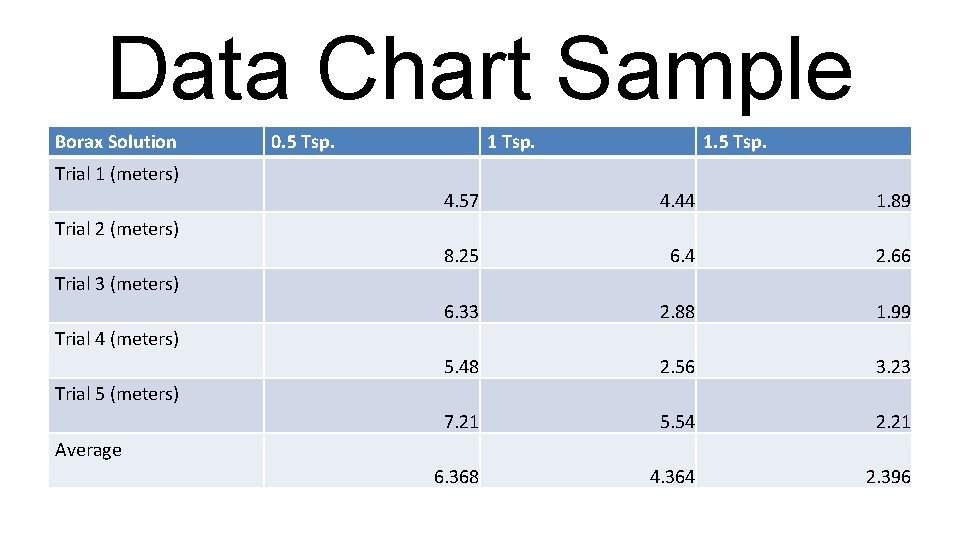
Data Chart • Refer to your data from Green Logbook pages 6 -9 to create your data chart. You will average the data from each of the 5 trials in order to determine your results. To create your data chart, click the “TABLE” tab on the upper left of the screen. Read Yellow Science Fair Planning Guide pages 8 -9.
Data Chart Sample Borax Solution 0. 5 Tsp. 1. 5 Tsp. Trial 1 (meters) 4. 57 4. 44 1. 89 8. 25 6. 4 2. 66 6. 33 2. 88 1. 99 5. 48 2. 56 3. 23 7. 21 5. 54 2. 21 6. 368 4. 364 2. 396 Trial 2 (meters) Trial 3 (meters) Trial 4 (meters) Trial 5 (meters) Average
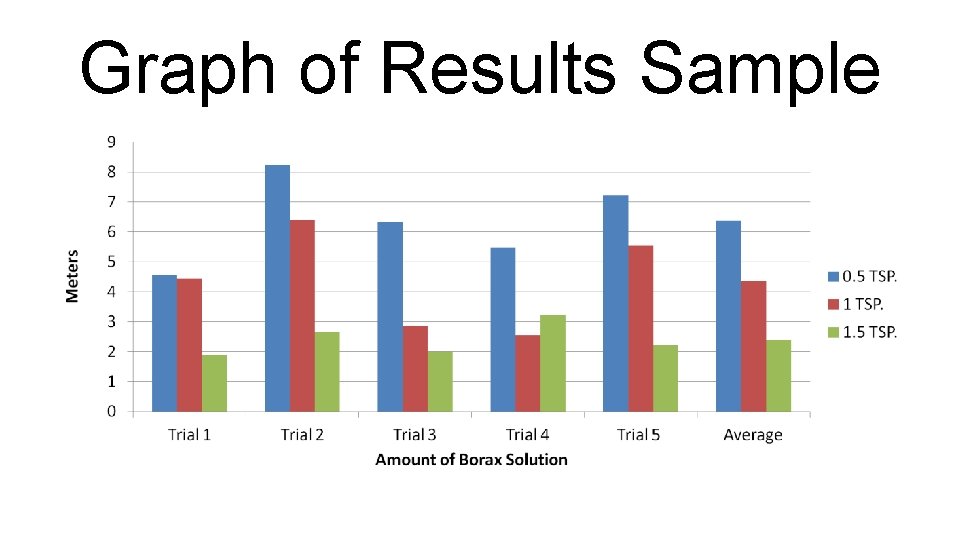
Graph of Results • Using the data and averages from your data chart, create a graph to demonstrate the results. Bar graphs and pie charts work well and are “Easy on the Eyes. ” Read Yellow Science Fair Planning Guide page 9.
Graph of Results Sample