
Purple Class Curriculum Overview 2018 2019 MEET THE
- Slides: 1
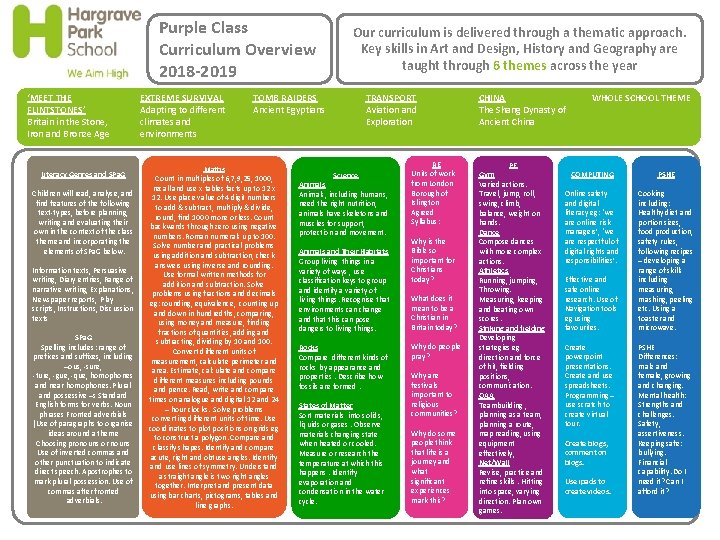
Purple Class Curriculum Overview 2018 -2019 ‘MEET THE FLINTSTONES’ Britain in the Stone, Iron and Bronze Age Literacy Genres and SPa. G Children will read, analyse, and find features of the following text-types, before planning, writing and evaluating their own in the context of the class theme and incorporating the elements of SPa. G below. Information texts, Persuasive writing, Diary entries, Range of narrative writing, Explanations, Newspaper reports, Play scripts, Instructions, Discussion texts SPa. G Spelling includes: range of prefixes and suffixes, including –ous, -sure, -ture, -gue, -que, homophones and near homophones. Plural and possessive –s Standard English forms for verbs. Noun phrases Fronted adverbials [Use of paragraphs to organise ideas around a theme Choosing pronouns or nouns Use of inverted commas and other punctuation to indicate direct speech. Apostrophes to mark plural possession. Use of commas after fronted adverbials. EXTREME SURVIVAL Adapting to different climates and environments Our curriculum is delivered through a thematic approach. Key skills in Art and Design, History and Geography are taught through 6 themes across the year TOMB RAIDERS Ancient Egyptians Maths Count in multiples of 6, 7, 9, 25, 1000, recall and use x tables facts up to 12 x 12. Use place value of 4 digit numbers to add & subtract, multiply & divide, round, find 1000 more or less. Count backwards through zero using negative numbers. Roman numerals up to 100. Solve number and practical problems using addition and subtraction, check answers using inverse and rounding. Use formal written methods for addition and subtraction. Solve problems using fractions and decimals eg: rounding, equivalence, counting up and down in hundredths, comparing, using money and measure, finding fractions of quantities, adding and subtracting, dividing by 10 and 100. Convert different units of measurement, calculate perimeter and area. Estimate, calculate and compare different measures including pounds and pence. Read, write and compare times on analogue and digital 12 and 24 – hour clocks. Solve problems converting different units of time. Use coordinates to plot positions on grids eg to construct a polygon. Compare and classify shapes. Identify and compare acute, right and obtuse angles. Identify and use lines of symmetry. Understand a straight angle is two right angles together. Interpret and present data using bar charts, pictograms, tables and line graphs. TRANSPORT Aviation and Exploration Science Animals, including humans, need the right nutrition, animals have skeletons and muscles for support, protection and movement. Animals and Their Habitats Group living things in a variety of ways , use classification keys to group and identify a variety of living things. Recognise that environments can change and that this can pose dangers to living things. Rocks Compare different kinds of rocks by appearance and properties. Describe how fossils are formed. States of Matter Sort materials into solids, liquids or gases. Observe materials changing state when heated or cooled. Measure or research the temperature at which this happens. Identify evaporation and condensation in the water cycle. RE Units of work from London Borough of Islington Agreed Syllabus: Why is the Bible so important for Christians today? What does it mean to be a Christian in Britain today? Why do people pray? Why are festivals important to religious communities? Why do some people think that life is a journey and what significant experiences mark this? CHINA The Shang Dynasty of Ancient China PE Gym Varied actions. Travel, jump, roll, swing, climb, balance, weight on hands. Dance Compose dances with more complex actions. Athletics Running, jumping, Throwing. Measuring, keeping and beating own scores. Striking and fielding Developing strategies eg direction and force of hit, fielding positions, communication. OAA Teambuilding , planning as a team, planning a route, map reading, using equipment effectively, Net/Wall Revise, practice and refine skills. Hitting into space, varying direction. Plan own games. WHOLE SCHOOL THEME COMPUTING PSHE Online safety and digital literacy eg: ‘we are online risk managers’, ‘we are respectful of digital rights and responsibilities’. Cooking including: Healthy diet and portion sizes, food production, safety rules, following recipes – developing a range of skills including measuring, mashing, peeling etc. Using a toaster and microwave. Effective and safe online research. Use of Navigation tools eg using favourites. Create powerpoint presentations. Create and use spreadsheets. Programming – use scratch to create virtual tour. Create blogs, comment on blogs. Use ipads to create videos. PSHE Differences: male and female, growing and changing. Mental health: Strengths and challenges. Safety, assertiveness. Keeping safe: bullying. Financial capability. Do I need it? Can I afford it?