
Purge gas flow impact on tritium permeation Integrated

- Slides: 10
Purge gas flow impact on tritium permeation Integrated simulation on tritium permeation in the solid breeder unit Hongjie Zhang FNST, August 18 -20, 2009
Motivations and Objectives FNST 2009 l l Issues l Tritium behavior in blanket is a complicated phenomenon which consist of tritium generation, tritium permeation, purge gas thermofluid and nuclear heating l No single integrated program of theory, computer modeling to simulate tritium behavior in blanket units. l Handling of 3 D complicated large scale geometry Objective l Develop a predictive capability of tritium and hydrogen permeation from breeding zones to the coolant in the helium cooled pebble-bed blanket. l Construct 3 -D convection-diffusion models Integrated with thermalfluid analysis in TBM unit l Take into account the tritium generation rate distribution and nuclear heating rate distribution. l Provide predictive capabilities, and Assist solid breeder design
Previous work and Recent advancement FNST 2009 Two multi-physics models based on different codes were developed l COMSOL model Set-up Convection-diffusion model with imported velocity and temperature profiles l Apply Law-boundary conditions at gas-metal interface. l Works on 2 -D or 3 -D small scale geometry l Memory issue for large-scale geometry Sctetra model l Extend CFD code for tritium permeation assessment in TBM unit l Add multi-species permeation / Isotope permeation l Support Law-dependent boundary condition or Rate-dependent boundary condition at gas-metal interface l Support 3 -D complex geometry at large scale l l
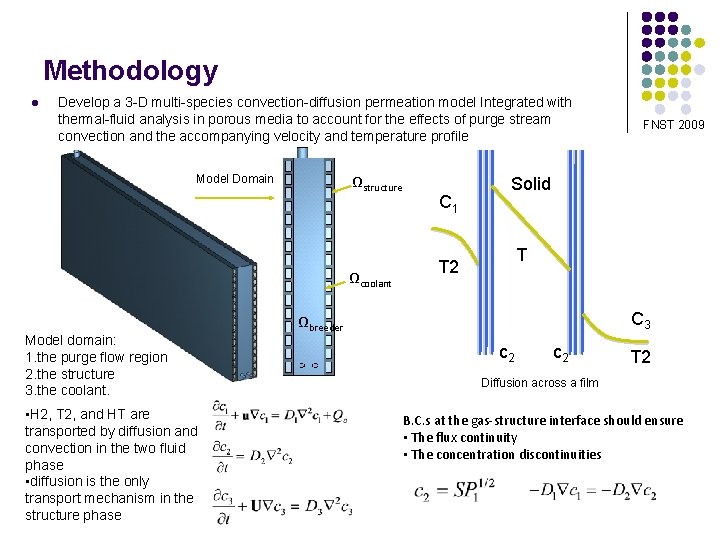
Methodology l Develop a 3 -D multi-species convection-diffusion permeation model Integrated with thermal-fluid analysis in porous media to account for the effects of purge stream convection and the accompanying velocity and temperature profile Ωstructure Model Domain Ωcoolant Model domain: 1. the purge flow region 2. the structure 3. the coolant. • H 2, T 2, and HT are transported by diffusion and convection in the two fluid phase • diffusion is the only transport mechanism in the structure phase C 1 FNST 2009 Solid T T 2 C 3 Ωbreeder c 2 T 2 Diffusion across a film B. C. s at the gas-structure interface should ensure • The flux continuity • The concentration discontinuities
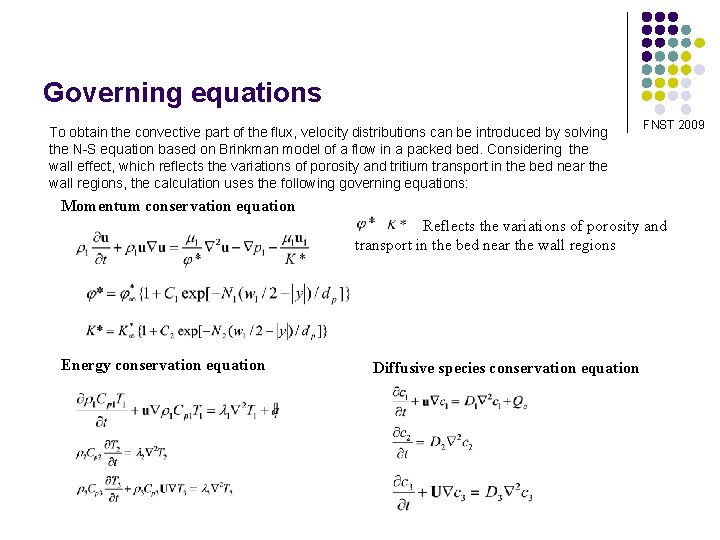
Governing equations To obtain the convective part of the flux, velocity distributions can be introduced by solving the N-S equation based on Brinkman model of a flow in a packed bed. Considering the wall effect, which reflects the variations of porosity and tritium transport in the bed near the wall regions, the calculation uses the following governing equations: FNST 2009 Momentum conservation equation Reflects the variations of porosity and transport in the bed near the wall regions Energy conservation equation Diffusive species conservation equation
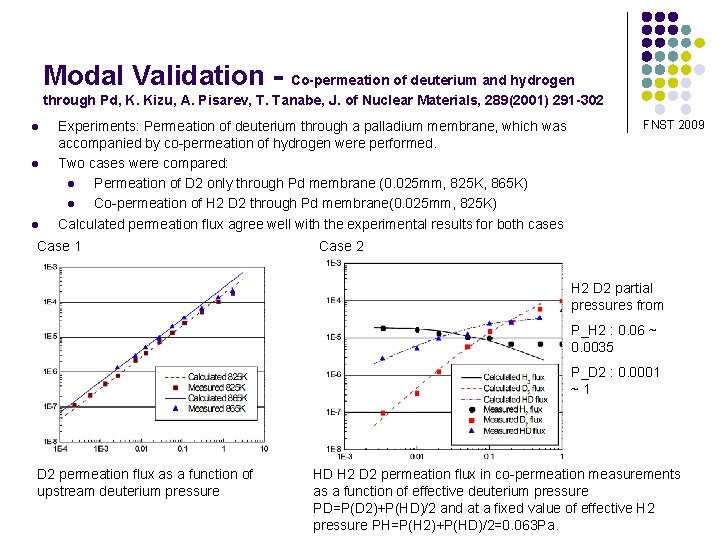
Modal Validation - Co-permeation of deuterium and hydrogen through Pd, K. Kizu, A. Pisarev, T. Tanabe, J. of Nuclear Materials, 289(2001) 291 -302 l l l Experiments: Permeation of deuterium through a palladium membrane, which was accompanied by co-permeation of hydrogen were performed. Two cases were compared: l Permeation of D 2 only through Pd membrane (0. 025 mm, 825 K, 865 K) l Co-permeation of H 2 D 2 through Pd membrane(0. 025 mm, 825 K) Calculated permeation flux agree well with the experimental results for both cases Case 1 FNST 2009 Case 2 H 2 D 2 partial pressures from P_H 2 : 0. 06 ~ 0. 0035 P_D 2 : 0. 0001 ~1 D 2 permeation flux as a function of upstream deuterium pressure HD H 2 D 2 permeation flux in co-permeation measurements as a function of effective deuterium pressure PD=P(D 2)+P(HD)/2 and at a fixed value of effective H 2 pressure PH=P(H 2)+P(HD)/2=0. 063 Pa.
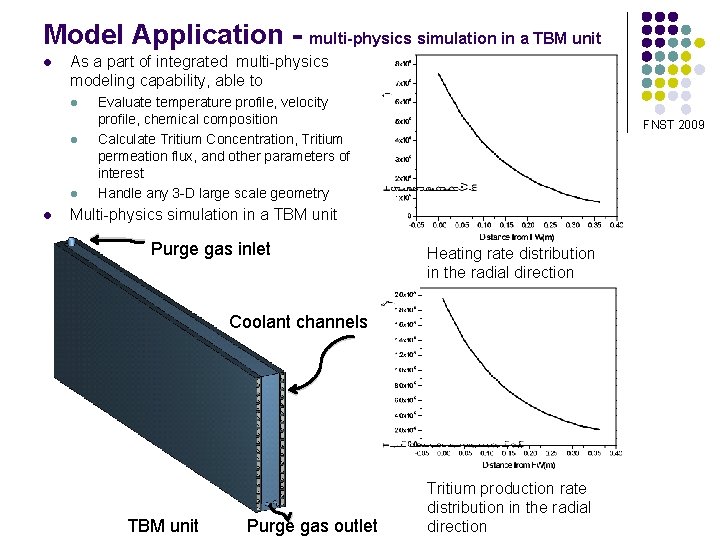
Model Application - multi-physics simulation in a TBM unit l As a part of integrated multi-physics modeling capability, able to l l Evaluate temperature profile, velocity profile, chemical composition Calculate Tritium Concentration, Tritium permeation flux, and other parameters of interest Handle any 3 -D large scale geometry FNST 2009 Multi-physics simulation in a TBM unit Purge gas inlet Heating rate distribution in the radial direction Coolant channels TBM unit Purge gas outlet Tritium production rate distribution in the radial direction
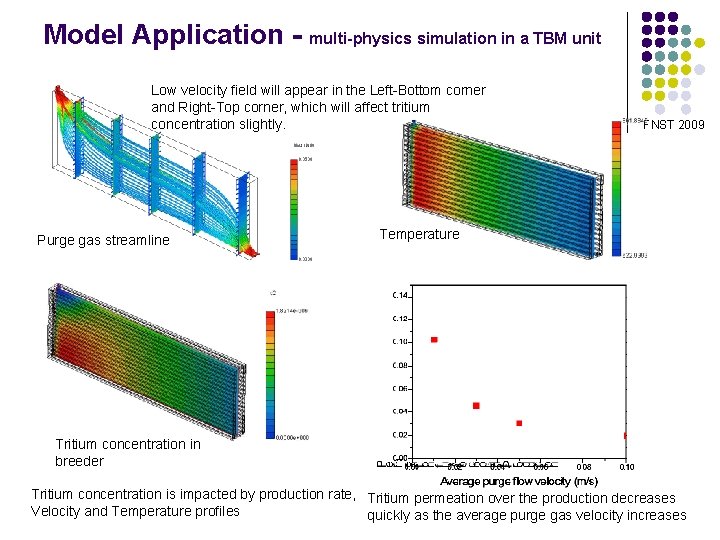
Model Application - multi-physics simulation in a TBM unit Low velocity field will appear in the Left-Bottom corner and Right-Top corner, which will affect tritium concentration slightly. Purge gas streamline FNST 2009 Temperature Tritium concentration in breeder Tritium concentration is impacted by production rate, Tritium permeation over the production decreases Velocity and Temperature profiles quickly as the average purge gas velocity increases
Conclusion FNST 2009 l l l 3 -D multi-species convection-diffusion permeation model Integrated with thermal-fluid analysis in porous media are assessed to provide predictive capabilities and assist solid breeder design Benchmark cases agree well with experimental results, and more benchmark with available data can be done As a part of integrated multi-physics modeling capability, able to l l Evaluate temperature profile, velocity profile, chemical composition Calculate Tritium Concentration, Tritium permeation flux, and other parameters of interest Handle 3 -D large scale geometry Simulation in a TBM unit show that parameters such as temperature distribution and purge gas flow can strongly affect tritium transport. Under reasonable purge velocity profile, increasing the inlet velocity is an effective method to reduce tritium permeation to the coolant.
Thank you FNST 2009