
Pure Substances Mixtures and Solutions matter that has
Pure Substances, Mixtures, and Solutions

• _______: matter that has a fixed (constant) composition and unique properties. Contains only 1 type element or compound; homogeneous §______: Contains at least 2 PHYSICALLY combined compounds; can be homogeneous or heterogeneous
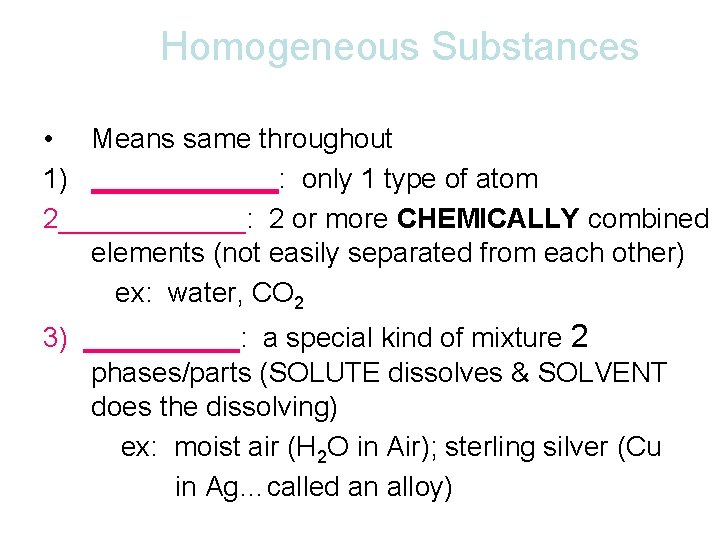
Homogeneous Substances • Means same throughout 1) ______: only 1 type of atom 2______: 2 or more CHEMICALLY combined elements (not easily separated from each other) ex: water, CO 2 3) _____: a special kind of mixture 2 phases/parts (SOLUTE dissolves & SOLVENT does the dissolving) ex: moist air (H 2 O in Air); sterling silver (Cu in Ag…called an alloy)
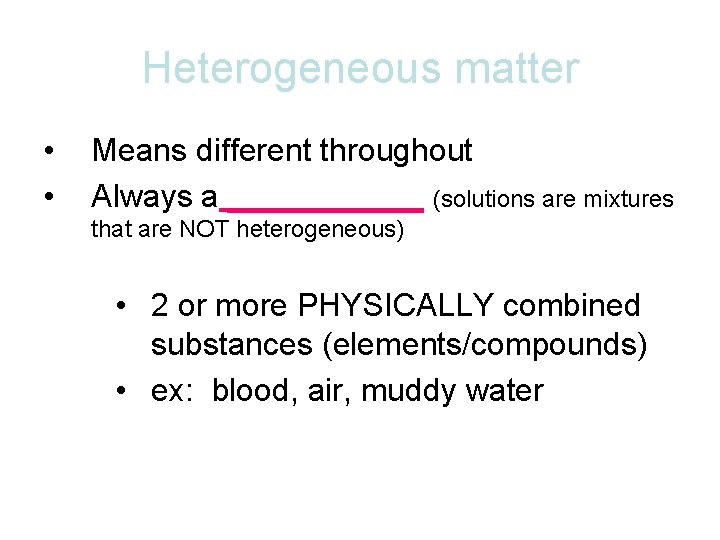
Heterogeneous matter • • Means different throughout Always a ______ (solutions are mixtures that are NOT heterogeneous) • 2 or more PHYSICALLY combined substances (elements/compounds) • ex: blood, air, muddy water
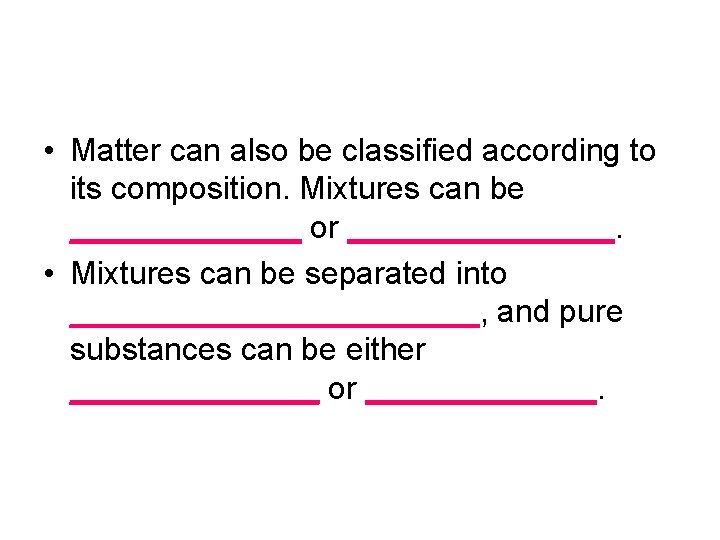
• Matter can also be classified according to its composition. Mixtures can be _______ or ________. • Mixtures can be separated into ____________, and pure substances can be either _______ or _______.
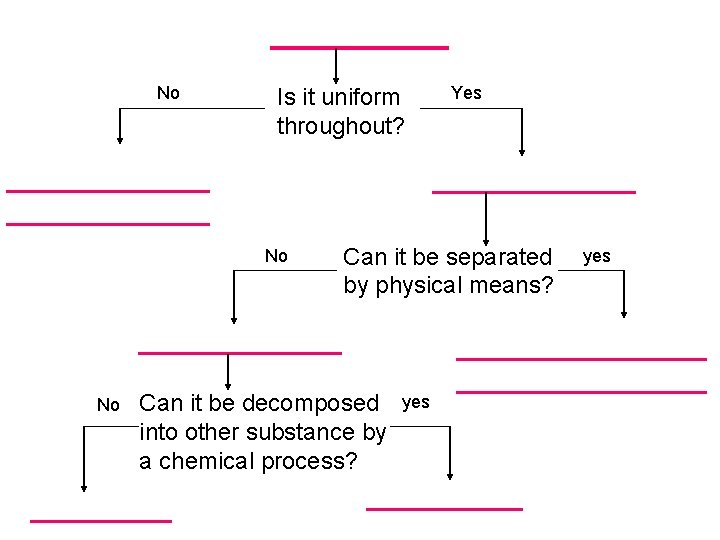
____ No Is it uniform throughout? _____________ No Can it be separated by physical means? _______ No Can it be decomposed into other substance by a chemical process? _____ Yes yes ________________
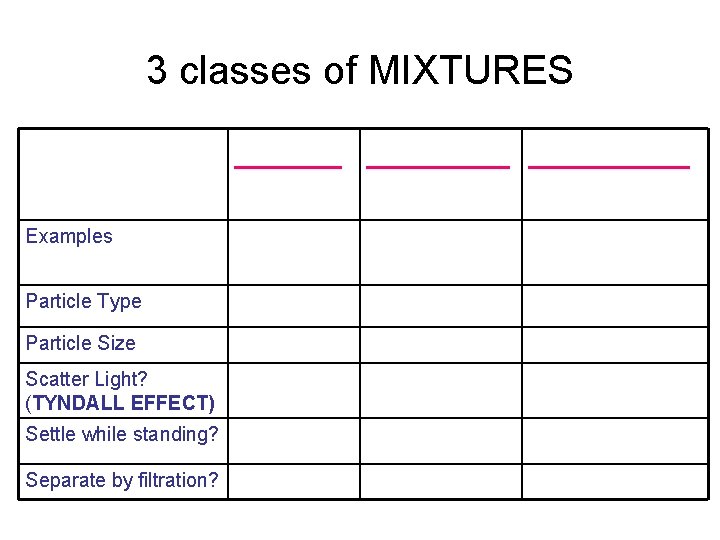
3 classes of MIXTURES ________ Examples Particle Type Particle Size Scatter Light? (TYNDALL EFFECT) Settle while standing? Separate by filtration?
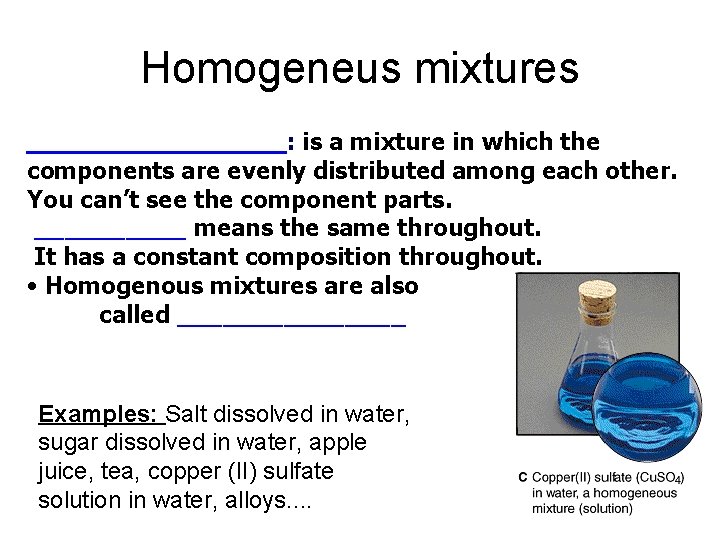
Homogeneus mixtures _________: is a mixture in which the components are evenly distributed among each other. You can’t see the component parts. _____ means the same throughout. It has a constant composition throughout. • Homogenous mixtures are also called ________ Examples: Salt dissolved in water, sugar dissolved in water, apple juice, tea, copper (II) sulfate solution in water, alloys. .
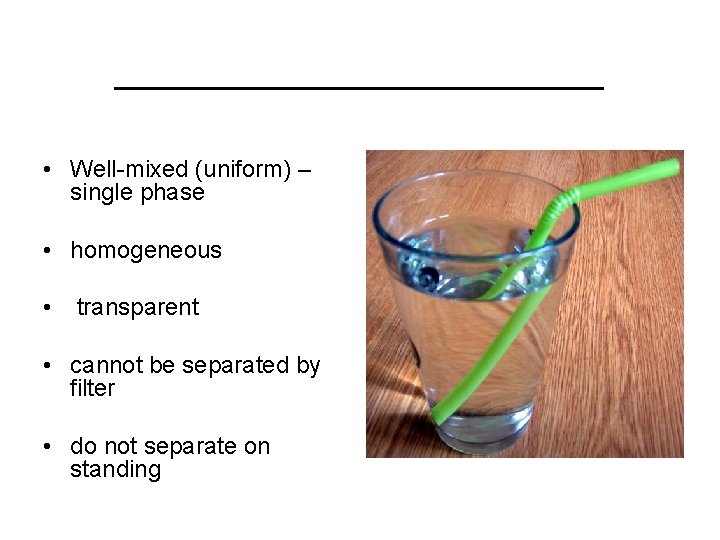
___________ • Well-mixed (uniform) – single phase • homogeneous • transparent • cannot be separated by filter • do not separate on standing
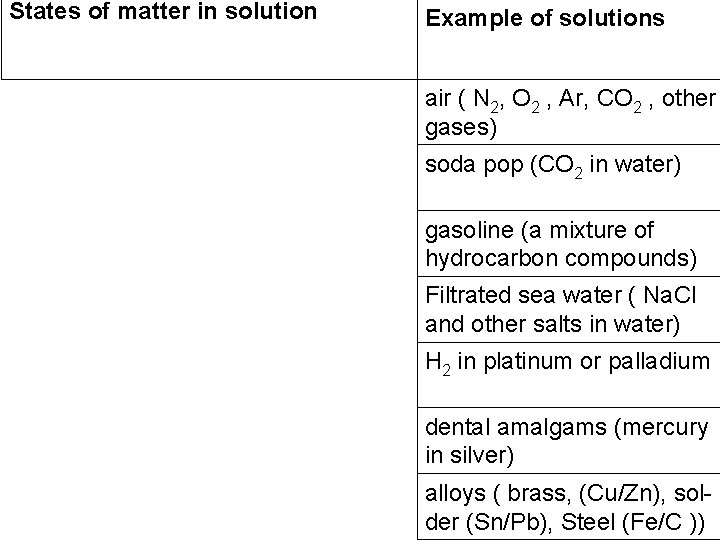
States of matter in solution Example of solutions air ( N 2, O 2 , Ar, CO 2 , other gases) soda pop (CO 2 in water) gasoline (a mixture of hydrocarbon compounds) Filtrated sea water ( Na. Cl and other salts in water) H 2 in platinum or palladium dental amalgams (mercury in silver) alloys ( brass, (Cu/Zn), solder (Sn/Pb), Steel (Fe/C ))

heterogeneous mixtures ___________: the components are not evenly distributed among each other. An heterogeneous mixture has ______________that are usually detectable. This type of mixture does NOT have uniform properties. Heterogeneous mixtures that look like solutions can be distinguished because they scatter light (________). Examples: Sand water, oil and water, milk, sulfur and iron, granite, blood. . .
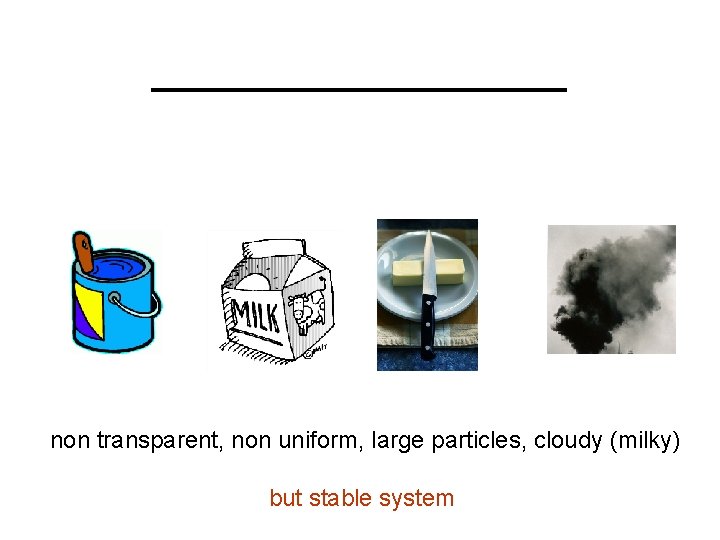
Colloids _________ non transparent, non uniform, large particles, cloudy (milky) but stable system
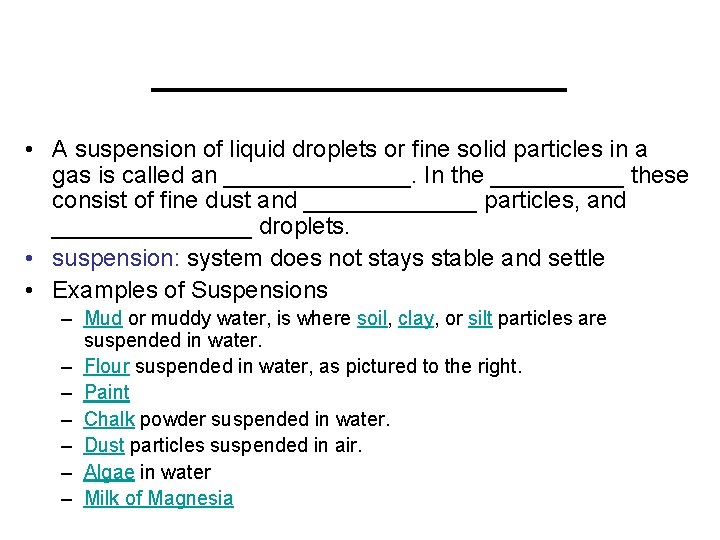
_________ • A suspension of liquid droplets or fine solid particles in a gas is called an _______. In the _____ these consist of fine dust and _______ particles, and ________ droplets. • suspension: system does not stays stable and settle • Examples of Suspensions – Mud or muddy water, is where soil, clay, or silt particles are suspended in water. – Flour suspended in water, as pictured to the right. – Paint – Chalk powder suspended in water. – Dust particles suspended in air. – Algae in water – Milk of Magnesia
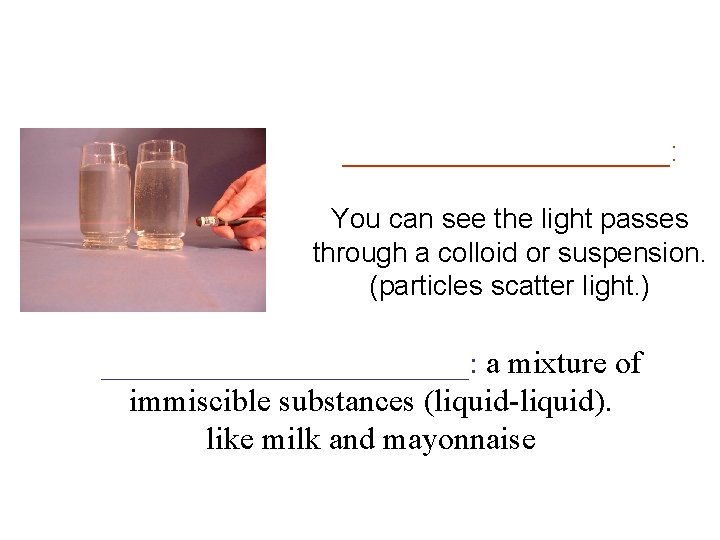
Colloids ___________: You can see the light passes through a colloid or suspension. (particles scatter light. ) ____________: a mixture of immiscible substances (liquid-liquid). like milk and mayonnaise
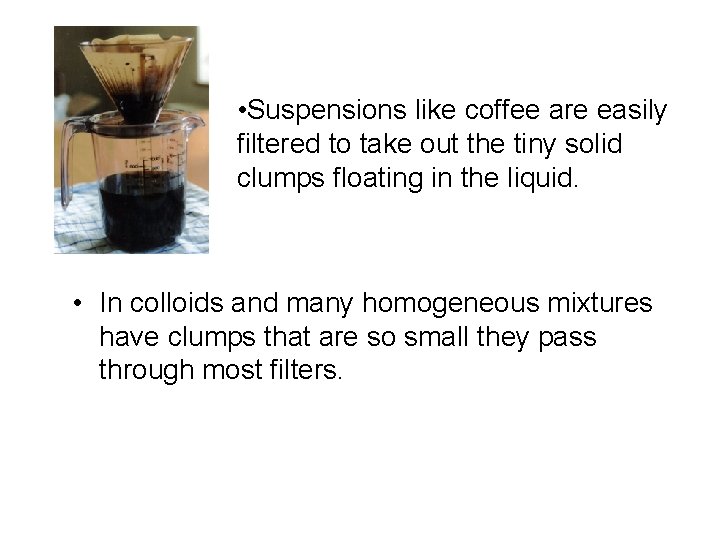
• Suspensions like coffee are easily filtered to take out the tiny solid clumps floating in the liquid. • In colloids and many homogeneous mixtures have clumps that are so small they pass through most filters.
- Slides: 15