
Pure Monopoly Unit 4 will include Perfect Competition






- Slides: 36
Pure Monopoly Unit 4 will include Perfect Competition also
Most Competitive Perfect Competition Least Competitive Monopoly
Are monopolies legal or illegal?
- A single seller in the market. - The seller is a price searcher/maker. - Produce a product in which there are no close or efficient substitutes.
- There are significant barriers to market entry: - Extremely expensive to enter. - (Economies of scale) - Private Property Protections - Ownership of Essential Resources - Regulation
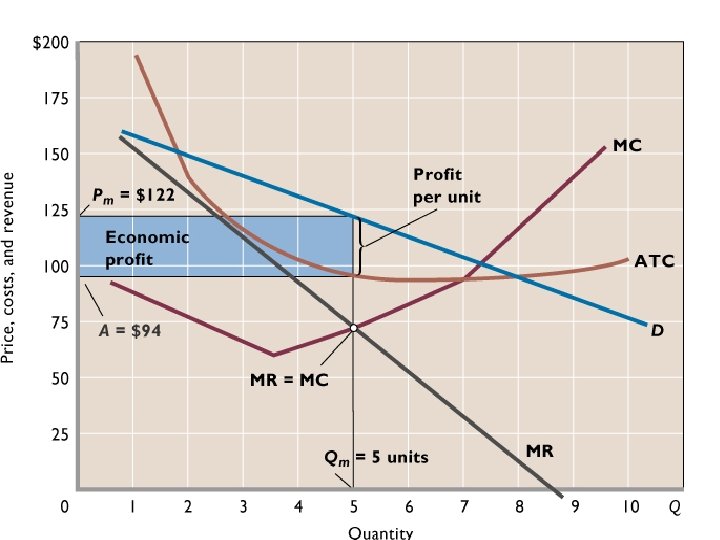
- They will produce to maximize profits or minimize losses at MR=MC.
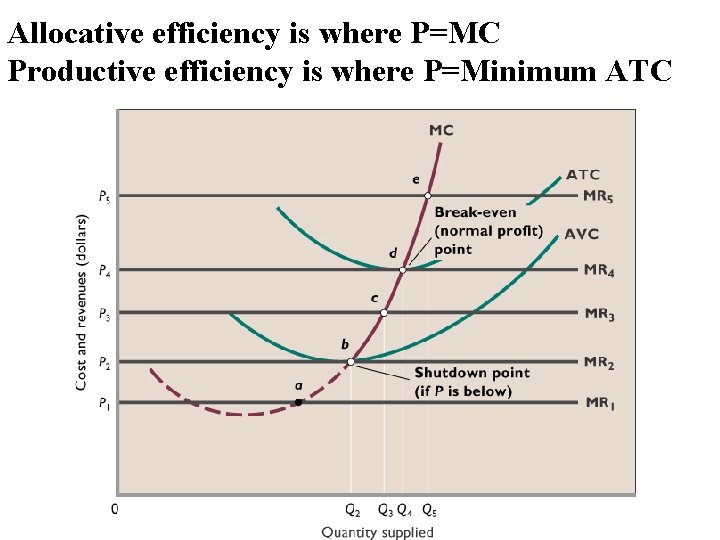
- The single seller can operate inefficiently because there is no competition. Allocative efficiency is where P=MC Productive efficiency is where P=Minimum ATC
Long Run/Short Run Pure Monopolies will: (Doesn’t Matter) • • Economic Profit Breakeven Economic Loss Won’t shutdown – Raise the price or lower ATC
Private Property Protections • Legally protecting your ideas • Nobody can then use the protected ideas without compensating property owner. • May lead to Monopoly Power
Private Property Protections • Patents • Copyrights • Trademarks
The patent owner has the right to exclude others from making, selling, offering for sale, or importing into the U. S. the invention protected by the patent, unless they have the express permission of the patent holder to do so.
Good for the life of the author plus 50 years
A trademark includes any word, name, symbol, or device, or any combination, used, or intended to be used, in commerce to identify and distinguish the goods of one manufacturer or seller from goods manufactured or sold by others, and to indicate the source of the goods. In short, a trademark is a brand name.
Only one graph. No side by sides. Demand curve is now downsloping. (Highly Inelastic) MR=MC still determines Qty. Unregulated and/or regulated.
Only one graph. No side by sides. Demand curve is now downsloping. (Highly Inelastic) MR=MC still determines Qty. Free Market and/or regulated. Let’s graph a non-regulated MONOPOLY!
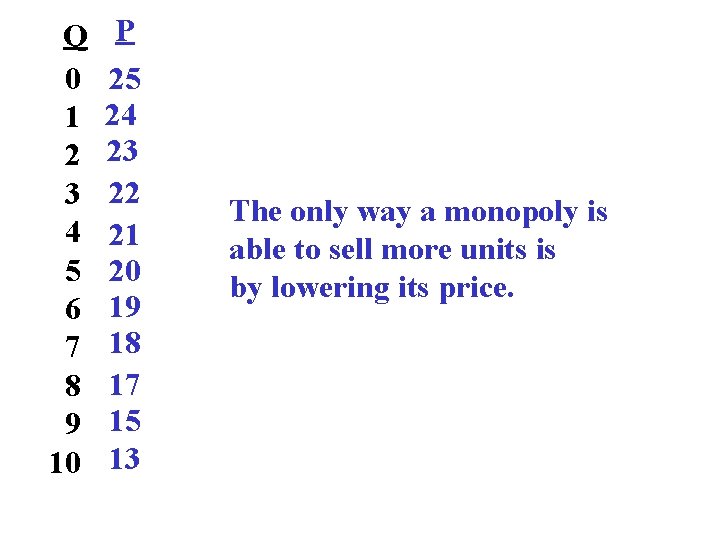
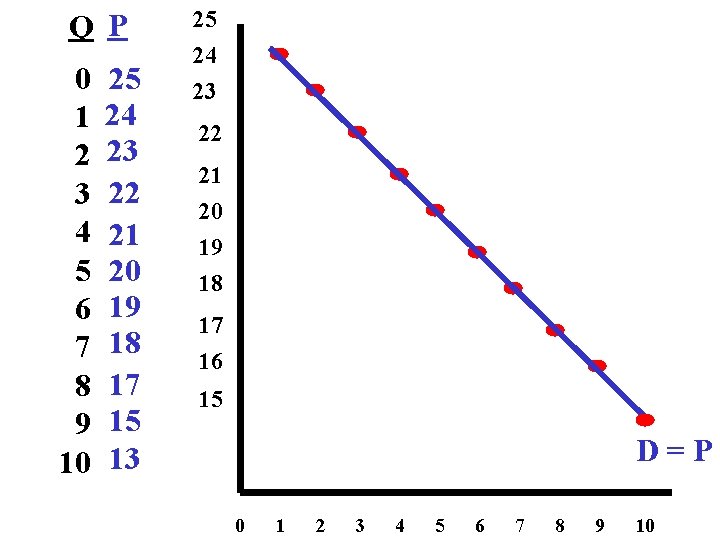
Q 0 1 2 3 4 5 6 7 8 9 10 P 25 24 23 22 21 20 19 18 17 15 13 The only way a monopoly is able to sell more units is by lowering its price.
Q P 0 1 2 3 4 5 6 7 8 9 10 25 24 23 22 21 20 19 18 17 15 13 25 24 23 22 21 20 19 18 17 16 15 D=P 0 1 2 3 4 5 6 7 8 9 10
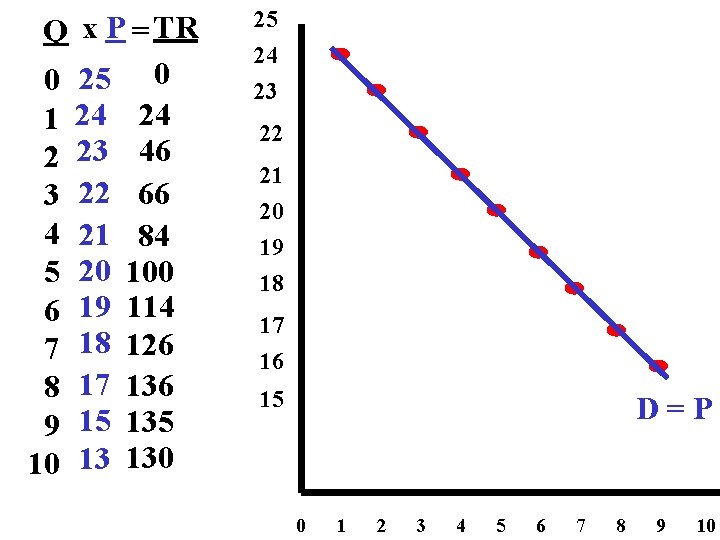
Q x P = TR 0 25 0 1 24 24 2 23 46 3 22 66 4 21 84 5 20 100 6 19 114 7 18 126 8 17 136 9 15 135 10 13 130 25 24 23 22 21 20 19 18 17 16 15 D=P 0 1 2 3 4 5 6 7 8 9 10
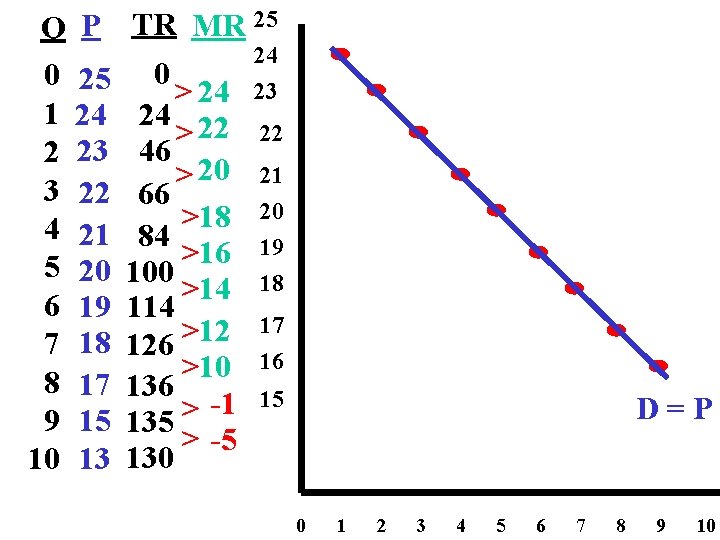
Q P 0 25 1 24 2 23 3 22 4 21 5 20 6 19 7 18 8 17 9 15 10 13 TR MR 25 24 0 > 24 23 24 22 22 > 46 > 20 21 66 >18 20 84 >16 19 100 >14 18 114 17 > 12 126 >10 16 136 -1 15 > 135 > -5 130 D=P 0 1 2 3 4 5 6 7 8 9 10
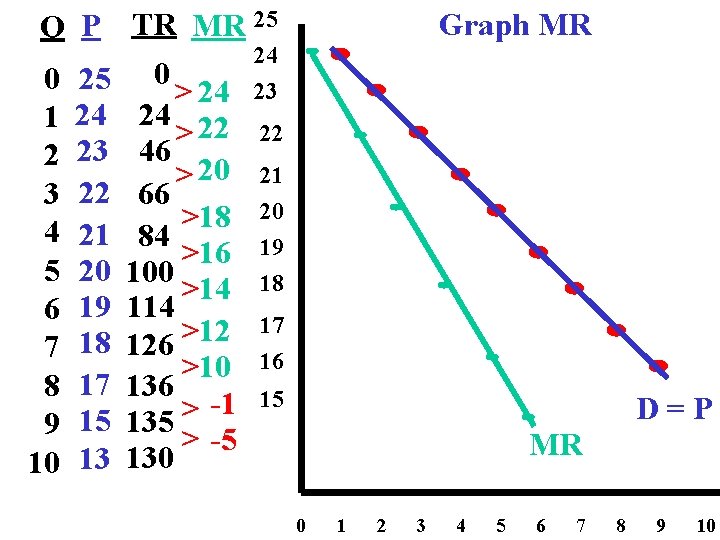
Q P TR MR 25 24 0 25 0 > 24 23 1 24 24 > 22 22 2 23 46 20 21 > 3 22 66 20 > 18 4 21 84 >16 19 5 20 100 >14 18 6 19 114 17 > 12 7 18 126 >10 16 8 17 136 -1 15 > 9 15 135 > -5 10 13 130 Graph MR D=P MR 0 1 2 3 4 5 6 7 8 9 10
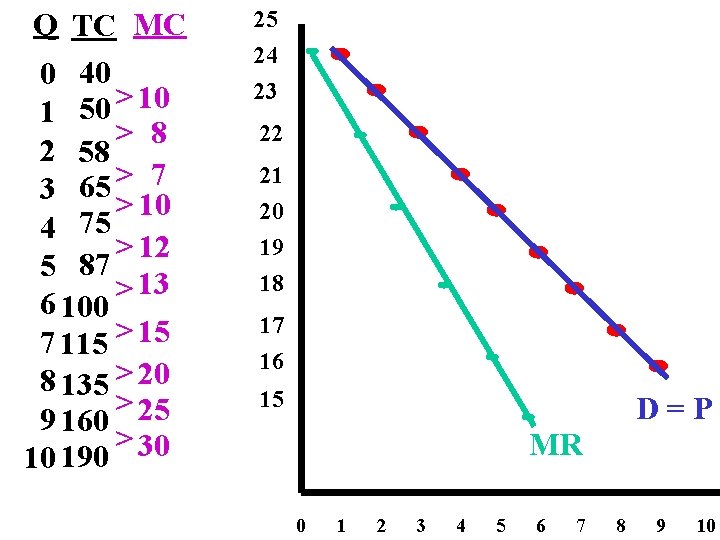
Q TC MC 0 40 > 10 50 1 > 8 2 58 7 3 65 > > 10 4 75 > 12 5 87 13 > 6 100 7 115 > 15 8 135 > 20 > 25 9 160 > 30 10 190 25 24 23 22 21 20 19 18 17 16 15 D=P MR 0 1 2 3 4 5 6 7 8 9 10
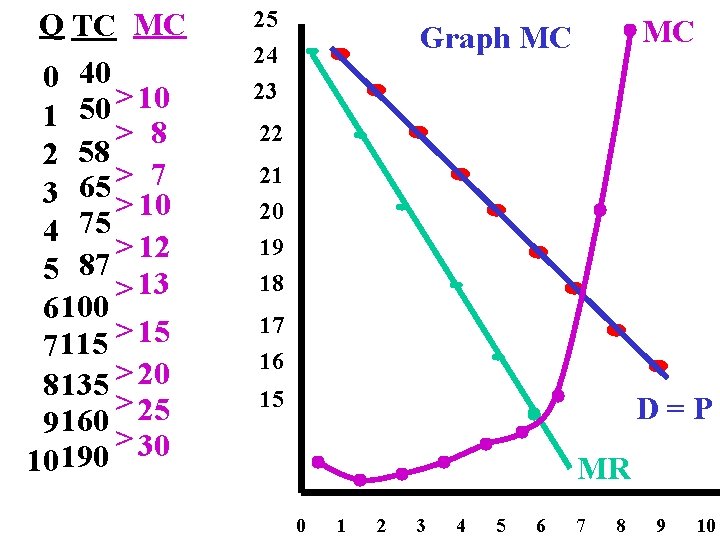
Q TC MC 0 40 > 10 50 1 > 8 2 58 > 7 65 3 > 10 4 75 > 12 5 87 13 > 6 100 > 15 115 7 8 135 > 20 > 25 9 160 > 30 190 10 25 24 23 MC Graph MC 22 21 20 19 18 17 16 15 D=P MR 0 1 2 3 4 5 6 7 8 9 10
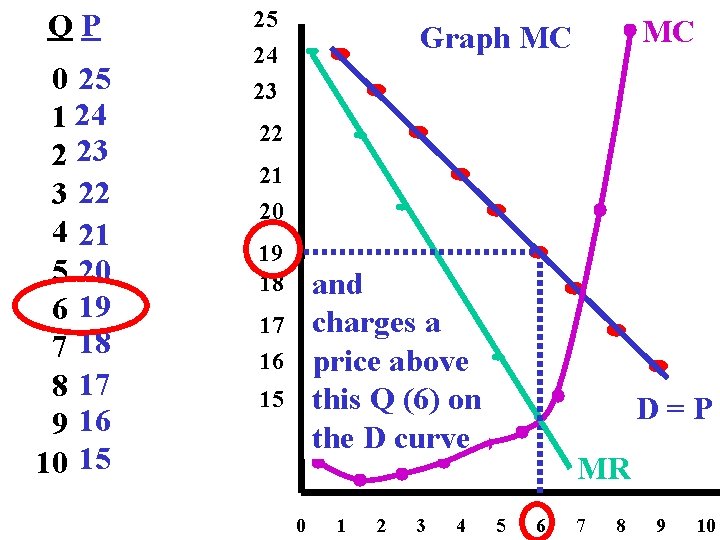
QTC P MC 25 0 40 > 10 50 1 24 > 8 58 2 23 > 7 65 3 22 > 10 4 75 21 > 12 20 13 5 87 > 19 6100 > 15 18 115 7 17 > 20 8135 > 25 16 9160 > 30 15 10190 25 24 23 MC Graph MC 22 21 20 19 18 A and monopolist charges a produces price above where this Q (6) on MRD= curve MC the 17 16 15 0 1 2 3 4 D=P MR 5 6 7 8 9 10
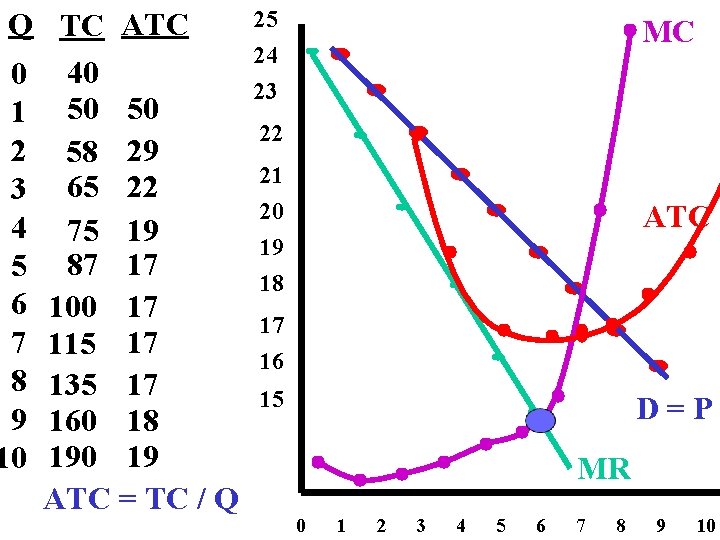
Q TC ATC 0 40 1 50 50 2 58 29 3 65 22 4 75 19 5 87 17 6 100 17 7 115 17 8 135 17 9 160 18 10 19 ATC = TC / Q 25 24 23 MC 22 21 20 19 18 ATC 17 16 15 D=P MR 0 1 2 3 4 5 6 7 8 9 10
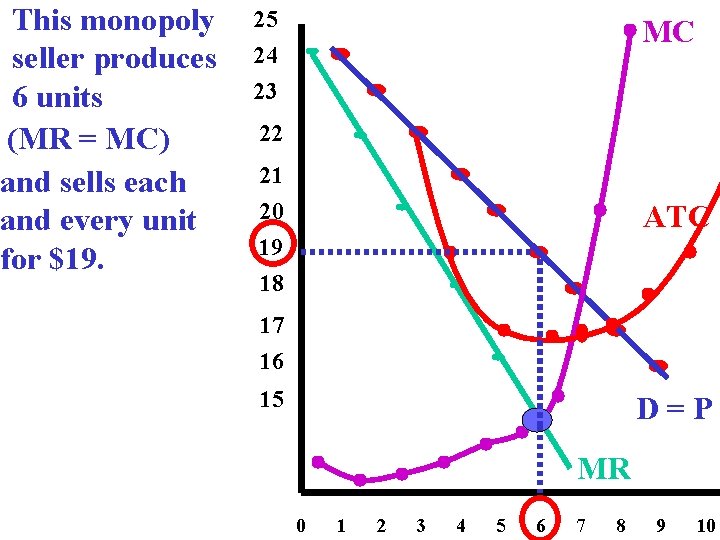
This monopoly seller produces 6 units (MR = MC) and sells each and every unit for $19. 25 24 23 MC 22 21 20 19 18 ATC 17 16 15 D=P MR 0 1 2 3 4 5 6 7 8 9 10
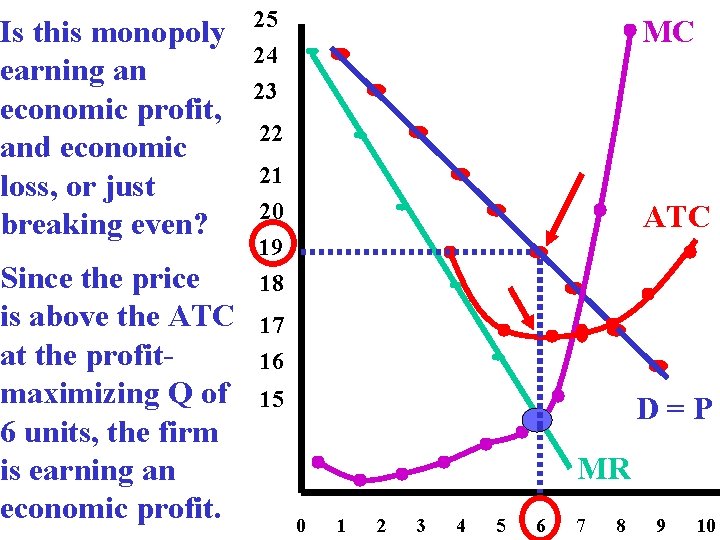
Is this monopoly earning an economic profit, and economic loss, or just breaking even? Since the price is above the ATC at the profitmaximizing Q of 6 units, the firm is earning an economic profit. 25 24 23 MC 22 21 20 19 18 ATC 17 16 15 D=P MR 0 1 2 3 4 5 6 7 8 9 10
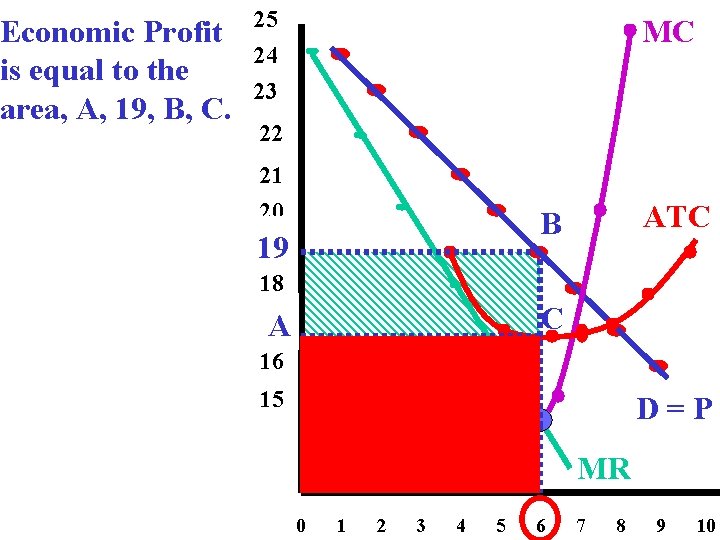
Economic Profit is equal to the area, A, 19, B, C. 25 24 23 MC 22 21 20 19 19 18 ATC B C 17 A 16 15 D=P MR 0 1 2 3 4 5 6 7 8 9 10
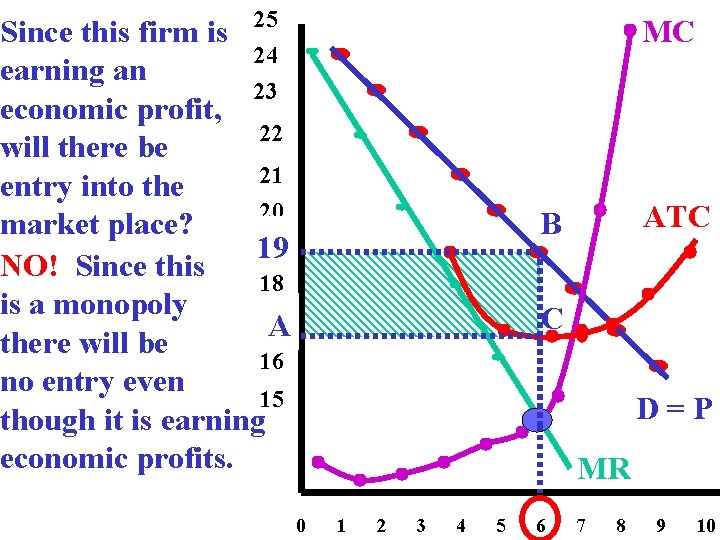
25 24 23 Since this firm is earning an economic profit, 22 will there be 21 entry into the 20 market place? 19 19 NO! Since this 18 is a monopoly 17 A there will be 16 no entry even 15 though it is earning economic profits. MC ATC B C D=P MR 0 1 2 3 4 5 6 7 8 9 10
Allocative efficiency is where P=MC Productive efficiency is where P=Minimum ATC
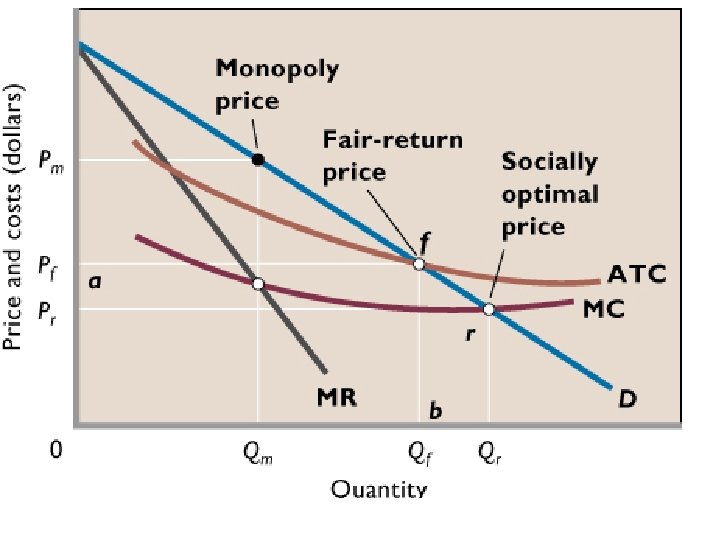
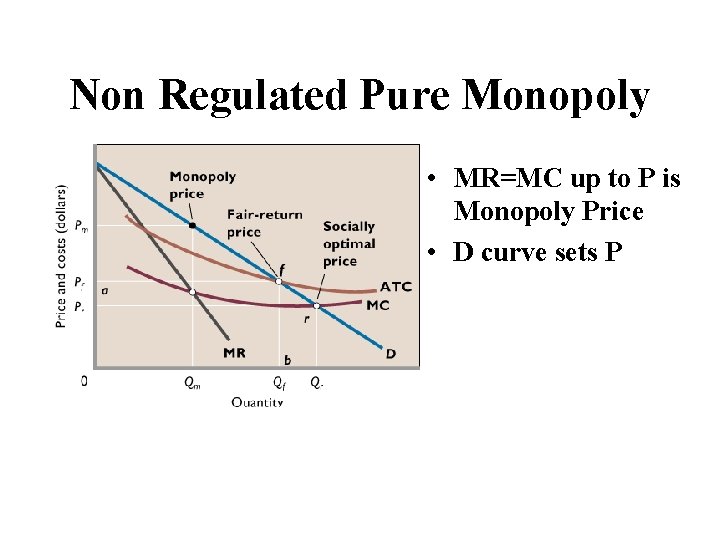
Non Regulated Pure Monopoly • MR=MC up to P is Monopoly Price • D curve sets P
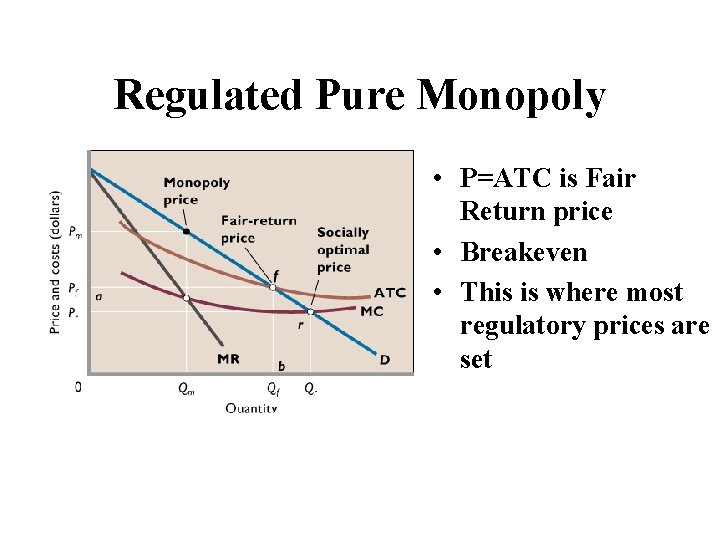
Regulated Pure Monopoly • P=ATC is Fair Return price • Breakeven • This is where most regulatory prices are set
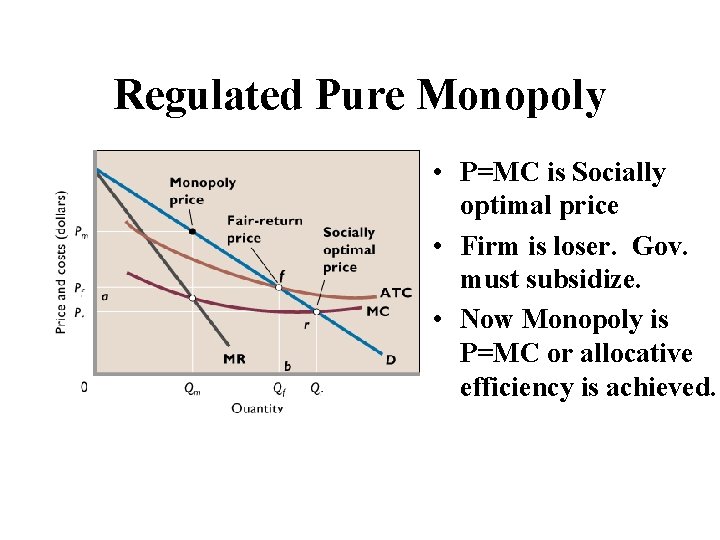
Regulated Pure Monopoly • P=MC is Socially optimal price • Firm is loser. Gov. must subsidize. • Now Monopoly is P=MC or allocative efficiency is achieved.