
Pure Competition in the ShortRun Assumptions of Perfect
- Slides: 21
Pure Competition in the Short-Run
Assumptions of Perfect Competition �Pure competition is rare in the real world. However, the model provides a standard for evaluating the efficiency in market economies. �There are three major features of perfectly competitive markets � 1) Many Buyers and Sellers: no seller or buyer is large enough to have any control over prices. o A perfect competitor is a price taker � 2) Standard Product: the products are homogeneous (identical) � 3) Easy Entry and Exit: there are no barriers to entry or
Short-run versus Long-run �Short-run: is the time period in which at least one input is fixed o This implies that in the short-run firms can neither enter or exit the market �Long-run: is the time period in which all inputs can be adjusted o This implies that in the long-run new firms can enter and existing firms can exit the market
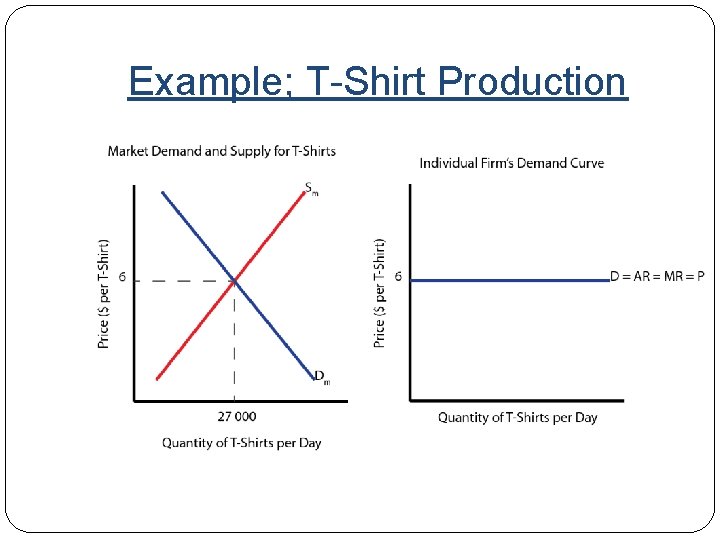
Perfect Competitor’s Demand �A perfect competitor is a price taker �This means that the firm takes the prices determined in the market place by supply and demand �Therefore, the demand curve faced by the individual firm in the market is perfectly elastic. �That is, customers will buy all that any individual firm might want to produce at the going market price and none at a higher price. �Because firms are profit maximizers it is irrational to sell at a lower price, as sales will not increase
Example; T-Shirt Production
Output under Perfect-Competition �Question: How much should a firm produce? o The answer depends on the firms objective. o Economists usually assume the firms objective is to maximize profits o Profit = Total revenue (TR) – Total costs (TC) �There are three key revenue relationships that we need to examine for perfect competition � 1) Total Revenue (TR) o Total revenue is the total earnings from selling a product o TR = Price (P) × Quantity (Q)
� 2) Average Revenue (AR) o Average revenue is the firms total revenue per unit of output o AR = TR ÷ Q = PQ ÷ Q =P � 3) Marginal Revenue (MR) o Marginal revenue is the extra revenue earned when the firm sells another unit of output o MR = ∆ TR ÷ ∆ Q =P
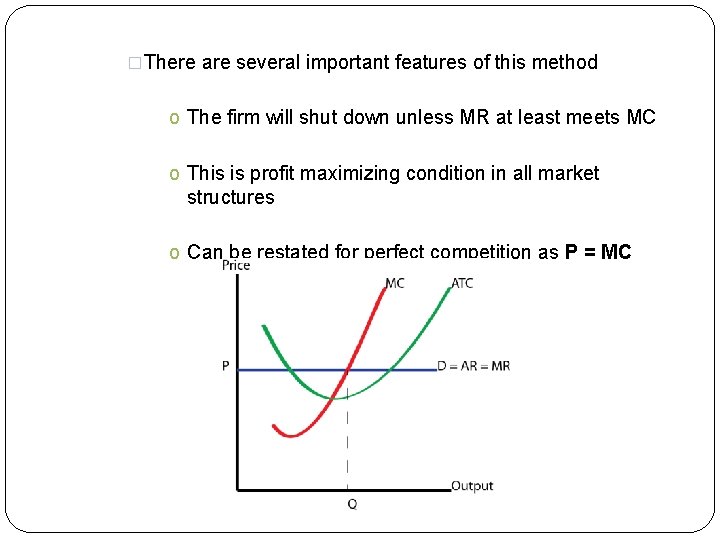
Short-run Equilibrium �There are two ways to determine the level of output at which a competitive firm will realize maximum profit or alternatively minimize loss o Marginal revenue-marginal cost approach o Total-revenue-total cost approach �Marginal Revenue –Marginal Cost Approach: the firm compares the amount each additional unit output adds to revenue (marginal revenue) and the additional cost each unit of output adds (marginal cost). o In the short run, this approach predicts profit will be maximized, or loss minimized for a firm at MR = MC.
�There are several important features of this method o The firm will shut down unless MR at least meets MC o This is profit maximizing condition in all market structures o Can be restated for perfect competition as P = MC
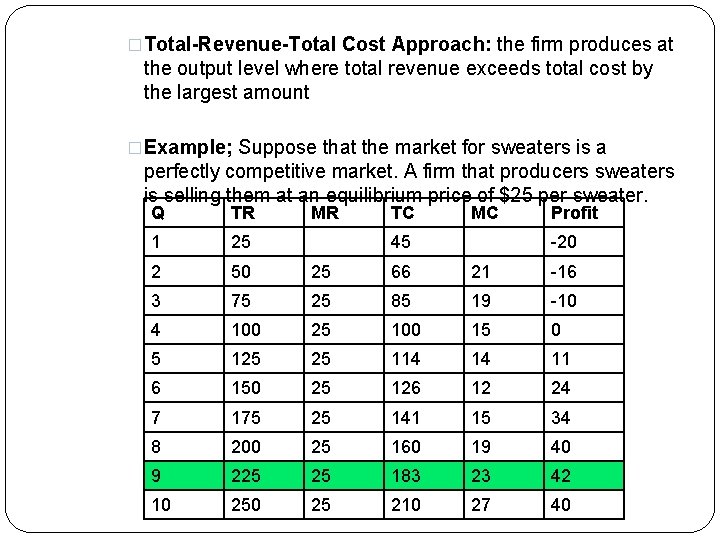
�Total-Revenue-Total Cost Approach: the firm produces at the output level where total revenue exceeds total cost by the largest amount �Example; Suppose that the market for sweaters is a perfectly competitive market. A firm that producers sweaters is selling them at an equilibrium price of $25 per sweater. Q TR MR TC MC 1 25 2 50 25 66 21 -16 3 75 25 85 19 -10 4 100 25 100 15 0 5 125 25 114 14 11 6 150 25 126 12 24 7 175 25 141 15 34 8 200 25 160 19 40 9 225 25 183 23 42 10 25 210 27 40 45 Profit -20
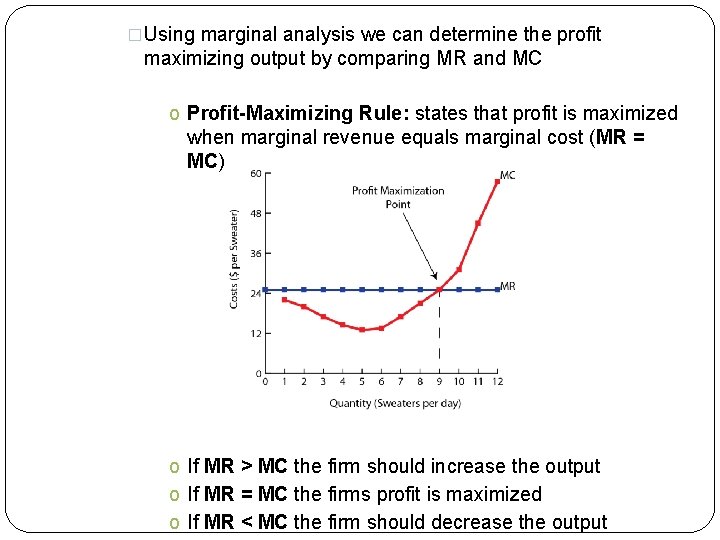
�Using marginal analysis we can determine the profit maximizing output by comparing MR and MC o Profit-Maximizing Rule: states that profit is maximized when marginal revenue equals marginal cost (MR = MC) o If MR > MC the firm should increase the output o If MR = MC the firms profit is maximized o If MR < MC the firm should decrease the output
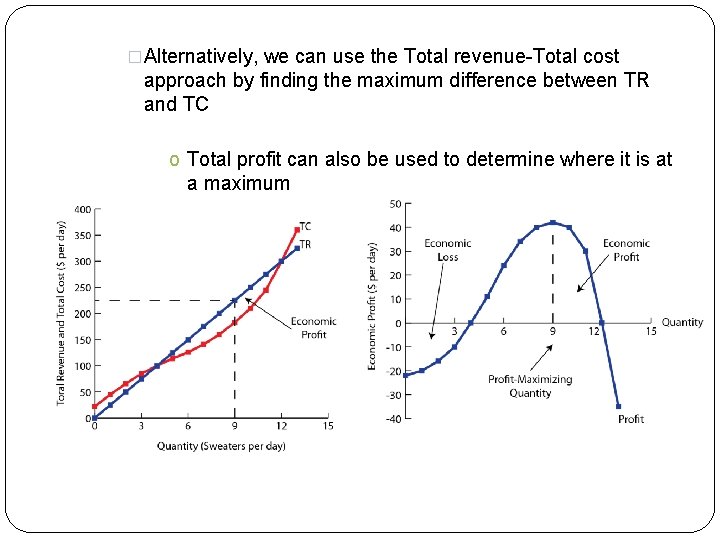
�Alternatively, we can use the Total revenue-Total cost approach by finding the maximum difference between TR and TC o Total profit can also be used to determine where it is at a maximum
Profit and Losses in the Short. Run �Even when the firm produces its profit-maximizing output, the firm may earn negative, zero or positive profits �Recall, Profit = TR – TC = PQ – TC = [(PQ ÷ Q) – (TC ÷ Q)] × Q = [P – AC] × Q �To determine whether a firm is making an economic profit or incurring and economic loss, we compare the firms average total cost at the profit-maximizing output with the market price �There are three possible cases when determining the profit maximizing or cost-minimizing output
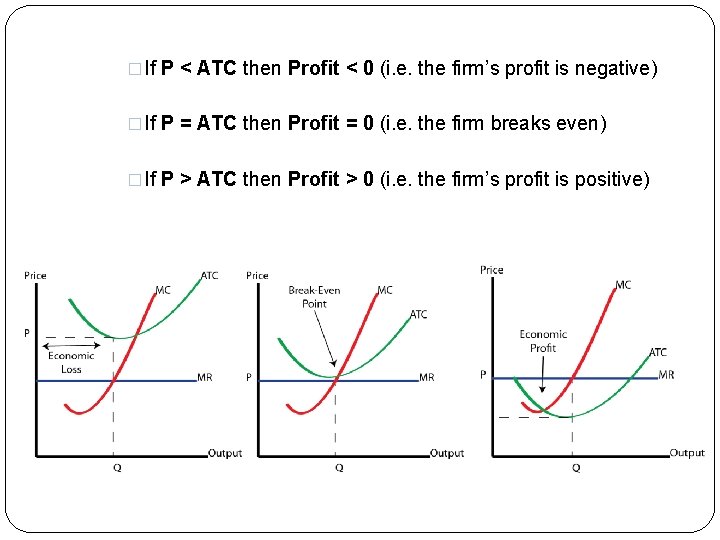
�If P < ATC then Profit < 0 (i. e. the firm’s profit is negative) �If P = ATC then Profit = 0 (i. e. the firm breaks even) �If P > ATC then Profit > 0 (i. e. the firm’s profit is positive)
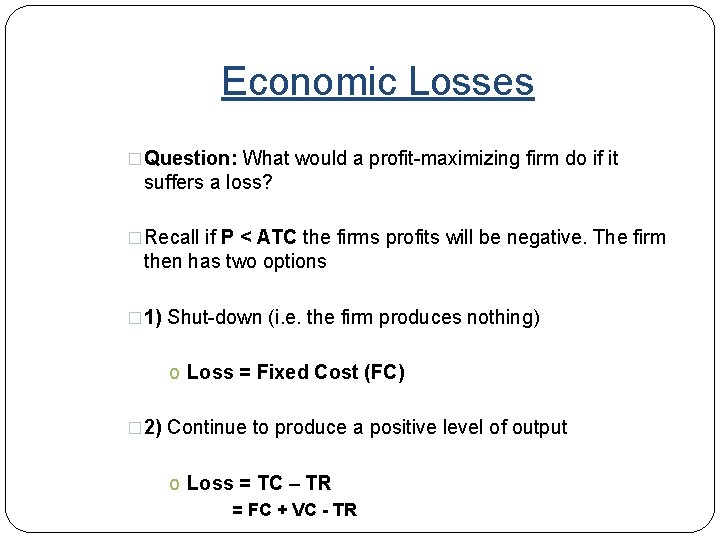
Economic Losses �Question: What would a profit-maximizing firm do if it suffers a loss? �Recall if P < ATC the firms profits will be negative. The firm then has two options � 1) Shut-down (i. e. the firm produces nothing) o Loss = Fixed Cost (FC) � 2) Continue to produce a positive level of output o Loss = TC – TR = FC + VC - TR
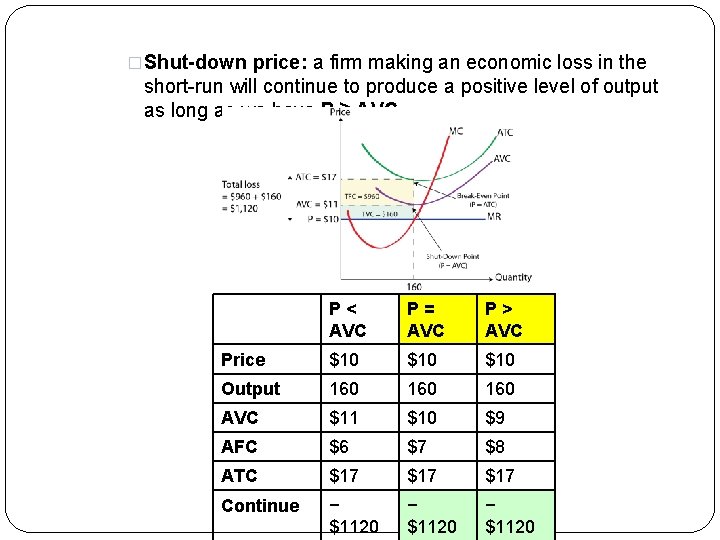
�Shut-down price: a firm making an economic loss in the short-run will continue to produce a positive level of output as long as we have P ≥ AVC P< AVC P= AVC P> AVC Price $10 $10 Output 160 160 AVC $11 $10 $9 AFC $6 $7 $8 ATC $17 $17 Continue − $1120
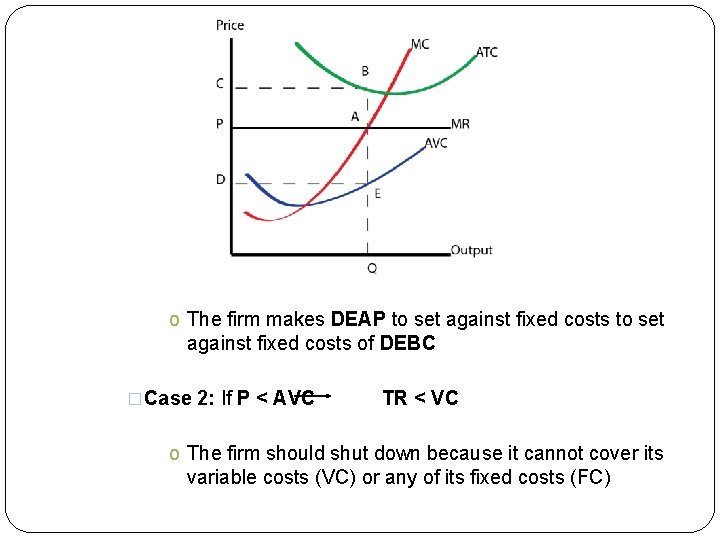
�There are two cases that need to be examined in order to determine whether a firm should shut-down. �Case 1: If P > AVC TR > VC o The firm should continue producing in the short-run because it can cover all its variable costs and some of its fixed costs o That is, the firm’s loss will be less than its FC if it continues to produce o Hence, it should remain in business because fixed costs (FC) have to be paid even if the firm produces nothing o Suppose the firm is making losses PABC
o The firm makes DEAP to set against fixed costs of DEBC �Case 2: If P < AVC TR < VC o The firm should shut down because it cannot cover its variable costs (VC) or any of its fixed costs (FC)
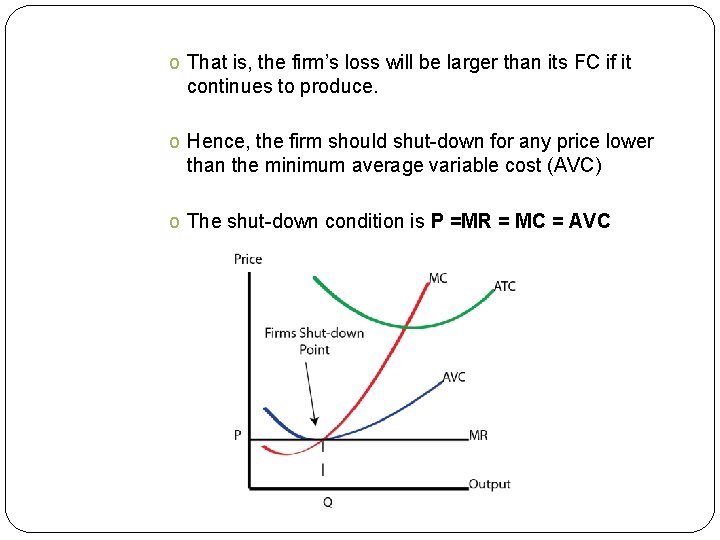
o That is, the firm’s loss will be larger than its FC if it continues to produce. o Hence, the firm should shut-down for any price lower than the minimum average variable cost (AVC) o The shut-down condition is P =MR = MC = AVC
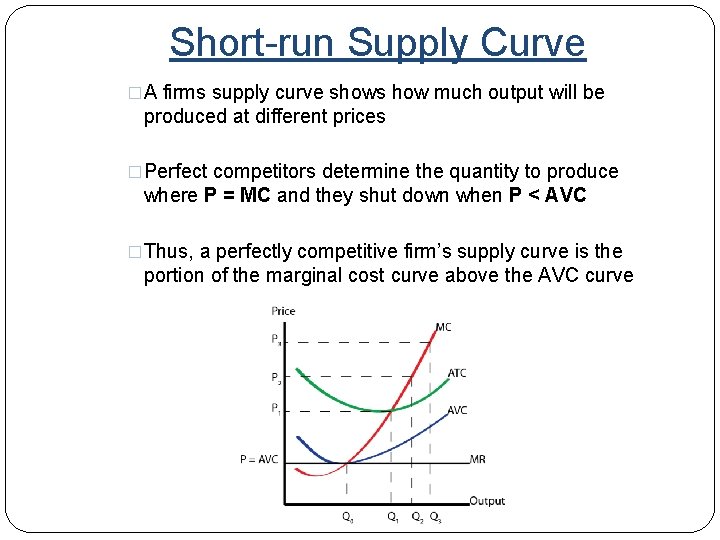
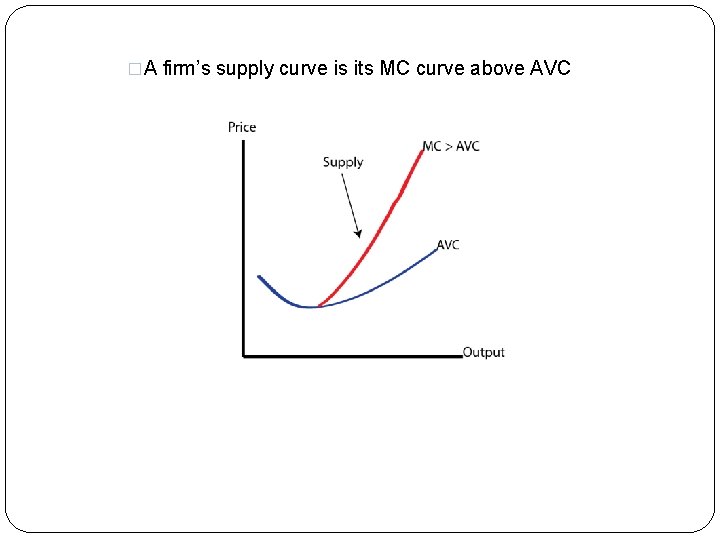
Short-run Supply Curve �A firms supply curve shows how much output will be produced at different prices �Perfect competitors determine the quantity to produce where P = MC and they shut down when P < AVC �Thus, a perfectly competitive firm’s supply curve is the portion of the marginal cost curve above the AVC curve
�A firm’s supply curve is its MC curve above AVC