
PURDUE P 2 SACSafety shower and eyewash system

- Slides: 15
PURDUE P 2 SACSafety shower and eyewash system STUDENT: Xinyu Zhen MENTOR: Dr. Ray A. Mentzer 05/14/2021
Summary This project is about safety shower and eyewash system survey results and recommended best practices. Country. Mark, SABIC and 3 M participated in an effort to develop and conduct a survey of issues with the use of safety shower and eyewash units in refinery, chemical and manufacturing facilities. Eleven responses were received from: Tate & Lyle, Celanese, Cummins, 3 M, Marathon, Country. Mark, Corteva, American Chemistry Council, SABIC (Mount Vernon, IN), SABIC (Ottawa, IL), and Qual. Ex. Survey questions were summarized in six categories: a. General; b. Water source; c. Corrosion; d. Maintenance, training, and management systems; e. Self-contained devices; f. Other issues or comments. All results are provided in a 52 -page report.
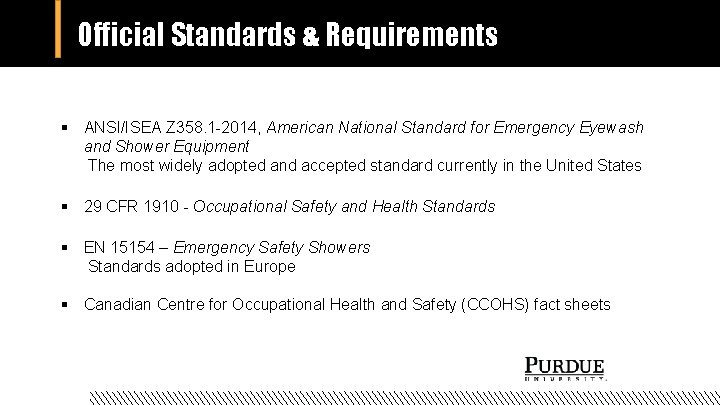
Official Standards & Requirements § ANSI/ISEA Z 358. 1 -2014, American National Standard for Emergency Eyewash and Shower Equipment The most widely adopted and accepted standard currently in the United States § 29 CFR 1910 - Occupational Safety and Health Standards § EN 15154 – Emergency Safety Showers Standards adopted in Europe § Canadian Centre for Occupational Health and Safety (CCOHS) fact sheets
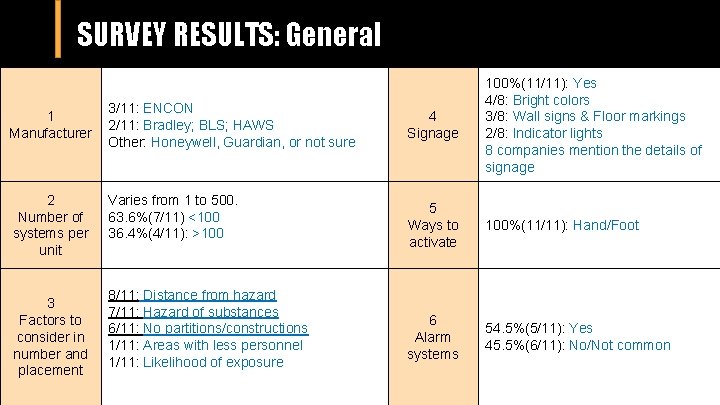
SURVEY RESULTS: General 1 Manufacturer 2 Number of systems per unit 3 Factors to consider in number and placement 3/11: ENCON 2/11: Bradley; BLS; HAWS Other: Honeywell, Guardian, or not sure Varies from 1 to 500. 63. 6%(7/11) <100 36. 4%(4/11): >100 8/11: Distance from hazard 7/11: Hazard of substances 6/11: No partitions/constructions 1/11: Areas with less personnel 1/11: Likelihood of exposure 4 Signage 100%(11/11): Yes 4/8: Bright colors 3/8: Wall signs & Floor markings 2/8: Indicator lights 8 companies mention the details of signage 5 Ways to activate 100%(11/11): Hand/Foot 6 Alarm systems 54. 5%(5/11): Yes 45. 5%(6/11): No/Not common
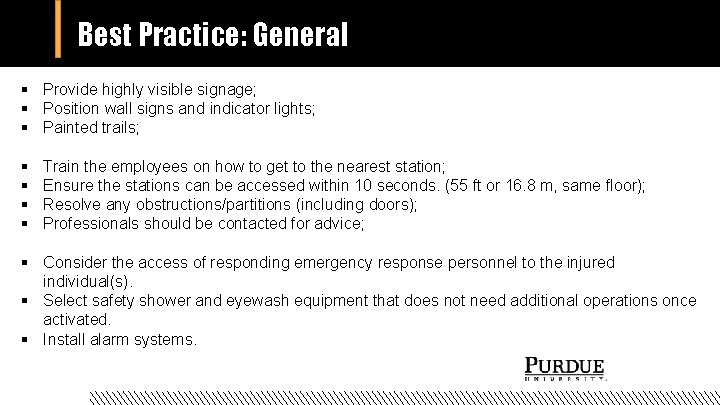
Best Practice: General § Provide highly visible signage; § Position wall signs and indicator lights; § Painted trails; § § Train the employees on how to get to the nearest station; Ensure the stations can be accessed within 10 seconds. (55 ft or 16. 8 m, same floor); Resolve any obstructions/partitions (including doors); Professionals should be contacted for advice; § Consider the access of responding emergency response personnel to the injured individual(s). § Select safety shower and eyewash equipment that does not need additional operations once activated. § Install alarm systems.
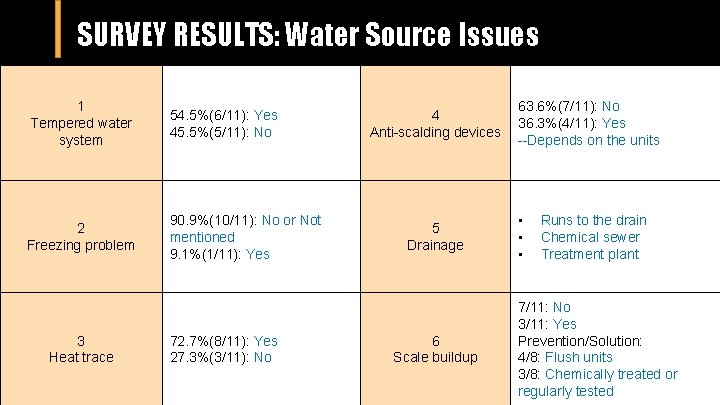
SURVEY RESULTS: Water Source Issues 1 Tempered water system 54. 5%(6/11): Yes 45. 5%(5/11): No 2 Freezing problem 90. 9%(10/11): No or Not mentioned 9. 1%(1/11): Yes 3 Heat trace 72. 7%(8/11): Yes 27. 3%(3/11): No 4 Anti-scalding devices 5 Drainage 6 Scale buildup 63. 6%(7/11): No 36. 3%(4/11): Yes --Depends on the units • • • Runs to the drain Chemical sewer Treatment plant 7/11: No 3/11: Yes Prevention/Solution: 4/8: Flush units 3/8: Chemically treated or regularly tested
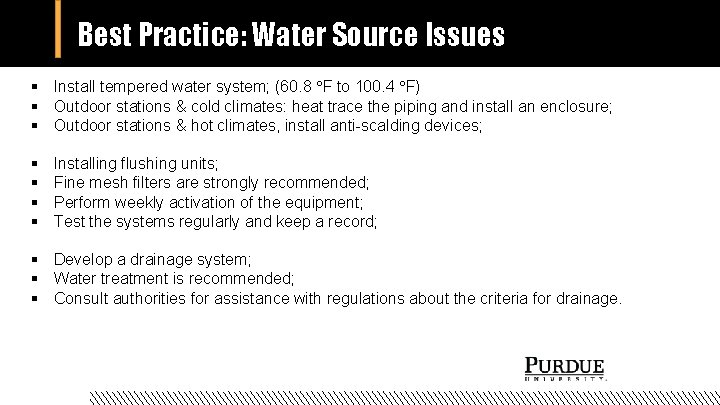
Best Practice: Water Source Issues § Install tempered water system; (60. 8 F to 100. 4 F) § Outdoor stations & cold climates: heat trace the piping and install an enclosure; § Outdoor stations & hot climates, install anti-scalding devices; § § Installing flushing units; Fine mesh filters are strongly recommended; Perform weekly activation of the equipment; Test the systems regularly and keep a record; § Develop a drainage system; § Water treatment is recommended; § Consult authorities for assistance with regulations about the criteria for drainage.
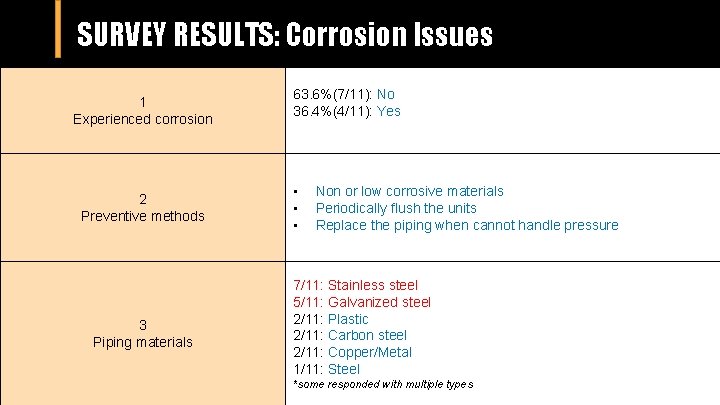
SURVEY RESULTS: Corrosion Issues 1 Experienced corrosion 2 Preventive methods 3 Piping materials 63. 6%(7/11): No 36. 4%(4/11): Yes • • • Non or low corrosive materials Periodically flush the units Replace the piping when cannot handle pressure 7/11: Stainless steel 5/11: Galvanized steel 2/11: Plastic 2/11: Carbon steel 2/11: Copper/Metal 1/11: Steel *some responded with multiple types
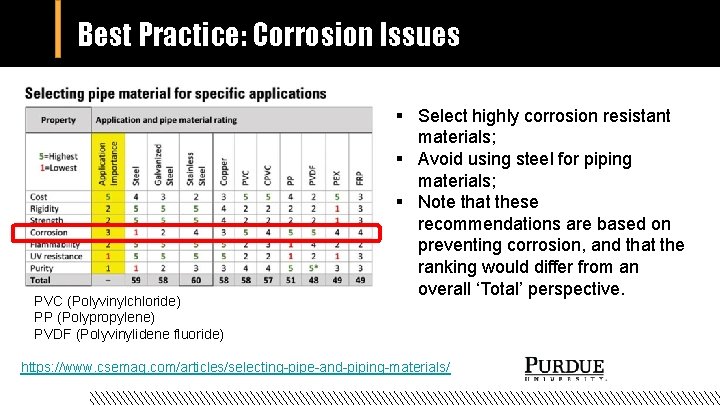
Best Practice: Corrosion Issues PVC (Polyvinylchloride) PP (Polypropylene) PVDF (Polyvinylidene fluoride) § Select highly corrosion resistant materials; § Avoid using steel for piping materials; § Note that these recommendations are based on preventing corrosion, and that the ranking would differ from an overall ‘Total’ perspective. https: //www. csemag. com/articles/selecting-pipe-and-piping-materials/
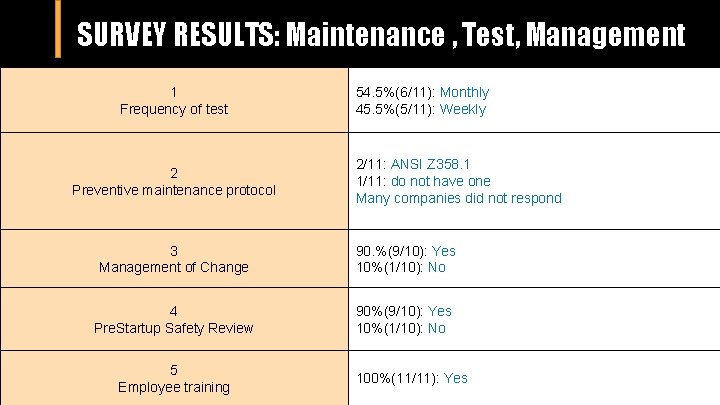
SURVEY RESULTS: Maintenance , Test, Management 1 Frequency of test 2 Preventive maintenance protocol 54. 5%(6/11): Monthly 45. 5%(5/11): Weekly 2/11: ANSI Z 358. 1 1/11: do not have one Many companies did not respond 3 Management of Change 90. %(9/10): Yes 10%(1/10): No 4 Pre. Startup Safety Review 90%(9/10): Yes 10%(1/10): No 5 Employee training 100%(11/11): Yes
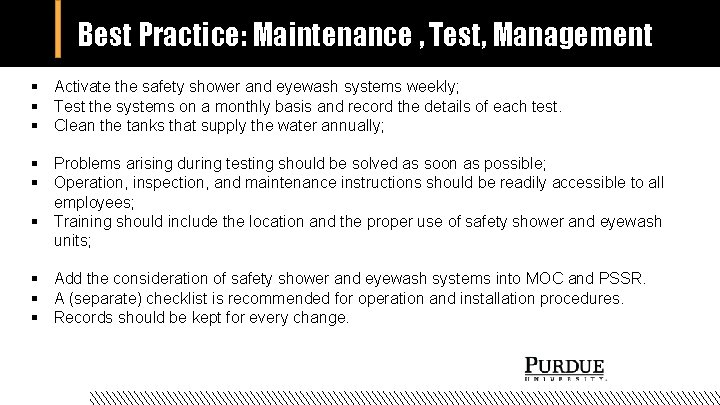
Best Practice: Maintenance , Test, Management § Activate the safety shower and eyewash systems weekly; § Test the systems on a monthly basis and record the details of each test. § Clean the tanks that supply the water annually; § Problems arising during testing should be solved as soon as possible; § Operation, inspection, and maintenance instructions should be readily accessible to all employees; § Training should include the location and the proper use of safety shower and eyewash units; § Add the consideration of safety shower and eyewash systems into MOC and PSSR. § A (separate) checklist is recommended for operation and installation procedures. § Records should be kept for every change.
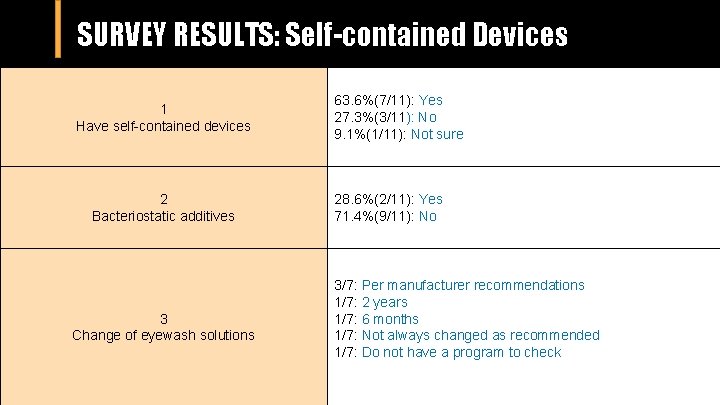
SURVEY RESULTS: Self-contained Devices 1 Have self-contained devices 2 Bacteriostatic additives 3 Change of eyewash solutions 63. 6%(7/11): Yes 27. 3%(3/11): No 9. 1%(1/11): Not sure 28. 6%(2/11): Yes 71. 4%(9/11): No 3/7: Per manufacturer recommendations 1/7: 2 years 1/7: 6 months 1/7: Not always changed as recommended 1/7: Do not have a program to check
Best Practice: Self-contained Devices § Provide sufficient number of easily accessible self-contained devices in each unit. § Add bacteriostatic additives as per manufacturer. § Train employees on operating self-contained devices. § Change the water in the bottle per manufacturer’s recommendation.
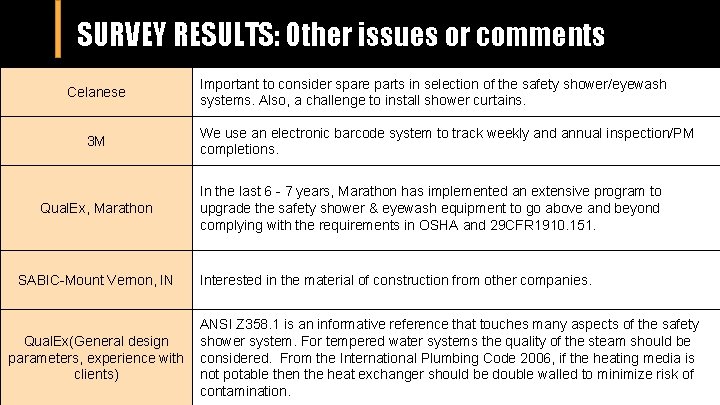
SURVEY RESULTS: Other issues or comments Celanese 3 M Qual. Ex, Marathon SABIC-Mount Vernon, IN Qual. Ex(General design parameters, experience with clients) Important to consider spare parts in selection of the safety shower/eyewash systems. Also, a challenge to install shower curtains. We use an electronic barcode system to track weekly and annual inspection/PM completions. In the last 6 - 7 years, Marathon has implemented an extensive program to upgrade the safety shower & eyewash equipment to go above and beyond complying with the requirements in OSHA and 29 CFR 1910. 151. Interested in the material of construction from other companies. ANSI Z 358. 1 is an informative reference that touches many aspects of the safety shower system. For tempered water systems the quality of the steam should be considered. From the International Plumbing Code 2006, if the heating media is not potable then the heat exchanger should be double walled to minimize risk of contamination.
Thank You! Questions?