
Purchasing strategy Market Assessment Business Need Supplier Selection
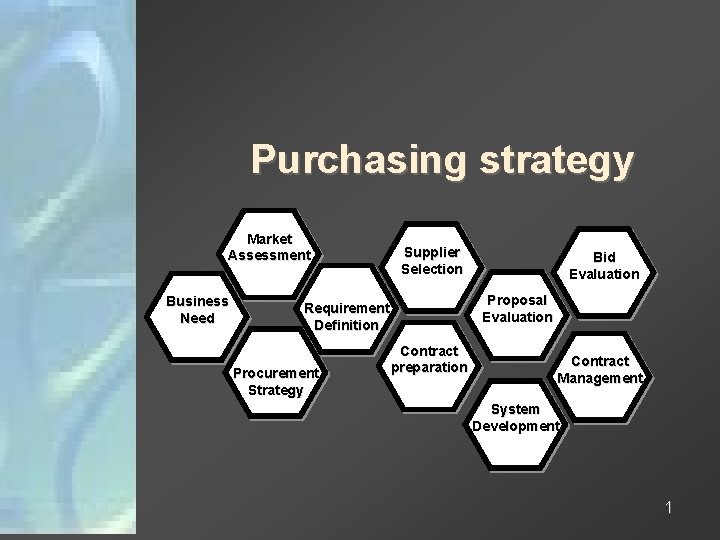
Purchasing strategy Market Assessment Business Need Supplier Selection Proposal Evaluation Requirement Definition Procurement Strategy Bid Evaluation Contract preparation Contract Management System Development 1
Purchasing objectives Buy to requirements so that • Inventory is available when, where and in wanted form (minimum effort to use) • Least cost for quality • Optimise purchasing department/function overheads, accumulated costs, cash flow, warehousing & timely delivery The BUYER is the KEY - responsible for researching, placing and progressing orders. 2
What research goes into purchasing? • Supplier investigation: competencies, capacities, credit rating, service quality • Our dependency on particular suppliers • Competitor information • Advising suppliers on how to meet our quality requirements • Economic forecasting & the supplier • Purchase targets & their attainment • Financial targets & our profit plan • Value analysis - of buying processes & items we buy • Our quality/service requirements & control methods 3
Purchasing procedures & methods? • Purchasing by commodity group – – – Knowledge of the buyer Price leverages Data collection & analysis • Exception for action & progress reports for planning • Audit & monitoring procedures: wastage, obsolescence, theft, stock-outs. Pareto 80/20, warehousing costs 4

Procurement - Key Skills? 1. 2. 3. 4. 5. 6. 7. 8. 9. 10. 11. 12. 13. Business awareness and strategic procurement Developing & managing procurement systems Purchasing techniques and methods Supplier evaluation and selection Risk and value management Contract management Legal aspects of procurement (contracts) Purchasing negotiations Quality management Service level agreements Ethical behaviours in procurement Relationship management (client-server) Performance evaluation of suppliers & self Change management 5

Buying and negotiation? • Supplier partnerships vs. competitive (least cost) buying • Negotiation skills – researching sources, assessing sources, customer relationships management, win-win & mutual respect. – Methods to keep costs down - tendering, WWW & B 2 B, Buying portals – Negotiate: preparation, the negotiation, completing the buy. – Attention to detail – Humour, patience, self-control, Avoid dramatics – Analytical approach to problems – Questioning & listening – Verification - contract formulation & testing 6
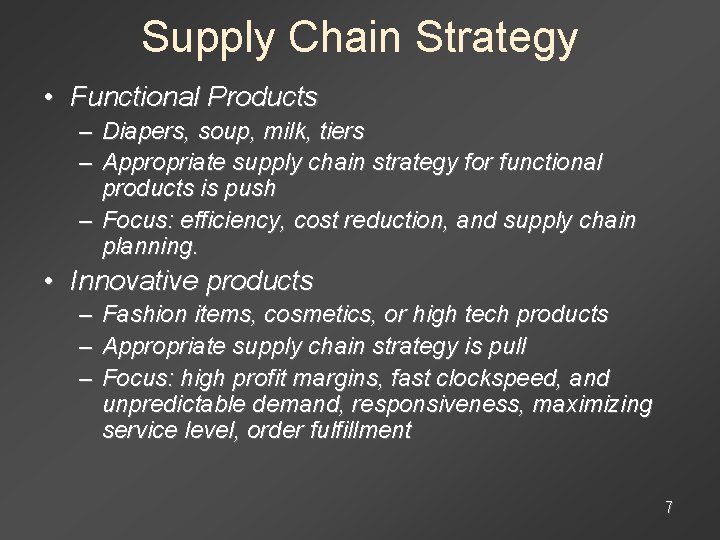
Supply Chain Strategy • Functional Products – Diapers, soup, milk, tiers – Appropriate supply chain strategy for functional products is push – Focus: efficiency, cost reduction, and supply chain planning. • Innovative products – Fashion items, cosmetics, or high tech products – Appropriate supply chain strategy is pull – Focus: high profit margins, fast clockspeed, and unpredictable demand, responsiveness, maximizing service level, order fulfillment 7

Procurement Strategy for the Two Types • Functional Products – Focus should be on minimizing total landed cost • • • unit cost transportation cost inventory holding cost handling cost duties and taxation cost of financing – Sourcing from low-cost countries, e. g. , mainland China and Taiwan is appropriate • Innovative Products – Focus should be on reducing lead times and on supply flexibility. – Sourcing close to the market area – Short lead time may be achieved using air shipments 8
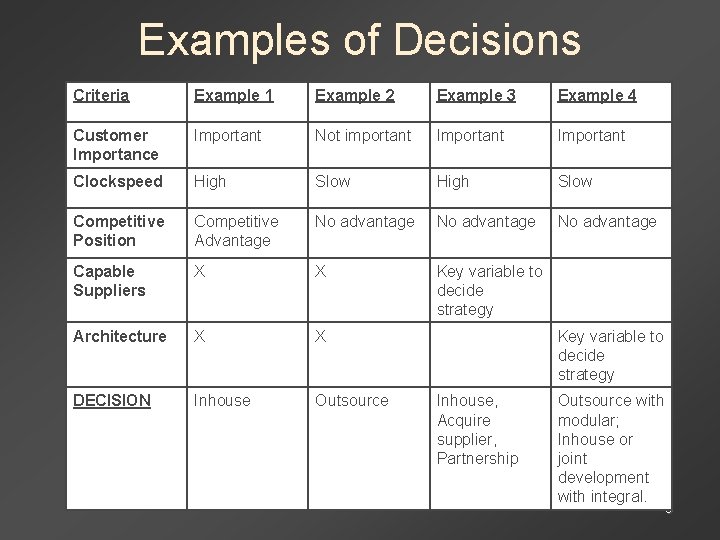
Examples of Decisions Criteria Example 1 Example 2 Example 3 Example 4 Customer Importance Important Not important Important Clockspeed High Slow Competitive Position Competitive Advantage No advantage Capable Suppliers X X Key variable to decide strategy Architecture X X DECISION Inhouse Outsource Key variable to decide strategy Inhouse, Acquire supplier, Partnership Outsource with modular; Inhouse or joint development with integral. 9
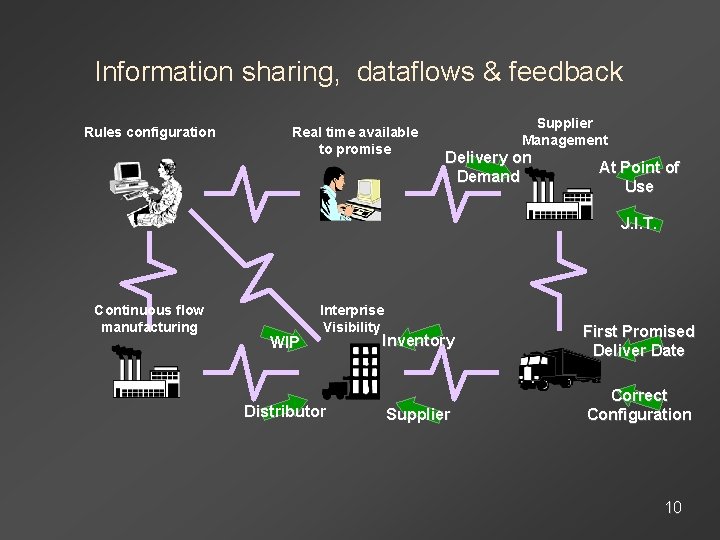
Information sharing, dataflows & feedback Rules configuration Real time available to promise Supplier Management Delivery on Demand At Point of Use J. I. T. Continuous flow manufacturing WIP Interprise Visibility Distributor Inventory Supplier First Promised Deliver Date Correct Configuration 10

Supply/Procurement Issues Quality Speed Reliabiity Flexibility Cost §make or buy (contract out) §market-based purchasing? §supply partnerships? Supply network relationships Capacity Process technologies Decisions Market competitiveness Performance objectives Resource Usage buyers market sellers market 11
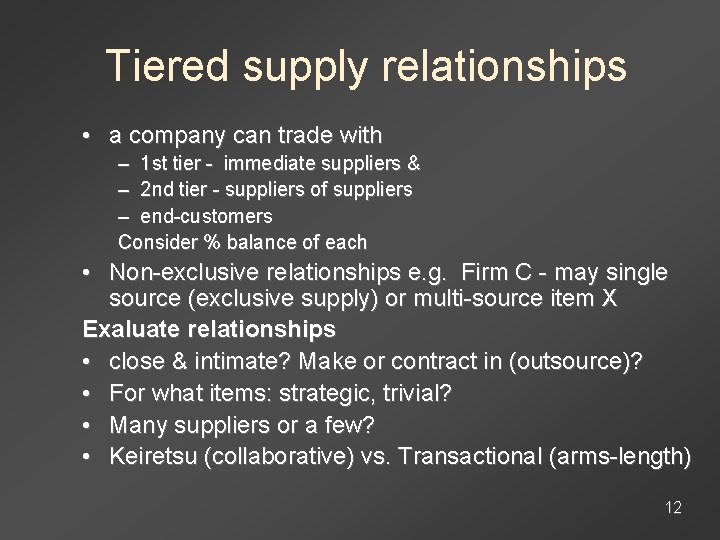
Tiered supply relationships • a company can trade with – 1 st tier - immediate suppliers & – 2 nd tier - suppliers of suppliers – end-customers Consider % balance of each • Non-exclusive relationships e. g. Firm C - may single source (exclusive supply) or multi-source item X Exaluate relationships • close & intimate? Make or contract in (outsource)? • For what items: strategic, trivial? • Many suppliers or a few? • Keiretsu (collaborative) vs. Transactional (arms-length) 12
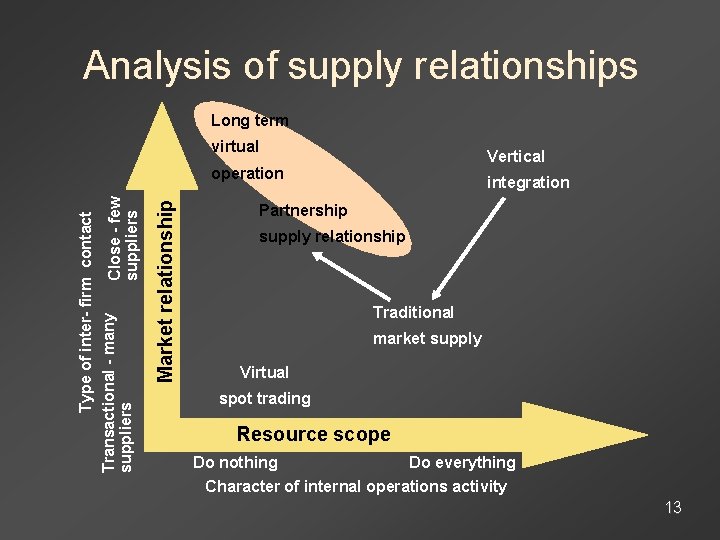
Analysis of supply relationships Long term virtual Vertical Market relationship Type of inter- firm contact Transactional - many Close - few suppliers operation integration Partnership supply relationship Traditional market supply Virtual spot trading Resource scope Do nothing Do everything Character of internal operations activity 13
- Slides: 13