
PURCHASING REQUIREMENTS AND CONTRACT MANAGEMENT 2019 Texas Association
- Slides: 33
PURCHASING REQUIREMENTS AND CONTRACT MANAGEMENT 2019 Texas Association of Community College Business Officers Annual Meeting and Conference Denise Cheney Bickerstaff Heath Delgado Acosta, LLP dcheney@bickerstaff. com https: //www. bickerstaff. com ©Denise V. Cheney 2019
1. Chapter 44, Subchapter B of the Texas Education Code is the main purchasing statute for Texas School Districts and Community Colleges. 2. Chapter 2269 of the Texas Government Code is the main procurement statute for construction projects. 3. Chapter 44, Subchapter B applies to junior college districts except for the “ purchase, acquisition, or license of library goods and services for a library operated as a part of a © Denise V. Cheney 2019
a. “Library goods and services” means: 1) serial and journal subscriptions, including electronic databases, 2) 3) 4) 5) digital content, and information products; other library materials and resources, including books, e-books, and media not available under a statewide contract and papers; library services, including periodical jobber and binding services not available under a statewide contract; equipment and supplies specific to the storage and access of library content; and library or resource-sharing programs operated by the Texas State Library and Archives Commission. Section 130. 0101(a), Education Code b. Procurement requirements are the same as for State universities and colleges, and are exempt from competitive procurement requirements. Section 130. 0101, Education Code; 2155. 139, Gov’t Code. © Denise V. Cheney 2019
Section 44. 031(a) Unless otherwise provided by Ch. 44 Subch. B, a district contract for the purchase of goods and services, (other than produce or vehicle fuel) valued at $50, 000 or more in the aggregate for each 12 -month period, has to be made by the method, out of the following methods, that provides the best value for the district: 1. a. b. c. d. e. f. Competitive bid for services other than construction services; Competitive seal proposals other than construction services; Request for proposals other than construction services; Interlocal contract (including Cooperative Purchasing Programs); Alternative Construction Delivery Method for construction services (2269 Gov’t Code); Reverse Auction Procedure as defined by 2155. 062(d) Gov’t Code; or © Denise V. Cheney 2019
2. The purchase or lease of one or more school buses, including a lease with an option to purchase, must be submitted to competitive bidding when the contract is valued at $20, 000 or more. 3. Section 44. 3016. In determining to whom to award a contract, the district shall consider: a. the purchase price; b. the reputation of the vendor and of the vendor's goods or services; c. the quality of the vendor's goods or services; d. the extent to which the goods or services meet the district's needs; e. the vendor's past relationship with the district; f. the impact on the ability of the district to comply with laws and rules relating to historically underutilized businesses; the total long-term cost to the district to acquire the vendor's goods or services; g. for a contract for goods and services, other than goods and services related to telecommunications and information services, building construction and maintenance, or instructional materials, whether the vendor or the vendor's ultimate parent company or majority owner: h. i. has its principal place of business in this state; or ii. employs at least 500 persons in this state; and any other relevant factor specifically listed in the request for bids or proposals. © Denise V. Cheney 2019
4. In awarding a contract by competitive sealed bid, a district with a central administrative office located in a city with a population of < 250, 000 can consider a bidder’s principal place of business in the manner provided by Section 271. 9051 of the Local Government Code. In purchasing any real property, personal property that is not affixed to real property, or services, if a district receives one or more competitive sealed bids from a bidder whose principal place of business is in the district and whose bid is within five percent of the lowest bid price received by the district from a bidder who is not a resident of the district, the district may enter into a construction contract for construction in an amount of less than $100, 000 or a contract for other purchases in an amount of less than $500, 000 with: the lowest bidder; or b. The bidder whose principal place of business is in the district if the Board determines, in writing, that the local bidder offers the district the best combination of contract price and additional economic development opportunities for the district created by the contract award, including the employment of residents of the district and increased tax revenues to the district. a. This section does not apply to the purchase of telecommunications © Denise V. Cheney 2019
A. SOLE SOURCE 1. A district may purchase an item that is available from only one source, including: a. an item for which competition is precluded because of the existence of a patent, copyright, secret process, or monopoly; b. film, manuscript, or book; c. a utility service, including electricity, gas, or water; and d. a captive replacement part or component for equipment. 2. These exceptions do not apply to mainframe data- processing equipment and peripheral attachments with a single-item purchase price in excess of $15, 000. © Denise V. Cheney 2019
B. PROFESSIONAL SERVICES 1. Section 44. 031 doesn’t apply to a contract for professional services, including: § architect, § attorney, § certified public accountant, § engineer, or § fiscal agent. 2. A district may contract for financial consultant or technology consultant services under Section 2254. 003, Government Code (Professional Services Procurement Act), or Section 44. 031. © Denise V. Cheney 2019
C. DESTRUCTION OR DAMAGE TO EQUIPMENT OR FACILITIES An exemption applies if: a. school equipment, a school facility, or a portion of a school facility is destroyed, severely damaged, or experiences a major unforeseen operational or structural failure, or b. school equipment or a part of a school facility or personal property is destroyed or severely damaged or, as a result of an unforeseen catastrophe or emergency, undergoes major operational or structural failure, and c. the Board determines that the delay posed by the methods provided in Section 44. 031 would prevent or substantially impair the conduct of classes or other essential school activities. © Denise V. Cheney 2019
D. PURCHASE THROUGH THE INFORMATION RESOURCES DEPARTMENT OF A district may acquire computers, computer-related equipment, and computer software, through the Department of Information Resources under contracts entered into in accordance with Chapter 2054 or 2157, Government Code. E. PURCHASE MADE AT THE CAMPUS LEVEL If a purchase is made at the campus level in a district with a student enrollment of 180, 000 or more that has formally adopted a site-based decision-making plan under Subchapter F, Chapter 11, that delegates purchasing decisions to the campus level, § 44. 031 applies only to the campus and does not require the district to aggregate and jointly award purchasing contracts. © Denise V. Cheney 2019
A. MANAGEMENT FEES UNDER CERTAIN COOPERATIVE PURCHASING CONTRACTS A district that enters into a purchase contract valued at $25, 000 or more under the alternative construction delivery methods (Ch. 2269, Gov’t Code) or under a cooperative purchasing program, shall document any contract-related fee, including any management fee, and the purpose of each fee under the contract. The amount, purpose, and disposition of any fee must be presented in a written report and submitted annually in an open meeting to the board of trustees. The written report must appear as an agenda item. © Denise V. Cheney 2019
B. NOTIFICATION OF CRIMINAL HISTORY OF CONTRACTOR A person or business entity that enters into a contract with a district must give advance notice to the district if the person or an owner or operator of the business entity has been convicted of a felony. The notice must include a general description of the conduct resulting in the conviction of a felony. The district may terminate a contract with a person or business entity who failed to give notice or misrepresented the conduct resulting in the conviction. But must pay for services performed before the termination of the contract. This requirement does not apply to a publicly held corporation. C. CONTRACT WITH PERSON INDEBTED TO DISTRICT The board of trustees by resolution may establish regulations permitting the district to refuse to enter into a contract or other transaction with a person indebted to the district. © Denise V. Cheney 2019
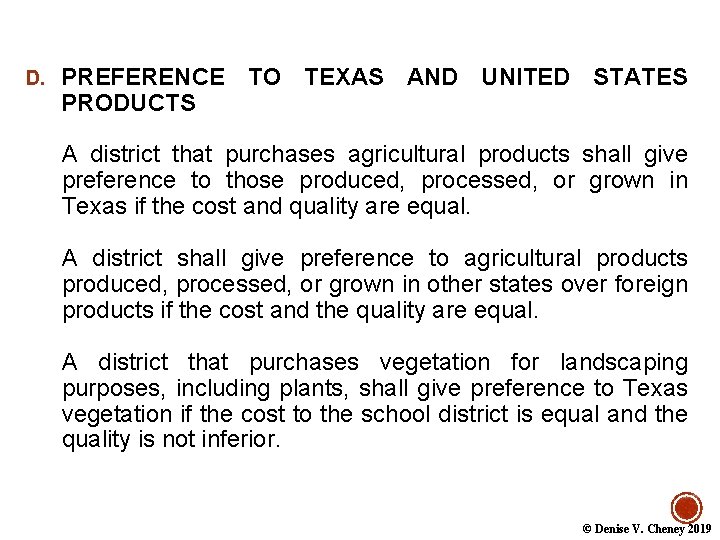
D. PREFERENCE PRODUCTS TO TEXAS AND UNITED STATES A district that purchases agricultural products shall give preference to those produced, processed, or grown in Texas if the cost and quality are equal. A district shall give preference to agricultural products produced, processed, or grown in other states over foreign products if the cost and the quality are equal. A district that purchases vegetation for landscaping purposes, including plants, shall give preference to Texas vegetation if the cost to the school district is equal and the quality is not inferior. © Denise V. Cheney 2019
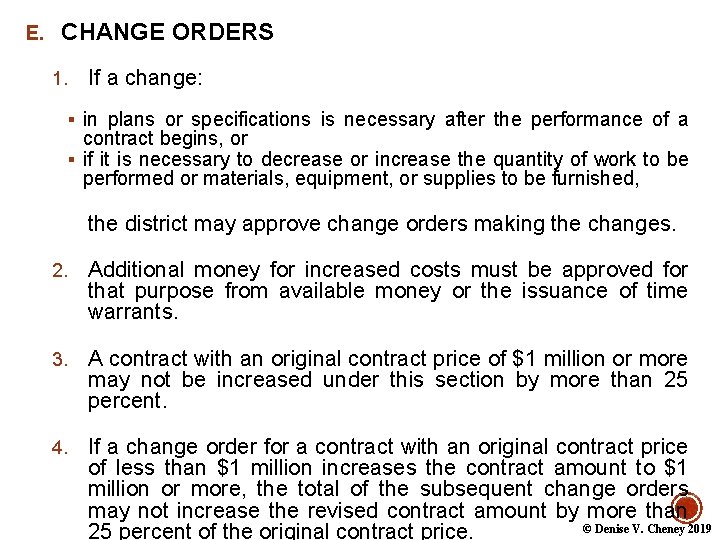
E. CHANGE ORDERS 1. If a change: § in plans or specifications is necessary after the performance of a contract begins, or § if it is necessary to decrease or increase the quantity of work to be performed or materials, equipment, or supplies to be furnished, the district may approve change orders making the changes. 2. Additional money for increased costs must be approved for that purpose from available money or the issuance of time warrants. 3. A contract with an original contract price of $1 million or more may not be increased under this section by more than 25 percent. 4. If a change order for a contract with an original contract price of less than $1 million increases the contract amount to $1 million or more, the total of the subsequent change orders may not increase the revised contract amount by more than © Denise V. Cheney 2019 25 percent of the original contract price.
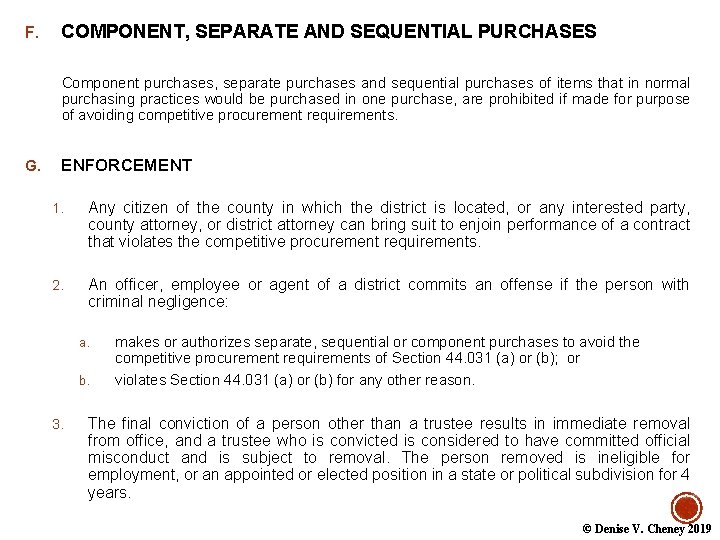
F. COMPONENT, SEPARATE AND SEQUENTIAL PURCHASES Component purchases, separate purchases and sequential purchases of items that in normal purchasing practices would be purchased in one purchase, are prohibited if made for purpose of avoiding competitive procurement requirements. G. ENFORCEMENT 1. Any citizen of the county in which the district is located, or any interested party, county attorney, or district attorney can bring suit to enjoin performance of a contract that violates the competitive procurement requirements. 2. An officer, employee or agent of a district commits an offense if the person with criminal negligence: a. b. 3. makes or authorizes separate, sequential or component purchases to avoid the competitive procurement requirements of Section 44. 031 (a) or (b); or violates Section 44. 031 (a) or (b) for any other reason. The final conviction of a person other than a trustee results in immediate removal from office, and a trustee who is convicted is considered to have committed official misconduct and is subject to removal. The person removed is ineligible for employment, or an appointed or elected position in a state or political subdivision for 4 years. © Denise V. Cheney 2019
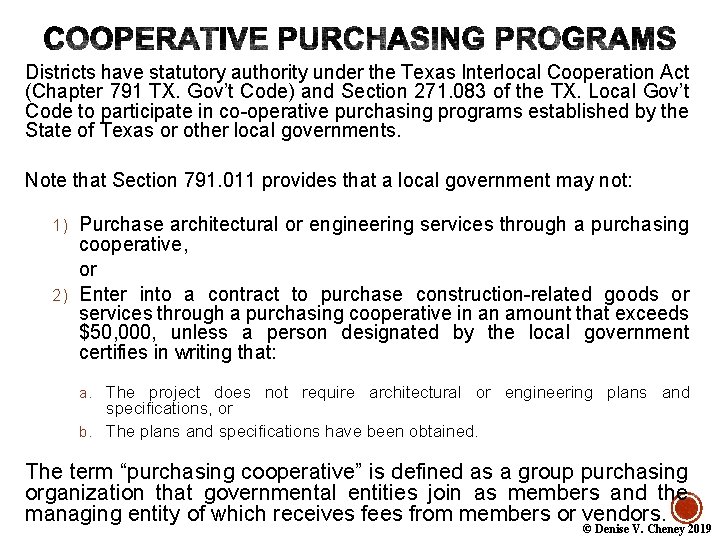
Districts have statutory authority under the Texas Interlocal Cooperation Act (Chapter 791 TX. Gov’t Code) and Section 271. 083 of the TX. Local Gov’t Code to participate in co-operative purchasing programs established by the State of Texas or other local governments. Note that Section 791. 011 provides that a local government may not: 1) Purchase architectural or engineering services through a purchasing cooperative, or 2) Enter into a contract to purchase construction-related goods or services through a purchasing cooperative in an amount that exceeds $50, 000, unless a person designated by the local government certifies in writing that: a. The project does not require architectural or engineering plans and specifications, or b. The plans and specifications have been obtained. The term “purchasing cooperative” is defined as a group purchasing organization that governmental entities join as members and the managing entity of which receives fees from members or vendors. © Denise V. Cheney 2019
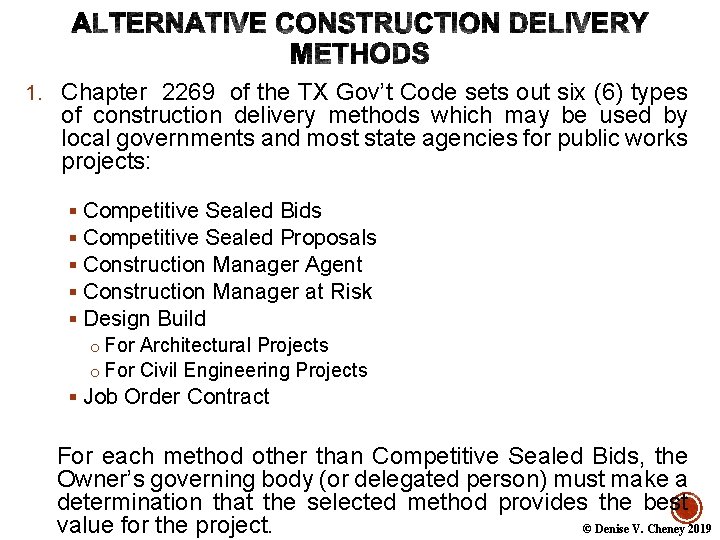
1. Chapter 2269 of the TX Gov’t Code sets out six (6) types of construction delivery methods which may be used by local governments and most state agencies for public works projects: § Competitive Sealed Bids § Competitive Sealed Proposals § Construction Manager Agent § Construction Manager at Risk § Design Build o For Architectural Projects o For Civil Engineering Projects § Job Order Contract For each method other than Competitive Sealed Bids, the Owner’s governing body (or delegated person) must make a determination that the selected method provides the best value for the project. © Denise V. Cheney 2019
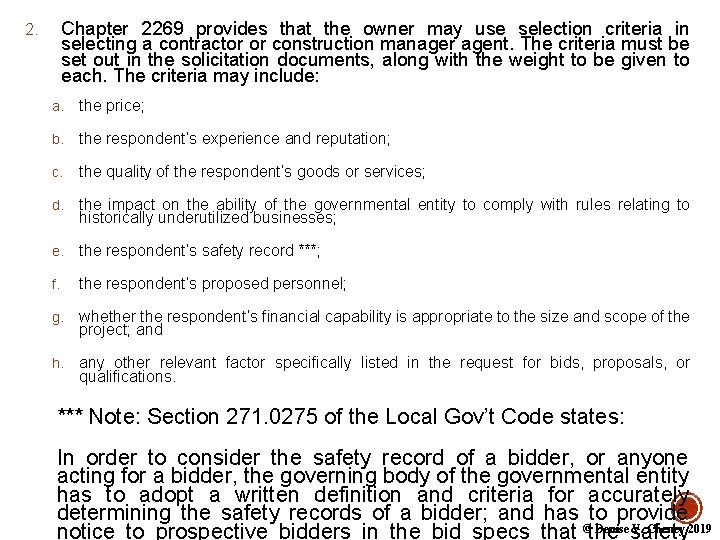
Chapter 2269 provides that the owner may use selection criteria in selecting a contractor or construction manager agent. The criteria must be set out in the solicitation documents, along with the weight to be given to each. The criteria may include: 2. a. the price; b. the respondent’s experience and reputation; c. the quality of the respondent’s goods or services; d. the impact on the ability of the governmental entity to comply with rules relating to historically underutilized businesses; e. the respondent’s safety record ***; f. the respondent’s proposed personnel; g. whether the respondent’s financial capability is appropriate to the size and scope of the project; and h. any other relevant factor specifically listed in the request for bids, proposals, or qualifications. *** Note: Section 271. 0275 of the Local Gov’t Code states: In order to consider the safety record of a bidder, or anyone acting for a bidder, the governing body of the governmental entity has to adopt a written definition and criteria for accurately determining the safety records of a bidder; and has to provide Denise safety V. Cheney 2019 notice to prospective bidders in the bid specs that ©the
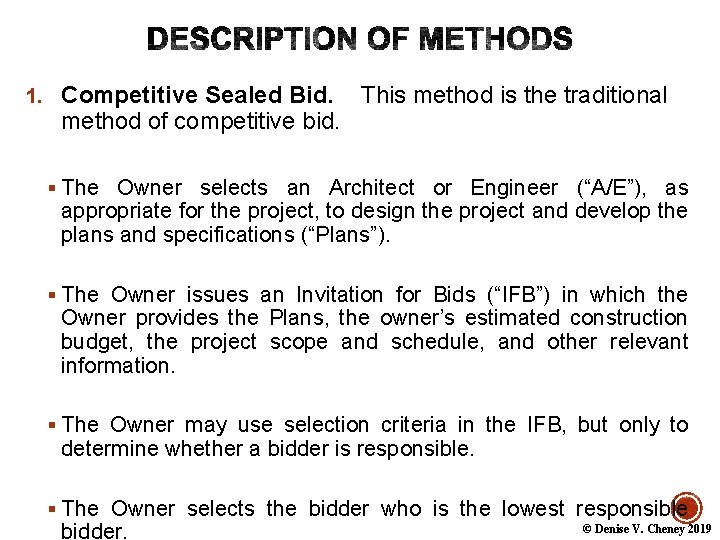
1. Competitive Sealed Bid. method of competitive bid. This method is the traditional § The Owner selects an Architect or Engineer (“A/E”), as appropriate for the project, to design the project and develop the plans and specifications (“Plans”). § The Owner issues an Invitation for Bids (“IFB”) in which the Owner provides the Plans, the owner’s estimated construction budget, the project scope and schedule, and other relevant information. § The Owner may use selection criteria in the IFB, but only to determine whether a bidder is responsible. § The Owner selects the bidder who is the lowest responsible bidder. © Denise V. Cheney 2019
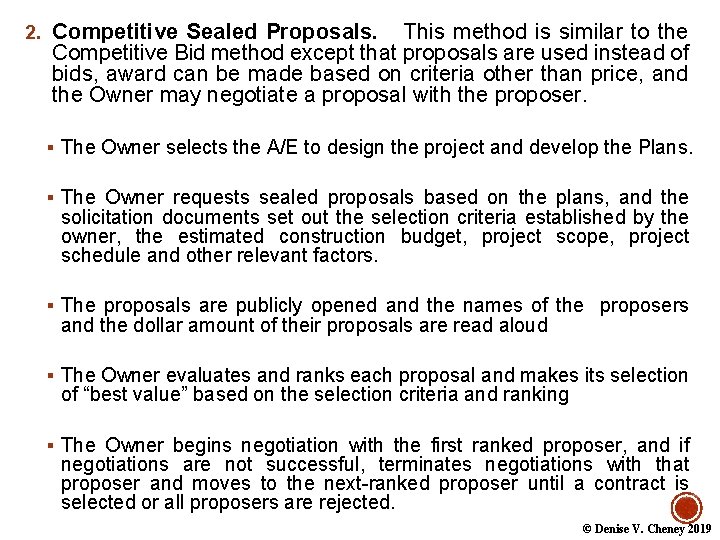
2. Competitive Sealed Proposals. This method is similar to the Competitive Bid method except that proposals are used instead of bids, award can be made based on criteria other than price, and the Owner may negotiate a proposal with the proposer. § The Owner selects the A/E to design the project and develop the Plans. § The Owner requests sealed proposals based on the plans, and the solicitation documents set out the selection criteria established by the owner, the estimated construction budget, project scope, project schedule and other relevant factors. § The proposals are publicly opened and the names of the proposers and the dollar amount of their proposals are read aloud § The Owner evaluates and ranks each proposal and makes its selection of “best value” based on the selection criteria and ranking § The Owner begins negotiation with the first ranked proposer, and if negotiations are not successful, terminates negotiations with that proposer and moves to the next-ranked proposer until a contract is selected or all proposers are rejected. © Denise V. Cheney 2019
3. Construction Manager at Risk. In this method, the Construction Manager at Risk (“CMR”) provides preconstruction services during the design of the project to help prevent constructability problems and to reduce costs, and serves as the general contractor during construction. The contract will usually provide a guaranteed maximum price for construction. § The Owner selects the A/E to design the project and prepare the Plans. § At the same time, or at any time thereafter, the Owner selects the Construction Manager at Risk (“CMR”) through either a onestep or two-step process. In the one-step process, the Owner uses a Request for Proposals (“RFP”); in the two-step process, the Owner first sends out a Request for Qualifications (“RFQ), then selects five or fewer candidates to receive the RFP. § The Owner evaluates and ranks each contractor and makes its selection of “best value” based on the selection criteria and ranking. § The Owner begins negotiation with the first ranked contractor, and if negotiations are not successful, moves down the rank until a selection is made or all proposers have been rejected. © Denise V. Cheney 2019
4. Construction Manager Agent. This is a method where the Construction Manager Agent (“CMA”) serves as a project manager and does not have any responsibility for construction. § Owner selects A/E to design project and prepare Plans and a contractor to perform construction using one of the other construction delivery methods. § Owner selects Construction Manager as Agent (“CMA”) through an RFP on the basis of demonstrated competence and qualifications in the same manner as under the Professional Services Procurement Act. § Owner acts as general contractor and enters into contract with trade contractors. § The CMA serves as a consultant to the Owner, and oversees and coordinates work under the construction contract. © Denise V. Cheney 2019
5. Design/Build for architectural projects. This is a method where the Owner contracts with a single entity to design and build the project. § Owner selects its own A/E to develop a design-criteria package for the project. § Selection of the design/build team, consisting of AE and the contractor, is made in two phases. In Phase 1, Owner prepares an RFQ for a design/build team that includes general information on the project, selection criteria, project scope, budget, and the designcriteria package, and evaluates each respondent based on experience, competence and other qualifications. § In Phase 2, the Owner selects five or fewer respondents to receive an RFP. The Owner will rank the teams and make its selection based on the selection criteria and ranking. § If Owner cannot negotiate a contract with the first ranked team, it moves down the rank until a design builder is selected or all respondents are rejected. § The selected design-builder designs the plans and constructs the project. § The design-builder is responsible for all pre-construction and © Denise V. Cheney 2019
6. Job Order Method. This method is used for repairs, rehabilitation alteration or minor construction for a building or buildings when the work is of a recurring nature, such as recarpeting, reroofing, or repainting interiors or exteriors, but the delivery times are indefinite. It cannot be used for civil engineering project or for large construction projects, such as the construction of a building. § If a job order contract or an order requires A/E services, those services must be provided in accordance with the manner provided by law. § To select the contractor, the Owner prepares an RFP which sets out the Selection Criteria, and may require a proposal for unit prices. The Owner evaluates and ranks the contractors. § The Owner may select more than one contractor in connection with each RFP. Each contractor will then be eligible to perform job order contracts for the Owner. § After the award, when the need for specific work arises, the Owner may contact any of the approved job order contractors and ask them to submit a proposal for the specific tasks that need to be done. If a © Denise V. Cheney 2019
I. MAKE SURE YOU HAVE A GOOD CONTRACT FORM II. MAKE SURE YOU HAVE A VALID CONTRACT A. Verify identity of contracting party when you review bids/proposals or before signing contract. 1. Ask for information on type of entity in solicitation documents, together with a resolution or other documentation that: a. authorizes the entity to submit the bid or proposal, and b. authorizes a specific person to respond or negotiate regarding the bid or proposal © Denise V. Cheney 2019
2. If vendor is a corporation, limited liability company, or limited partnership look vendor up in records of the Secretary of State (“SOS”) to avoid problems such as: § Vendor is not a corporation or other legal entity o This sometimes happens with sole proprietors who call themselves president of a corporation. § Error in name of entity o Especially if vendor has more than 1 company, or o Just doesn’t use correct name e. g. Fairfield Development Corporation vs. Fairfield Redevelopment Corporation § Entity is not in existence o Existence forfeited by failure to pay franchise taxes or file reports. This can be fixed, but should be cured before contract signed. o Entity just doesn’t exist. o Name given is a d/b/a –not full legal name of entity. © Denise V. Cheney 2019
3. If entity was formed in another state, need to verify from SOS that entity is authorized to do business in Texas. 4. If vendor is a general partnership (this is rare) need to get copy of partnership agreement from vendor. Contract with entity that doesn’t exist, is the wrong entity or under an incorrect name creates problem with the validity of the contract. © Denise V. Cheney 2019
B. Verify who has authority to sign the contract on behalf of the vendor 1. If vendor is a corporation, limited liability company or limited partnership, the SOS records will show who is the President, Manager or General Partner. § Another legal entity may be the manager or general partner—will need to look this entity up at SOS as well 2. Should require a corporate resolution or other documentation from the legal entity indicating that the contract has been authorized and stating who has authority to sign it. Signature by person without authority to act on behalf of the legal entity may render the contract unenforceable. © Denise V. Cheney 2019
III. NEED GOOD INSURANCE REQUIREMENTS A. Use an insurance risk manager or insurance consultant to establish insurance requirements 1. Typical Required Construction Insurance § Commercial General Liability § Worker’s Compensation – required by statute for construction and contractors and subcontractors and Employer’s Liability § Commercial Vehicular Insurance for all autos – rented, employee-owned and vendor-owned § Builder’s Risk (coverage will terminate at substantial completion – Owner will need to get any property coverage at this time. © Denise V. Cheney 2019
2. Other Insurance may be needed or advantageous § Pollution Liability Coverage § Project Insurance (covers all construction contractors and consultants, including engineer, geotech, etc. ) § Professional Liability if contractor or subcontractor will be providing professional services as part of scope of work, e. g: o Trench safety program o Design and installation components of the work o Surveying o Abatement plan 3. Design-Build Contract § Need Insurance from both design professional (including professional liability insurance) and contractor © Denise V. Cheney 2019
4. It is not sufficient just to require general categories of insurance and policy amounts. a. Need to specify what coverage is required in the policies or by endorsement e. g. : § § § additional insured endorsements, waivers of subrogation Primary coverage for CGL 30 days notice of cancellation Duration of policy – some need to extend beyond completion of the contract 5. Need to specify other requirements, e. g. : a. Vendor must give notice prior to renewal or change in coverage, b. new certificates must be provided if change in coverage or insured c. A. M. Best or other rating for insurer © Denise V. Cheney 2019
B. Verify required insurance is in place including on renewals or changes in coverage 1. Usual method is by a Certificate of Insurance issued 2. 3. 4. 5. by the insurance agent Note that: Certificate of Insurance is not an enforceable agreement either by the agent or the insurer Only way to verify coverage provided is by reading the policies – most Owners do not do that unless it is a big or complex project Look up required A. M. Best or other rating on the insurance company Establish a method to verify that new certificates of insurance are obtained upon expiration or change of the policies © Denise V. Cheney 2019
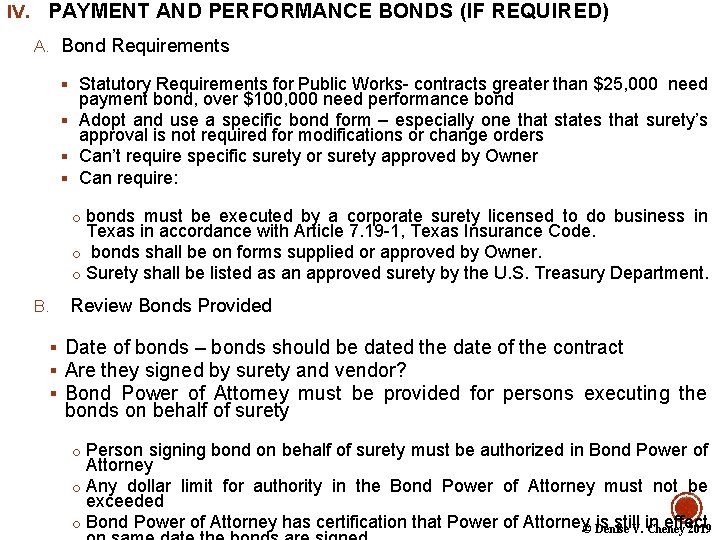
IV. PAYMENT AND PERFORMANCE BONDS (IF REQUIRED) A. Bond Requirements § Statutory Requirements for Public Works- contracts greater than $25, 000 need payment bond, over $100, 000 need performance bond § Adopt and use a specific bond form – especially one that states that surety’s approval is not required for modifications or change orders § Can’t require specific surety or surety approved by Owner § Can require: o bonds must be executed by a corporate surety licensed to do business in Texas in accordance with Article 7. 19 -1, Texas Insurance Code. o bonds shall be on forms supplied or approved by Owner. o Surety shall be listed as an approved surety by the U. S. Treasury Department. B. Review Bonds Provided § Date of bonds – bonds should be dated the date of the contract § Are they signed by surety and vendor? § Bond Power of Attorney must be provided for persons executing the bonds on behalf of surety o Person signing bond on behalf of surety must be authorized in Bond Power of Attorney o Any dollar limit for authority in the Bond Power of Attorney must not be exceeded o Bond Power of Attorney has certification that Power of Attorney© Denise is still. V. in effect Cheney 2019