
Pupils know What they are learning How they
- Slides: 2
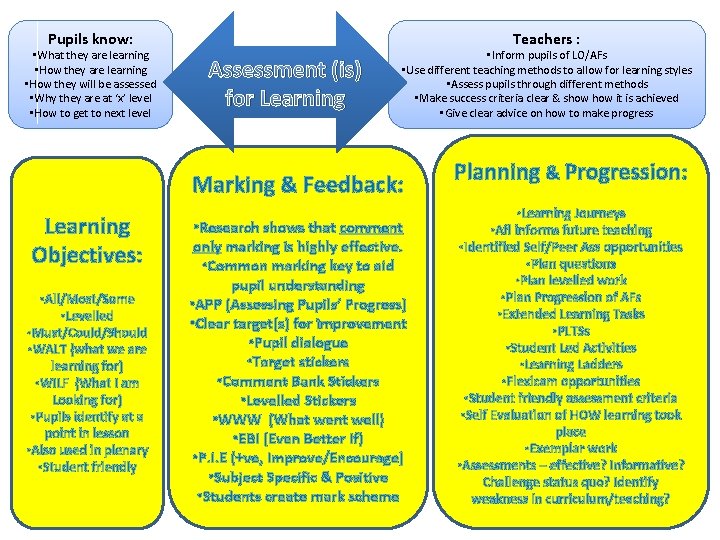
Pupils know: • What they are learning • How they will be assessed • Why they are at ‘x’ level • How to get to next level Teachers : Assessment (is) for Learning • Inform pupils of LO/AFs • Use different teaching methods to allow for learning styles • Assess pupils through different methods • Make success criteria clear & show it is achieved • Give clear advice on how to make progress Marking & Feedback: Learning Objectives: • All/Most/Some • Levelled • Must/Could/Should • WALT (what we are learning for) • WILF (What I am Looking for) • Pupils identify at a point in lesson • Also used in plenary • Student friendly • Research shows that comment only marking is highly effective. • Common marking key to aid pupil understanding • APP (Assessing Pupils’ Progress) • Clear target(s) for improvement • Pupil dialogue • Target stickers • Comment Bank Stickers • Levelled Stickers • WWW (What went well) • EBI (Even Better If) • P. I. E (+ve, Improve/Encourage) • Subject Specific & Positive • Students create mark scheme Planning & Progression: • Learning Journeys • Afl informs future teaching • Identified Self/Peer Ass opportunities • Plan questions • Plan levelled work • Plan Progression of AFs • Extended Learning Tasks • PLTSs • Student Led Activities • Learning Ladders • Flexicam opportunities • Student friendly assessment criteria • Self Evaluation of HOW learning took place • Exemplar work • Assessments – effective? Informative? Challenge status quo? Identify weakness in curriculum/teaching?
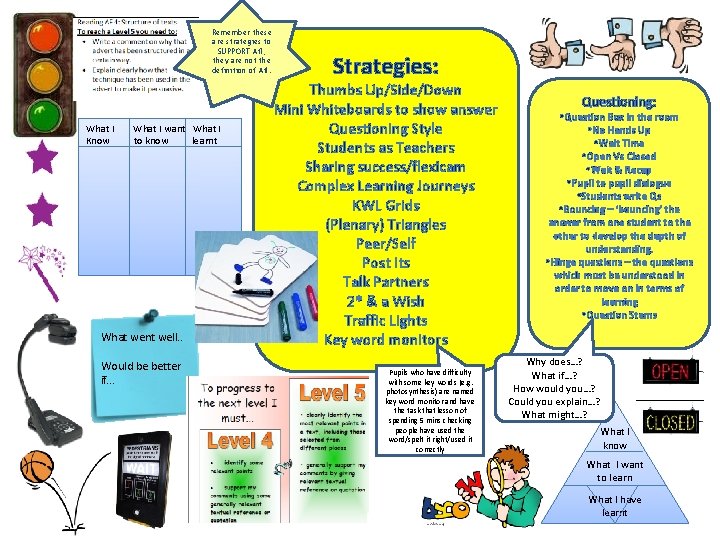
Remember these are strategies to SUPPORT Afl, they are not the definition of Afl. What I Know What I want What I to know learnt What went well. . Would be better if. . . Strategies: Thumbs Up/Side/Down Mini Whiteboards to show answer Questioning Style Students as Teachers Sharing success/flexicam Complex Learning Journeys KWL Grids (Plenary) Triangles Peer/Self Post Its Talk Partners 2* & a Wish Traffic Lights Key word monitors Pupils who have difficulty with some key words (e. g. photosynthesis) are named key word monitor and have the task that lesson of spending 5 mins checking people have used the word/spelt it right/used it correctly Questioning: • Question Box in the room • No Hands Up • Wait Time • Open Vs Closed • Wait & Recap • Pupil to pupil dialogue • Students write Qs • Bouncing – ‘bouncing’ the answer from one student to the other to develop the depth of understanding. • Hinge questions – the questions which must be understood in order to move on in terms of learning • Question Stems Why does…? What if…? How would you…? Could you explain…? What might…? What I know What I want to learn What I have learnt