
PUNCTUATION USING PERIODS Use a period to end

- Slides: 72
PUNCTUATION
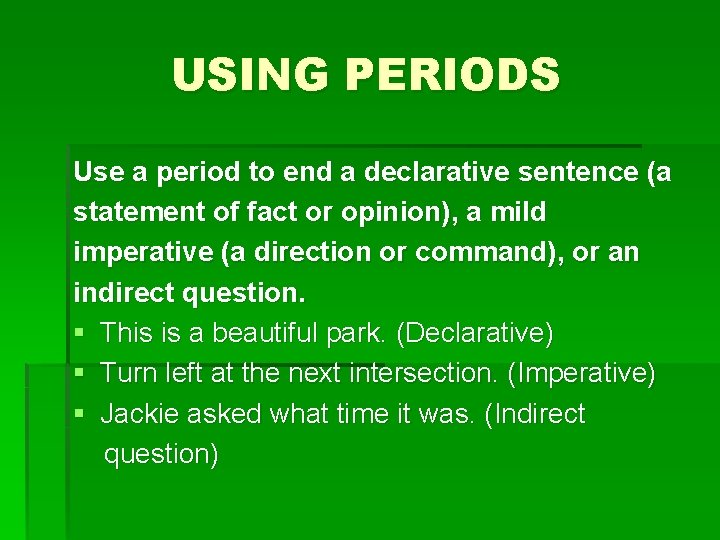
USING PERIODS Use a period to end a declarative sentence (a statement of fact or opinion), a mild imperative (a direction or command), or an indirect question. § This is a beautiful park. (Declarative) § Turn left at the next intersection. (Imperative) § Jackie asked what time it was. (Indirect question)
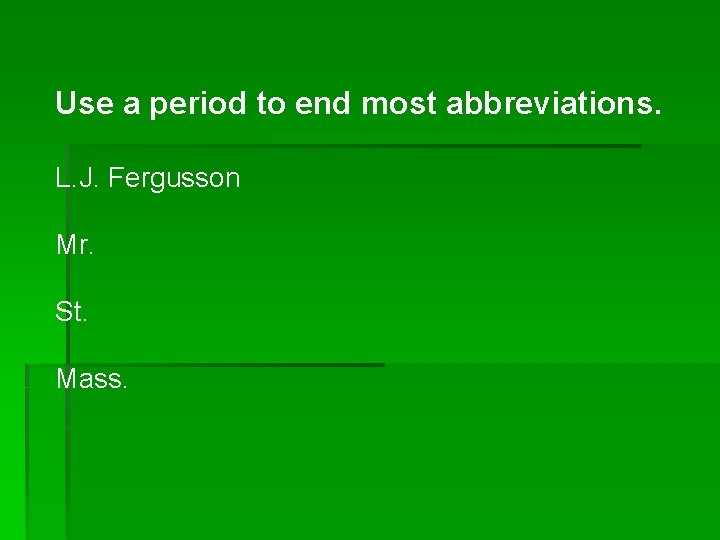
Use a period to end most abbreviations. L. J. Fergusson Mr. St. Mass.
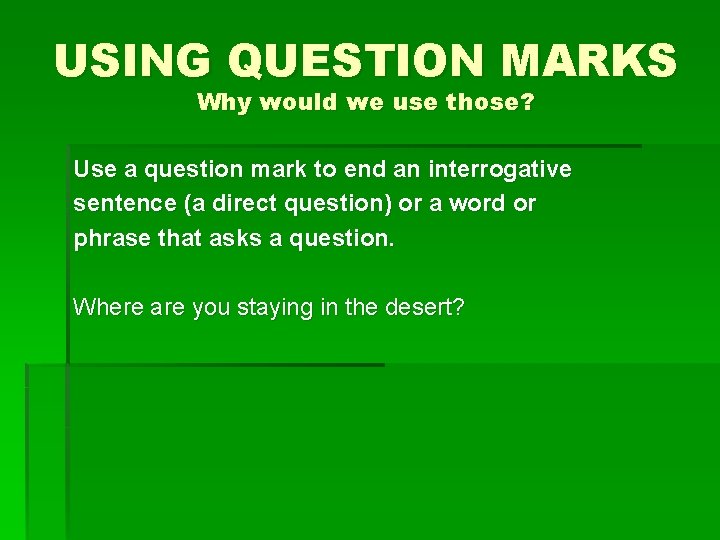
USING QUESTION MARKS Why would we use those? Use a question mark to end an interrogative sentence (a direct question) or a word or phrase that asks a question. Where are you staying in the desert?
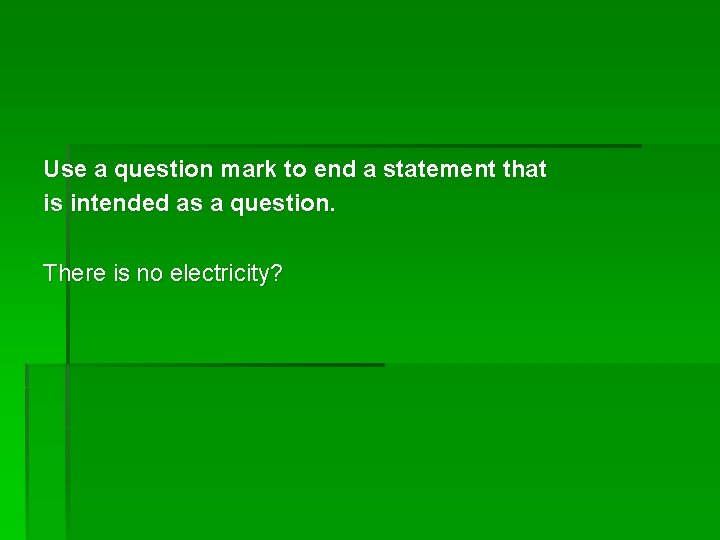
Use a question mark to end a statement that is intended as a question. There is no electricity?
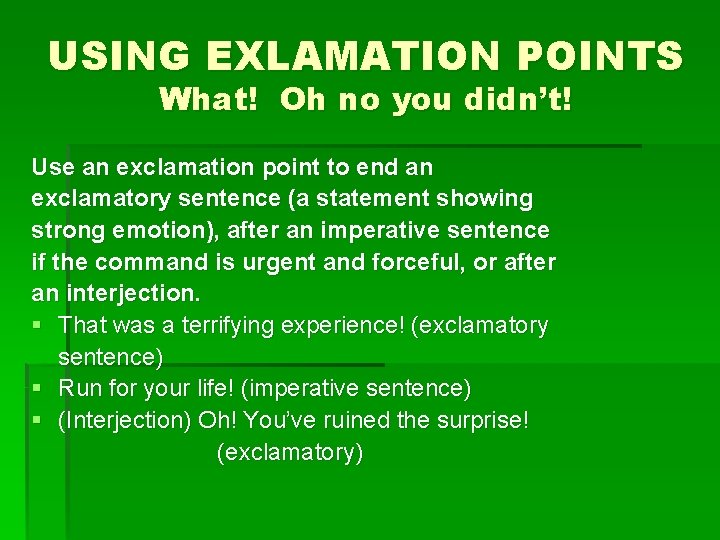
USING EXLAMATION POINTS What! Oh no you didn’t! Use an exclamation point to end an exclamatory sentence (a statement showing strong emotion), after an imperative sentence if the command is urgent and forceful, or after an interjection. § That was a terrifying experience! (exclamatory sentence) § Run for your life! (imperative sentence) § (Interjection) Oh! You’ve ruined the surprise! (exclamatory)
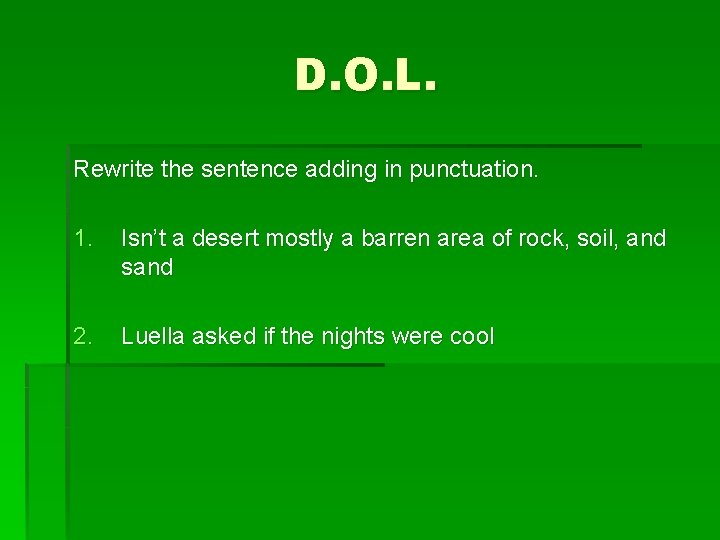
D. O. L. Rewrite the sentence adding in punctuation. 1. Isn’t a desert mostly a barren area of rock, soil, and sand 2. Luella asked if the nights were cool
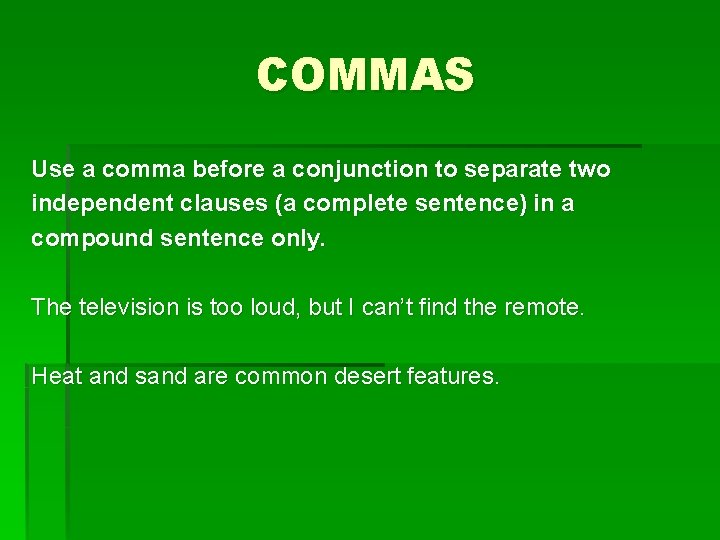
COMMAS Use a comma before a conjunction to separate two independent clauses (a complete sentence) in a compound sentence only. The television is too loud, but I can’t find the remote. Heat and sand are common desert features.
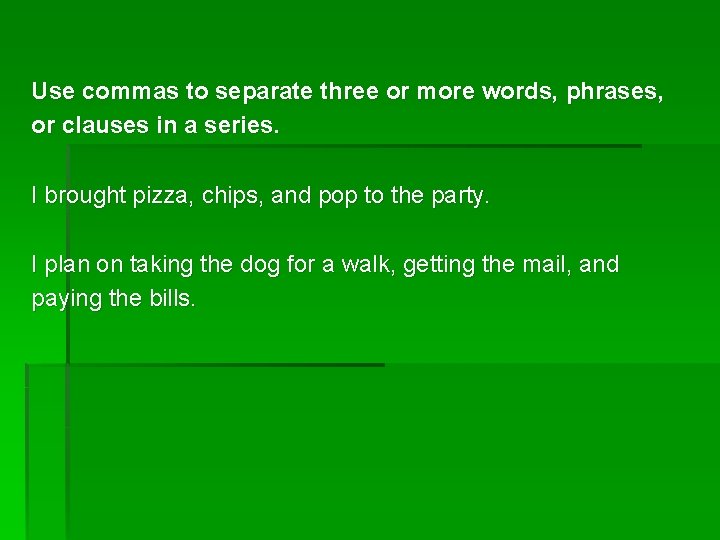
Use commas to separate three or more words, phrases, or clauses in a series. I brought pizza, chips, and pop to the party. I plan on taking the dog for a walk, getting the mail, and paying the bills.
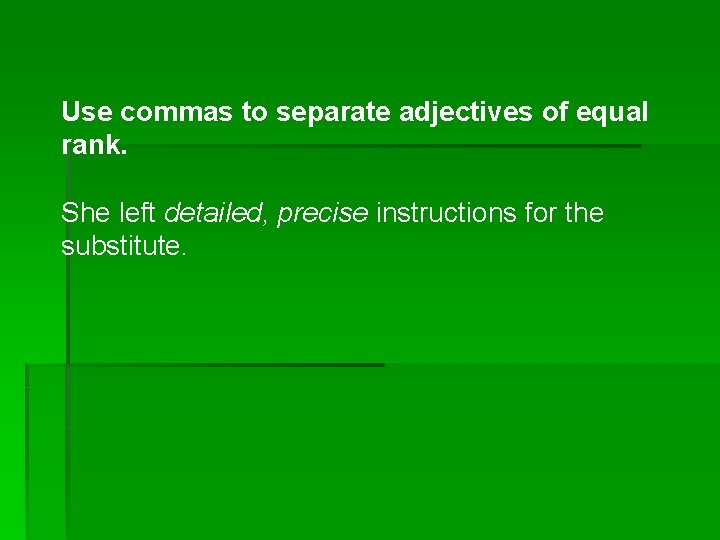
Use commas to separate adjectives of equal rank. She left detailed, precise instructions for the substitute.
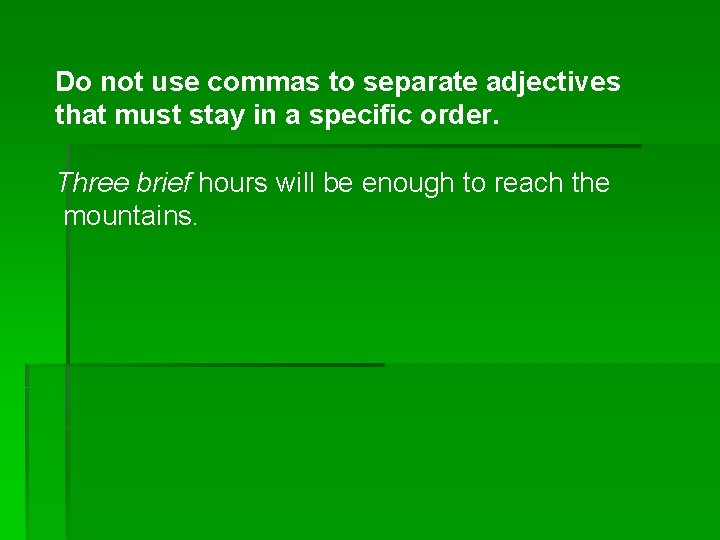
Do not use commas to separate adjectives that must stay in a specific order. Three brief hours will be enough to reach the mountains.
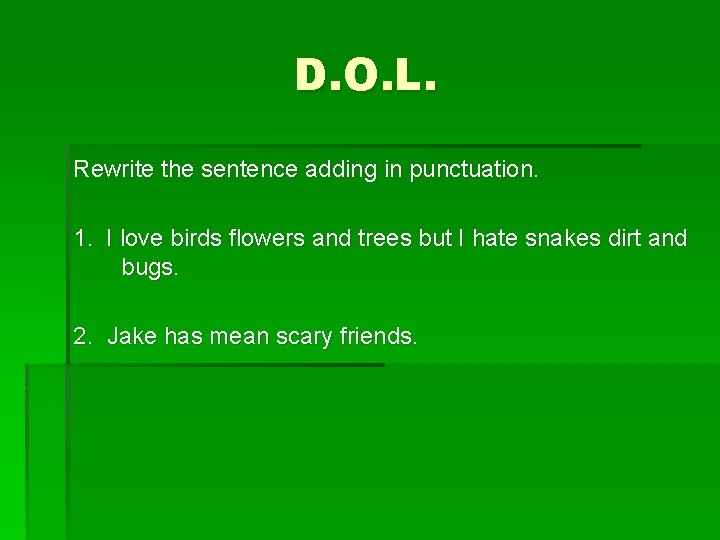
D. O. L. Rewrite the sentence adding in punctuation. 1. I love birds flowers and trees but I hate snakes dirt and bugs. 2. Jake has mean scary friends.
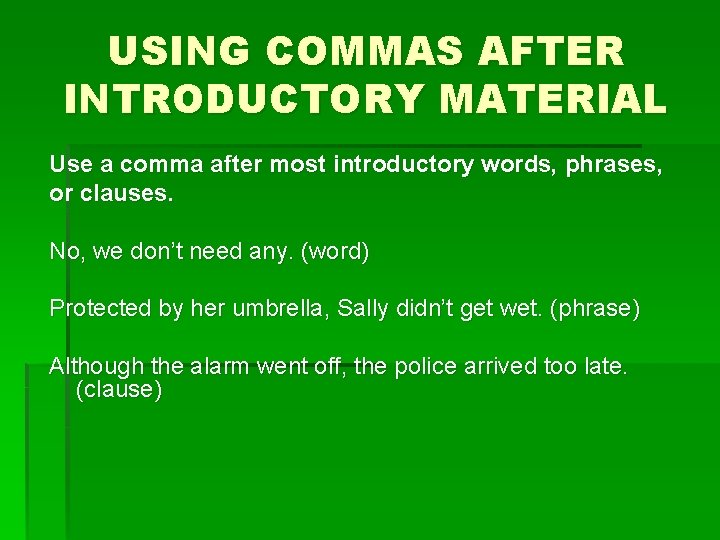
USING COMMAS AFTER INTRODUCTORY MATERIAL Use a comma after most introductory words, phrases, or clauses. No, we don’t need any. (word) Protected by her umbrella, Sally didn’t get wet. (phrase) Although the alarm went off, the police arrived too late. (clause)
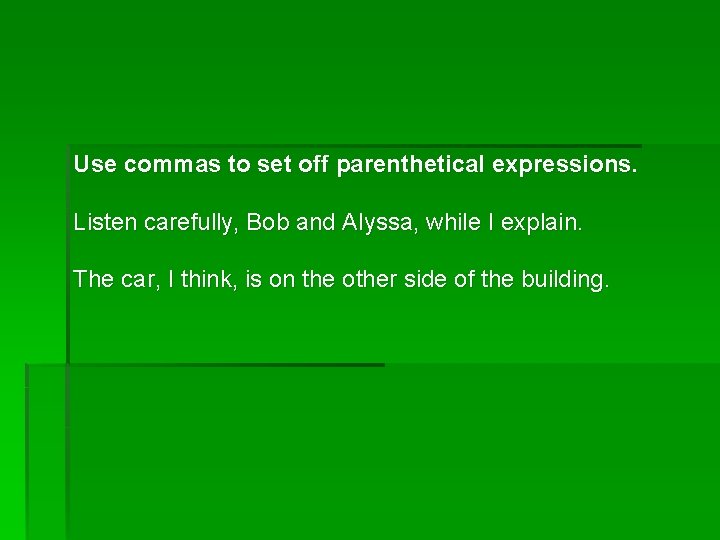
Use commas to set off parenthetical expressions. Listen carefully, Bob and Alyssa, while I explain. The car, I think, is on the other side of the building.
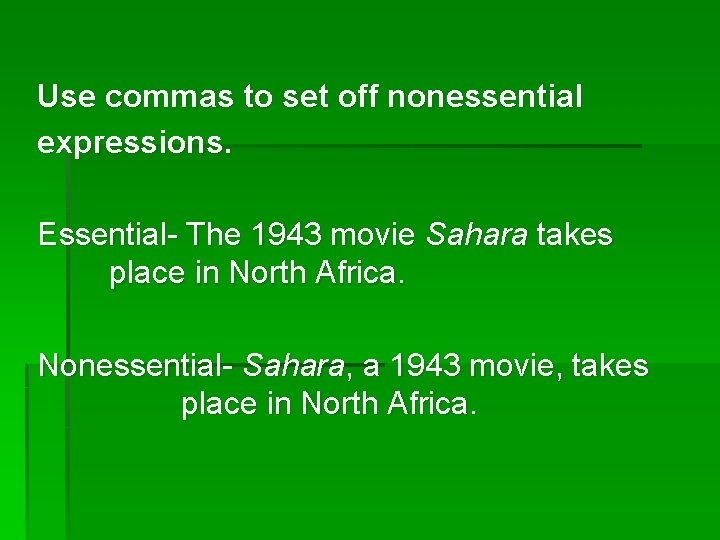
Use commas to set off nonessential expressions. Essential- The 1943 movie Sahara takes place in North Africa. Nonessential- Sahara, a 1943 movie, takes place in North Africa.
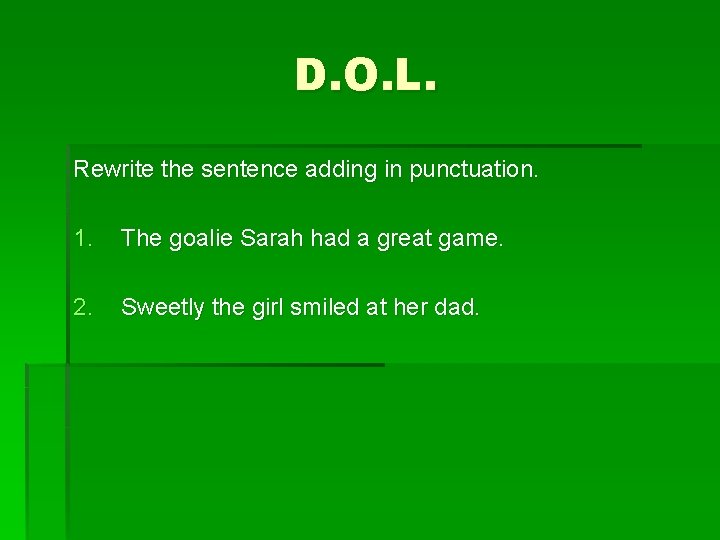
D. O. L. Rewrite the sentence adding in punctuation. 1. The goalie Sarah had a great game. 2. Sweetly the girl smiled at her dad.
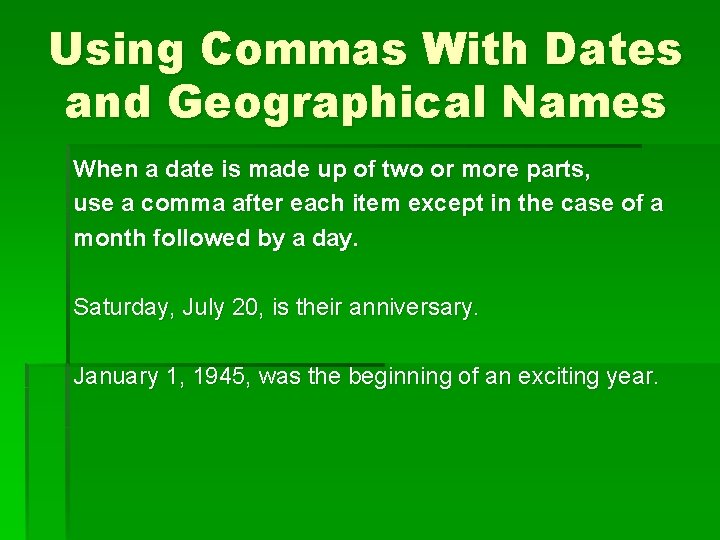
Using Commas With Dates and Geographical Names When a date is made up of two or more parts, use a comma after each item except in the case of a month followed by a day. Saturday, July 20, is their anniversary. January 1, 1945, was the beginning of an exciting year.
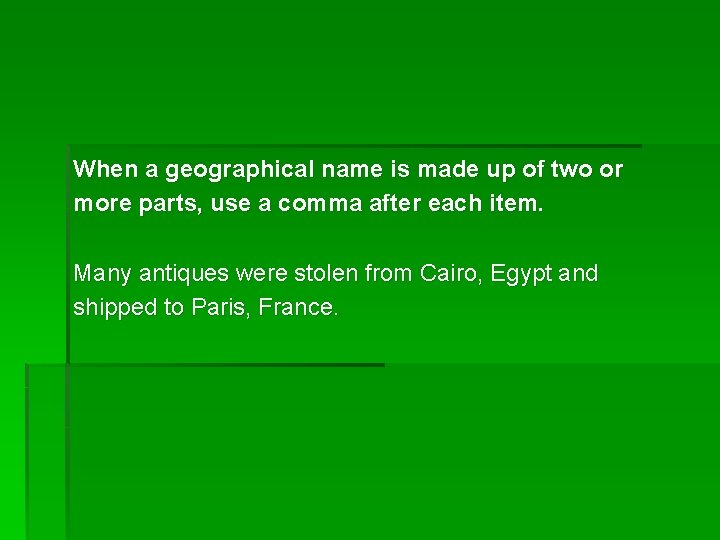
When a geographical name is made up of two or more parts, use a comma after each item. Many antiques were stolen from Cairo, Egypt and shipped to Paris, France.
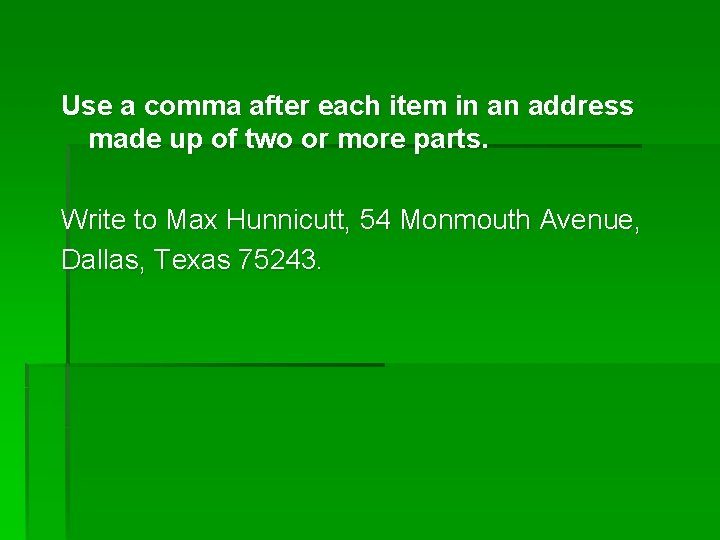
Use a comma after each item in an address made up of two or more parts. Write to Max Hunnicutt, 54 Monmouth Avenue, Dallas, Texas 75243.
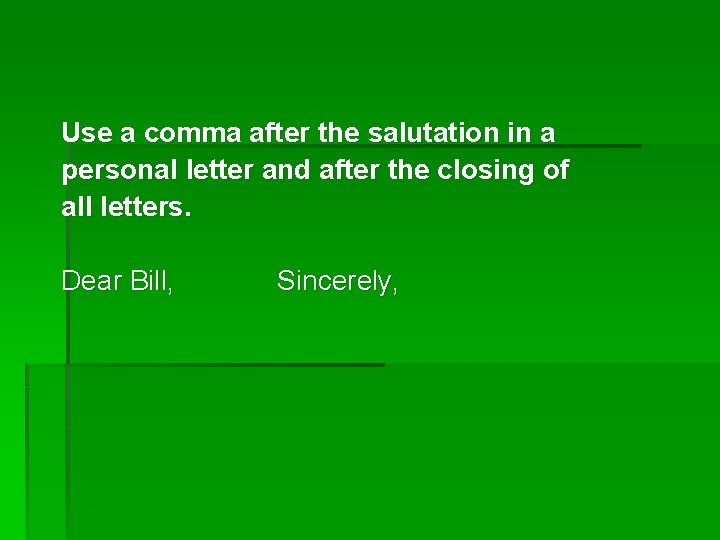
Use a comma after the salutation in a personal letter and after the closing of all letters. Dear Bill, Sincerely,
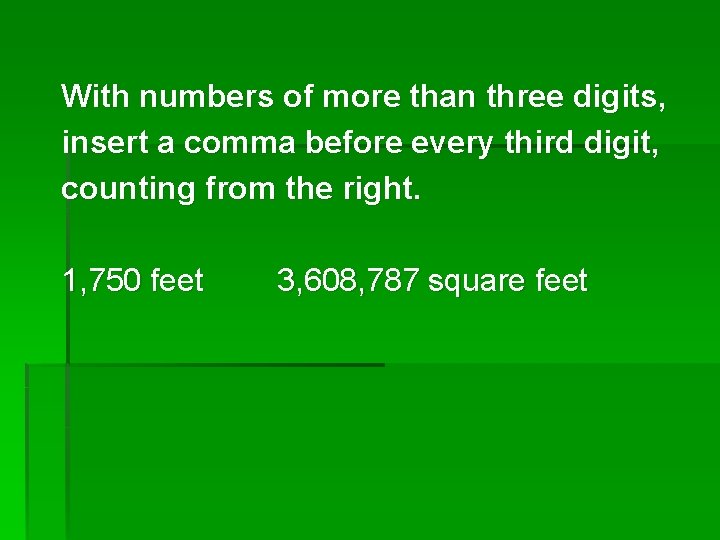
With numbers of more than three digits, insert a comma before every third digit, counting from the right. 1, 750 feet 3, 608, 787 square feet
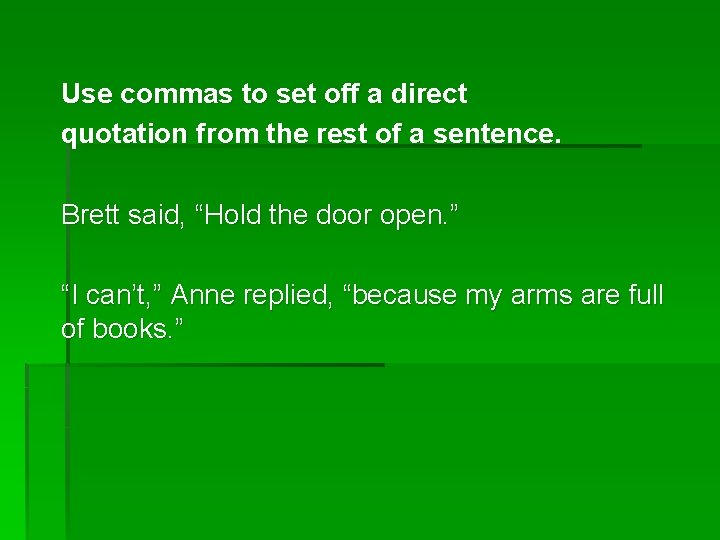
Use commas to set off a direct quotation from the rest of a sentence. Brett said, “Hold the door open. ” “I can’t, ” Anne replied, “because my arms are full of books. ”
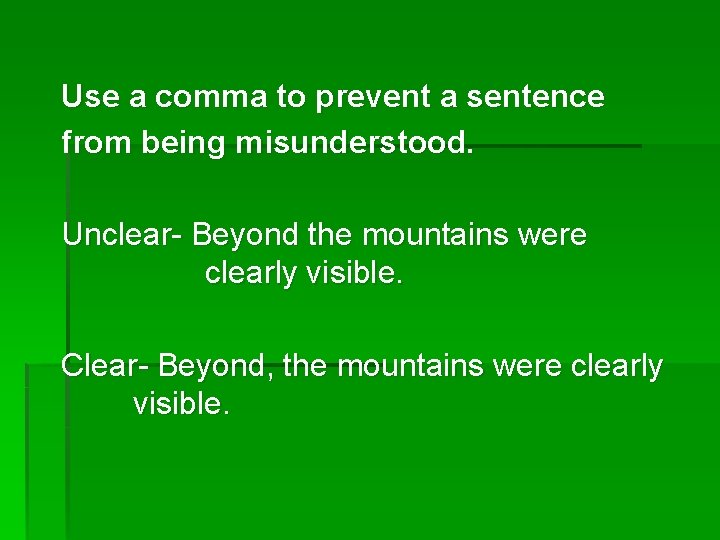
Use a comma to prevent a sentence from being misunderstood. Unclear- Beyond the mountains were clearly visible. Clear- Beyond, the mountains were clearly visible.
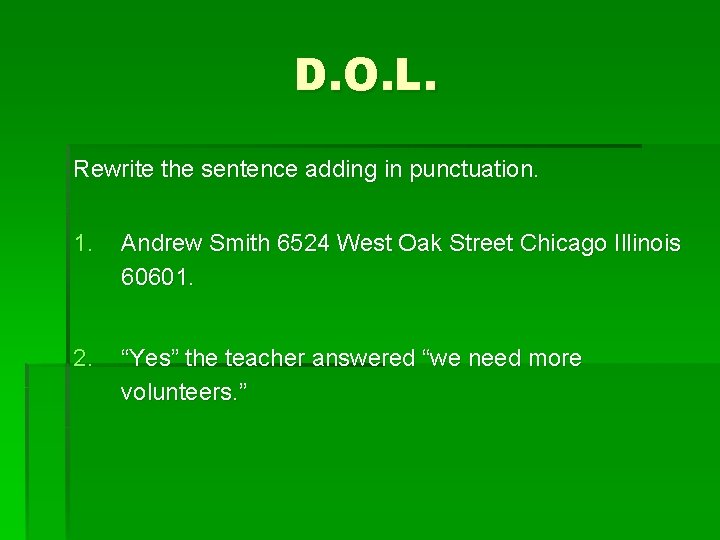
D. O. L. Rewrite the sentence adding in punctuation. 1. Andrew Smith 6524 West Oak Street Chicago Illinois 60601. 2. “Yes” the teacher answered “we need more volunteers. ”
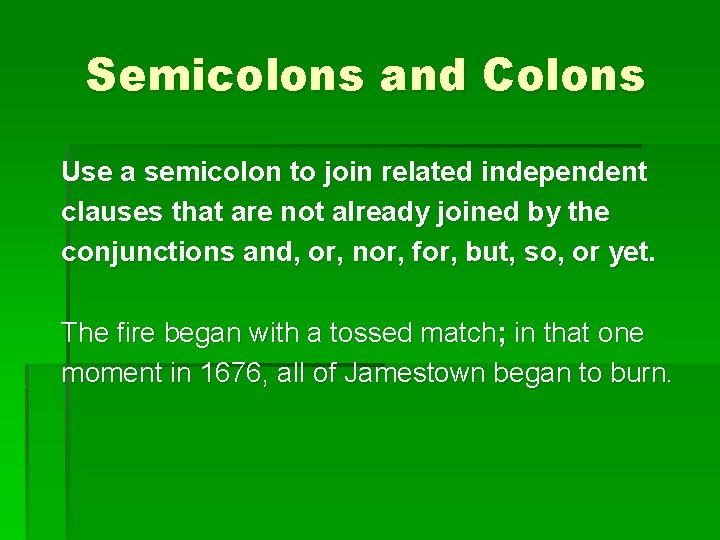
Semicolons and Colons Use a semicolon to join related independent clauses that are not already joined by the conjunctions and, or, nor, for, but, so, or yet. The fire began with a tossed match; in that one moment in 1676, all of Jamestown began to burn.
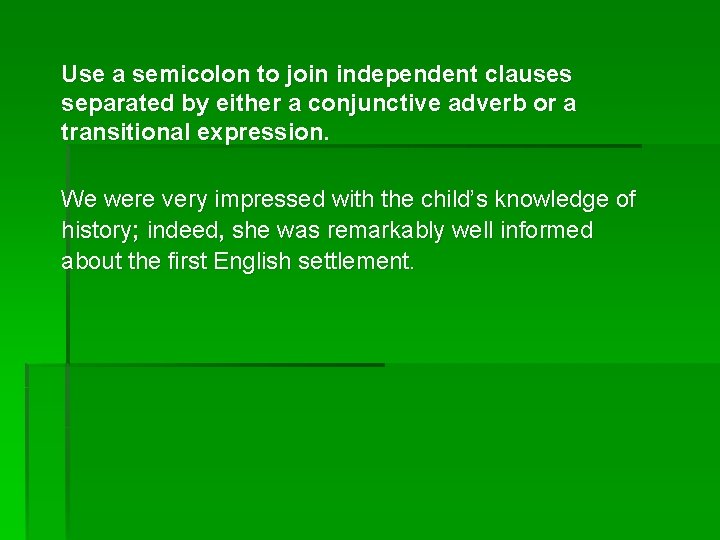
Use a semicolon to join independent clauses separated by either a conjunctive adverb or a transitional expression. We were very impressed with the child’s knowledge of history; indeed, she was remarkably well informed about the first English settlement.
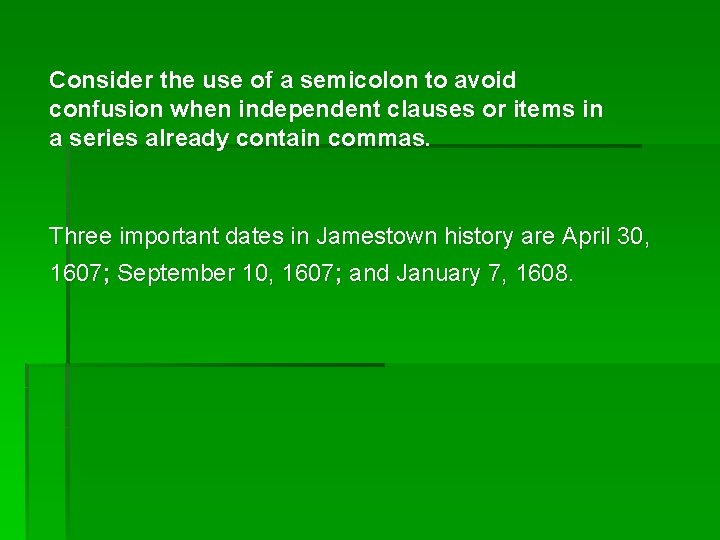
Consider the use of a semicolon to avoid confusion when independent clauses or items in a series already contain commas. Three important dates in Jamestown history are April 30, 1607; September 10, 1607; and January 7, 1608.
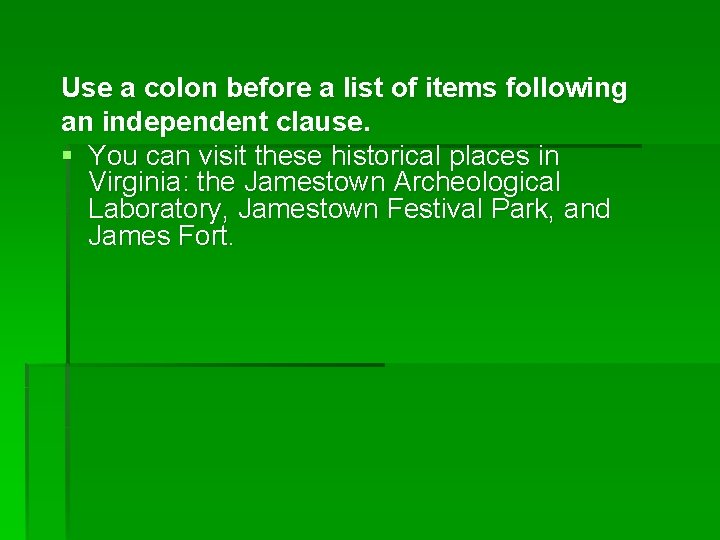
Use a colon before a list of items following an independent clause. § You can visit these historical places in Virginia: the Jamestown Archeological Laboratory, Jamestown Festival Park, and James Fort.
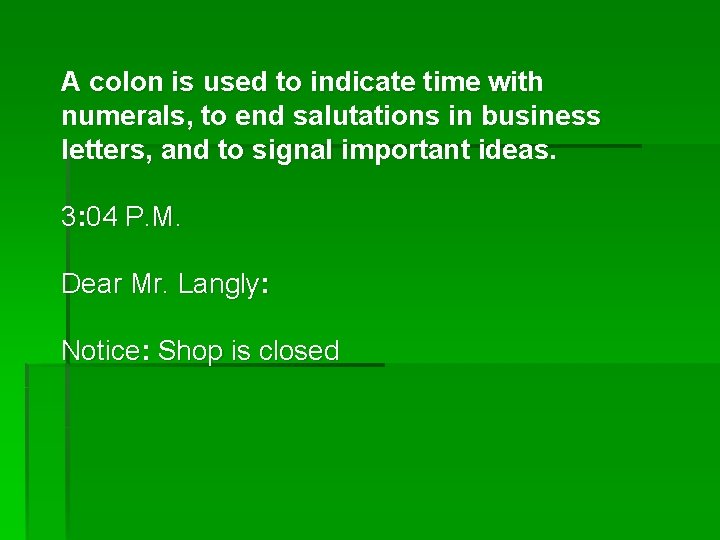
A colon is used to indicate time with numerals, to end salutations in business letters, and to signal important ideas. 3: 04 P. M. Dear Mr. Langly: Notice: Shop is closed
D. O. L. Rewrite the sentence adding in punctuation. 1. Tuesday August 31 was the last day of the month. 2. We traveled 1235 miles this summer.
Quotation Marks and Underlining A direct quotation represents a person’s exact speech or thoughts and is enclosed in quotation marks. Kate said, “Williamsburg had the first theater. ”
An indirect quotation reports the general meaning of what a person said or thought and does not require quotation marks. Margo said that she would do it for me.
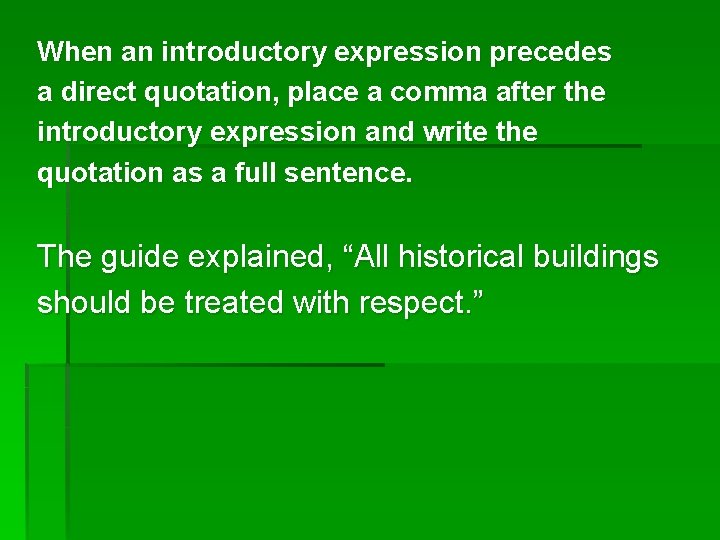
When an introductory expression precedes a direct quotation, place a comma after the introductory expression and write the quotation as a full sentence. The guide explained, “All historical buildings should be treated with respect. ”
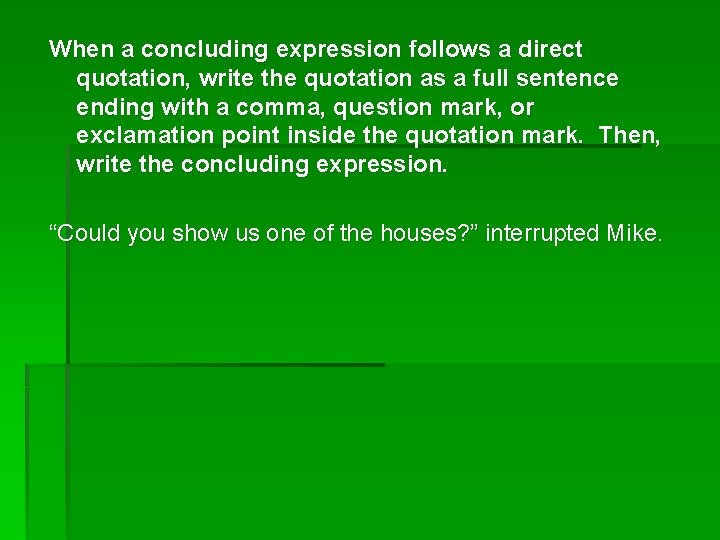
When a concluding expression follows a direct quotation, write the quotation as a full sentence ending with a comma, question mark, or exclamation point inside the quotation mark. Then, write the concluding expression. “Could you show us one of the houses? ” interrupted Mike.
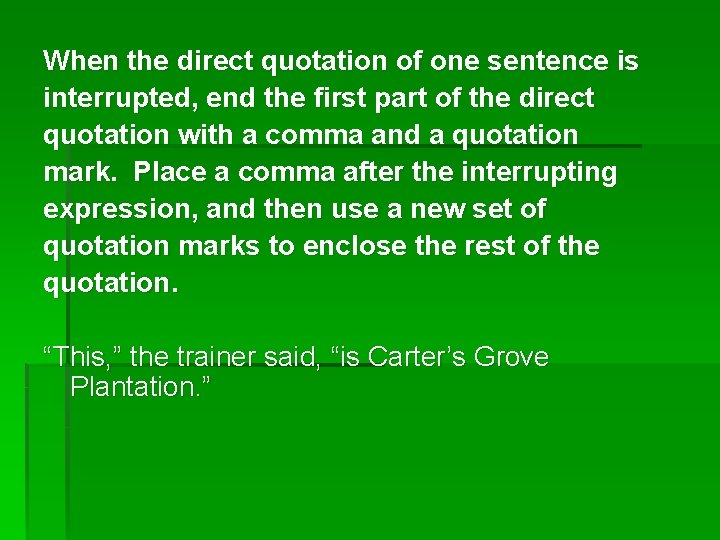
When the direct quotation of one sentence is interrupted, end the first part of the direct quotation with a comma and a quotation mark. Place a comma after the interrupting expression, and then use a new set of quotation marks to enclose the rest of the quotation. “This, ” the trainer said, “is Carter’s Grove Plantation. ”
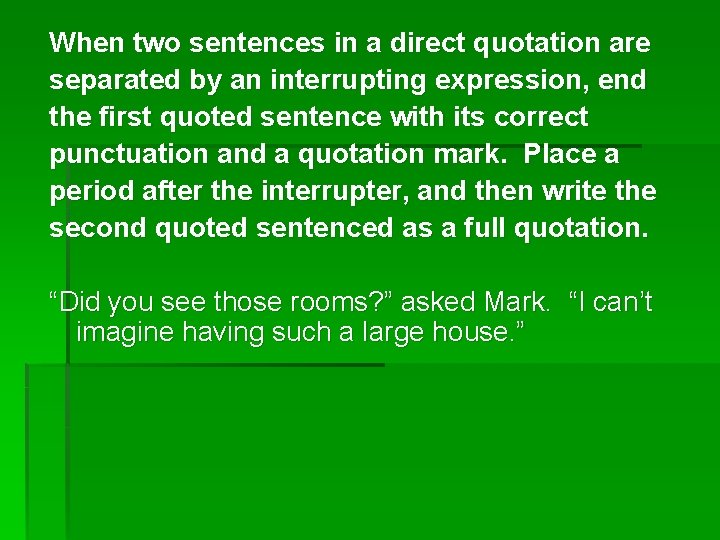
When two sentences in a direct quotation are separated by an interrupting expression, end the first quoted sentence with its correct punctuation and a quotation mark. Place a period after the interrupter, and then write the second quoted sentenced as a full quotation. “Did you see those rooms? ” asked Mark. “I can’t imagine having such a large house. ”
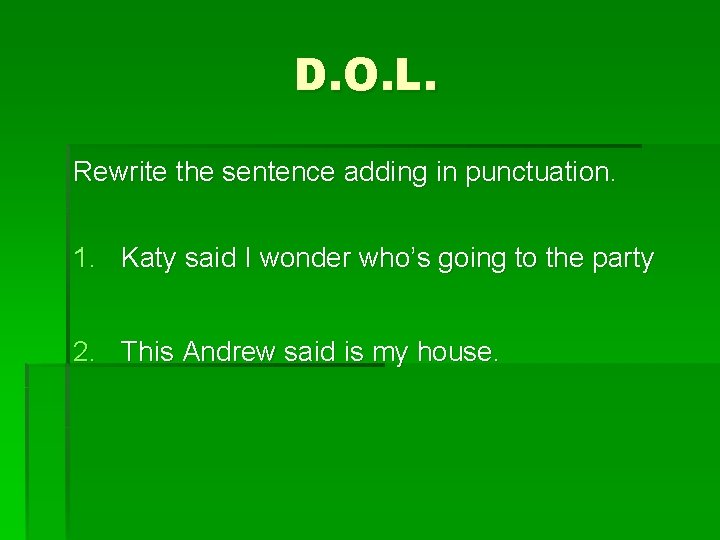
D. O. L. Rewrite the sentence adding in punctuation. 1. Katy said I wonder who’s going to the party 2. This Andrew said is my house.
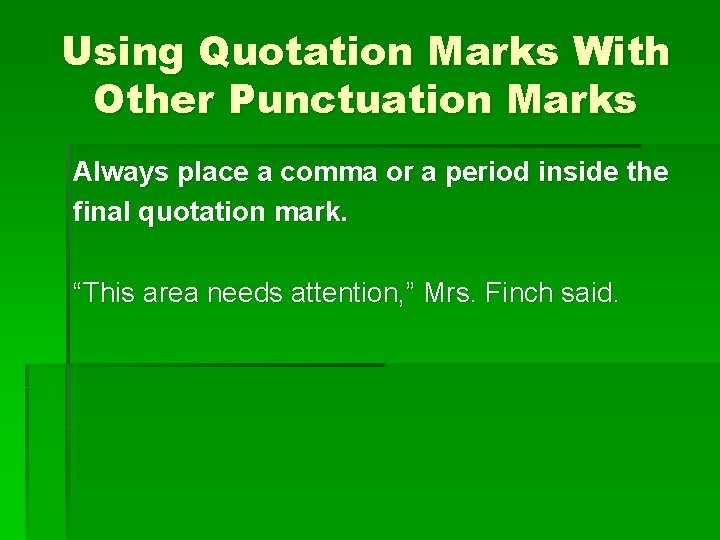
Using Quotation Marks With Other Punctuation Marks Always place a comma or a period inside the final quotation mark. “This area needs attention, ” Mrs. Finch said.
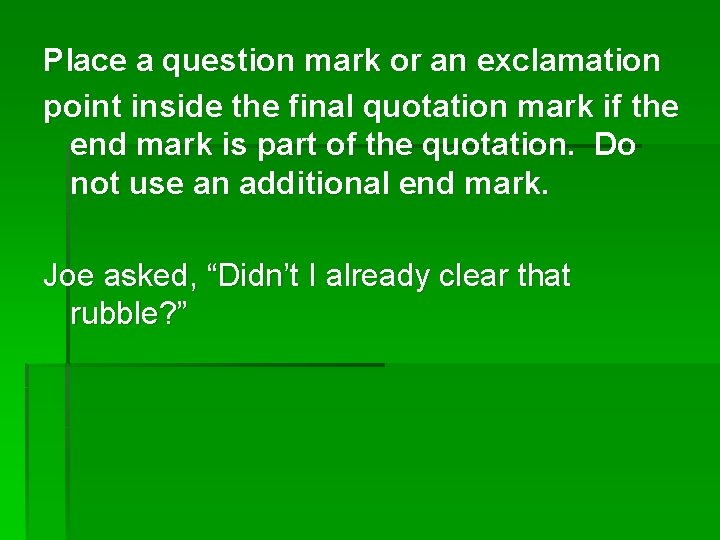
Place a question mark or an exclamation point inside the final quotation mark if the end mark is part of the quotation. Do not use an additional end mark. Joe asked, “Didn’t I already clear that rubble? ”
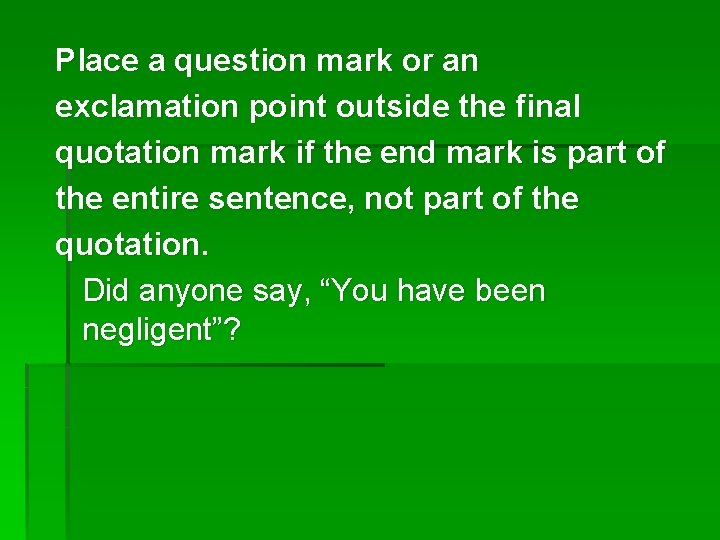
Place a question mark or an exclamation point outside the final quotation mark if the end mark is part of the entire sentence, not part of the quotation. Did anyone say, “You have been negligent”?
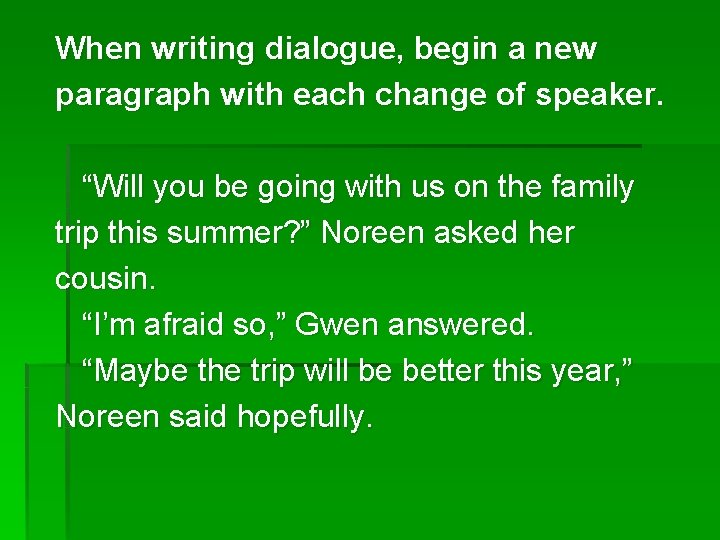
When writing dialogue, begin a new paragraph with each change of speaker. “Will you be going with us on the family trip this summer? ” Noreen asked her cousin. “I’m afraid so, ” Gwen answered. “Maybe the trip will be better this year, ” Noreen said hopefully.
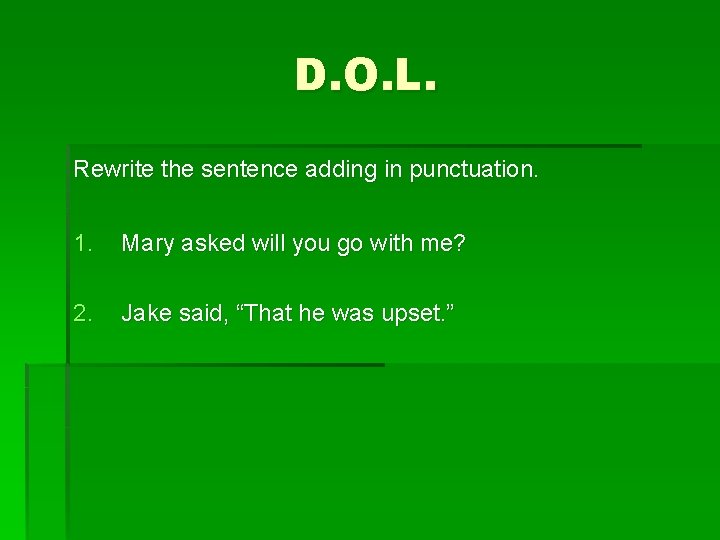
D. O. L. Rewrite the sentence adding in punctuation. 1. Mary asked will you go with me? 2. Jake said, “That he was upset. ”
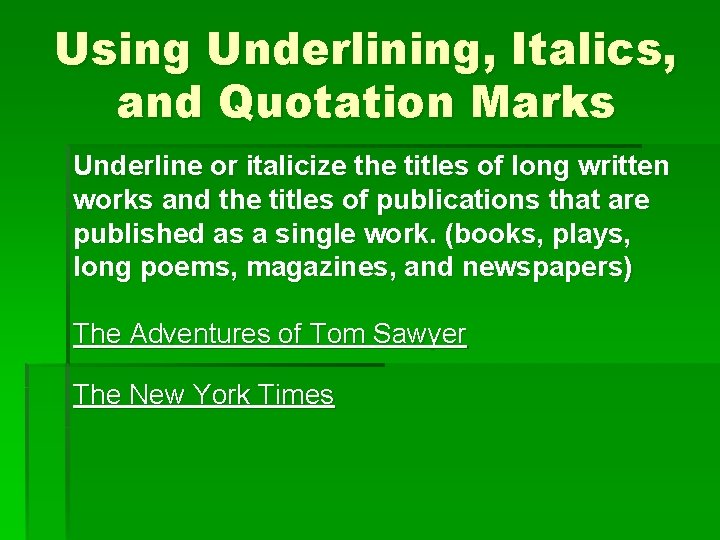
Using Underlining, Italics, and Quotation Marks Underline or italicize the titles of long written works and the titles of publications that are published as a single work. (books, plays, long poems, magazines, and newspapers) The Adventures of Tom Sawyer The New York Times
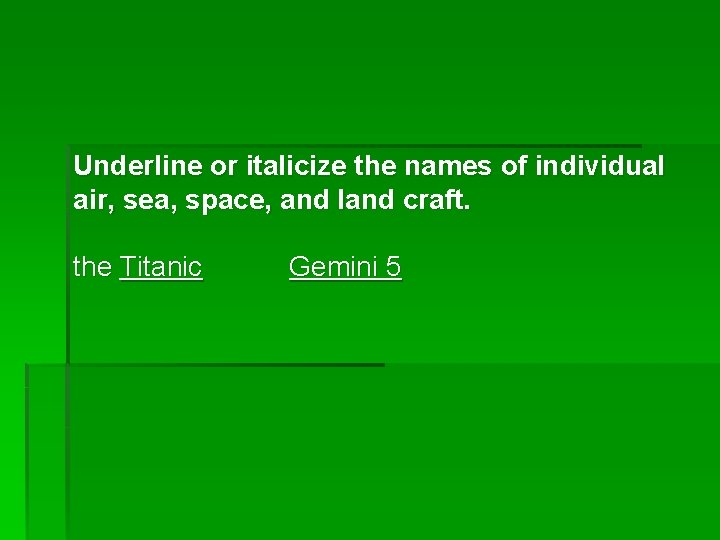
Underline or italicize the names of individual air, sea, space, and land craft. the Titanic Gemini 5
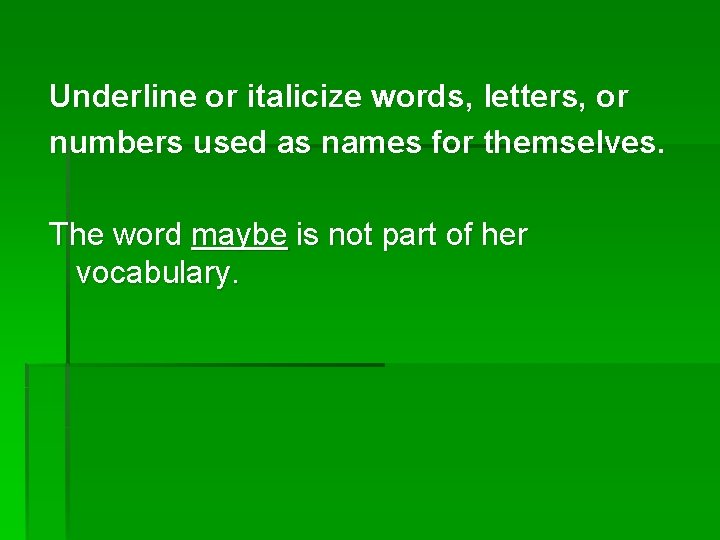
Underline or italicize words, letters, or numbers used as names for themselves. The word maybe is not part of her vocabulary.
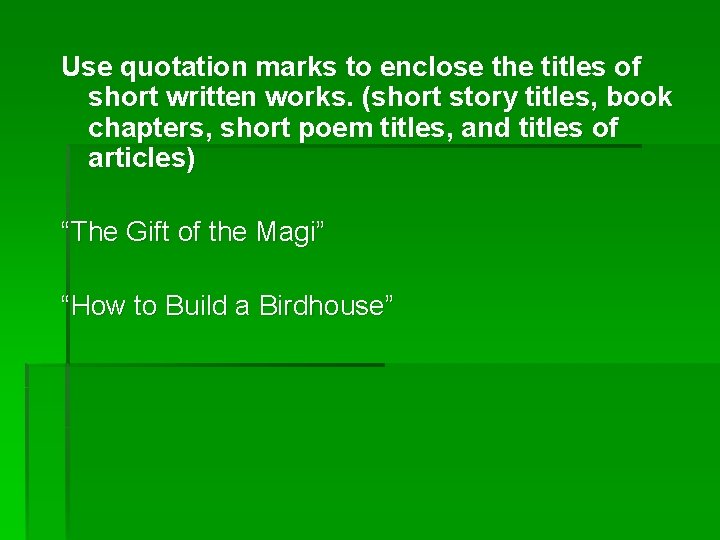
Use quotation marks to enclose the titles of short written works. (short story titles, book chapters, short poem titles, and titles of articles) “The Gift of the Magi” “How to Build a Birdhouse”
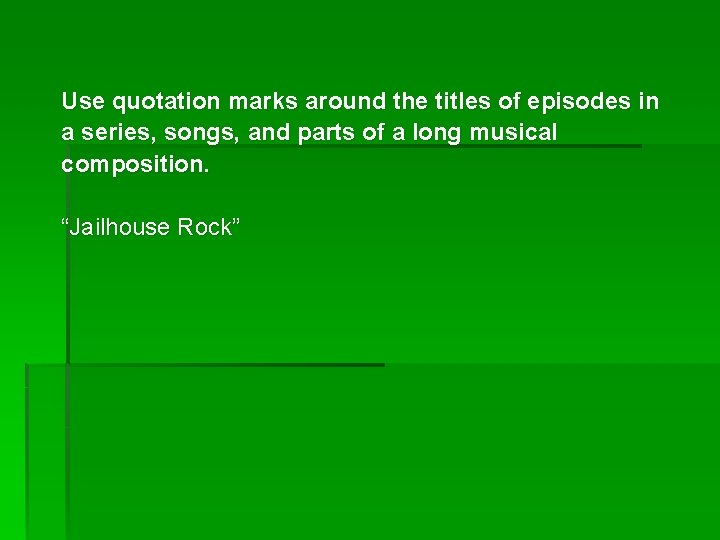
Use quotation marks around the titles of episodes in a series, songs, and parts of a long musical composition. “Jailhouse Rock”
Use quotation marks around the title of a work that is mentioned as part of a collection. “Raymond’s Run” in The Language of Literature
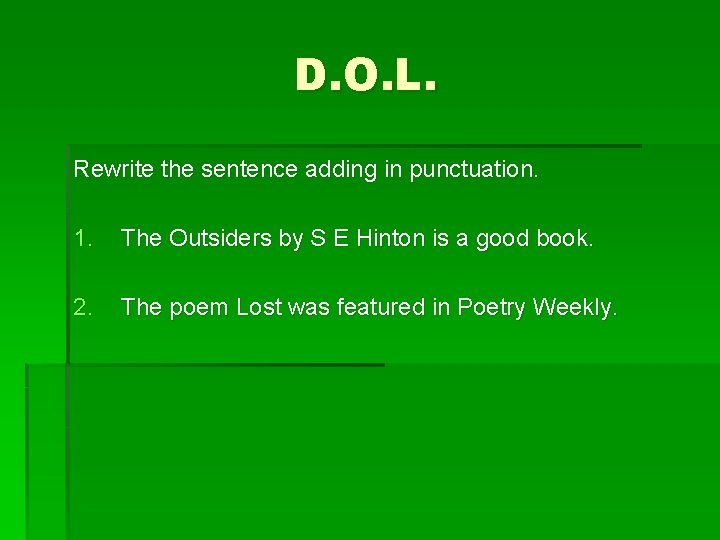
D. O. L. Rewrite the sentence adding in punctuation. 1. The Outsiders by S E Hinton is a good book. 2. The poem Lost was featured in Poetry Weekly.
Using Hyphens Use a hyphen writing out two-word numbers from twenty-one through ninetynine. There were thirty-four people panning for gold.
Use a hyphen writing fractions that are used as adjectives. A four-fifths majority wanted to head west.
If a fraction is used as a noun do not use a hyphen. Two thirds of the ore had been placed in the cart.
Use a hyphen after a prefix that is followed by a proper noun or an adjective. Many settlers moved west in the post. Revolutionary years.
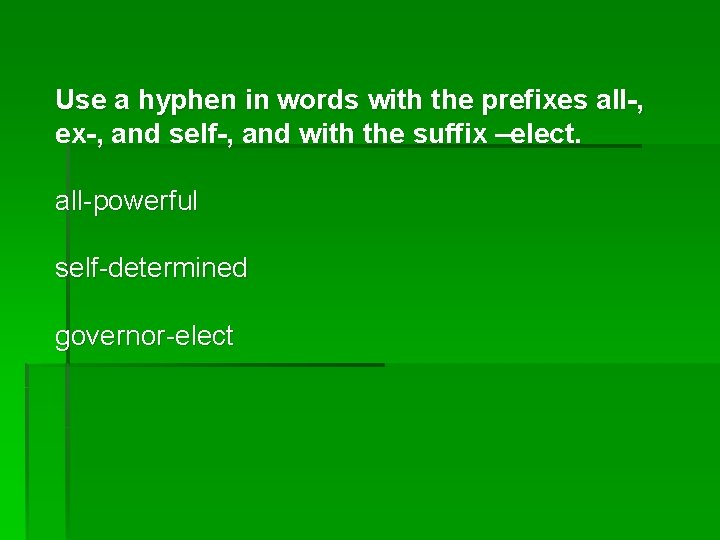
Use a hyphen in words with the prefixes all-, ex-, and self-, and with the suffix –elect. all-powerful self-determined governor-elect
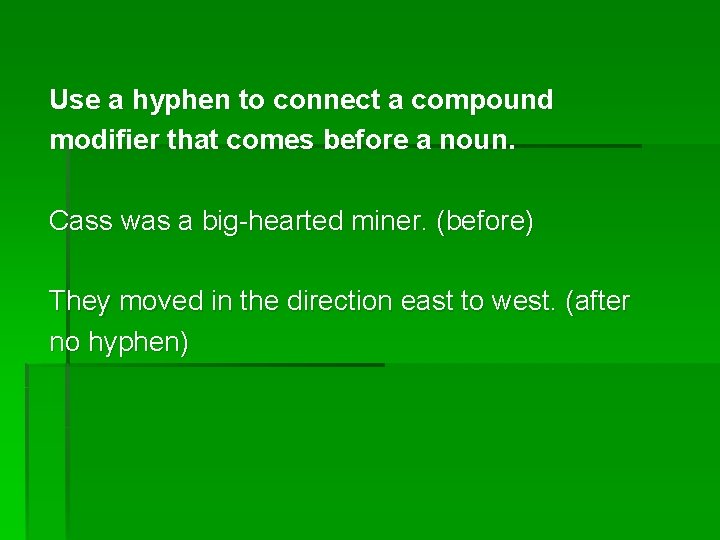
Use a hyphen to connect a compound modifier that comes before a noun. Cass was a big-hearted miner. (before) They moved in the direction east to west. (after no hyphen)
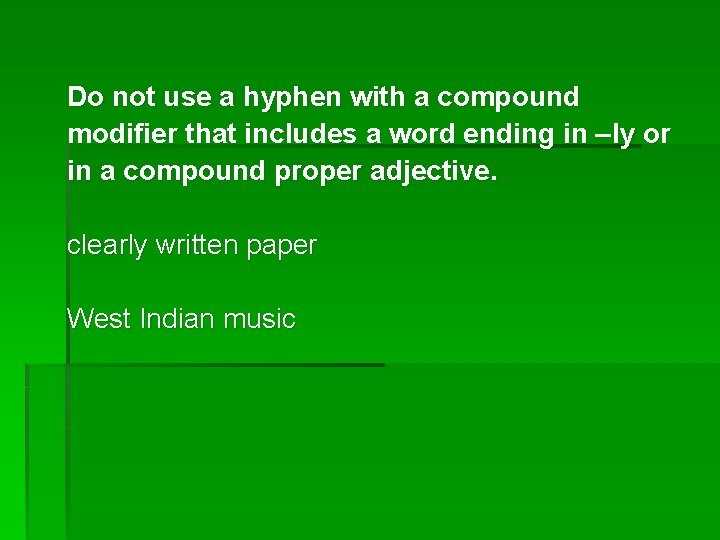
Do not use a hyphen with a compound modifier that includes a word ending in –ly or in a compound proper adjective. clearly written paper West Indian music
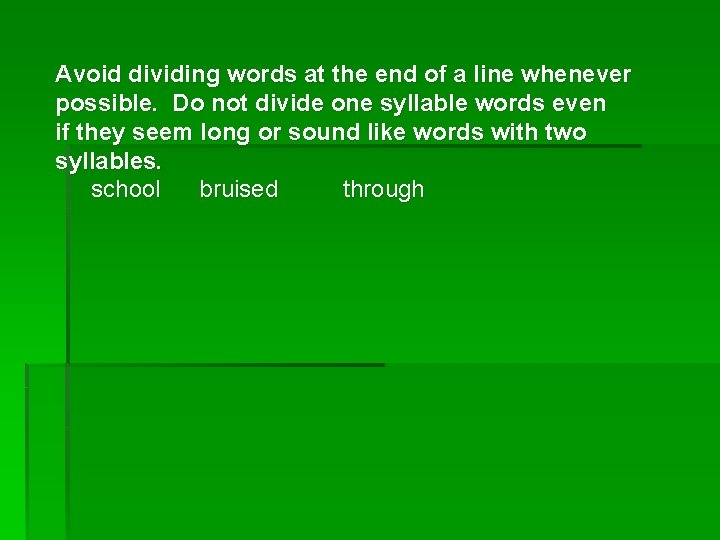
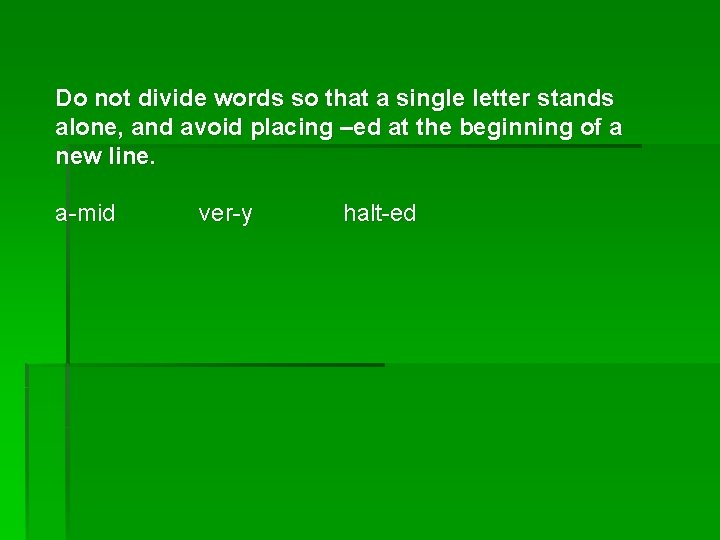
Avoid dividing words at the end of a line whenever possible. Do not divide one syllable words even if they seem long or sound like words with two syllables. school bruised through
Do not divide words so that a single letter stands alone, and avoid placing –ed at the beginning of a new line. a-mid ver-y halt-ed
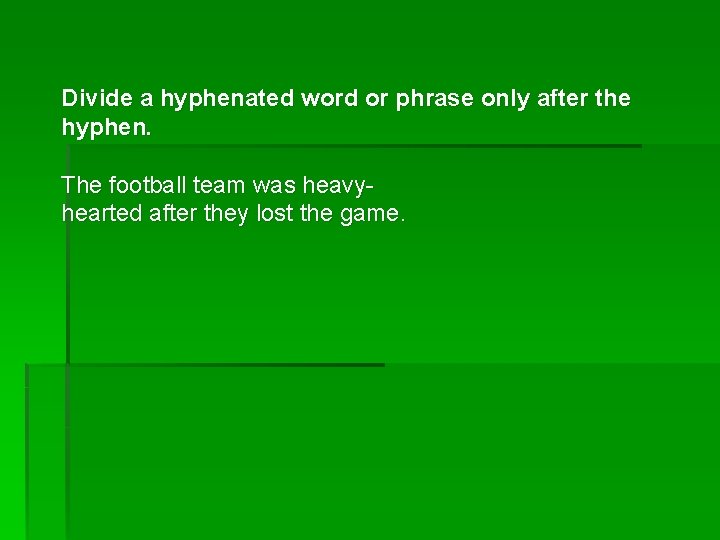
Divide a hyphenated word or phrase only after the hyphen. The football team was heavyhearted after they lost the game.
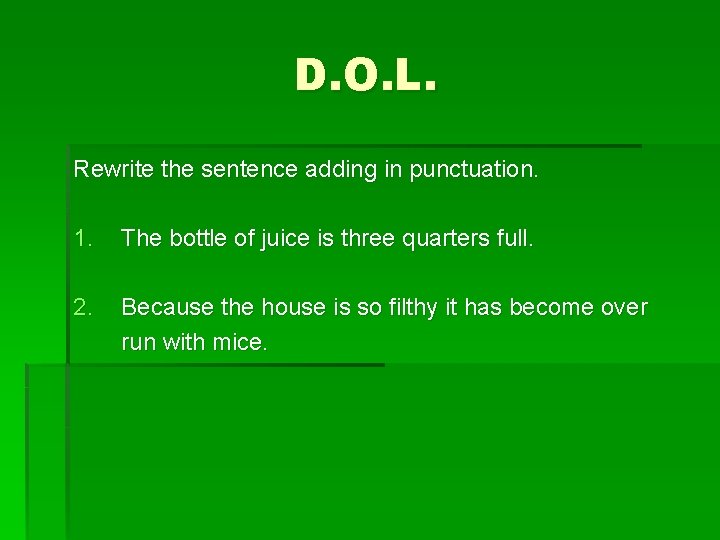
D. O. L. Rewrite the sentence adding in punctuation. 1. The bottle of juice is three quarters full. 2. Because the house is so filthy it has become over run with mice.
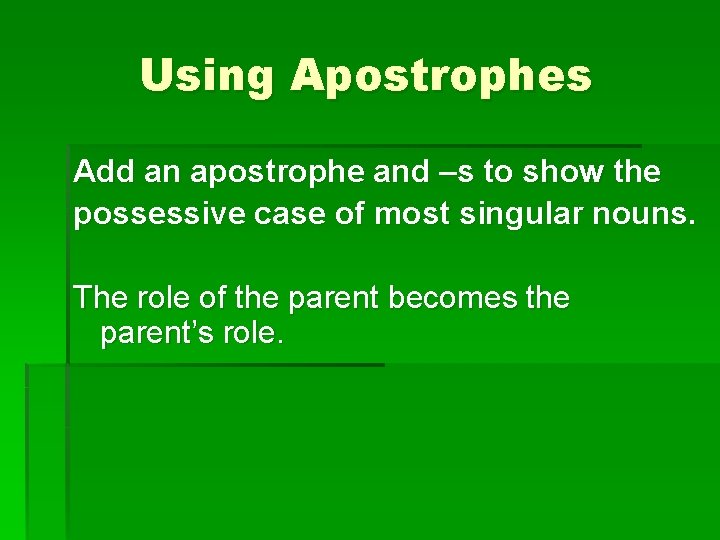
Using Apostrophes Add an apostrophe and –s to show the possessive case of most singular nouns. The role of the parent becomes the parent’s role.
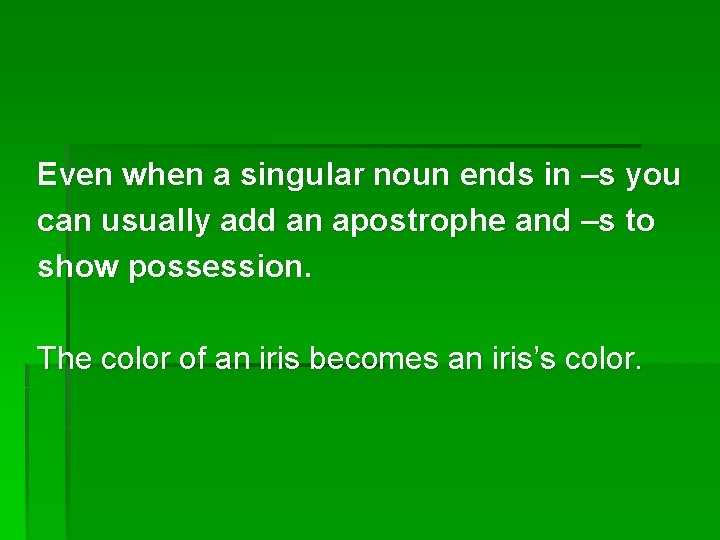
Even when a singular noun ends in –s you can usually add an apostrophe and –s to show possession. The color of an iris becomes an iris’s color.
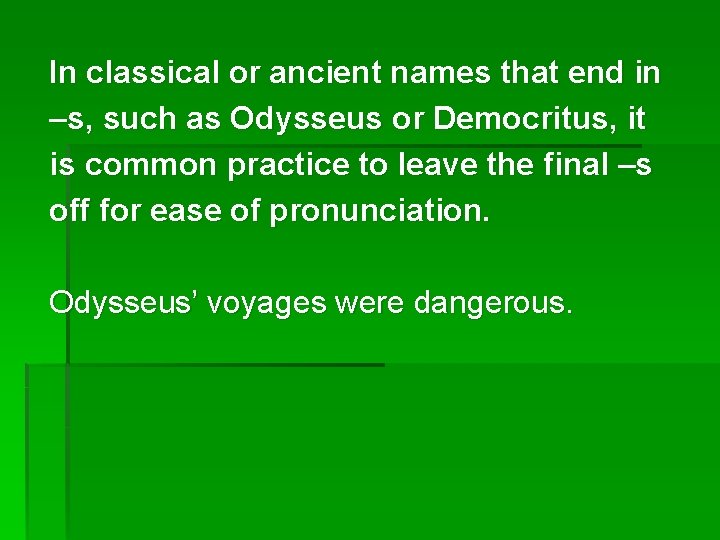
In classical or ancient names that end in –s, such as Odysseus or Democritus, it is common practice to leave the final –s off for ease of pronunciation. Odysseus’ voyages were dangerous.
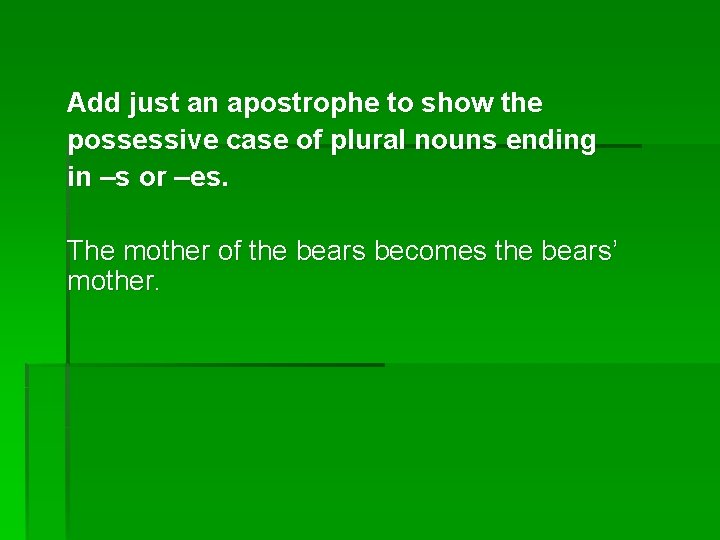
Add just an apostrophe to show the possessive case of plural nouns ending in –s or –es. The mother of the bears becomes the bears’ mother.
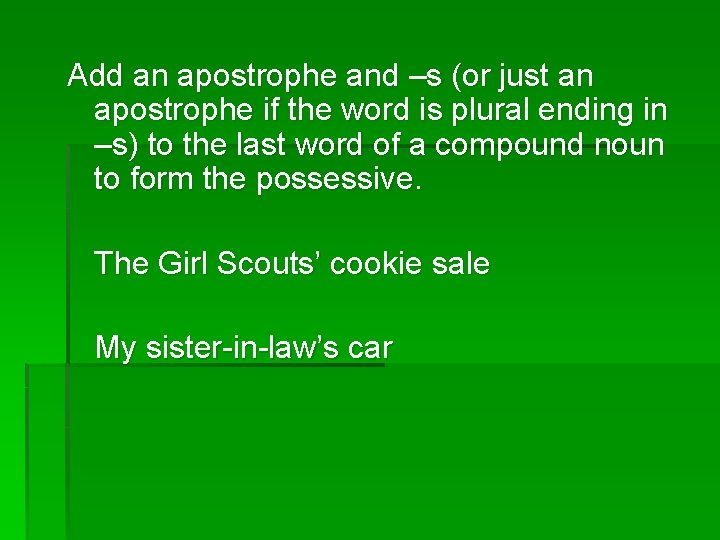
Add an apostrophe and –s (or just an apostrophe if the word is plural ending in –s) to the last word of a compound noun to form the possessive. The Girl Scouts’ cookie sale My sister-in-law’s car
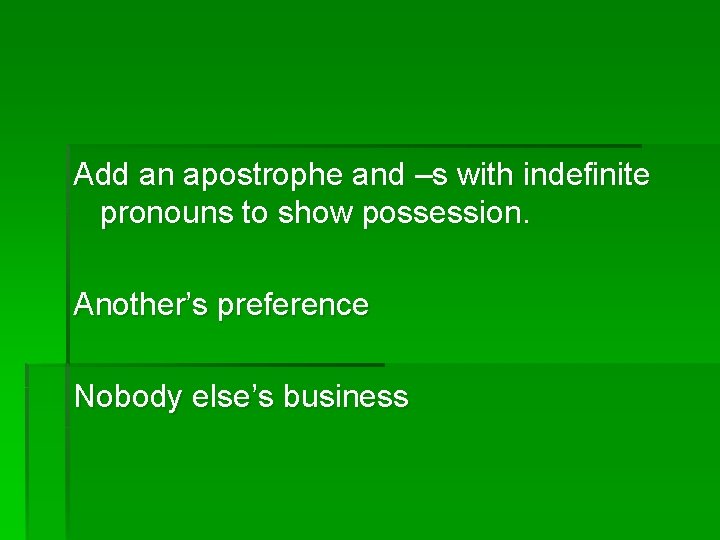
Add an apostrophe and –s with indefinite pronouns to show possession. Another’s preference Nobody else’s business
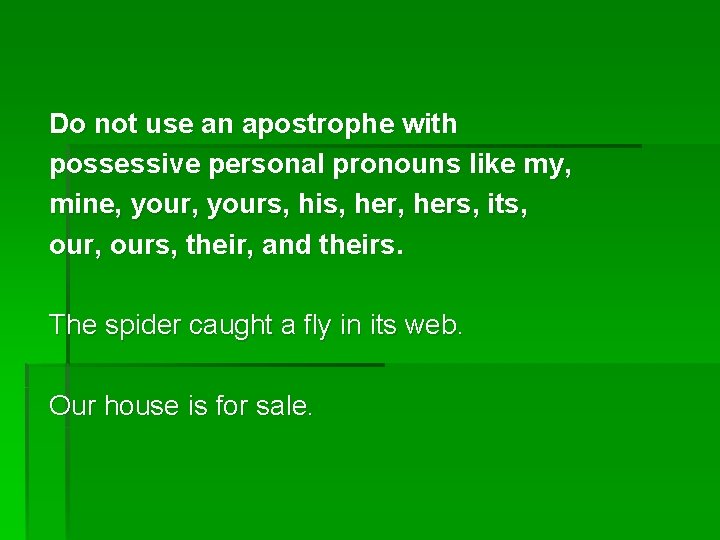
Do not use an apostrophe with possessive personal pronouns like my, mine, yours, his, hers, its, ours, their, and theirs. The spider caught a fly in its web. Our house is for sale.
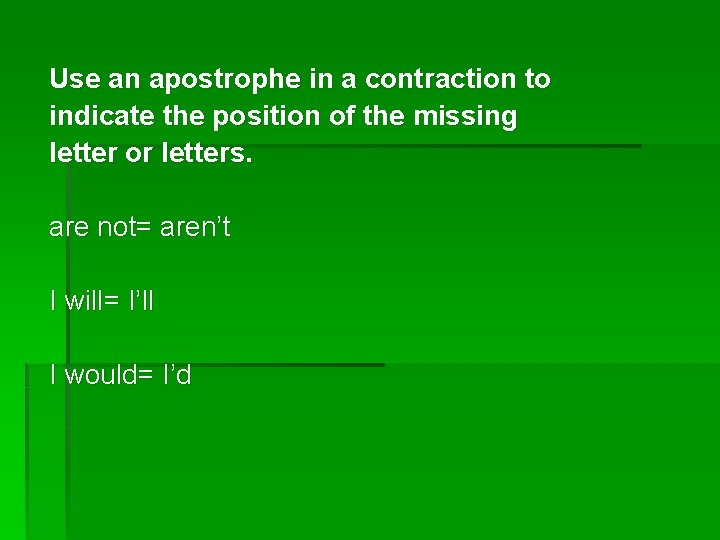
Use an apostrophe in a contraction to indicate the position of the missing letter or letters. are not= aren’t I will= I’ll I would= I’d
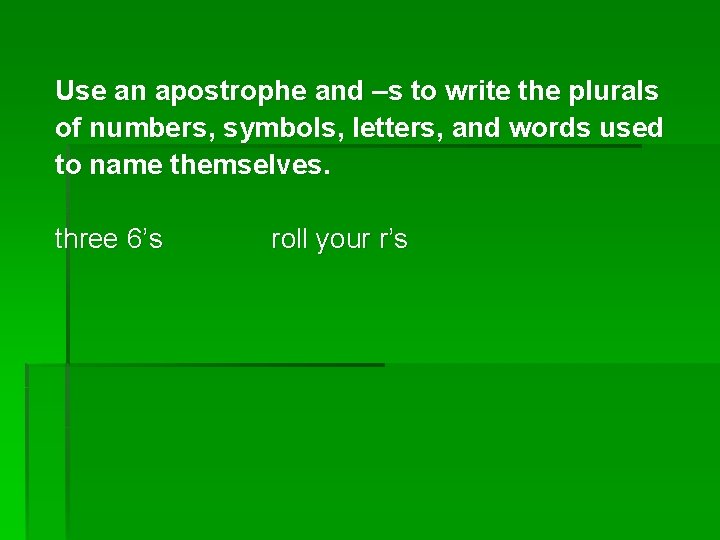
Use an apostrophe and –s to write the plurals of numbers, symbols, letters, and words used to name themselves. three 6’s roll your r’s
Remember: It’s always apostrophe -s Unless It’s a plural noun that ends in -s or -es!
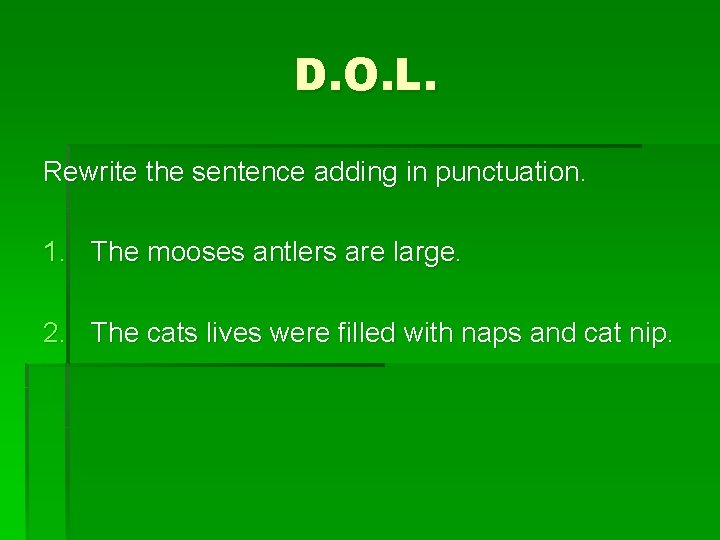
D. O. L. Rewrite the sentence adding in punctuation. 1. The mooses antlers are large. 2. The cats lives were filled with naps and cat nip.
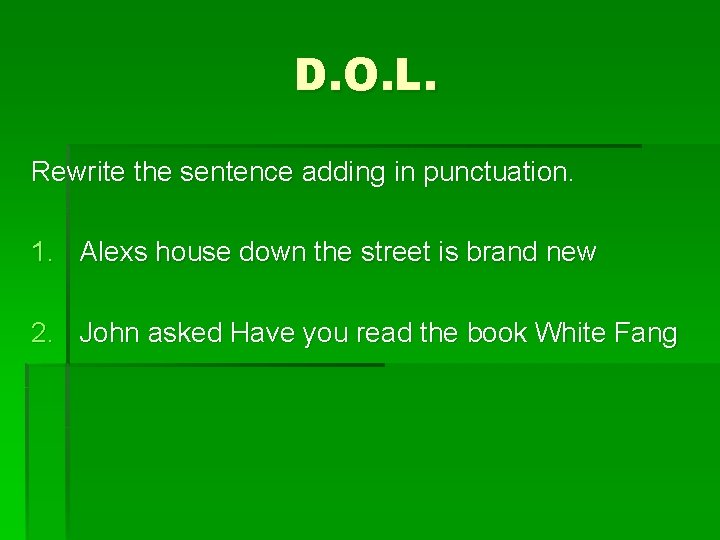
D. O. L. Rewrite the sentence adding in punctuation. 1. Alexs house down the street is brand new 2. John asked Have you read the book White Fang