
PUNCTUATION Period Question mark and Exclamation Point 1
- Slides: 10
PUNCTUATION
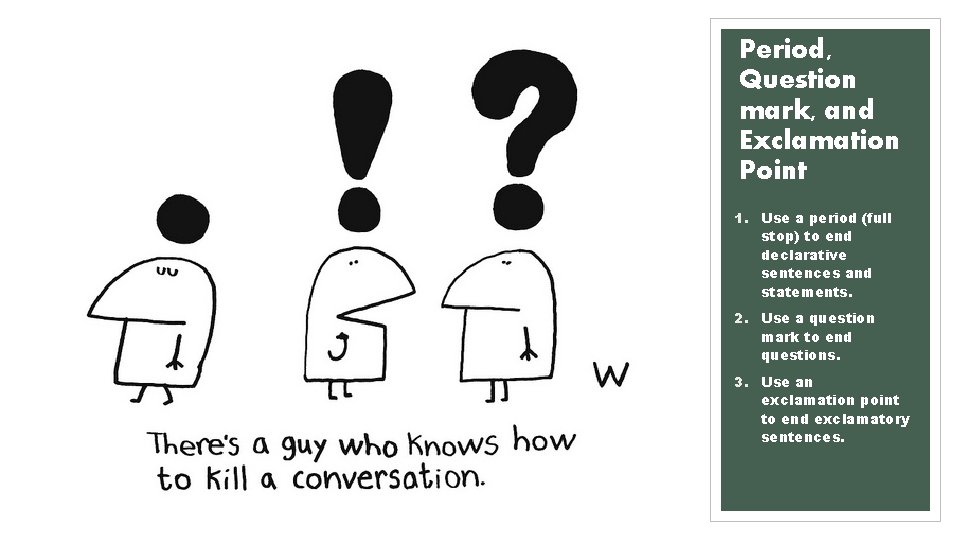
Period, Question mark, and Exclamation Point 1. Use a period (full stop) to end declarative sentences and statements. 2. Use a question mark to end questions. 3. Use an exclamation point to end exclamatory sentences.
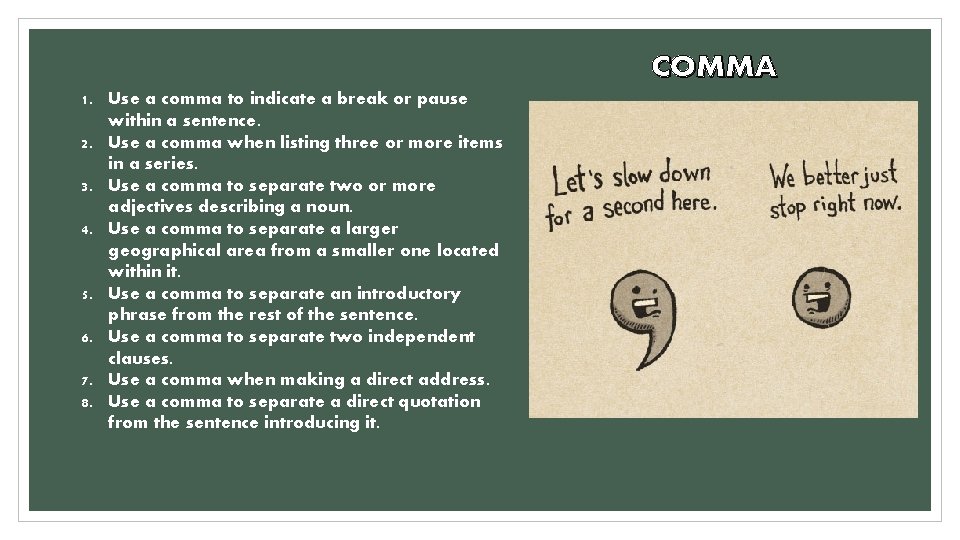
COMMA 1. Use a comma to indicate a break or pause within a sentence. 2. Use a comma when listing three or more items in a series. 3. Use a comma to separate two or more adjectives describing a noun. 4. Use a comma to separate a larger geographical area from a smaller one located within it. 5. Use a comma to separate an introductory phrase from the rest of the sentence. 6. Use a comma to separate two independent clauses. 7. Use a comma when making a direct address. 8. Use a comma to separate a direct quotation from the sentence introducing it.
Examples: • The fruit basket contained apples, bananas, and oranges. (listing three or more items) • The big, red truck came our way. (separate two or more adjectives) • Oakland, California, is where I grew up. (separate a larger area from a smaller one) • On the back of my couch, my cat's claws have slowly been carving a large hole. (separate introductory phrase) • Ryan went to the beach yesterday, but he forgot his sunscreen. (separate two independent clauses) • Amber, could you come here for a moment? (direct address)
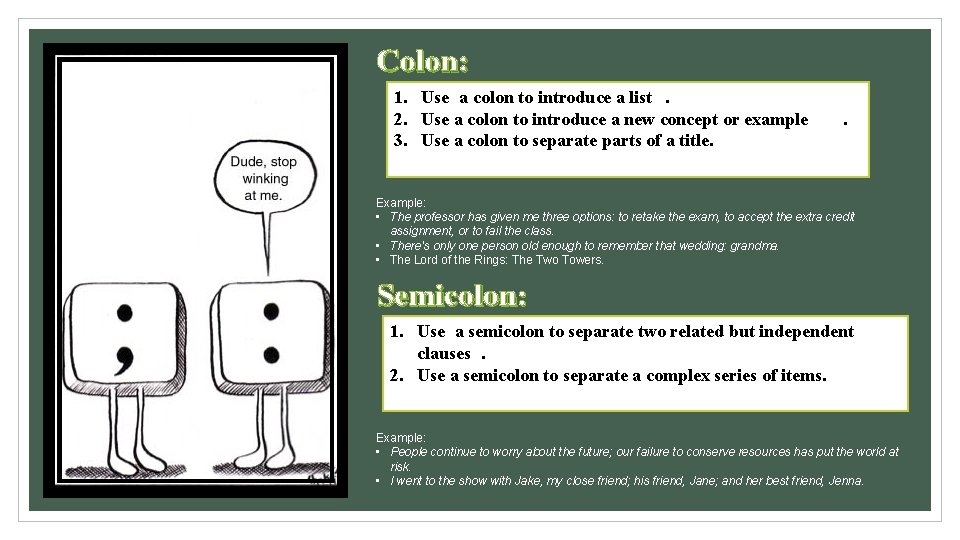
Colon: 1. Use a colon to introduce a list. 2. Use a colon to introduce a new concept or example 3. Use a colon to separate parts of a title. . Example: • The professor has given me three options: to retake the exam, to accept the extra credit assignment, or to fail the class. • There's only one person old enough to remember that wedding: grandma. • The Lord of the Rings: The Two Towers. Semicolon: 1. Use a semicolon to separate two related but independent clauses. 2. Use a semicolon to separate a complex series of items. Example: • People continue to worry about the future; our failure to conserve resources has put the world at risk. • I went to the show with Jake, my close friend; his friend, Jane; and her best friend, Jenna.
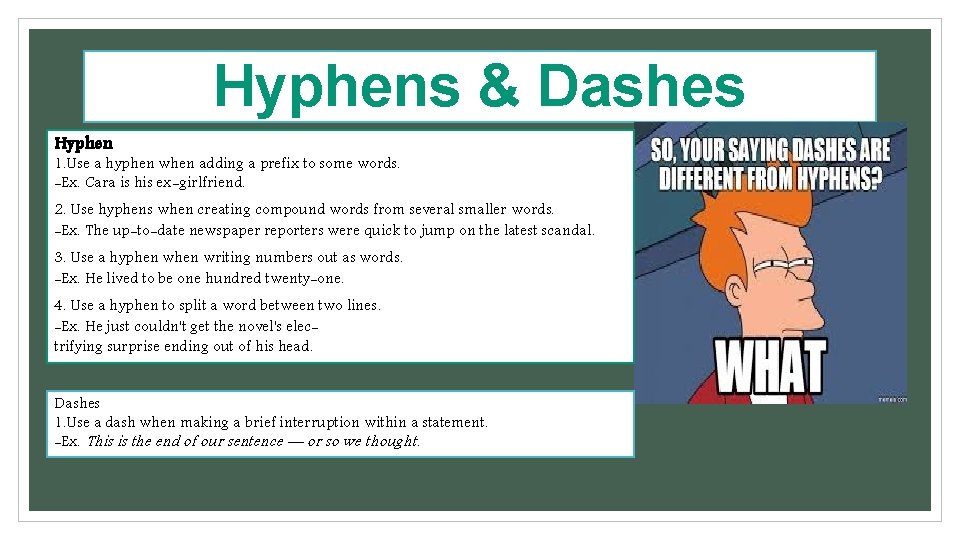
Hyphens & Dashes Hyphen 1. Use a hyphen when adding a prefix to some words. -Ex. Cara is his ex-girlfriend. 2. Use hyphens when creating compound words from several smaller words. -Ex. The up-to-date newspaper reporters were quick to jump on the latest scandal. 3. Use a hyphen writing numbers out as words. -Ex. He lived to be one hundred twenty-one. 4. Use a hyphen to split a word between two lines. -Ex. He just couldn't get the novel's electrifying surprise ending out of his head. Dashes 1. Use a dash when making a brief interruption within a statement. -Ex. This is the end of our sentence — or so we thought.
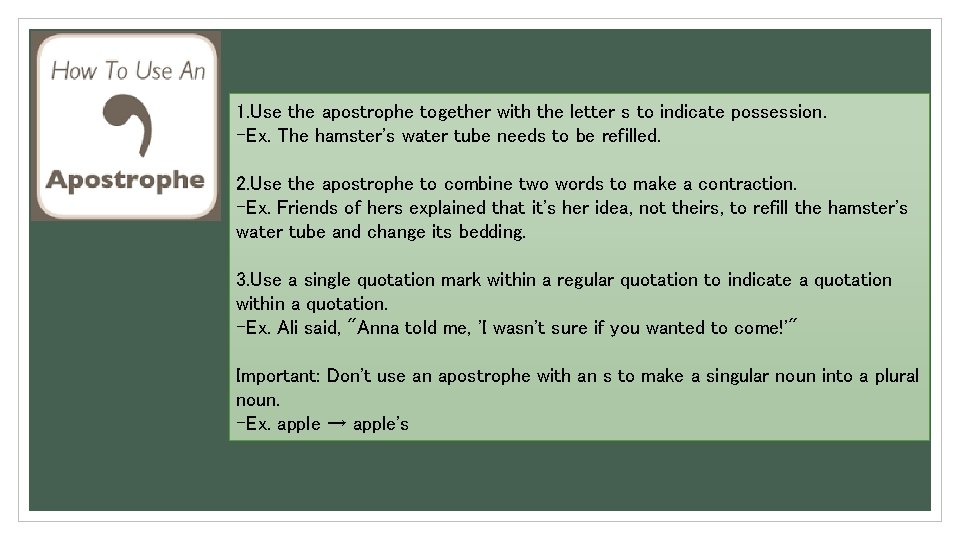
1. Use the apostrophe together with the letter s to indicate possession. -Ex. The hamster's water tube needs to be refilled. 2. Use the apostrophe to combine two words to make a contraction. -Ex. Friends of hers explained that it's her idea, not theirs, to refill the hamster's water tube and change its bedding. 3. Use a single quotation mark within a regular quotation to indicate a quotation within a quotation. -Ex. Ali said, "Anna told me, 'I wasn't sure if you wanted to come!'" Important: Don't use an apostrophe with an s to make a singular noun into a plural noun. -Ex. apple → apple's
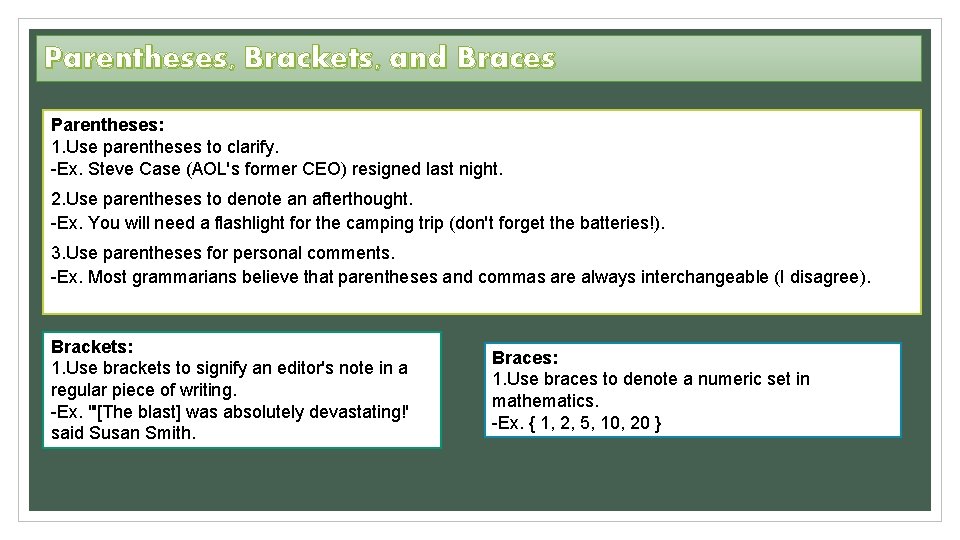
Parentheses, Brackets, and Braces Parentheses: 1. Use parentheses to clarify. -Ex. Steve Case (AOL's former CEO) resigned last night. 2. Use parentheses to denote an afterthought. -Ex. You will need a flashlight for the camping trip (don't forget the batteries!). 3. Use parentheses for personal comments. -Ex. Most grammarians believe that parentheses and commas are always interchangeable (I disagree). Brackets: 1. Use brackets to signify an editor's note in a regular piece of writing. -Ex. "'[The blast] was absolutely devastating!' said Susan Smith. Braces: 1. Use braces to denote a numeric set in mathematics. -Ex. { 1, 2, 5, 10, 20 }
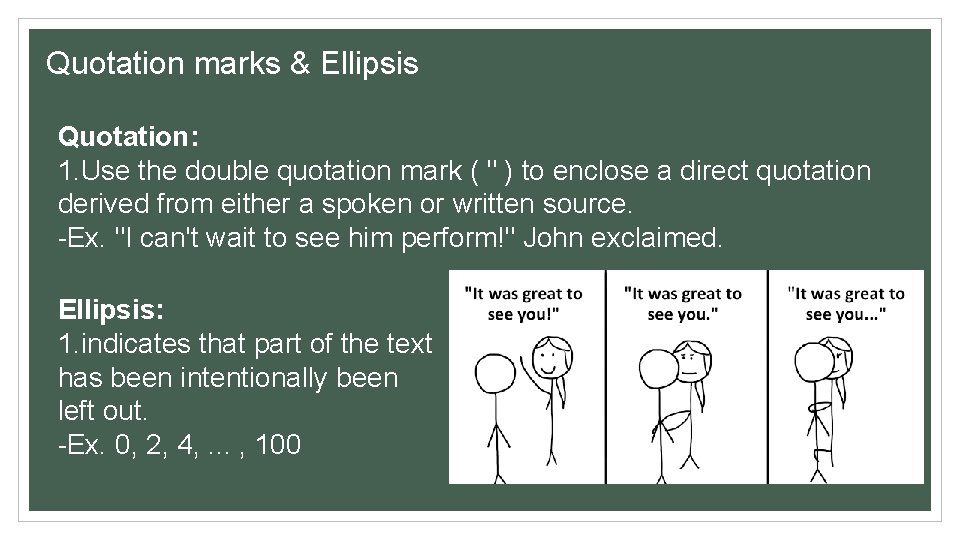
Quotation marks & Ellipsis Quotation: 1. Use the double quotation mark ( " ) to enclose a direct quotation derived from either a spoken or written source. -Ex. "I can't wait to see him perform!" John exclaimed. Ellipsis: 1. indicates that part of the text has been intentionally been left out. -Ex. 0, 2, 4, . . . , 100
http: //faculty. southwest. tn. edu/sblack/dspw 0800/ Memos/Punctuation. Quiz. htm