
Punctuation notes I recommend you print these slides



- Slides: 10
Punctuation notes **I recommend you print these slides out to reference later**
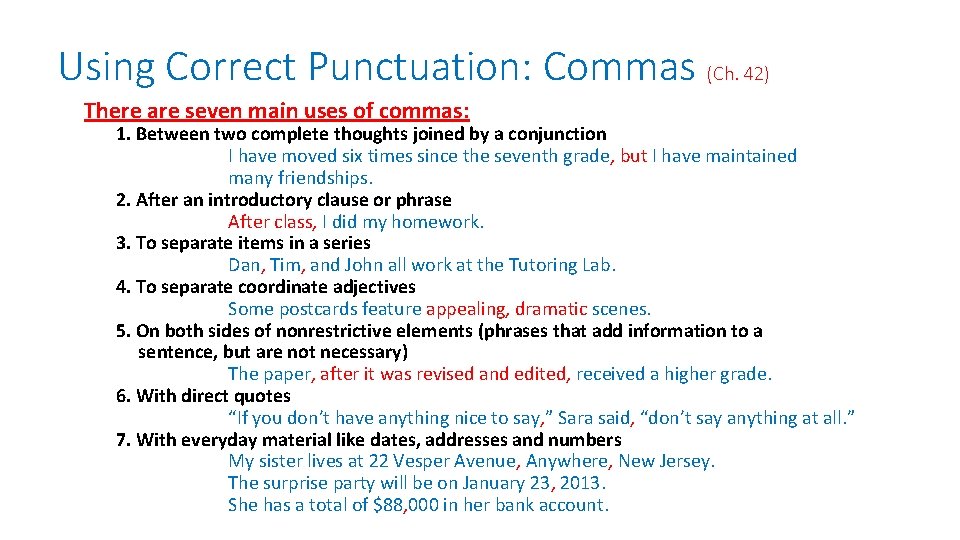
Using Correct Punctuation: Commas (Ch. 42) There are seven main uses of commas: 1. Between two complete thoughts joined by a conjunction I have moved six times since the seventh grade, but I have maintained many friendships. 2. After an introductory clause or phrase After class, I did my homework. 3. To separate items in a series Dan, Tim, and John all work at the Tutoring Lab. 4. To separate coordinate adjectives Some postcards feature appealing, dramatic scenes. 5. On both sides of nonrestrictive elements (phrases that add information to a sentence, but are not necessary) The paper, after it was revised and edited, received a higher grade. 6. With direct quotes “If you don’t have anything nice to say, ” Sara said, “don’t say anything at all. ” 7. With everyday material like dates, addresses and numbers My sister lives at 22 Vesper Avenue, Anywhere, New Jersey. The surprise party will be on January 23, 2013. She has a total of $88, 000 in her bank account.
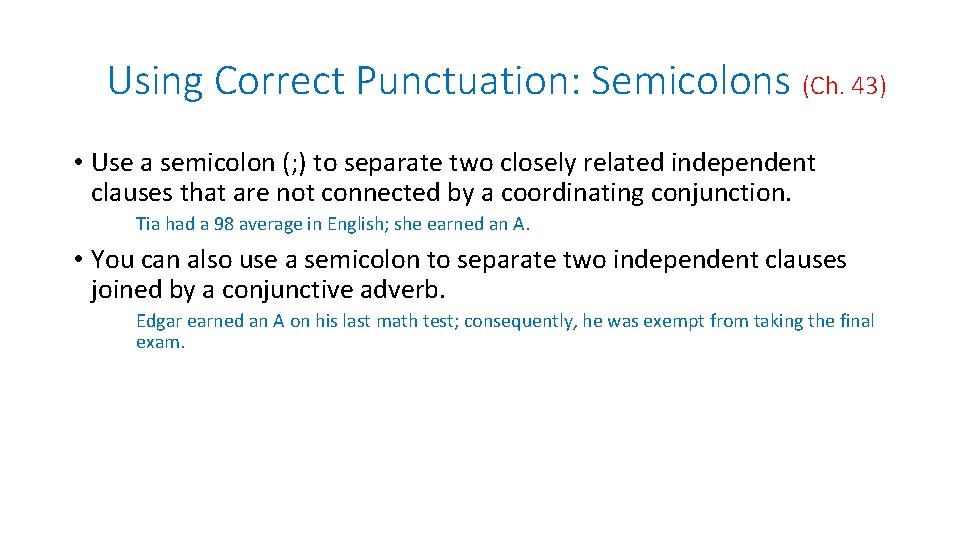
Using Correct Punctuation: Semicolons (Ch. 43) • Use a semicolon (; ) to separate two closely related independent clauses that are not connected by a coordinating conjunction. Tia had a 98 average in English; she earned an A. • You can also use a semicolon to separate two independent clauses joined by a conjunctive adverb. Edgar earned an A on his last math test; consequently, he was exempt from taking the final exam.
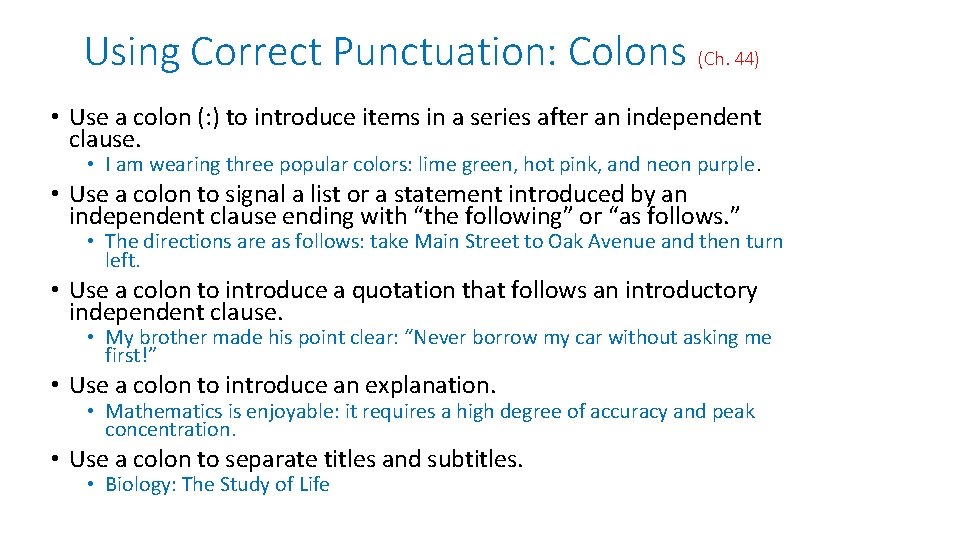
Using Correct Punctuation: Colons (Ch. 44) • Use a colon (: ) to introduce items in a series after an independent clause. • I am wearing three popular colors: lime green, hot pink, and neon purple. • Use a colon to signal a list or a statement introduced by an independent clause ending with “the following” or “as follows. ” • The directions are as follows: take Main Street to Oak Avenue and then turn left. • Use a colon to introduce a quotation that follows an introductory independent clause. • My brother made his point clear: “Never borrow my car without asking me first!” • Use a colon to introduce an explanation. • Mathematics is enjoyable: it requires a high degree of accuracy and peak concentration. • Use a colon to separate titles and subtitles. • Biology: The Study of Life
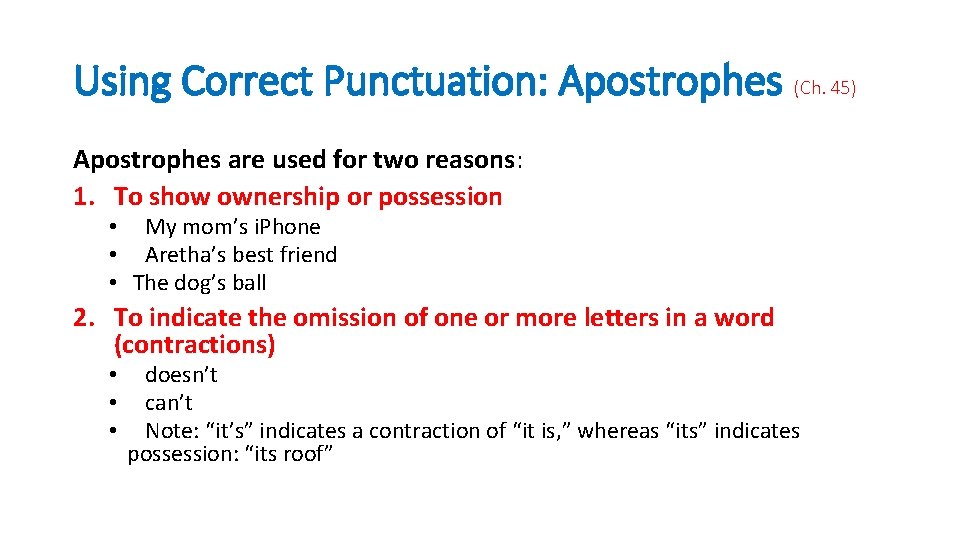
Using Correct Punctuation: Apostrophes (Ch. 45) Apostrophes are used for two reasons: 1. To show ownership or possession • My mom’s i. Phone • Aretha’s best friend • The dog’s ball 2. To indicate the omission of one or more letters in a word (contractions) • • • doesn’t can’t Note: “it’s” indicates a contraction of “it is, ” whereas “its” indicates possession: “its roof”
Using Correct Punctuation: Quotation Marks (Ch. 46) • Quotation marks (“Hello”) are always used in pairs to separate a direct quotation from the sentence that contains it. • “I’m going to fail this test, ” Kyle admitted, “because I didn’t study. ” • Quotation marks are also used to indicate titles of songs, short stories, articles, reports, and essays. • Amy Tan wrote a terrific essay titled, “Mother Tongue. ” • Note, punctuation goes inside of quotation marks, with the only exception being question marks and exclamation points when they are not part of the quoted material. • What did Kyle mean when he said, “I didn’t study”?
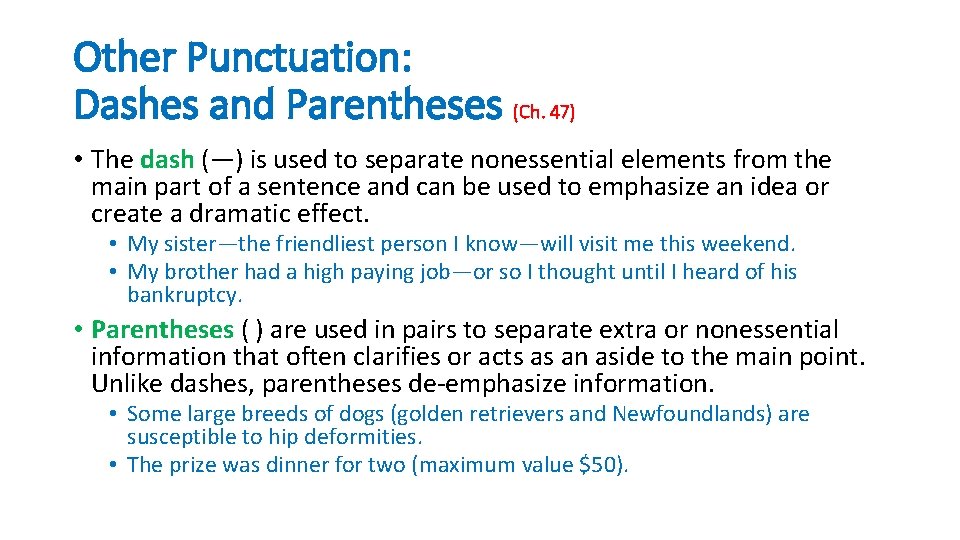
Other Punctuation: Dashes and Parentheses (Ch. 47) • The dash (—) is used to separate nonessential elements from the main part of a sentence and can be used to emphasize an idea or create a dramatic effect. • My sister—the friendliest person I know—will visit me this weekend. • My brother had a high paying job—or so I thought until I heard of his bankruptcy. • Parentheses ( ) are used in pairs to separate extra or nonessential information that often clarifies or acts as an aside to the main point. Unlike dashes, parentheses de-emphasize information. • Some large breeds of dogs (golden retrievers and Newfoundlands) are susceptible to hip deformities. • The prize was dinner for two (maximum value $50).
Using Correct Capitalization (Ch. 48) • Capitalize the first word in every sentence • Prewriting is useful. • Capitalize the first word in a direct quote • Sarah commented, “That exam was difficult. ” • Capitalize the names of people, including the pronoun “I” • Mr. Thomas Smith • Capitalize the names of specific places, cities, states, and geographic areas • Carneys Point, New Jersey • Capitalize government and public offices and buildings and names of organizations • House of Representatives; the White House; Boy Scouts • Capitalize the names of months, days of the week, holidays, and major historical events • Tuesday, January 23 rd; Thanksgiving; World War II • In titles, capitalize the first letter of each word except articles, prepositions and conjunctions • Biology: The Study of Life • Capitalize races, nationalities, languages, and religions. • African American; English; Hinduism; God, the Bible • Capitalize the names of products • Pampers; Pepperidge Farm Goldfish • Capitalize specific course titles • English Composition I
Abbreviations When to abbreviate: • You can abbreviate some titles before and after people’s names • Mr. Ling • Samantha Smith, M. D. • You can abbreviate time references • 7: 30 a. m. When not to abbreviate: • Do not abbreviate geographic or other place names in a sentence. • • Write: I went to New York. Not: I went to N. Y. Write: Hollywood Avenue Not: Hollywood Ave. • Do not abbreviate parts of written works in a sentence. • Write: I read chapter three. • Not: I read ch. 3. • Do not abbreviate days, months or holidays. • Tuesday not Tues. • Do not abbreviate or use symbols for common words like “and, ” “at, ” and “etcetera. ” • Do not use: & @ etc.
Numbers can be written as numerals (600) or words (six hundred). Here are the guidelines for when to use numerals and when to use words: Use numerals: • For numbers 11 and higher • 547 students • For days and years • January 23, 2014 • For percentages over ten • 57 percent • For exact times and exact amounts of money • 9: 27 a. m. • $5. 60 • For pages, chapters, volumes • Chapter 12 • For addresses • 460 Hollywood Avenue • Scores and statistics • 23— 33 Use words: • For numbers ten and under • Nine students • When numbers begin a sentence • Fifteen students ate lunch.