
Punctuation Marks Period Use a period After a

- Slides: 9
Punctuation Marks
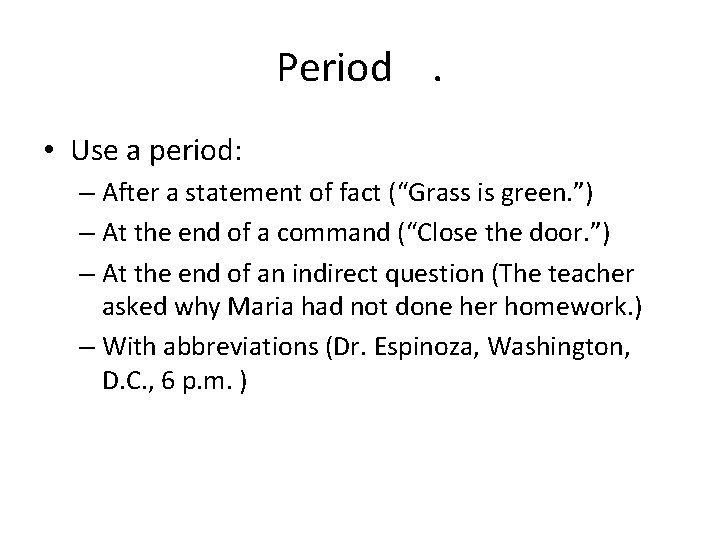
Period. • Use a period: – After a statement of fact (“Grass is green. ”) – At the end of a command (“Close the door. ”) – At the end of an indirect question (The teacher asked why Maria had not done her homework. ) – With abbreviations (Dr. Espinoza, Washington, D. C. , 6 p. m. )
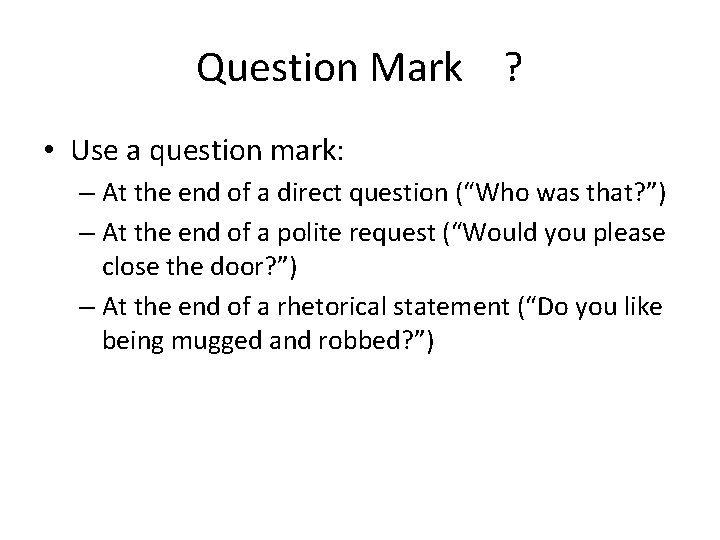
Question Mark ? • Use a question mark: – At the end of a direct question (“Who was that? ”) – At the end of a polite request (“Would you please close the door? ”) – At the end of a rhetorical statement (“Do you like being mugged and robbed? ”)
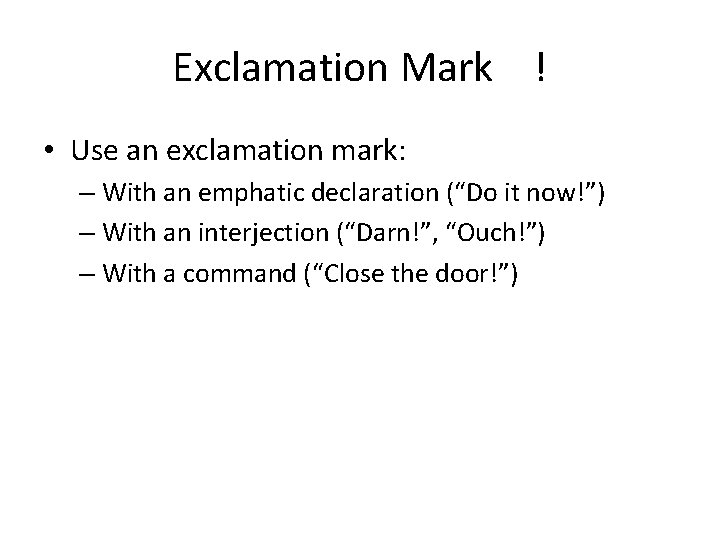
Exclamation Mark ! • Use an exclamation mark: – With an emphatic declaration (“Do it now!”) – With an interjection (“Darn!”, “Ouch!”) – With a command (“Close the door!”)
Colon : • Use a colon: – For a list (“We need the following: eggs, butter, bread. ”) – In a formal letter (“Dear Mr. Smith: ”)
Semicolon ; • Use a semi colon: – To sort out a list (“While on vacation we went to Portland, Oregon; Bangor, Maine; Hartford, Connecticut; and Pittsburgh, Pennsylvania. ”) – To separate closely related ideas (“She was a new worker; she really tried her best to impress the boss. ”)
Hyphen • Use a hyphen: – When creating compound words before nouns (“the well-known actor”, “my six-year-old daughter”) – When writing out numbers twenty-one to ninetynine and fractions (“five-eighths”, “one-fourth”) – adding certain prefixes to words. The prefixes self -, all-, and ex- nearly always require a hyphen (“exhusband”, “all-inclusive”, “self-control”)
Parenthesis ( ) • Use parenthesis: – For examples (like this one) – For extra information in a sentence: “George Washington (our first President) chopped down his father’s cherry tree. ”
Apostrophe ‘ • Use an apostrophe: – To create possessives (“This is my father’s car. ”) – To create contractions (“It’s a beautiful day outside. ”) – To form some plurals, especially the plural of letters and digits. (“Raoul got four A's last term”, “His sister got four 6's in the ice-skating competition. ”)