
Punctuation Full stop Question mark and Exclamation mark
![Brackets (()) / ([]) � () to separate information off that is not essential](https://slidetodoc.com/presentation_image_h2/ae46187b477c3b099096e929a1671c13/image-9.jpg "Brackets (()) / ([]) � () to separate information off that is not essential")
- Slides: 16
Punctuation
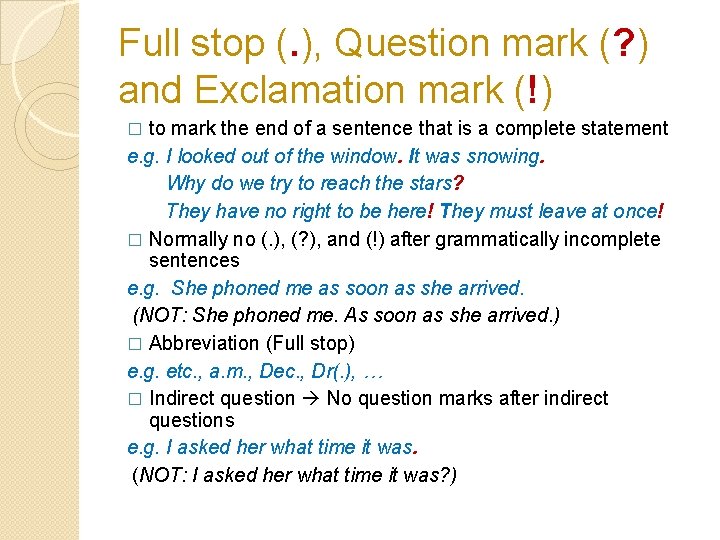
Full stop (. ), Question mark (? ) and Exclamation mark (!) to mark the end of a sentence that is a complete statement e. g. I looked out of the window. It was snowing. Why do we try to reach the stars? They have no right to be here! They must leave at once! � Normally no (. ), (? ), and (!) after grammatically incomplete sentences e. g. She phoned me as soon as she arrived. (NOT: She phoned me. As soon as she arrived. ) � Abbreviation (Full stop) e. g. etc. , a. m. , Dec. , Dr(. ), … � Indirect question No question marks after indirect questions e. g. I asked her what time it was. (NOT: I asked her what time it was? ) �
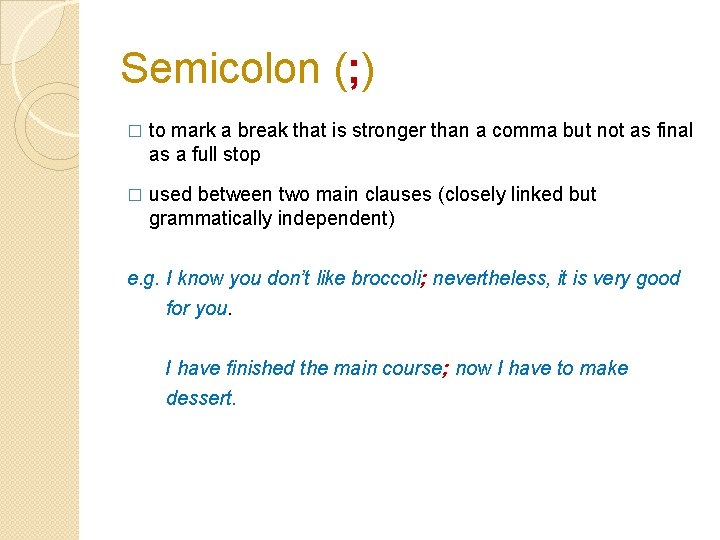
Semicolon (; ) � to mark a break that is stronger than a comma but not as final as a full stop � used between two main clauses (closely linked but grammatically independent) e. g. I know you don’t like broccoli; nevertheless, it is very good for you. I have finished the main course; now I have to make dessert.
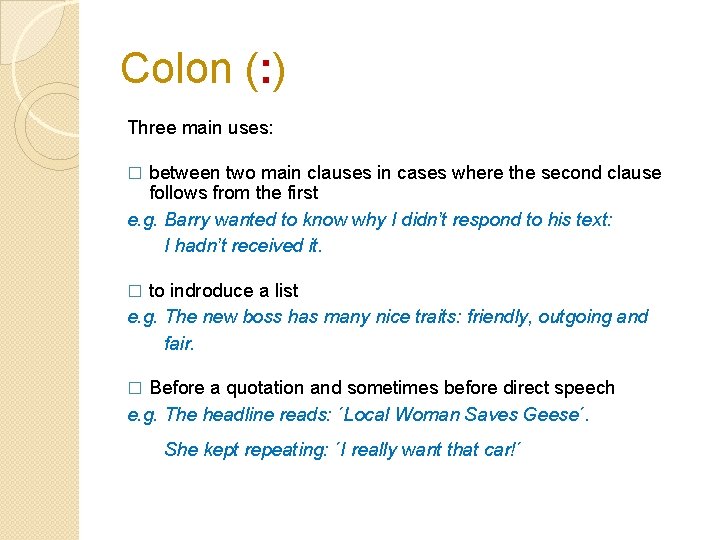
Colon (: ) Three main uses: between two main clauses in cases where the second clause follows from the first e. g. Barry wanted to know why I didn’t respond to his text: I hadn’t received it. � to indroduce a list e. g. The new boss has many nice traits: friendly, outgoing and fair. � Before a quotation and sometimes before direct speech e. g. The headline reads: ´Local Woman Saves Geese´. � She kept repeating: ´I really want that car!´
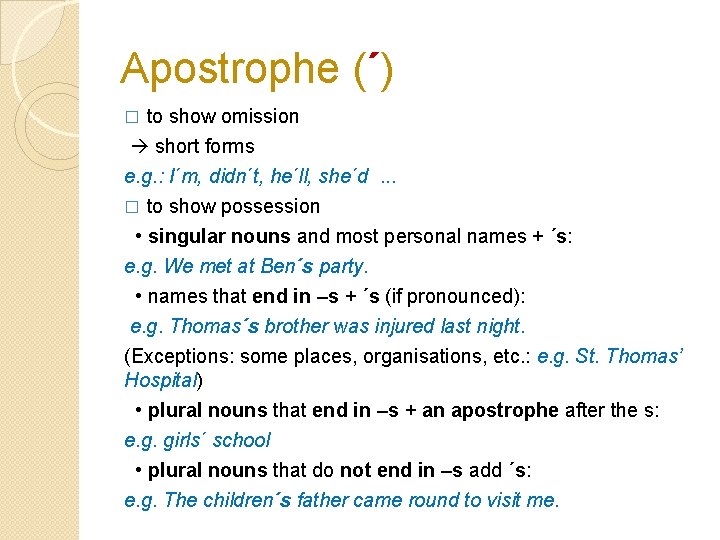
Apostrophe (´) to show omission short forms � e. g. : I´m, didn´t, he´ll, she´d. . . � to show possession • singular nouns and most personal names + ´s: e. g. We met at Ben´s party. • names that end in –s + ´s (if pronounced): e. g. Thomas´s brother was injured last night. (Exceptions: some places, organisations, etc. : e. g. St. Thomas’ Hospital) • plural nouns that end in –s + an apostrophe after the s: e. g. girls´ school • plural nouns that do not end in –s add ´s: e. g. The children´s father came round to visit me.
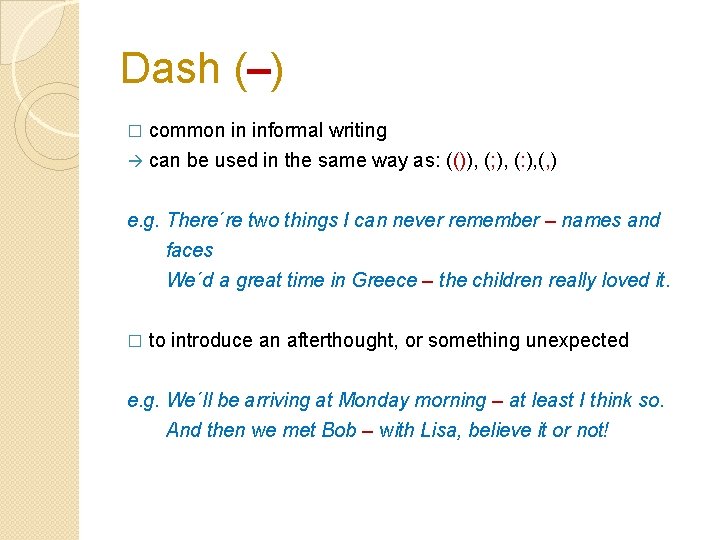
Dash (–) common in informal writing can be used in the same way as: (()), (; ), (: ), (, ) � e. g. There´re two things I can never remember – names and faces We´d a great time in Greece – the children really loved it. � to introduce an afterthought, or something unexpected e. g. We´ll be arriving at Monday morning – at least I think so. And then we met Bob – with Lisa, believe it or not!
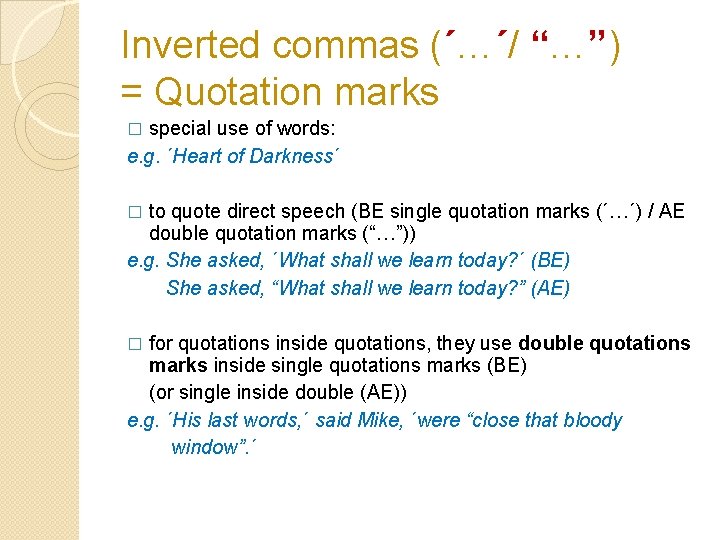
Inverted commas (´…´/ “…”) = Quotation marks special use of words: e. g. ´Heart of Darkness´ � to quote direct speech (BE single quotation marks (´…´) / AE double quotation marks (“…”)) e. g. She asked, ´What shall we learn today? ´ (BE) She asked, “What shall we learn today? ” (AE) � for quotations inside quotations, they use double quotations marks inside single quotations marks (BE) (or single inside double (AE)) e. g. ´His last words, ´ said Mike, ´were “close that bloody window”. ´ �
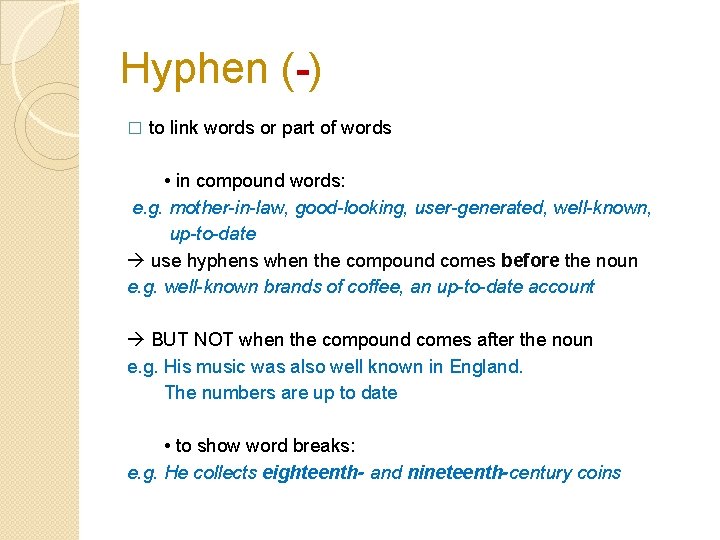
Hyphen (-) � to link words or part of words • in compound words: e. g. mother-in-law, good-looking, user-generated, well-known, up-to-date use hyphens when the compound comes before the noun e. g. well-known brands of coffee, an up-to-date account BUT NOT when the compound comes after the noun e. g. His music was also well known in England. The numbers are up to date • to show word breaks: e. g. He collects eighteenth- and nineteenth-century coins
Brackets (()) / ([]) � () to separate information off that is not essential to the meaning of the rest of the sentence e. g. He asked Juliet (his mother) for a loan. [] to enclose words added by someone other than the original writer or speaker e. g. The woman said: ´Gary [Thompson] was not usually late for work. �
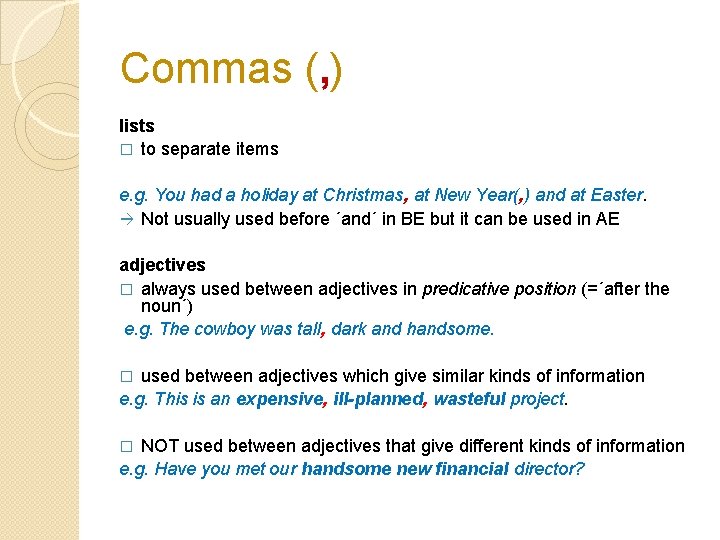
Commas (, ) lists � to separate items e. g. You had a holiday at Christmas, at New Year(, ) and at Easter. Not usually used before ´and´ in BE but it can be used in AE adjectives � always used between adjectives in predicative position (=´after the noun´) e. g. The cowboy was tall, dark and handsome. used between adjectives which give similar kinds of information e. g. This is an expensive, ill-planned, wasteful project. � NOT used between adjectives that give different kinds of information e. g. Have you met our handsome new financial director? �
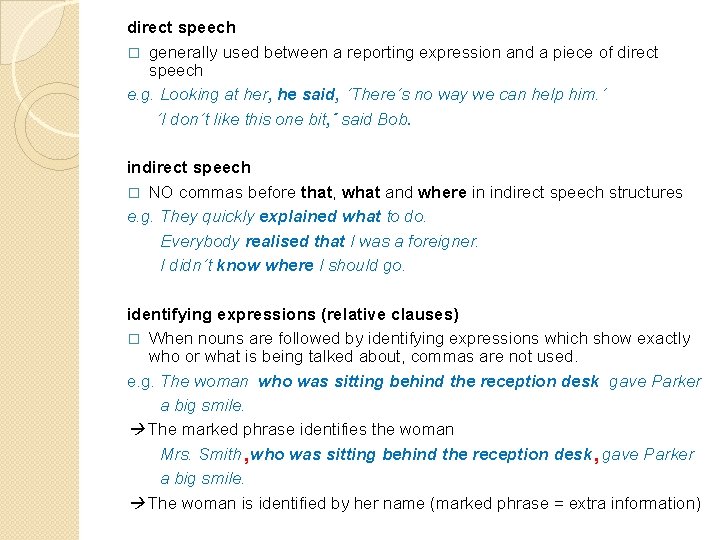
a direct speech � generally used between a reporting expression and a piece of direct speech e. g. Looking at her, he said, ´There´s no way we can help him. ´ ´I don´t like this one bit, ´ said Bob. indirect speech � NO commas before that, what and where in indirect speech structures e. g. They quickly explained what to do. Everybody realised that I was a foreigner. I didn´t know where I should go. identifying expressions (relative clauses) � When nouns are followed by identifying expressions which show exactly who or what is being talked about, commas are not used. e. g. The woman who was sitting behind the reception desk gave Parker a big smile. The marked phrase identifies the woman Mrs. Smith , who was sitting behind the reception desk , gave Parker a big smile. The woman is identified by her name (marked phrase = extra information)
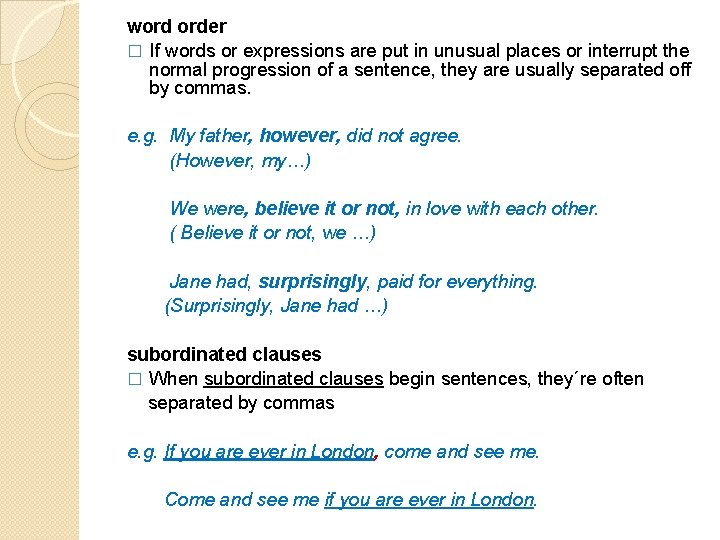
aword order � If words or expressions are put in unusual places or interrupt the normal progression of a sentence, they are usually separated off by commas. e. g. My father, however, did not agree. (However, my…) We were, believe it or not, in love with each other. ( Believe it or not, we …) Jane had, surprisingly, paid for everything. (Surprisingly, Jane had …) subordinated clauses � When subordinated clauses begin sentences, they´re often separated by commas e. g. If you are ever in London, come and see me. Come and see me if you are ever in London.
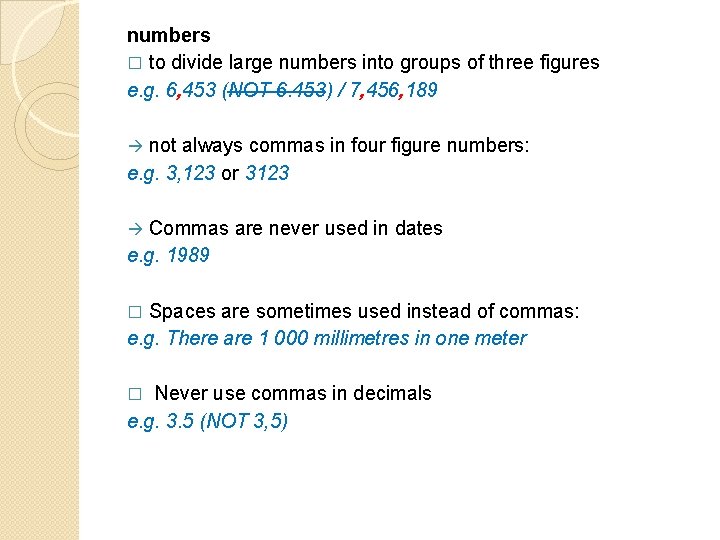
anumbers to divide large numbers into groups of three figures e. g. 6, 453 (NOT 6. 453) / 7, 456, 189 � not always commas in four figure numbers: e. g. 3, 123 or 3123 Commas are never used in dates e. g. 1989 Spaces are sometimes used instead of commas: e. g. There are 1 000 millimetres in one meter � Never use commas in decimals e. g. 3. 5 (NOT 3, 5) �
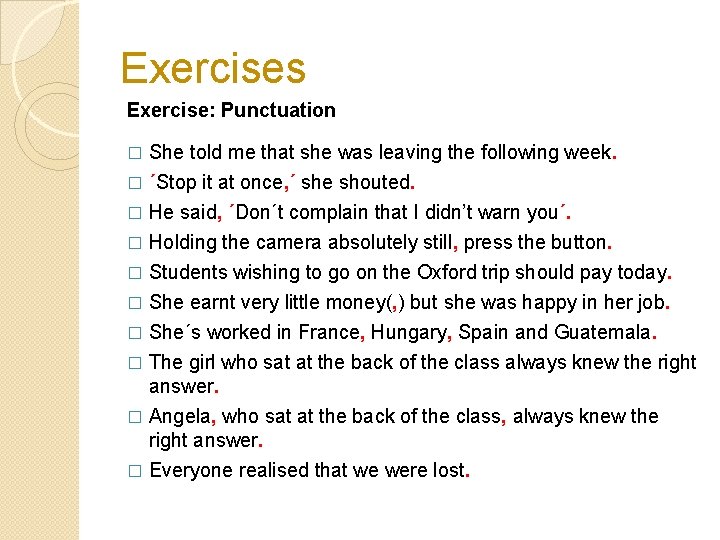
Exercises Exercise: Punctuation � She told me that she was leaving the following week. ´Stop it at once, ´ she shouted. � He said, ´Don´t complain that I didn’t warn you´. � Holding the camera absolutely still, press the button. � Students wishing to go on the Oxford trip should pay today. � She earnt very little money(, ) but she was happy in her job. � She´s worked in France, Hungary, Spain and Guatemala. � The girl who sat at the back of the class always knew the right answer. � Angela, who sat at the back of the class, always knew the right answer. � Everyone realised that we were lost. �
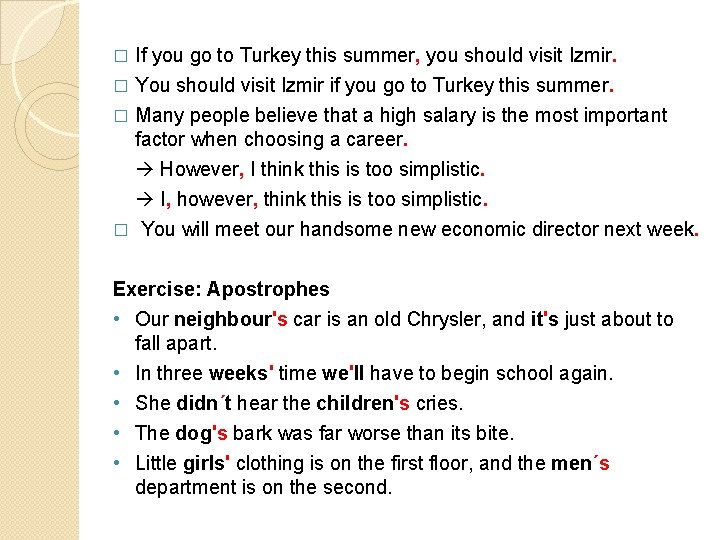
a � If you go to Turkey this summer, you should visit Izmir. You should visit Izmir if you go to Turkey this summer. � Many people believe that a high salary is the most important factor when choosing a career. However, I think this is too simplistic. I, however, think this is too simplistic. � � You will meet our handsome new economic director next week. Exercise: Apostrophes • Our neighbour's car is an old Chrysler, and it's just about to fall apart. • In three weeks' time we'll have to begin school again. • She didn´t hear the children's cries. • The dog's bark was far worse than its bite. • Little girls' clothing is on the first floor, and the men´s department is on the second.
Sources https: //en. oxforddictionaries. com/ � http: //www. linguee. de/englischdeutsch/uebersetzung/economic+director. html � https: //www. google. de/search? q=Exercises&oq=Exercises&a qs=chrome. . 69 i 57 j 69 i 65 l 2 j 0 l 3. 307 j 0 j 7&sourceid=chrome&ie= UTF 8#q=you+will+meet+a+tall%2 C+dark%2 C+handsome+strang er � https: //owl. english. purdue. edu/exercises/3/3/10/answer �