
Punctuation Definition Punctuation is a collection of marks

- Slides: 13
Punctuation
Definition Punctuation is a collection of marks and signs which arrange words into groups and give other useful information to help us understand what we are reading and hearing. Punctuation is crucial, not ornamental!
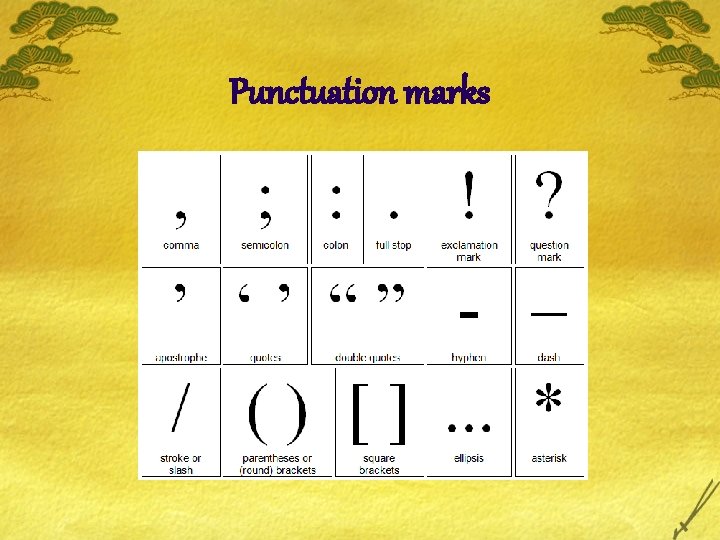
Punctuation marks
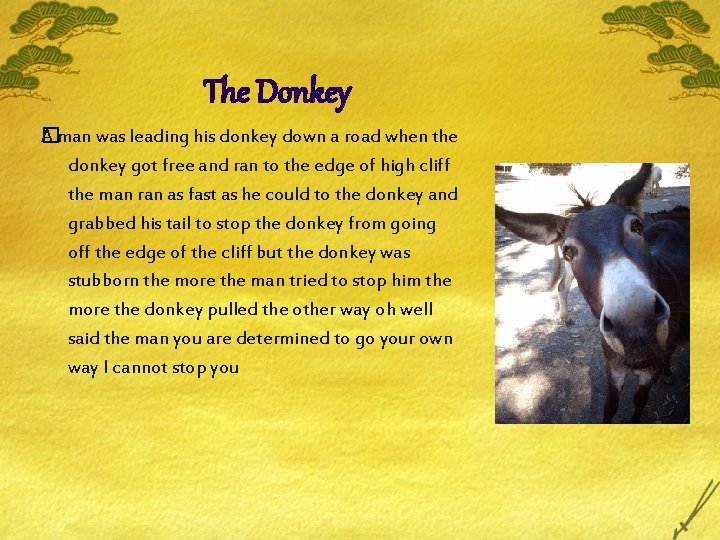
The Donkey A man was leading his donkey down a road when the � donkey got free and ran to the edge of high cliff the man ran as fast as he could to the donkey and grabbed his tail to stop the donkey from going off the edge of the cliff but the donkey was stubborn the more the man tried to stop him the more the donkey pulled the other way oh well said the man you are determined to go your own way I cannot stop you
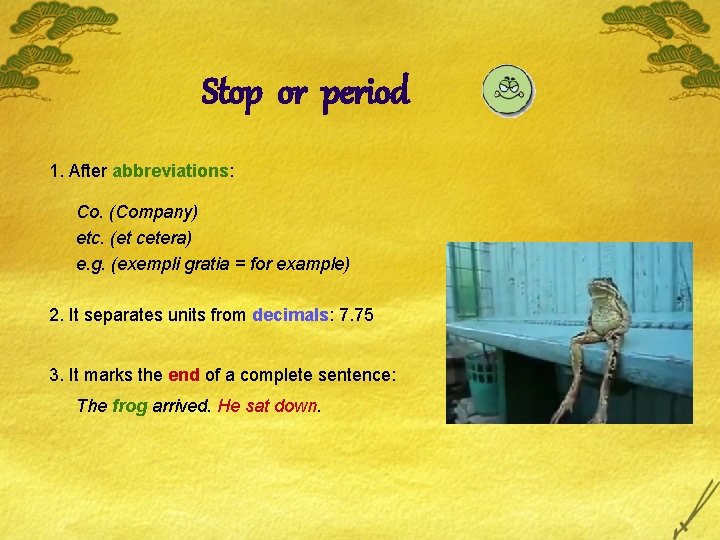
Stop or period 1. After abbreviations: Co. (Company) etc. (et cetera) e. g. (exempli gratia = for example) 2. It separates units from decimals: 7. 75 3. It marks the end of a complete sentence: The frog arrived. He sat down.
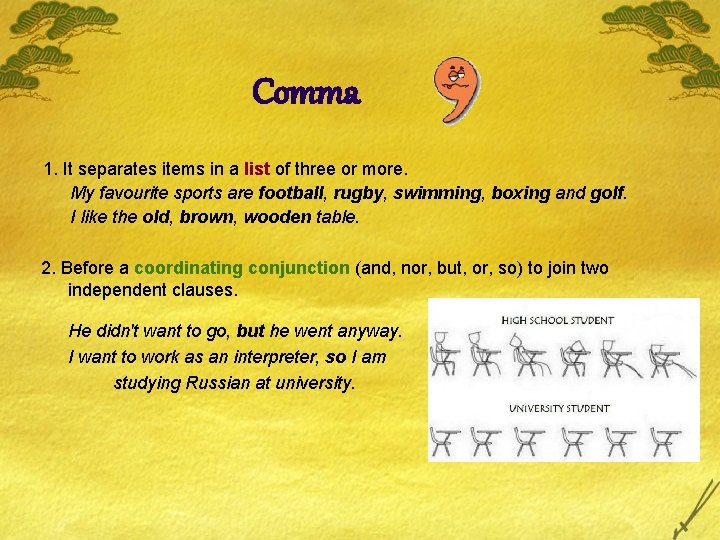
Comma 1. It separates items in a list of three or more. My favourite sports are football, rugby, swimming, boxing and golf. I like the old, brown, wooden table. 2. Before a coordinating conjunction (and, nor, but, or, so) to join two independent clauses. He didn't want to go, but he went anyway. I want to work as an interpreter, so I am studying Russian at university.
Comma 3. In parenthetical elements: it is any part of a sentence that can be removed without changing the real meaning of the sentence. John Geton, who is chairman of the company, is quite old. Andrew, my wife's brother, cannot come. 4. An adverbial clause often needs a comma when it comes at the beginning of a sentence (but not at the end of a sentence). If I win the lottery, I will buy a castle if I win the lottery.
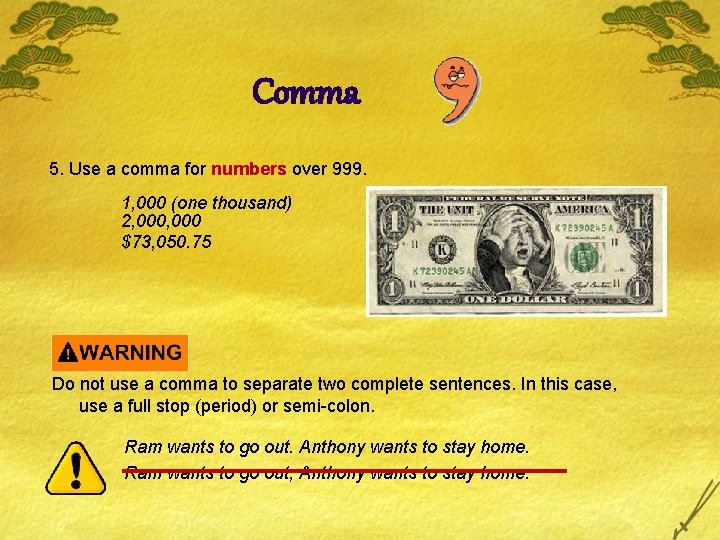
Comma 5. Use a comma for numbers over 999. 1, 000 (one thousand) 2, 000 $73, 050. 75 Do not use a comma to separate two complete sentences. In this case, use a full stop (period) or semi-colon. Ram wants to go out. Anthony wants to stay home. Ram wants to go out, Anthony wants to stay home.
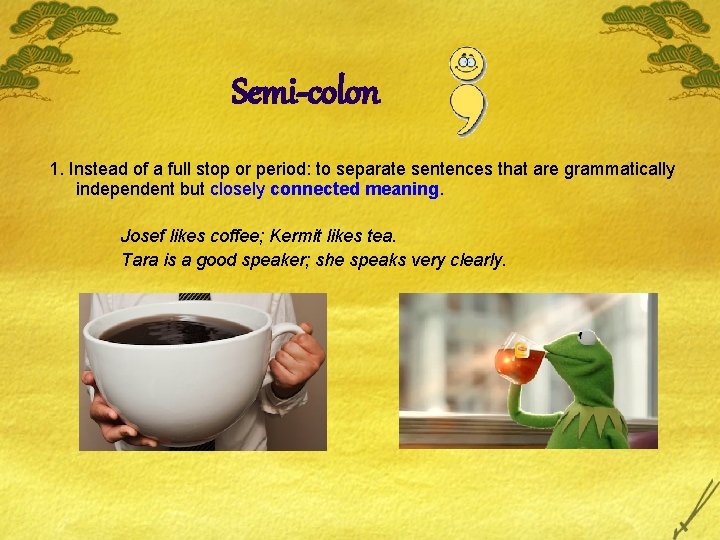
Semi-colon 1. Instead of a full stop or period: to separate sentences that are grammatically independent but closely connected meaning. Josef likes coffee; Kermit likes tea. Tara is a good speaker; she speaks very clearly.
Semi-colon 2. ”Super comma”: when we have a list of items, we usually separate the items with commas. If the list is complicated, we may prefer to use semicolons in some cases. ABC Investments has offices in five locations: Kensington, London; Brighton & Hove; Oxford; Cambridge; Manchester. Rental cars must be returned on time; with a full tank of petrol; in undamaged condition; and at the same location as they were collected from.
Colon 1. It introduces a list or examples: There are three countries in North America: Mexico, the USA and Canada. We can see many things in the sky at night: the moon, stars, planets, comets, planes and even satellites. 2. Actually, it introduces a single item, especially when you want to emphasize that item: We were all waiting for the hero of the evening: John. The job of the colon is simple: to introduce.
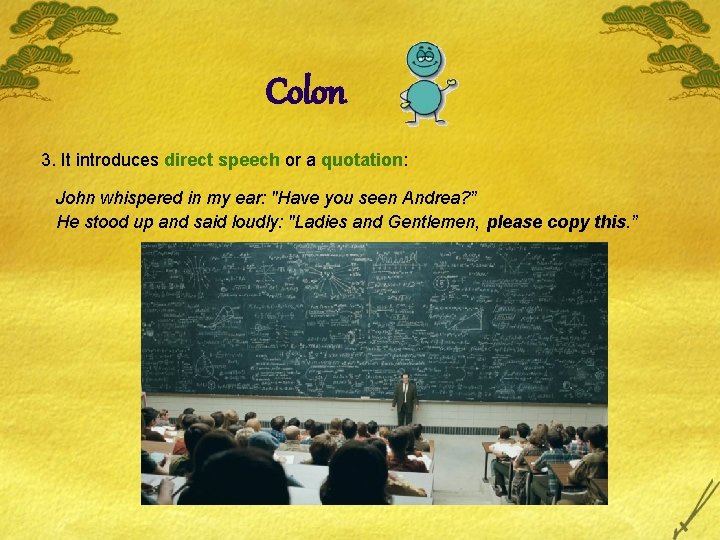
Colon 3. It introduces direct speech or a quotation: John whispered in my ear: "Have you seen Andrea? ” He stood up and said loudly: "Ladies and Gentlemen, please copy this. ”