
Punctuation Clauses 1 Beginning Punctuation GOALS n Distinguish
Punctuation: Clauses 1
Beginning Punctuation GOALS n Distinguish between – Phrases and Clauses – Main and Subordinate Clauses n Know How to Punctuate Clause Combinations 2
Vocabulary n. A Phrase is any group of words n A Clause is a group of words with a subject and a verb n There are two types of clauses: – Main (also called Independent) Clauses – Subordinate (also called Dependent) Clauses 3
Clauses n An Independent/Main Clause can stand alone as a complete sentence – Example: He went to the movies. Technical Definition: n A Independent Clause is not introduced by a subordinating conjunction or a relative pronoun n • subordinating conjunctions: after, although, because, until, whereas (some listed on 313 of Keys for Writers) • relative pronouns: that, which, who/whom, whose, whoever/whomever, etc. 4
Clauses, cont. n. A Subordinate Clause cannot stand alone – Example: Before he went to the movies n Technical Definition: n A subordinate clause is introduced by a subordinating conjunction or a relative pronoun 5
More Vocabulary n Types of Sentences – A Simple Sentence has one main clause and no subordinate clauses. • The rules of grammar are complex. – A Compound Sentence has more than one Independent Clause. • The rules of grammar are complex, and few people understand them all. 6
Types of Sentences, cont, – A Complex Sentence has one or more Subordinate Clauses. • Few people understand grammar because its rules are complex. – A Compound-Complex sentence has more than one Independent Clause and at least one Subordinate Clause • Because grammar is complex, few people understand it, and even fewer people enjoy studying it. 7
Principle #1 n Every complete sentence must contain one Main or Independent Clause n If a group of words lacks a subject, finite (conjugated) verb, or main clause, it is a fragment 8
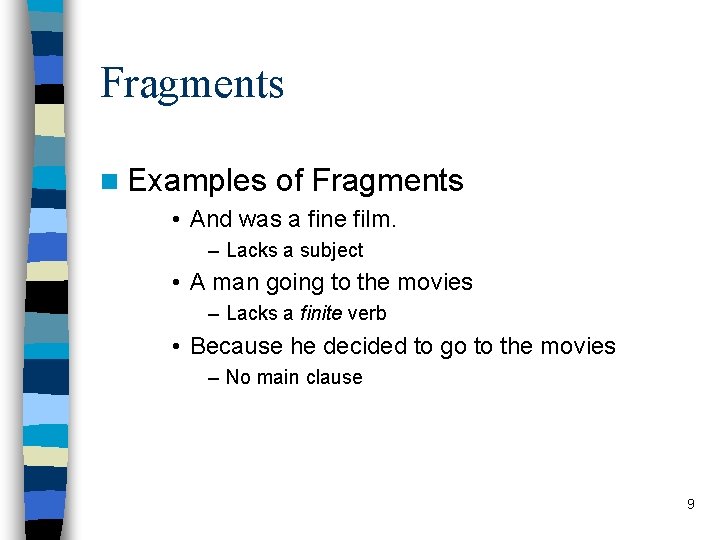
Fragments n Examples of Fragments • And was a fine film. – Lacks a subject • A man going to the movies – Lacks a finite verb • Because he decided to go to the movies – No main clause 9
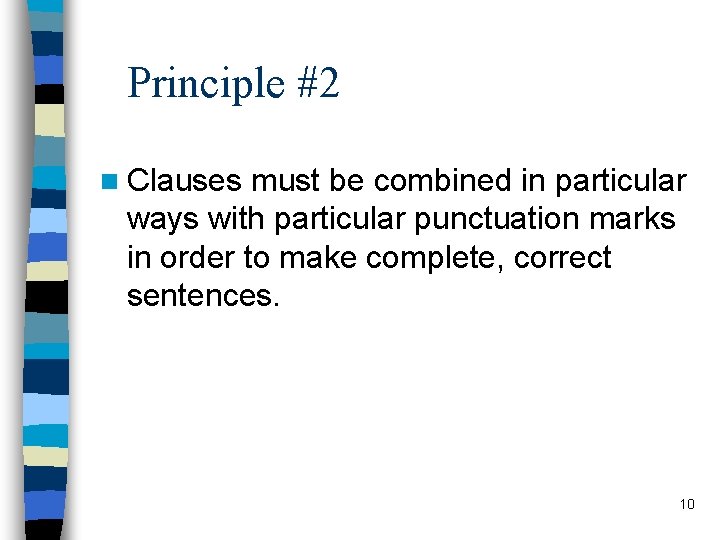
Principle #2 n Clauses must be combined in particular ways with particular punctuation marks in order to make complete, correct sentences. 10
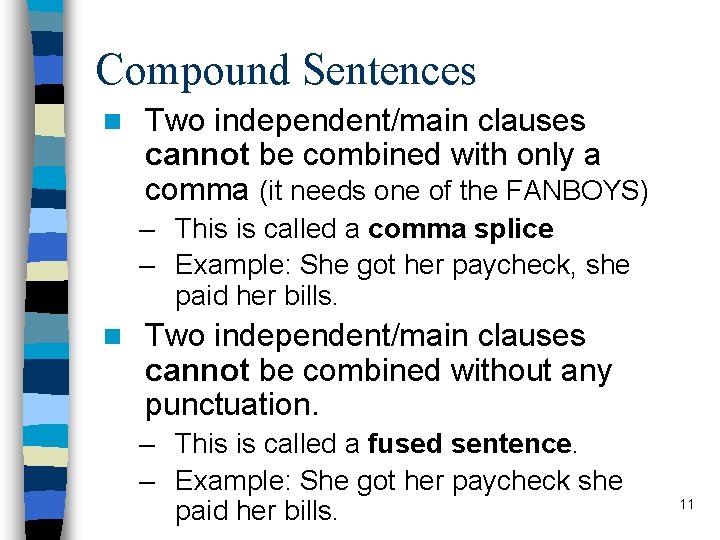
Compound Sentences n Two independent/main clauses cannot be combined with only a comma (it needs one of the FANBOYS) – This is called a comma splice – Example: She got her paycheck, she paid her bills. n Two independent/main clauses cannot be combined without any punctuation. – This is called a fused sentence. – Example: She got her paycheck she paid her bills. 11
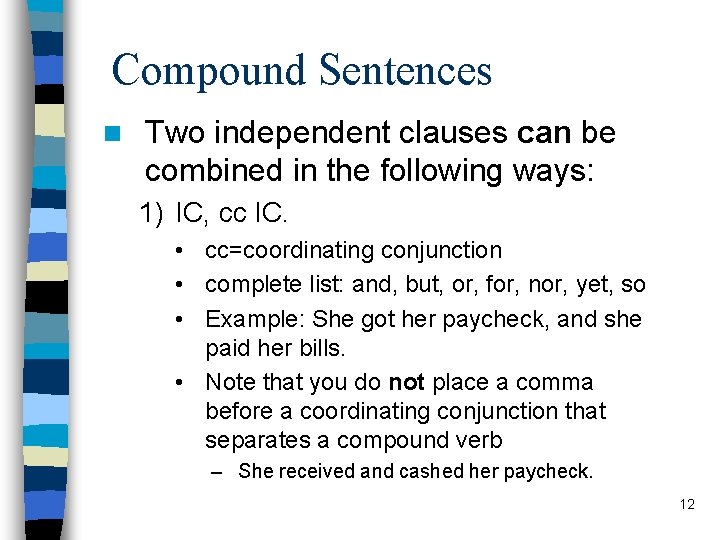
Compound Sentences n Two independent clauses can be combined in the following ways: 1) IC, cc IC. • cc=coordinating conjunction • complete list: and, but, or, for, nor, yet, so • Example: She got her paycheck, and she paid her bills. • Note that you do not place a comma before a coordinating conjunction that separates a compound verb – She received and cashed her paycheck. 12
Compound Sentences, cont. 2) IC; IC. • Example: She got her paycheck; she paid her bills. 3) IC; ca, IC. • • • ca=conjunctive adverb (sometimes called transitional expression) (386 -7) some examples: furthermore, therefore, otherwise, indeed, for example Example: She got her paycheck; consequently, she paid her bills. 13
Compound Sentences, cont. 4) IC: IC. • • The colon is only a good strategy if the second independent clause explains or clarifies the first Example: She can pay her bills now: she finally got her paycheck. 14
Complex Sentences n If the Subordinate Clause comes first, you will ordinarily use a comma – SC, IC – Even though he woke up with a headache, he went to all of his classes. n If the Independent Clause comes first, no punctuation is necessary – IC SC. – He went to all of his classes even though he woke up with a headache. 15
Summary n The first step in learning proper punctuation is to learn how to – distinguish between phrases and clauses – identify Independent/Main and Subordinate Clauses – know which punctuation marks are appropriate for which situations 16
- Slides: 16