
Pumps Troubleshooting Guide Pumps Troubleshooting Guide q Contents
“Pumps” Troubleshooting Guide

Pumps Troubleshooting Guide q. Contents: § Pump leaks while running. § Pump leaks while not running. § Lube Seal Vapor leak. § No flow or low flow. § Noise and/or vibration is noticeable. § Motor runs hot or throws breaker.

Pumps Troubleshooting Guide q Pump Leaks § Whenever leakage is encountered and before removing your pump, determine when the leakage is occurring… while running, or while not running. § During these inspections you should try to determine the exact origin of the leak. § Special attention should be given to the shaft sleeve. § Once you have determined when the pump is leaking, refer to the guide below.

Pump Troubleshooting Guide q Pump Leaks While Running Test q Visually determi ne the exact leakage point Test Results Ø Leakage from the seal area at shaft sleeve. Indicates Pump suction pressure exceeds expeller capacity. § Excessive expeller wear, corrosion, clearance orplating between vanes. § n Pump running too slow. § Check sheaves, motor, and VFD limits. n Damaged seal surface, gasket failure or loose bolts. § Check bolt tightness. Remove pump and check gaskets and o-rings for wear. Be sure the Sealing surfaces are clean and undamaged. n n Ø Leakage comes from caseor gasket area. Action to Take § § Check inlet pressure. Wilfley offers free engineering to ensure your pump is matched to your service. Remove pump and inspect the expeller for wear. Check the impeller clearances for your pump.

Pump Troubleshooting Guide q Pump Leaks While NOT Running. Test q Verify that Test Results Ø leakage originates from the seal area. Leakage comes from case or gasket area. Indicates n Damaged sealing surface gasket failure or loose bolts. Action to Take § § § Verify that leakage originates from the seal area. q Ø Leakage is observed on seal or shaft sleeve. n Seal or actuator problem. § § § Check bolt tightness. Remove pump and check gaskets and orings for wear. Be sure the sealing surfaces are clean and undamaged. Disassemble seal and be sure that all parts operate freely. Check for cleanliness and wear. Replace parts as necessary.

Pump Troubleshooting Guide q Lube Seal Vapor Leak. Test Check for vapors coming from the seal area. q Test Results Ø Vapors detected. Indicates n n Lubricator is out of lubricant. Lubricator has failed. Action to Take § Replace lubricator. § Replace Lube Seal.

Pump Troubleshooting Guide q No Flow or Low Flow. Test 1 2 3 Test Results Indicates Action to Take Rotate motor shaft by hand. Rotates freely. Shaft won't turn or rubbing. Pump or motor failure. Proceed to number 2. Remove coupling and rotate motor and pump shafts by hand. Pump shaft won't turn or rubbing noise is present. Pump problem. Remove pump and repair. Motor shaft won't turn or Motor bearing problem. Replace motor and proceed to number 3. Start motor and check direction of rotation. Rotation correct. Rotation incorrect. Proceed to number 3. Proceed to number 4. Motor wiring reversed Correct hookup.
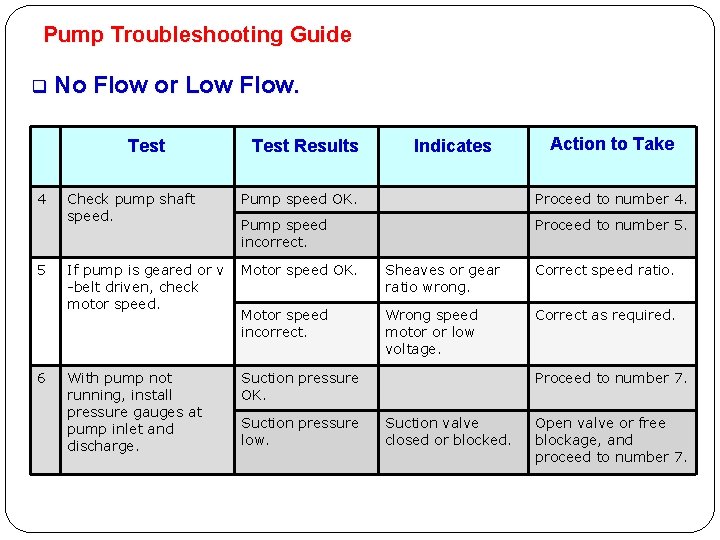
Pump Troubleshooting Guide q No Flow or Low Flow. Test 4 5 6 Test Results Indicates Action to Take Check pump shaft speed. Pump speed OK. Proceed to number 4. Pump speed incorrect. Proceed to number 5. If pump is geared or v -belt driven, check motor speed. Motor speed OK. Sheaves or gear ratio wrong. Correct speed ratio. Motor speed incorrect. Wrong speed motor or low voltage. Correct as required. With pump not running, install pressure gauges at pump inlet and discharge. Suction pressure OK. Suction pressure low. Proceed to number 7. Suction valve closed or blocked. Open valve or free blockage, and proceed to number 7.
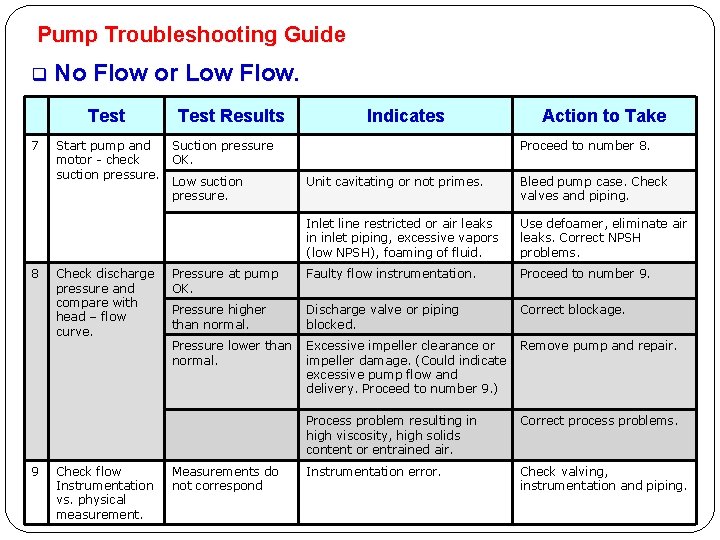
Pump Troubleshooting Guide q No Flow or Low Flow. Test 7 8 9 Start pump and motor - check suction pressure. Check discharge pressure and compare with head – flow curve. Check flow Instrumentation vs. physical measurement. Test Results Indicates Suction pressure OK. Low suction pressure. Action to Take Proceed to number 8. Unit cavitating or not primes. Bleed pump case. Check valves and piping. Inlet line restricted or air leaks in inlet piping, excessive vapors (low NPSH), foaming of fluid. Use defoamer, eliminate air leaks. Correct NPSH problems. Pressure at pump OK. Faulty flow instrumentation. Proceed to number 9. Pressure higher than normal. Discharge valve or piping blocked. Correct blockage. Pressure lower than normal. Excessive impeller clearance or impeller damage. (Could indicate excessive pump flow and delivery. Proceed to number 9. ) Remove pump and repair. Process problem resulting in high viscosity, high solids content or entrained air. Correct process problems. Instrumentation error. Check valving, instrumentation and piping. Measurements do not correspond

Pump Troubleshooting Guide q Noise and/or Vibration is Noticeable. Test 1 2 Test Results Indicates Action to Take Visually check for loose or missing screws or bolts from coupling or tiedown points. Bolt and screw OK. Rotate unit by hand. Unit free and clear. Proceed to number 3. Scraping, clunking or other unusual noise heard. Proceed to number 4. Unit won't turn freely and easily. Proceed to number 4. Loose or missing bolts. Proceed to number 2. Improper or incomplete assembly. Replace and tighten bolts.

Pump Troubleshooting Guide q Noise and/or Vibration is Noticeable. Test 3 4 Test Results Indicates Action to Take With unit running, monitor type and location of noise. Use stethoscope or screwdriver held against pump and motor housing over bearings. Grinding, scraping, rubbing noise heard from pump only. Impeller or expeller rubbing inside case. Remove and repair. Check clearances. Scraping or rubbing noise heard from motor only. Possibly motor fan blades loose or bent. Consult motor manual. Thumping or clicking noise or excessive vibration. Bad bearing, Proceed to number 4. damaged bearings. or excessive vibration. coupling or pump/motor misalignment. Uncouple pump. Push and pull pump and motor shafts in both radial and axial directions. No shaft movements observed. Proceed to number 5. Shaft wiggles or moves. Failed bearings. Remove and repair. Proceed to number 6.

Pump Troubleshooting Guide q Noise and/or Vibration is Noticeable. Test 5 6 7 Test Results Indicates Action to Take With coupling removed, turn on motor and listen for noise. Motor quiet. Motor noisy. Motor failure. Remove and replace motor. Check pump and motor shaft align ment with dial indicator Axial alignment and squareness within. 005 – inch. Correct alignment. Proceed to number 7. Remove pump frame oil drain plug. Check for metallic particles on drain plug magnet. Proceed to number 6. Axial alignment and Poor alignment. squareness not within. 005 – inch. Align units. No metal chips or particles. Recheck tests. Metallic chips or particles found. Bearing failure. Remove pump and repair.

Pump Troubleshooting Guide q Motor Runs Hot or Throws Breaker Test 1 2 Test Results Indicates Action to Take With motor and pump not running, verify that the units rotate freely without noise or drag by rotating the shaft by hand. Shaft turns freely with no noise. Proceed to number 2. Shaft drags or noise Mechanical is heard. problems. Go to the problem section on noise and vibration. Check breaker fuse size and motor nameplate rating. Breaker fuse and motor rating correspond. Correct motor and fuse. Proceed to number 3. Breaker fuse and motor rating do not correspond. Incorrect fuse. Install proper fuse.
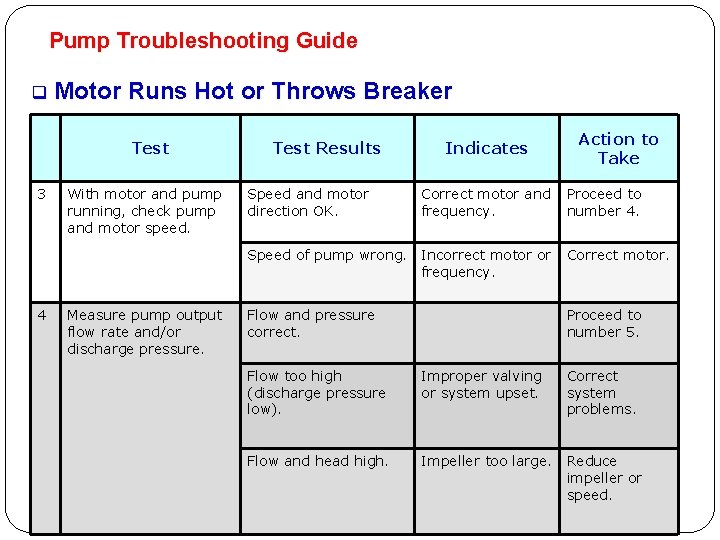
Pump Troubleshooting Guide q Motor Runs Hot or Throws Breaker Test 3 4 With motor and pump running, check pump and motor speed. Measure pump output flow rate and/or discharge pressure. Test Results Speed and motor direction OK. Indicates Correct motor and frequency. Action to Take Proceed to number 4. Speed of pump wrong. Incorrect motor or frequency. Correct motor. Flow and pressure correct. Proceed to number 5. Flow too high (discharge pressure low). Improper valving or system upset. Correct system problems. Flow and head high. Impeller too large. Reduce impeller or speed.
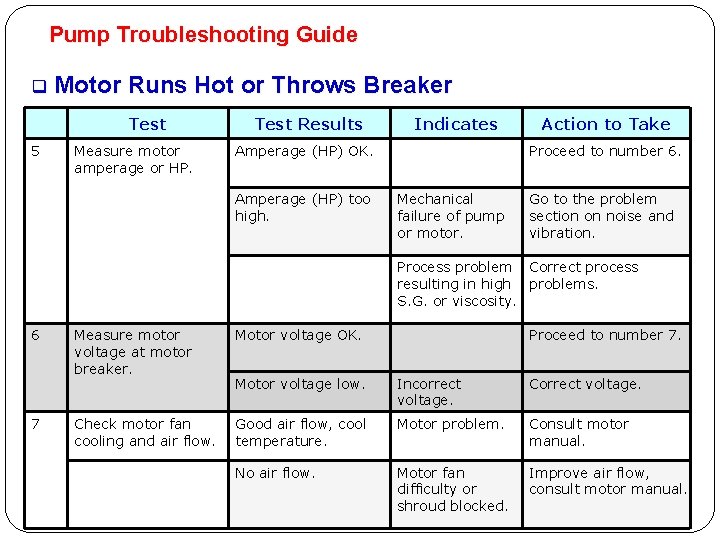
Pump Troubleshooting Guide q Motor Runs Hot or Throws Breaker Test 5 Measure motor amperage or HP. Test Results Indicates Amperage (HP) OK. Amperage (HP) too high. Action to Take Proceed to number 6. Mechanical failure of pump or motor. Go to the problem section on noise and vibration. Process problem Correct process resulting in high problems. S. G. or viscosity. 6 7 Measure motor voltage at motor breaker. Motor voltage OK. Proceed to number 7. Motor voltage low. Incorrect voltage. Check motor fan cooling and air flow. Good air flow, cool temperature. Motor problem. Consult motor manual. No air flow. Motor fan difficulty or shroud blocked. Improve air flow, consult motor manual.
- Slides: 15