
Pump Selection Meeting and Exceeding ASHRAE Standard 90





- Slides: 36
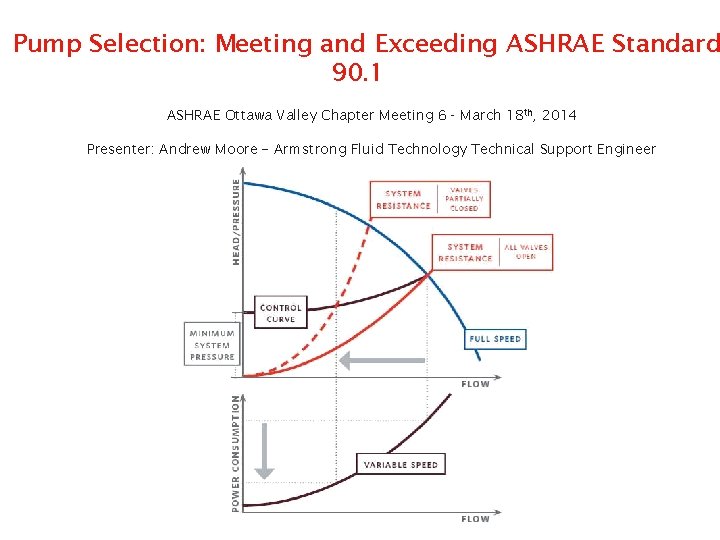
Pump Selection: Meeting and Exceeding ASHRAE Standard 90. 1 ASHRAE Ottawa Valley Chapter Meeting 6 - March 18 th, 2014 Presenter: Andrew Moore – Armstrong Fluid Technology Technical Support Engineer
ASHRAE 90. 1 Standards for Energy Efficient Buildings Two Main Points q. Systems shall have control valves capable of reducing system flow to 50% or less of the design day flow q. Systems shall have controls to reduce pumping energy use by 70% of design flow power at 50% flow
Presentation Objectives q. The purpose of this presentation is to articulate how pumps are sized q. We also want to discuss various strategies for controlling pumps and their impact on energy demand
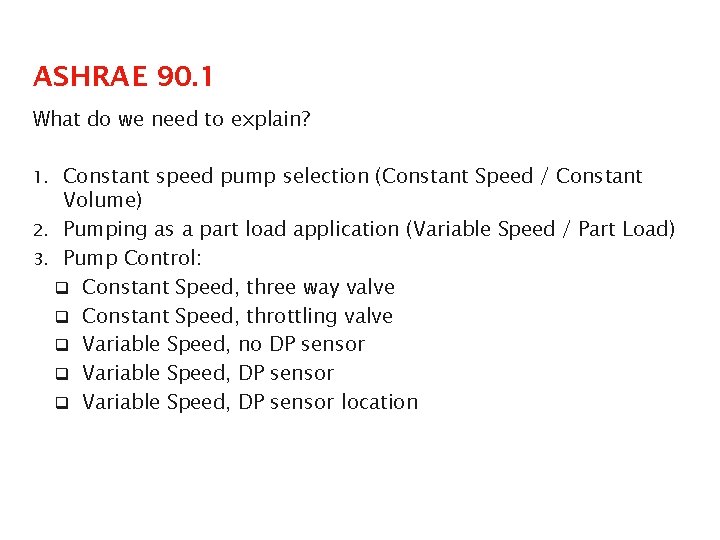
ASHRAE 90. 1 What do we need to explain? 1. Constant speed pump selection (Constant Speed / Constant Volume) 2. Pumping as a part load application (Variable Speed / Part Load) 3. Pump Control: q Constant Speed, three way valve q Constant Speed, throttling valve q Variable Speed, no DP sensor q Variable Speed, DP sensor location
Tonight’s Agenda q. Constant speed, constant volume pumping q. Variable Speed, part load pumping q. Pump Affinity Laws q. Understanding the pump curve q. Control with a three valve q. Control with a two way valve q. Control with a differential pressure sensor and drive q. Pump selection (left of the curve, right of the curve) q. Part load efficiency q. Understanding the system curve q. Understanding the control curve q. DP valve location and how it effects efficiency
Heat Transfer Equation (Solving the System) Load (BTU) = Flow (Q) x 500 x (Δ T)
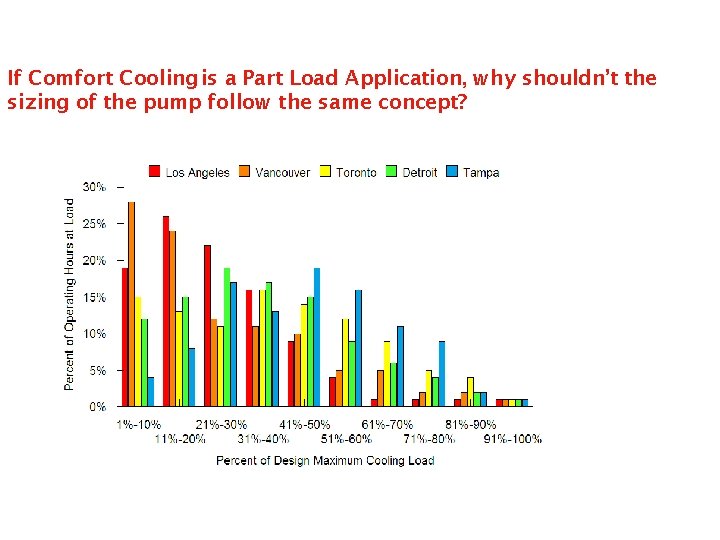
If Comfort Cooling is a Part Load Application, why shouldn’t the sizing of the pump follow the same concept?
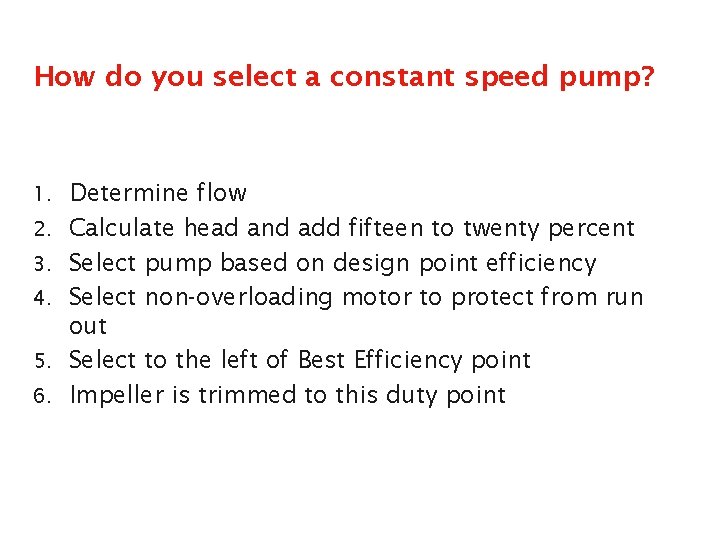
How do you select a constant speed pump? 1. Determine flow 2. Calculate head and add fifteen to twenty percent 3. Select pump based on design point efficiency 4. Select non-overloading motor to protect from run out 5. Select to the left of Best Efficiency point 6. Impeller is trimmed to this duty point
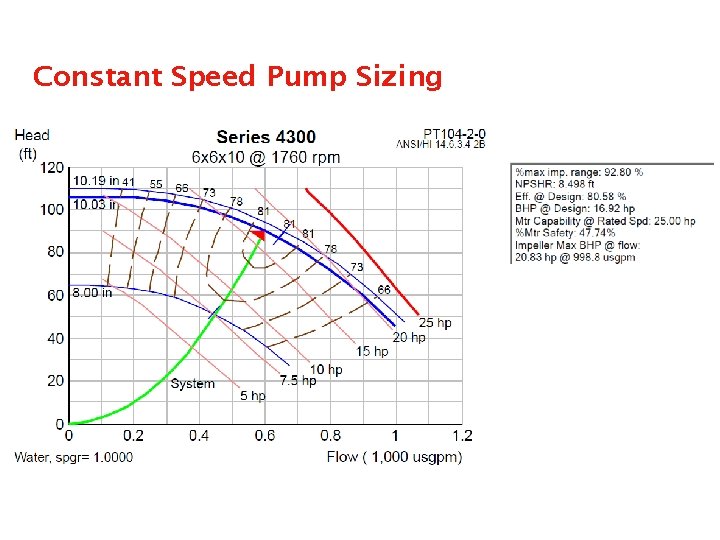
Constant Speed Pump Sizing
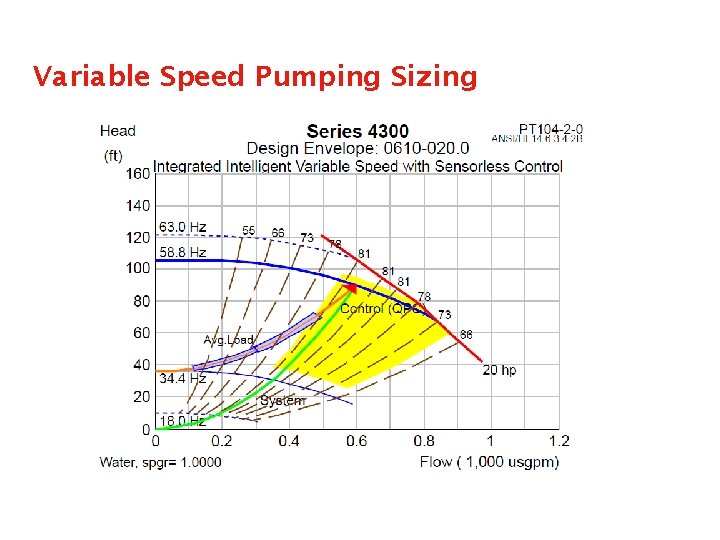
Variable Speed Pumping Sizing
Variable Speed Pumping Sizing
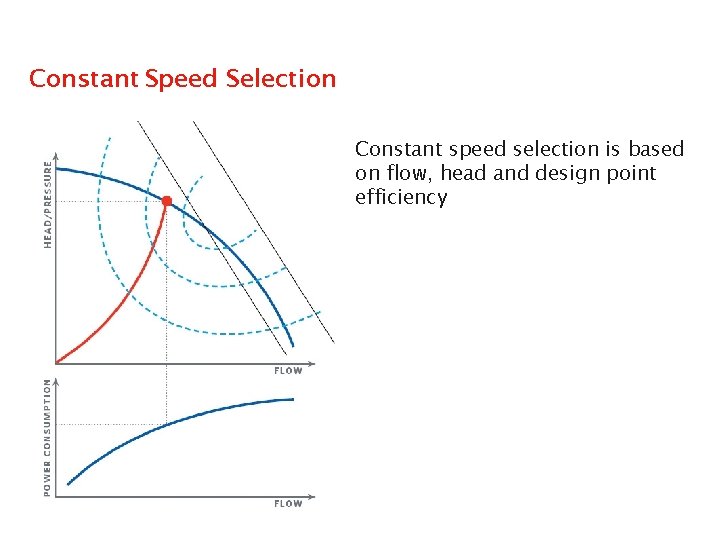
Constant Speed Selection Constant speed selection is based on flow, head and design point efficiency
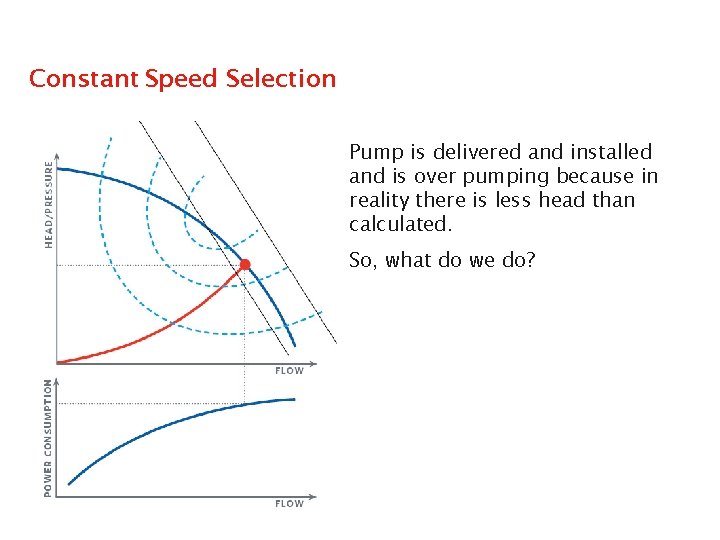
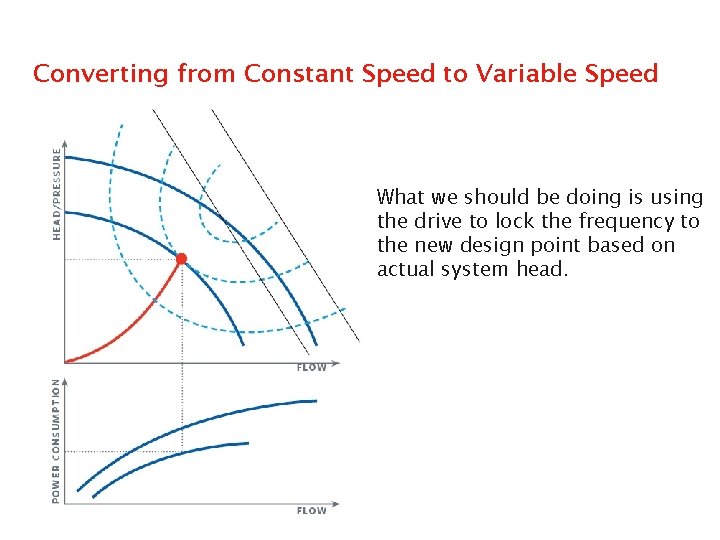
Constant Speed Selection Pump is delivered and installed and is over pumping because in reality there is less head than calculated. So, what do we do?
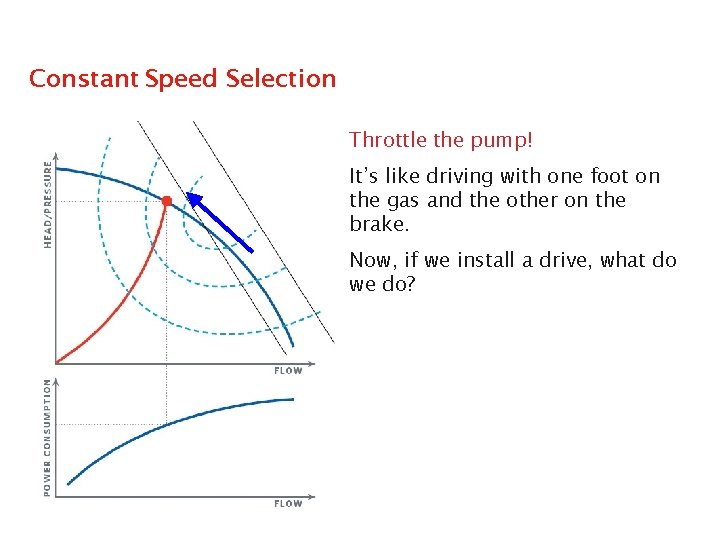
Constant Speed Selection Throttle the pump! It’s like driving with one foot on the gas and the other on the brake. Now, if we install a drive, what do we do?
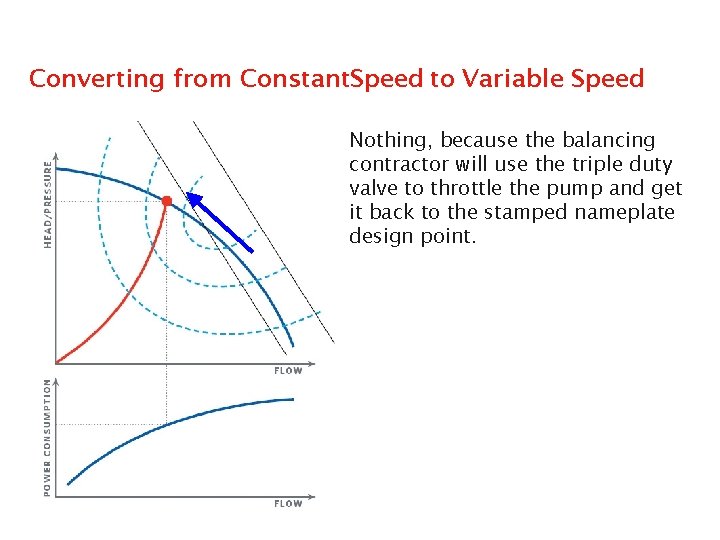
Converting from Constant. Speed to Variable Speed Nothing, because the balancing contractor will use the triple duty valve to throttle the pump and get it back to the stamped nameplate design point.
Converting from Constant Speed to Variable Speed What we should be doing is using the drive to lock the frequency to the new design point based on actual system head.
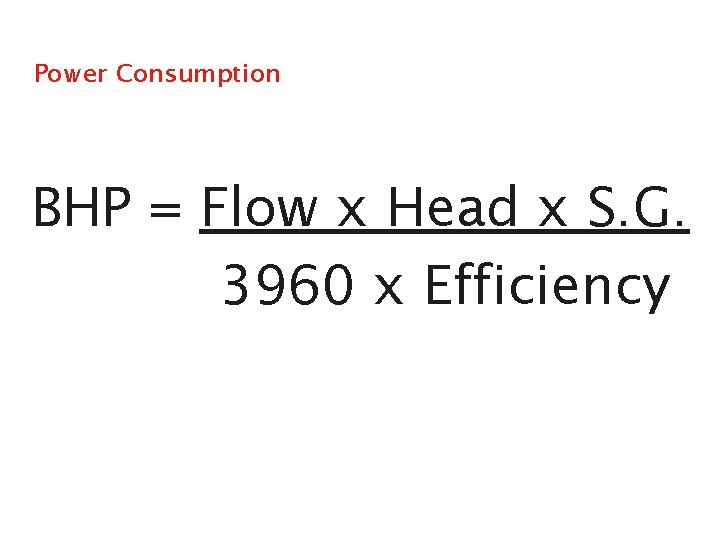
Power Consumption BHP = Flow x Head x S. G. 3960 x Efficiency
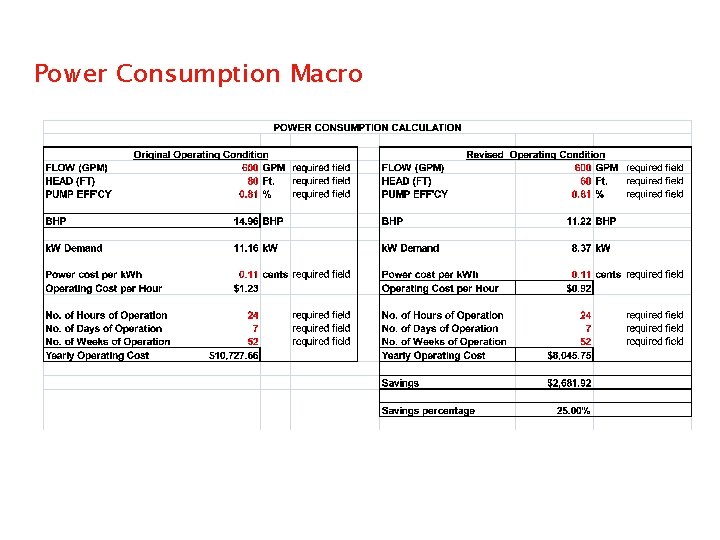
Power Consumption Macro
Pump Control Strategies How do we control a pump?
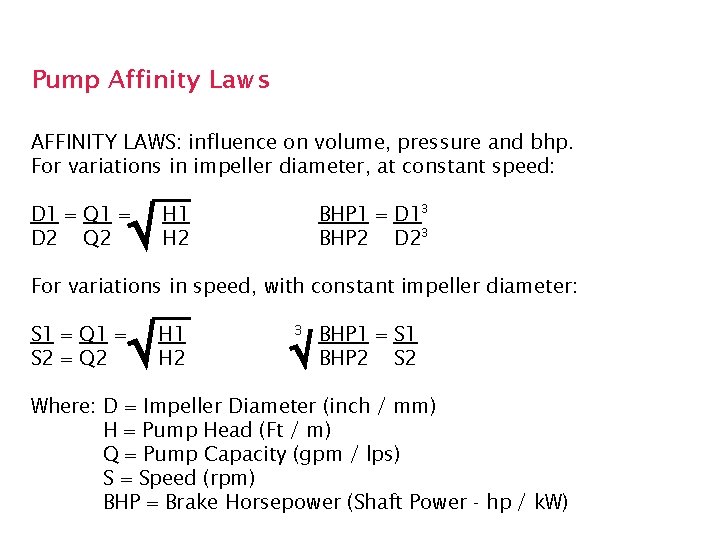
Pump Affinity Laws AFFINITY LAWS: influence on volume, pressure and bhp. For variations in impeller diameter, at constant speed: D 1 = Q 1 = D 2 Q 2 BHP 1 = D 13 BHP 2 D 23 H 1 H 2 For variations in speed, with constant impeller diameter: S 1 = Q 1 = S 2 = Q 2 H 1 H 2 3 BHP 1 = S 1 BHP 2 S 2 Where: D = Impeller Diameter (inch / mm) H = Pump Head (Ft / m) Q = Pump Capacity (gpm / lps) S = Speed (rpm) BHP = Brake Horsepower (Shaft Power - hp / k. W)
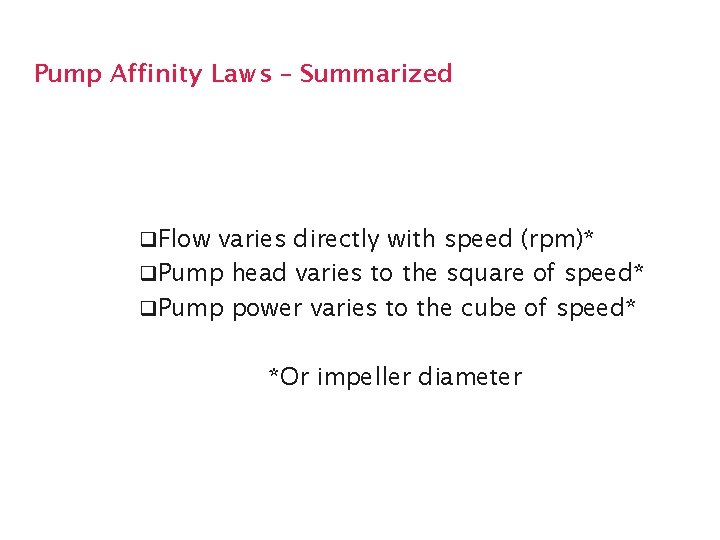
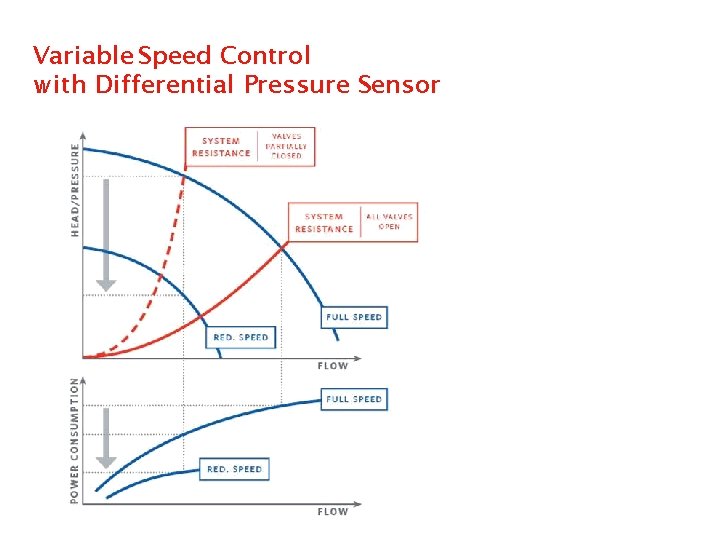
Pump Affinity Laws – Summarized q. Flow varies directly with speed (rpm)* q. Pump head varies to the square of speed* q. Pump power varies to the cube of speed* *Or impeller diameter
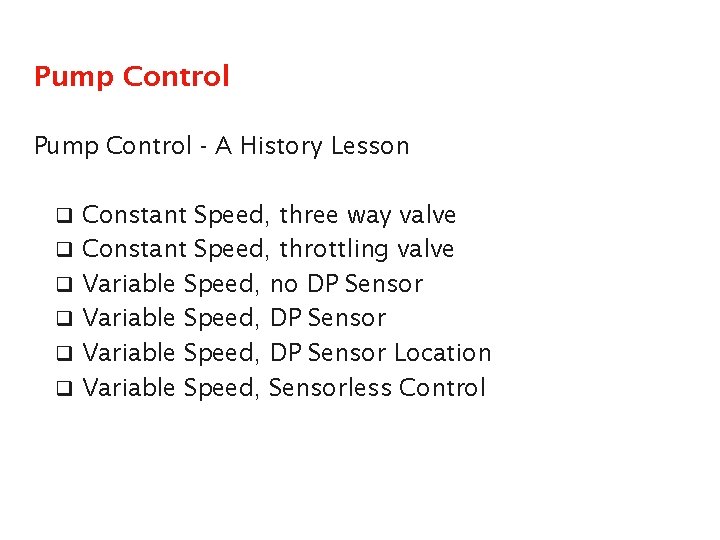
Pump Control - A History Lesson q Constant Speed, three way valve q Constant Speed, throttling valve q Variable Speed, no DP Sensor q Variable Speed, DP Sensor Location q Variable Speed, Sensorless Control
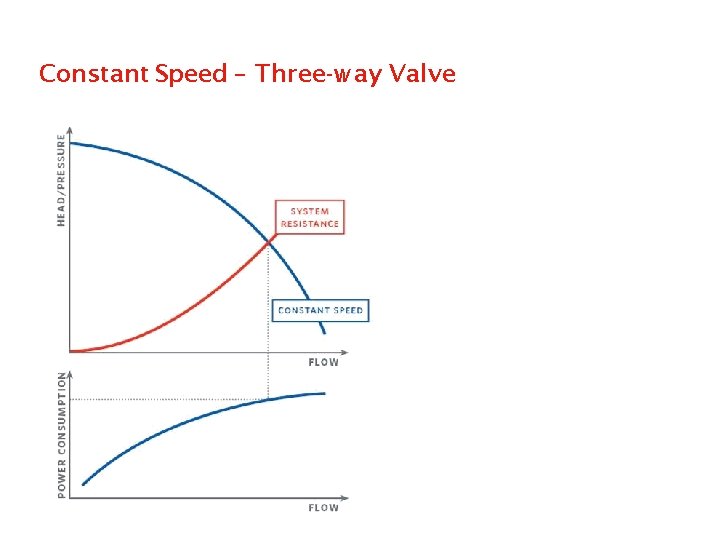
Constant Speed – Three-way Valve
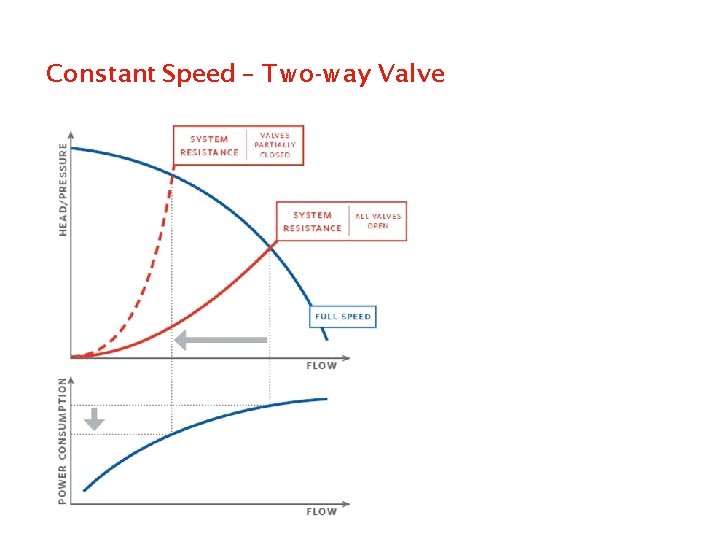
Constant Speed – Two-way Valve
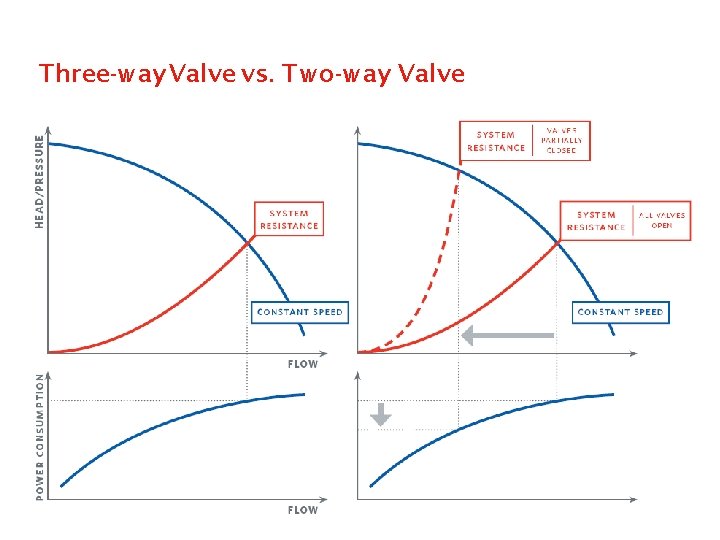
Three-way Valve vs. Two-way Valve
Variable Speed Control with Differential Pressure Sensor
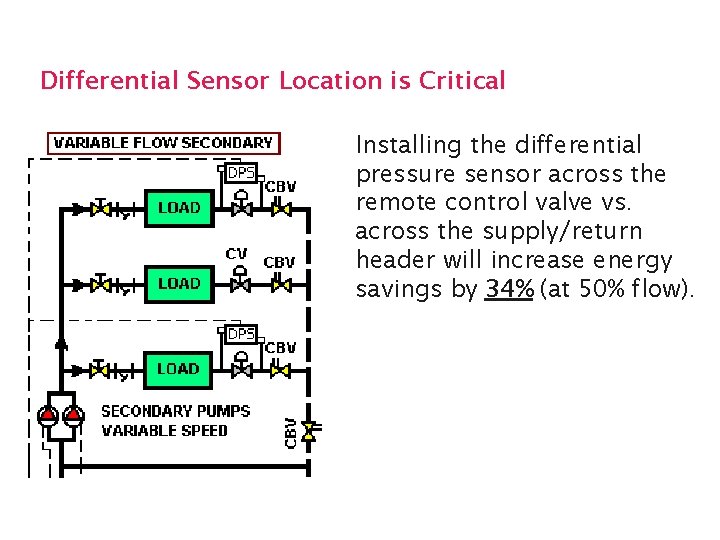
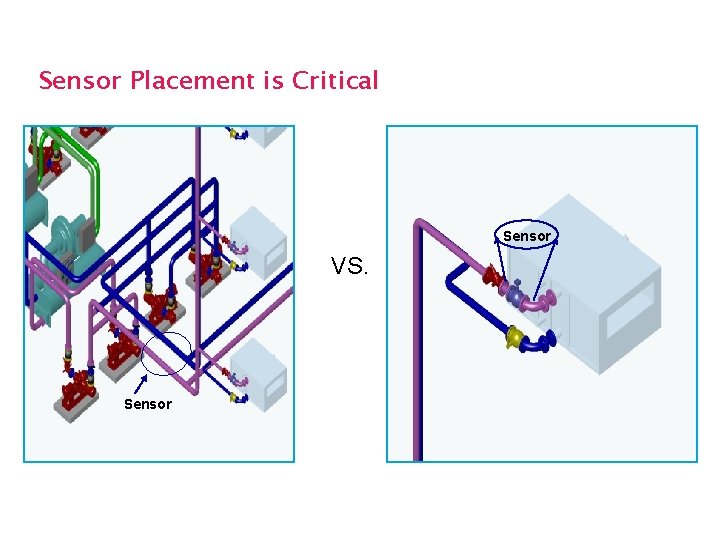
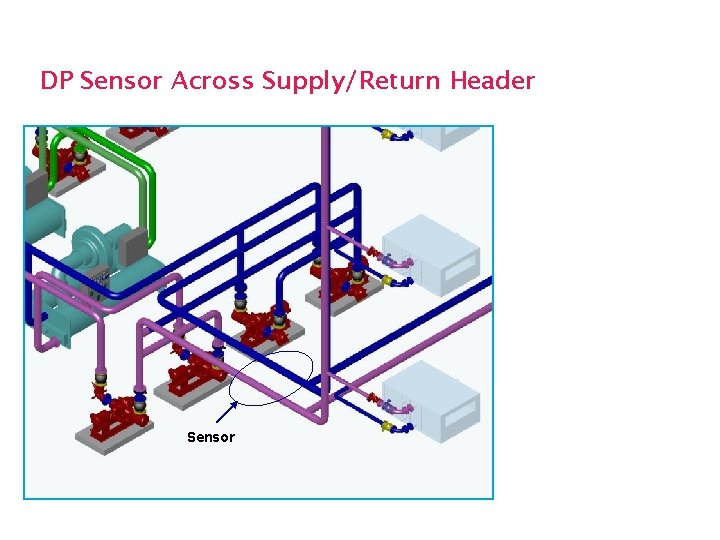
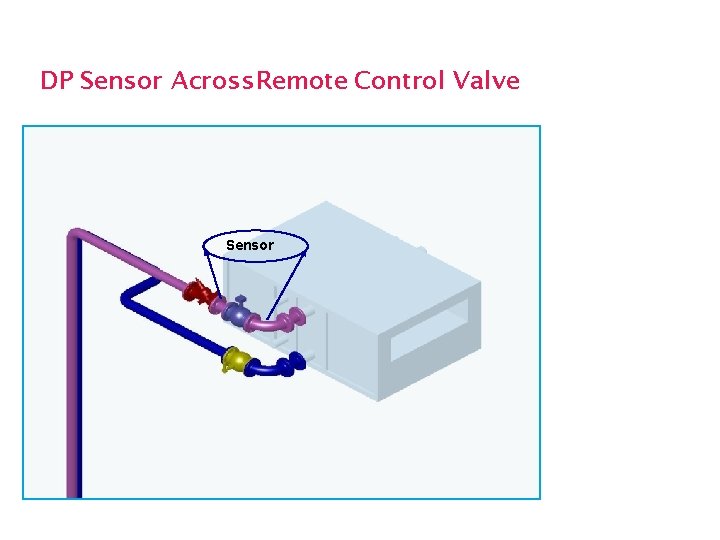
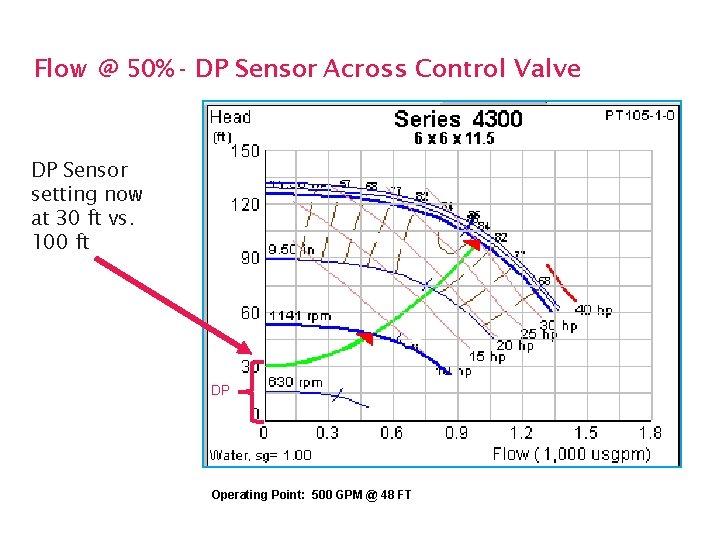
Differential Sensor Location is Critical Installing the differential pressure sensor across the remote control valve vs. across the supply/return header will increase energy savings by 34% (at 50% flow).
Sensor Placement is Critical Sensor VS. Sensor
DP Sensor Across Supply/Return Header Sensor
Flow @ 50% DP Sensor. Across Pump (100 ft) DP Sensor setting at 100 ft to overcome the entire system head DP: Sensor Setting Operating Point: 500 GPM @ 100 FT
DP Sensor Across. Remote Control Valve Sensor
Flow @ 50% - DP Sensor Across Control Valve DP Sensor setting now at 30 ft vs. 100 ft DP DP Operating Point: 500 GPM @ 48 FT
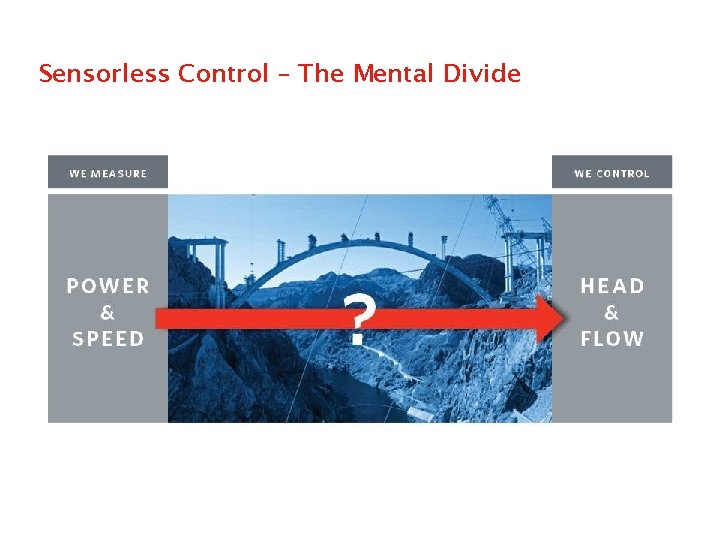
Sensorless Control – The Mental Divide
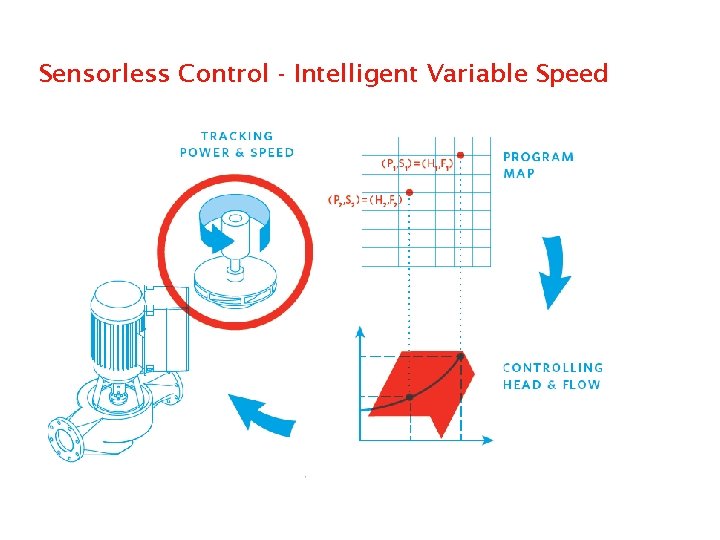
Sensorless Control - Intelligent Variable Speed
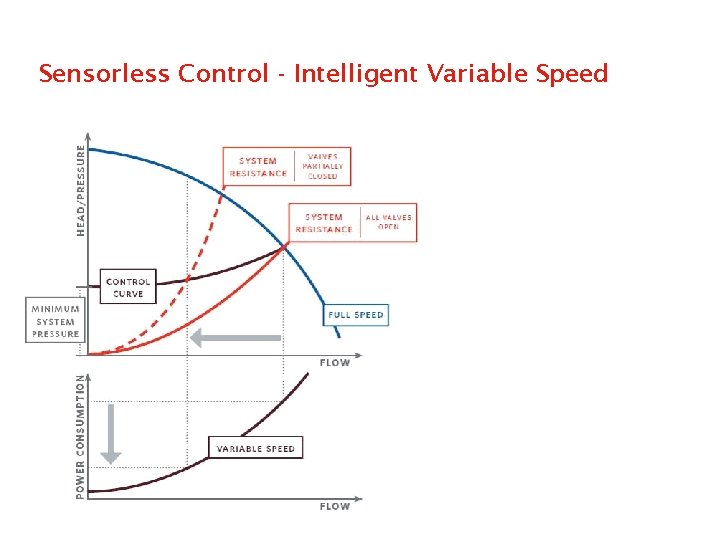
Sensorless Control - Intelligent Variable Speed
Questions and Answers. . .