
Pulsed laser deposition of oxide epitaxial thin films
- Slides: 24
Pulsed laser deposition of oxide epitaxial thin films. Recent results on Sr 4 Fe 6 O 13 Dr. JOSÉ A. PARDO Department of Materials Science and Technology, & Aragón Institute of Nanoscience University of Zaragoza
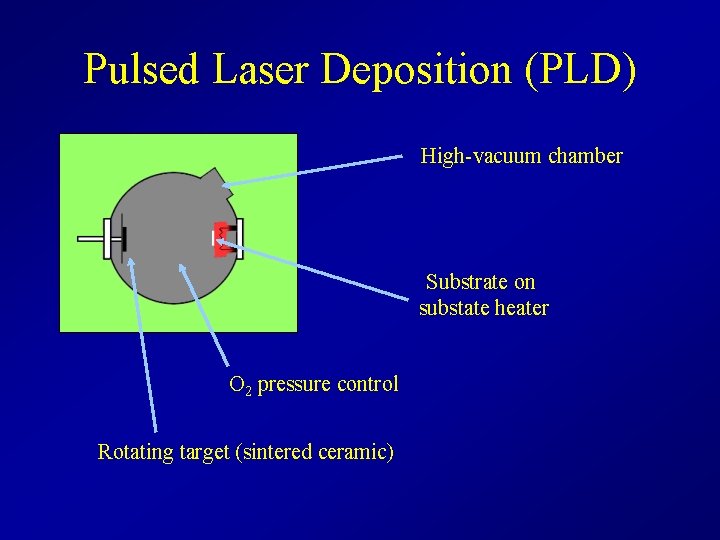
Pulsed Laser Deposition (PLD) High-vacuum chamber Substrate on substate heater O 2 pressure control Rotating target (sintered ceramic)
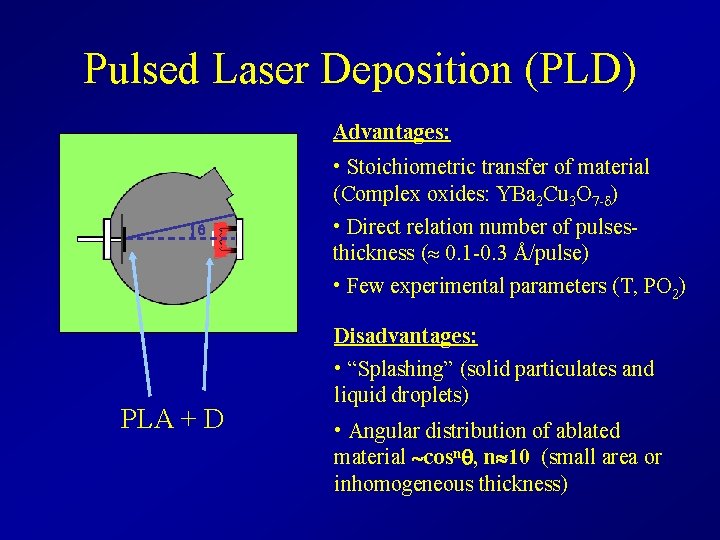
Pulsed Laser Deposition (PLD) Advantages: q PLA + D • Stoichiometric transfer of material (Complex oxides: YBa 2 Cu 3 O 7 - ) • Direct relation number of pulsesthickness ( 0. 1 -0. 3 Å/pulse) • Few experimental parameters (T, PO 2) Disadvantages: • “Splashing” (solid particulates and liquid droplets) • Angular distribution of ablated material cosnq, n 10 (small area or inhomogeneous thickness)
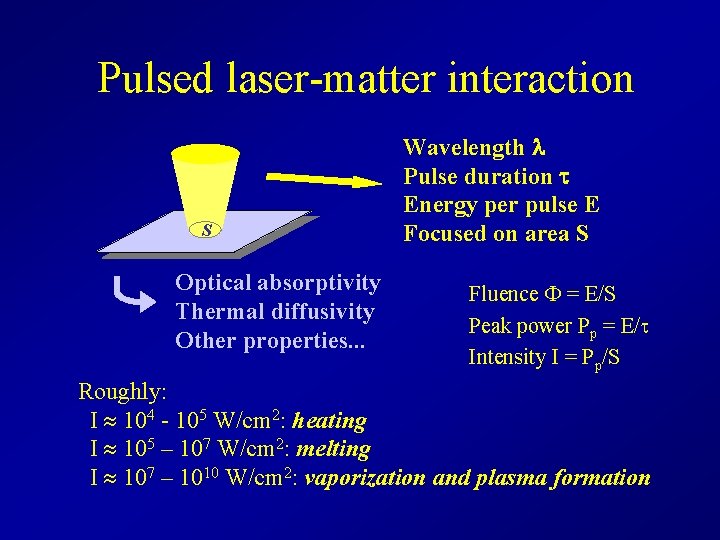
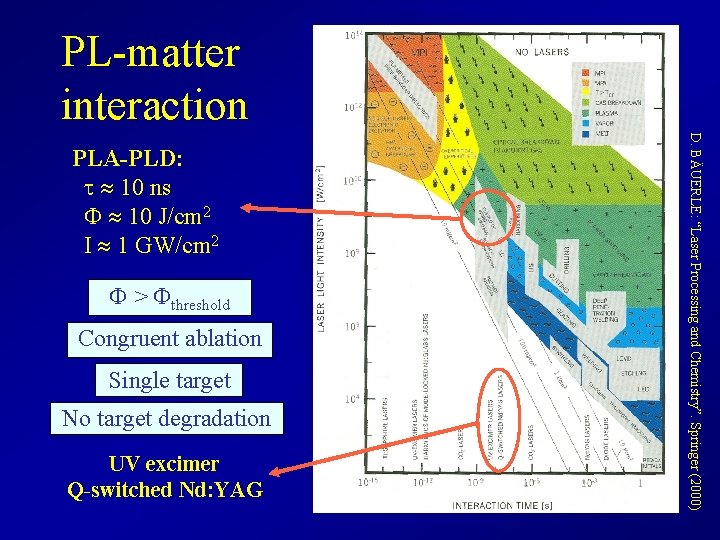
Pulsed laser-matter interaction S Optical absorptivity Thermal diffusivity Other properties. . . Wavelength l Pulse duration t Energy per pulse E Focused on area S Fluence F = E/S Peak power Pp = E/t Intensity I = Pp/S Roughly: I 104 - 105 W/cm 2: heating I 105 – 107 W/cm 2: melting I 107 – 1010 W/cm 2: vaporization and plasma formation
PL-matter interaction F > Fthreshold Congruent ablation Single target No target degradation UV excimer Q-switched Nd: YAG D. BÄUERLE: “Laser Processing and Chemistry”. Springer (2000) PLA-PLD: t 10 ns F 10 J/cm 2 I 1 GW/cm 2
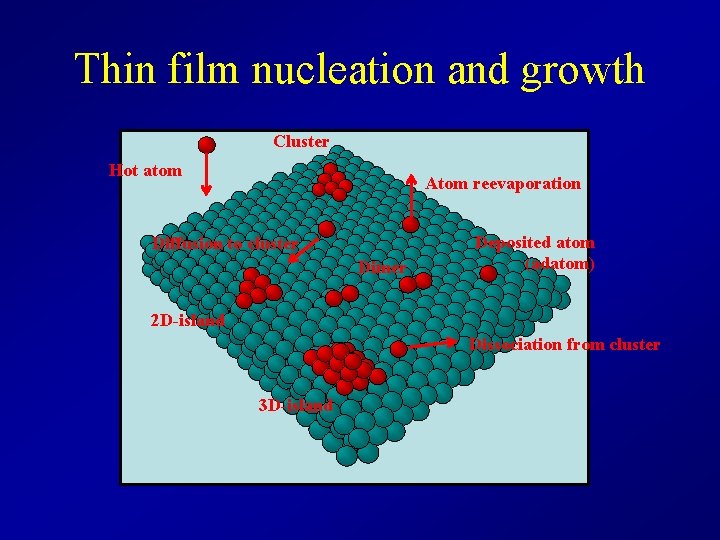
Thin film nucleation and growth Cluster Hot atom Atom reevaporation Diffusion to cluster Dimer Deposited atom (adatom) 2 D-island Dissociation from cluster 3 D-island
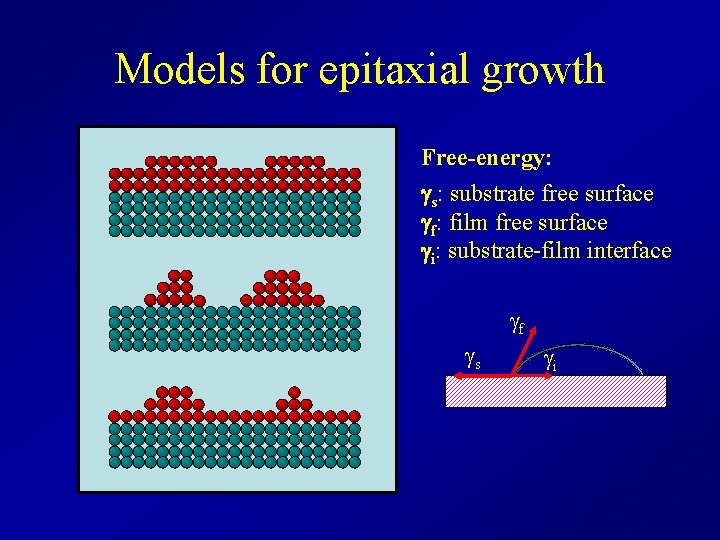
Models for epitaxial growth Free-energy: gs: substrate free surface gf: film free surface gi: substrate-film interface gf gs gi
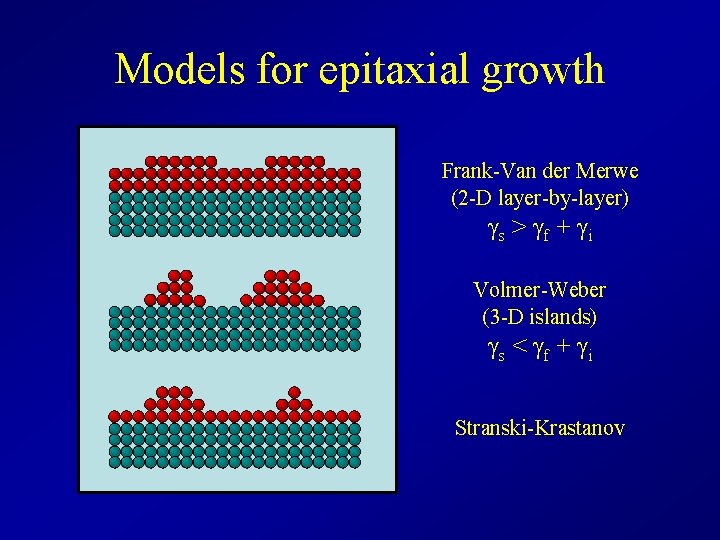
Models for epitaxial growth Frank-Van der Merwe (2 -D layer-by-layer) gs > gf + gi Volmer-Weber (3 -D islands) gs < gf + gi Stranski-Krastanov
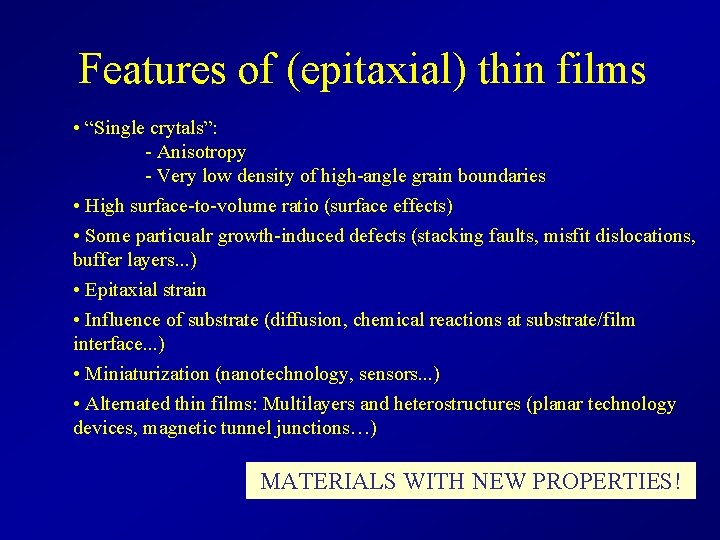
Features of (epitaxial) thin films • “Single crytals”: - Anisotropy - Very low density of high-angle grain boundaries • High surface-to-volume ratio (surface effects) • Some particualr growth-induced defects (stacking faults, misfit dislocations, buffer layers. . . ) • Epitaxial strain • Influence of substrate (diffusion, chemical reactions at substrate/film interface. . . ) • Miniaturization (nanotechnology, sensors. . . ) • Alternated thin films: Multilayers and heterostructures (planar technology devices, magnetic tunnel junctions…) MATERIALS WITH NEW PROPERTIES!
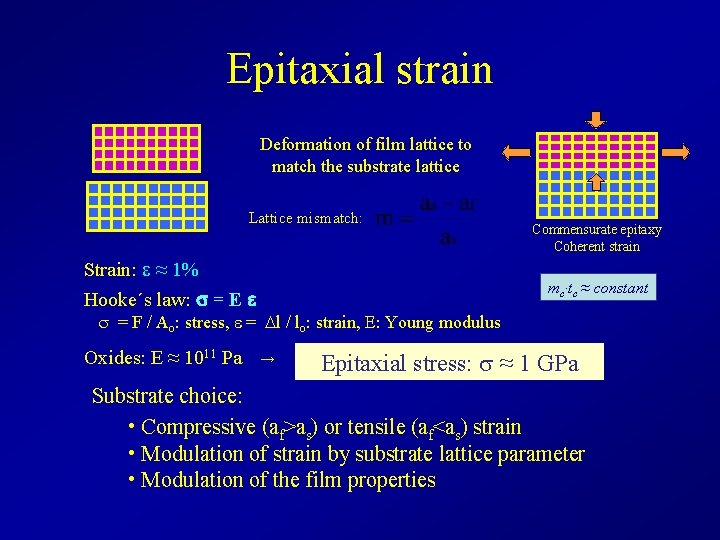
Epitaxial strain Deformation of film lattice to match the substrate lattice Lattice mismatch: Strain: e ≈ 1% Hooke´s law: s = E Commensurate epitaxy Coherent strain mc·tc ≈ constant s = F / Ao: stress, e = Dl / lo: strain, E: Young modulus Oxides: E ≈ 1011 Pa → Epitaxial stress: s ≈ 1 GPa Substrate choice: • Compressive (af>as) or tensile (af<as) strain • Modulation of strain by substrate lattice parameter • Modulation of the film properties
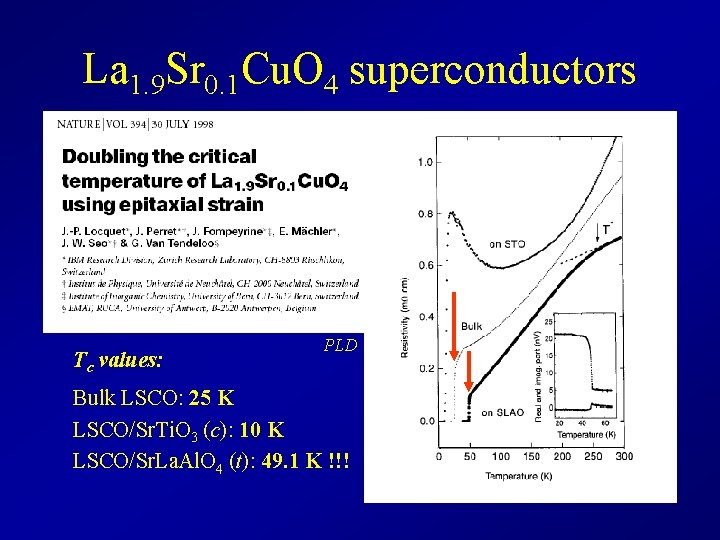
La 1. 9 Sr 0. 1 Cu. O 4 superconductors Tc values: PLD Bulk LSCO: 25 K LSCO/Sr. Ti. O 3 (c): 10 K LSCO/Sr. La. Al. O 4 (t): 49. 1 K !!!
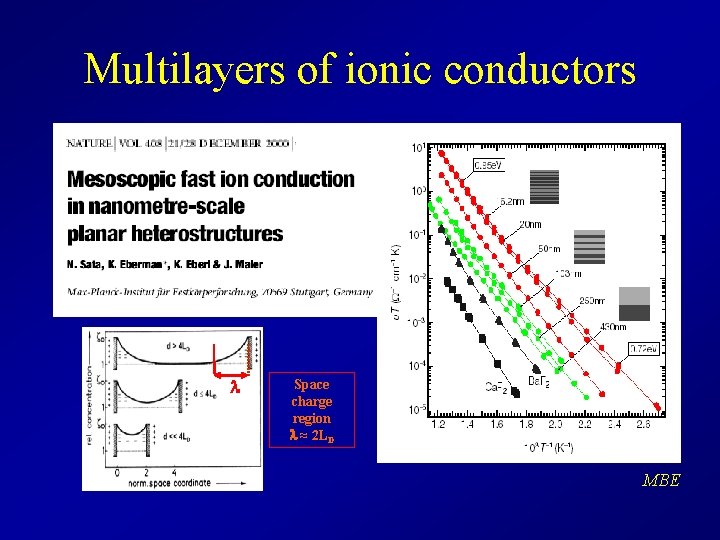
Multilayers of ionic conductors l Space charge region l ≈ 2 LD MBE
PLD of Sr 4 Fe 6 O 13 epitaxial films PEOPLE INVOLVED: • Barcelona - ICMAB: J. A. Pardo, J. Santiso, C. Solís, G. Garcia, M. Burriel, A. Figueras (PLD, CVD, XRR, SEM, Impedance) • Antwerp - EMAT: G. Van Tendeloo & M. D. Rossell (TEM, HREM and ED) • Sacavém - ITN: J. C. Waerenborgh (Mössbauer) • Barcelona - ICMAB: X. Torrellas (Synchrotron) • Lisbon - FCUL: M. Godinho (Magnetism)
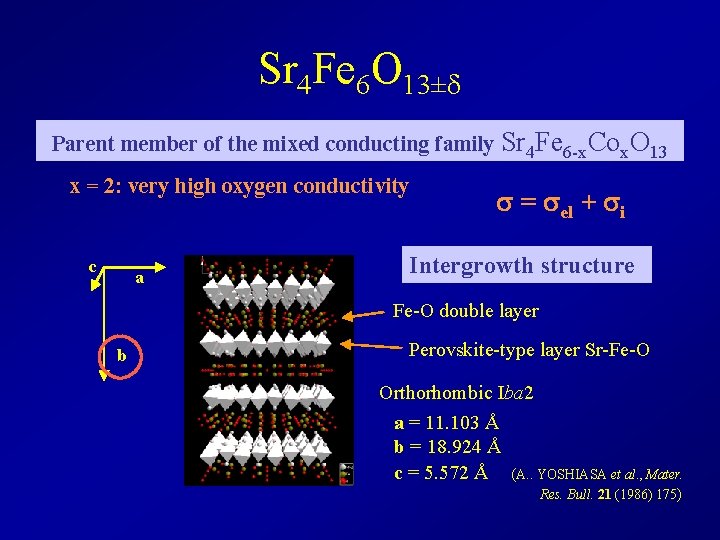
Sr 4 Fe 6 O 13± Parent member of the mixed conducting family Sr 4 Fe 6 -x. Cox. O 13 x = 2: very high oxygen conductivity c a s = sel + si Intergrowth structure Fe-O double layer b Perovskite-type layer Sr-Fe-O Orthorhombic Iba 2 a = 11. 103 Å b = 18. 924 Å c = 5. 572 Å (A. . YOSHIASA et al. , Mater. Res. Bull. 21 (1986) 175)
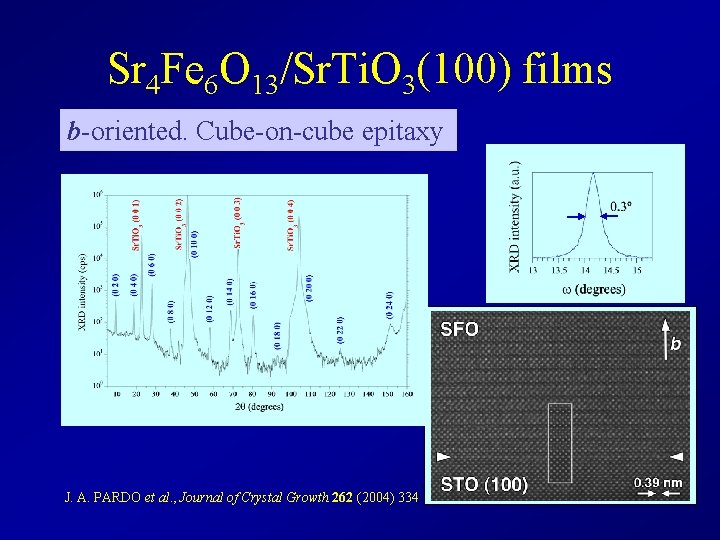
Sr 4 Fe 6 O 13/Sr. Ti. O 3(100) films b-oriented. Cube-on-cube epitaxy J. A. PARDO et al. , Journal of Crystal Growth 262 (2004) 334
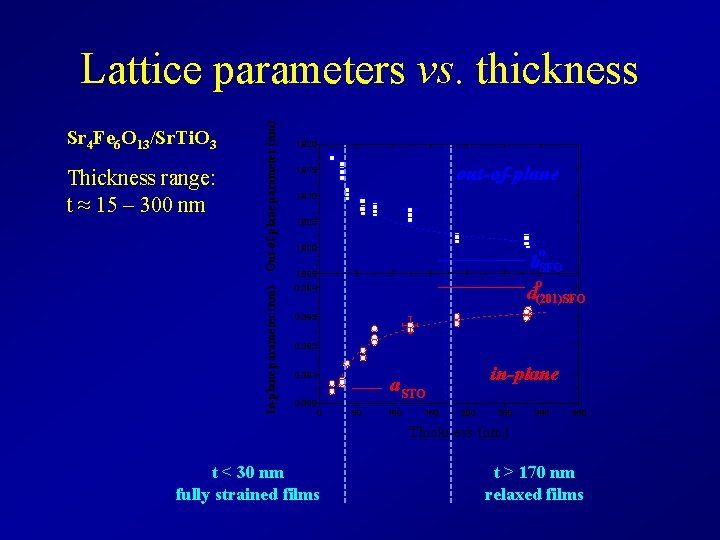
Sr 4 Fe 6 O 13/Sr. Ti. O 3 In-plane parameter (nm) Thickness range: t ≈ 15 – 300 nm Out-of-plane parameter (nm) Lattice parameters vs. thickness 1, 920 out-of-plane 1, 915 1, 910 1, 905 1, 900 o b. SFO 1, 895 o d(201)SFO 0, 394 0, 393 0, 392 0, 391 0, 390 0 in-plane a STO 50 100 150 200 250 300 350 Thickness (nm) t < 30 nm fully strained films t > 170 nm relaxed films
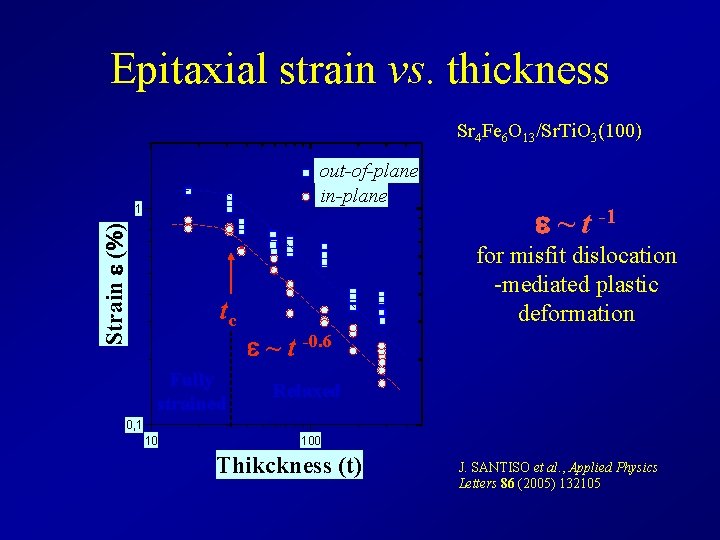
Epitaxial strain vs. thickness Sr 4 Fe 6 O 13/Sr. Ti. O 3(100) out-of-plane in-plane Strain (%) 1 tc Fully strained ~ t -1 for misfit dislocation -mediated plastic deformation ~ t -0. 6 Relaxed 0, 1 10 100 Thikckness (t) J. SANTISO et al. , Applied Physics Letters 86 (2005) 132105
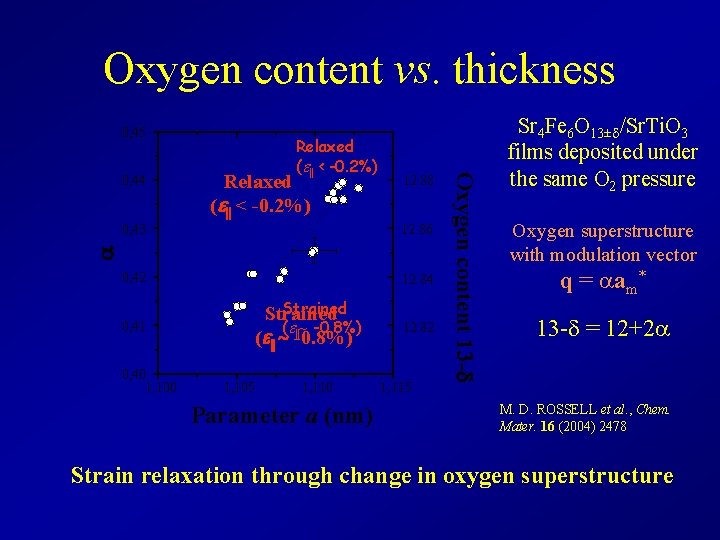
Oxygen content vs. thickness 0, 45 Relaxed ( < -0. 2%) 12. 88 12. 86 0, 42 12. 84 a 0, 43 0, 41 0, 40 1, 100 Strained ( -0. 8%) 1, 105 1, 110 Parameter a (nm) 12. 82 1, 115 Oxygen content 13 -d 0, 44 Relaxed ( < -0. 2%) Sr 4 Fe 6 O 13± /Sr. Ti. O 3 films deposited under the same O 2 pressure Oxygen superstructure with modulation vector q = aam* 13 - = 12+2 a M. D. ROSSELL et al. , Chem. Mater. 16 (2004) 2478 Strain relaxation through change in oxygen superstructure
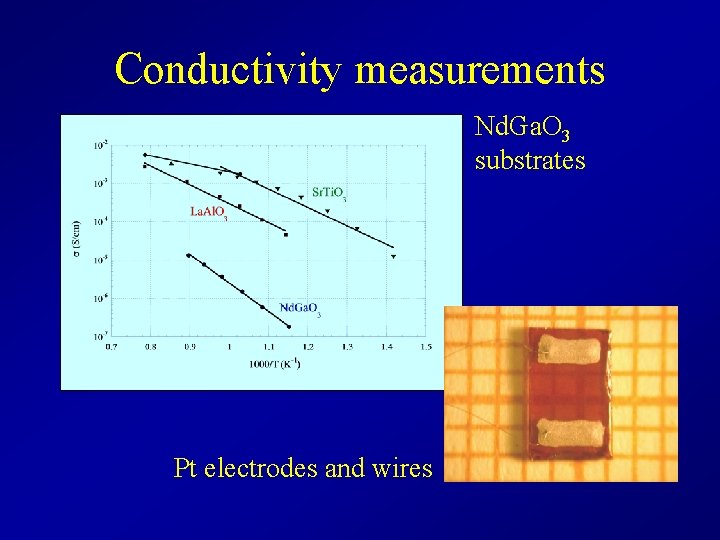
Conductivity measurements Nd. Ga. O 3 substrates Pt electrodes and wires
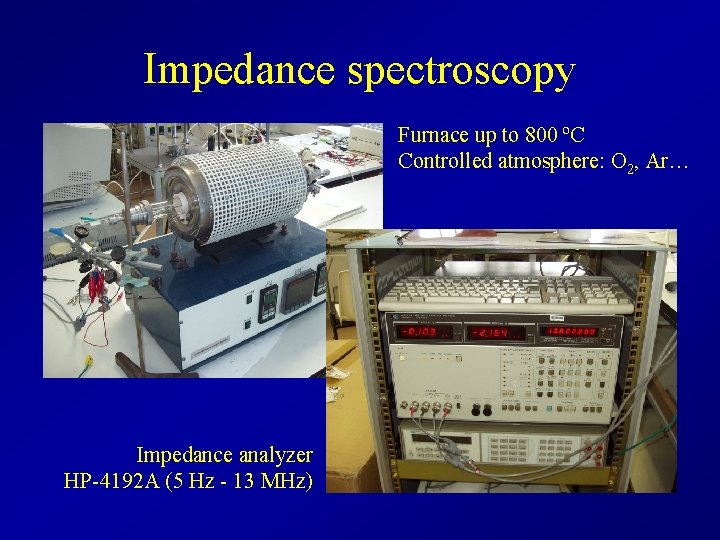
Impedance spectroscopy Furnace up to 800 ºC Controlled atmosphere: O 2, Ar… Impedance analyzer HP-4192 A (5 Hz - 13 MHz)
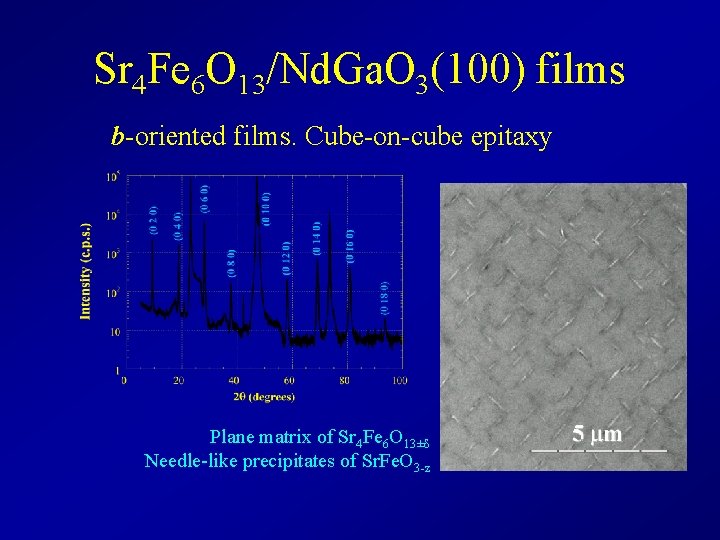
Sr 4 Fe 6 O 13/Nd. Ga. O 3(100) films b-oriented films. Cube-on-cube epitaxy Plane matrix of Sr 4 Fe 6 O 13± Needle-like precipitates of Sr. Fe. O 3 -z
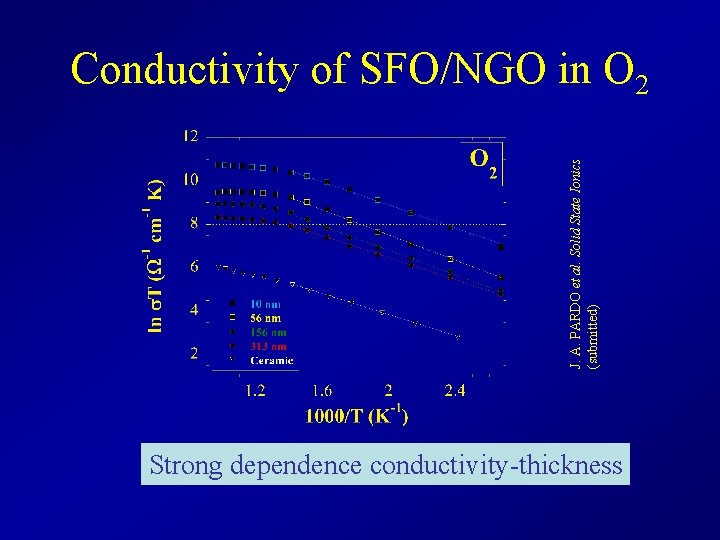
J. A. PARDO et al. Solid State Ionics (submitted) Conductivity of SFO/NGO in O 2 Strong dependence conductivity-thickness
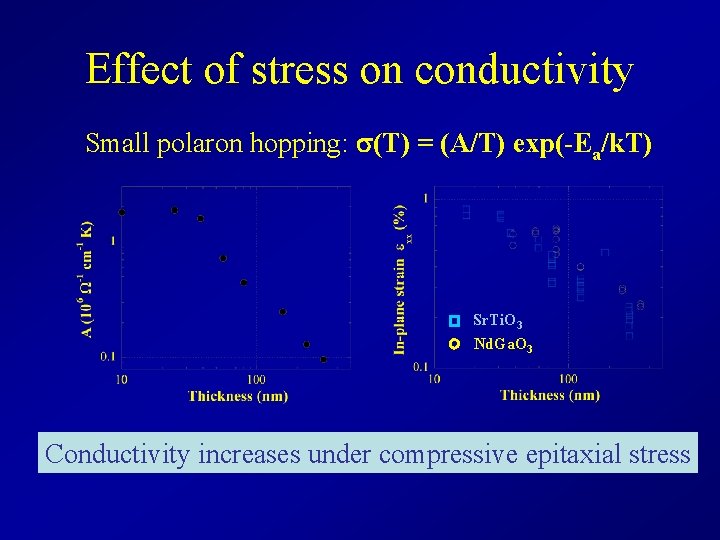
Effect of stress on conductivity Small polaron hopping: s(T) = (A/T) exp(-Ea/k. T) Sr. Ti. O 3 Nd. Ga. O 3 Conductivity increases under compressive epitaxial stress
Summary • PLD is a versatile technique for the deposition of high-quality epitaxial thin films of oxides. • The conductivity of epitaxial thin films of Sr 4 Fe 6 O 13/Nd. Ga. O 3(100) strongly depends on the film thickness. • This dependence is most probably due to the effect of compressive epitaxial stress.