
Pulsed Laser Deposition and Quantum Efficency of Mg
- Slides: 14
Pulsed Laser Deposition and Quantum Efficency of Mg films L. Cultrera University of Lecce
Outline • PLD of Mg films improvements; – Vacuum system; – Target surface laser cleaning; – Deposition in inert gas; • Quantum efficiency results; • Necessary improvements for QE set-up; • Future plans.
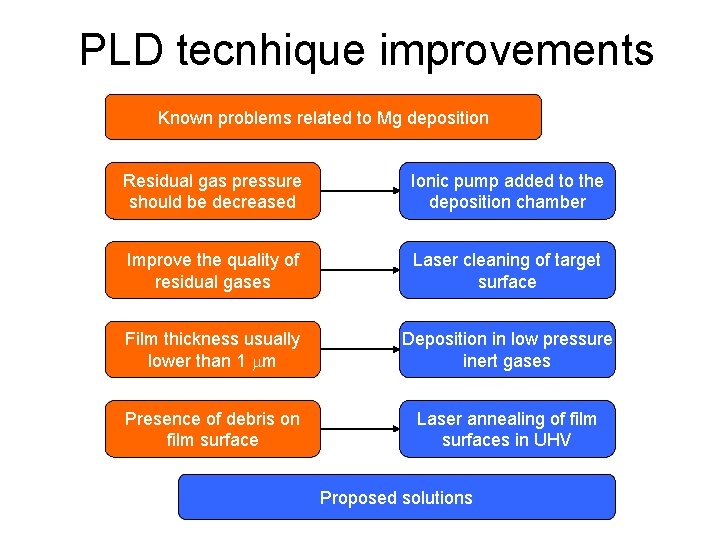
PLD tecnhique improvements Known problems related to Mg deposition Residual gas pressure should be decreased Ionic pump added to the deposition chamber Improve the quality of residual gases Laser cleaning of target surface Film thickness usually lower than 1 mm Deposition in low pressure inert gases Presence of debris on film surface Laser annealing of film surfaces in UHV Proposed solutions
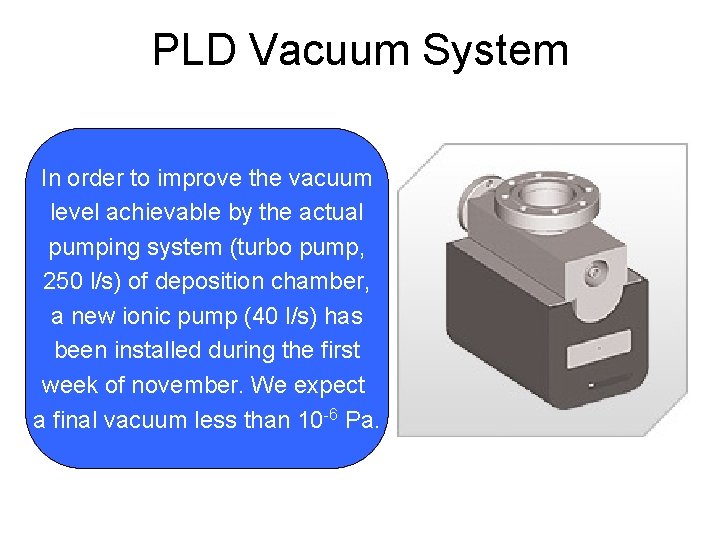
PLD Vacuum System In order to improve the vacuum level achievable by the actual pumping system (turbo pump, 250 l/s) of deposition chamber, a new ionic pump (40 l/s) has been installed during the first week of november. We expect a final vacuum less than 10 -6 Pa.
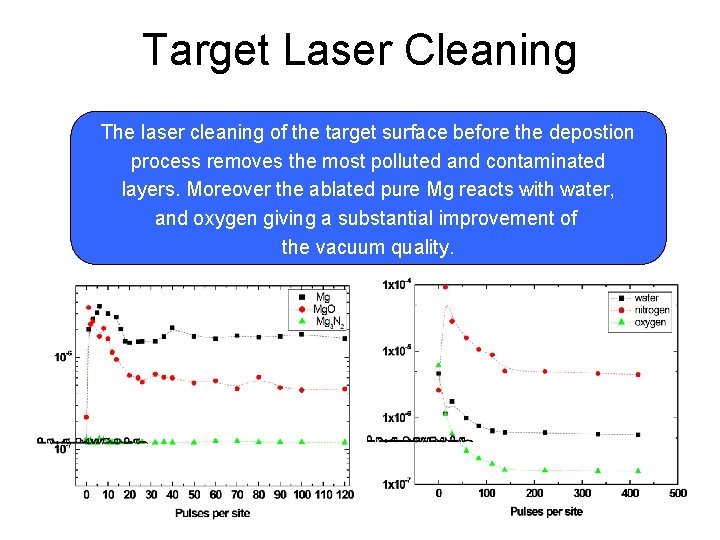
Target Laser Cleaning The laser cleaning of the target surface before the depostion process removes the most polluted and contaminated layers. Moreover the ablated pure Mg reacts with water, and oxygen giving a substantial improvement of the vacuum quality.
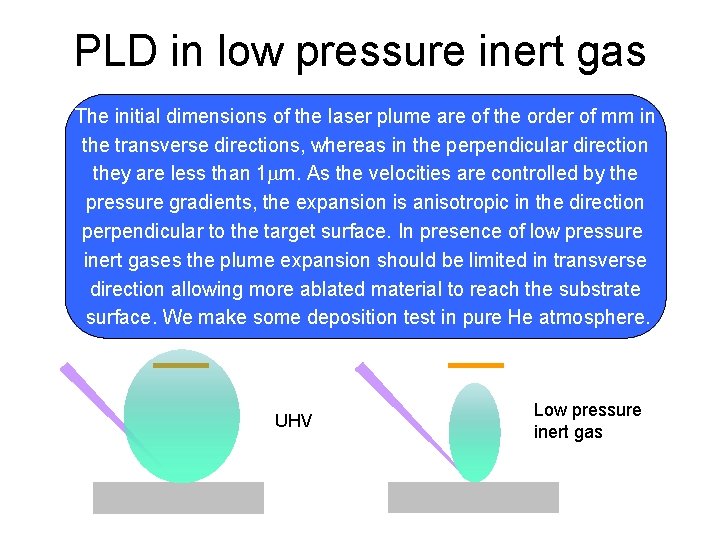
PLD in low pressure inert gas The initial dimensions of the laser plume are of the order of mm in the transverse directions, whereas in the perpendicular direction they are less than 1 mm. As the velocities are controlled by the pressure gradients, the expansion is anisotropic in the direction perpendicular to the target surface. In presence of low pressure inert gases the plume expansion should be limited in transverse direction allowing more ablated material to reach the substrate surface. We make some deposition test in pure He atmosphere. UHV Low pressure inert gas
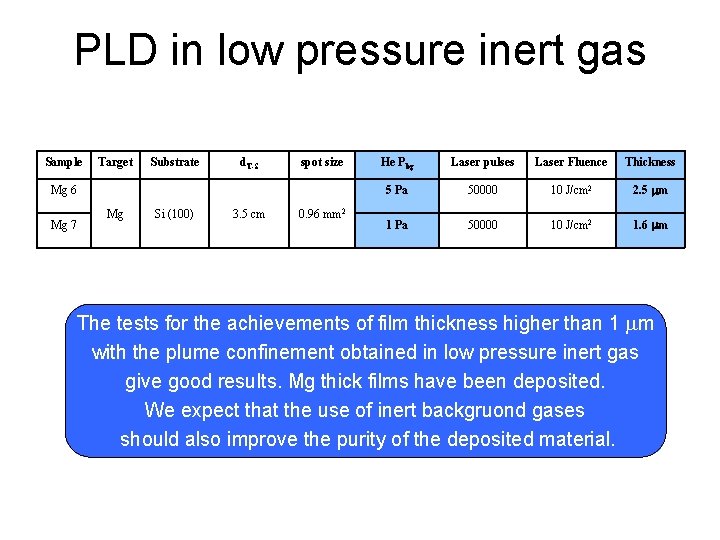
PLD in low pressure inert gas Sample Target Substrate d. T-S spot size Mg 6 Mg 7 Mg Si (100) 3. 5 cm 0. 96 mm 2 He Pbg Laser pulses Laser Fluence Thickness 5 Pa 50000 10 J/cm 2 2. 5 mm 1 Pa 50000 10 J/cm 2 1. 6 mm The tests for the achievements of film thickness higher than 1 mm with the plume confinement obtained in low pressure inert gas give good results. Mg thick films have been deposited. We expect that the use of inert backgruond gases should also improve the purity of the deposited material.
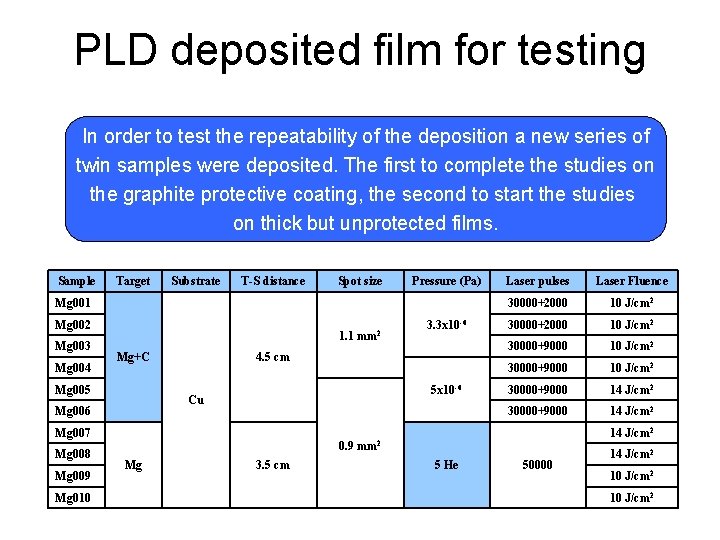
PLD deposited film for testing In order to test the repeatability of the deposition a new series of twin samples were deposited. The first to complete the studies on the graphite protective coating, the second to start the studies on thick but unprotected films. Sample Target Substrate T-S distance Spot size Pressure (Pa) Mg 001 Mg 002 Mg 003 Mg 004 1. 1 mm 2 Mg+C Mg 005 4. 5 cm 5 x 10 -6 Cu Mg 006 Mg 007 Mg 008 Mg 009 Mg 010 0. 9 Mg 3. 3 x 10 -6 3. 5 cm Laser pulses Laser Fluence 30000+2000 10 J/cm 2 30000+9000 14 J/cm 2 mm 2 5 He 50000 14 J/cm 2 10 J/cm 2
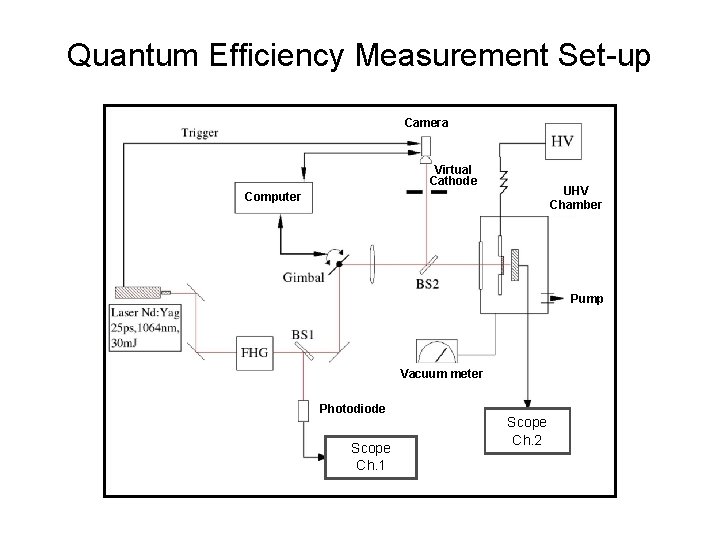
Quantum Efficiency Measurement Set-up Camera Virtual Cathode UHV Chamber Computer Pump Vacuum meter Photodiode Scope Ch. 1 Scope Ch. 2
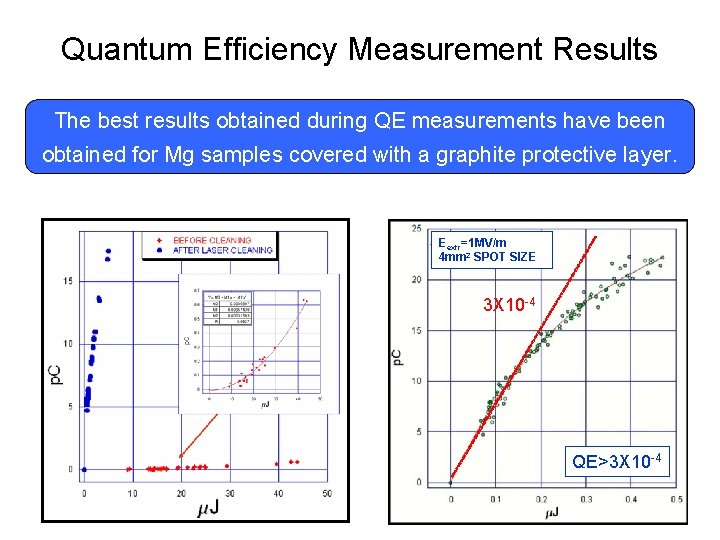
Quantum Efficiency Measurement Results The best results obtained during QE measurements have been obtained for Mg samples covered with a graphite protective layer. Eextr=1 MV/m 4 mm 2 SPOT SIZE 3 X 10 -4 QE>3 X 10 -4
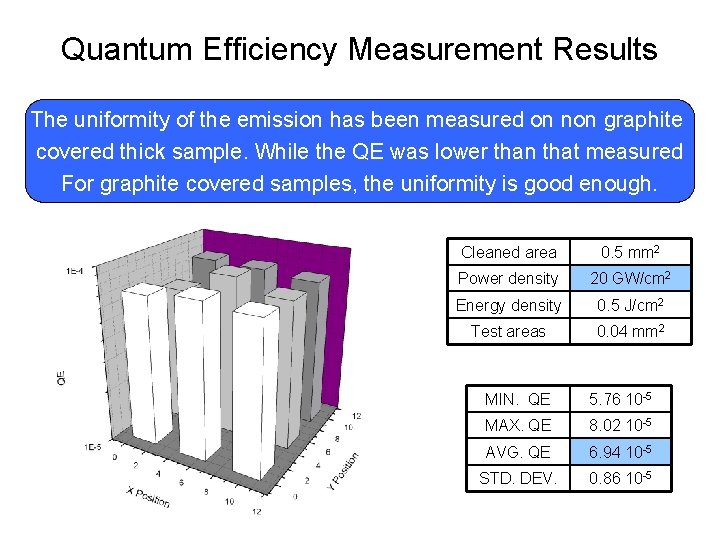
Quantum Efficiency Measurement Results The uniformity of the emission has been measured on non graphite covered thick sample. While the QE was lower than that measured For graphite covered samples, the uniformity is good enough. Cleaned area 0. 5 mm 2 Power density 20 GW/cm 2 Energy density 0. 5 J/cm 2 Test areas 0. 04 mm 2 MIN. QE 5. 76 10 -5 MAX. QE 8. 02 10 -5 AVG. QE 6. 94 10 -5 STD. DEV. 0. 86 10 -5
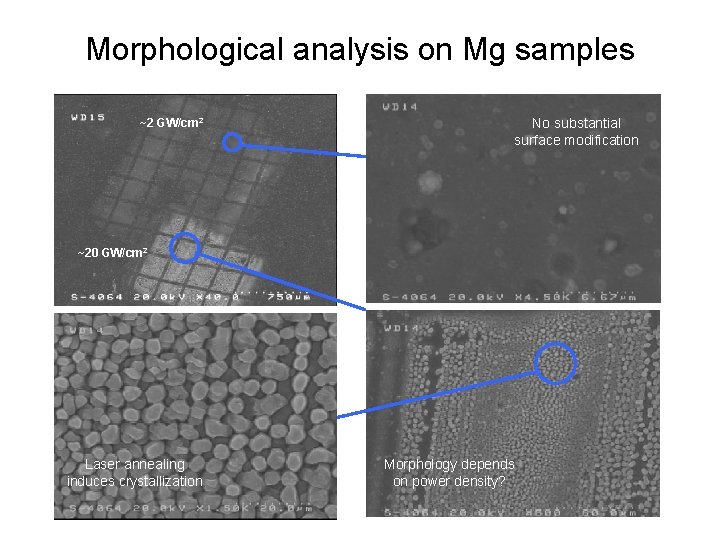
Morphological analysis on Mg samples ~2 GW/cm 2 No substantial surface modification ~20 GW/cm 2 Laser annealing induces crystallization Morphology depends on power density?
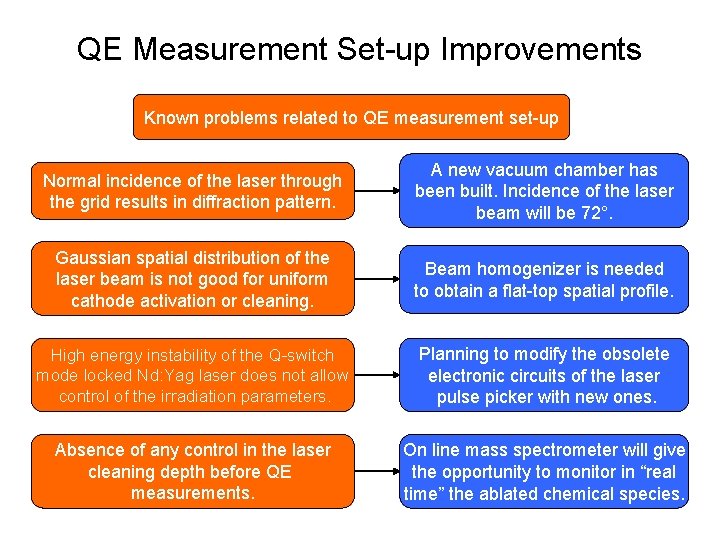
QE Measurement Set-up Improvements Known problems related to QE measurement set-up Normal incidence of the laser through the grid results in diffraction pattern. A new vacuum chamber has been built. Incidence of the laser beam will be 72°. Gaussian spatial distribution of the laser beam is not good for uniform cathode activation or cleaning. Beam homogenizer is needed to obtain a flat-top spatial profile. High energy instability of the Q-switch mode locked Nd: Yag laser does not allow control of the irradiation parameters. Planning to modify the obsolete electronic circuits of the laser pulse picker with new ones. Absence of any control in the laser cleaning depth before QE measurements. On line mass spectrometer will give the opportunity to monitor in “real time” the ablated chemical species.
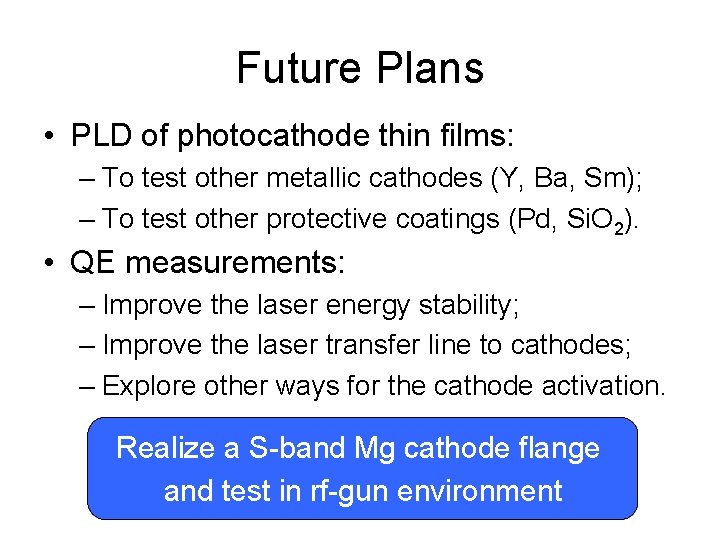
Future Plans • PLD of photocathode thin films: – To test other metallic cathodes (Y, Ba, Sm); – To test other protective coatings (Pd, Si. O 2). • QE measurements: – Improve the laser energy stability; – Improve the laser transfer line to cathodes; – Explore other ways for the cathode activation. Realize a S-band Mg cathode flange and test in rf-gun environment