
Pulsed laser ablation of Ge investigated by employing
Pulsed laser ablation of Ge investigated by employing photoacoustic deflection technique and SEM analysis Dr. Shazia Bashir Associate Professor In charge laser Laboratories Centre for Advanced Studies in Physics GC University Lahore , Pakistan
OUTLINE CONTENTS Research objectives Motivation 1)Introduction § Laser ablation § Laser induced plasma § Introduction to photoacoustic deflection technique and Photoacoustic effect § Incubation effect 2) Experimental details a) Setup for determination of ablation threshold fluence of Ge by photoacoustic technique b) Setup for determination of analytical value of ablation threshold fluence of Ge c) Surface morphological analysis 3) Results and discussion 4) Conclusions
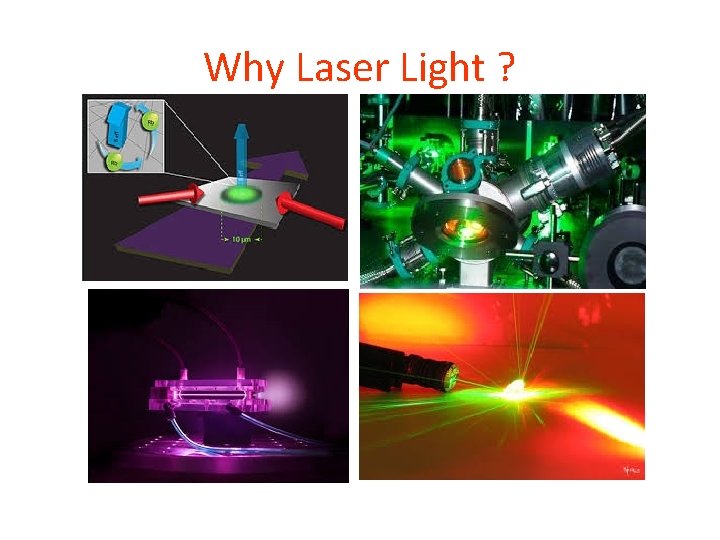
Why Laser Light ?
RESEARCH OBJECTIVES o To investigate the ablation threshold fluence of Ge by photoacoustic deflection technique. o To evaluate the analytical value of ablation threshold fluence of Ge as well as incubation coefficients for single and multiple laser-shots. o To investigate the surface morphology of laser irradiated Ge.
MOTIVATIONS v Threshold fluence determination is important for finding the suitable ablation parameters for q Thin film deposition q Ion implantation q Nano/micostructuring of materials q Nanoparticle generation q Plasma formation v Nano/microstructuring of Ge is important for altering optical and electrical properties of Ge
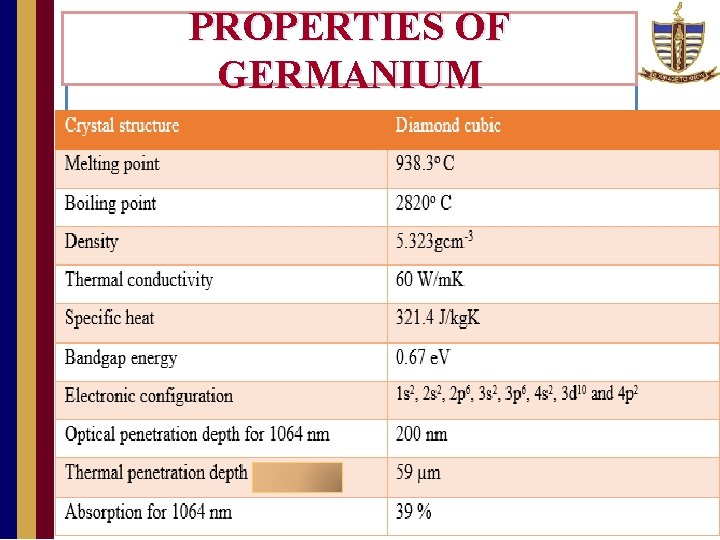
PROPERTIES OF TARGETS GERMANIUM
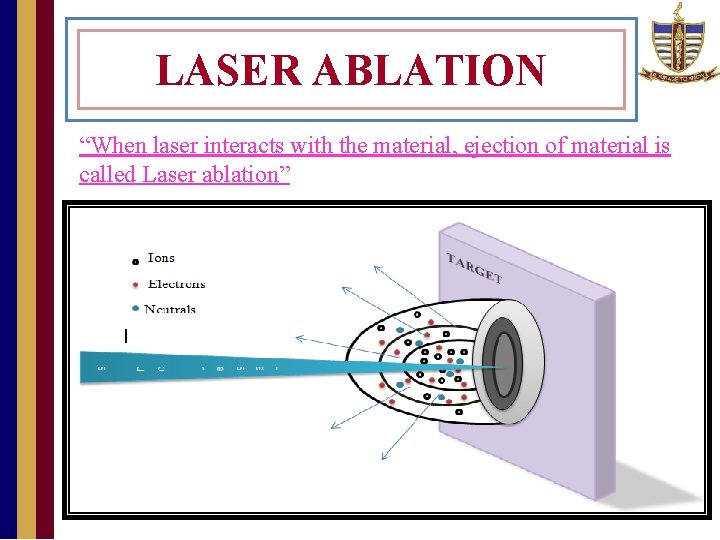
LASER ABLATION “When laser interacts with the material, ejection of material is called Laser ablation”
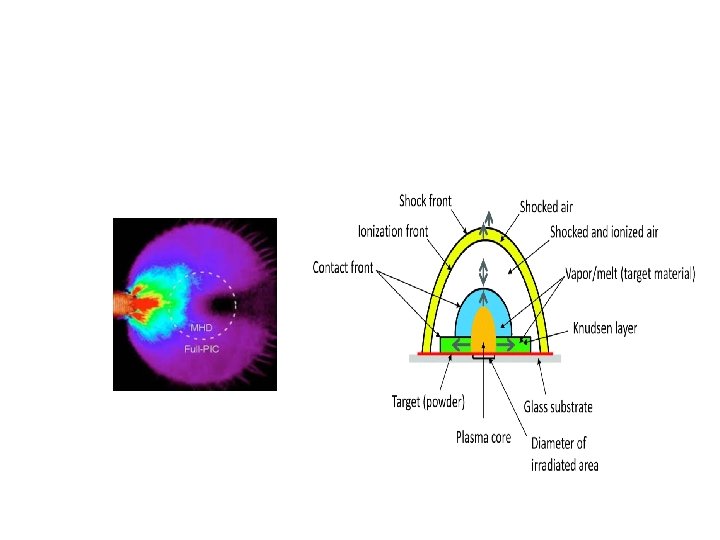
LASER INDUCED PLASMA “The creation of a highly ionized plasma consisting of electrons, ions and neutrals by the end of the laser pulse is regarded as laser induce plasma’’ Mainly, two mechanisms are responsible for generation and growth of plasma: Ø Inverse Bremsstrahlung Ionization Ø Multiphoton Ionization
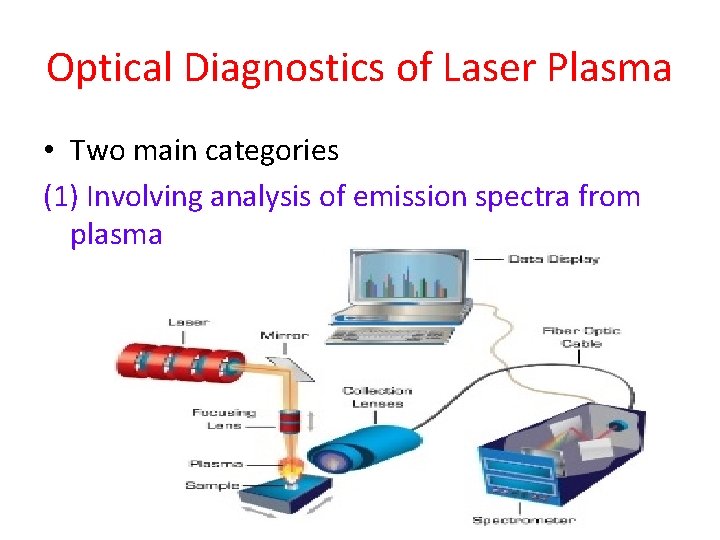
Optical Diagnostics of Laser Plasma • Two main categories (1) Involving analysis of emission spectra from plasma
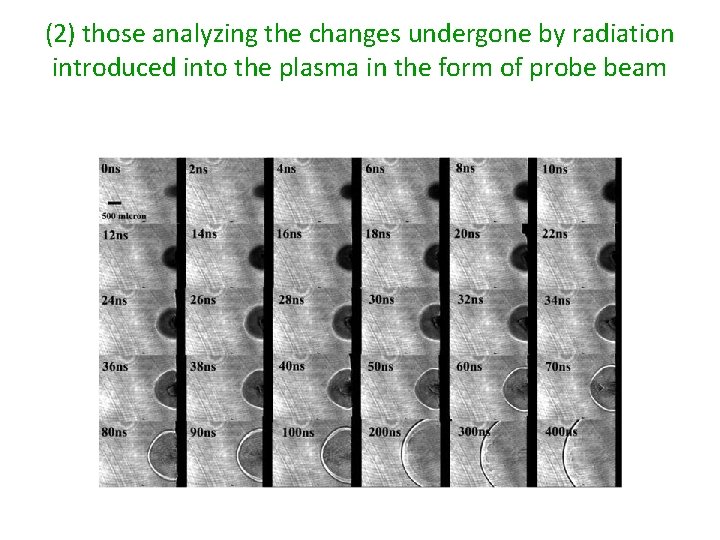
(2) those analyzing the changes undergone by radiation introduced into the plasma in the form of probe beam
ABLATION THRESHOLD FLUENCE “The minimum energy per unit area required to induce breakdown of material and for their ejection from the material surface is called ablation threshold fluence. ” Laser ablation have three fluence regime 1. F < Fth 2. F = Fth 3. F > Fth
PHOTOACOUSTIC DEFLECTION TECHNIQUE “The type of photothermal spectroscopic technique based on the studies of the pressure wave measurement and is known as photoacoustic technique. ” Thermalization of the laser induced heat in the sample brings about the changes not only in the temperature but also in many other parameters such as density, pressure and hence refractive index of the sample or medium. Photoacoustic deflection technique takes the advantage of deflection of probe beam due to this change in refractive index within plasma.
Features of Propagating laser plasma • Laser Absorption waves (a) Laser supported combustion waves At low laser irradiance, Thermal conduction is assumed to be primary mechanism (b) Laser supported detonation waves At intermediate laser irradiance (c) Laser supported radiation waves At sufficiently high laser irradiance •
SCHEMATIC DIAGRAM Oscilloscope Photodiode
Basic processes responsible for the deflection of probe beam `
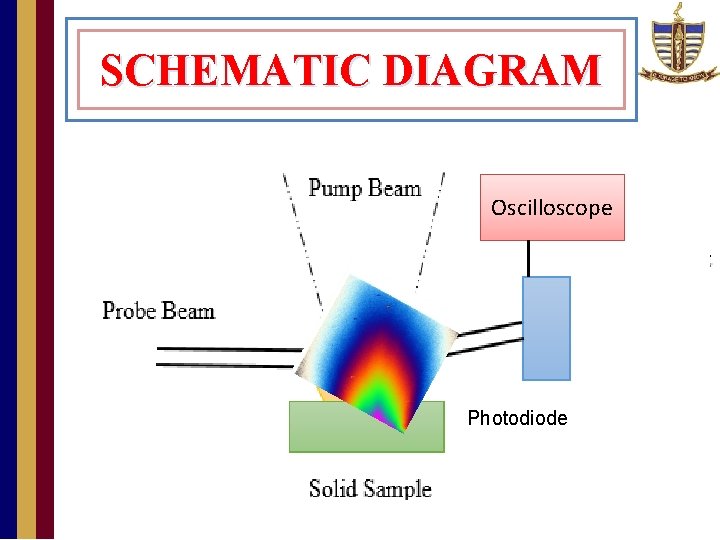
PHOTOACOUSTIC EFFECT “Photoacoustic effect is the conversion of optical energy into acoustical perturbations, when an incoming laser beam interacts with target. ” When a sample is irradiated with the incoming laser radiations a part of the absorbed energy liberated through non-radiative channel and will cause generation of thermal waves due to temperature rise of the sample. When thermal waves diffuse from the sample to the coupling medium, it will generate periodic pressure fluctuation at sample-medium interface. This pressure variation can be probed using photoacoustic deflection technique by using probe beam which is deflected while passing through the laser induced plasma.
INCUBATION EFFECT “Incubation effect is regarded as the reduction in the threshold fluence of a material by irradiating its surface with multiple laser-shots. ” In many materials, it is found that when a material is irradiated with multiple laser-shots ablation threshold of the material decreases. This decay in the threshold fluence is attributed to the accumulation of laser induced heat and structural changes that leads towards plastic deformation
EXPERIMENTAL DETAILS It consists of three parts • a) Threshold fluence determination by photoacoustic deflection technique • b) Threshold fluence determination by quantitative analysis • c) Surface morphological analysis
SAMPLE PREPARATION Commercially polished single crystal Ge (100) was selected as a target material. The targets were cut into the dimensions of 10 x 1 mm 3 with the help of diamond cutter for the experiment. After cutting the sample was cleaned with acetone.
A) THRESHOLD FLUENCE DETERMINATION BY PHOTOACOUSTIC DEFLECTION TECHNIQUE
LASER IRRADIATION SPECIFICATIONS For the determination of ablation threshold fluence of Ge by photoacoustic deflection technique Ø Nd: YAG laser : (wavelength 1064 nm) Ø Repetition rate : 1 Hz Ø Pulse duration : 10 ns Ø Ambient environment : air Ø Laser energy: 13 m. J, 25 m. J, 50 m. J, 75 m. J, 100 m. J and 125 m. J Ø Focal length of lens : 50 cm
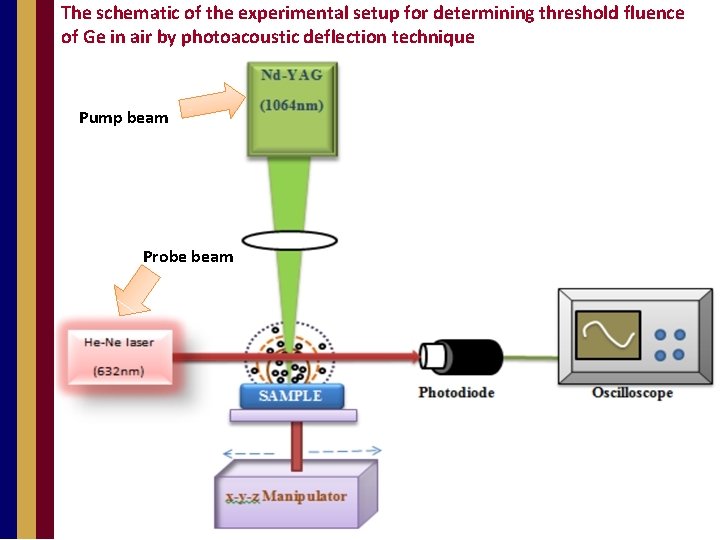
The schematic of the experimental setup for determining threshold fluence of Ge in air by photoacoustic deflection technique Pump beam Probe beam
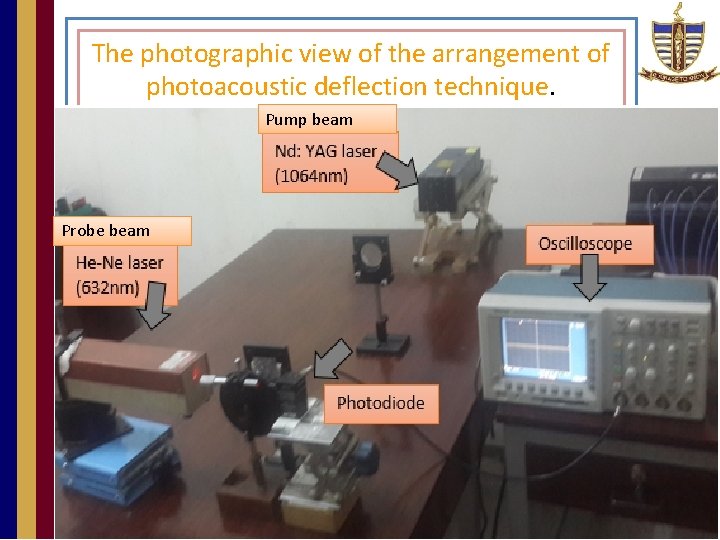
The photographic view of the arrangement of photoacoustic deflection technique. Pump beam Probe beam

RESULTS AND DISCUSSION
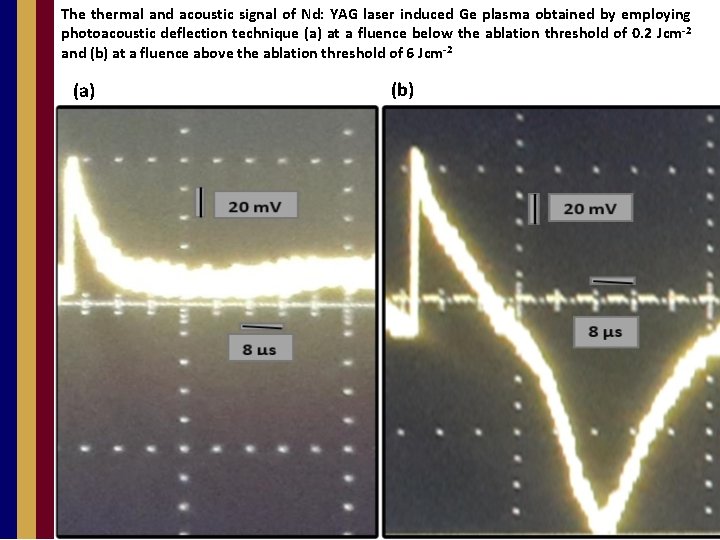
The thermal and acoustic signal of Nd: YAG laser induced Ge plasma obtained by employing photoacoustic deflection technique (a) at a fluence below the ablation threshold of 0. 2 Jcm-2 and (b) at a fluence above the ablation threshold of 6 Jcm-2 (a) (b)
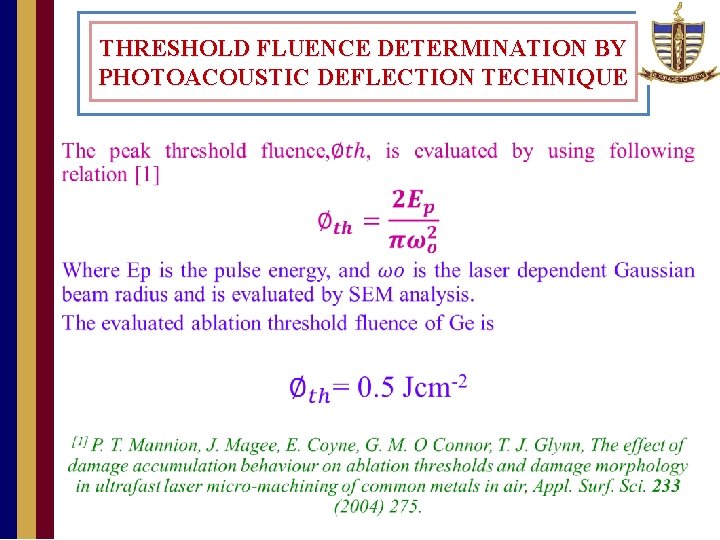
THRESHOLD FLUENCE DETERMINATION BY PHOTOACOUSTIC DEFLECTION TECHNIQUE •
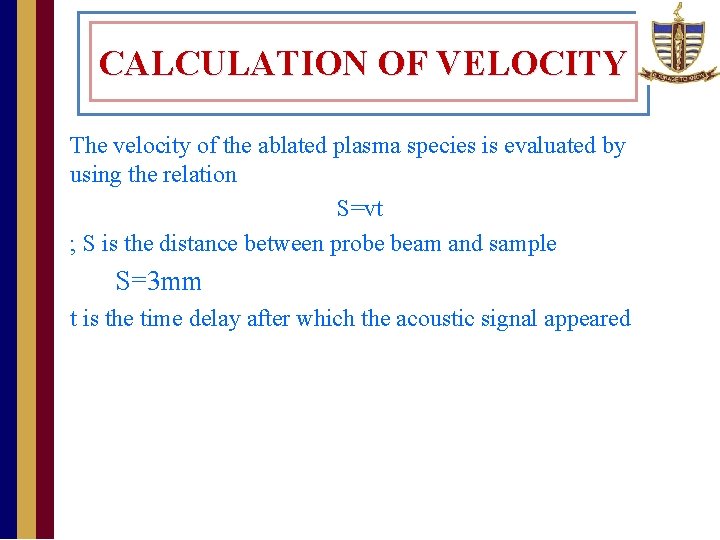
CALCULATION OF VELOCITY • The velocity of the ablated plasma species is evaluated by using the relation S=vt • ; S is the distance between probe beam and sample S=3 mm • t is the time delay after which the acoustic signal appeared
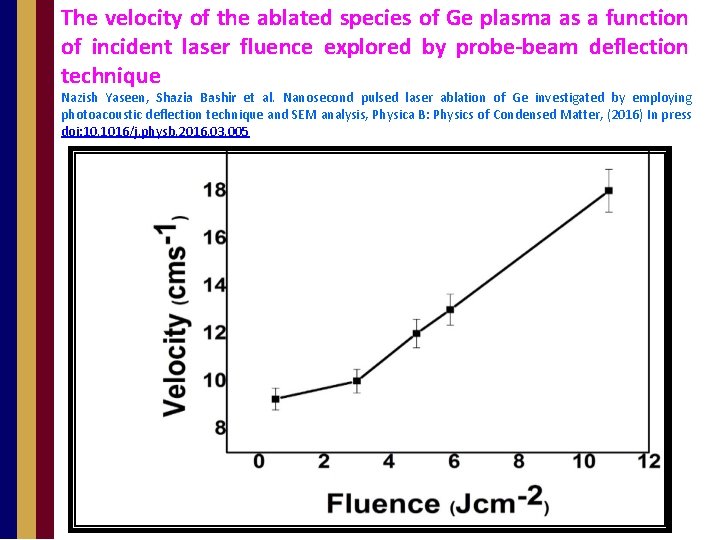
The velocity of the ablated species of Ge plasma as a function of incident laser fluence explored by probe-beam deflection technique Nazish Yaseen, Shazia Bashir et al. Nanosecond pulsed laser ablation of Ge investigated by employing photoacoustic deflection technique and SEM analysis, Physica B: Physics of Condensed Matter, (2016) In press doi: 10. 1016/j. physb. 2016. 03. 005
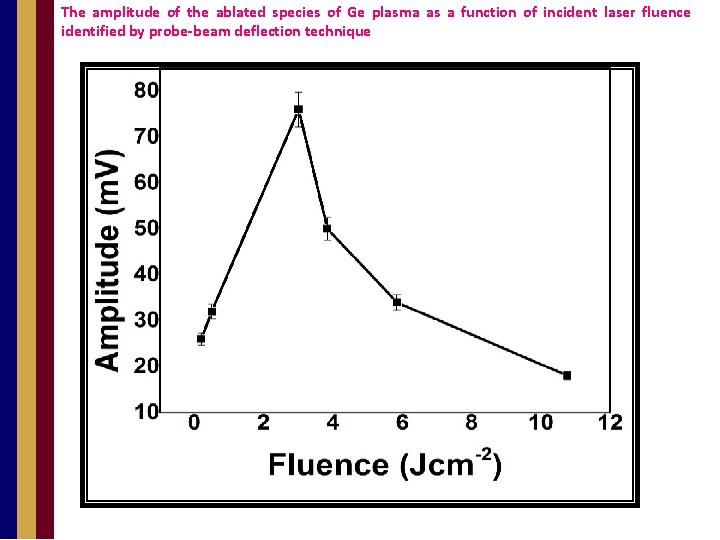
The amplitude of the ablated species of Ge plasma as a function of incident laser fluence identified by probe-beam deflection technique
B) THRESHOLD FLUENCE DETERMINATION BY QUANTITATIVE ANALYSIS (SEM ANALYSIS)
LASER IRRADIATION SPECIFICATIONS For the determination of threshold fluence of Ge by quantitative analysis Ø Nd: YAG laser : (wavelength 1064 nm) Ø Repetition rate : 10 Hz Ø Pulse duration : 10 ns Ø Ambient environment : air Ø Laser fluence: 0. 2 Jcm-2, 0. 5 Jcm-2 , 1. 5 Jcm-2, 3 Jcm-2, 6 Jcm-2, 11 Jcm-2 Ø Laser shots: 1, 5, 10, 50 and 100 Ø Focal length of lens : 50 cm
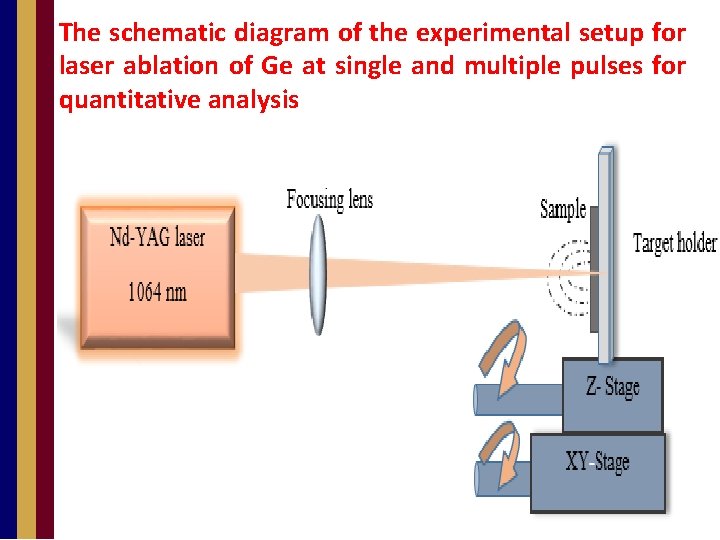
The schematic diagram of the experimental setup for laser ablation of Ge at single and multiple pulses for quantitative analysis

RESULTS AND DISCUSSION
The squared diameter ‘D 2’ of the laser spot of ablated Ge as a function of the logarithm of pulse energy (ln. E) for various incident laser-shots of (a) 1 shot, (b) 5 shots, (c) 10 shots, (d) 50 shots and (e) 100 shots. The solid lines represent the least-squares fit according to (1)
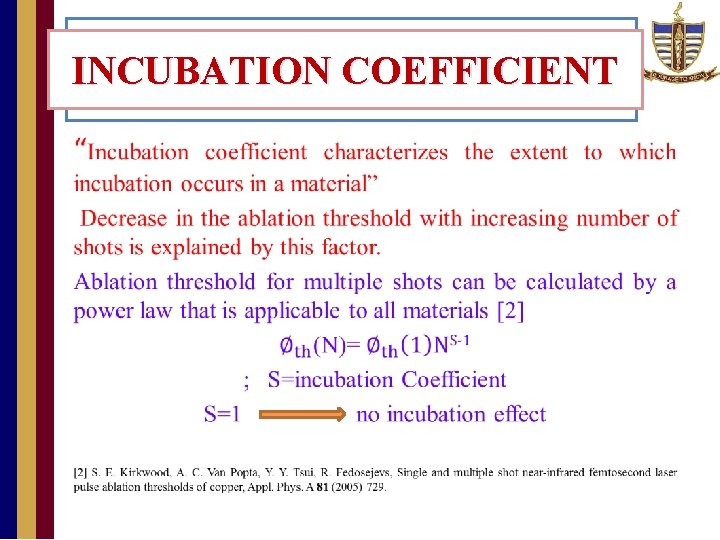
INCUBATION COEFFICIENT •
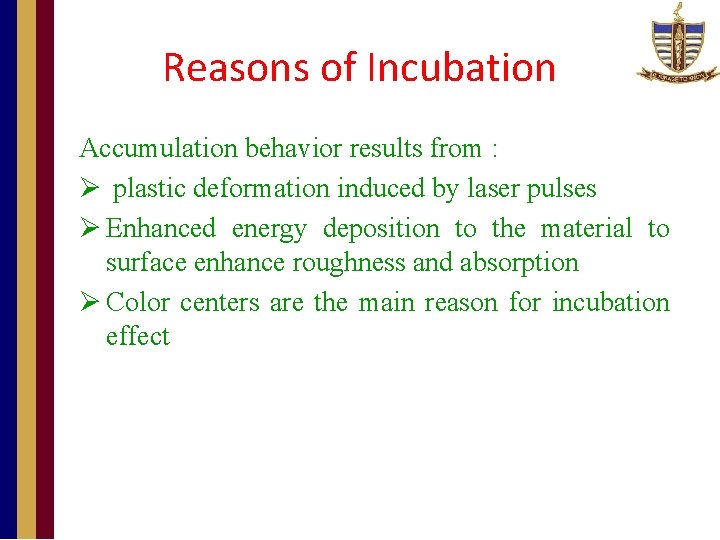
Reasons of Incubation Accumulation behavior results from : Ø plastic deformation induced by laser pulses Ø Enhanced energy deposition to the material to surface enhance roughness and absorption Ø Color centers are the main reason for incubation effect
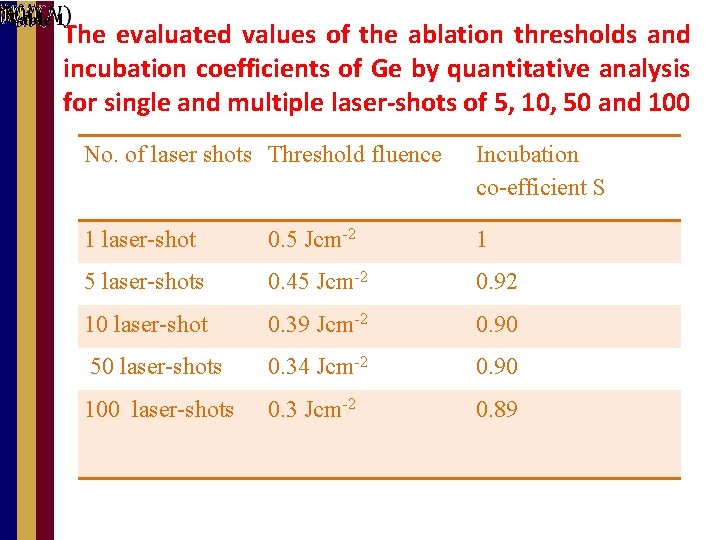
Table 1 The evaluated values of the ablation thresholds and incubation coefficients of Ge by quantitative analysis for single and multiple laser-shots of 5, 10, 50 and 100 No. of laser shots Threshold fluence Incubation co-efficient S 1 laser-shot 0. 5 Jcm-2 1 5 laser-shots 0. 45 Jcm-2 0. 92 10 laser-shot 0. 39 Jcm-2 0. 90 50 laser-shots 0. 34 Jcm-2 0. 90 100 laser-shots 0. 3 Jcm-2 0. 89
• The ablation threshold fluence of Ge obtained by photoacoustic deflection technique as well as quantitative analysis for single laser shot is compatible with each other and comes out to be 0. 5 Jcm-2.

C) SURFACE MORPHOLOGICAL ANALYSIS
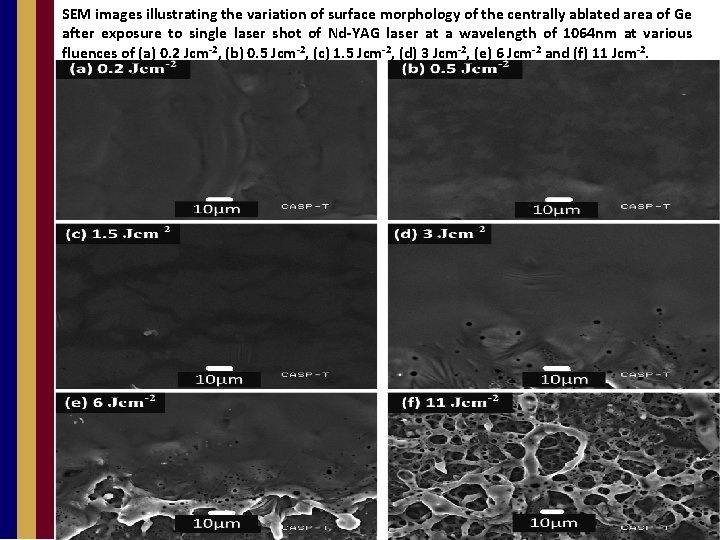
SEM images illustrating the variation of surface morphology of the centrally ablated area of Ge after exposure to single laser shot of Nd-YAG laser at a wavelength of 1064 nm at various fluences of (a) 0. 2 Jcm-2, (b) 0. 5 Jcm-2, (c) 1. 5 Jcm-2, (d) 3 Jcm-2, (e) 6 Jcm-2 and (f) 11 Jcm-2.
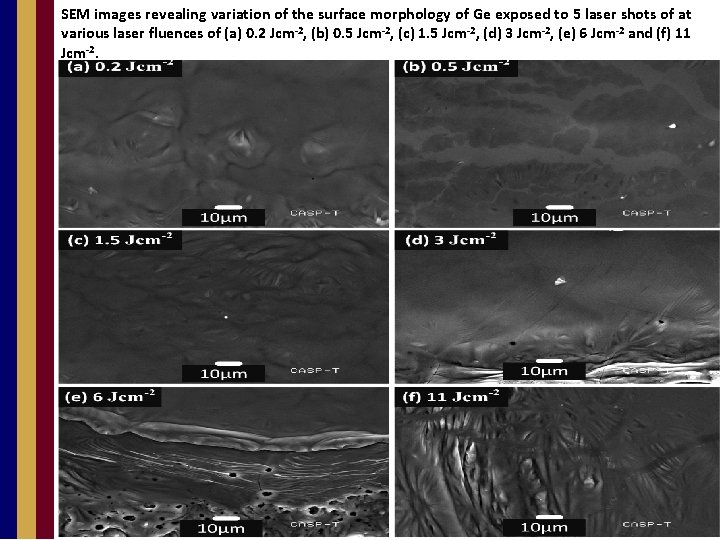
SEM images revealing variation of the surface morphology of Ge exposed to 5 laser shots of at various laser fluences of (a) 0. 2 Jcm-2, (b) 0. 5 Jcm-2, (c) 1. 5 Jcm-2, (d) 3 Jcm-2, (e) 6 Jcm-2 and (f) 11 Jcm-2.
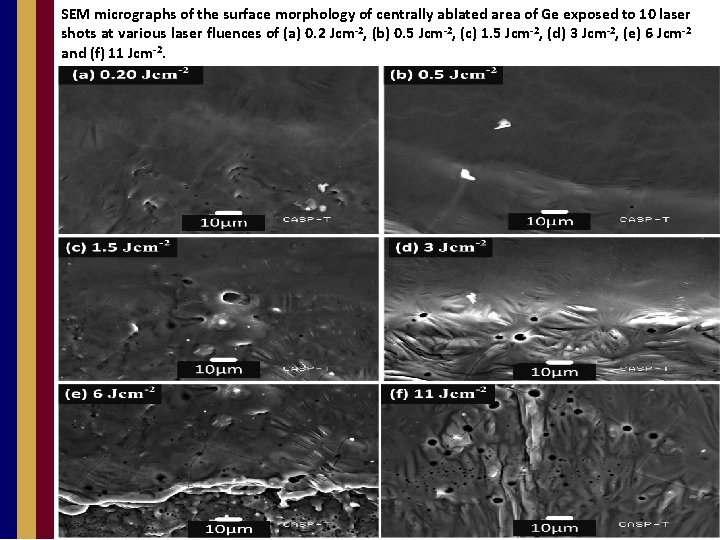
SEM micrographs of the surface morphology of centrally ablated area of Ge exposed to 10 laser shots at various laser fluences of (a) 0. 2 Jcm-2, (b) 0. 5 Jcm-2, (c) 1. 5 Jcm-2, (d) 3 Jcm-2, (e) 6 Jcm-2 and (f) 11 Jcm-2.
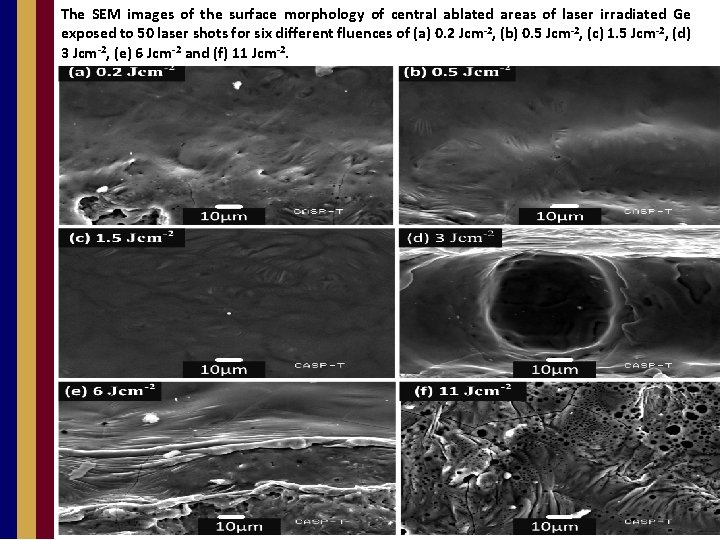
The SEM images of the surface morphology of central ablated areas of laser irradiated Ge exposed to 50 laser shots for six different fluences of (a) 0. 2 Jcm-2, (b) 0. 5 Jcm-2, (c) 1. 5 Jcm-2, (d) 3 Jcm-2, (e) 6 Jcm-2 and (f) 11 Jcm-2.
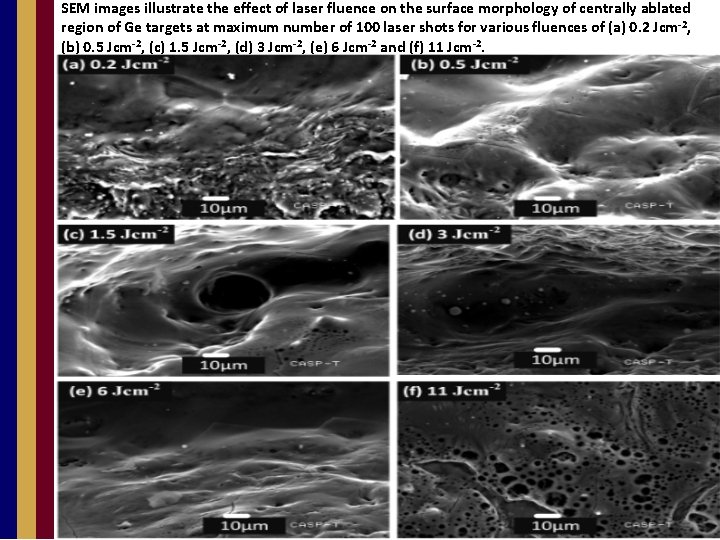
SEM images illustrate the effect of laser fluence on the surface morphology of centrally ablated region of Ge targets at maximum number of 100 laser shots for various fluences of (a) 0. 2 Jcm-2, (b) 0. 5 Jcm-2, (c) 1. 5 Jcm-2, (d) 3 Jcm-2, (e) 6 Jcm-2 and (f) 11 Jcm-2.
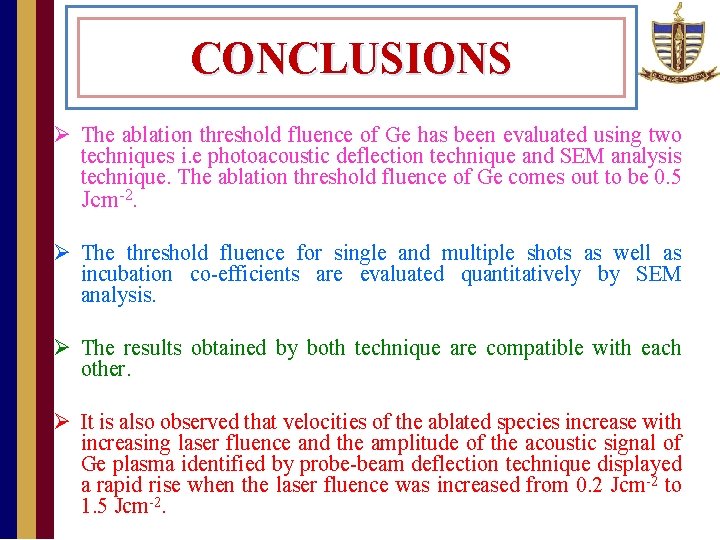
CONCLUSIONS Ø The ablation threshold fluence of Ge has been evaluated using two techniques i. e photoacoustic deflection technique and SEM analysis technique. The ablation threshold fluence of Ge comes out to be 0. 5 Jcm-2. Ø The threshold fluence for single and multiple shots as well as incubation co-efficients are evaluated quantitatively by SEM analysis. Ø The results obtained by both technique are compatible with each other. Ø It is also observed that velocities of the ablated species increase with increasing laser fluence and the amplitude of the acoustic signal of Ge plasma identified by probe-beam deflection technique displayed a rapid rise when the laser fluence was increased from 0. 2 Jcm-2 to 1. 5 Jcm-2.
Ø The significant effects of the incident laser fluence and number of laser-shots on the surface modification of Ge was investigated. Ø The formation of pores, winkles and cracks was observed on irradiated target. Laser fluence and number of pulses strongly influence the shape, size and growth of these structures.
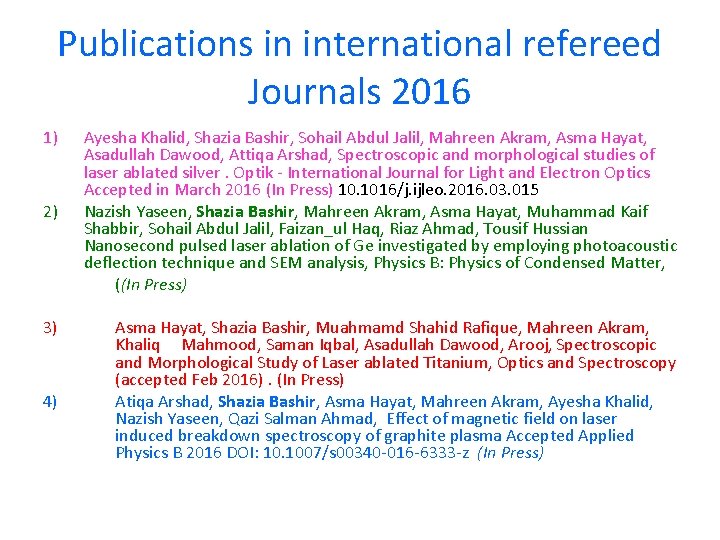
Publications in international refereed Journals 2016 1) 2) 3) 4) Ayesha Khalid, Shazia Bashir, Sohail Abdul Jalil, Mahreen Akram, Asma Hayat, Asadullah Dawood, Attiqa Arshad, Spectroscopic and morphological studies of laser ablated silver. Optik - International Journal for Light and Electron Optics Accepted in March 2016 (In Press) 10. 1016/j. ijleo. 2016. 03. 015 Nazish Yaseen, Shazia Bashir, Mahreen Akram, Asma Hayat, Muhammad Kaif Shabbir, Sohail Abdul Jalil, Faizan_ul Haq, Riaz Ahmad, Tousif Hussian Nanosecond pulsed laser ablation of Ge investigated by employing photoacoustic deflection technique and SEM analysis, Physics B: Physics of Condensed Matter, ((In Press) Asma Hayat, Shazia Bashir, Muahmamd Shahid Rafique, Mahreen Akram, Khaliq Mahmood, Saman Iqbal, Asadullah Dawood, Arooj, Spectroscopic and Morphological Study of Laser ablated Titanium, Optics and Spectroscopy (accepted Feb 2016). (In Press) Atiqa Arshad, Shazia Bashir, Asma Hayat, Mahreen Akram, Ayesha Khalid, Nazish Yaseen, Qazi Salman Ahmad, Effect of magnetic field on laser induced breakdown spectroscopy of graphite plasma Accepted Applied Physics B 2016 DOI: 10. 1007/s 00340 -016 -6333 -z (In Press)
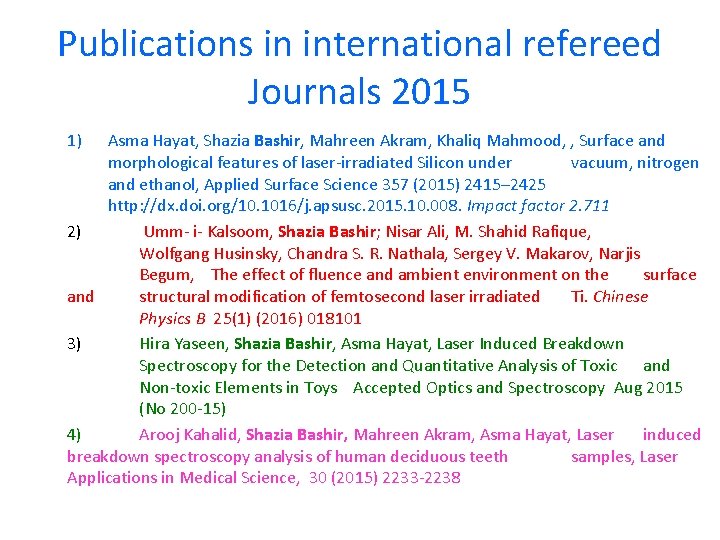
Publications in international refereed Journals 2015 1) Asma Hayat, Shazia Bashir, Mahreen Akram, Khaliq Mahmood, , Surface and morphological features of laser-irradiated Silicon under vacuum, nitrogen and ethanol, Applied Surface Science 357 (2015) 2415– 2425 http: //dx. doi. org/10. 1016/j. apsusc. 2015. 10. 008. Impact factor 2. 711 2) Umm- i- Kalsoom, Shazia Bashir; Nisar Ali, M. Shahid Rafique, Wolfgang Husinsky, Chandra S. R. Nathala, Sergey V. Makarov, Narjis Begum, The effect of fluence and ambient environment on the surface and structural modification of femtosecond laser irradiated Ti. Chinese Physics B 25(1) (2016) 018101 3) Hira Yaseen, Shazia Bashir, Asma Hayat, Laser Induced Breakdown Spectroscopy for the Detection and Quantitative Analysis of Toxic and Non-toxic Elements in Toys Accepted Optics and Spectroscopy Aug 2015 (No 200 -15) 4) Arooj Kahalid, Shazia Bashir, Mahreen Akram, Asma Hayat, Laser induced breakdown spectroscopy analysis of human deciduous teeth samples, Laser Applications in Medical Science, 30 (2015) 2233 -2238
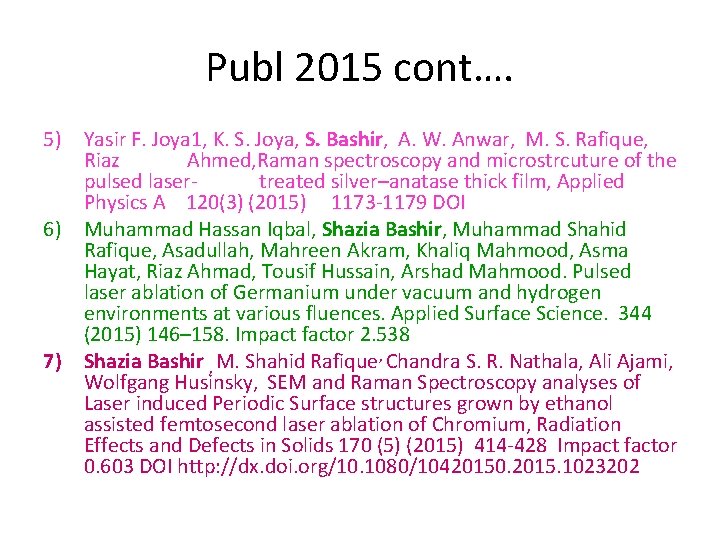
Publ 2015 cont…. 5) Yasir F. Joya 1, K. S. Joya, S. Bashir, A. W. Anwar, M. S. Rafique, Riaz Ahmed, Raman spectroscopy and microstrcuture of the pulsed lasertreated silver–anatase thick film, Applied Physics A 120(3) (2015) 1173 -1179 DOI 6) Muhammad Hassan Iqbal, Shazia Bashir, Muhammad Shahid Rafique, Asadullah, Mahreen Akram, Khaliq Mahmood, Asma Hayat, Riaz Ahmad, Tousif Hussain, Arshad Mahmood. Pulsed laser ablation of Germanium under vacuum and hydrogen environments at various fluences. Applied Surface Science. 344 (2015) 146– 158. Impact factor 2. 538 7) Shazia Bashir , M. Shahid Rafique, Chandra S. R. Nathala, Ali Ajami, Wolfgang Husinsky, SEM and Raman Spectroscopy analyses of Laser induced Periodic Surface structures grown by ethanol assisted femtosecond laser ablation of Chromium, Radiation Effects and Defects in Solids 170 (5) (2015) 414 -428 Impact factor 0. 603 DOI http: //dx. doi. org/10. 1080/10420150. 2015. 1023202
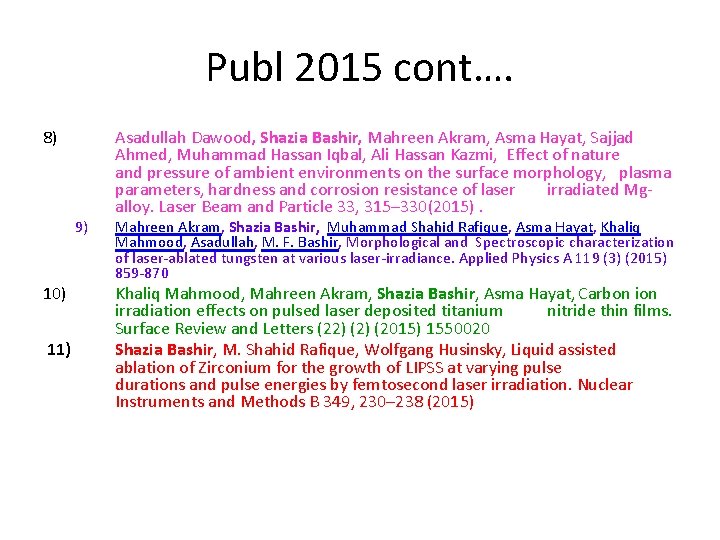
Publ 2015 cont…. 8) 9) 10) 11) Asadullah Dawood, Shazia Bashir, Mahreen Akram, Asma Hayat, Sajjad Ahmed, Muhammad Hassan Iqbal, Ali Hassan Kazmi, Effect of nature and pressure of ambient environments on the surface morphology, plasma parameters, hardness and corrosion resistance of laser irradiated Mgalloy. Laser Beam and Particle 33, 315– 330(2015). Mahreen Akram, Shazia Bashir, Muhammad Shahid Rafique, Asma Hayat, Khaliq Mahmood, Asadullah, M. F. Bashir, Morphological and Spectroscopic characterization of laser-ablated tungsten at various laser-irradiance. Applied Physics A 119 (3) (2015) 859 -870 Khaliq Mahmood, Mahreen Akram, Shazia Bashir, Asma Hayat, Carbon irradiation effects on pulsed laser deposited titanium nitride thin films. Surface Review and Letters (22) (2015) 1550020 Shazia Bashir, M. Shahid Rafique, Wolfgang Husinsky, Liquid assisted ablation of Zirconium for the growth of LIPSS at varying pulse durations and pulse energies by femtosecond laser irradiation. Nuclear Instruments and Methods B 349, 230– 238 (2015)
Publ 2015 cont……………. . 12) Shahbaz Ahmad, Shazia Bashir, Daniel Yousaf, Nisar Ali, Tousif Hussain, Surface Analysis Correlated with Structural and Mechanical Properties of Laser Irradiated Brass Materials Sciences and Applications, 6 (2015) 23 - 32. 13) Shazia Bashir, Shazaib Khurshid, Nisar Ali, Umm-i-Kalsoom, Shahbaz Ahmad, Mahreen Akram, Daniel Yousaf, Khushboo Zehra “Pulsed Laser ablation of Ni under ambient environment of vacuum and N 2 for various fluences” Quantum Electronics 45 (7) 640 – 647 (2015) DOI: 10. 1070/QE 2015 v 045 n 07 ABEH 000000 14) Nisar Ali, Shazia Bashir, Umm-i-Kalsoom, Daniel Yousaf, Shahbaz Ahmad “Effect of laser pulses on the surface and structural modification of ablated titanium in a liquid confined environment” Radiation effects and Defects in Solids 170 ( 2) (2015) 121– 129 doi: http: //dx. doi. org/10. 1080/10420150. 2014. 998672
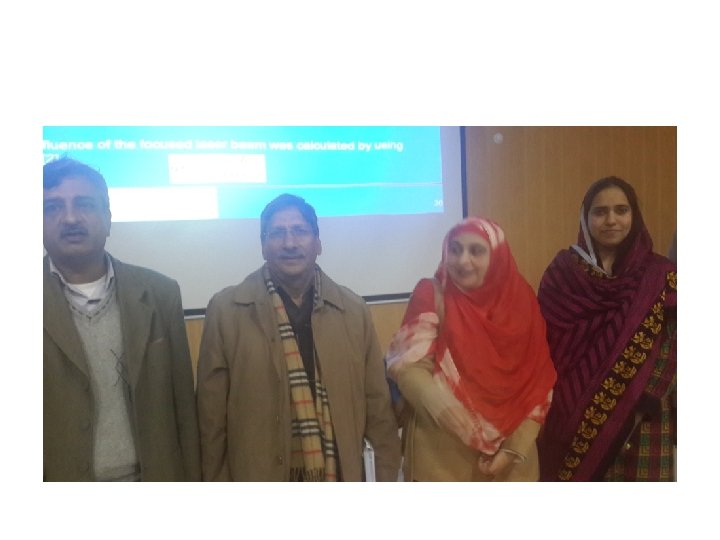
Graduates • Two Ph. D; s in 2015 • Two Ph. D; s have submitted their theses in 2015
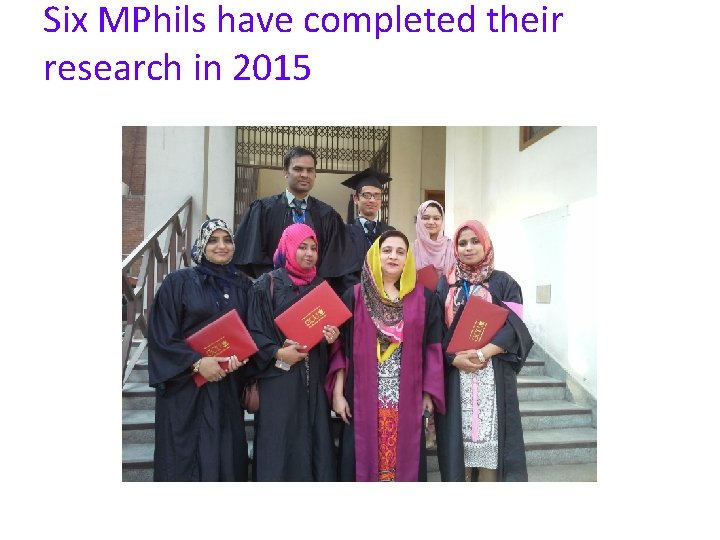
Six MPhils have completed their research in 2015
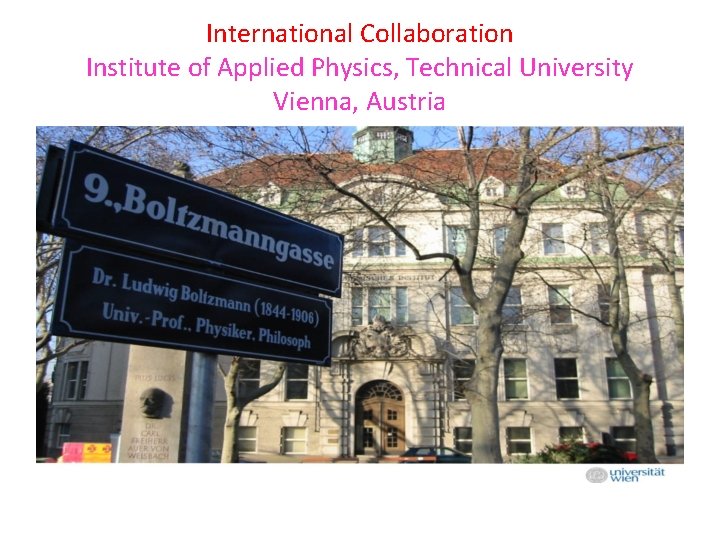
International Collaboration Institute of Applied Physics, Technical University Vienna, Austria
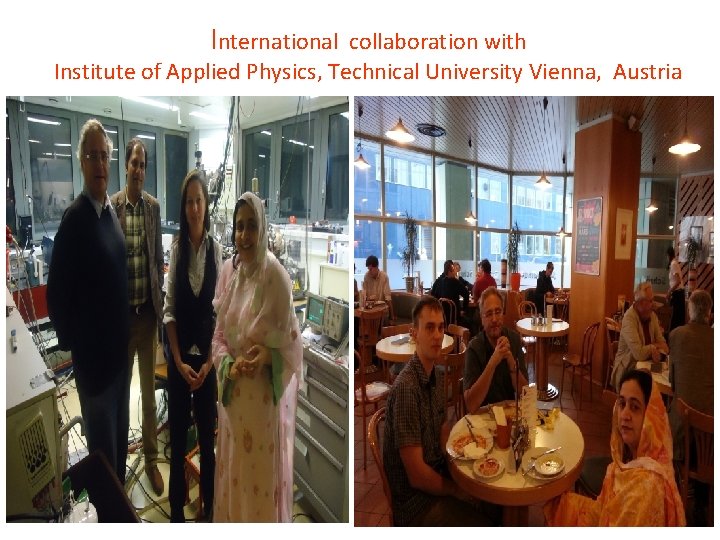
International collaboration with Institute of Applied Physics, Technical University Vienna, Austria
ACKNOWLEDGEMENT We are grateful to Professor Dr. Riaz Ahmad for providing all the lab facilities. We are thankful to Higher Education Commission (HEC) for funding the project of upgradation of lab facilities.
- Slides: 59