
PULSED ELECTRIC FIELD NON THERMAL PROCESSING Producing fresh

- Slides: 7
PULSED ELECTRIC FIELD
NON THERMAL PROCESSING • Producing fresh like foods by replacing thermal treatments. • Produces minimally processed foods with fresh quality an higher nutritive because of color and flavor retention. • Examples ohmic heating microwave hating ultrasonication PULSED ELECTRIC FIELD
WHAT IS PULSE ELECTRIC FIELD 1. Pulsed electric field uses short electric pulses to preserve food. 2. PEF is an innovative and promising method for non – thermal processing of food 3. It is one of the most appealing technology due to - short treatment time. - energy lost is minimized during hating of food -for fresh like characteristics of food, along with high sensorial quality and nutrient content. 4. It is suitable for preserving liquid and semi liquid foods removing microorganisms and producing functional constituents.
THEORY Various theories of microbial inactivation have been propounded to explain the actual mechanism of killing microorganisms by PEFs. 1) Transmembrane potential (TMP) : It is the difference in potential between bacterial cell and its external environment. TMP of cell is 1 volt. 2) Dielectric Rupture : It is based on the difference in dielectric constant between cell and foods (60 – 80) which causes cell inactivation. When TMP crosses a critical value repulsion between charged molecules forms pores in the bacterial cell membrane, increase cell permeability through which all the cell sap comes out and cell dies. 3) Viscolastic Effect : The ability of a cell to withstand forces to which it is subjected to is referred as viscoelasticity. When electro compressive force > viscoelastic force, the cell membrane ruptures and pores are formed through which cell sap flows out and bacteria dies. 4) Electroporation : Electroporation of cell membrane occurs due to denaturation of proteins or gelatinization of dipolar lipids in the cell membranes due to joule heating.
5) Electro Mechanical Instability : Application of high intensity PEF subjects cells to considerably higher electrical and mechanical forces, which causes cell inactivation 6) Fluid Mosaic Arrangement : When electric fields are applied, a dipolar reorientation in phospholipid structure of the orderly structured arrangement in the cell membrane occurs, which leads to cell inactivation. 7) Osmotic Swelling : Cell inactivation is a result of osmotic imbalance across cell membrane induced by electroporation. 8) Other Theories : Some other theories discuss enzyme inactivation in a cell, oxidative reactions and conformational change in tertiary structure of proteins promoting aggregation in cell membranes.
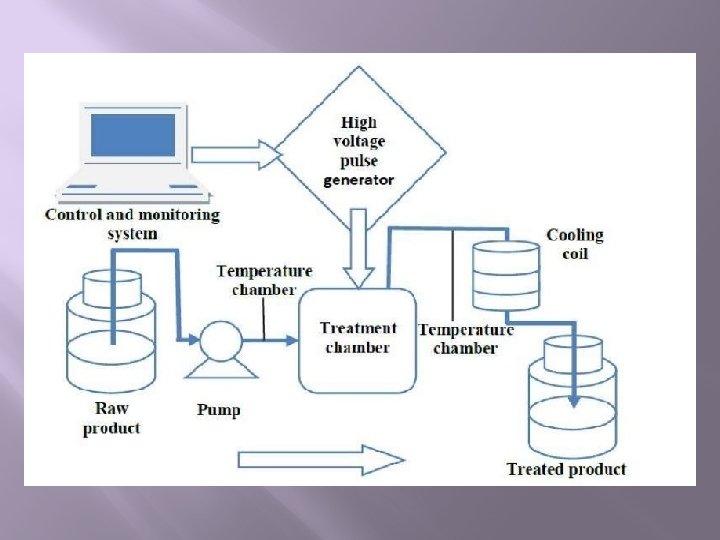
PEF PROCESS PEF systems are designed for both batch process and continuous process. 1. Duration and bubble inhibition unit prior to treatment chamber should be provided to avoid dielectric breakdown causing a decrease in process efficiency. 2. Do not let the food temperature increase to avoid electric resistance heating or ohmic heating. 3. PEF energy should b high enough (short duration high voltage) for achieving satisfactory inactivation. 4. Impurities are separated before PEF processing as they may lead to dielectric breakdown. 5. In continuous systems electrical and flow parameters are selected in such a manner that each unit volume of food is subjected to a specific degree of treatment achieving satisfactory degree of microbial inactivation.