
Pulse Transit Time Measuring Device Team Jonathan Baran
Pulse Transit Time Measuring Device Team: Jonathan Baran, Karen Chen, William Stanford, Mark Yarmarkovich University of Wisconsin. Madison BME 200/300 October 20, 2006

Intellectual Property n n n All information provided by individuals or Design Project Groups during this or subsequent presentations is the property of the University and of the researchers presenting this information. In addition, any information provided herein may include results sponsored by and provided to a member company of the Biomedical Engineering Student Design Consortium (SDC). The above information may include intellectual property rights belonging to the University to which the SDC may have license rights. Anyone to whom this information is disclosed: 1) Agrees to use this information solely for purposes related to this review; 2) Agrees not to use this information for any other purpose unless approved in advance by the Project Group, the Client / SDC, and the Advisor; 3) Agrees to keep this information in confidence until the University and the relevant parties listed in Part (2) above have evaluated and secured any applicable intellectual property rights in this information; 4) Acknowledges that worldwide patent rights are waived if publication or public dissemination occur prior to filing a corresponding U. S. provisional or utility patent application.

Client: Dr. Christopher Green Department of Pedatrics Advisor: Wally Block Associate Professor Department of Biomedical Engineering
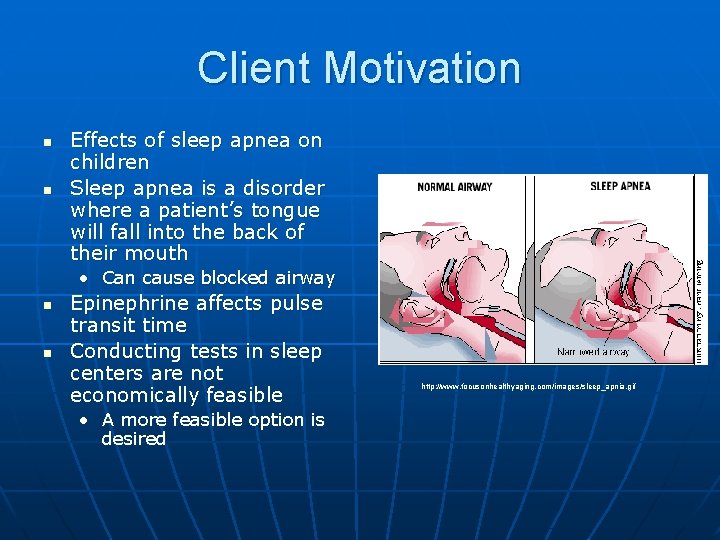
Client Motivation n n Effects of sleep apnea on children Sleep apnea is a disorder where a patient’s tongue will fall into the back of their mouth • Can cause blocked airway n n Epinephrine affects pulse transit time Conducting tests in sleep centers are not economically feasible • A more feasible option is desired http: //www. focusonhealthyaging. com/images/sleep_apnia. gif
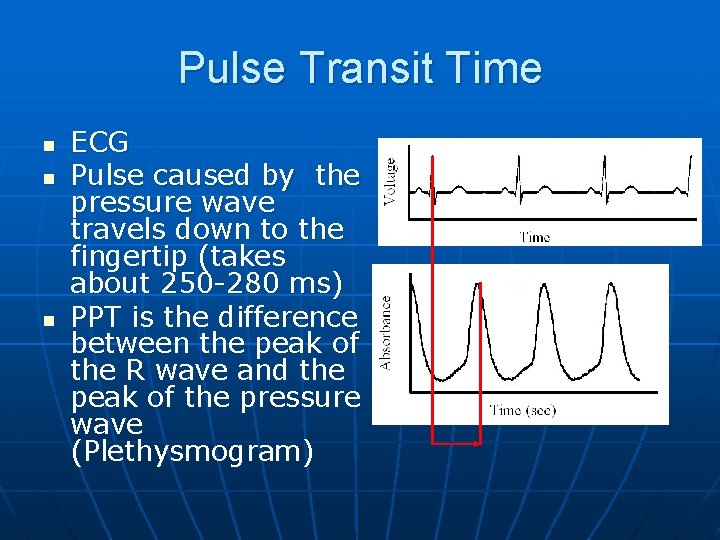
Pulse Transit Time n n n ECG Pulse caused by the pressure wave travels down to the fingertip (takes about 250 -280 ms) PPT is the difference between the peak of the R wave and the peak of the pressure wave (Plethysmogram)
Problem Statement Current instruments used in the measurement of pulse transit time are inefficient for home use. An existing product with working ECG and pulse wave circuits along with software to analyze the data has been provided. The primary goal will be to optimize the existing setup for use at home. This will be performed by miniaturizing the circuit, improving the signal to noise ratio, and improving of the already existing software. These tasks will attempt to be rectified by numerous design additions.

Specifications n n n Finger probe (uses LED 805 nm) Circuits to magnify detected voltages Power supply to run for up to 10 hours Peak detection of ECG (QRS complex) and plethsymograph waves (finger tip) Reduced wires Small, portable device http: //www. susquemicro. com/image/probes/smi_refurb. jpg

Existing Device Setup ECG Circuit Laptop Computer Labview Program DAQ Plethysmogram Circuit User Display
Existing Setup: Pros/Cons n n Pros • Data stored directly on computer • Analyzed immediately after collection Cons • Bulky • Restricts patient movement in sleep • Cords detach during sleep • High noise levels • Imperfect software
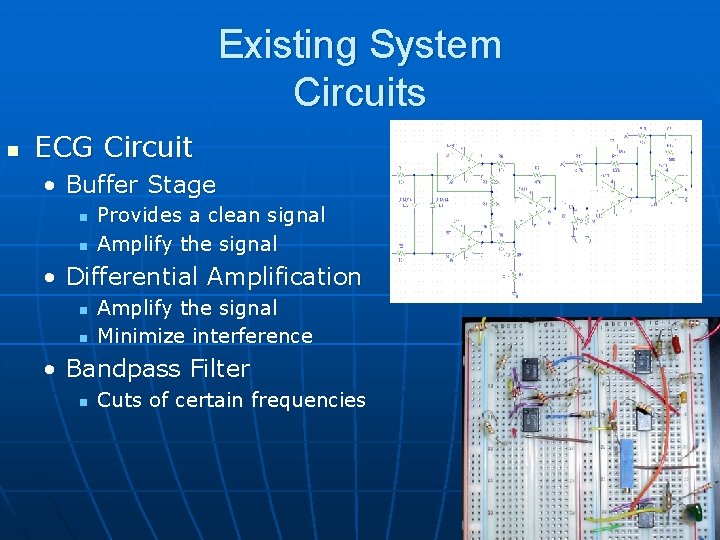
Existing System Circuits n ECG Circuit • Buffer Stage n n Provides a clean signal Amplify the signal • Differential Amplification n n Amplify the signal Minimize interference • Bandpass Filter n Cuts of certain frequencies
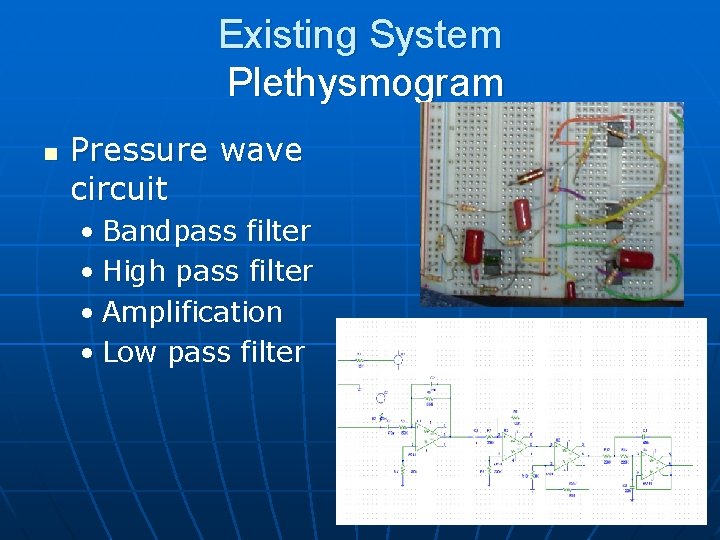
Existing System Plethysmogram n Pressure wave circuit • Bandpass filter • High pass filter • Amplification • Low pass filter
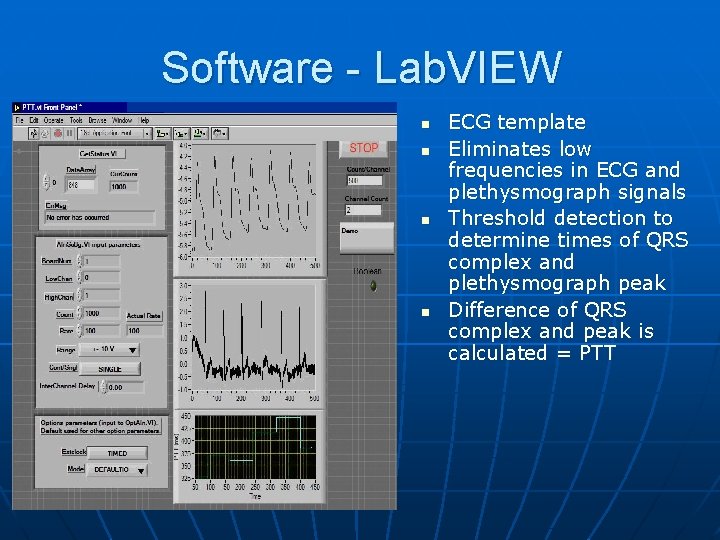
Software - Lab. VIEW n n ECG template Eliminates low frequencies in ECG and plethysmograph signals Threshold detection to determine times of QRS complex and plethysmograph peak Difference of QRS complex and peak is calculated = PTT
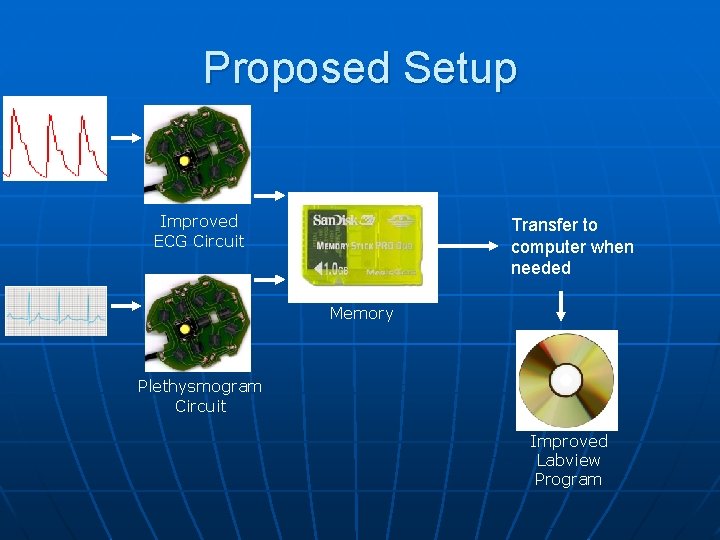
Proposed Setup Improved ECG Circuit Transfer to computer when needed Memory Plethysmogram Circuit Improved Labview Program
Proposed Setup: Pros/Cons Memory Addition n Pros • Small and wearable • Eliminates bedside computer • No restriction of movement n Cons • No immediate permanent data storage • No immediate analysis
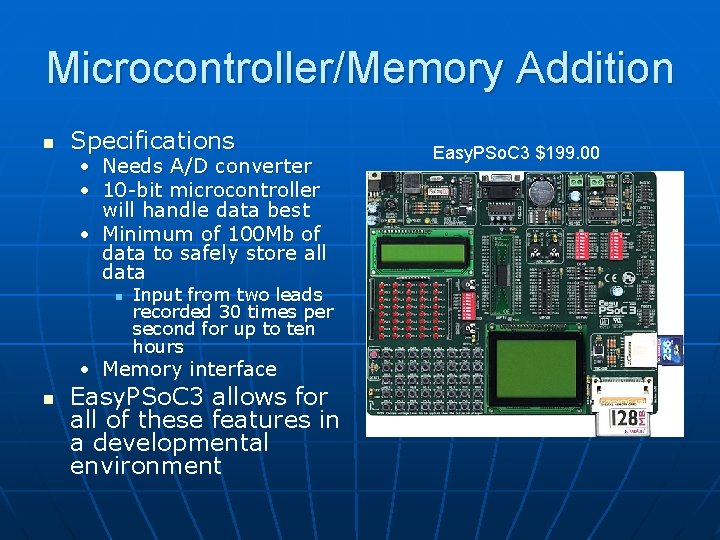
Microcontroller/Memory Addition n Specifications • Needs A/D converter • 10 -bit microcontroller will handle data best • Minimum of 100 Mb of data to safely store all data n Input from two leads recorded 30 times per second for up to ten hours • Memory interface n Easy. PSo. C 3 allows for all of these features in a developmental environment Easy. PSo. C 3 $199. 00
Pros of Additional Modifications Improved ECG circuit n Reduce noise in the circuit n Miniaturize circuit How will this be done? n Addition of an instrumentation amplifier • Reduces noise by combining many parts of the circuit into one Improved Lab. VIEW software Allow for more accurate measurements How will this be done? n Programming of the software to account for skipped beats n
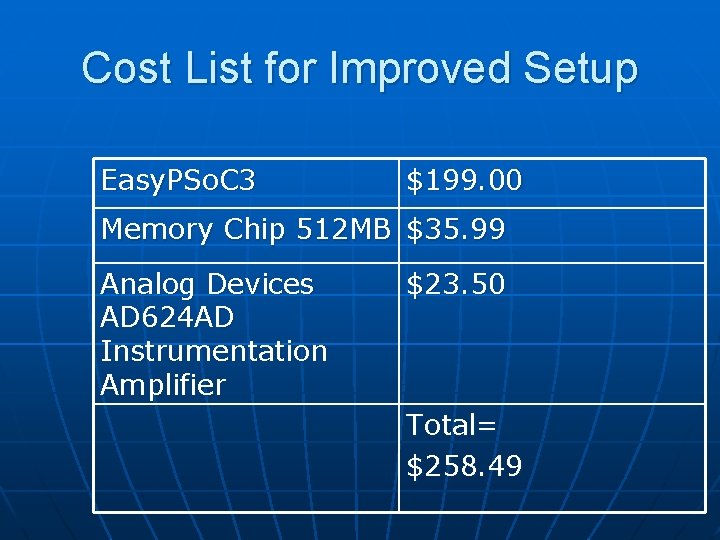
Cost List for Improved Setup Easy. PSo. C 3 $199. 00 Memory Chip 512 MB $35. 99 Analog Devices AD 624 AD Instrumentation Amplifier $23. 50 Total= $258. 49
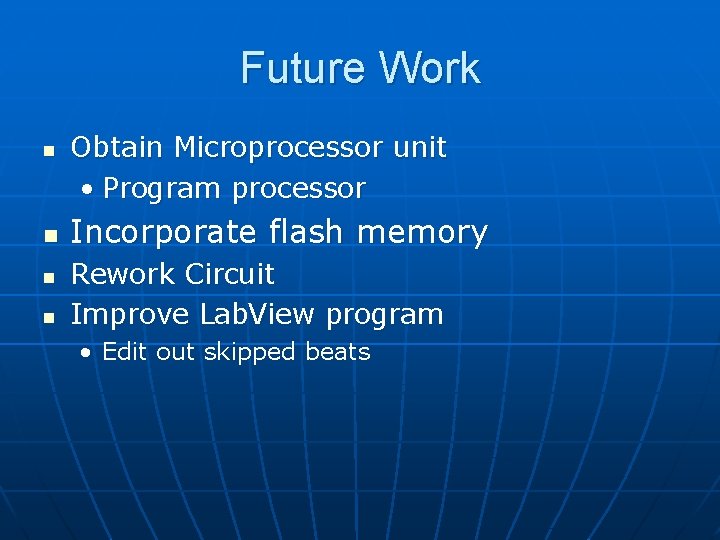
Future Work n n Obtain Microprocessor unit • Program processor Incorporate flash memory Rework Circuit Improve Lab. View program • Edit out skipped beats
References n n http: //www. sciam. com/article. cfm? article. ID=000 C 74 E 4 -5172 -1 C 749 B 81809 EC 588 EF 21&page. Number=1&cat. ID=2 http: //www. focusonhealthyaging. com/images/sleep_apnia. gif http: //www. susquemicro. com/image/probes/smi_refurb. jpg www. wikipedia. com

Questions?
- Slides: 20