
Pulse Oximetry Screening UK Survey and BWH Experience
Pulse Oximetry Screening: UK Survey and BWH Experience Quad Network Study Day Anju Singh, SV Rasiah, Andy Ewer 29/11/2012
Neonatal pulse oximetry screening: a national survey. Kang et al. Arch Dis Child Fetal Neonatal Ed 2011; 96: F 312 7% routine use of pulse oximetry to supplement postnatal examination
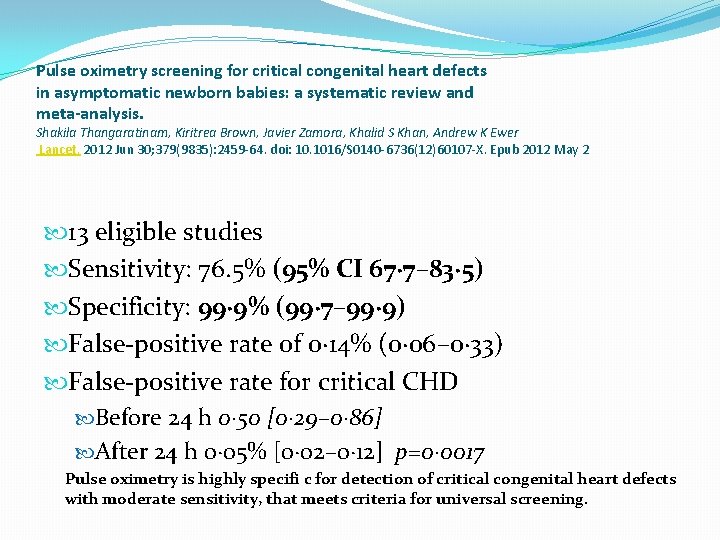
Pulse oximetry screening for critical congenital heart defects in asymptomatic newborn babies: a systematic review and meta-analysis. Shakila Thangaratinam, Kiritrea Brown, Javier Zamora, Khalid S Khan, Andrew K Ewer Lancet. 2012 Jun 30; 379(9835): 2459 -64. doi: 10. 1016/S 0140 -6736(12)60107 -X. Epub 2012 May 2 13 eligible studies Sensitivity: 76. 5% (95% CI 67· 7– 83· 5) Specificity: 99· 9% (99· 7– 99· 9) False-positive rate of 0· 14% (0· 06– 0· 33) False-positive rate for critical CHD Before 24 h 0· 50 [0· 29– 0· 86] After 24 h 0· 05% [0· 02– 0· 12] p=0· 0017 Pulse oximetry is highly specifi c for detection of critical congenital heart defects with moderate sensitivity, that meets criteria for universal screening.
Pulse Oximetry Screening for critical congenital heart defects: A UK national survey Singh A , Ewer A Who does the Routine Screening? Who intends to do it? Who doesn’t? Anticipated Barriers?
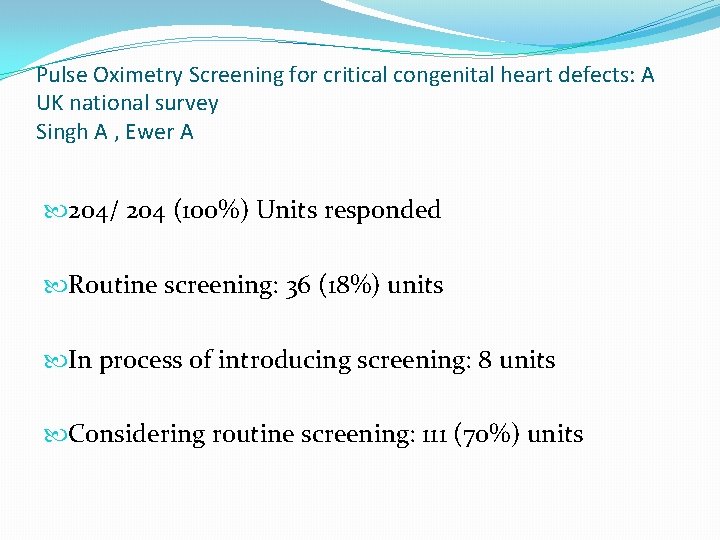
Pulse Oximetry Screening for critical congenital heart defects: A UK national survey Singh A , Ewer A 204/ 204 (100%) Units responded Routine screening: 36 (18%) units In process of introducing screening: 8 units Considering routine screening: 111 (70%) units
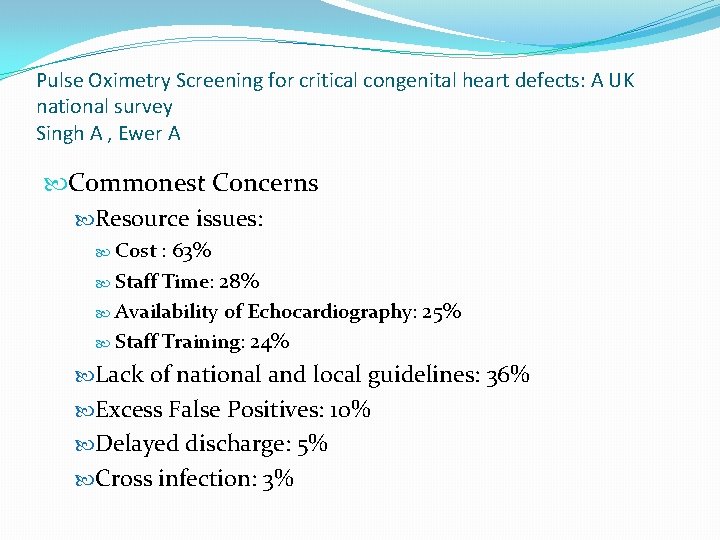
Pulse Oximetry Screening for critical congenital heart defects: A UK national survey Singh A , Ewer A Commonest Concerns Resource issues: Cost : 63% Staff Time: 28% Availability of Echocardiography: 25% Staff Training: 24% Lack of national and local guidelines: 36% Excess False Positives: 10% Delayed discharge: 5% Cross infection: 3%
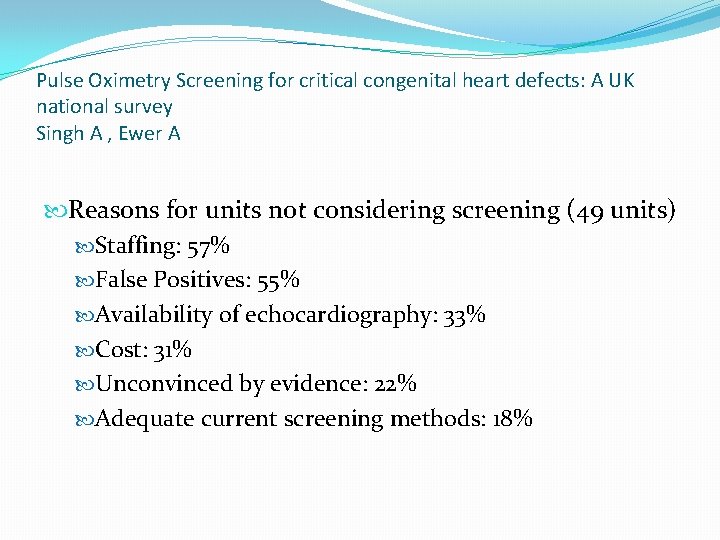
Pulse Oximetry Screening for critical congenital heart defects: A UK national survey Singh A , Ewer A Reasons for units not considering screening (49 units) Staffing: 57% False Positives: 55% Availability of echocardiography: 33% Cost: 31% Unconvinced by evidence: 22% Adequate current screening methods: 18%
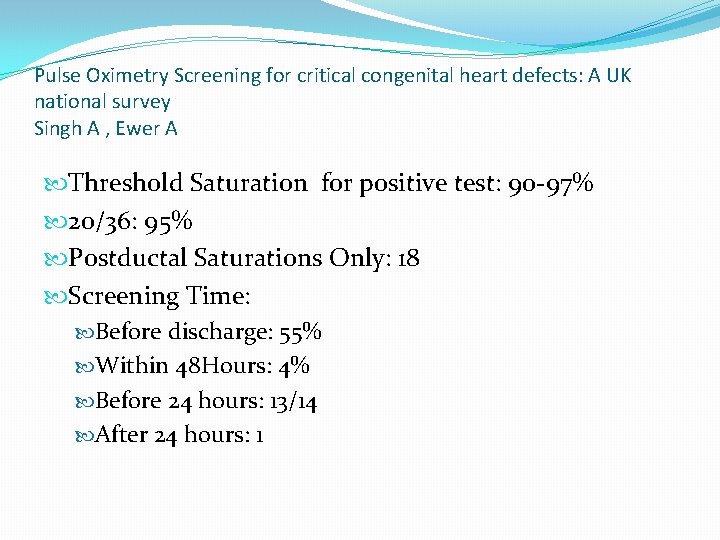
Pulse Oximetry Screening for critical congenital heart defects: A UK national survey Singh A , Ewer A Threshold Saturation for positive test: 90 -97% 20/36: 95% Postductal Saturations Only: 18 Screening Time: Before discharge: 55% Within 48 Hours: 4% Before 24 hours: 13/14 After 24 hours: 1
Pulse Oximetry Screening for critical congenital heart defects: A UK national survey Singh A , Ewer A Conclusion Shift of opinion of among UK Neonatologists regarding pulse oximetry screening with a significant majority now in favour, albeit with some reservations
The impact of pre- discharge pulse oximetry screening in a Regional Neonatal unit Singh A, Rasiah SV, Ewer A To evaluate the impact of routine pulse oximetry screening on the rate of unexpected admissions and need for echocardiography. To review the outcomes of babies admitted as a result of positive pulse oximetry screening.
Routine pre-discharge pulse oximetry screening at BWH Pre and postductal Sats Abnormal Test: <95% or a difference of >2% Expedited Clinical Examination Repeat Pulse Ox in 1 -2 hrs Test Positive 2 abnormal pulse ox readings 1 abnormal pulse ox reading + abnormal Clinical Exam
Methods Retrospective review of all unexpected admissions to the unit April’ 10 –March’ 12 Review of Indication for admission Clinical diagnosis Management Outcome
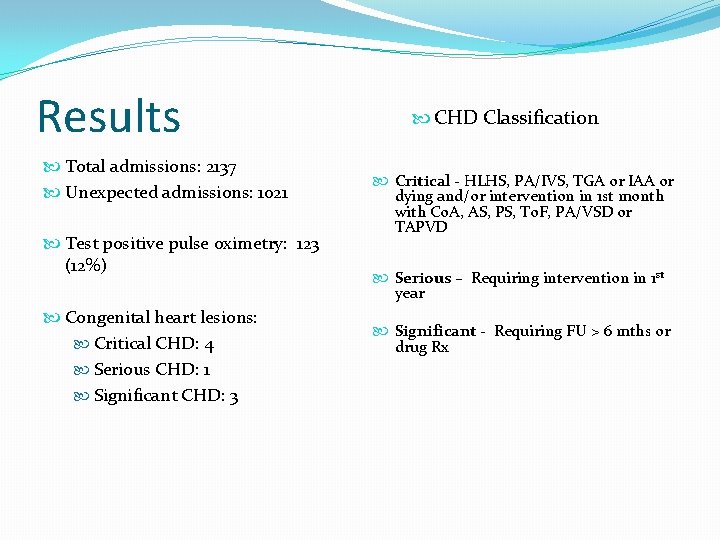
Results Total admissions: 2137 Unexpected admissions: 1021 Test positive pulse oximetry: 123 (12%) Congenital heart lesions: Critical CHD: 4 Serious CHD: 1 Significant CHD: 3 CHD Classification Critical - HLHS, PA/IVS, TGA or IAA or dying and/or intervention in 1 st month with Co. A, AS, PS, To. F, PA/VSD or TAPVD Serious – Requiring intervention in 1 st year Significant - Requiring FU > 6 mths or drug Rx
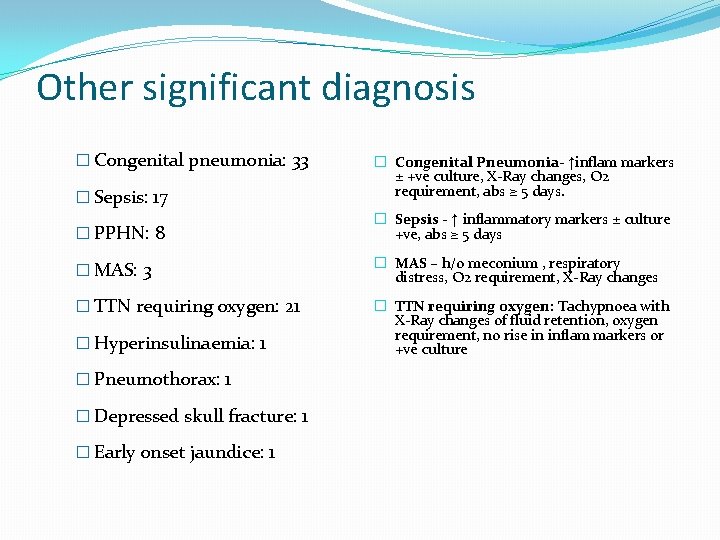
Other significant diagnosis � Congenital pneumonia: 33 � Sepsis: 17 � Congenital Pneumonia- ↑inflam markers ± +ve culture, X-Ray changes, O 2 requirement, abs ≥ 5 days. � PPHN: 8 � Sepsis - ↑ inflammatory markers ± culture +ve, abs ≥ 5 days � MAS: 3 � MAS – h/o meconium , respiratory distress, O 2 requirement, X-Ray changes � TTN requiring oxygen: 21 � TTN requiring oxygen: Tachypnoea with X-Ray changes of fluid retention, oxygen requirement, no rise in inflam markers or +ve culture � Hyperinsulinaemia: 1 � Pneumothorax: 1 � Depressed skull fracture: 1 � Early onset jaundice: 1
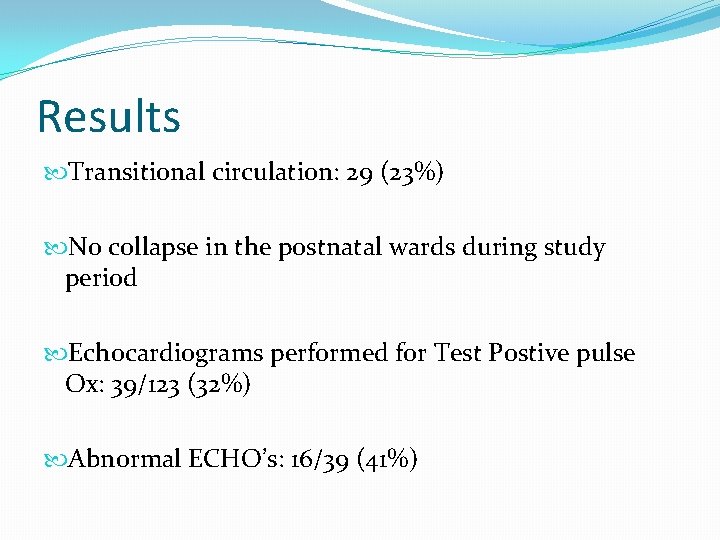
Results Transitional circulation: 29 (23%) No collapse in the postnatal wards during study period Echocardiograms performed for Test Postive pulse Ox: 39/123 (32%) Abnormal ECHO’s: 16/39 (41%)
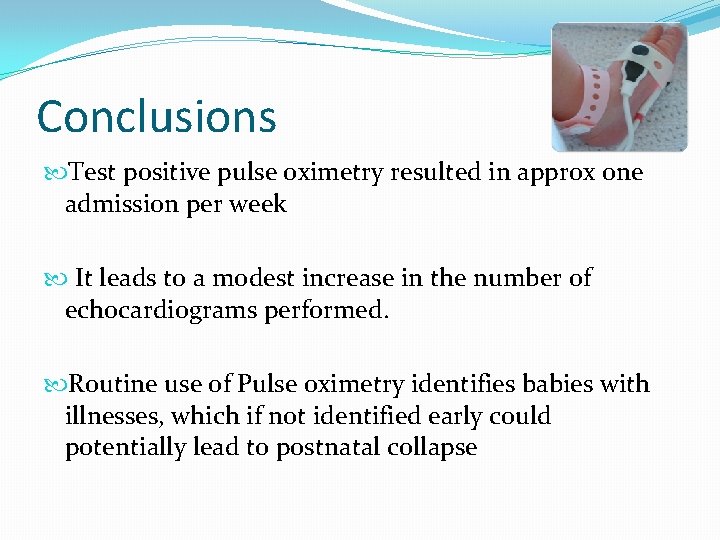
Conclusions Test positive pulse oximetry resulted in approx one admission per week It leads to a modest increase in the number of echocardiograms performed. Routine use of Pulse oximetry identifies babies with illnesses, which if not identified early could potentially lead to postnatal collapse
References Ewer AK, et al. Pulse oximetry as a screening test for congenital heart defects in newborn infants: the Pulse. Ox test accuracy study. The Lancet 2011 Aug 27; 378(9793): 785 -94. Kang et al. Neonatal pulse oximetry screening: a national survey. Arch Dis Child Fetal Neonatal Ed 2011; 96: F 312.
- Slides: 17