
Pulse Dampener Size Analysis Part I Required Compliant
- Slides: 15
Pulse Dampener Size Analysis Part I - Required Compliant Gas Volume Calculation Part II - Additional Attenuation Using a Series Flow Resistance Craig E. Nelson - Consultant Engineer Nelson Research, Inc. 2142 – N. 88 th St. Seattle, WA. 98103 USA 206 -498 -9447 Craigmail @ aol. com
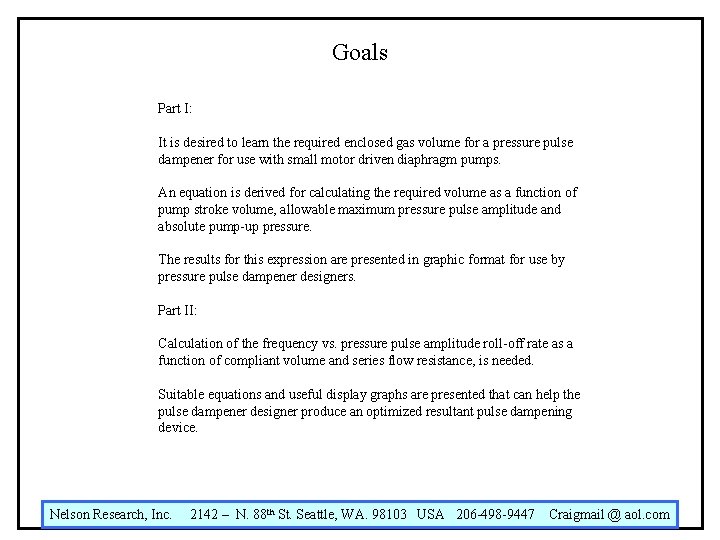
Goals Part I: It is desired to learn the required enclosed gas volume for a pressure pulse dampener for use with small motor driven diaphragm pumps. An equation is derived for calculating the required volume as a function of pump stroke volume, allowable maximum pressure pulse amplitude and absolute pump-up pressure. The results for this expression are presented in graphic format for use by pressure pulse dampener designers. Part II: Calculation of the frequency vs. pressure pulse amplitude roll-off rate as a function of compliant volume and series flow resistance, is needed. Suitable equations and useful display graphs are presented that can help the pulse dampener designer produce an optimized resultant pulse dampening device. Nelson Research, Inc. 2142 – N. 88 th St. Seattle, WA. 98103 USA 206 -498 -9447 Craigmail @ aol. com
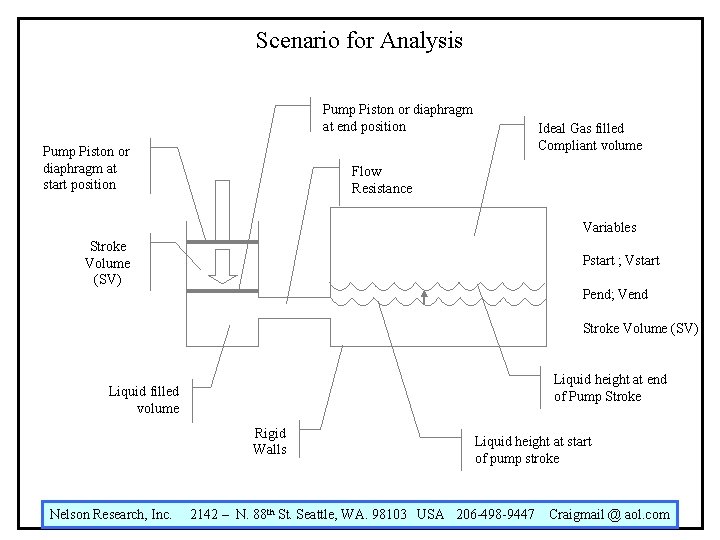
Scenario for Analysis Pump Piston or diaphragm at end position Pump Piston or diaphragm at start position Ideal Gas filled Compliant volume Flow Resistance Variables Stroke Volume (SV) Pstart ; Vstart Pend; Vend Stroke Volume (SV) Liquid height at end of Pump Stroke Liquid filled volume Rigid Walls Nelson Research, Inc. Liquid height at start of pump stroke 2142 – N. 88 th St. Seattle, WA. 98103 USA 206 -498 -9447 Craigmail @ aol. com
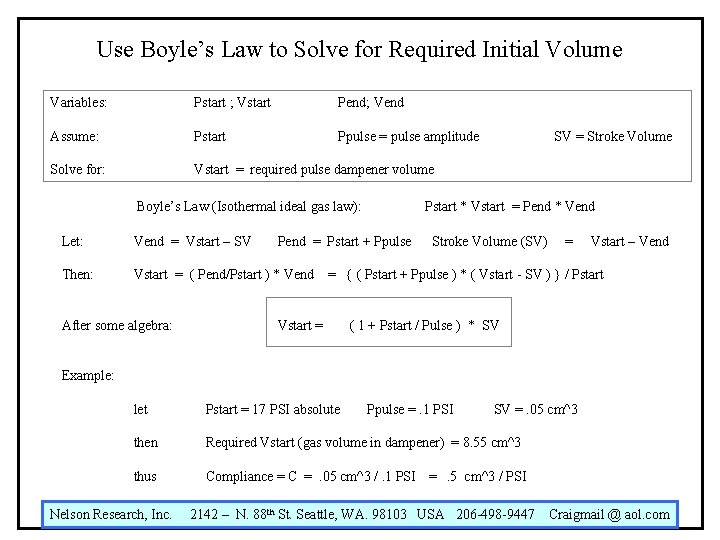
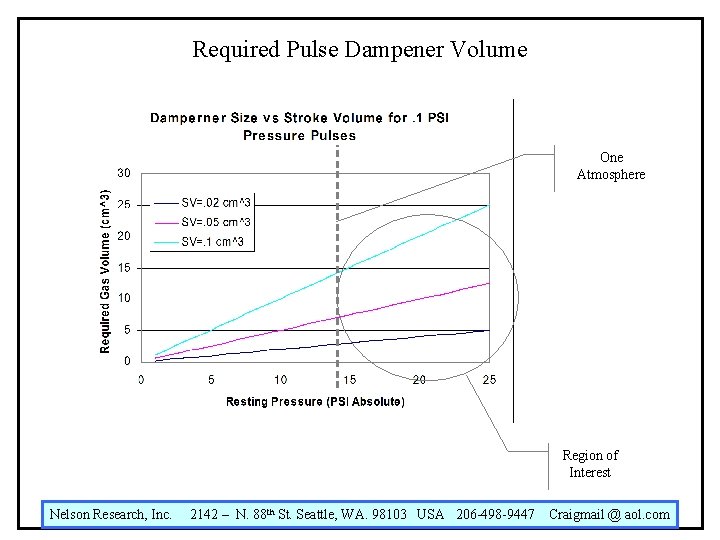
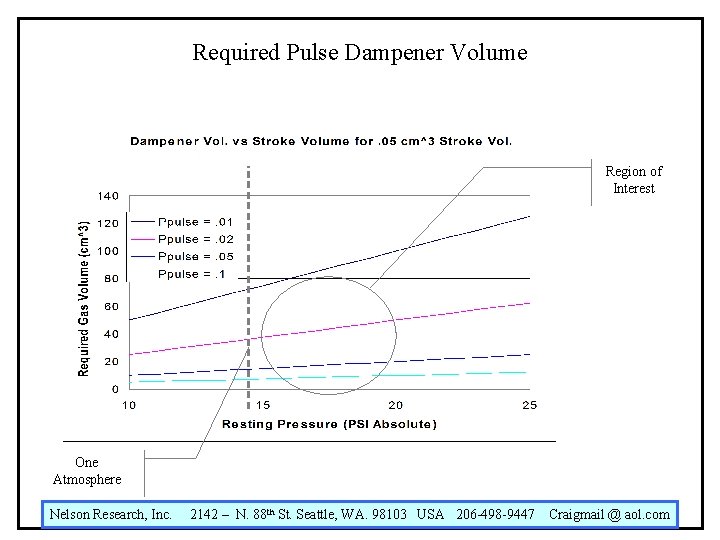
Use Boyle’s Law to Solve for Required Initial Volume Variables: Pstart ; Vstart Pend; Vend Assume: Pstart Ppulse = pulse amplitude Solve for: Vstart = required pulse dampener volume Boyle’s Law (Isothermal ideal gas law): SV = Stroke Volume Pstart * Vstart = Pend * Vend Let: Vend = Vstart – SV Then: Vstart = ( Pend/Pstart ) * Vend = { ( Pstart + Ppulse ) * ( Vstart - SV ) } / Pstart After some algebra: Pend = Pstart + Ppulse Vstart = Stroke Volume (SV) = Vstart – Vend ( 1 + Pstart / Pulse ) * SV Example: let Pstart = 17 PSI absolute then Required Vstart (gas volume in dampener) = 8. 55 cm^3 thus Compliance = C =. 05 cm^3 /. 1 PSI =. 5 cm^3 / PSI Nelson Research, Inc. Ppulse =. 1 PSI SV =. 05 cm^3 2142 – N. 88 th St. Seattle, WA. 98103 USA 206 -498 -9447 Craigmail @ aol. com
Required Pulse Dampener Volume One Atmosphere Region of Interest Nelson Research, Inc. 2142 – N. 88 th St. Seattle, WA. 98103 USA 206 -498 -9447 Craigmail @ aol. com
Required Pulse Dampener Volume Region of Interest One Atmosphere Nelson Research, Inc. 2142 – N. 88 th St. Seattle, WA. 98103 USA 206 -498 -9447 Craigmail @ aol. com
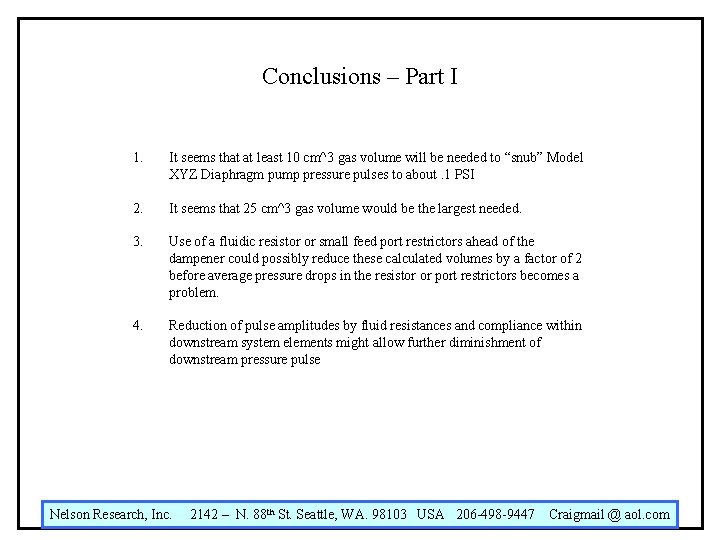
Conclusions – Part I 1. It seems that at least 10 cm^3 gas volume will be needed to “snub” Model XYZ Diaphragm pump pressure pulses to about. 1 PSI 2. It seems that 25 cm^3 gas volume would be the largest needed. 3. Use of a fluidic resistor or small feed port restrictors ahead of the dampener could possibly reduce these calculated volumes by a factor of 2 before average pressure drops in the resistor or port restrictors becomes a problem. 4. Reduction of pulse amplitudes by fluid resistances and compliance within downstream system elements might allow further diminishment of downstream pressure pulse Nelson Research, Inc. 2142 – N. 88 th St. Seattle, WA. 98103 USA 206 -498 -9447 Craigmail @ aol. com
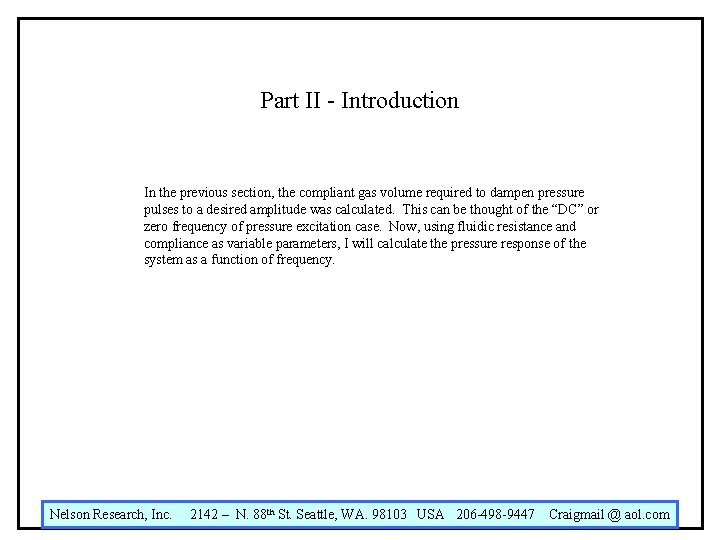
Part II - Introduction In the previous section, the compliant gas volume required to dampen pressure pulses to a desired amplitude was calculated. This can be thought of the “DC” or zero frequency of pressure excitation case. Now, using fluidic resistance and compliance as variable parameters, I will calculate the pressure response of the system as a function of frequency. Nelson Research, Inc. 2142 – N. 88 th St. Seattle, WA. 98103 USA 206 -498 -9447 Craigmail @ aol. com
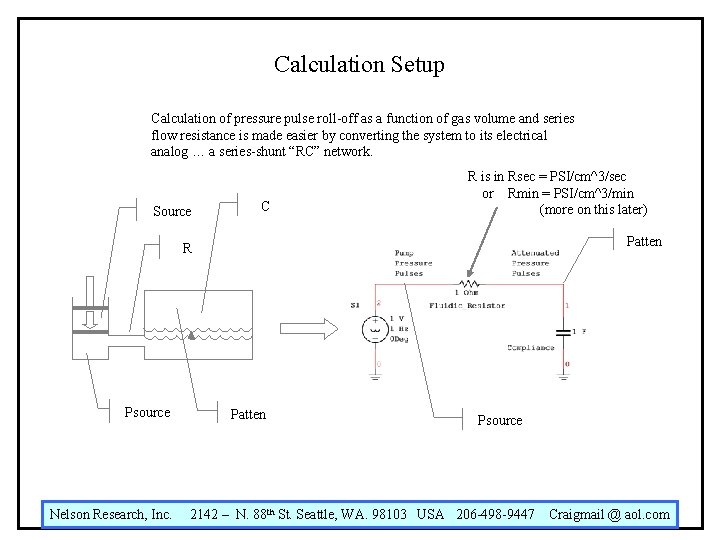
Calculation Setup Calculation of pressure pulse roll-off as a function of gas volume and series flow resistance is made easier by converting the system to its electrical analog … a series-shunt “RC” network. Source C R is in Rsec = PSI/cm^3/sec or Rmin = PSI/cm^3/min (more on this later) Patten R Psource Nelson Research, Inc. Patten Psource 2142 – N. 88 th St. Seattle, WA. 98103 USA 206 -498 -9447 Craigmail @ aol. com
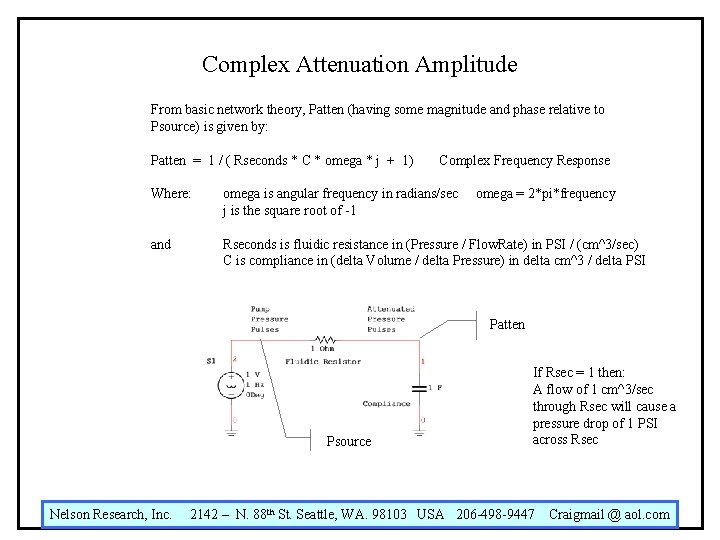
Complex Attenuation Amplitude From basic network theory, Patten (having some magnitude and phase relative to Psource) is given by: Patten = 1 / ( Rseconds * C * omega * j + 1) Complex Frequency Response Where: omega is angular frequency in radians/sec j is the square root of -1 omega = 2*pi*frequency and Rseconds is fluidic resistance in (Pressure / Flow. Rate) in PSI / (cm^3/sec) C is compliance in (delta Volume / delta Pressure) in delta cm^3 / delta PSI Patten Psource Nelson Research, Inc. If Rsec = 1 then: A flow of 1 cm^3/sec through Rsec will cause a pressure drop of 1 PSI across Rsec 2142 – N. 88 th St. Seattle, WA. 98103 USA 206 -498 -9447 Craigmail @ aol. com
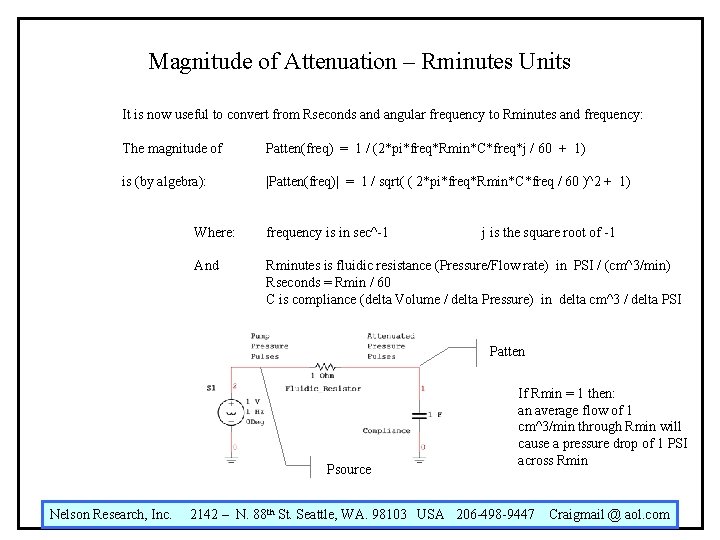
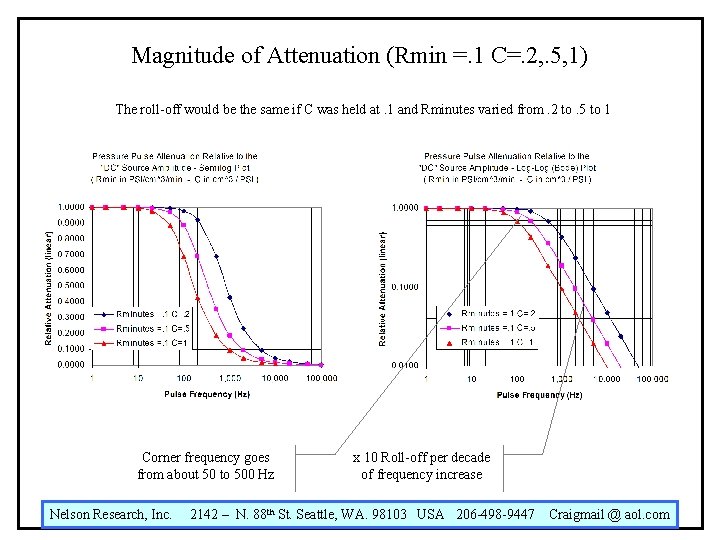
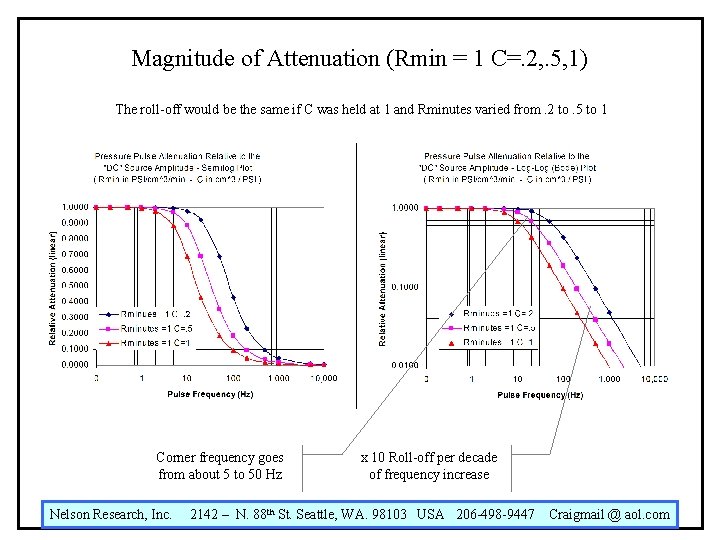
Magnitude of Attenuation – Rminutes Units It is now useful to convert from Rseconds and angular frequency to Rminutes and frequency: The magnitude of Patten(freq) = 1 / (2*pi*freq*Rmin*C*freq*j / 60 + 1) is (by algebra): |Patten(freq)| = 1 / sqrt( ( 2*pi*freq*Rmin*C*freq / 60 )^2 + 1) Where: frequency is in sec^-1 j is the square root of -1 And Rminutes is fluidic resistance (Pressure/Flow rate) in PSI / (cm^3/min) Rseconds = Rmin / 60 C is compliance (delta Volume / delta Pressure) in delta cm^3 / delta PSI Patten Psource Nelson Research, Inc. If Rmin = 1 then: an average flow of 1 cm^3/min through Rmin will cause a pressure drop of 1 PSI across Rmin 2142 – N. 88 th St. Seattle, WA. 98103 USA 206 -498 -9447 Craigmail @ aol. com
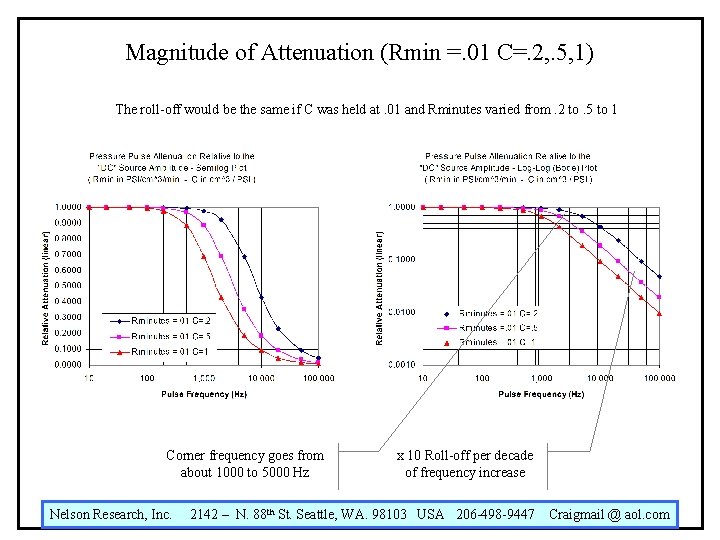
Magnitude of Attenuation (Rmin =. 01 C=. 2, . 5, 1) The roll-off would be the same if C was held at. 01 and Rminutes varied from. 2 to. 5 to 1 Corner frequency goes from about 1000 to 5000 Hz Nelson Research, Inc. x 10 Roll-off per decade of frequency increase 2142 – N. 88 th St. Seattle, WA. 98103 USA 206 -498 -9447 Craigmail @ aol. com
Magnitude of Attenuation (Rmin =. 1 C=. 2, . 5, 1) The roll-off would be the same if C was held at. 1 and Rminutes varied from. 2 to. 5 to 1 Corner frequency goes from about 50 to 500 Hz Nelson Research, Inc. x 10 Roll-off per decade of frequency increase 2142 – N. 88 th St. Seattle, WA. 98103 USA 206 -498 -9447 Craigmail @ aol. com
Magnitude of Attenuation (Rmin = 1 C=. 2, . 5, 1) The roll-off would be the same if C was held at 1 and Rminutes varied from. 2 to. 5 to 1 Corner frequency goes from about 5 to 50 Hz Nelson Research, Inc. x 10 Roll-off per decade of frequency increase 2142 – N. 88 th St. Seattle, WA. 98103 USA 206 -498 -9447 Craigmail @ aol. com
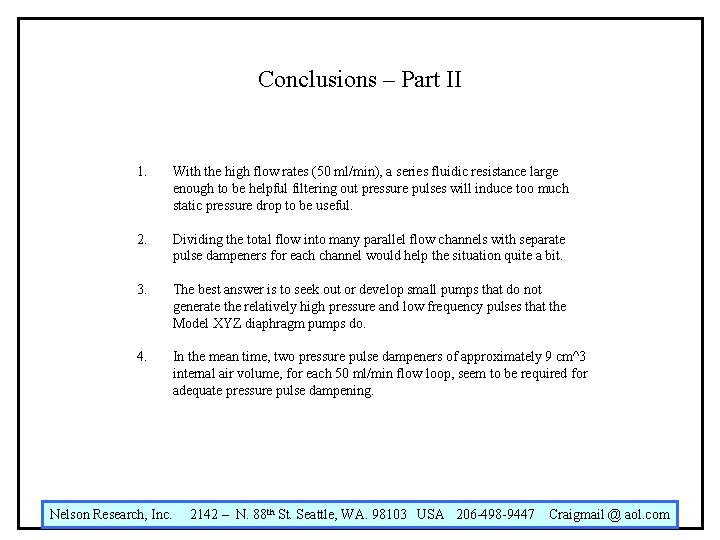
Conclusions – Part II 1. With the high flow rates (50 ml/min), a series fluidic resistance large enough to be helpful filtering out pressure pulses will induce too much static pressure drop to be useful. 2. Dividing the total flow into many parallel flow channels with separate pulse dampeners for each channel would help the situation quite a bit. 3. The best answer is to seek out or develop small pumps that do not generate the relatively high pressure and low frequency pulses that the Model XYZ diaphragm pumps do. 4. In the mean time, two pressure pulse dampeners of approximately 9 cm^3 internal air volume, for each 50 ml/min flow loop, seem to be required for adequate pressure pulse dampening. Nelson Research, Inc. 2142 – N. 88 th St. Seattle, WA. 98103 USA 206 -498 -9447 Craigmail @ aol. com