
Pulsatile Pressure and Flow WeiTing Yeh July 14

- Slides: 18
Pulsatile Pressure and Flow Wei-Ting Yeh July 14, 2014
Outline • Goals • History • Windkessel Model • Womersley Model • Improvements • Summary • References
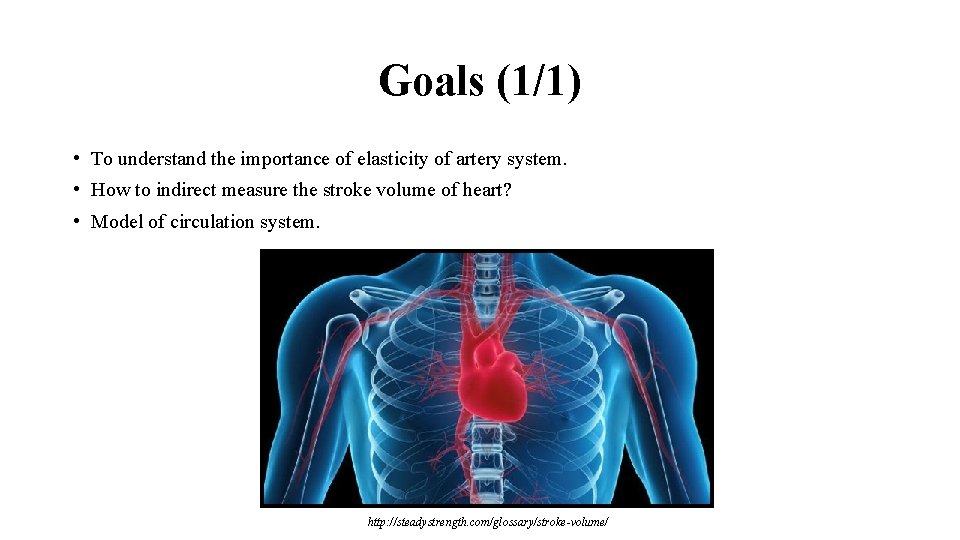
Goals (1/1) • To understand the importance of elasticity of artery system. • How to indirect measure the stroke volume of heart? • Model of circulation system. http: //steadystrength. com/glossary/stroke-volume/
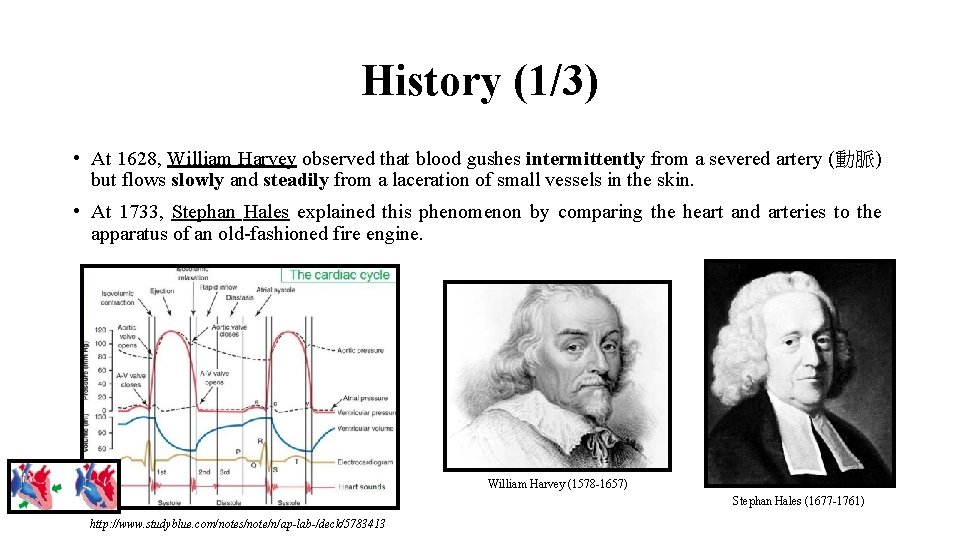
History (1/3) • At 1628, William Harvey observed that blood gushes intermittently from a severed artery (動脈) but flows slowly and steadily from a laceration of small vessels in the skin. • At 1733, Stephan Hales explained this phenomenon by comparing the heart and arteries to the apparatus of an old-fashioned fire engine. William Harvey (1578 -1657) Stephan Hales (1677 -1761) http: //www. studyblue. com/notes/note/n/ap-lab-/deck/5783413
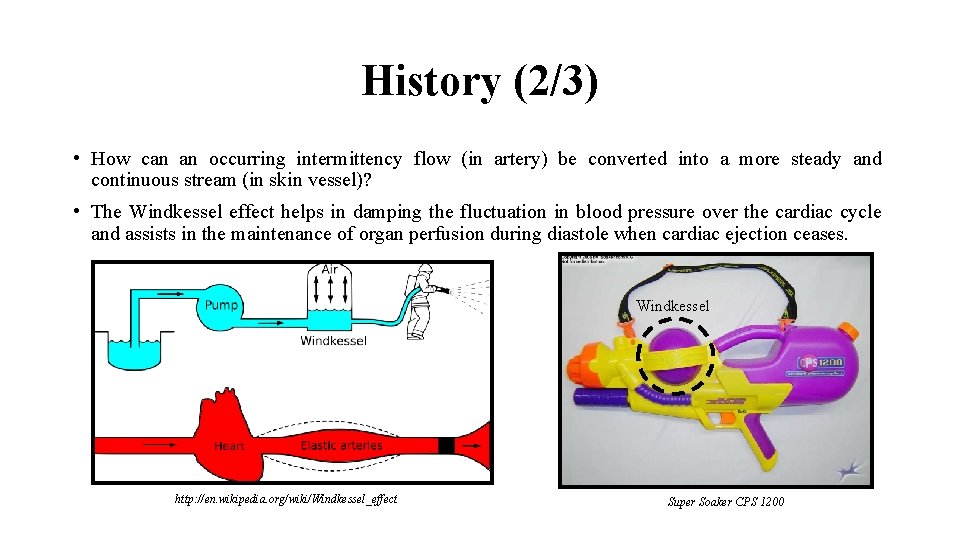
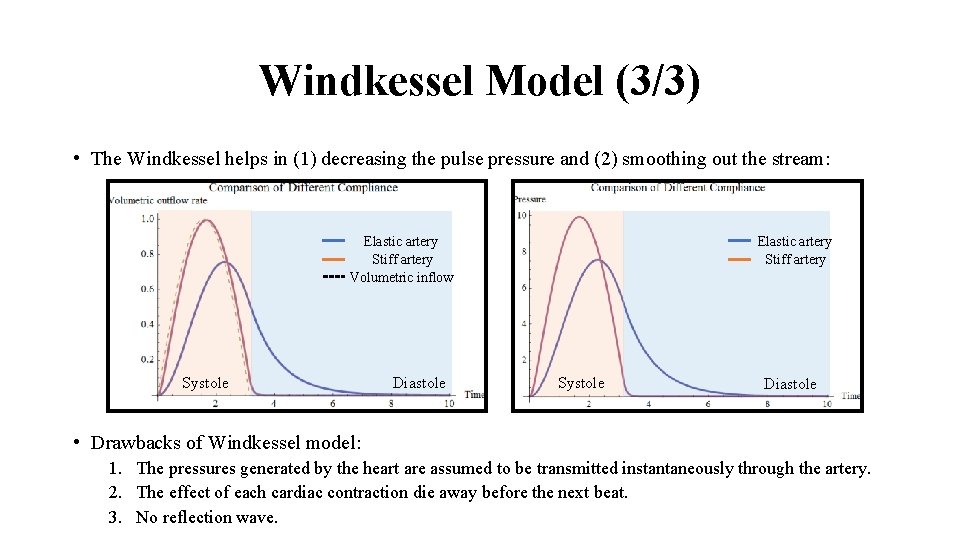
History (2/3) • How can an occurring intermittency flow (in artery) be converted into a more steady and continuous stream (in skin vessel)? • The Windkessel effect helps in damping the fluctuation in blood pressure over the cardiac cycle and assists in the maintenance of organ perfusion during diastole when cardiac ejection ceases. Windkessel http: //en. wikipedia. org/wiki/Windkessel_effect Super Soaker CPS 1200
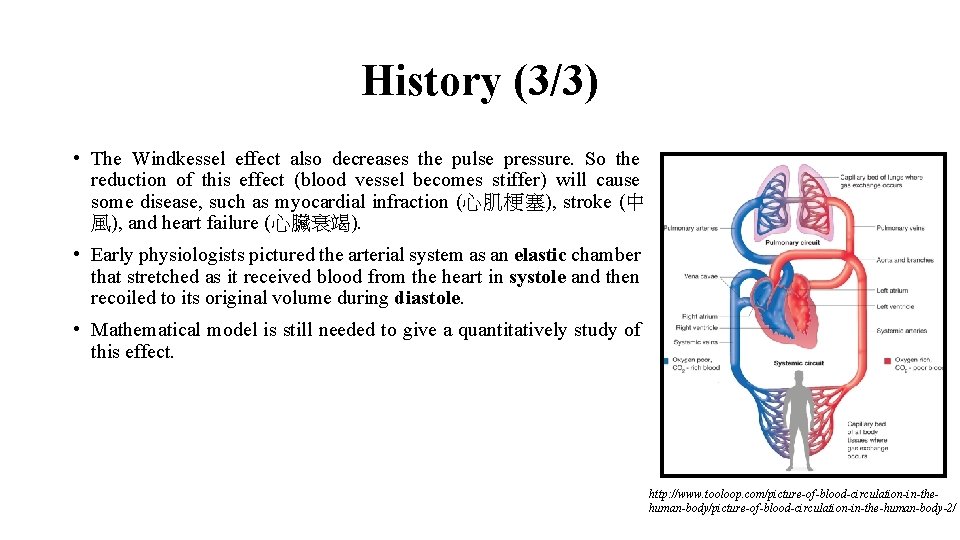
History (3/3) • The Windkessel effect also decreases the pulse pressure. So the reduction of this effect (blood vessel becomes stiffer) will cause some disease, such as myocardial infraction (心肌梗塞), stroke (中 風), and heart failure (心臟衰竭). • Early physiologists pictured the arterial system as an elastic chamber that stretched as it received blood from the heart in systole and then recoiled to its original volume during diastole. • Mathematical model is still needed to give a quantitatively study of this effect. http: //www. tooloop. com/picture-of-blood-circulation-in-thehuman-body/picture-of-blood-circulation-in-the-human-body-2/
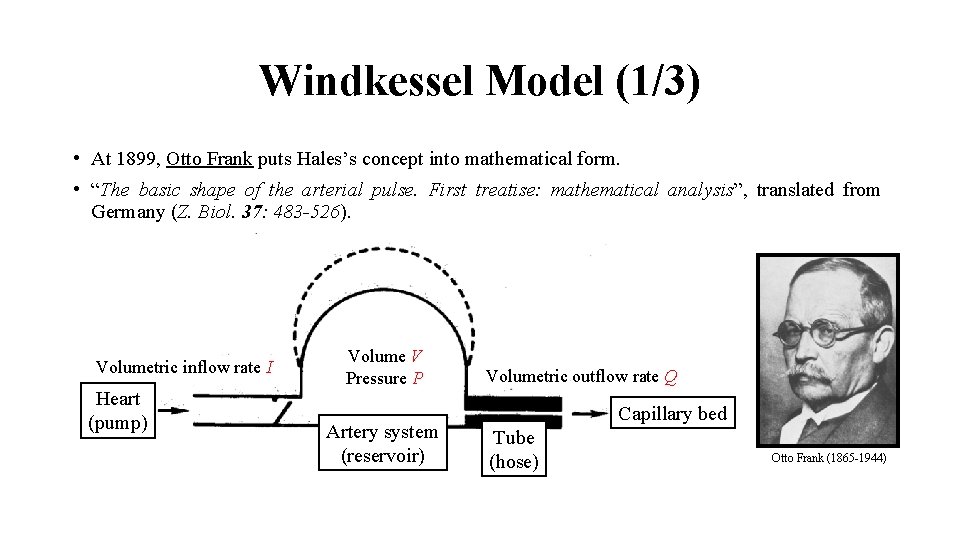
Windkessel Model (1/3) • At 1899, Otto Frank puts Hales’s concept into mathematical form. • “The basic shape of the arterial pulse. First treatise: mathematical analysis”, translated from Germany (Z. Biol. 37: 483 -526). Volumetric inflow rate I Heart (pump) Volume V Pressure P Artery system (reservoir) Volumetric outflow rate Q Capillary bed Tube (hose) Otto Frank (1865 -1944)
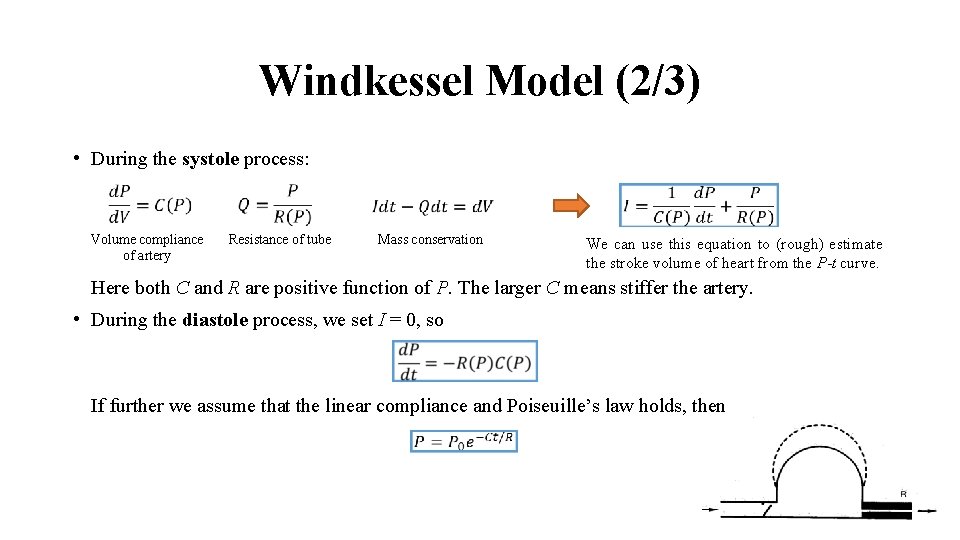
Windkessel Model (2/3) • During the systole process: Volume compliance of artery Resistance of tube Mass conservation We can use this equation to (rough) estimate the stroke volume of heart from the P-t curve. Here both C and R are positive function of P. The larger C means stiffer the artery. • During the diastole process, we set I = 0, so If further we assume that the linear compliance and Poiseuille’s law holds, then
Windkessel Model (3/3) • The Windkessel helps in (1) decreasing the pulse pressure and (2) smoothing out the stream: Elastic artery Stiff artery Volumetric inflow Systole Diastole Systole Elastic artery Stiff artery Systole Diastole • Drawbacks of Windkessel model: 1. The pressures generated by the heart are assumed to be transmitted instantaneously through the artery. 2. The effect of each cardiac contraction die away before the next beat. 3. No reflection wave.
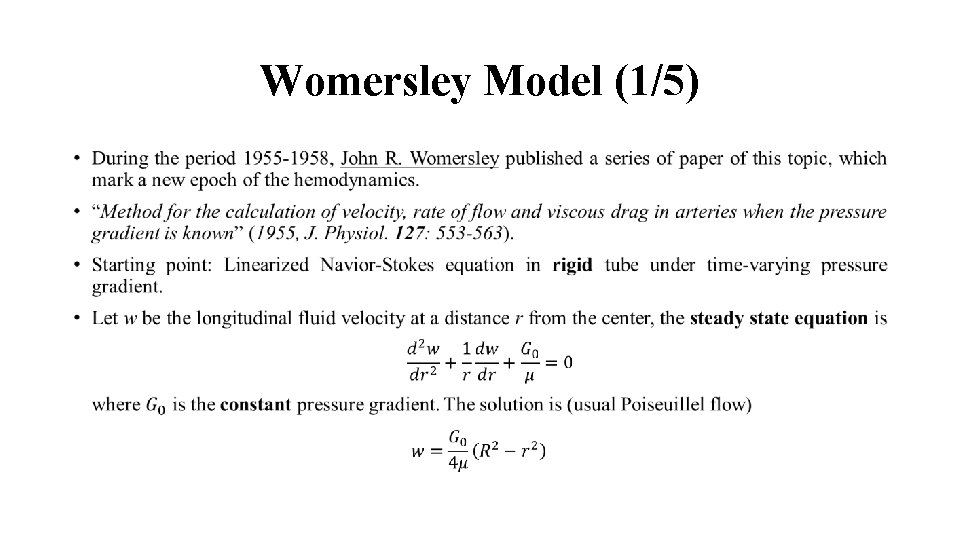
Womersley Model (1/5) •
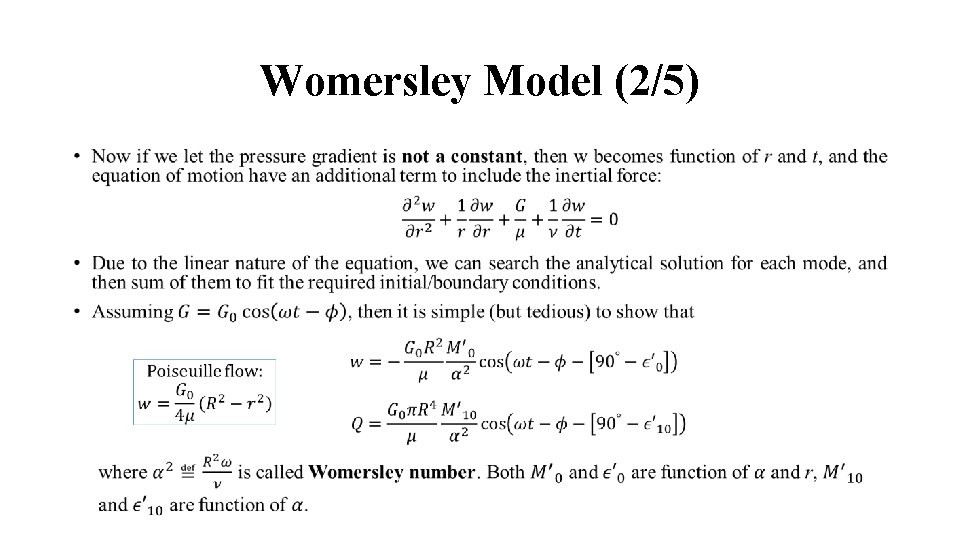
Womersley Model (2/5) •
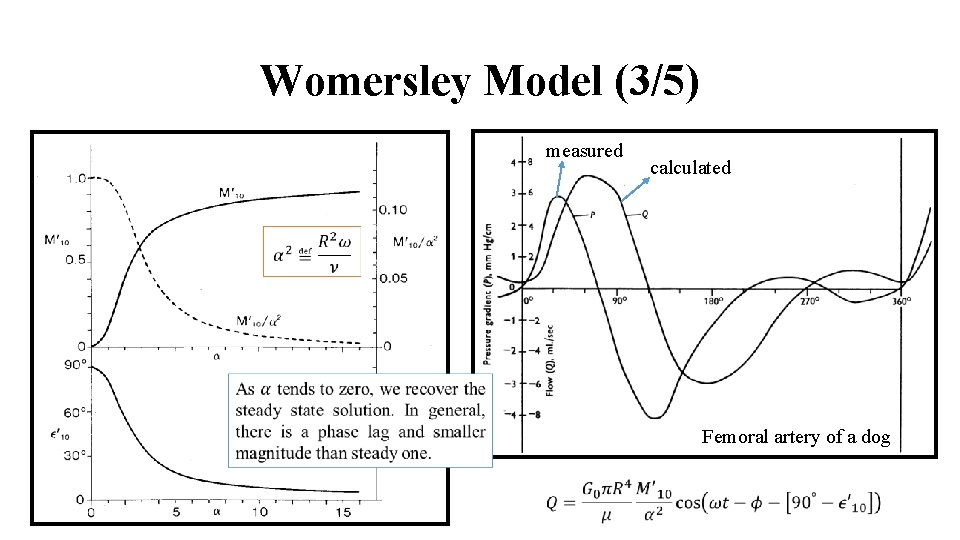
Womersley Model (3/5) measured calculated Femoral artery of a dog
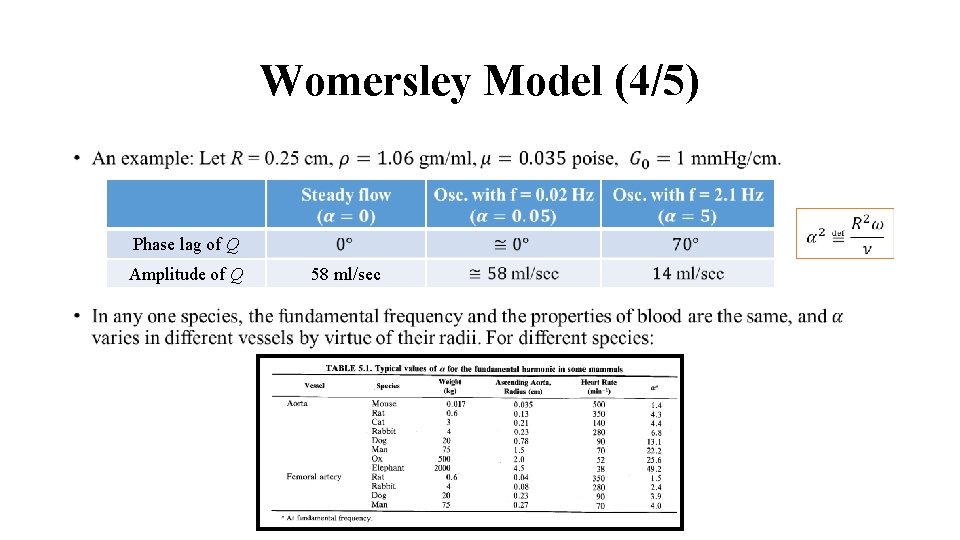
Womersley Model (4/5) • Phase lag of Q Amplitude of Q 58 ml/sec
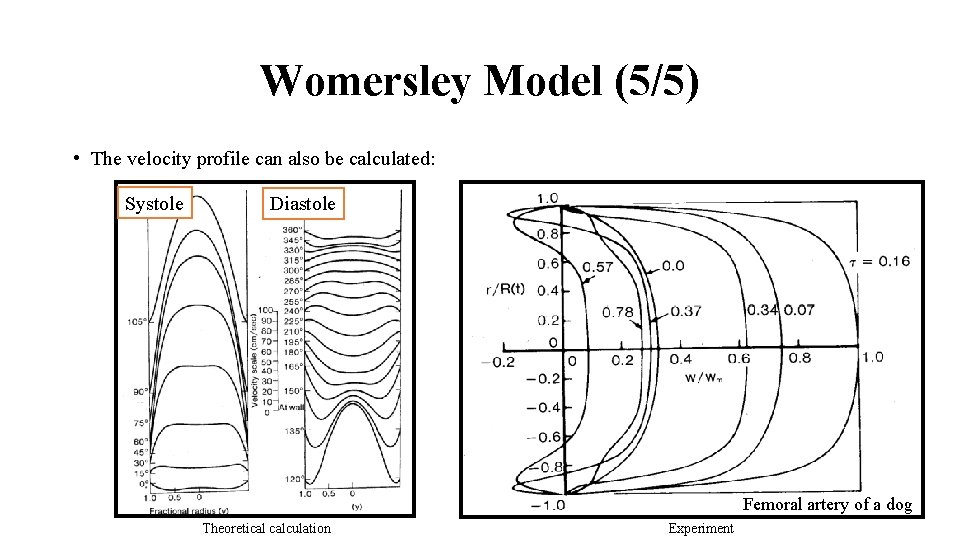
Womersley Model (5/5) • The velocity profile can also be calculated: Systole Diastole Femoral artery of a dog Theoretical calculation Experiment
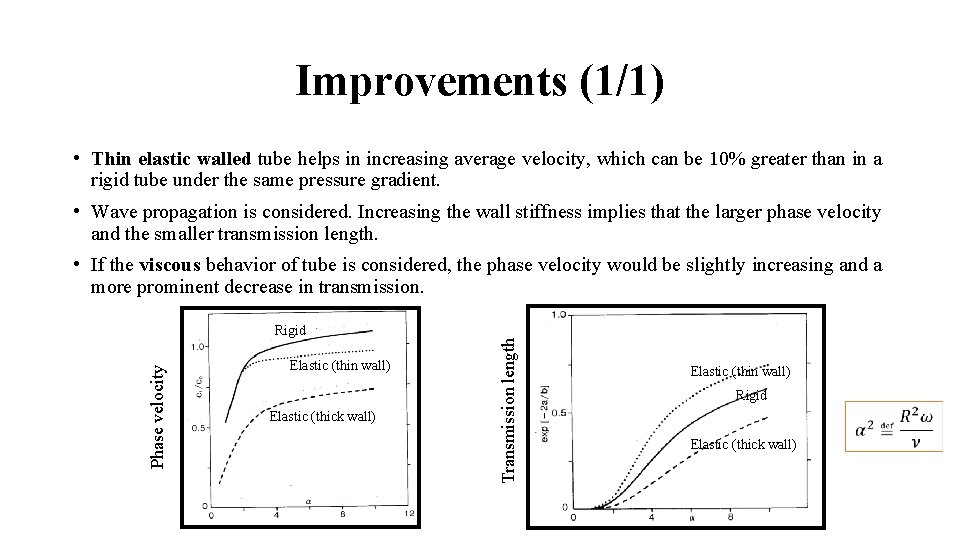
Improvements (1/1) • Thin elastic walled tube helps in increasing average velocity, which can be 10% greater than in a rigid tube under the same pressure gradient. • Wave propagation is considered. Increasing the wall stiffness implies that the larger phase velocity and the smaller transmission length. • If the viscous behavior of tube is considered, the phase velocity would be slightly increasing and a more prominent decrease in transmission. Elastic (thin wall) Elastic (thick wall) Transmission length Phase velocity Rigid Elastic (thin wall) Rigid Elastic (thick wall)
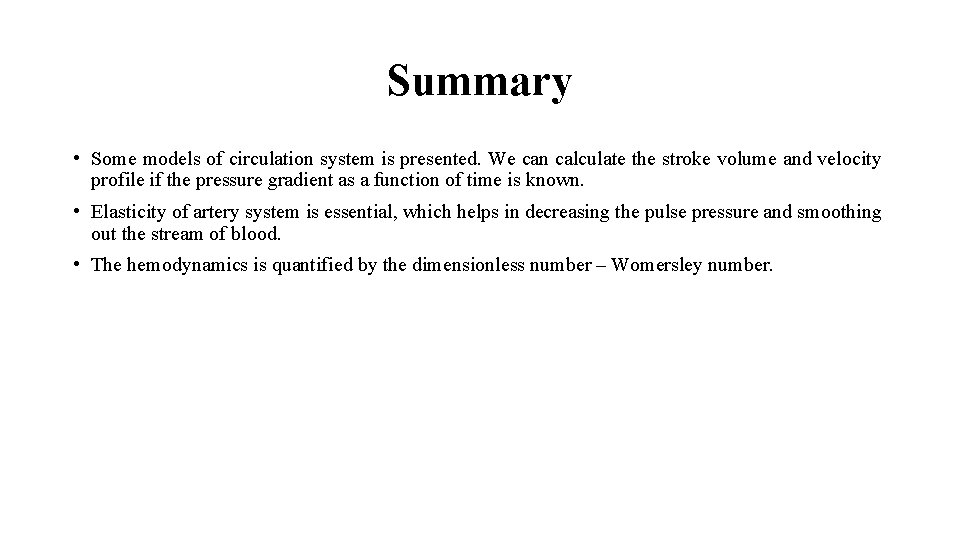
Summary • Some models of circulation system is presented. We can calculate the stroke volume and velocity profile if the pressure gradient as a function of time is known. • Elasticity of artery system is essential, which helps in decreasing the pulse pressure and smoothing out the stream of blood. • The hemodynamics is quantified by the dimensionless number – Womersley number.
References • Milnor WR (1982), Hemodynamics, Williams & Wilkins. • Frank O (1899), The basic shape of the arterial pulse. First treatise: mathematical analysis ( translated from Germany), Z. Biol. 37: 483 -526. • Womersley JR (1955), Method for the calculation of velocity, rate of flow and viscous drag in arteries when the pressure gradient is known, J. Physiol. 127: 553 -563. • Hale JF, Mc. Donald DA, and Womersley JR (1955), “Velocity profile of oscillating arterial flow, with some calculations of viscous drag and the Reynolds number”, J. Physiol. 128: 629 -640.
END