
Pulsar timing with tempo 2 George Hobbs Australia
Pulsar timing with tempo 2 George Hobbs Australia Telescope National Facility george. hobbs@csiro. au

Contents • • Basis of pulsar timing Getting tempo 2 Using tempo 2 Developing tempo 2 CSIRO. Gravitational wave detection
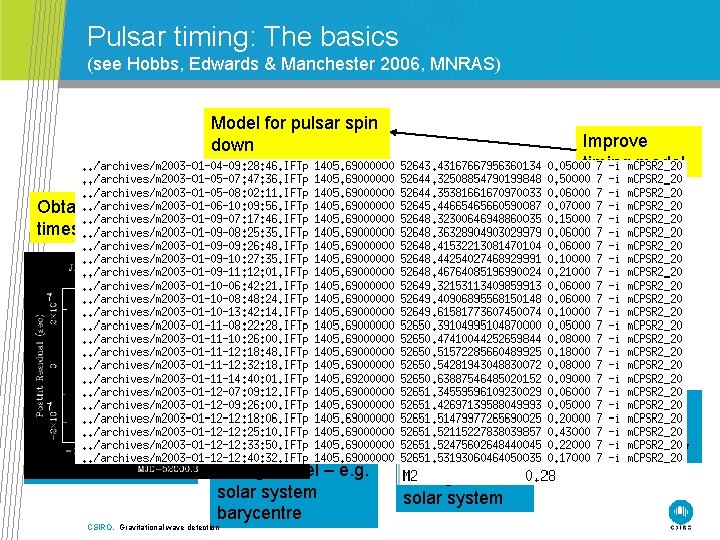
Pulsar timing: The basics (see Hobbs, Edwards & Manchester 2006, MNRAS) Model for pulsar spin down Obtain pulse arrival times at observatory Form timing residuals – how good is the timing model at predicting the arrival times Must average many thousands of pulses together to obtain stable profile Must convert to conform with terrestrial time standards Improve timing model Must convert to reference frame suitable for the timing model – e. g. solar system barycentre CSIRO. Gravitational wave detection Must add extra propagation delays e. g. through the solar system Must convert to arrival times at infinite frequency
Tempo 2 • Paper 1: Hobbs, Edwards & Manchester (2006), MNRAS, 369, 655 • Paper 2: Edwards, Hobbs & Manchester (2006), MNRAS, 372, 1549 • Paper 3: Hobbs, Jenet, Lee et al. (2009), MNRAS, 394, 1945 CSIRO. Gravitational wave detection
Getting tempo 2 • • • Wiki: http: //www. atnf. csiro. au/research/pulsar/tempo 2 Main repository: https: //sourceforge. net/projects/tempo 2/ Get data: >cvs -z 3 -d: pserver: anonymous@tempo 2. cvs. sourceforge. net: /cvsroot/tempo 2 co tempo 2 Email distribution list: http: //lists. pulsarastronomy. net/mailman/listinfo/tempo 2_lists. pulsarastronomy. net • Ingrid’s help page for using tempo 2: http: //www. astro. ubc. ca/people/stairs/tempo 2. html CSIRO. Gravitational wave detection
Paper I: overview • Tempo 2 accurate for known physics to 1 ns (factor of ~100 better than tempo 1 and ~1000 better than psrtime) • Tempo 2 is compliant with the general relativistic framework of the IAU 1991 and 2000 resolutions - uses the international celestial reference system, barycentric coordinate time and upto-date precession, nutation and polar motion models CSIRO. Gravitational wave detection
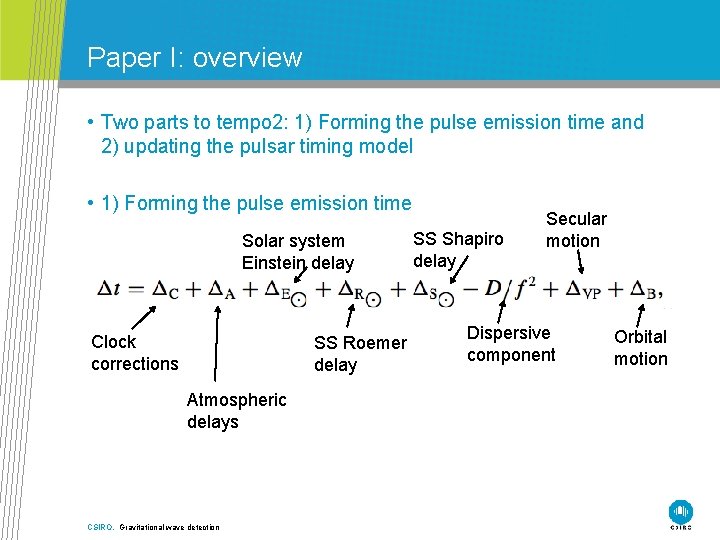
Paper I: overview • Two parts to tempo 2: 1) Forming the pulse emission time and 2) updating the pulsar timing model • 1) Forming the pulse emission time Solar system Einstein delay Clock corrections SS Roemer delay Atmospheric delays CSIRO. Gravitational wave detection SS Shapiro delay Secular motion Dispersive component Orbital motion
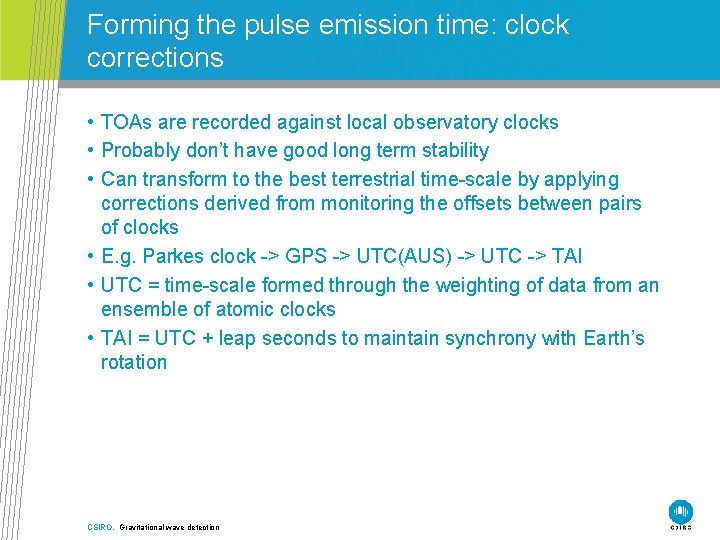
Forming the pulse emission time: clock corrections • TOAs are recorded against local observatory clocks • Probably don’t have good long term stability • Can transform to the best terrestrial time-scale by applying corrections derived from monitoring the offsets between pairs of clocks • E. g. Parkes clock -> GPS -> UTC(AUS) -> UTC -> TAI • UTC = time-scale formed through the weighting of data from an ensemble of atomic clocks • TAI = UTC + leap seconds to maintain synchrony with Earth’s rotation CSIRO. Gravitational wave detection
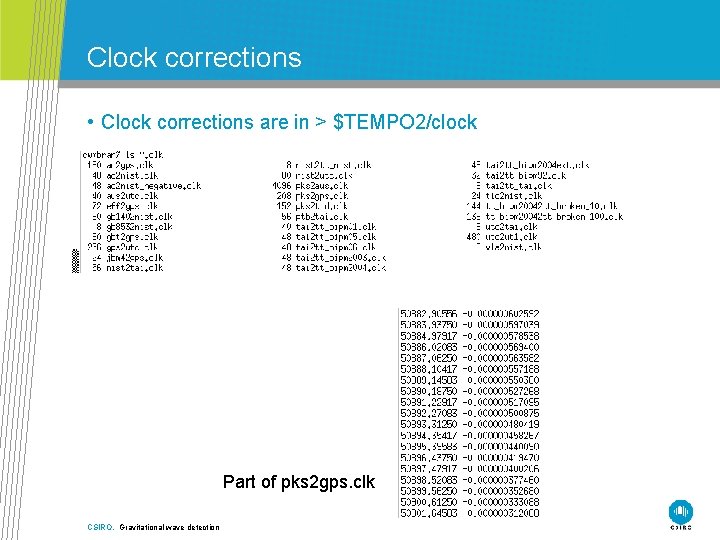
Clock corrections • Clock corrections are in > $TEMPO 2/clock Part of pks 2 gps. clk CSIRO. Gravitational wave detection
Atmospheric propagation delays • Can get effects by the ionised fraction of the atmosphere (ionosphere) and the neutron fraction (mainly the troposphere). It is possible to provide TEMPO 2 with lists of surface atmospheric pressure for the most accurate determinations. • Not normally needed! CSIRO. Gravitational wave detection
Einstein delay • Damour & Deruelle 1986 • Quantifies the change in TOAs due to variations in clocks at the observatory and the SSB due to changes in the gravitational potential of the Earth and the Earth’s motion • Use barycentric corrdinate time (TBC) instead of barycentric dynamical time which was used in tempo 1 => tempo 1 parameter files can not immediately be used in tempo 2 • Note: tempo 2 parameters are in SI units …. Tempo 1 parameters are not! CSIRO. Gravitational wave detection
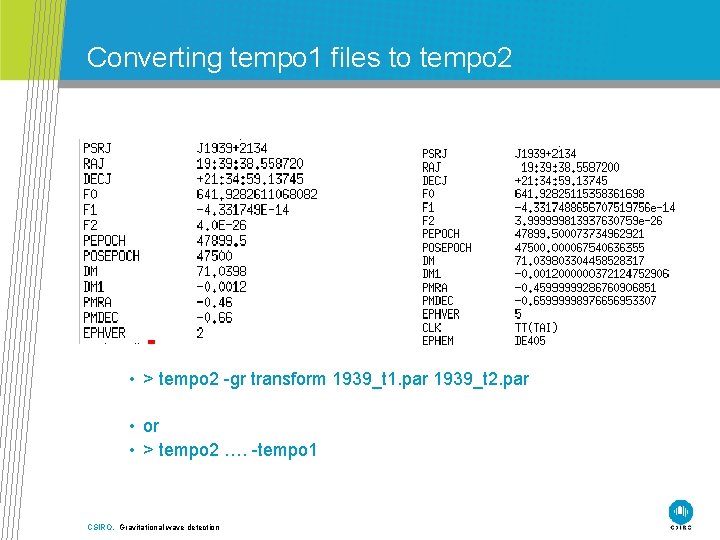
Converting tempo 1 files to tempo 2 • > tempo 2 -gr transform 1939_t 1. par 1939_t 2. par • or • > tempo 2 …. -tempo 1 CSIRO. Gravitational wave detection
Roemer delay • The vacuum light travel time between the pulse arriving at the observatory and the equivalent arrival time at the SSB • Calculated by determining the time-delay between a pulse arriving at the observatory and at the Earth’s centre and from the Earth’s centre to the SSB • Pulsar positions determined in the ICRS (International celestial reference system). Telescope positions are in the ITRF (International terrestrial reference system). Require precession, nutation, polar motion and Earth rotation information to convert between the two. TEMPO 1 does not include polar motion • Use DEXXX or INPOPXX Solar System models for conversion. Recommend DE 405. CSIRO. Gravitational wave detection
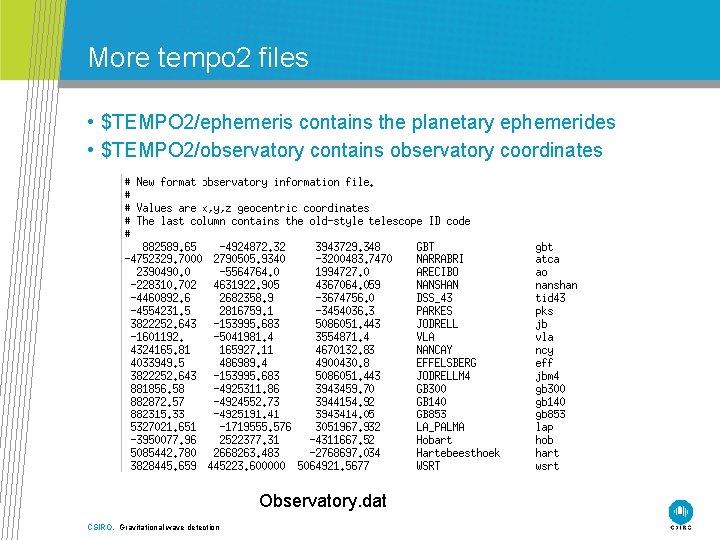
More tempo 2 files • $TEMPO 2/ephemeris contains the planetary ephemerides • $TEMPO 2/observatory contains observatory coordinates Observatory. dat CSIRO. Gravitational wave detection
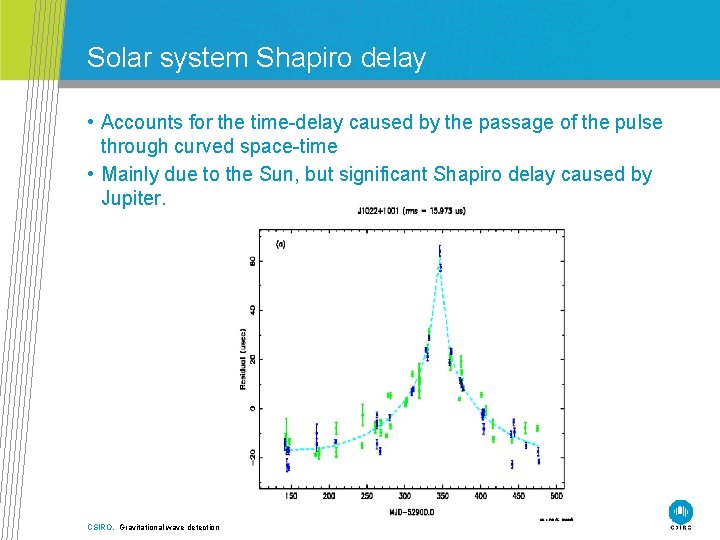
Solar system Shapiro delay • Accounts for the time-delay caused by the passage of the pulse through curved space-time • Mainly due to the Sun, but significant Shapiro delay caused by Jupiter. CSIRO. Gravitational wave detection
Dispersive effects • Caused by the ISM - assume delays propto f^-2. • Also dispersive delay caused by the Solar wind. Approximated in tempo 2 with the electron density decreasing as an inverse square law from the centre of the sun. • You Xiaopeng developed this model - see You, Hobbs, Coles et al. (2007 MNRAS. 378. . 493) and You, Hobbs, Coles et al. (2007 Ap. J. . . 671. . 907) CSIRO. Gravitational wave detection
Shklovskii effect and radial motion • Pulsar-timing measurements are affected by the motion of the pulsar relative to the SSB. This includes radial velocity, the Shklovskii effect and radial acceleration. • Can be absorbed by other parameters or included individually CSIRO. Gravitational wave detection
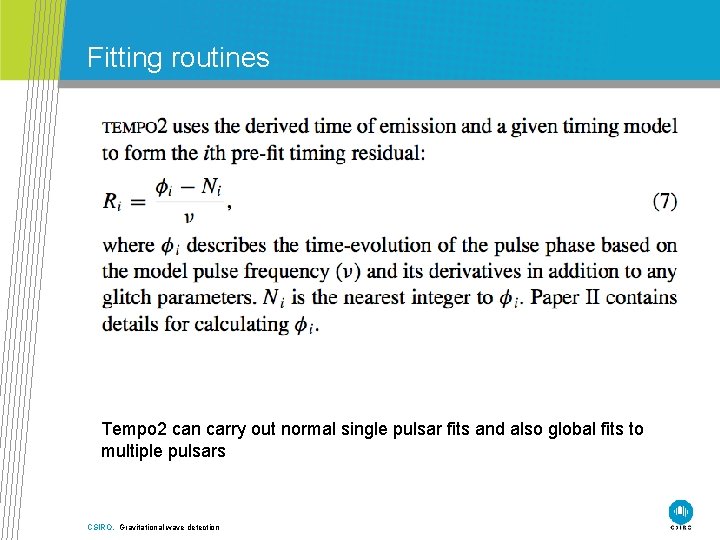
Fitting routines Tempo 2 can carry out normal single pulsar fits and also global fits to multiple pulsars CSIRO. Gravitational wave detection
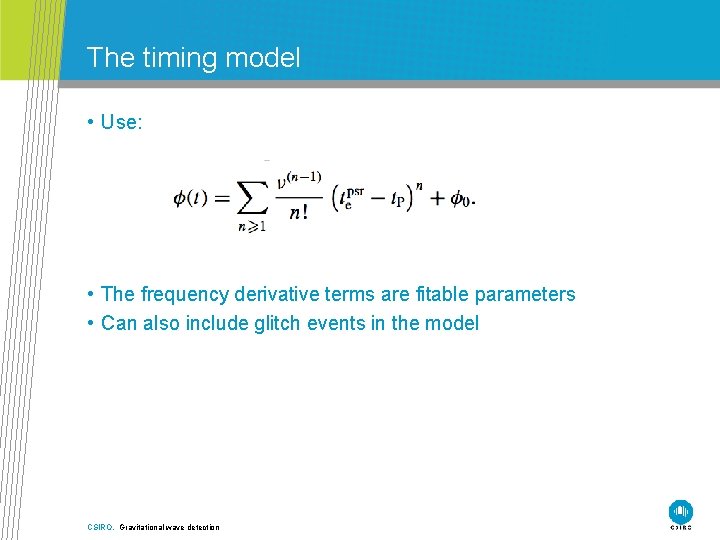
The timing model • Use: • The frequency derivative terms are fitable parameters • Can also include glitch events in the model CSIRO. Gravitational wave detection
Binary models • Have various models implemented from tempo 1 (BT, ELL 1, DD, MSS …) • Recommend use of T 2 binary model • Can assume GR (DDGR model) or small eccentricities (ELL 1) CSIRO. Gravitational wave detection
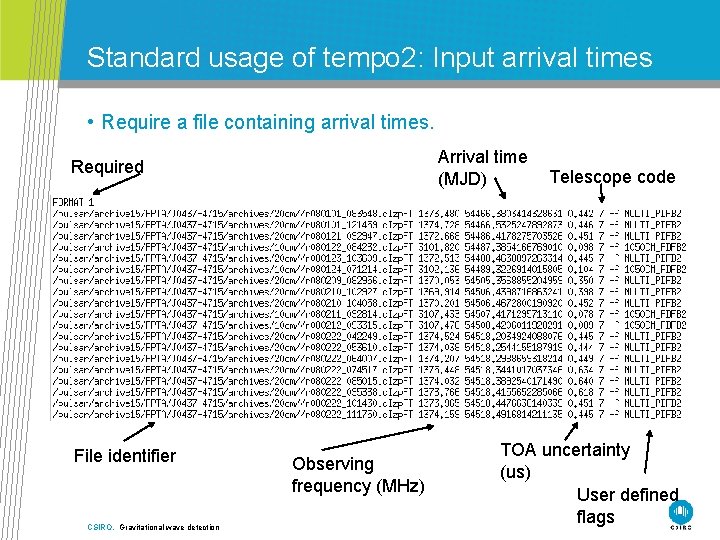
Standard usage of tempo 2: Input arrival times • Require a file containing arrival times. Arrival time (MJD) Required File identifier CSIRO. Gravitational wave detection Observing frequency (MHz) Telescope code TOA uncertainty (us) User defined flags
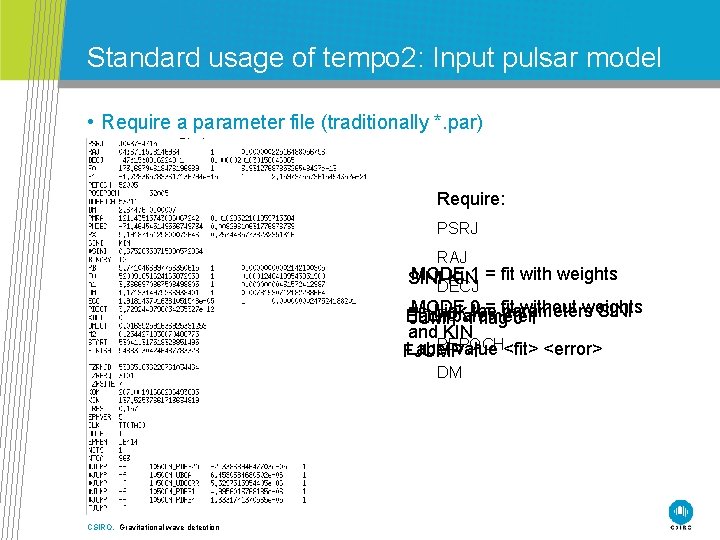
Standard usage of tempo 2: Input pulsar model • Require a parameter file (traditionally *. par) Require: PSRJ RAJ MODE SINI KIN 1 = fit with weights DECJ MODE 0 = fit without weights => Link SINI F 0 parameter Each JUMP -fthe flagparameters 01 and KIN PEPOCH Label value FJUMP -f <fit> <error> DM CSIRO. Gravitational wave detection
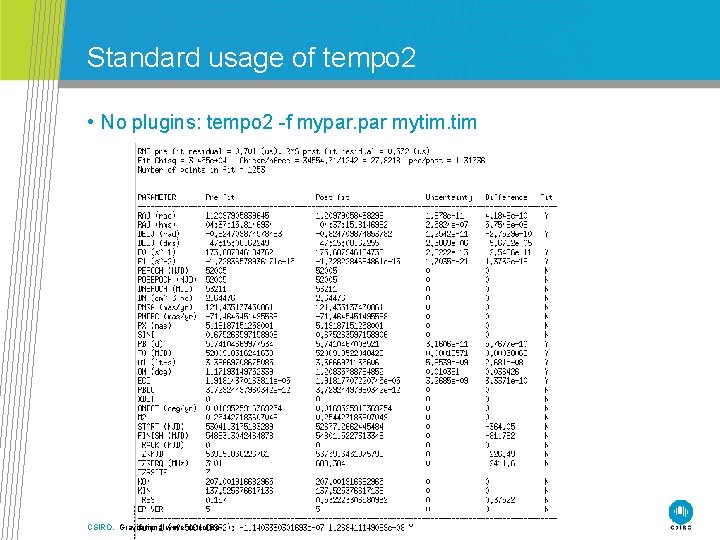
Standard usage of tempo 2 • No plugins: tempo 2 -f mypar. par mytim. tim CSIRO. Gravitational wave detection
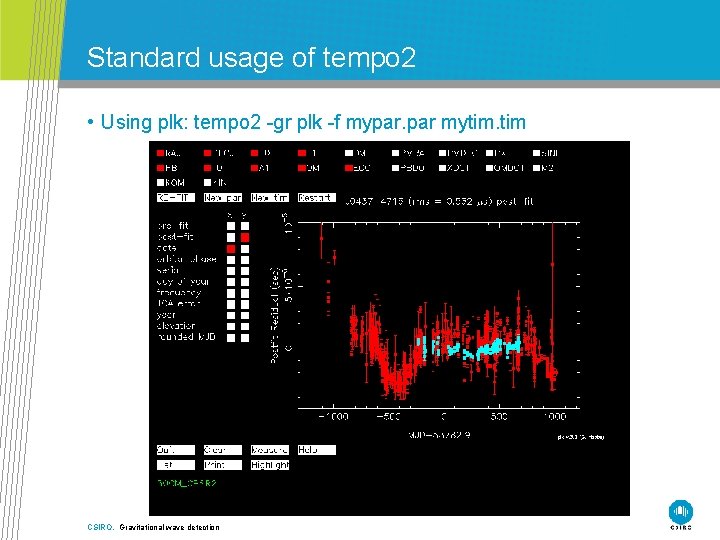
Standard usage of tempo 2 • Using plk: tempo 2 -gr plk -f mypar. par mytim. tim CSIRO. Gravitational wave detection
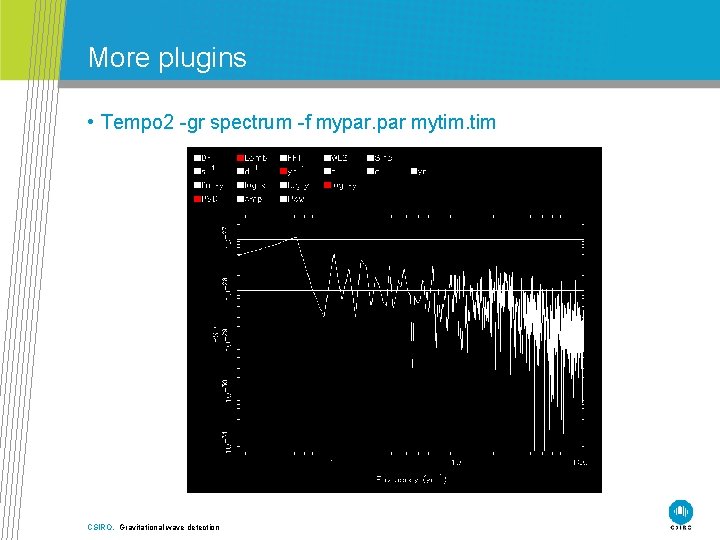
More plugins • Tempo 2 -gr spectrum -f mypar. par mytim. tim CSIRO. Gravitational wave detection
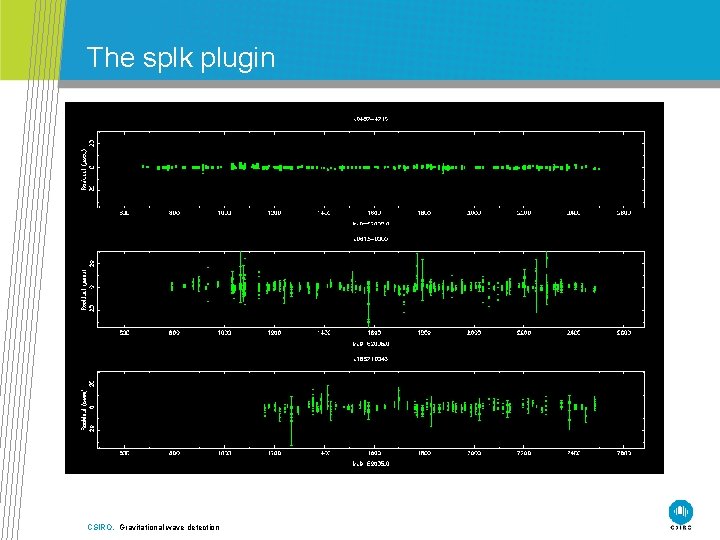
The splk plugin CSIRO. Gravitational wave detection
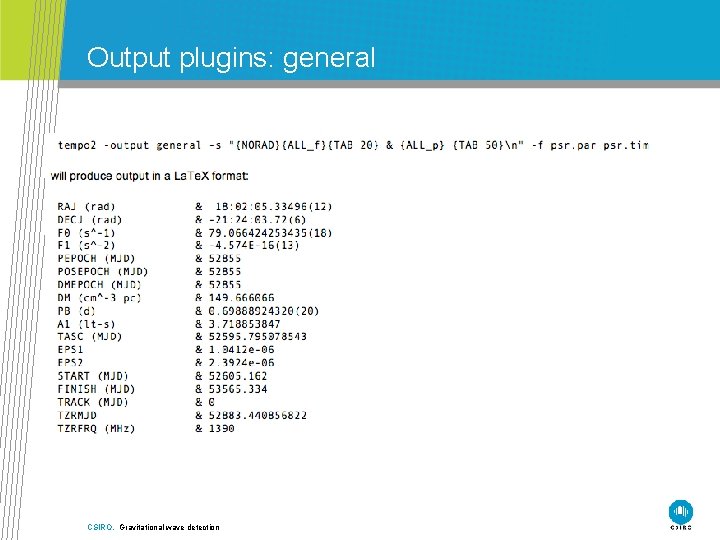
Output plugins: general CSIRO. Gravitational wave detection
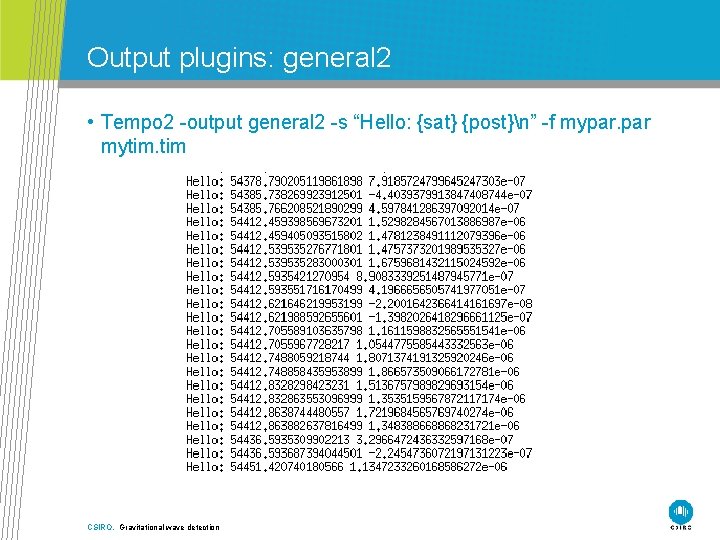
Output plugins: general 2 • Tempo 2 -output general 2 -s “Hello: {sat} {post}n” -f mypar. par mytim. tim CSIRO. Gravitational wave detection
Many plugins exist …. • • • Plotting Spectral analysis Simulating data Adding noise to data Adding gravitational wave signals to data …. CSIRO. Gravitational wave detection
Developing tempo 2 • Anyone can create more plugins. • Talk to me if you want to modify the main tempo 2 code. • Easiest to use C/C++ and pgplot, but can use other languages/libraries CSIRO. Gravitational wave detection
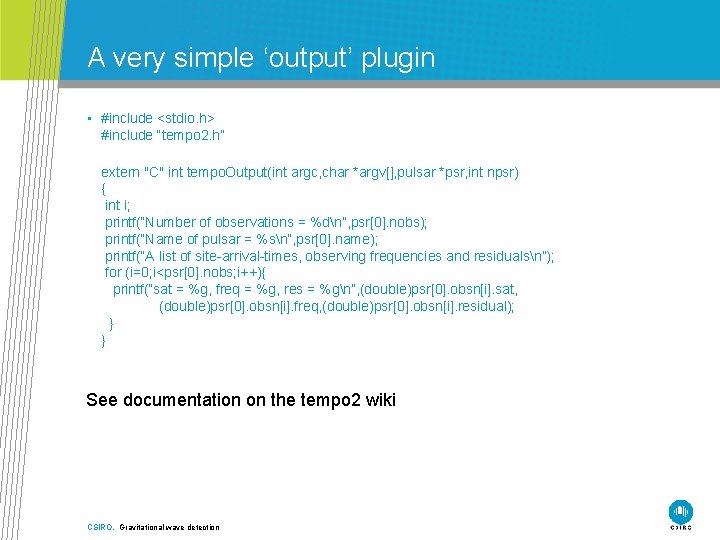
A very simple ‘output’ plugin • #include <stdio. h> #include “tempo 2. h” extern "C" int tempo. Output(int argc, char *argv[], pulsar *psr, int npsr) { int i; printf(“Number of observations = %dn”, psr[0]. nobs); printf(“Name of pulsar = %sn”, psr[0]. name); printf(“A list of site-arrival-times, observing frequencies and residualsn”); for (i=0; i<psr[0]. nobs; i++){ printf(“sat = %g, freq = %g, res = %gn”, (double)psr[0]. obsn[i]. sat, (double)psr[0]. obsn[i]. freq, (double)psr[0]. obsn[i]. residual); } } See documentation on the tempo 2 wiki CSIRO. Gravitational wave detection
Ideas for new plugins • Want to analyse the residuals in a new way (wavelet analysis? ) • Want to model the effect of precession in pulsar timing • Want to look for correlated signals in multiple pulsar timing residuals • Want to simulate thousands of realisations of realistic timing residuals • … CSIRO. Gravitational wave detection
Tempo 2 demonstration • No plugins • General 2 • Plk - plot options, filter, pass, zoom, delete, measure, highlight, turning jumps on and off • Splk • Spectrum CSIRO. Gravitational wave detection
- Slides: 33