
PULPITIS ETIOLOGY PATHOGENY CLASIFICATION TREATMENT AND PREVENTION The



- Slides: 30
PULPITIS ETIOLOGY PATHOGENY CLASIFICATION TREATMENT AND PREVENTION
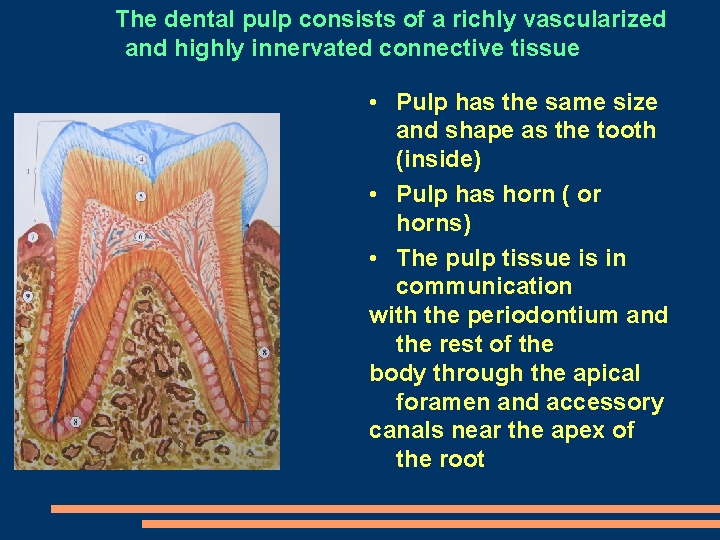
The dental pulp consists of a richly vascularized and highly innervated connective tissue • Pulp has the same size and shape as the tooth (inside) • Pulp has horn ( or horns) • The pulp tissue is in communication with the periodontium and the rest of the body through the apical foramen and accessory canals near the apex of the root
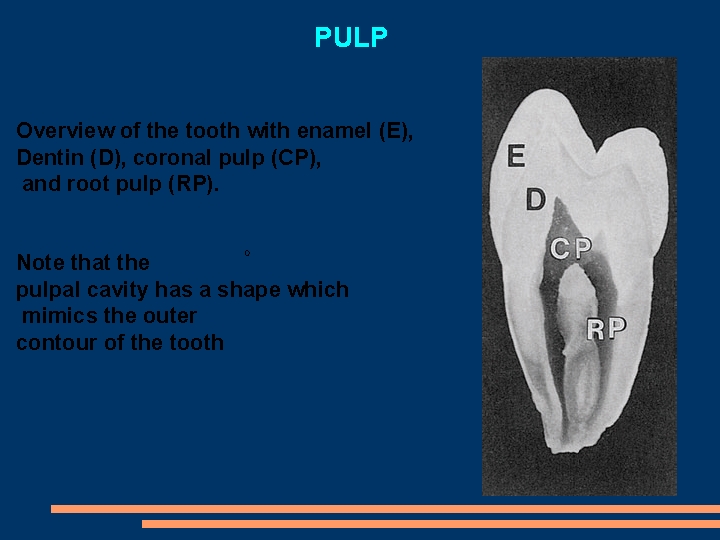
PULP Overview of the tooth with enamel (E), Dentin (D), coronal pulp (CP), and root pulp (RP). O Note that the pulpal cavity has a shape which mimics the outer contour of the tooth
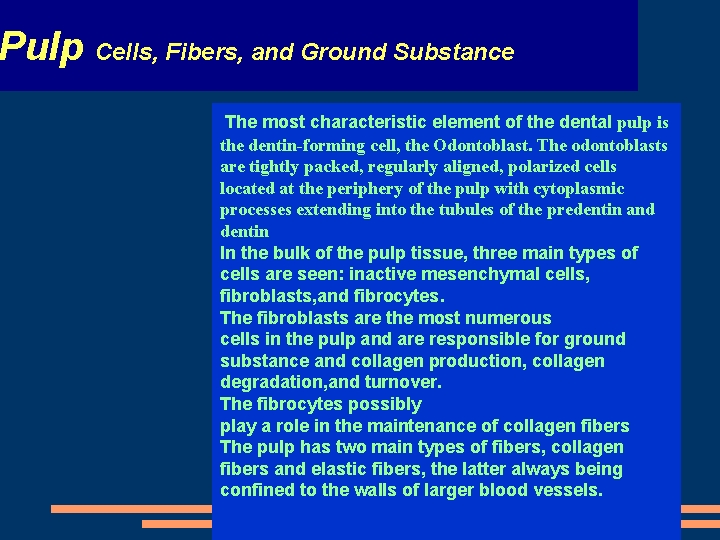
Pulp Cells, Fibers, and Ground Substance The most characteristic element of the dental pulp is the dentin-forming cell, the Odontoblast. The odontoblasts are tightly packed, regularly aligned, polarized cells located at the periphery of the pulp with cytoplasmic processes extending into the tubules of the predentin and dentin In the bulk of the pulp tissue, three main types of cells are seen: inactive mesenchymal cells, fibroblasts, and fibrocytes. The fibroblasts are the most numerous cells in the pulp and are responsible for ground substance and collagen production, collagen degradation, and turnover. The fibrocytes possibly play a role in the maintenance of collagen fibers The pulp has two main types of fibers, collagen fibers and elastic fibers, the latter always being confined to the walls of larger blood vessels.
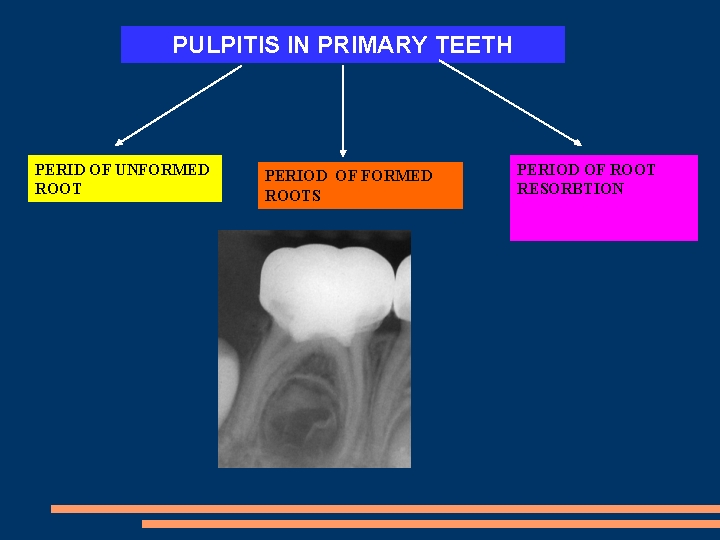
PULPITIS IN PRIMARY TEETH PERID OF UNFORMED ROOT PERIOD OF FORMED ROOTS PERIOD OF ROOT RESORBTION
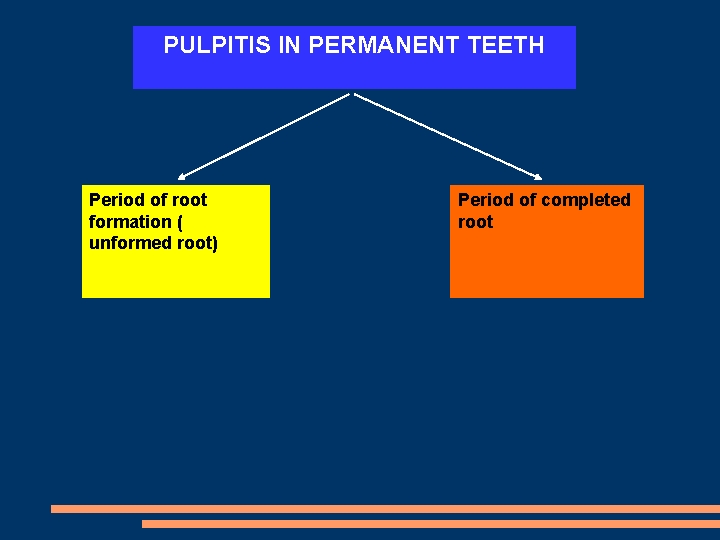
PULPITIS IN PERMANENT TEETH Period of root formation ( unformed root) Period of completed root
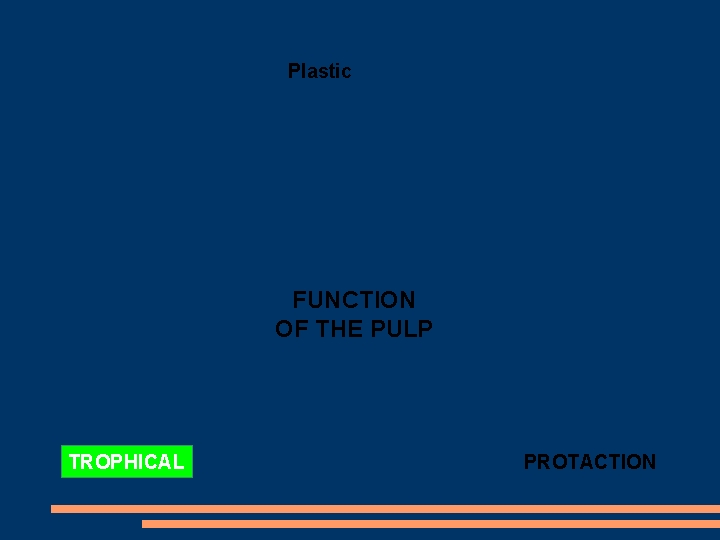
Plastic FUNCTION OF THE PULP TROPHICAL PROTACTION
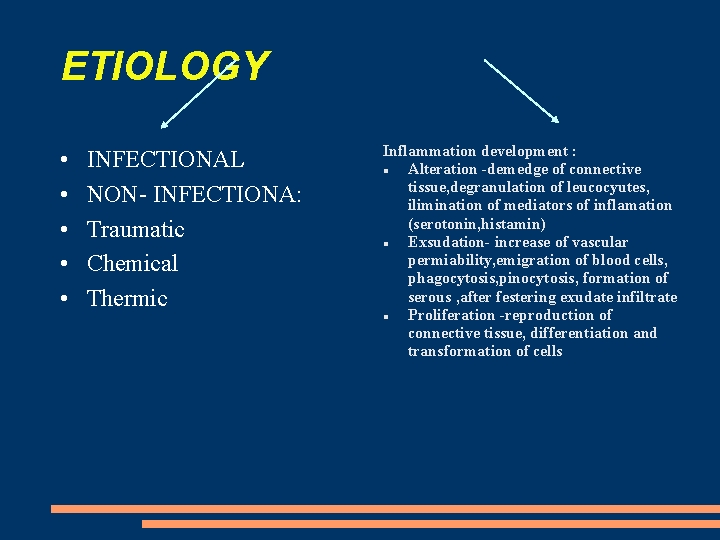
ETIOLOGY • • • INFECTIONAL NON- INFECTIONA: Traumatic Chemical Thermic Inflammation development : Alteration -demedge of connective tissue, degranulation of leucocyutes, ilimination of mediators of inflamation (serotonin, histamin) Exsudation- increase of vascular permiability, emigration of blood cells, phagocytosis, pinocytosis, formation of serous , after festering exudate infiltrate Proliferation -reproduction of connective tissue, differentiation and transformation of cells
Diagnosis and treatment planning: Medical History Clinical Examination. Visual inspection of the soft tissues should include an assessment of color, contour, and consistency. Localized redness, edema, swelling, or a sinus tract can indicate inflammatory disease. Examination of the hard structures may reveal clinical findings such as developmental defects, caries, abrasion, attrition, erosion, defective restorations, fractured cusps, cracked teeth, and tooth discoloration Diagnostic Testing
Diagnostic Testing: PULP TESTING (They are designed to assess responsiveness and localize symptomatic teeth by reproducing the patient's symptoms. Electrical and thermal. DIRECT DENTINAL STIMULATION (TEST CAVITY): PERCUSSION PALPATION MOBILITY. Radiographic Examination
Radiographic Examination
The clinical course of pulpitis in children: 1 inflammation of the pulp of the tooth with a shallow cavity 2 rapid spread of inflammation 3 fast transition to chronic inflammation 4 the prevalence of chronic pulpitis 5 variety of clinic pulpit depends on the formation of the tooth (the root) 6 the presence of elements of purulent inflammation in all forms of pulpitis 7 common reaction of the periodontal 8 body reaction (symptoms of intoxication) 9, the value of the compensation degree of caries 10 frequent discrepancy between the morphological changes in the pulp of the clinic
PRIMARY MOLAR PULP THERAPY
Differentiating with exacerbated chronic pulpitis, you need to take into account the degree of activity of caries: acute pulpitis more often compensated by the degree of caries, with decompensated form of dental caries symptoms of acute pulpitis treated as exacerbation of a chronic process. Diagnostic value of a sensing cavity, place of intense pain, or pain-free. Tooth cavity in acute pulpitis closed. The reaction of the regional lymph nodes is manifested by edema of soft tissue submandibular region and the presence of enlarged lymph nodes painful movable, soft consistency.
Chronic pulpitis of deciduous teeth Most often diagnosed during a routine drainage. Are due to acute processes in the pulp or as a primary chronic processes. The leading subjective symptom is pain on thermal cues in chronic gangrenous process - while receiving a warm meal or during the transition from cold to warm. In proliferative hypertrophic pulpitis in contact with food in a cavity, pain and bleeding from the cavity made of pulp polyp. On examination of the tooth with a simple chronic pulpitis carious lesions of small size with the softened dentin, tooth cavity can be closed, sounding sharply painful, bleeding slightly, the temperature stimulus may provoke a long bout of pain, percussion painless.
In chronic gangrenous pulpitis tooth dark color, carious lesions performed ihoroznym soft touch smell, tooth cavity can be closed, surface sensing painless, can be enlarged regional lymph nodes. Chronic proliferative pulpitis diagnosed at the stage of hypertrophy of the pulp, sometimes resembling proliferation of granulation tissue at the gingival polyp, or perforation of periodontal at the bottom of the cavity of the tooth. Research radiographs with pulpitis of deciduous teeth showed that pulpitis often accompanied by destructive changes in the periodontal tissues in the form of chronic granulating periodontitis
The method of vital amputation apply in cases where oral hygiene is subject to general anesthesia, in other cases it is necessary to carry out the injection interpulpal regional anesthesia and anesthesia, but the children can not tolerate these methods are limited in practice. Carrying vital amputation is recommended after treatment of cavities and tooth cavity opening in the absence of destructive changes in the periodontium.
In the axle in the treatment of almost all forms of pulpitis of deciduous teeth, except for acute diffuse pulpit with symptoms of periodontal disease, as well as during the formation or resorption of the root, using the method of non-vital amputation. For devitalization of the pulp of deciduous teeth with roots formed using arsenious paste for 24 hours, or paraformaldehyde pasta for 7 -10 days. Devitalization paste is applied to exempt most decayed dentine area of contact with the pulp cavity, impose devitalization substance on the cotton swab with camphor, phenol and anestezin, close the cavity of the temporary patch of dentin to the optimum time. After devitalization important step is mummification remaining after amputation root pulp. For this purpose, use resorcinol-formalin mixture on a cotton swab in a sealed chamber for 3 -5 days or paste "Paratsin", "Rezoform", "Paratsin» , «Mummifying Paste» . The use of resorcinol-formalin paste is allowed only in the treatment of primary teeth with pulpitis root resorption. Rounding out the treatment of non-vital amputation of the pulpit by imposing on resorcinol-formalin paste water dentin, gaskets and seals permanent
Devitalized hysterectomy involves the complete removal of devitalized pulp. The indications are all forms of pulpitis stage formed roots. During the second visit the bandage is removed, remove the root pulp, carry antiseptic treatment of root canals were dried and filled to the apical hole plastic netverdeyuschimi pastes. Most use zinc evgenolovuyu, yodoformnuyu, thymol. In chronic gangrenous pulpitis devitalized extirpation can be performed after the pre-coagulation pulp with phenol anestezin if not removed, the paste is applied devitaliziruyuschuyu after ekstirpatsii appropriate use of drugs antianaerobnogo action (hydrogen peroxide, sodium hypochlorite, metrodzhil, metronidazole)
Pulpitises PERMANENT TEETH IN CHILDREN. Age children can clearly identify and articulate the complaint, to assess the reaction of the tooth to thermal stimuli, percussion, probing, in permanent teeth with the formation of roots can use EDI. Hyperemia of the pulp in teeth are more often diagnosed with the formation of the root in somatically healthy children. Characterized by paroxysmal transient localized pain as a result of thermal or mechanical stimuli In teeth with unformed roots are shallow carious lesions is made softened dentin and sounding determined slight soreness around the bottom, the cold - increased pain, which is more protracted than in deep caries. Acute partial pulpitis - a longer localized pain to stimuli, night pain. Softened dentin is removed layers, which confirms the acute process. Sounding painfully over the bottom of the cavity and especially in the pulp horns, percussion painless. Increase the duration and intensity of pain, reduction of painless periods, especially at night - a sign of acute diffuse pulpit. In teeth with unformed roots less intense bouts of pain, without irradiation. Cold provokes an attack, and the heat is soothing. . Probing painfully over the bottom, positive percussion - a sign of inflammations are.
Acute suppurative pulpitis Increasing the intensity of pain (throbbing, radiating), especially at night, aggravated by thermal factors Chill several soothes the pain. No pain radiating at the root of the unshaped Deep carious lesions with the softened dentin Surface sensing can be very painful, easily punctured pulp chamber deep - painful Pain on percussion (phenomenon perifocal periodontitis) In unformed roots - an increase of regional lymph nodes, swelling of the collateral. If the tooth cavity is opened, the process can become chronic.
Chronic fibrous pulpitis permanent teeth. Perhaps primary chronic Nagging, nagging pain from stimuli Can flow asymptomatic Tooth cavity can be closed. In an open cavity sounding painfully weak pulp bleeding.
Chronic hypertrophic pulpitis Bleeding from the tooth and pain while eating. Carious cavity is large, communicates with the cavity of the tooth. In the coronal part of granulation tissue. Differs from chronic hypertrophic papillita, which is less painful and less bleeding. The darkening of the tooth crown, pain in the tooth from the hot, bad smell of the tooth - in favor CHRONIC gangrene Cavities communicates with the cavity of the tooth, probing coronal pulp painless mouth, painful, there may be changes in the form of destruction or deformation of the periodontal ligament on the radiograph
Treatment of pulpitis PERMANENT TEETH preserves the functional value of the tooth. Biological methods, is shown at the pulp hyperemia, acute traumatic and limited serous pulpitis lasting no more than a day in healthy children. In the first visit after the anesthetic conduct cavity preparation, adhering to the maximum of aseptic and antiseptic, a cavity is isolated from saliva, pharmacological treatment is carried out with a strong antimicrobial anti-inflammatory effect (mikrotsid, ekteritsid, furatsillin, the solution novoimanina, etoniya, hlorofillipta who better to warm up body temperature, do not use chlorine-based products, hydrogen peroxide, alcohol. carious cavity is sealed on the day.
During the second visit, with no complaints, and the normal reaction of a tooth on percussion and EDI, the treatment can complete the filling of the tooth, put it on the bottom of the oral calcium-containing paste. If a second visit to a child complains of pain on percussion or thermal stimuli, or in a large number of cavities softened dentin, no normalization of EDI, sealing do not produce, and use of antimicrobial agents, antiinflammatory and allergen action. With anti-inflammatory purpose use for 1 -2 days pasta Oksizon "gioksizon» PULPOVITAL "by the band. In order to stimulate dentinoobrazovaniya and remineralization is applied to the bottom of the cavity calcium-containing gasket on the basis of calcium hydroxide - Calcipulp, Reogan rapid, Calcicur, Calxyl (for direct pulp capping); Dycal, Calcimol, Life (for indirect coverage), the insulating gasket and seal. Calcium hydroxide paste with anti-inflammatory action and dehydration
In the case of acute traumatic pulpitis treatment is done in one visit, a calcium-pad is applied to the bottom of the cavity, a tooth is hermetically sealed by a material with high adhesion (JRC composites). Children are taken to the dispensary registration with the control after 2 weeks, then 3 months, 6 months, a year before the complete formation of the tooth root.
METHOD vital amputation is the most promising. Improving the treatment of pain, the possibility of treatment schyadyaschego pulpit in one session with the possibility of further growth and formation of the root contribute to widespread adoption of this technique. Use the explorer, infiltration anesthesia or vnutripulparnuyu after applicative. Conducted extensive disclosure cavity for free manipulation in tooth cavities and channels. The operative field and the tooth was treated with 3% iodine, insulate the tooth from saliva. Spend perforation tooth cavity, the roof of pulp chamber, pulp amputation obratnokonusnym or round bur, the removal of the pulp excavator, with a stop bleeding (hemostatic sponge, kaprofer, gemofobin, aminocaproic acid), the formation of additional sites in the mouths of the channels, stump treatment with antiseptics, antibiotics (polymyxin ) (excluding cytotoxic agents), the imposition of calcium-paste that promotes the formation of dentin bridge formation full apex and periodontal (apeksogenezu), gaskets and seals. Clinical supervision - first inspection after 5 -6 days, then every 6 months. If the manifest tendency of further growth of the root (Xray) - that after 12 months