
Pulmonary Circulation THIS IS A REVIEW blood enters
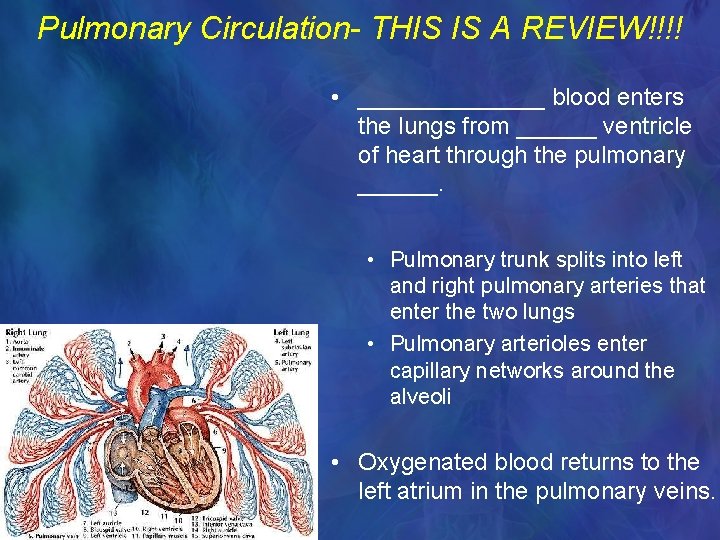
Pulmonary Circulation- THIS IS A REVIEW!!!! • _______ blood enters the lungs from ______ ventricle of heart through the pulmonary ______. • Pulmonary trunk splits into left and right pulmonary arteries that enter the two lungs • Pulmonary arterioles enter capillary networks around the alveoli • Oxygenated blood returns to the left atrium in the pulmonary veins.
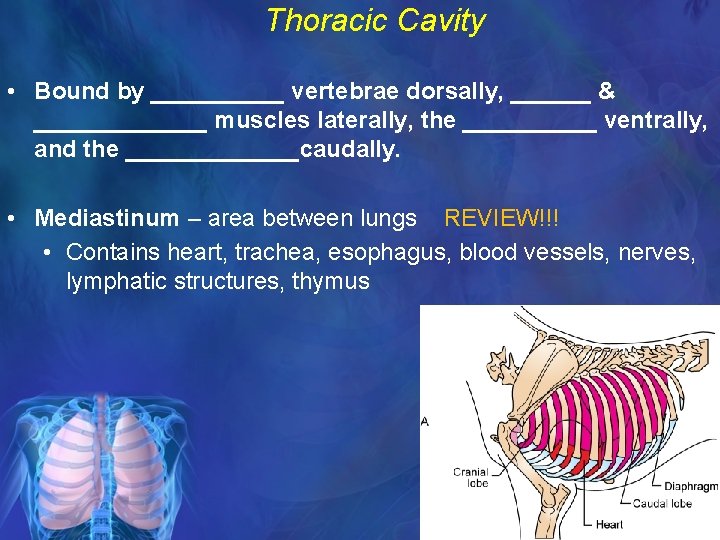
Thoracic Cavity • Bound by _____ vertebrae dorsally, ______ & _______ muscles laterally, the _____ ventrally, and the _______caudally. • Mediastinum – area between lungs REVIEW!!! • Contains heart, trachea, esophagus, blood vessels, nerves, lymphatic structures, thymus

Pleura- REVIEW!!! • Serous membrane that lines thoracic cavity and covers organs and structures in thorax • _____ layer covers thoracic organs and structures • _____ layer lines the cavity • Space between the two pleural layers is filled with a small amount of pleural _____ (same in abdomen, pericardium) • Helps ensure that surfaces of organs slide smoothly along lining of thorax during breathing (________)
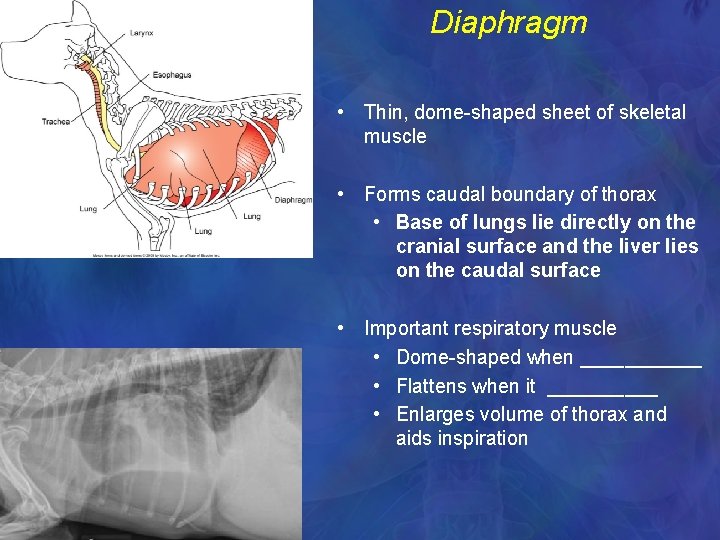
Diaphragm • Thin, dome-shaped sheet of skeletal muscle • Forms caudal boundary of thorax • Base of lungs lie directly on the cranial surface and the liver lies on the caudal surface • Important respiratory muscle • Dome-shaped when ______ • Flattens when it _____ • Enlarges volume of thorax and aids inspiration
Process of Respiration • Requires effective movement of air into and out of lungs at an appropriate rate and in sufficient volume to meet the body’s needs at any particular time. • Pressure within the thorax is ______ with respect to atmospheric pressure. • Pulls lungs tight against the thoracic wall • Flexible nature of lungs allows them to conform with shape of the thoracic wall. • Pleural fluid provides _____. • Lungs follow movements of thoracic wall • Negative intrathoracic pressure helps draw blood through ____ in the mediastinum and into atria
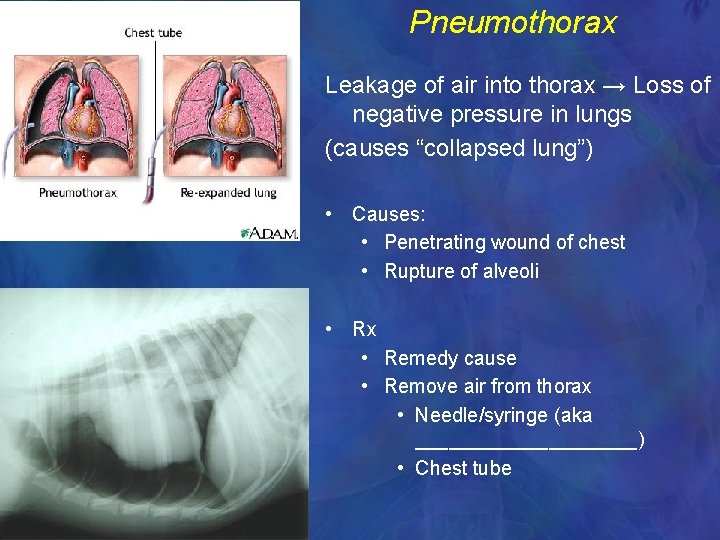
Pneumothorax Leakage of air into thorax → Loss of negative pressure in lungs (causes “collapsed lung”) • Causes: • Penetrating wound of chest • Rupture of alveoli • Rx • Remedy cause • Remove air from thorax • Needle/syringe (aka __________) • Chest tube
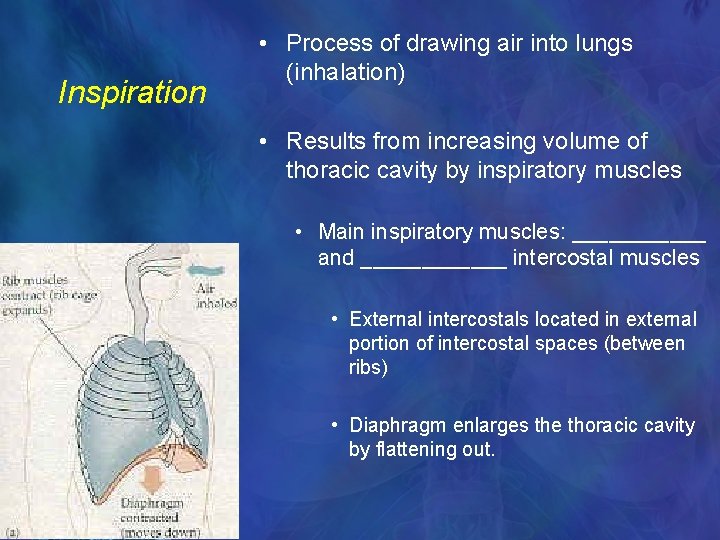
Inspiration • Process of drawing air into lungs (inhalation) • Results from increasing volume of thoracic cavity by inspiratory muscles • Main inspiratory muscles: ______ and ______ intercostal muscles • External intercostals located in external portion of intercostal spaces (between ribs) • Diaphragm enlarges the thoracic cavity by flattening out.
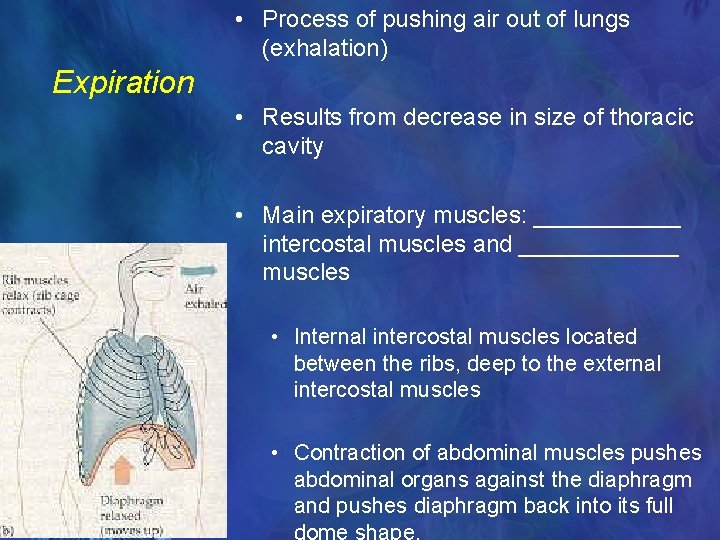
• Process of pushing air out of lungs (exhalation) Expiration • Results from decrease in size of thoracic cavity • Main expiratory muscles: ______ intercostal muscles and ______ muscles • Internal intercostal muscles located between the ribs, deep to the external intercostal muscles • Contraction of abdominal muscles pushes abdominal organs against the diaphragm and pushes diaphragm back into its full dome shape.
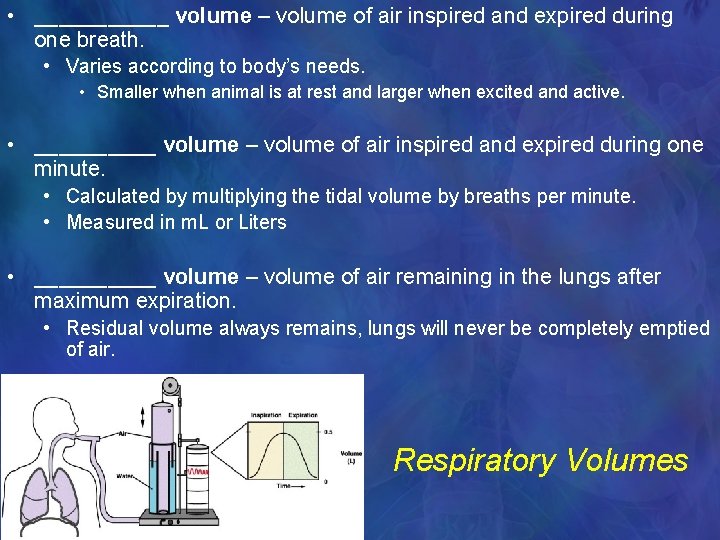
• ______ volume – volume of air inspired and expired during one breath. • Varies according to body’s needs. • Smaller when animal is at rest and larger when excited and active. • _____ volume – volume of air inspired and expired during one minute. • Calculated by multiplying the tidal volume by breaths per minute. • Measured in m. L or Liters • _____ volume – volume of air remaining in the lungs after maximum expiration. • Residual volume always remains, lungs will never be completely emptied of air. Respiratory Volumes
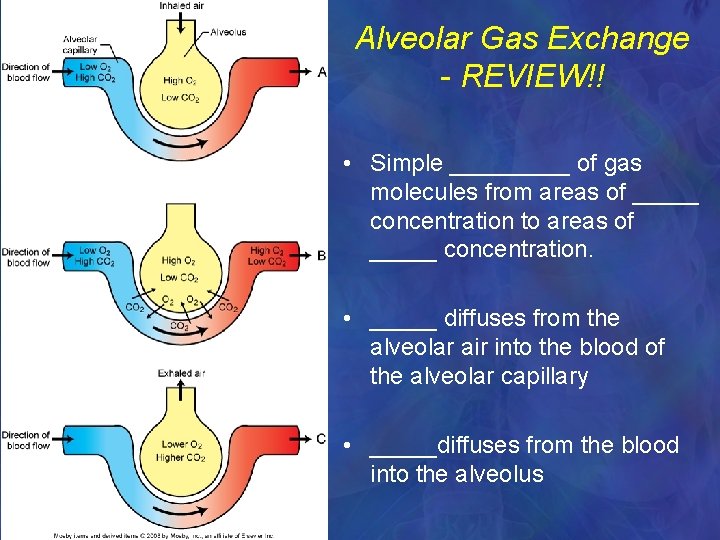
Alveolar Gas Exchange - REVIEW!! • Simple _____ of gas molecules from areas of _____ concentration to areas of _____ concentration. • _____ diffuses from the alveolar air into the blood of the alveolar capillary • _____diffuses from the blood into the alveolus
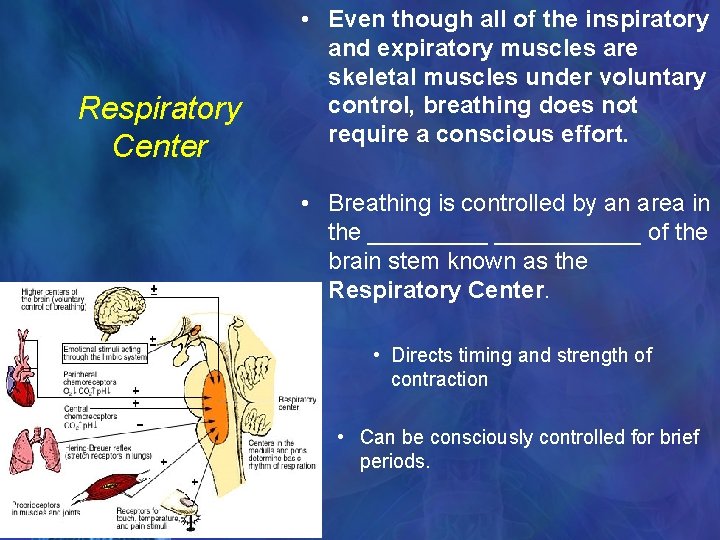
Respiratory Center • Even though all of the inspiratory and expiratory muscles are skeletal muscles under voluntary control, breathing does not require a conscious effort. • Breathing is controlled by an area in the ___________ of the brain stem known as the Respiratory Center. • Directs timing and strength of contraction • Can be consciously controlled for brief periods.
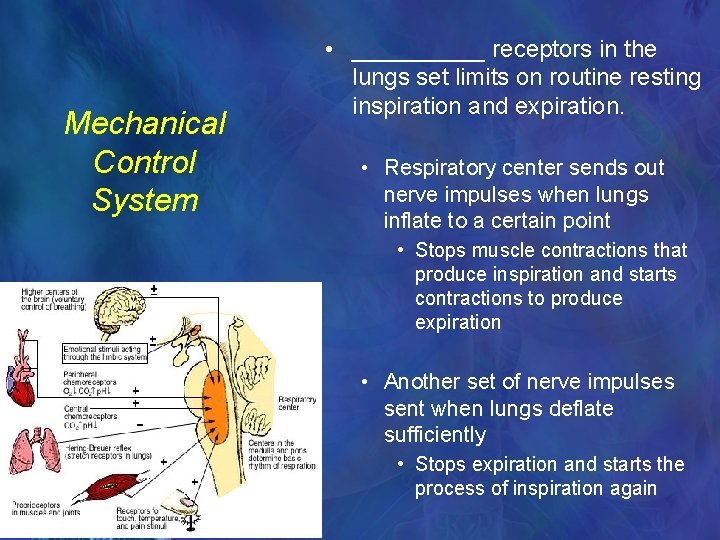
Mechanical Control System • _____ receptors in the lungs set limits on routine resting inspiration and expiration. • Respiratory center sends out nerve impulses when lungs inflate to a certain point • Stops muscle contractions that produce inspiration and starts contractions to produce expiration • Another set of nerve impulses sent when lungs deflate sufficiently • Stops expiration and starts the process of inspiration again
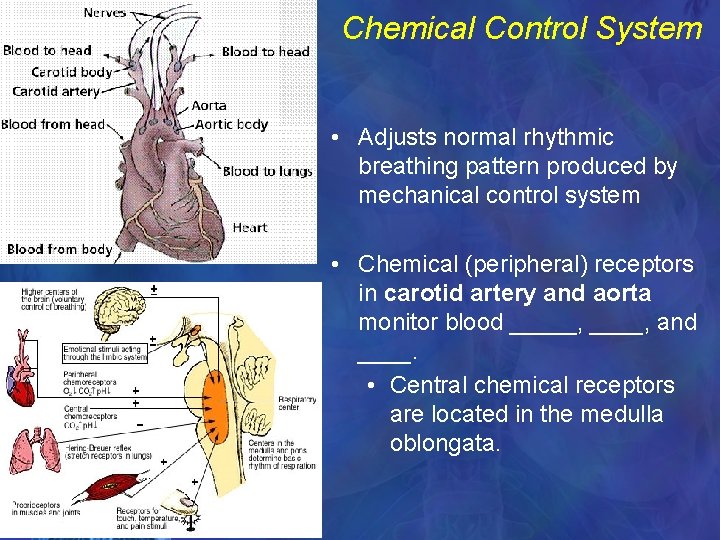
Chemical Control System • Adjusts normal rhythmic breathing pattern produced by mechanical control system • Chemical (peripheral) receptors in carotid artery and aorta monitor blood _____, and ____. • Central chemical receptors are located in the medulla oblongata.
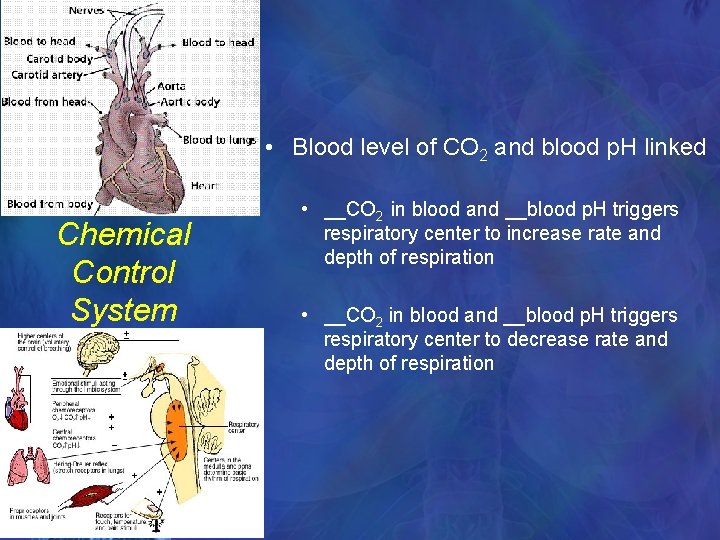
• Blood level of CO 2 and blood p. H linked Chemical Control System • __CO 2 in blood and __blood p. H triggers respiratory center to increase rate and depth of respiration • __CO 2 in blood and __blood p. H triggers respiratory center to decrease rate and depth of respiration
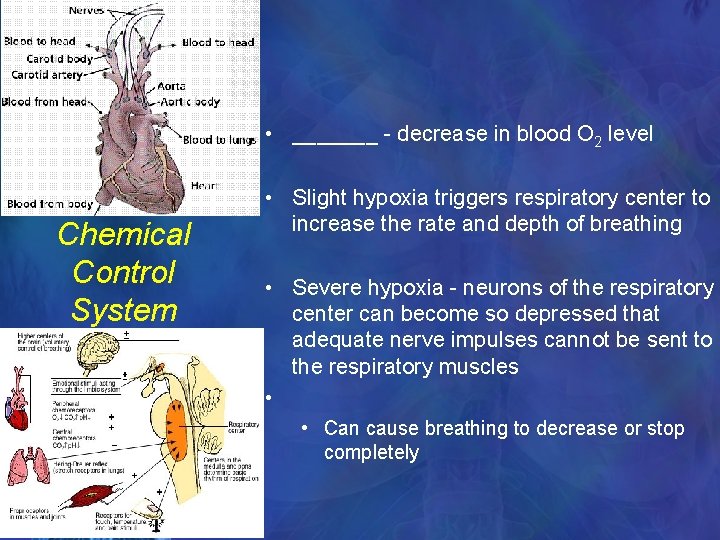
• _______ - decrease in blood O 2 level Chemical Control System • Slight hypoxia triggers respiratory center to increase the rate and depth of breathing • Severe hypoxia - neurons of the respiratory center can become so depressed that adequate nerve impulses cannot be sent to the respiratory muscles • • Can cause breathing to decrease or stop completely
- Slides: 15