
Pulmonary Artery PressureGuided Therapy for Ambulatory Heart Failure
Pulmonary Artery Pressure-Guided Therapy for Ambulatory Heart Failure Patients in Clinical Practice: 1 -Year Outcomes from the Cardio. MEMS Post-Approval Study David M. Shavelle MD 1, Akshay S. Desai MD, William T. Abraham MD, Robert C. Bourge MD, Nirav Raval MD, Lisa D. Rathman NP, J. Thomas J. Heywood MD, Rita A. Jermyn MD, Jamie Pelzel MD, Orvar T. Jonsson MD, Maria Rosa Costanzo MD, John D. Henderson, Sandra A. Carey Ph. D, Philip B. Adamson MD and Lynne W. Stevenson MD for the Cardio. MEMS PAS Investigators 1 Division of Cardiology, University of Southern California, Los Angeles, CA Registration: www. clinicaltrials. gov, NCT 02279888
Disclosure Statement David M. Shavelle, MD Consulting fees: Abbott Vascular Research Support: Abbott Vascular, Abiomed, NIH, v-wave Medical, Bio. Cardia
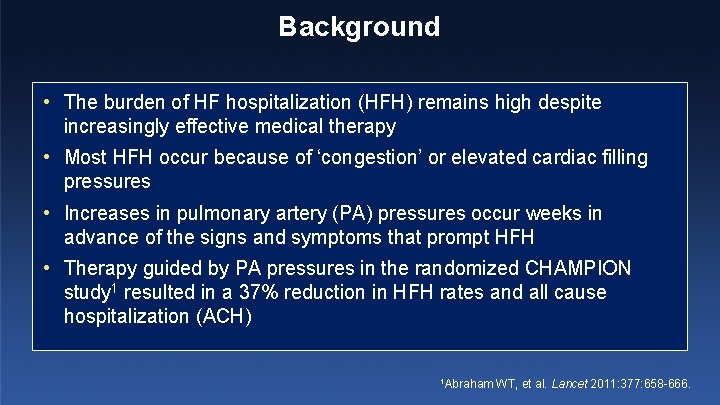
Background • The burden of HF hospitalization (HFH) remains high despite increasingly effective medical therapy • Most HFH occur because of ‘congestion’ or elevated cardiac filling pressures • Increases in pulmonary artery (PA) pressures occur weeks in advance of the signs and symptoms that prompt HFH • Therapy guided by PA pressures in the randomized CHAMPION study 1 resulted in a 37% reduction in HFH rates and all cause hospitalization (ACH) 1 Abraham WT, et al. Lancet 2011: 377: 658 -666.

Cardio. MEMS-HF system: Ambulatory Hemodynamic Monitoring with an Implantable PAP Sensor Home electronics unit Database PA pressure trend data Systolic PAP Mean PAP Diastolic PAP Daily PA measurement
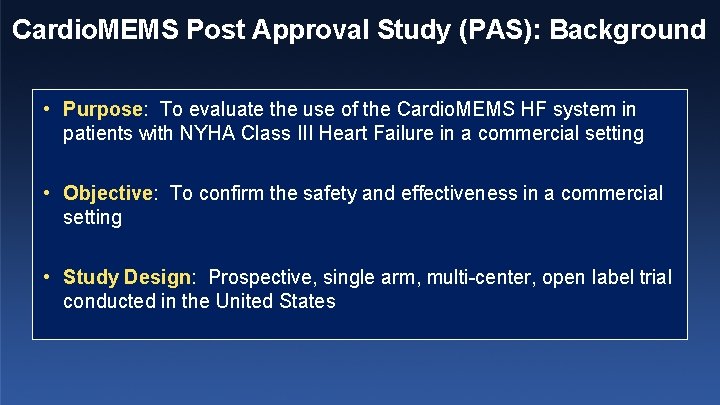
Cardio. MEMS Post Approval Study (PAS): Background • Purpose: To evaluate the use of the Cardio. MEMS HF system in patients with NYHA Class III Heart Failure in a commercial setting • Objective: To confirm the safety and effectiveness in a commercial setting • Study Design: Prospective, single arm, multi-center, open label trial conducted in the United States
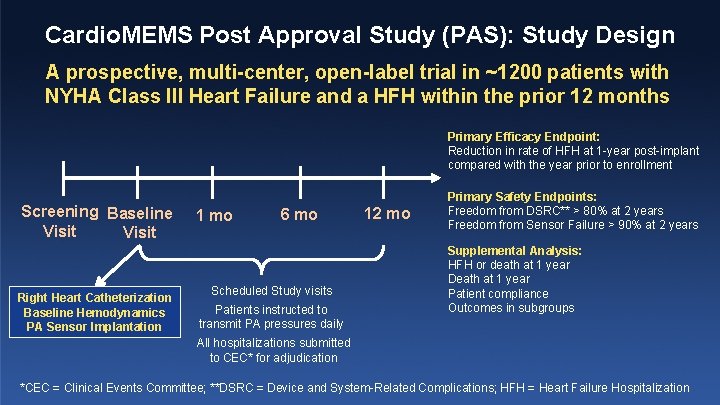
Cardio. MEMS Post Approval Study (PAS): Study Design A prospective, multi-center, open-label trial in ~1200 patients with NYHA Class III Heart Failure and a HFH within the prior 12 months Primary Efficacy Endpoint: Reduction in rate of HFH at 1 -year post-implant compared with the year prior to enrollment Screening Baseline Visit Right Heart Catheterization Baseline Hemodynamics PA Sensor Implantation 1 mo 6 mo Scheduled Study visits Patients instructed to transmit PA pressures daily 12 mo Primary Safety Endpoints: Freedom from DSRC** > 80% at 2 years Freedom from Sensor Failure > 90% at 2 years Supplemental Analysis: HFH or death at 1 year Death at 1 year Patient compliance Outcomes in subgroups All hospitalizations submitted to CEC* for adjudication *CEC = Clinical Events Committee; **DSRC = Device and System-Related Complications; HFH = Heart Failure Hospitalization

Inclusion Criteria 1. NYHA class III heart failure 2. At least 1 HFH within the previous 12 months 3. Patients with HFr. EF should be receiving a beta blocker for 3 months and an ACE-I or ARB for 1 month unless in the investigator's opinion, the patient is intolerant to beta blocker, ACE-I or ARB 4. Patients with BMI > 35 required chest circumference (at mid axillary level) to be < 65 inches 5. PA branch diameter ≥ 7 mm Exclusion Criteria 1. 2. Active infection History of recurrent (> 1) pulmonary embolism or deep vein thrombosis 3. Inability to tolerate right heart catheterization 4. A major cardiovascular event (e. g. , myocardial infarction, open heart surgery, cerebral vascular accident) within previous 2 months 5. CRT implanted within previous 3 months 6. GFR < 25 ml/min who are non-responsive to diuretic therapy or who are on chronic renal dialysis 7. Congenital heart disease or mechanical right heart valve 8. Likely to undergo heart transplantation or VAD within the next 6 months 9. Known coagulation disorders 10. Hypersensitivity or allergy to aspirin, and/or clopidogrel
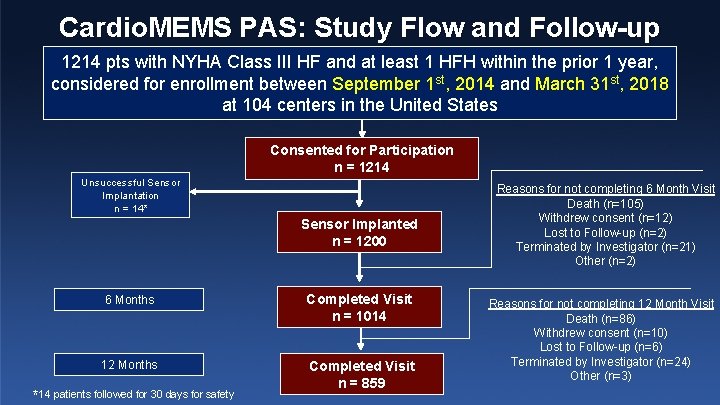
Cardio. MEMS PAS: Study Flow and Follow-up 1214 pts with NYHA Class III HF and at least 1 HFH within the prior 1 year, considered for enrollment between September 1 st, 2014 and March 31 st, 2018 at 104 centers in the United States Consented for Participation n = 1214 Unsuccessful Sensor Implantation n = 14* Sensor Implanted n = 1200 6 Months Completed Visit n = 1014 12 Months Completed Visit n = 859 *14 patients followed for 30 days for safety Reasons for not completing 6 Month Visit Death (n=105) Withdrew consent (n=12) Lost to Follow-up (n=2) Terminated by Investigator (n=21) Other (n=2) Reasons for not completing 12 Month Visit Death (n=86) Withdrew consent (n=10) Lost to Follow-up (n=6) Terminated by Investigator (n=24) Other (n=3)
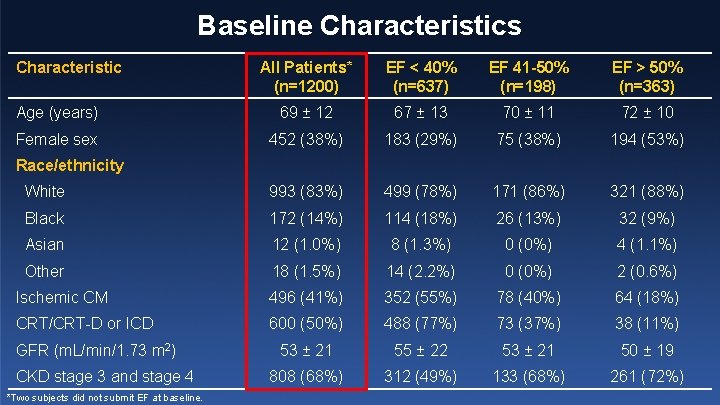
Baseline Characteristics Characteristic All Patients* (n=1200) EF < 40% (n=637) EF 41 -50% (n=198) EF > 50% (n=363) Age (years) 69 ± 12 67 ± 13 70 ± 11 72 ± 10 Female sex 452 (38%) 183 (29%) 75 (38%) 194 (53%) White 993 (83%) 499 (78%) 171 (86%) 321 (88%) Black 172 (14%) 114 (18%) 26 (13%) 32 (9%) Asian 12 (1. 0%) 8 (1. 3%) 0 (0%) 4 (1. 1%) Other 18 (1. 5%) 14 (2. 2%) 0 (0%) 2 (0. 6%) Ischemic CM 496 (41%) 352 (55%) 78 (40%) 64 (18%) CRT/CRT-D or ICD 600 (50%) 488 (77%) 73 (37%) 38 (11%) 53 ± 21 55 ± 22 53 ± 21 50 ± 19 808 (68%) 312 (49%) 133 (68%) 261 (72%) Race/ethnicity GFR (m. L/min/1. 73 m 2) CKD stage 3 and stage 4 *Two subjects did not submit EF at baseline.
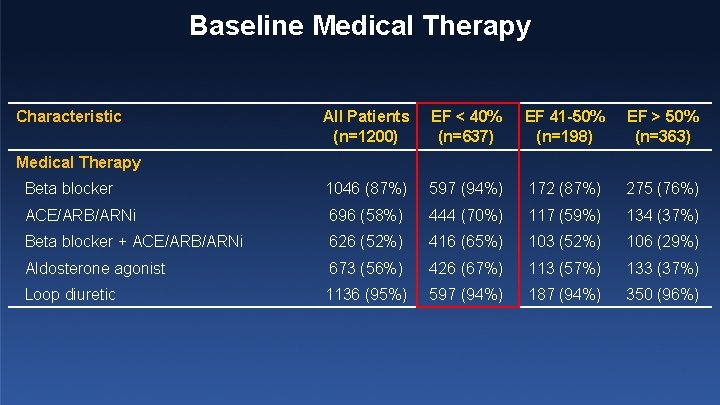
Baseline Medical Therapy Characteristic All Patients (n=1200) EF < 40% (n=637) EF 41 -50% (n=198) EF > 50% (n=363) Beta blocker 1046 (87%) 597 (94%) 172 (87%) 275 (76%) ACE/ARB/ARNi 696 (58%) 444 (70%) 117 (59%) 134 (37%) Beta blocker + ACE/ARB/ARNi 626 (52%) 416 (65%) 103 (52%) 106 (29%) Aldosterone agonist 673 (56%) 426 (67%) 113 (57%) 133 (37%) Loop diuretic 1136 (95%) 597 (94%) 187 (94%) 350 (96%) Medical Therapy
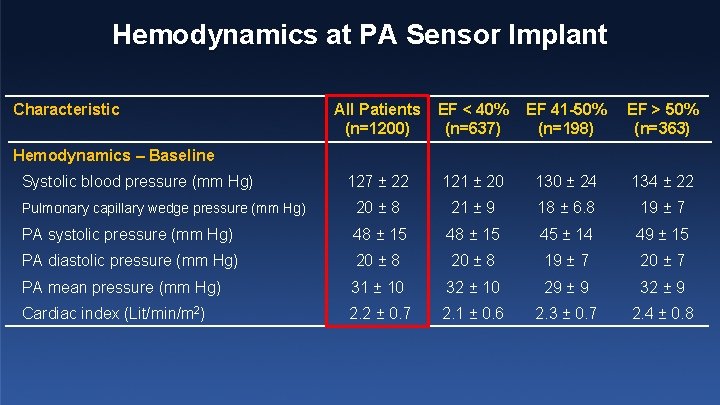
Hemodynamics at PA Sensor Implant Characteristic All Patients (n=1200) EF < 40% (n=637) EF 41 -50% (n=198) EF > 50% (n=363) 127 ± 22 121 ± 20 130 ± 24 134 ± 22 Pulmonary capillary wedge pressure (mm Hg) 20 ± 8 21 ± 9 18 ± 6. 8 19 ± 7 PA systolic pressure (mm Hg) 48 ± 15 45 ± 14 49 ± 15 PA diastolic pressure (mm Hg) 20 ± 8 19 ± 7 20 ± 7 PA mean pressure (mm Hg) 31 ± 10 32 ± 10 29 ± 9 32 ± 9 Cardiac index (Lit/min/m 2) 2. 2 ± 0. 7 2. 1 ± 0. 6 2. 3 ± 0. 7 2. 4 ± 0. 8 Hemodynamics – Baseline Systolic blood pressure (mm Hg)
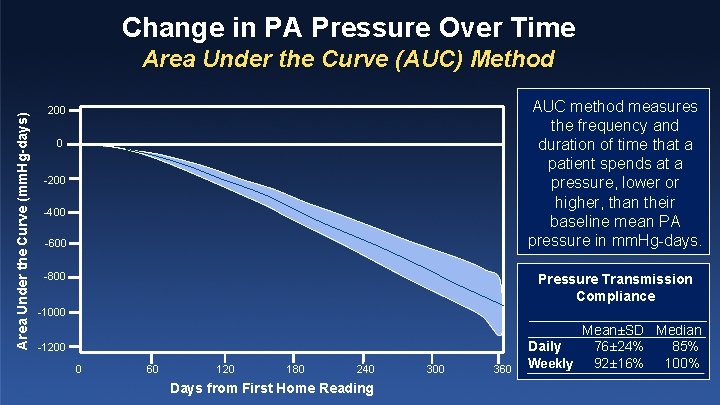
Change in PA Pressure Over Time Area Under the Curve (mm. Hg-days) Area Under the Curve (AUC) Method AUC method measures the frequency and duration of time that a patient spends at a pressure, lower or higher, than their baseline mean PA pressure in mm. Hg-days. 200 0 -200 -400 -600 -800 Pressure Transmission Compliance -1000 -1200 0 60 120 180 240 Days from First Home Reading 300 360 Mean±SD Median Daily 76± 24% 85% Weekly 92± 16% 100%
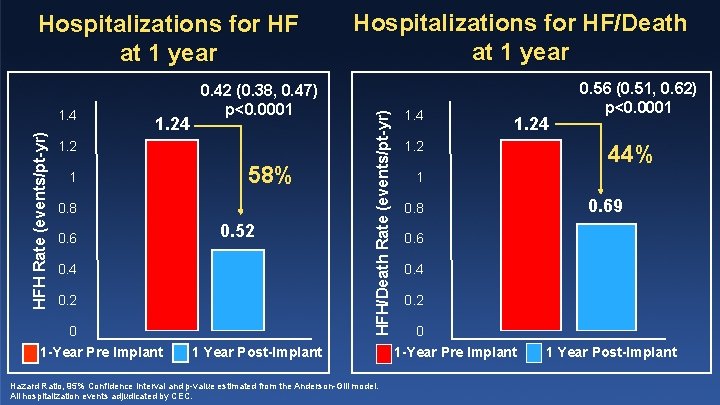
HFH Rate (events/pt-yr) 1. 4 1. 24 0. 42 (0. 38, 0. 47) p<0. 0001 1. 2 1 58% 0. 8 0. 6 0. 52 0. 4 0. 2 0 1 -Year Pre Implant Hospitalizations for HF/Death at 1 year HFH/Death Rate (events/pt-yr) Hospitalizations for HF at 1 year 1 Year Post-Implant Hazard Ratio, 95% Confidence Interval and p-value estimated from the Anderson-Gill model. All hospitalization events adjudicated by CEC. 1. 4 1. 2 0. 56 (0. 51, 0. 62) p<0. 0001 44% 1 0. 8 0. 69 0. 6 0. 4 0. 2 0 1 -Year Pre Implant 1 Year Post-Implant
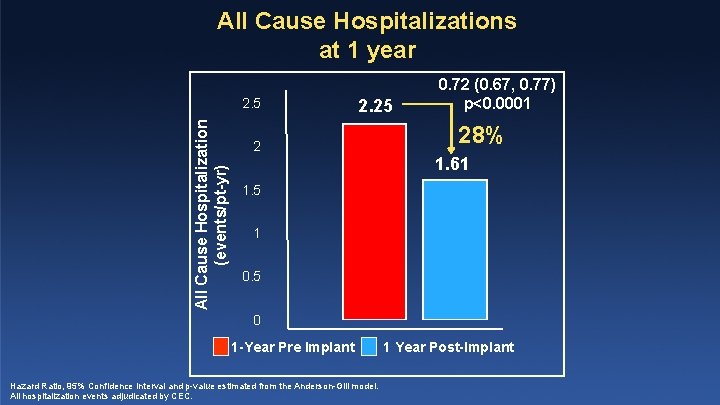
All Cause Hospitalizations at 1 year All Cause Hospitalization (events/pt-yr) 2. 5 2. 25 2 0. 72 (0. 67, 0. 77) p<0. 0001 28% 1. 61 1. 5 1 0. 5 0 1 -Year Pre Implant Hazard Ratio, 95% Confidence Interval and p-value estimated from the Anderson-Gill model. All hospitalization events adjudicated by CEC. 1 Year Post-Implant
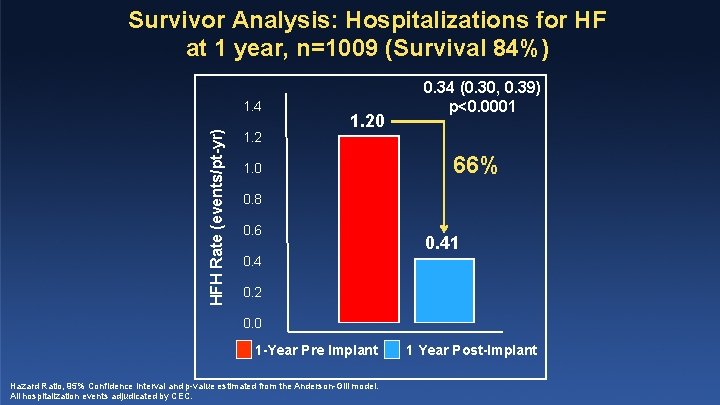
Survivor Analysis: Hospitalizations for HF at 1 year, n=1009 (Survival 84%) HFH Rate (events/pt-yr) 1. 4 1. 20 1. 0 0. 34 (0. 30, 0. 39) p<0. 0001 66% 0. 8 0. 6 0. 41 0. 4 0. 2 0. 0 1 -Year Pre Implant Hazard Ratio, 95% Confidence Interval and p-value estimated from the Anderson-Gill model. All hospitalization events adjudicated by CEC. 1 Year Post-Implant
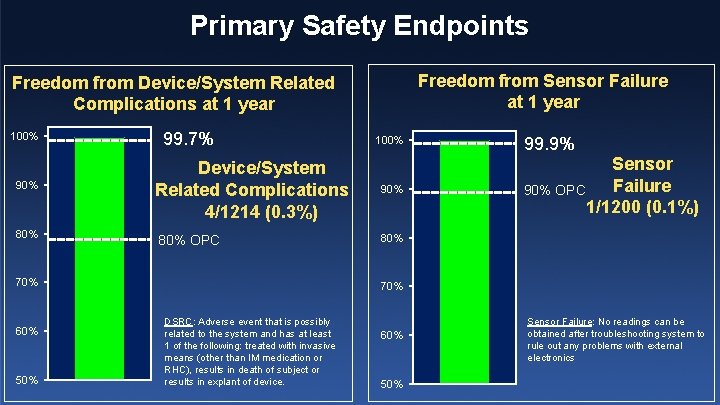
Primary Safety Endpoints Freedom from Sensor Failure at 1 year Freedom from Device/System Related Complications at 1 year 100% 90% 80% 99. 7% Device/System Related Complications 4/1214 (0. 3%) 80% OPC 70% 60% 50% 100% 99. 9% Sensor Failure 90% OPC 1/1200 (0. 1%) 80% 70% DSRC: Adverse event that is possibly related to the system and has at least 1 of the following: treated with invasive means (other than IM medication or RHC), results in death of subject or results in explant of device. 60% 50% Sensor Failure: No readings can be obtained after troubleshooting system to rule out any problems with external electronics
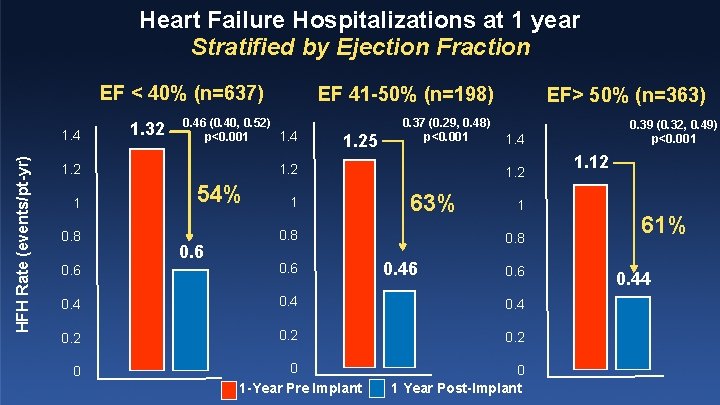
Heart Failure Hospitalizations at 1 year Stratified by Ejection Fraction EF < 40% (n=637) HFH Rate (events/pt-yr) 1. 4 1. 32 0. 46 (0. 40, 0. 52) 1. 4 p<0. 001 0. 8 1. 25 0. 37 (0. 29, 0. 48) p<0. 001 1. 2 1 EF 41 -50% (n=198) 54% 0. 6 1 EF> 50% (n=363) 1. 4 1. 2 63% 0. 8 1 0. 8 0. 46 0. 4 0. 2 0 0 1 -Year Pre Implant 0. 39 (0. 32, 0. 49) p<0. 001 0. 6 0 1 Year Post-Implant 1. 12 61% 0. 44
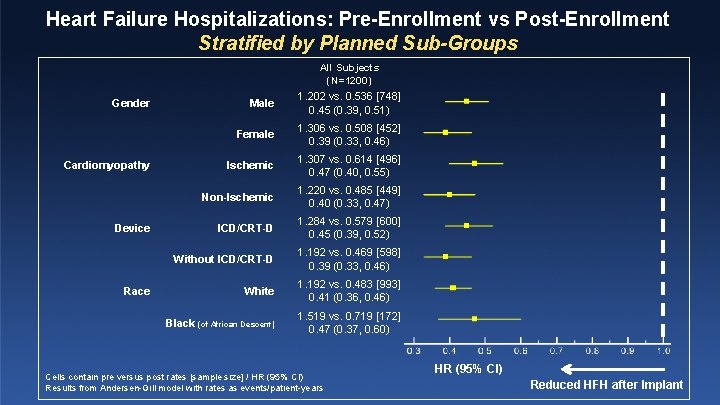
Heart Failure Hospitalizations: Pre-Enrollment vs Post-Enrollment Stratified by Planned Sub-Groups All Subjects (N=1200) Gender Cardiomyopathy Device Race Male 1. 202 vs. 0. 536 [748] 0. 45 (0. 39, 0. 51) Female 1. 306 vs. 0. 508 [452] 0. 39 (0. 33, 0. 46) Ischemic 1. 307 vs. 0. 614 [496] 0. 47 (0. 40, 0. 55) Non-Ischemic 1. 220 vs. 0. 485 [449] 0. 40 (0. 33, 0. 47) ICD/CRT-D 1. 284 vs. 0. 579 [600] 0. 45 (0. 39, 0. 52) Without ICD/CRT-D 1. 192 vs. 0. 469 [598] 0. 39 (0. 33, 0. 46) White 1. 192 vs. 0. 483 [993] 0. 41 (0. 36, 0. 46) Black (of African Descent) 1. 519 vs. 0. 719 [172] 0. 47 (0. 37, 0. 60) Cells contain pre versus post rates [sample size] / HR (95% CI) Results from Andersen-Gill model with rates as events/patient-years HR (95% CI) Reduced HFH after Implant
Limitations • • • Single arm study with prior to and post-enrollment comparisons Likely underestimation of HFH events prior to enrollment due to incomplete recall of events (information bias) Censoring at the time of death may have resulted in survivor bias, however: • HFH/death for the entire cohort reduced 44% • HFH for survivors reduced 66% PAS enrolled high risk patients: baseline event rate ~ 2 x higher than CHAMPION Comparable efficacy to prior studies: • Open Access Study ‘prior control group’: HFH/death reduced 39% • Cadio. MEMS PAS: HFH/death reduced 44%
Conclusions • In the commercial setting, PA pressure-guided therapy for HF: • Decreased PA pressures • Decreased HF Hospitalizations • Across sex and race • Across all EF ranges • Amongst 1 -year survivors • Decreased All-Cause Hospitalization • PA pressure-guided therapy was safe with few device/system related complications and a low rate of pressure sensor failure
Cardio. MEMS PAS Leadership • Steering Committee Lynne W. Stevenson (Chair), William T. Abraham, Robert C. Bourge, Maria Rosa Costanzo, Akshay S. Desai, J. Thomas Haywood, Lisa D. Rathman, Nirav Raval, David M. Shavelle, Richard Shlofmitz • Clinical Events Committee ¡ ¡ Alan Miller, Chair University of Florida ¡ Peter Carson Georgetown University ¡ Eugene Chung Christ Hospital ¡ Edward Michael Gilbert University of Utah ¡ Paul Hauptman University of Tennessee ¡ Wayne Levy University of Washington John Teerlink • Sponsor ¡ Abbott, Santa Clara, CA ¡ UC San Francisco
- Slides: 21