
Pulling It All Together Maintaining a balanced perspective
Pulling It All Together Maintaining a balanced perspective of assessment processes in the IR office TAIR 2002 Corpus Christi, Texas
Pulling It All Together • Organizing your workload • Sandra Shingleur • Research Assistant, Texas A&M University Texarkana • Dealing with persistent challenges • Lillian Young • Director of Institutional Effectiveness, Central Texas College, Killeen TAIR 2002
Pulling It All Together • Keeping research at the top of your priorities • Julie Thomas • Coordinator of Institutional Research, Central Texas College, Killeen • Managing external mandates • Dick Roach • Director of Institutional Effectiveness, Texas A&M University Texarkana TAIR 2002

Pulling It All Together Organizing your workload –Sandra Shingleur TAIR 2002 Corpus Christi, Texas
Organizing your workload Keeping track of the tasks and prioritizing the projects can add a valuable sense of control to your office. • Building a tracking matrix can help keep you on task when the projects pile up, and can help you to effectively delegate and manage projects. TAIR 2002
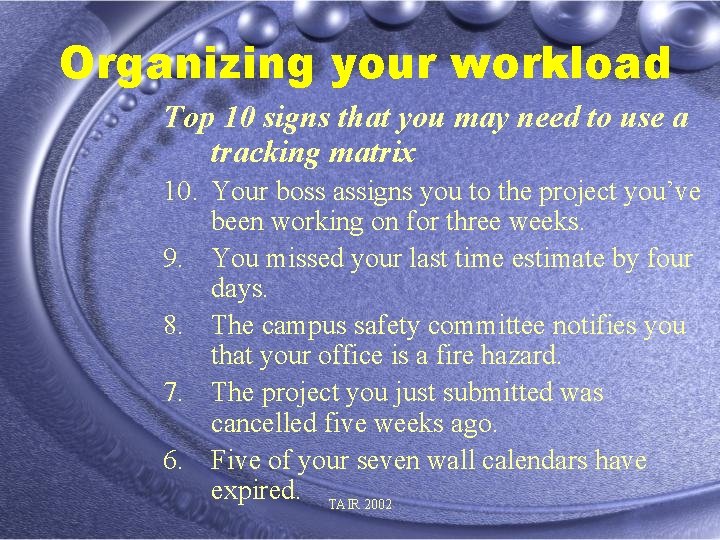
Organizing your workload Top 10 signs that you may need to use a tracking matrix 10. Your boss assigns you to the project you’ve been working on for three weeks. 9. You missed your last time estimate by four days. 8. The campus safety committee notifies you that your office is a fire hazard. 7. The project you just submitted was cancelled five weeks ago. 6. Five of your seven wall calendars have expired. TAIR 2002
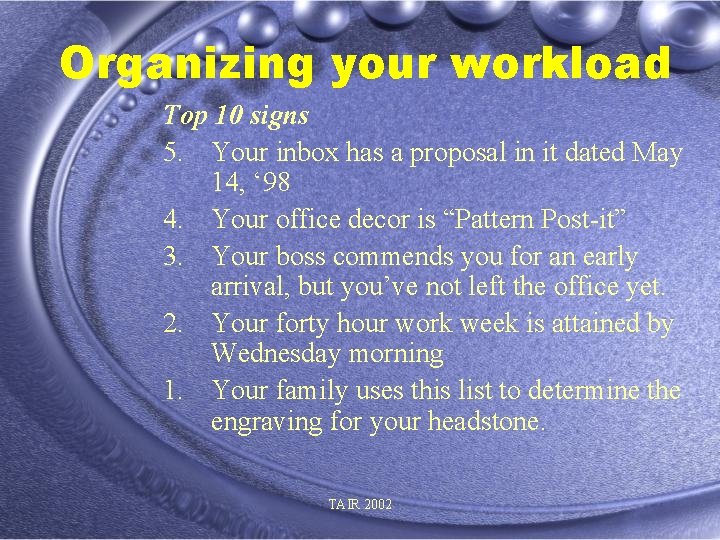
Organizing your workload Top 10 signs 5. Your inbox has a proposal in it dated May 14, ‘ 98 4. Your office decor is “Pattern Post it” 3. Your boss commends you for an early arrival, but you’ve not left the office yet. 2. Your forty hour work week is attained by Wednesday morning 1. Your family uses this list to determine the engraving for your headstone. TAIR 2002
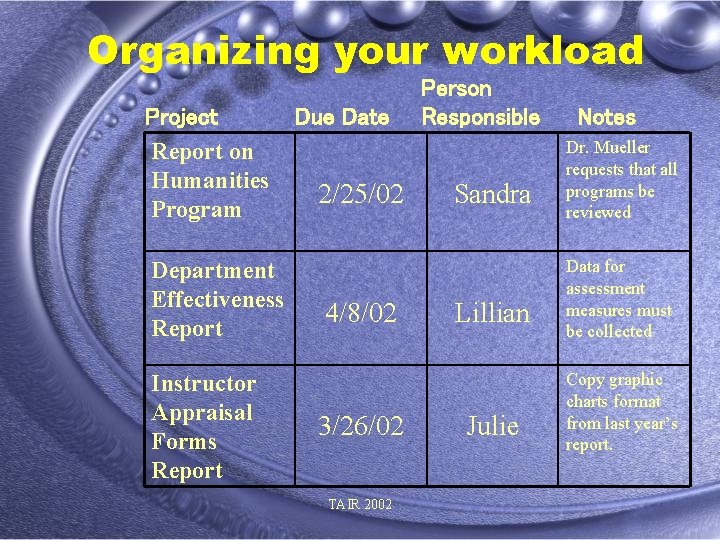
Organizing your workload Project Report on Humanities Program Department Effectiveness Report Instructor Appraisal Forms Report Due Date 2/25/02 4/8/02 3/26/02 TAIR 2002 Person Responsible Sandra Lillian Julie Notes Dr. Mueller requests that all programs be reviewed Data for assessment measures must be collected Copy graphic charts format from last year’s report.
Organizing your workload • Prioritizing those tasks can be as simple as asking yourself some basic questions: TAIR 2002
Organizing your workload • Will this project contribute significantly to the goals of the institution and/or department? • Is there another project that demands my attention? – Is it important? – Or is it urgent? • Who are the major stakeholders in this project? TAIR 2002
Organizing your workload • What will happen if the project is delayed? • What are the manageable components of the project? • Can this entire project be delegated? • Can part of the project be delegated? • Is there another study that provides much the same information? TAIR 2002
Organizing your workload “As a field of higher education, institutional research will be fruitful and gather strength if the individual researcher neither allows himself to be intimidated by those who wish to save our institutions through pervasive management un-tempered by social conscience nor permits himself to ignore the value to be derived from management tools when aptly applied… TAIR 2002
Organizing your workload “If we are pretentious in our pride for our achievements to date, then let us simply accept it: if we are satisfied to rest with this achievement we are foolish, and if we cannot accelerate and enlarge on our achievements, then I for one, will be damned disappointed. ” ~Sidney Suslow~ TAIR 2002
Pulling It All Together Dealing with persistent challenges –Lillian Young TAIR 2002 Corpus Christi, Texas

Dealing with Persistent challenges • • Prioritizing IR tasks Inconsistent data Inaccurate information Reports too complex Conflicting data Making recommendations Replicating reports TAIR 2002

Persistent challenges • Prioritizing IR tasks – Proactive vs. reactive – Anticipate needs – Review efficiency – Delegate – Negotiate priorities – Relate priorities to purpose – Communicate with constituents – Catalog reports and services TAIR 2002

Persistent challenges • Inconsistent data – Review data collection methods – Review procedures, noting: • Sharp changes in data • Where new systems came on-line • Where new staff were employed • Document inconsistencies • Document procedures for correction TAIR 2002
Persistent challenges • Inconsistent data (cont. ) – Document changes in collection procedures – Correlate definitions – Maintain error diagnostics plan – Document limitations of data TAIR 2002
Persistent challenges • Inaccurate information – Review data collection methods – Build cooperation with other departments – Assess the capabilities and limitations of information systems TAIR 2002
Persistent challenges • Inaccurate information (cont. ) – Build processes that address system and staff limitations • • Evaluate information systems processes Document limitations Establish team processes to address system limitations Promote institutional information systems upgrades – Establish IR’s role in information systems design TAIR 2002
Persistent challenges • Reports too complex – Establish client objectives – An executive summary – Avoid statistics in the narrative – Use most effective statistical tool – Simplify explanation of complex statistical techniques TAIR 2002
Persistent challenges • Conflicting data – Look for: • Changes in data collection procedures • Installation of new data system • Policy changes affecting data – Document inconsistencies and corrective actions TAIR 2002
Persistent challenges • Conflicting data (cont. ) – Procedures manual – Evaluate data definitions across the institution and other organizations – Routine to detect and correct data errors • Checks and trends • Rules for anomalies • Program error diagnostics • Relational edits TAIR 2002
Persistent challenges • Conflicting data (cont. ) – Explain limitations of the data – Share “preliminary reports” with key personnel TAIR 2002
Persistent challenges • Making recommendations – Provide alternate actions • Steer studies to “issues” orientation • Keep it relevant – Maintain “problem-solution” orientation – Present alternate solutions • Estimate advantages and disadvantages • Recommend one solution as best TAIR 2002
Persistent challenges • Replicating reports – Detail inventory of reports – Negotiate maximum use of existing data and reports – Expand report formats for broader utilization – Simplify report formats for intensity of impact TAIR 2002
Pulling It All Together Keeping research at the top of your priorities –Julie Thomas TAIR 2002 Corpus Christi, Texas
Keeping research at the top of your priorities • Prioritizing IR tasks • Time management for research • Avoid duplicating efforts • Utilizing the research committee TAIR 2002
Keeping research at the top of your priorities • Prioritizing IR tasks – Two Dimensions • Importance • Urgency TAIR 2002
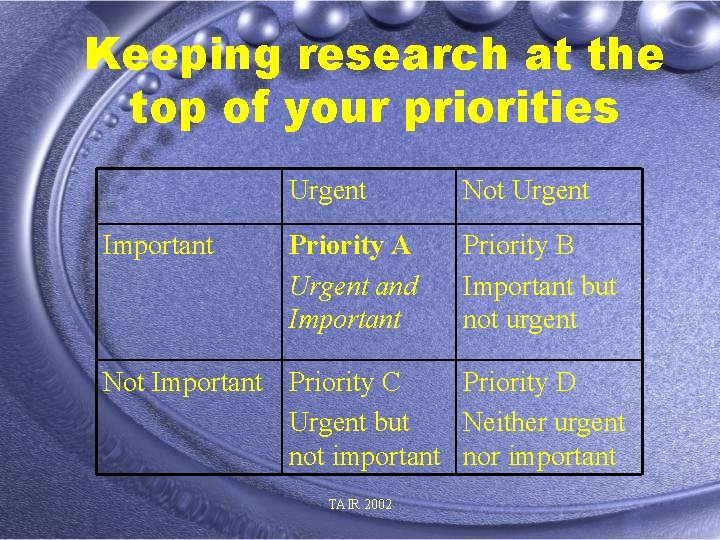
Keeping research at the top of your priorities Important Urgent Not Urgent Priority A Urgent and Important Priority B Important but not urgent Not Important Priority C Priority D Urgent but Neither urgent not important nor important TAIR 2002
Keeping research at the top of your priorities • Time management for research – Long Term Goals – “To do” lists – The Lakein Question TAIR 2002
Keeping research at the top of your priorities • Time management for research • Personal Long Term Goals – Which of the institution’s goals will make the greatest impact? – What would you like to accomplish at your institution in the next 3 years? – If you had only one report to influence the future of your institution, what would you choose? • Institutional mission and goals TAIR 2002
Keeping research at the top of your priorities • Time management for research –“To do” lists –Reasonable –Sufficient TAIR 2002
Keeping research at the top of your priorities • Time management for research –The Lakein* Question: “What is the best use of my time RIGHT NOW? * Lakein, Alan (1974). How to Get Control of your time and Your Life. Signet: New York. TAIR 2002
Keeping research at the top of your priorities • Time management for research –Avoid working on a single tedious task for extended periods –Work alternately on tasks requiring different skills, but maintain focus on priorities! –Accommodate your and others’ good and bad times of day TAIR 2002
Keeping research at the top of your priorities • Avoid duplicative efforts – Recycle your data – Check to see if it’s been done – Make your data available to others TAIR 2002
Keeping research at the top of your priorities • Utilizing the research committee – Presentations by department heads – Internal/External analysis – Experience and knowledge of diverse committee members TAIR 2002
Keeping research at the top of your priorities • If there is no research committee, strive for appointment to key committees to: – Learn what’s on the horizon – Offer research assistance for decision making – Make sure you have clear questions to answer, to avoid duplicating effort. TAIR 2002
Pulling It All Together Managing external mandates –Dick Roach TAIR 2002 Corpus Christi, Texas
Managing external mandates Frequently, the work of the IR office is driven by unseen external mandates. Identifying, prioritizing and coordinating these can help researchers manage the tasks at hand. TAIR 2002
Managing external mandates • • Common external drivers State mandates System plans Developing a management system TAIR 2002
Managing external mandates Common external drivers • Governing Boards – Texas Higher Education Coordinating Board (THECB) • Closing the Gaps – Uniform Recruitment and Retention Strategy Plan – Enrollment Management Plan • Distance Education Plan • P-16 Strategic Initiatives • TAMUS -“Regent’s Initiative” TAIR 2002
Managing external mandates Common external drivers • Legislative Appropriations – Texas Legislative Budget Board – Governor’s Office of Budget and Planning • Texas State Performance Measures • Texas State Benchmarks • Agency Strategic Plan (repealed – 77 th Legislature, HB 1545) TAIR 2002
Managing external mandates State mandates • Performance measures • Five-year projections for Outcomes • Customer Satisfaction Report • The report on the Survey of Organizational Excellence Results and Utilization Plans • Future performance funding TAIR 2002
Managing external mandates Common external drivers • Accrediting agencies – SACS • Criteria for Accreditation - 1998 • Principles of Accreditation – 2001 – Professional program accreditation TAIR 2002
Managing external mandates System plans • The A&M System’s “Integrative Plan” • The UH’s “International Initiatives” • UT System’s “Service to Texas in the New Century” • Other system plans TAIR 2002
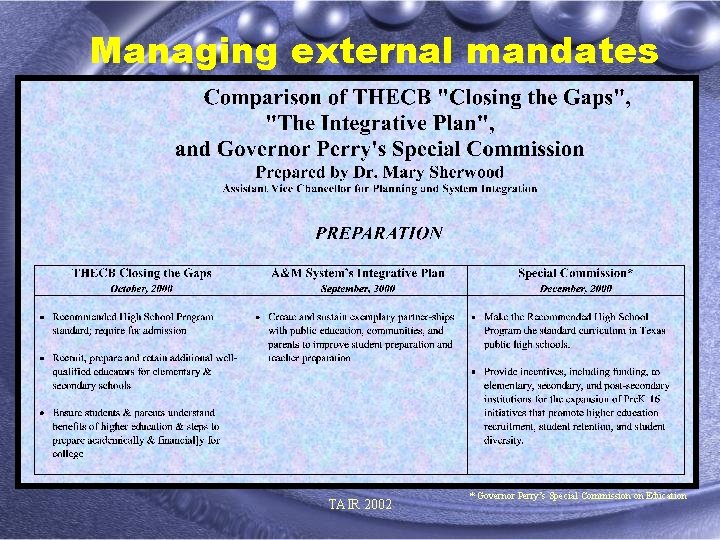
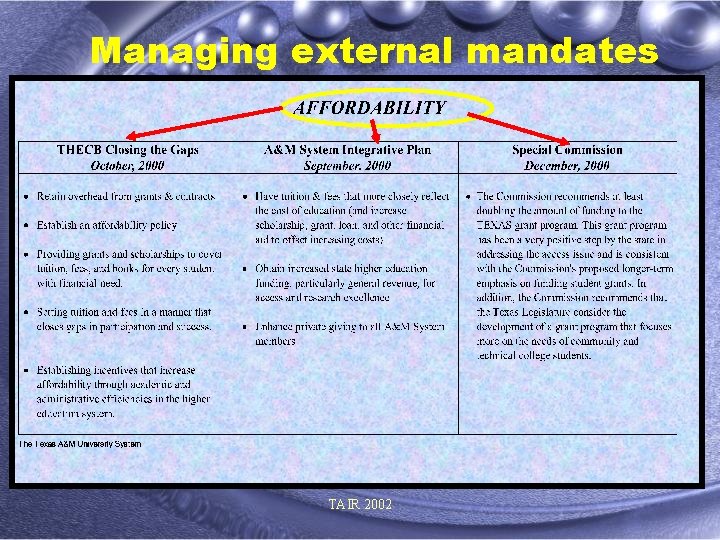
Managing external mandates Developing a Management system • Design a comparison matrix – Keep It Simple – Identify the basics of each plan – Determine which plan will be primary – Use it as a template – Develop your matrix as far as necessary to grasp the inter-relationships TAIR 2002
Managing external mandates TAIR 2002 * Governor Perry’s Special Commission on Education
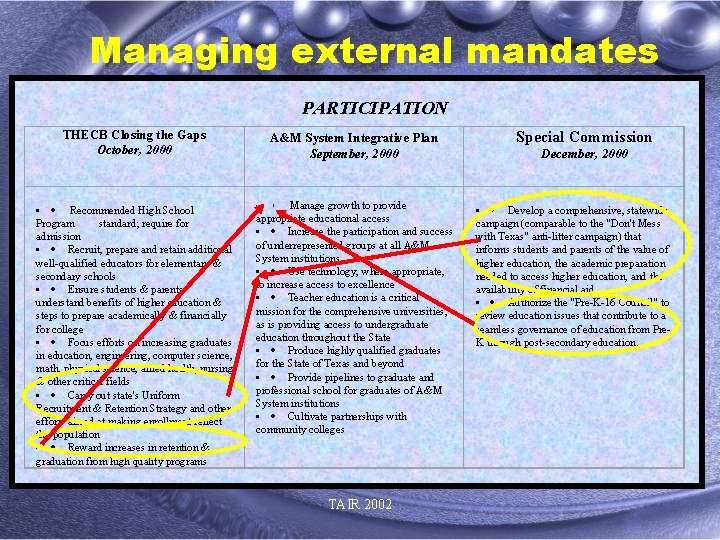
Managing external mandates PARTICIPATION THECB Closing the Gaps October, 2000 • · Recommended High School Program standard; require for admission • · Recruit, prepare and retain additional well qualified educators for elementary & secondary schools • · Ensure students & parents understand benefits of higher education & steps to prepare academically & financially for college • · Focus efforts on increasing graduates in education, engineering, computer science, math, physical science, allied health, nursing & other critical fields • · Carry out state's Uniform Recruitment & Retention Strategy and other efforts aimed at making enrollment reflect the population • · Reward increases in retention & graduation from high quality programs A&M System Integrative Plan September, 2000 * Manage growth to provide appropriate educational access • · Increase the participation and success of underrepresented groups at all A&M System institutions • · Use technology, where appropriate, to increase access to excellence • · Teacher education is a critical mission for the comprehensive universities, as is providing access to undergraduate education throughout the State • · Produce highly qualified graduates for the State of Texas and beyond • · Provide pipelines to graduate and professional school for graduates of A&M System institutions • · Cultivate partnerships with community colleges • TAIR 2002 Special Commission December, 2000 • · Develop a comprehensive, statewide campaign (comparable to the "Don't Mess with Texas" anti litter campaign) that informs students and parents of the value of higher education, the academic preparation needed to access higher education, and the availability of financial aid • · Authorize the "Pre K 16 Council" to review education issues that contribute to a seamless governance of education from Pre K through post secondary education.
Managing external mandates TAIR 2002
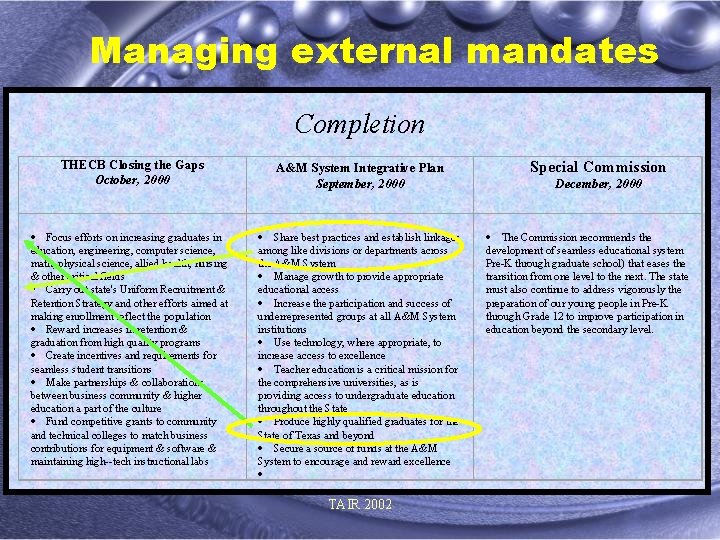
Managing external mandates Completion THECB Closing the Gaps October, 2000 A&M System Integrative Plan September, 2000 · Focus efforts on increasing graduates in education, engineering, computer science, math, physical science, allied health, nursing & other critical fields · Carry out state's Uniform Recruitment & Retention Strategy and other efforts aimed at making enrollment reflect the population · Reward increases in retention & graduation from high quality programs · Create incentives and requirements for seamless student transitions · Make partnerships & collaborations between business community & higher education a part of the culture · Fund competitive grants to community and technical colleges to match business contributions for equipment & software & maintaining high tech instructional labs · Share best practices and establish linkages among like divisions or departments across the A&M System · Manage growth to provide appropriate educational access · Increase the participation and success of underrepresented groups at all A&M System institutions · Use technology, where appropriate, to increase access to excellence · Teacher education is a critical mission for the comprehensive universities, as is providing access to undergraduate education throughout the State · Produce highly qualified graduates for the State of Texas and beyond · Secure a source of funds at the A&M System to encourage and reward excellence · TAIR 2002 Special Commission December, 2000 · The Commission recommends the development of seamless educational system Pre K through graduate school) that eases the transition from one level to the next. The state must also continue to address vigorously the preparation of our young people in Pre K through Grade 12 to improve participation in education beyond the secondary level.
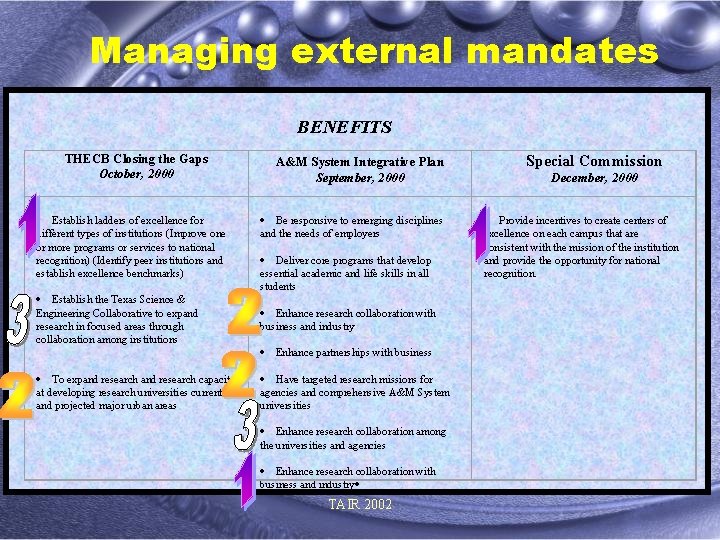
Managing external mandates BENEFITS THECB Closing the Gaps October, 2000 · Establish ladders of excellence for different types of institutions (Improve one or more programs or services to national recognition) (Identify peer institutions and establish excellence benchmarks) · Establish the Texas Science & Engineering Collaborative to expand research in focused areas through collaboration among institutions · To expand research capacity at developing research universities current and projected major urban areas A&M System Integrative Plan September, 2000 · Be responsive to emerging disciplines and the needs of employers · Deliver core programs that develop essential academic and life skills in all students · Enhance research collaboration with business and industry · Enhance partnerships with business · Have targeted research missions for agencies and comprehensive A&M System universities · Enhance research collaboration among the universities and agencies · Enhance research collaboration with business and industry· TAIR 2002 Special Commission December, 2000 · Provide incentives to create centers of excellence on each campus that are consistent with the mission of the institution and provide the opportunity for national recognition.
Managing external mandates • Outline anticipated reports • Develop compatible databases • Influence data requests as they are developed • Think broadly enough to avoid duplicative efforts • Make it fun and a challenge to synthesize productive plans and reports TAIR 2002
Pull it all together… TAIR 2002
- Slides: 54