
Pulleys Simple Machines that reduce force What is

- Slides: 16
Pulleys Simple Machines that reduce force.
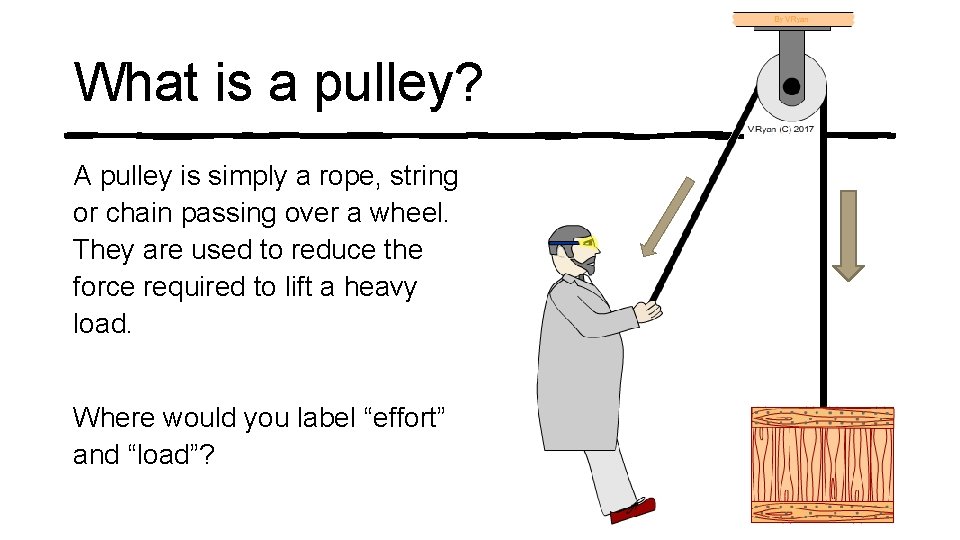
What is a pulley? A pulley is simply a rope, string or chain passing over a wheel. They are used to reduce the force required to lift a heavy load. Where would you label “effort” and “load”?
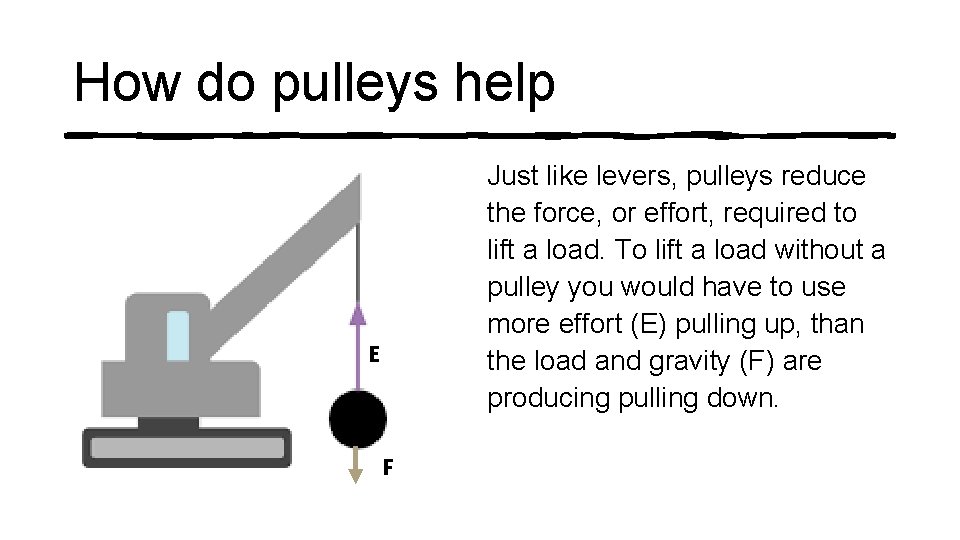
How do pulleys help Just like levers, pulleys reduce the force, or effort, required to lift a load. To lift a load without a pulley you would have to use more effort (E) pulling up, than the load and gravity (F) are producing pulling down. E F
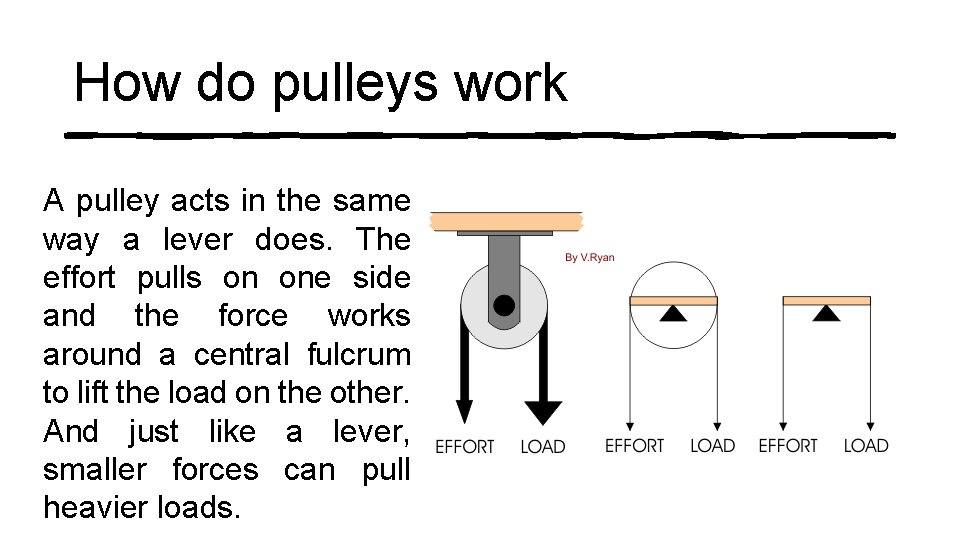
How do pulleys work A pulley acts in the same way a lever does. The effort pulls on one side and the force works around a central fulcrum to lift the load on the other. And just like a lever, smaller forces can pull heavier loads.
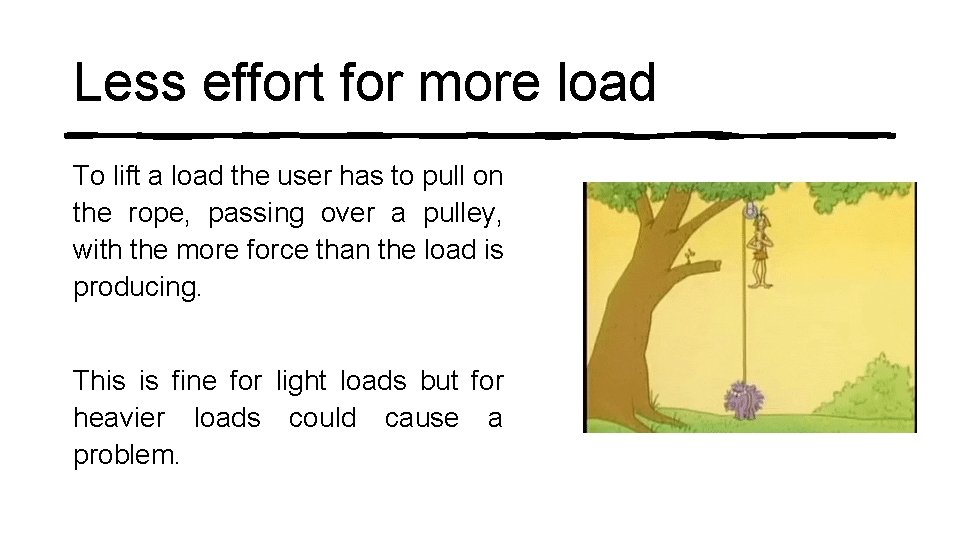
Less effort for more load To lift a load the user has to pull on the rope, passing over a pulley, with the more force than the load is producing. This is fine for light loads but for heavier loads could cause a problem.
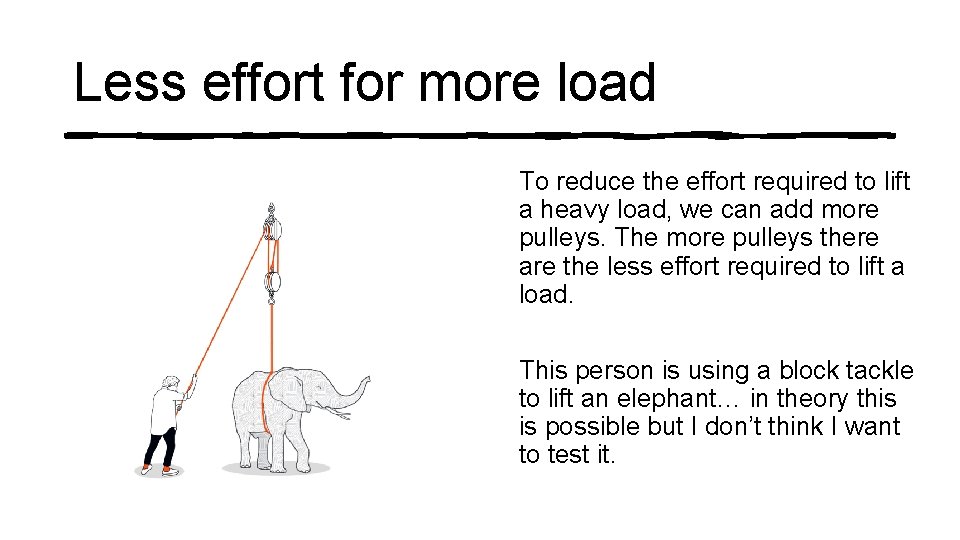
Less effort for more load To reduce the effort required to lift a heavy load, we can add more pulleys. The more pulleys there are the less effort required to lift a load. This person is using a block tackle to lift an elephant… in theory this is possible but I don’t think I want to test it.
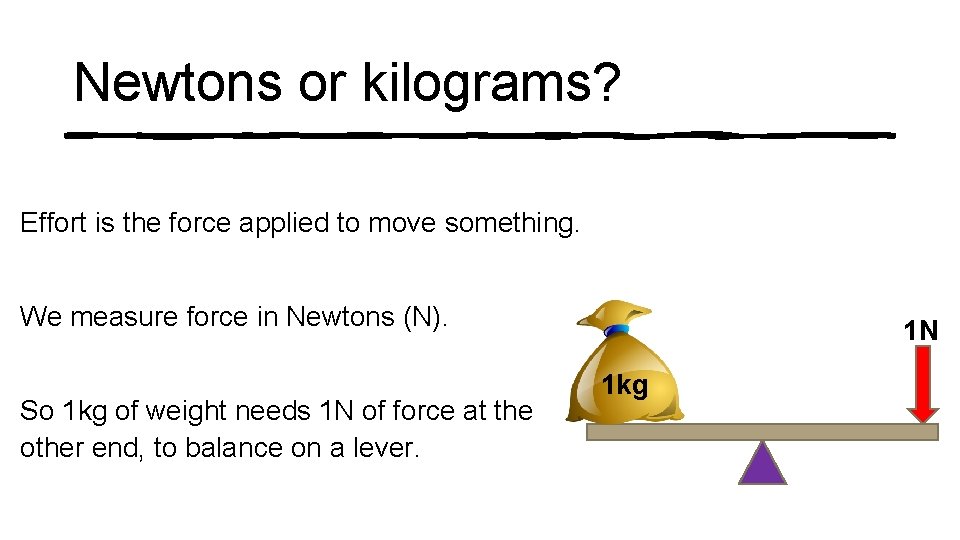
Newtons or kilograms? Effort is the force applied to move something. We measure force in Newtons (N). So 1 kg of weight needs 1 N of force at the other end, to balance on a lever. 1 N 1 kg
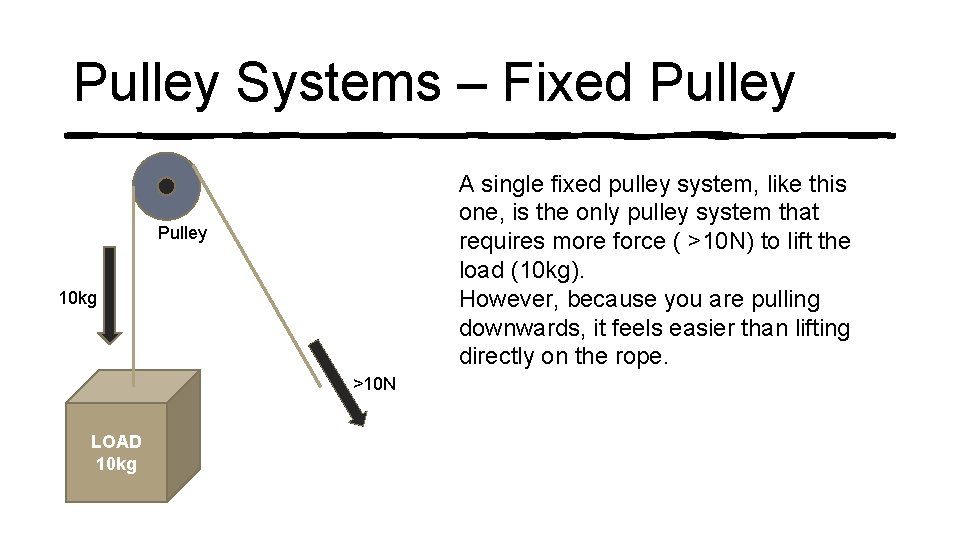
Pulley Systems – Fixed Pulley A single fixed pulley system, like this one, is the only pulley system that requires more force ( >10 N) to lift the load (10 kg). However, because you are pulling downwards, it feels easier than lifting directly on the rope. Pulley 10 kg >10 N LOAD 10 kg
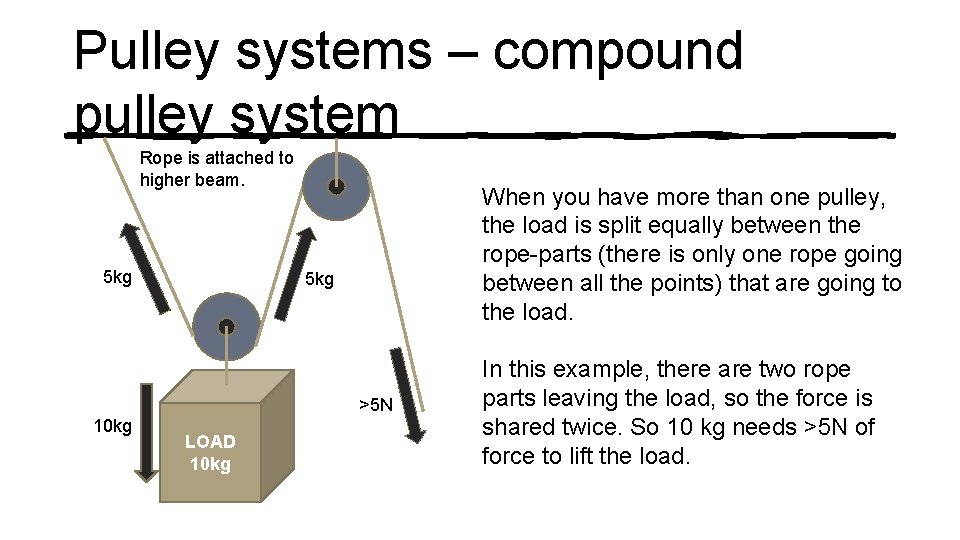
Pulley systems – compound pulley system Rope is attached to higher beam. 5 kg When you have more than one pulley, the load is split equally between the rope-parts (there is only one rope going between all the points) that are going to the load. 5 kg >5 N 10 kg LOAD 10 kg In this example, there are two rope parts leaving the load, so the force is shared twice. So 10 kg needs >5 N of force to lift the load.
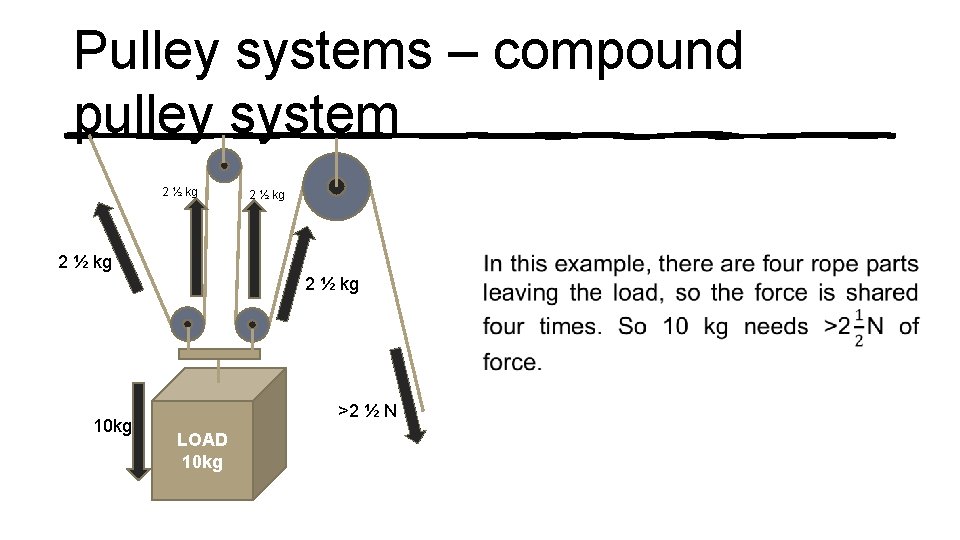
Pulley systems – compound pulley system 2 ½ kg 10 kg >2 ½ N LOAD 10 kg
worksheet Have a go at labelling the forces and sharing the loads on the worksheet and then sticking it into your book. Have a go at the Optional activity if you have the resources.
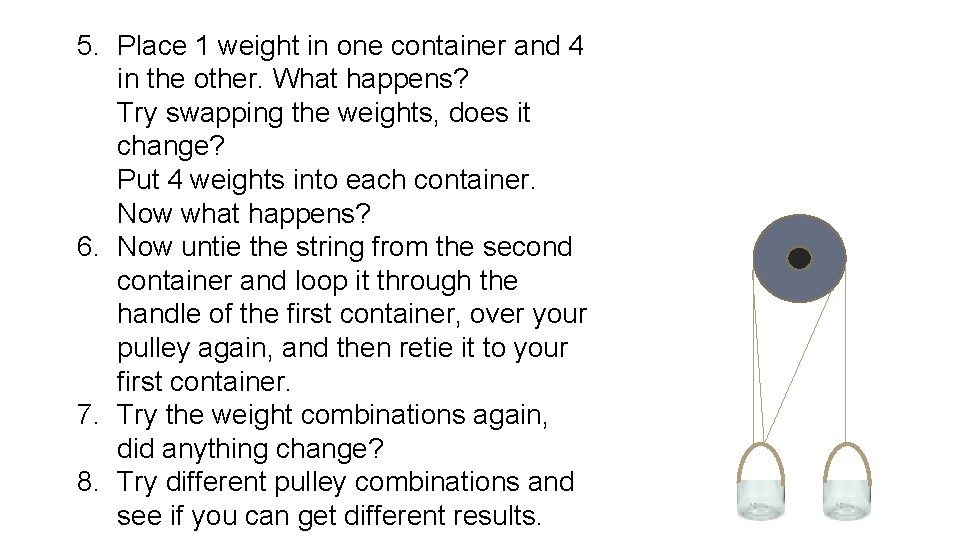
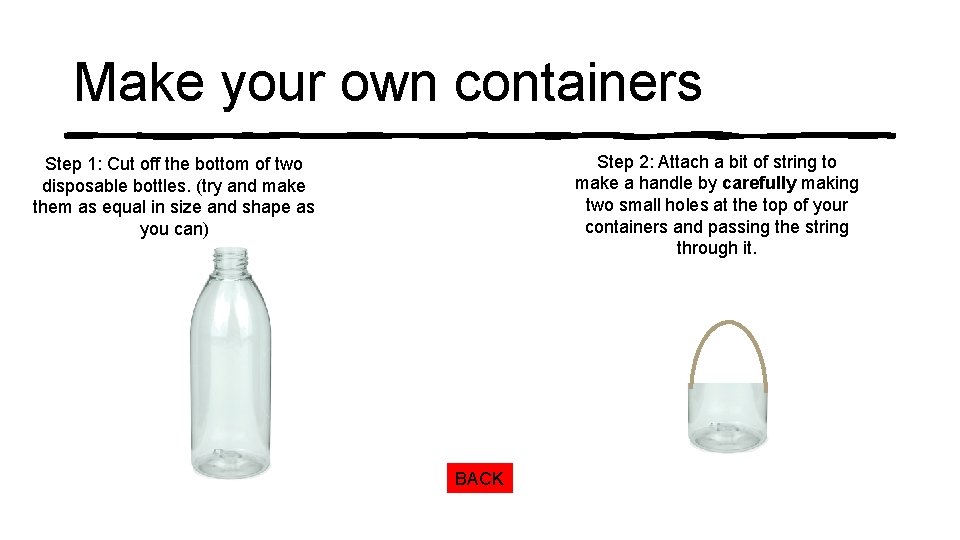
Optional activity You will need: String/ribbon/rope Two containers with handles (click here to see how you could make your own) Coins/lego bricks/any other small but consistent weights.
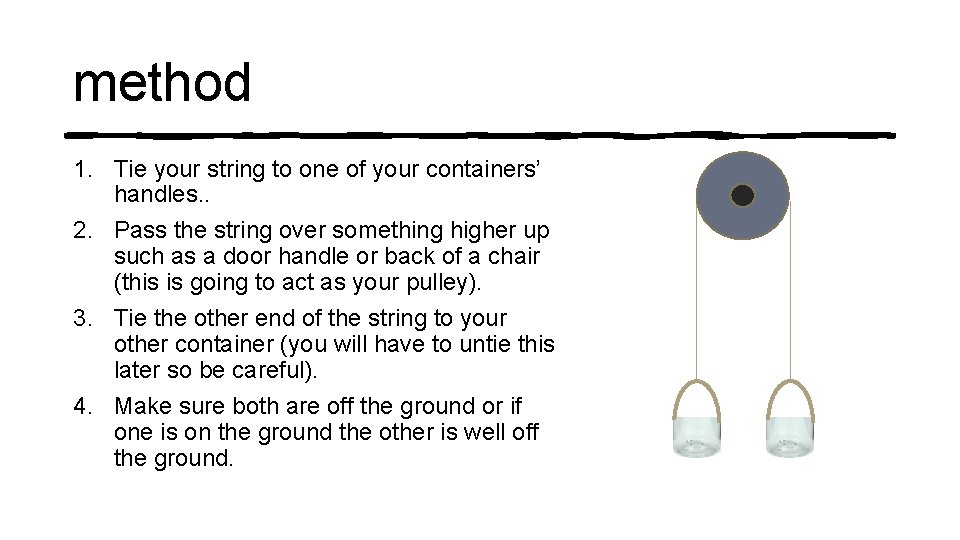
method 1. Tie your string to one of your containers’ handles. . 2. Pass the string over something higher up such as a door handle or back of a chair (this is going to act as your pulley). 3. Tie the other end of the string to your other container (you will have to untie this later so be careful). 4. Make sure both are off the ground or if one is on the ground the other is well off the ground.
5. Place 1 weight in one container and 4 in the other. What happens? Try swapping the weights, does it change? Put 4 weights into each container. Now what happens? 6. Now untie the string from the second container and loop it through the handle of the first container, over your pulley again, and then retie it to your first container. 7. Try the weight combinations again, did anything change? 8. Try different pulley combinations and see if you can get different results.
results You decide how best to record your results. You could use diagrams, a table, photos or even short videos. Make sure you are thinking about what happens. Could you start predicting results of your tests? Have Fun!
Make your own containers Step 2: Attach a bit of string to make a handle by carefully making two small holes at the top of your containers and passing the string through it. Step 1: Cut off the bottom of two disposable bottles. (try and make them as equal in size and shape as you can) BACK