
Pulley What is Pulley Pulley It is a

- Slides: 18
Pulley
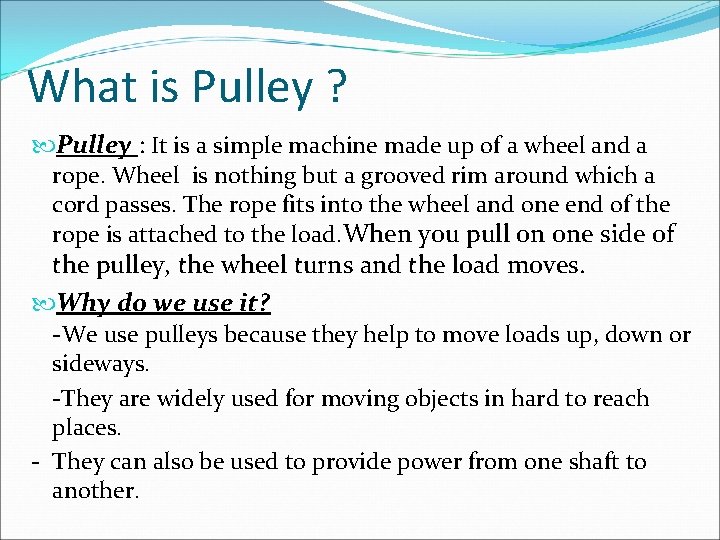
What is Pulley ? Pulley : It is a simple machine made up of a wheel and a rope. Wheel is nothing but a grooved rim around which a cord passes. The rope fits into the wheel and one end of the rope is attached to the load. When you pull on one side of the pulley, the wheel turns and the load moves. Why do we use it? -We use pulleys because they help to move loads up, down or sideways. -They are widely used for moving objects in hard to reach places. - They can also be used to provide power from one shaft to another.
Types of Pulley Systems Mainly there are two types : Fixed : A fixed pulley has an axle mounted in bearings attached to a supporting structure Movable : A movable pulley has an axle in a movable block
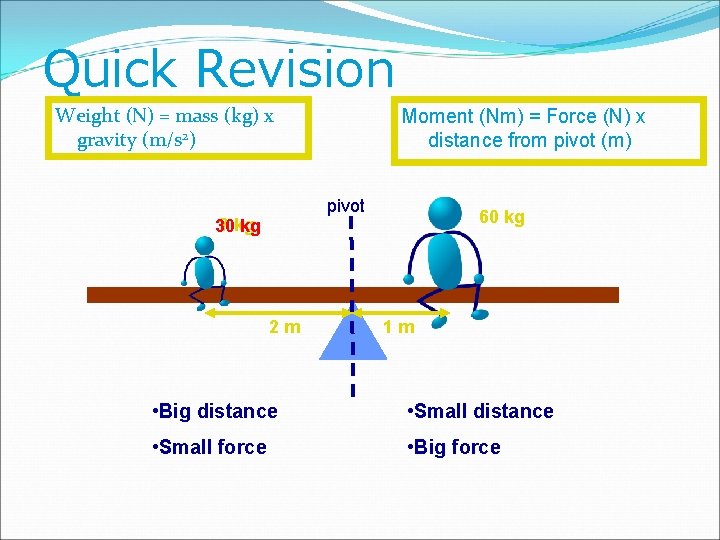
Quick Revision Weight (N) = mass (kg) x gravity (m/s 2) Moment (Nm) = Force (N) x distance from pivot (m) pivot ? kg 30 kg 2 m 60 kg 1 m • Big distance • Small force • Big force
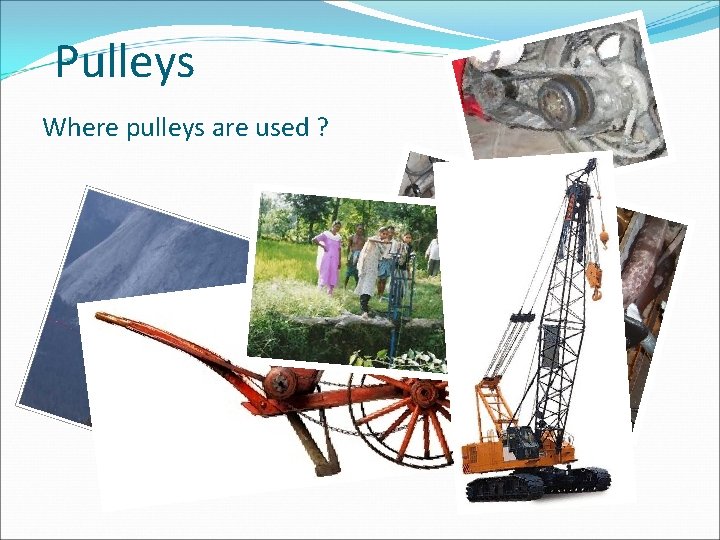
Pulleys Where pulleys are used ?
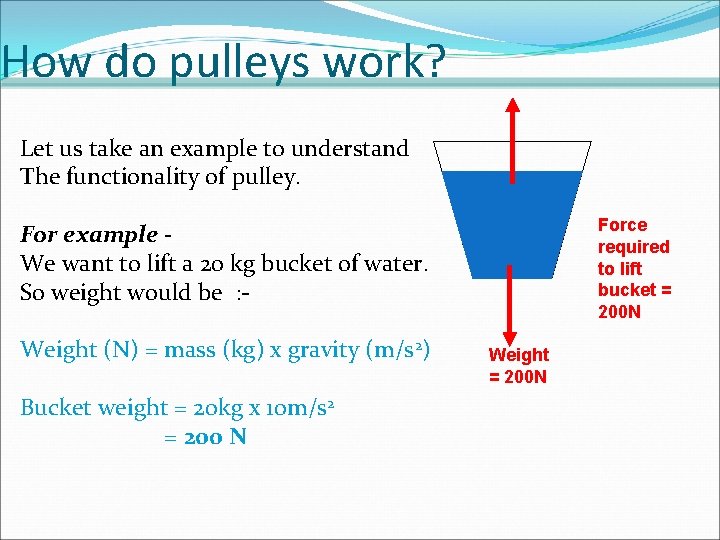
How do pulleys work? Let us take an example to understand The functionality of pulley. Force required to lift bucket = 200 N For example We want to lift a 20 kg bucket of water. So weight would be : Weight (N) = mass (kg) x gravity (m/s 2) Bucket weight = 20 kg x 10 m/s 2 = 200 N Weight = 200 N
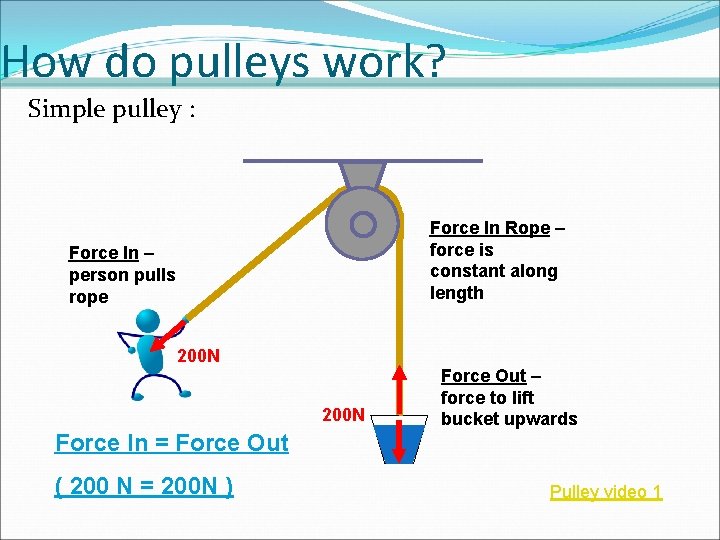
How do pulleys work? Simple pulley : Force In Rope – force is constant along length Force In – person pulls rope 200 N Force In = Force Out ( 200 N = 200 N ) Force Out – force to lift bucket upwards Pulley video 1
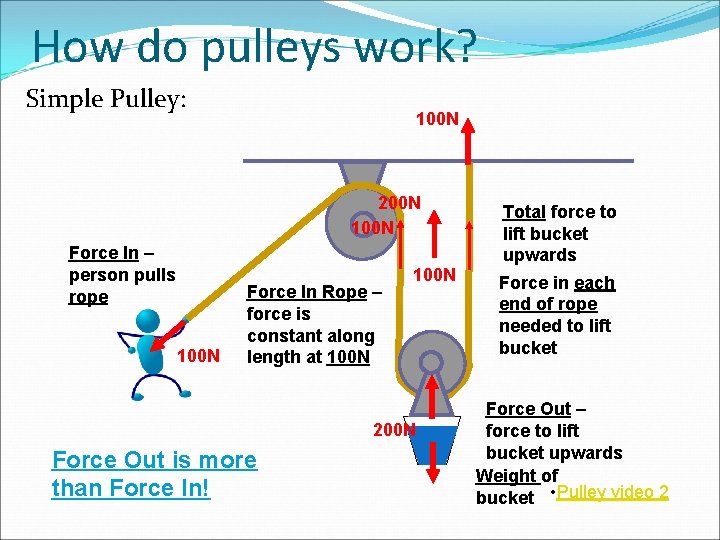
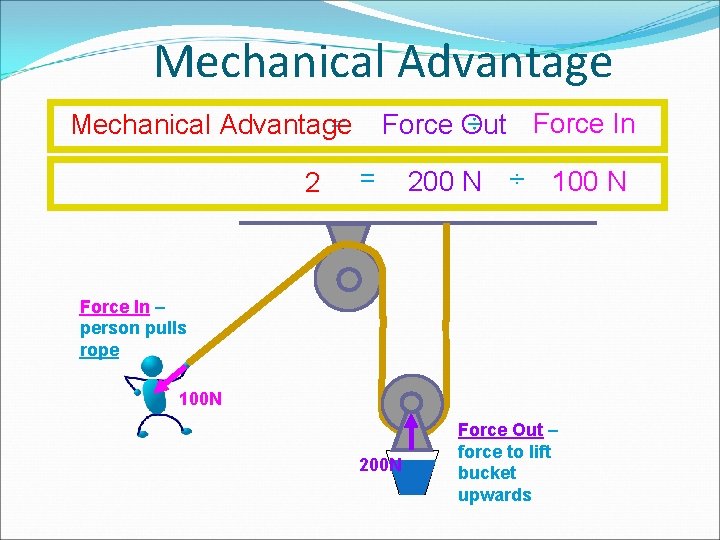
How do pulleys work? Simple Pulley: 100 N 200 N 100 N Force In – person pulls rope 100 N Force In Rope – force is constant along length at 100 N 200 N Force Out is more than Force In! Total force to lift bucket upwards Force in each end of rope needed to lift bucket Force Out – force to lift bucket upwards Weight of bucket • Pulley video 2
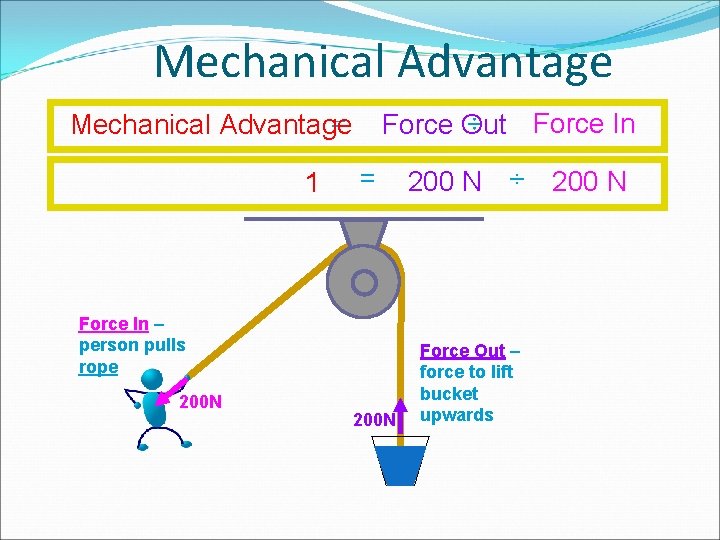
Mechanical Advantage = ÷ Mechanical Advantage Force Out Force In 1 = Force In – person pulls rope 200 N 200 N ÷ 200 N Force Out – force to lift bucket upwards
Mechanical Advantage = ÷ Mechanical Advantage Force Out Force In 2 = 200 N ÷ 100 N Force In – person pulls rope 100 N 200 N Force Out – force to lift bucket upwards
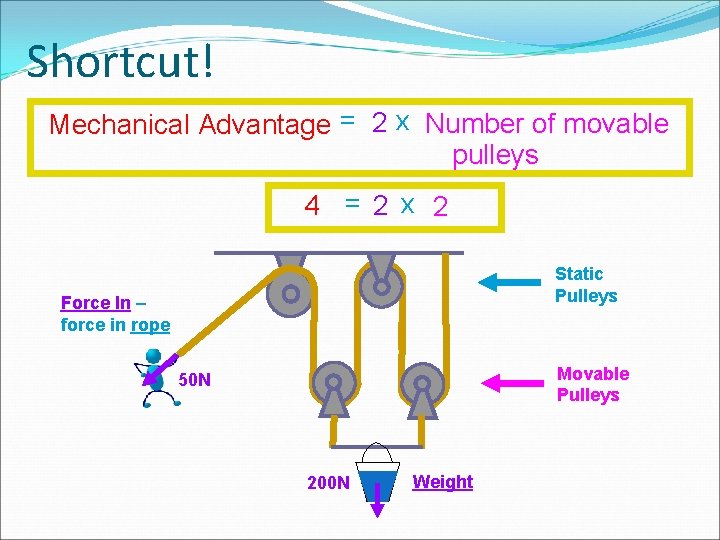
Shortcut! Mechanical Advantage = 2 x Number of movable pulleys 4 =2 x 2 Static Pulleys Force In – force in rope Movable Pulleys 50 N 200 N Weight
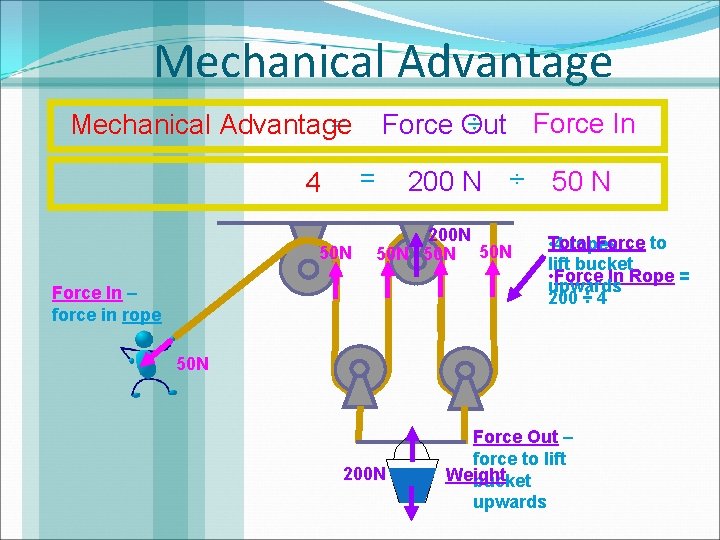
Mechanical Advantage = ÷ Mechanical Advantage Force Out Force In = 4 50 N 200 N ÷ 50 N 200 N 50 N 50 N Force In – force in rope Force to • Total 4 ropes lift bucket • Force In Rope = upwards 200 ÷ 4 50 N 200 N Force Out – force to lift Weight bucket upwards
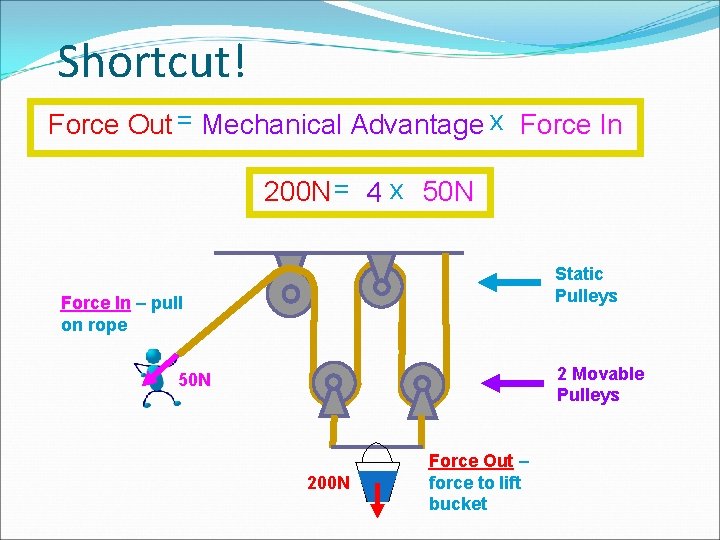
Shortcut! Force Out = Mechanical Advantage x Force In 200 N = 4 x 50 N Static Pulleys Force In – pull on rope 2 Movable Pulleys 50 N 200 N Force Out – force to lift bucket
Let us play a game !!! I am owner of a car manufacturing company I will need one big shutter for security purpose Shutter weight will be 1000 KG I want to have a solution that will allow the gate to be opened only from inside I do not want to spend too much money on it Extra points for creativity and good presentation!
Conditions Group of 4 Decide your team leader 10 mins –Plan your idea 20 mins – Load calculation 30 mins- Design work – (door, pulley, using space efficiently ) 20 mins - Working on business aspect – Why someone should choose your idea? Ensure that you can convince mathematically. Points will be calculated based on : -- “load calculation” only if it is accurate, new ideas, creative thinking, business logic, and neat presentation Winner will get a price !!!
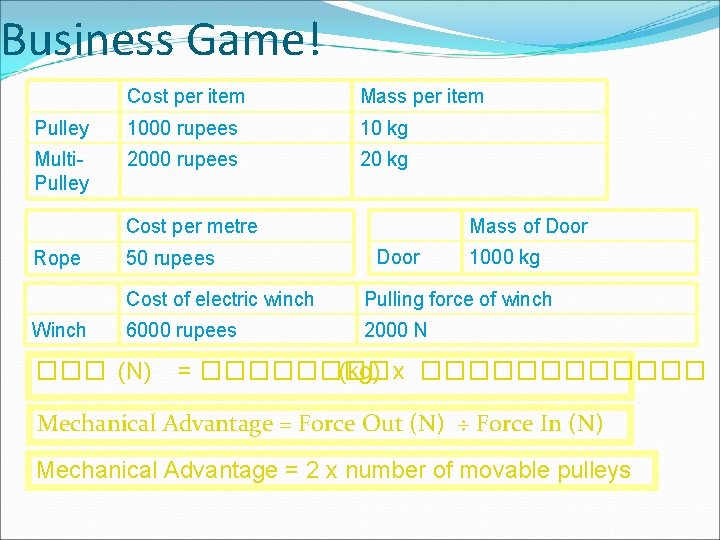
Business Game! Cost per item Mass per item Pulley 1000 rupees 10 kg Multi. Pulley 2000 rupees 20 kg Mass of Door Cost per metre Rope Winch 50 rupees Door 1000 kg Cost of electric winch Pulling force of winch 6000 rupees 2000 N ��� (N) = ���� (kg) x ������ Mechanical Advantage = Force Out (N) ÷ Force In (N) Mechanical Advantage = 2 x number of movable pulleys
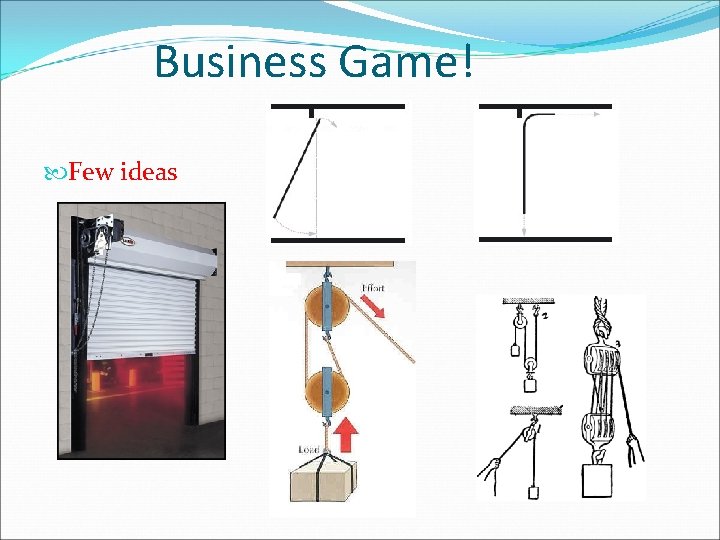
Business Game! Few ideas
Thanks For further information: Website : www. vigyanashram. com e-Mail : vapabal@gmail. com, director@vigyanashram. com