
Publishing scientific research in journals Dr Jeffrey Robens

Publishing scientific research in journals Dr Jeffrey Robens Editorial Development Manager Download at: tinyurl. com/springer-kazakhstan 2015

Springer Author Academy| 6/7/2021 | 2 Be an effective commiunicator Your goal is not only to be published, but also to be widely read in your field ü Academic publishing ü Write effectively ü How to choose an appropriate journal ü Logically organize your ideas in your manuscript and cover letter
Springer Author Academy| 6/7/2021 | 3 Academic publishing
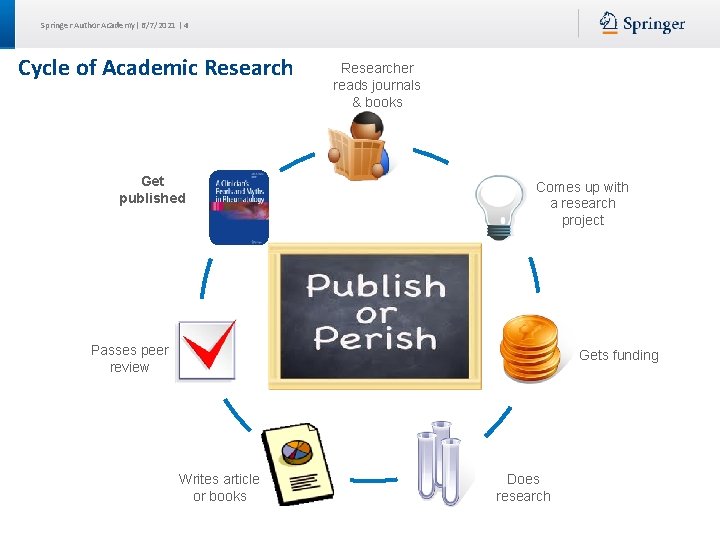
Springer Author Academy| 6/7/2021 | 4 Cycle of Academic Researcher reads journals & books Get published Comes up with a research project Publishing is essential in scientific research Passes peer review Writes article or books Gets funding Does research
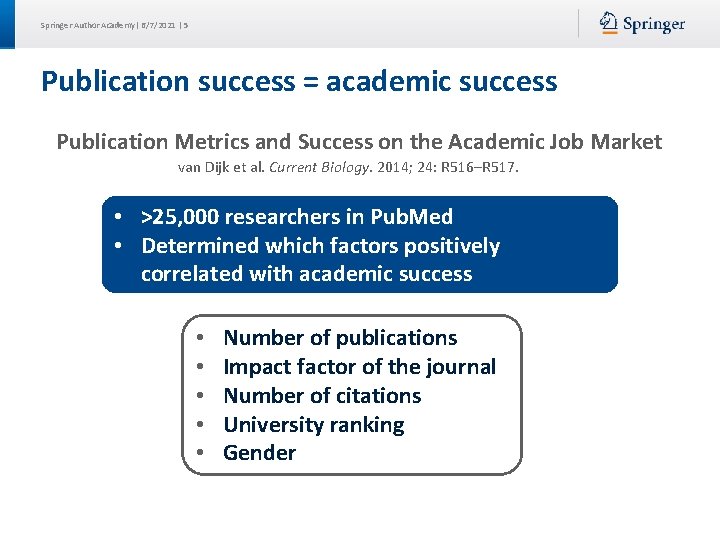
Springer Author Academy| 6/7/2021 | 5 Publication success = academic success Publication Metrics and Success on the Academic Job Market van Dijk et al. Current Biology. 2014; 24: R 516–R 517. • >25, 000 researchers in Pub. Med • Determined which factors positively correlated with academic success • • • Number of publications Impact factor of the journal Number of citations University ranking Gender
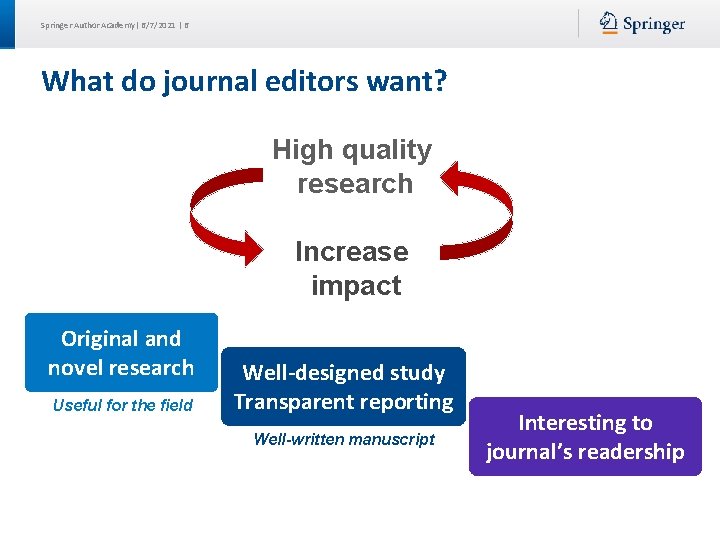
Springer Author Academy| 6/7/2021 | 6 What do journal editors want? High quality research Increase impact Original and novel research Useful for the field Well-designed study Transparent reporting Well-written manuscript Interesting to journal’s readership
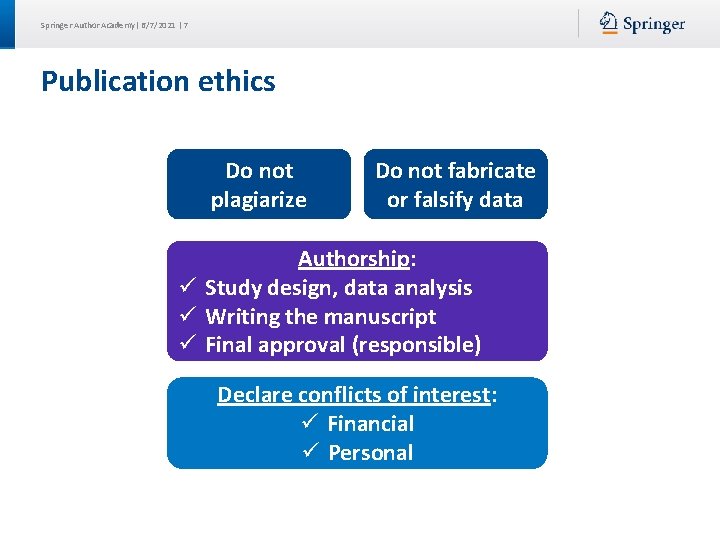
Springer Author Academy| 6/7/2021 | 7 Publication ethics Do not plagiarize Do not fabricate or falsify data Authorship: ü Study design, data analysis ü Writing the manuscript ü Final approval (responsible) Declare conflicts of interest: ü Financial ü Personal
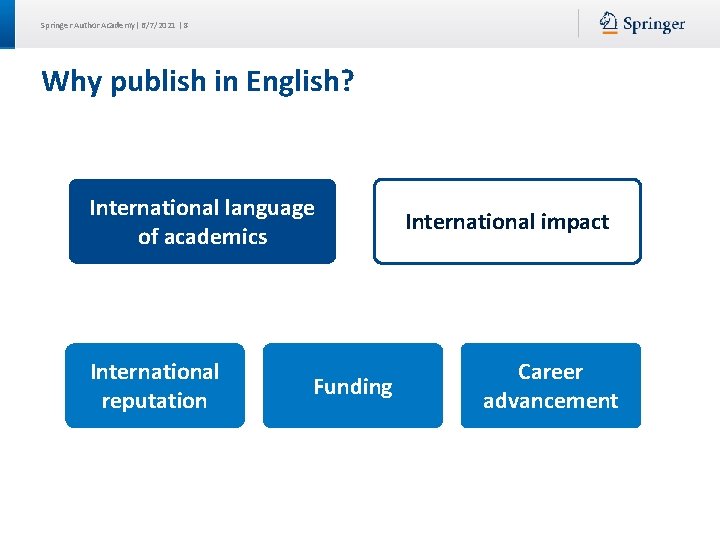
Springer Author Academy| 6/7/2021 | 8 Why publish in English? International language of academics International reputation Funding International impact Career advancement
Springer Author Academy| 6/7/2021 | 9 Effective English
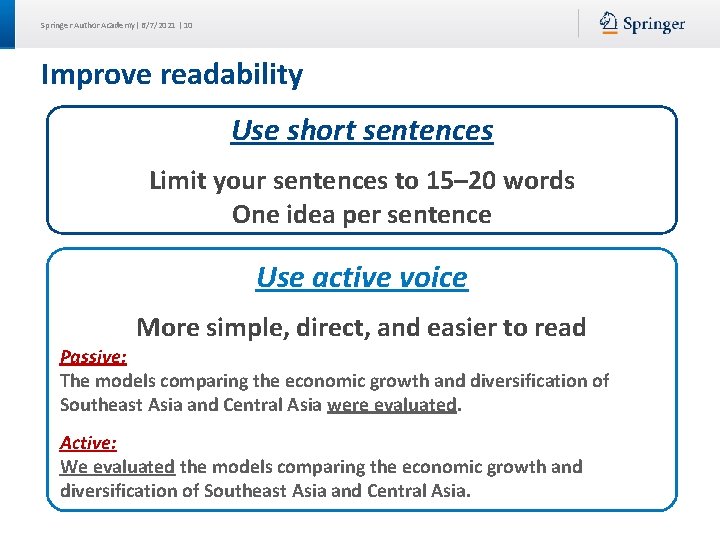
Springer Author Academy| 6/7/2021 | 10 Improve readability Use short sentences Limit your sentences to 15– 20 words One idea per sentence Use active voice More simple, direct, and easier to read Passive: The models comparing the economic growth and diversification of Southeast Asia and Central Asia were evaluated. Active: We evaluated the models comparing the economic growth and diversification of Southeast Asia and Central Asia.
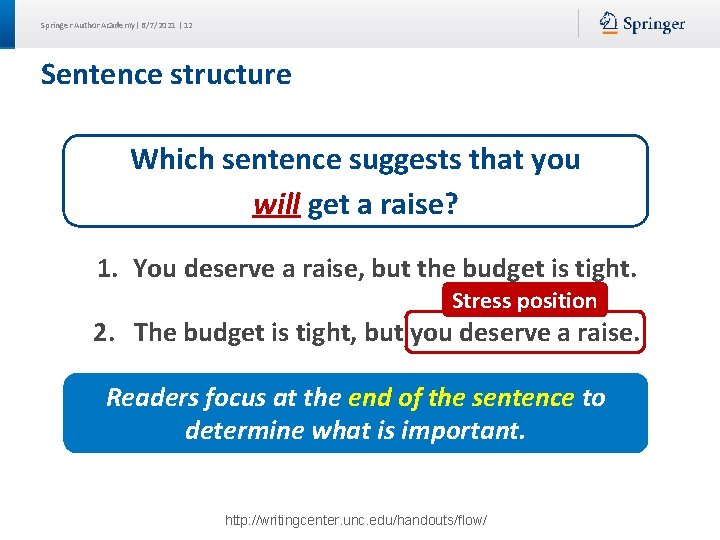
Springer Author Academy| 6/7/2021 | 12 Sentence structure Which sentence suggests that you will get a raise? 1. You deserve a raise, but the budget is tight. Stress position 2. The budget is tight, but you deserve a raise. Readers focus at the end of the sentence to determine what is important. http: //writingcenter. unc. edu/handouts/flow/
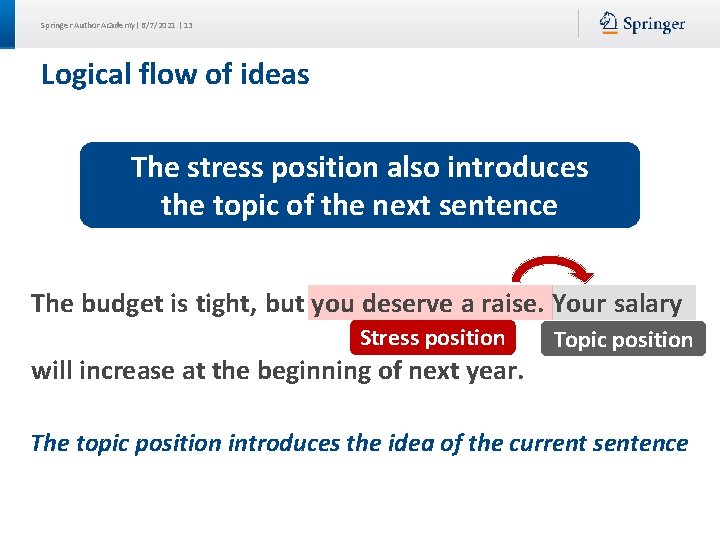
Springer Author Academy| 6/7/2021 | 13 Logical flow of ideas The stress position also introduces the topic of the next sentence The budget is tight, but you deserve a raise. Your salary Stress position will increase at the beginning of next year. Topic position The topic position introduces the idea of the current sentence
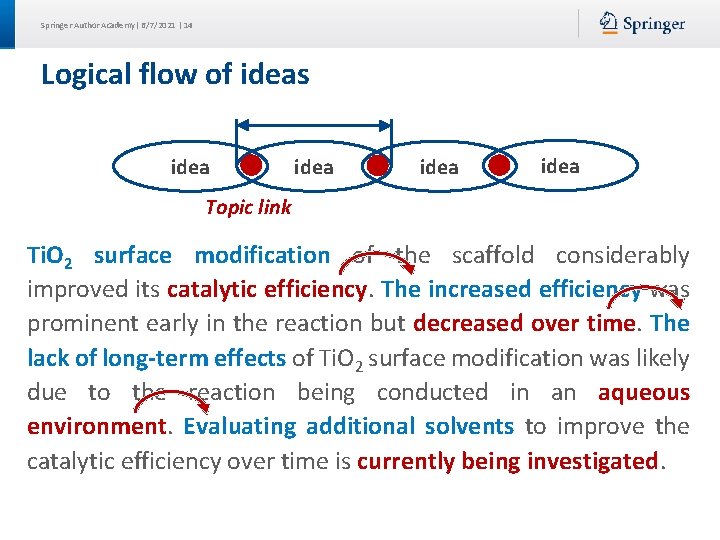
Springer Author Academy| 6/7/2021 | 14 Logical flow of ideas idea Topic link Ti. O 2 surface modification of the scaffold considerably improved its catalytic efficiency. The increased efficiency was prominent early in the reaction but decreased over time. The lack of long-term effects of Ti. O 2 surface modification was likely due to the reaction being conducted in an aqueous environment. Evaluating additional solvents to improve the catalytic efficiency over time is currently being investigated.
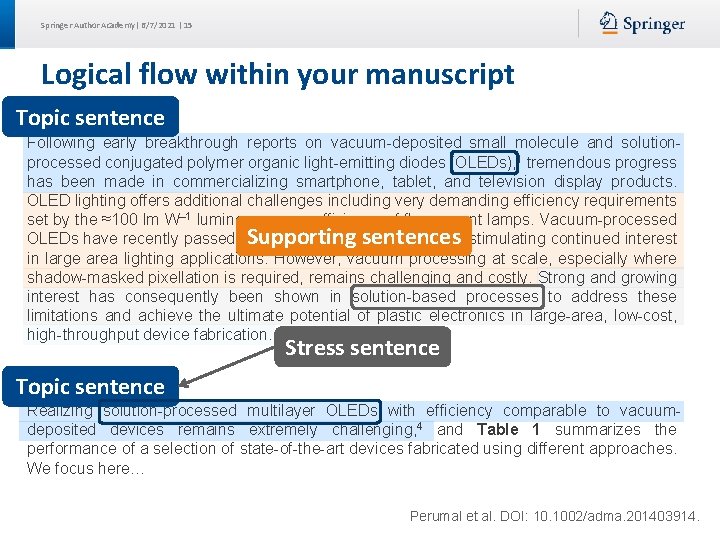
Springer Author Academy| 6/7/2021 | 15 Logical flow within your manuscript Topic sentence Following early breakthrough reports on vacuum-deposited small molecule and solutionprocessed conjugated polymer organic light-emitting diodes (OLEDs), 1 tremendous progress has been made in commercializing smartphone, tablet, and television display products. OLED lighting offers additional challenges including very demanding efficiency requirements set by the ≈100 lm W– 1 luminous power efficiency of fluorescent lamps. Vacuum-processed 2 thereby stimulating continued interest Supporting sentences OLEDs have recently passed this 100 lm W– 1 target, in large area lighting applications. However, vacuum processing at scale, especially where shadow-masked pixellation is required, remains challenging and costly. Strong and growing interest has consequently been shown in solution-based processes to address these limitations and achieve the ultimate potential of plastic electronics in large-area, low-cost, high-throughput device fabrication. Stress sentence Topic sentence Realizing solution-processed multilayer OLEDs with efficiency comparable to vacuumdeposited devices remains extremely challenging, 4 and Table 1 summarizes the performance of a selection of state-of-the-art devices fabricated using different approaches. We focus here… Perumal et al. DOI: 10. 1002/adma. 201403914.
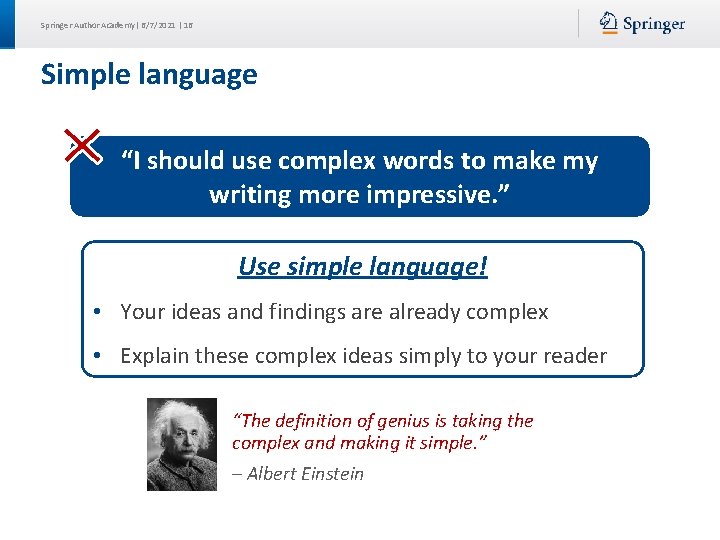
Springer Author Academy| 6/7/2021 | 16 Simple language “I should use complex words to make my writing more impressive. ” Use simple language! • Your ideas and findings are already complex • Explain these complex ideas simply to your reader “The definition of genius is taking the complex and making it simple. ” – Albert Einstein
Springer Author Academy| 6/7/2021 | 17 Simple language To ascertain the efficaciousness of the program, we interrogated the participants upon completion.
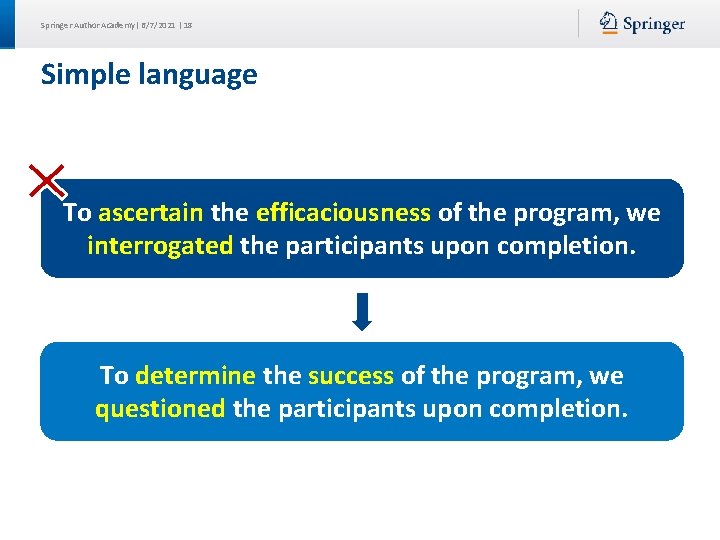
Springer Author Academy| 6/7/2021 | 18 Simple language To ascertain the efficaciousness of the program, we interrogated the participants upon completion. To determine the success of the program, we questioned the participants upon completion.

Springer Author Academy| 6/7/2021 | 20 Choose the right journal
Springer Author Academy| 6/7/2021 | 21 When to choose a journal? • After you have decided how much data you wish to publish – Short communication – Original research article • After you have decided how novel your findings are – High, medium, or low impact • After you have decided how broadly relevant your findings are – International vs. regional journal – Broadly or narrowly focused journal
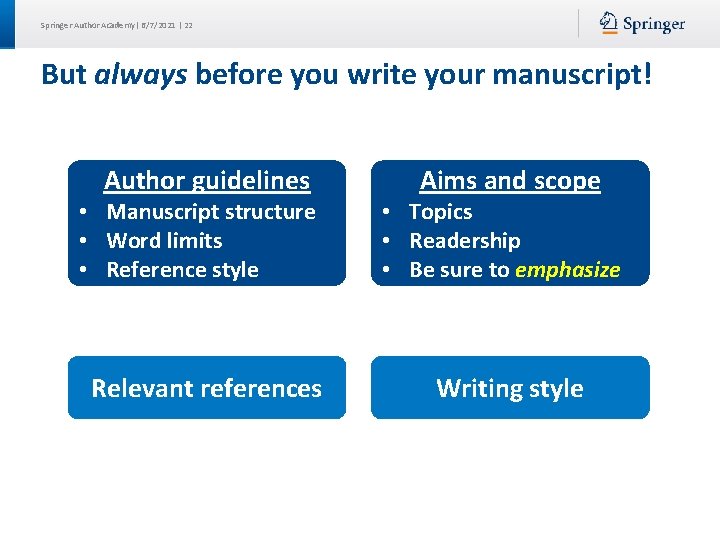
Springer Author Academy| 6/7/2021 | 22 But always before you write your manuscript! Author guidelines • Manuscript structure • Word limits • Reference style Relevant references Aims and scope • Topics • Readership • Be sure to emphasize Writing style
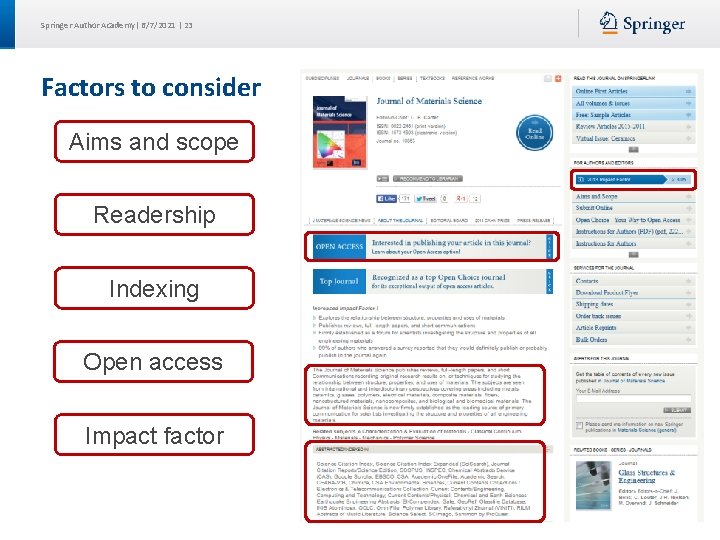
Springer Author Academy| 6/7/2021 | 23 Factors to consider Aims and scope Readership Indexing Open access Impact factor
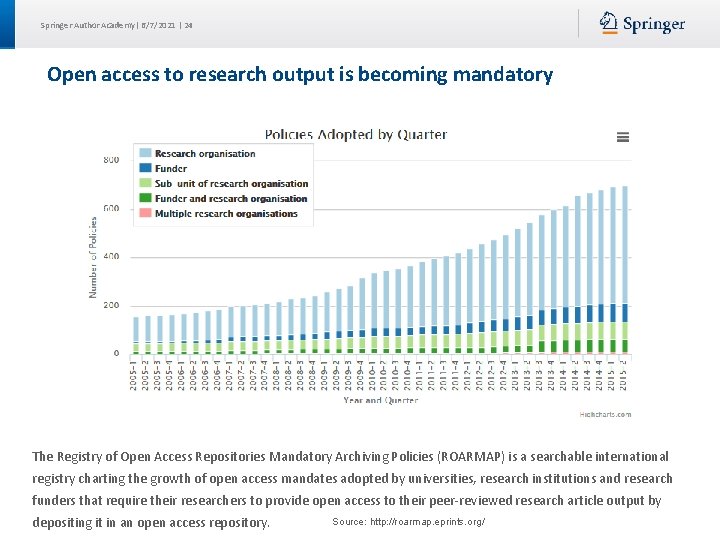
Springer Author Academy| 6/7/2021 | 24 Open access to research output is becoming mandatory The Registry of Open Access Repositories Mandatory Archiving Policies (ROARMAP) is a searchable international registry charting the growth of open access mandates adopted by universities, research institutions and research funders that require their researchers to provide open access to their peer-reviewed research article output by depositing it in an open access repository. Source: http: //roarmap. eprints. org/
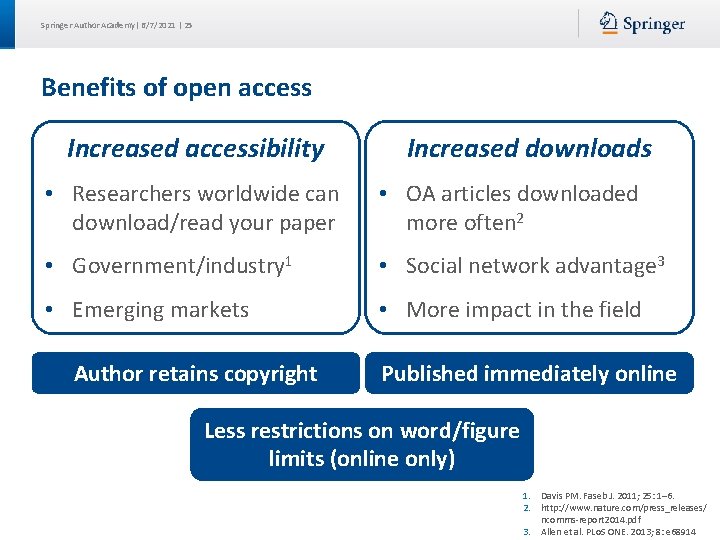
Springer Author Academy| 6/7/2021 | 25 Benefits of open access Increased accessibility Increased downloads • Researchers worldwide can download/read your paper • OA articles downloaded more often 2 • Government/industry 1 • Social network advantage 3 • Emerging markets • More impact in the field Author retains copyright Published immediately online Less restrictions on word/figure limits (online only) 1. Davis PM. Faseb J. 2011; 25: 1– 6. 2. http: //www. nature. com/press_releases/ ncomms-report 2014. pdf 3. Allen et al. PLo. S ONE. 2013; 8: e 68914
Springer Author Academy| 6/7/2021 | 26 Springer’s open access platforms 345+ Journals 200+ Journals Any Journal
Springer Author Academy| 6/7/2021 | 27 Open access myths The quality of OA journals is not good • OA journals have the same peer review process as subscription-based journals • IFs are lower partly because they are newer – Less visibility in the field – Fewer citations
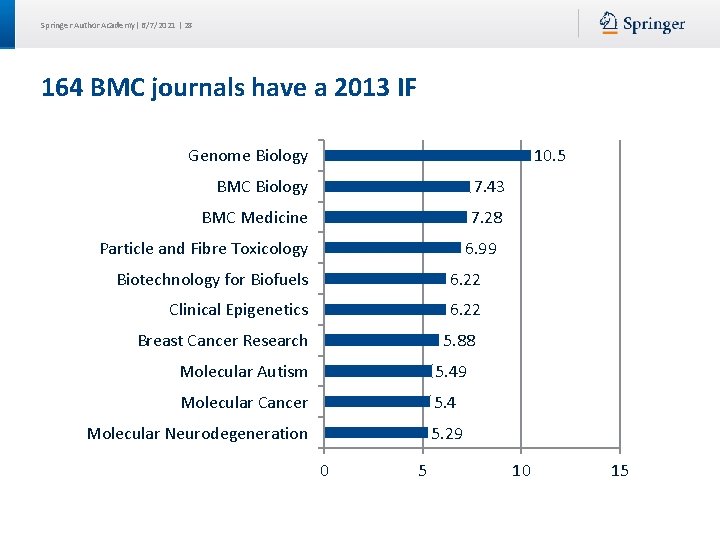
Springer Author Academy| 6/7/2021 | 28 164 BMC journals have a 2013 IF Genome Biology 10. 5 BMC Biology 7. 43 BMC Medicine 7. 28 Particle and Fibre Toxicology 6. 99 Biotechnology for Biofuels 6. 22 Clinical Epigenetics 6. 22 Breast Cancer Research 5. 88 Molecular Autism 5. 49 Molecular Cancer 5. 4 Molecular Neurodegeneration 5. 29 0 5 10 15
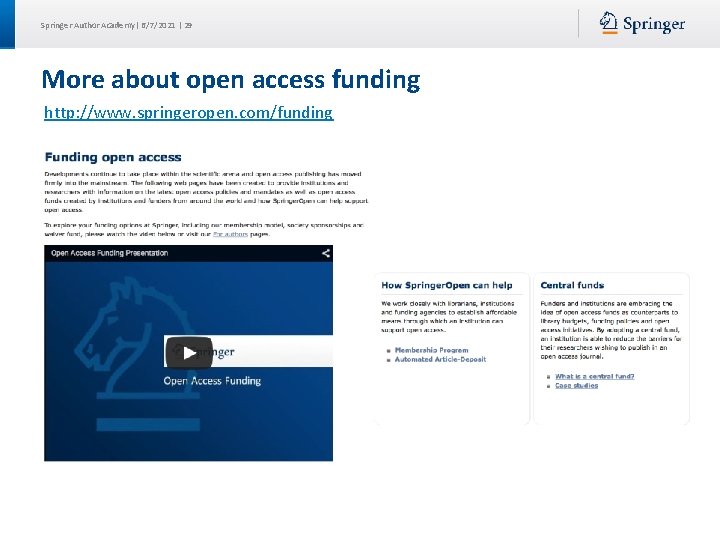
Springer Author Academy| 6/7/2021 | 29 More about open access funding http: //www. springeropen. com/funding
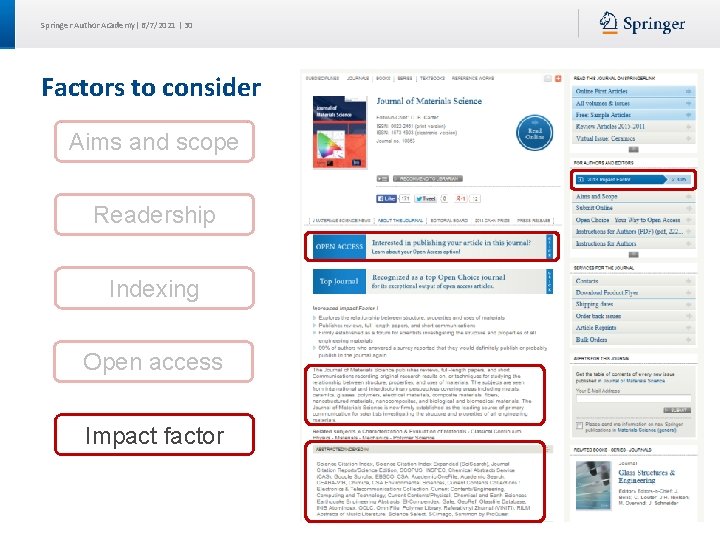
Springer Author Academy| 6/7/2021 | 30 Factors to consider Aims and scope Readership Indexing Open access Impact factor
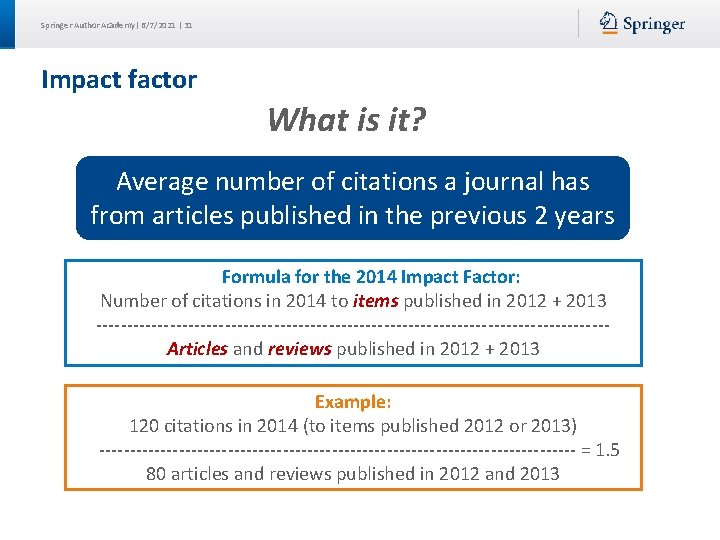
Springer Author Academy| 6/7/2021 | 31 Impact factor What is it? Average number of citations a journal has from articles published in the previous 2 years Formula for the 2014 Impact Factor: Number of citations in 2014 to items published in 2012 + 2013 ------------------------------------------Articles and reviews published in 2012 + 2013 Example: 120 citations in 2014 (to items published 2012 or 2013) --------------------------------------- = 1. 5 80 articles and reviews published in 2012 and 2013
Springer Author Academy| 6/7/2021 | 32 Impact factor Is it important? Higher IF may mean higher visibility • Frequent website visits • Emailed table of contents (e. TOCs) Often used as metric for success • Funding agencies • University committees
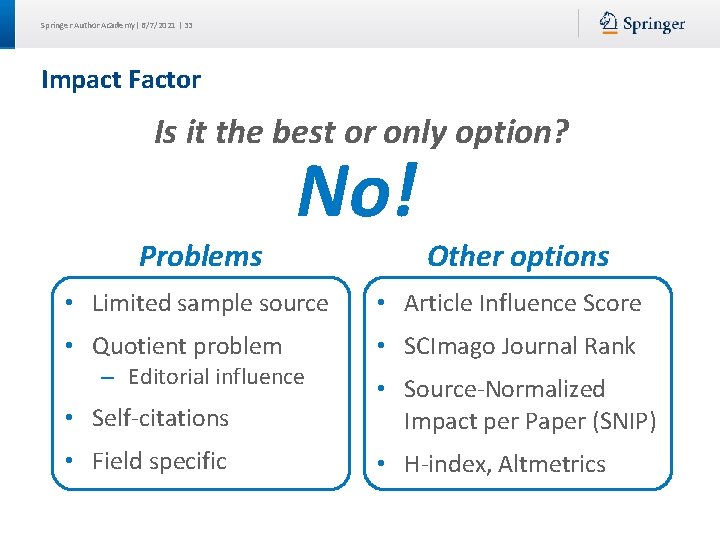
Springer Author Academy| 6/7/2021 | 33 Impact Factor Is it the best or only option? Problems No! Other options • Limited sample source • Article Influence Score • Quotient problem • SCImago Journal Rank • Self-citations • Source-Normalized Impact per Paper (SNIP) • Field specific • H-index, Altmetrics – Editorial influence
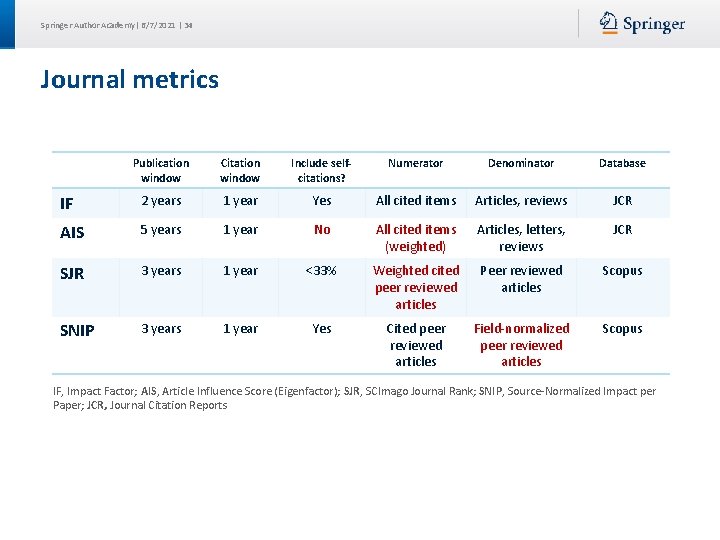
Springer Author Academy| 6/7/2021 | 34 Journal metrics Publication window Citation window Include selfcitations? Numerator Denominator Database IF 2 years 1 year Yes All cited items Articles, reviews JCR AIS 5 years 1 year No All cited items (weighted) Articles, letters, reviews JCR SJR 3 years 1 year <33% Weighted cited peer reviewed articles Peer reviewed articles Scopus SNIP 3 years 1 year Yes Cited peer reviewed articles Field-normalized peer reviewed articles Scopus IF, Impact Factor; AIS, Article Influence Score (Eigenfactor); SJR, SCImago Journal Rank; SNIP, Source-Normalized Impact per Paper; JCR, Journal Citation Reports
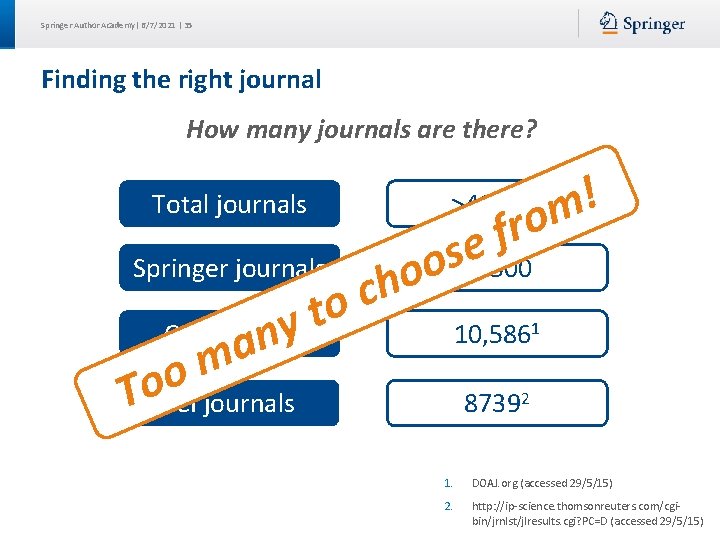
Springer Author Academy| 6/7/2021 | 35 Finding the right journal How many journals are there? Total journals Springer journals o t y OA journals n a m o o T SCI journals >40, 000 ! m o r f se >2500 o o ch 10, 5861 87392 1. DOAJ. org (accessed 29/5/15) 2. http: //ip-science. thomsonreuters. com/cgibin/jrnlst/jlresults. cgi? PC=D (accessed 29/5/15)
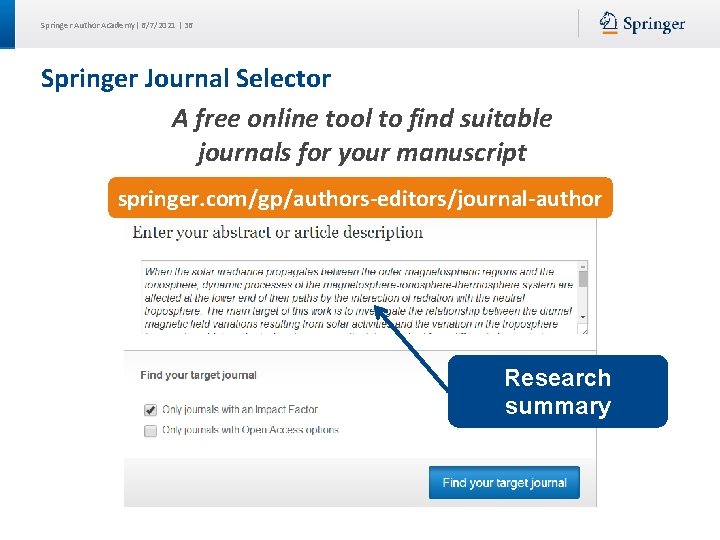
Springer Author Academy| 6/7/2021 | 36 Springer Journal Selector A free online tool to find suitable journals for your manuscript springer. com/gp/authors-editors/journal-author Research summary
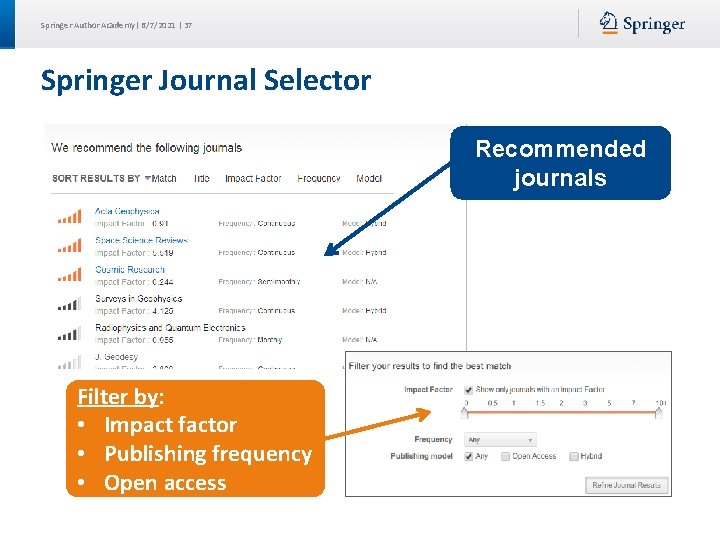
Springer Author Academy| 6/7/2021 | 37 Springer Journal Selector Recommended journals Filter by: • Impact factor • Publishing frequency • Open access
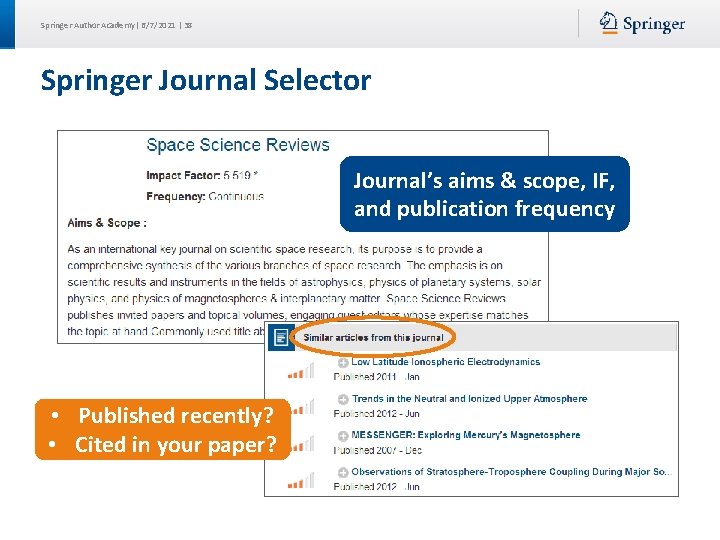
Springer Author Academy| 6/7/2021 | 38 Springer Journal Selector Journal’s aims & scope, IF, and publication frequency • Published recently? • Cited in your paper?
Springer Author Academy| 6/7/2021 | 39 Preparing your manuscript
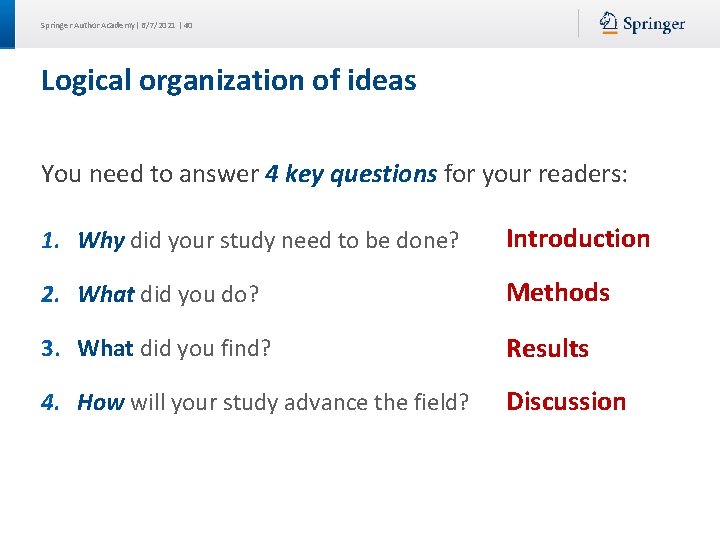
Springer Author Academy| 6/7/2021 | 40 Logical organization of ideas You need to answer 4 key questions for your readers: 1. Why did your study need to be done? Introduction 2. What did you do? Methods 3. What did you find? Results 4. How will your study advance the field? Discussion
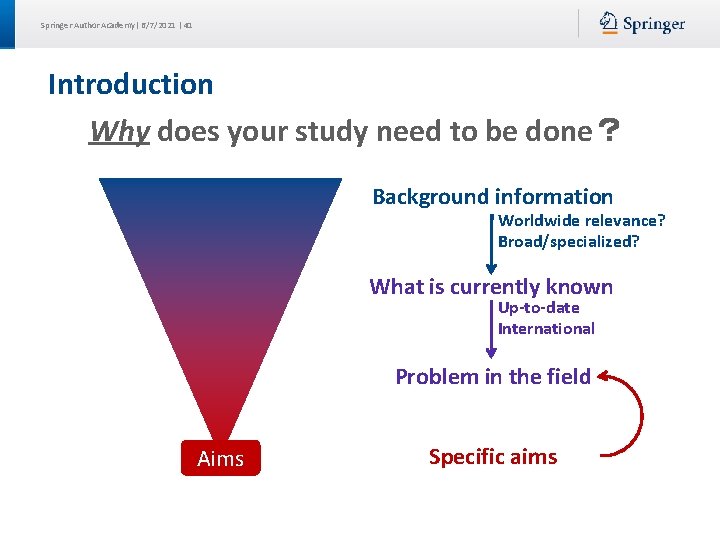
Springer Author Academy| 6/7/2021 | 41 Introduction Why does your study need to be done? Background information Worldwide relevance? Broad/specialized? What is currently known Up-to-date International Problem in the field Aims Specific aims
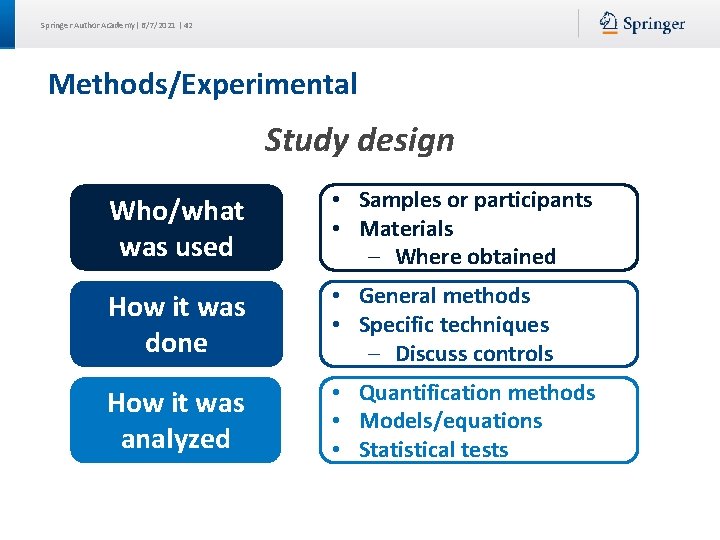
Springer Author Academy| 6/7/2021 | 42 Methods/Experimental Study design Who/what was used • Samples or participants • Materials – Where obtained How it was done • General methods • Specific techniques – Discuss controls How it was analyzed • Quantification methods • Models/equations • Statistical tests
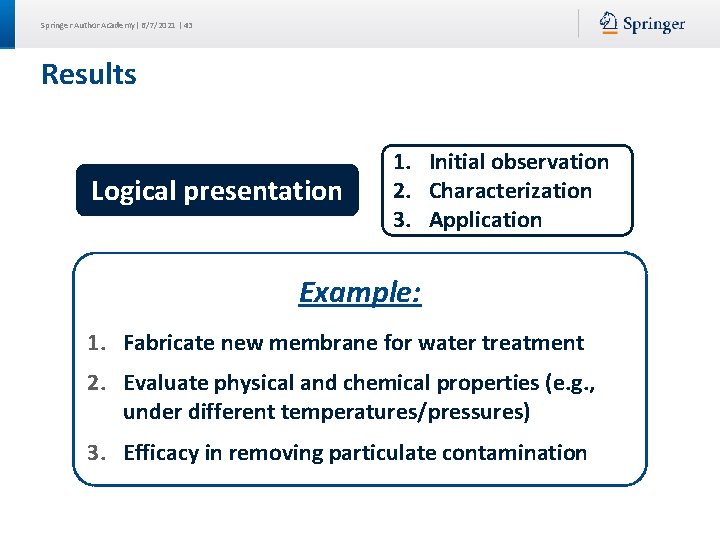
Springer Author Academy| 6/7/2021 | 43 Results Logical presentation 1. Initial observation 2. Characterization 3. Application Example: 1. Fabricate new membrane for water treatment 2. Evaluate physical and chemical properties (e. g. , under different temperatures/pressures) 3. Efficacy in removing particulate contamination
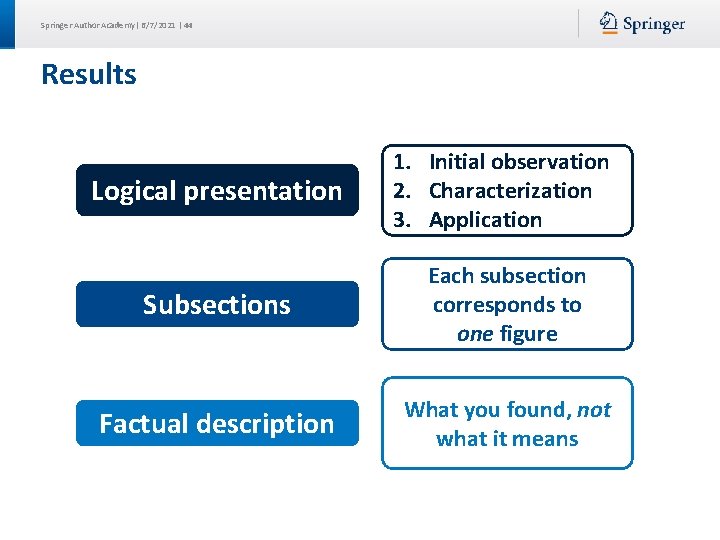
Springer Author Academy| 6/7/2021 | 44 Results Logical presentation 1. Initial observation 2. Characterization 3. Application Subsections Each subsection corresponds to one figure Factual description What you found, not what it means
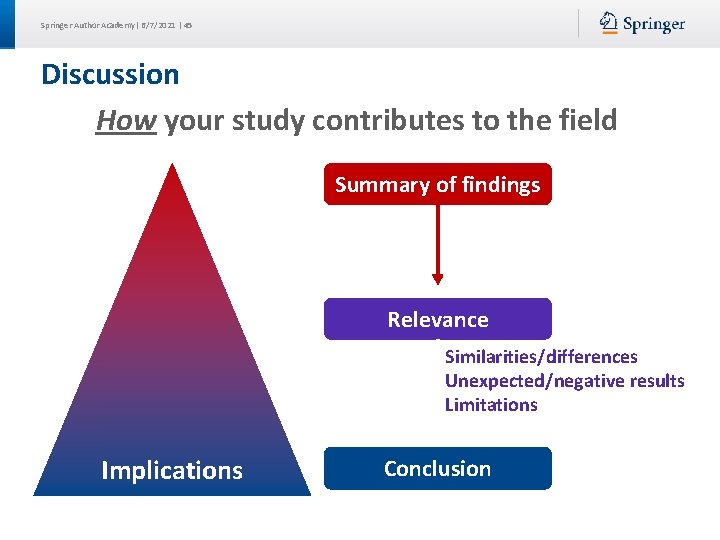
Springer Author Academy| 6/7/2021 | 45 Discussion How your study contributes to the field Summary of findings Relevance Similarities/differences Unexpected/negative results Limitations Implications Conclusion
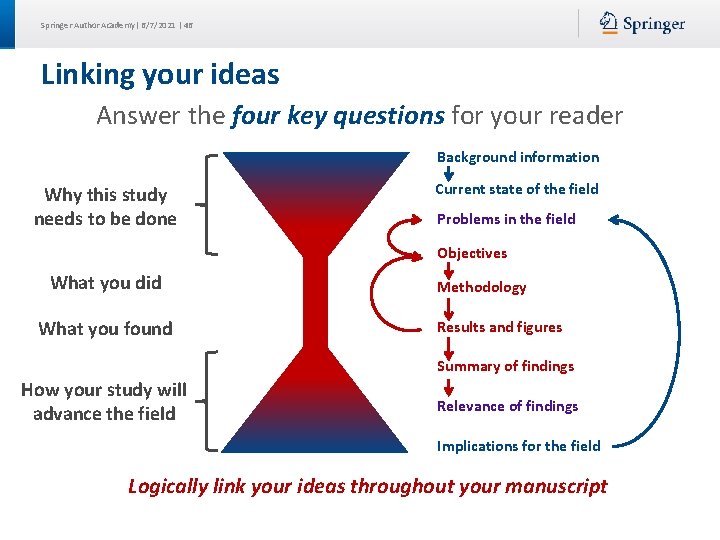
Springer Author Academy| 6/7/2021 | 46 Linking your ideas Answer the four key questions for your reader Background information Why this study needs to be done Current state of the field Problems in the field Objectives What you did What you found Methodology Results and figures Summary of findings How your study will advance the field Relevance of findings Implications for the field Logically link your ideas throughout your manuscript
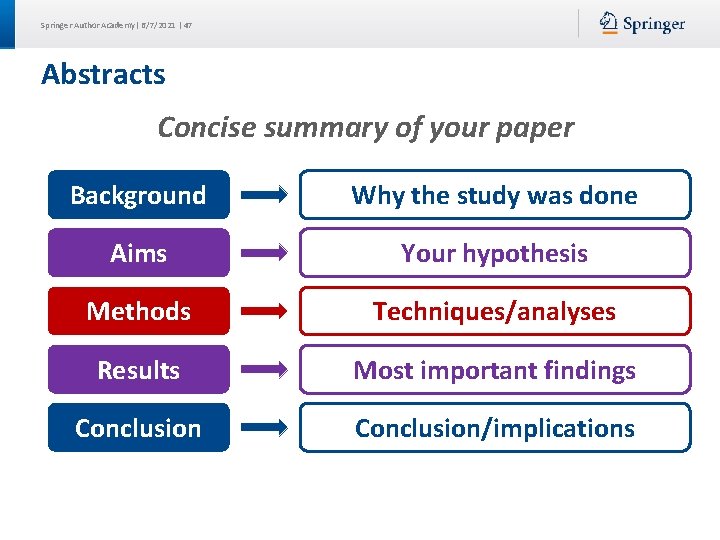
Springer Author Academy| 6/7/2021 | 47 Abstracts Concise summary of your paper Background Why the study was done Aims Your hypothesis Methods Techniques/analyses Results Most important findings Conclusion/implications
Springer Author Academy| 6/7/2021 | 48 q Chosen an appropriate journal q Written a clear and logical manuscript Ready to submit!
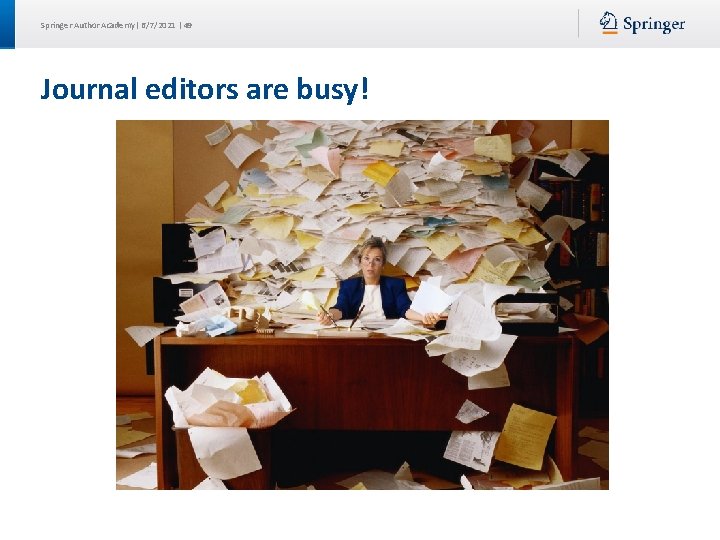
Springer Author Academy| 6/7/2021 | 49 Journal editors are busy!
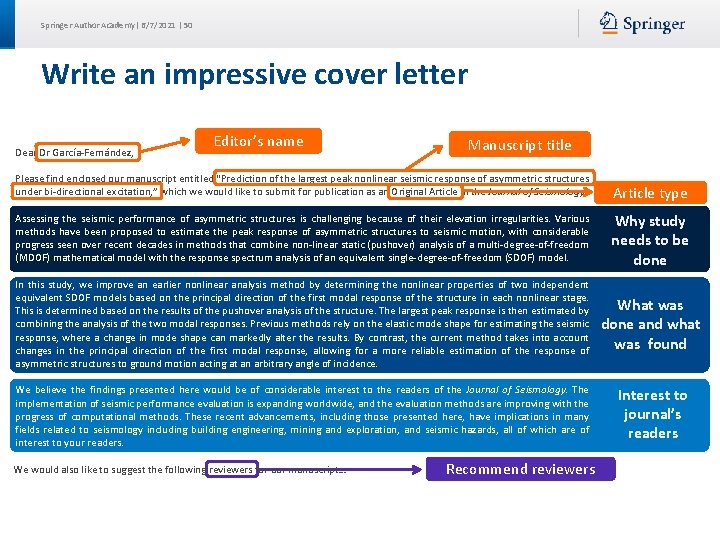
Springer Author Academy| 6/7/2021 | 50 Write an impressive cover letter Dear Dr García-Fernández, Editor’s name Manuscript title Please find enclosed our manuscript entitled “Prediction of the largest peak nonlinear seismic response of asymmetric structures under bi-directional excitation, ” which we would like to submit for publication as an Original Article in the Journal of Seismology. Article type Assessing the seismic performance of asymmetric structures is challenging because of their elevation irregularities. Various methods have been proposed to estimate the peak response of asymmetric structures to seismic motion, with considerable progress seen over recent decades in methods that combine non-linear static (pushover) analysis of a multi-degree-of-freedom (MDOF) mathematical model with the response spectrum analysis of an equivalent single-degree-of-freedom (SDOF) model. Why study needs to be done In this study, we improve an earlier nonlinear analysis method by determining the nonlinear properties of two independent equivalent SDOF models based on the principal direction of the first modal response of the structure in each nonlinear stage. This is determined based on the results of the pushover analysis of the structure. The largest peak response is then estimated by combining the analysis of the two modal responses. Previous methods rely on the elastic mode shape for estimating the seismic response, where a change in mode shape can markedly alter the results. By contrast, the current method takes into account changes in the principal direction of the first modal response, allowing for a more reliable estimation of the response of asymmetric structures to ground motion acting at an arbitrary angle of incidence. What was done and what was found We believe the findings presented here would be of considerable interest to the readers of the Journal of Seismology. The implementation of seismic performance evaluation is expanding worldwide, and the evaluation methods are improving with the progress of computational methods. These recent advancements, including those presented here, have implications in many fields related to seismology including building engineering, mining and exploration, and seismic hazards, all of which are of interest to your readers. Interest to journal’s readers We would also like to suggest the following reviewers for our manuscript… Recommend reviewers
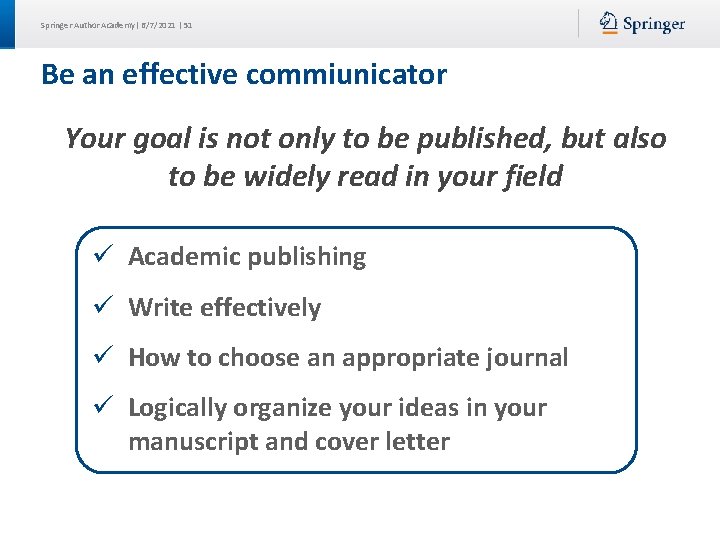
Springer Author Academy| 6/7/2021 | 51 Be an effective commiunicator Your goal is not only to be published, but also to be widely read in your field ü Academic publishing ü Write effectively ü How to choose an appropriate journal ü Logically organize your ideas in your manuscript and cover letter
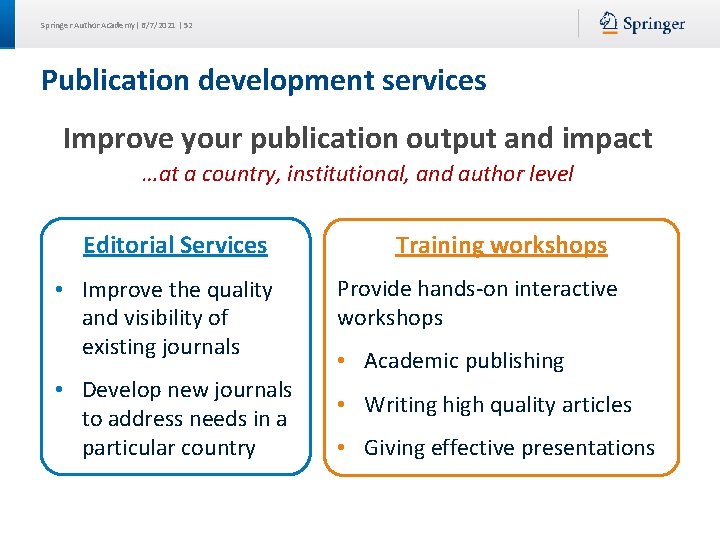
Springer Author Academy| 6/7/2021 | 52 Publication development services Improve your publication output and impact …at a country, institutional, and author level Editorial Services • Improve the quality and visibility of existing journals • Develop new journals to address needs in a particular country Training workshops Provide hands-on interactive workshops • Academic publishing • Writing high quality articles • Giving effective presentations
Thank you Good luck! Any questions? Download this presentation at: http: //tinyurl. com/springer-kazakhstan 2015

Extra slides
Springer Author Academy| 6/7/2021 | 55 Navigating peer review
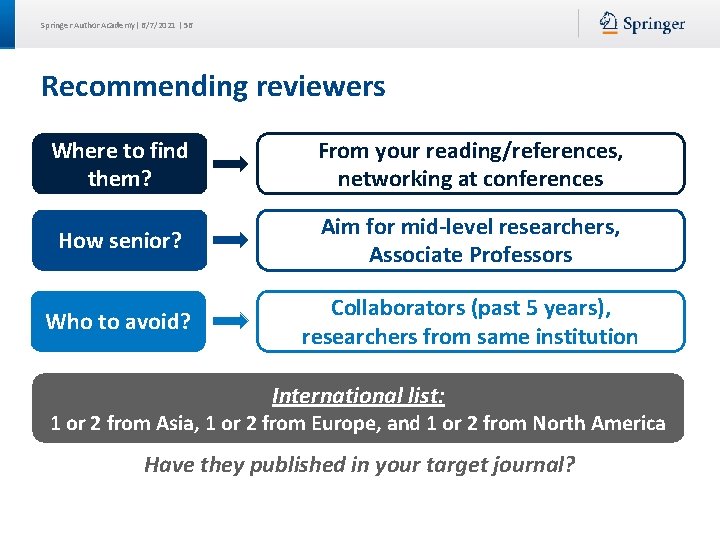
Springer Author Academy| 6/7/2021 | 56 Recommending reviewers Where to find them? From your reading/references, networking at conferences How senior? Aim for mid-level researchers, Associate Professors Who to avoid? Collaborators (past 5 years), researchers from same institution International list: 1 or 2 from Asia, 1 or 2 from Europe, and 1 or 2 from North America Have they published in your target journal?

Springer Author Academy| 6/7/2021 | 57 Writing response letters Read by the journal editor, not the reviewers Respond to every reviewer comment Refer to line and page numbers Easy to see changes Use a different color font Highlight the text Strikethrough font for deletions
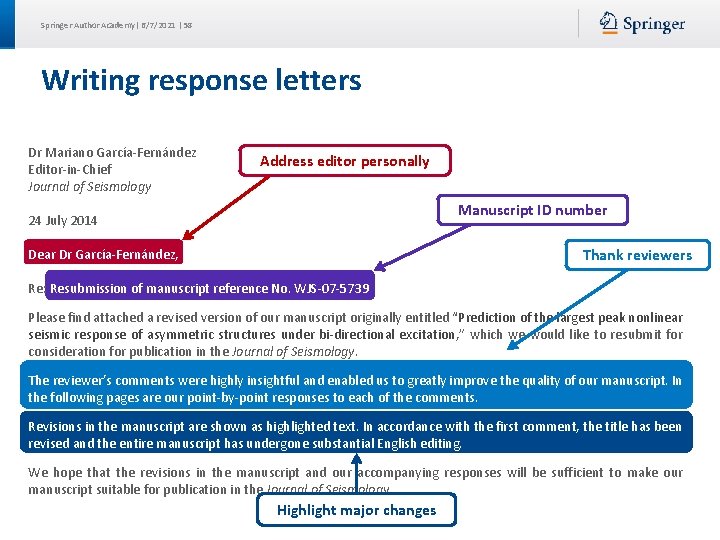
Springer Author Academy| 6/7/2021 | 58 Writing response letters Dr Mariano García-Fernández Editor-in-Chief Journal of Seismology Address editor personally Manuscript ID number 24 July 2014 Thank reviewers Dear Dr García-Fernández, Re: Resubmission of manuscript reference No. WJS-07 -5739 Please find attached a revised version of our manuscript originally entitled “Prediction of the largest peak nonlinear seismic response of asymmetric structures under bi-directional excitation, ” which we would like to resubmit for consideration for publication in the Journal of Seismology. The reviewer’s comments were highly insightful and enabled us to greatly improve the quality of our manuscript. In the following pages are our point-by-point responses to each of the comments. Revisions in the manuscript are shown as highlighted text. In accordance with the first comment, the title has been revised and the entire manuscript has undergone substantial English editing. We hope that the revisions in the manuscript and our accompanying responses will be sufficient to make our manuscript suitable for publication in the Journal of Seismology. Highlight major changes
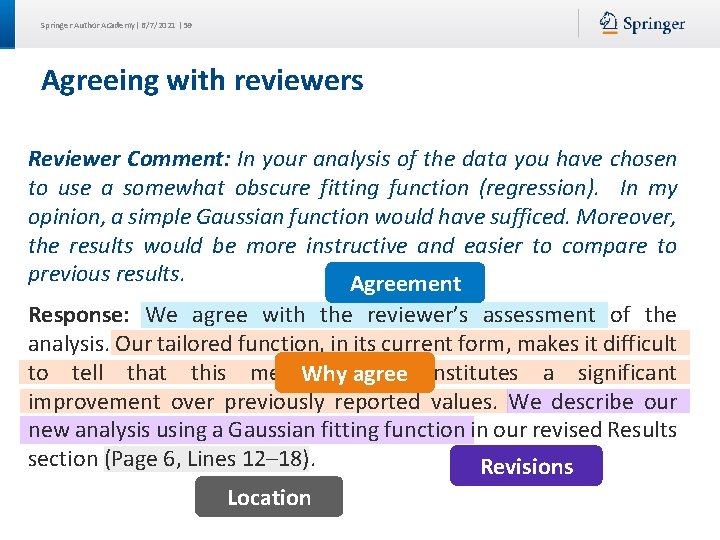
Springer Author Academy| 6/7/2021 | 59 Agreeing with reviewers Reviewer Comment: In your analysis of the data you have chosen to use a somewhat obscure fitting function (regression). In my opinion, a simple Gaussian function would have sufficed. Moreover, the results would be more instructive and easier to compare to previous results. Agreement Response: We agree with the reviewer’s assessment of the analysis. Our tailored function, in its current form, makes it difficult to tell that this measurement Why agree constitutes a significant improvement over previously reported values. We describe our new analysis using a Gaussian fitting function in our revised Results section (Page 6, Lines 12– 18). Revisions Location
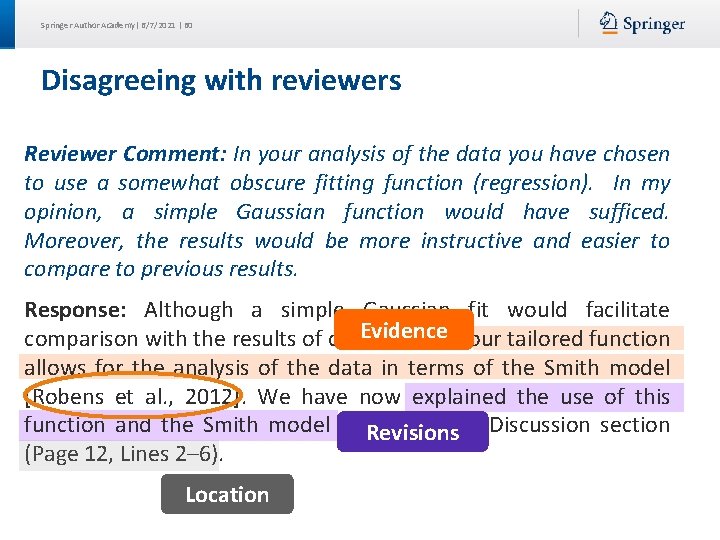
Springer Author Academy| 6/7/2021 | 60 Disagreeing with reviewers Reviewer Comment: In your analysis of the data you have chosen to use a somewhat obscure fitting function (regression). In my opinion, a simple Gaussian function would have sufficed. Moreover, the results would be more instructive and easier to compare to previous results. Response: Although a simple Gaussian fit would facilitate Evidence comparison with the results of other studies, our tailored function allows for the analysis of the data in terms of the Smith model [Robens et al. , 2012]. We have now explained the use of this function and the Smith model in Revisions our revised Discussion section (Page 12, Lines 2– 6). Location
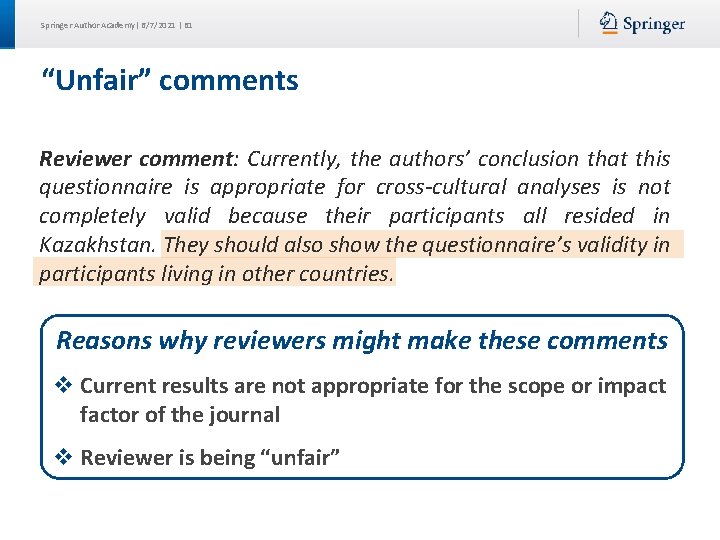
Springer Author Academy| 6/7/2021 | 61 “Unfair” comments Reviewer comment: Currently, the authors’ conclusion that this questionnaire is appropriate for cross-cultural analyses is not completely valid because their participants all resided in Kazakhstan. They should also show the questionnaire’s validity in participants living in other countries. Reasons why reviewers might make these comments v Current results are not appropriate for the scope or impact factor of the journal v Reviewer is being “unfair”
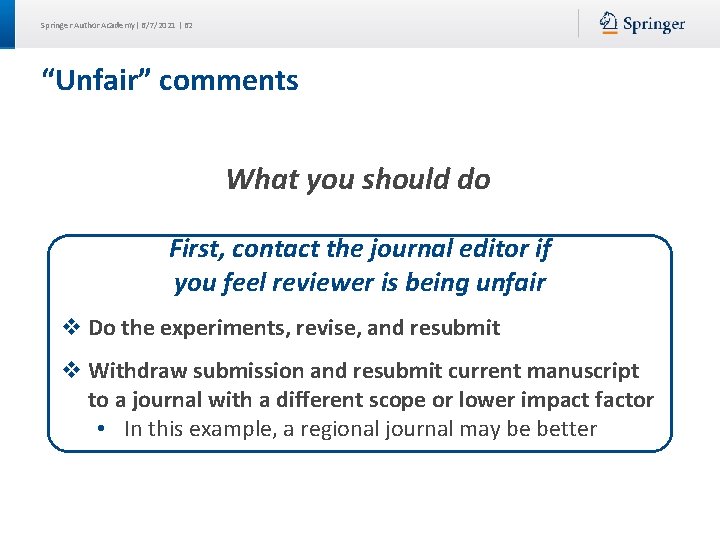
Springer Author Academy| 6/7/2021 | 62 “Unfair” comments What you should do First, contact the journal editor if you feel reviewer is being unfair v Do the experiments, revise, and resubmit v Withdraw submission and resubmit current manuscript to a journal with a different scope or lower impact factor • In this example, a regional journal may be better
Springer Author Academy| 6/7/2021 | 63 Increasing and tracking your impact
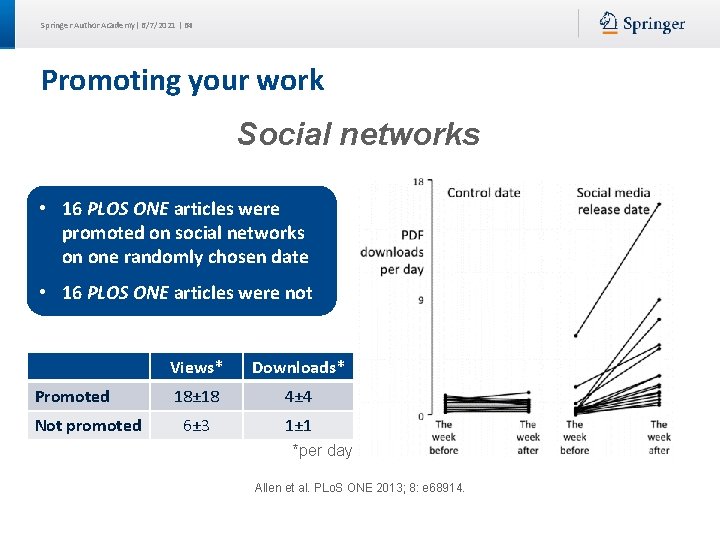
Springer Author Academy| 6/7/2021 | 64 Promoting your work Social networks • 16 PLOS ONE articles were promoted on social networks on one randomly chosen date • 16 PLOS ONE articles were not Promoted Not promoted Views* Downloads* 18± 18 4± 4 6± 3 1± 1 *per day Allen et al. PLo. S ONE 2013; 8: e 68914.
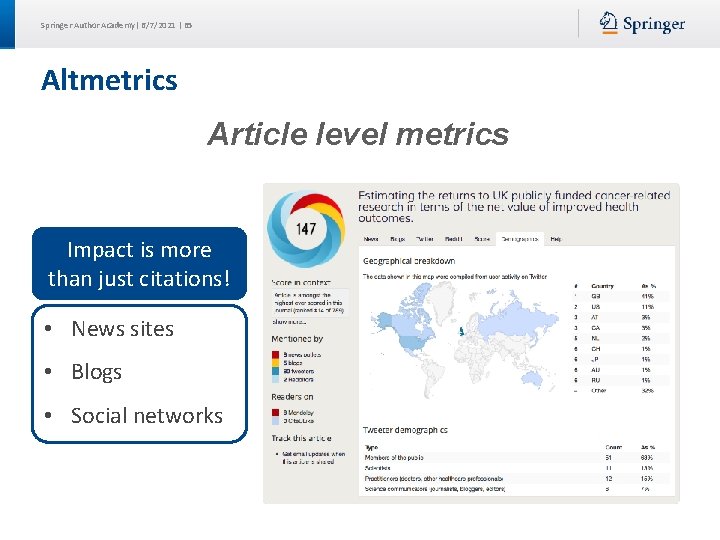
Springer Author Academy| 6/7/2021 | 65 Altmetrics Article level metrics Impact is more than just citations! • News sites • Blogs • Social networks
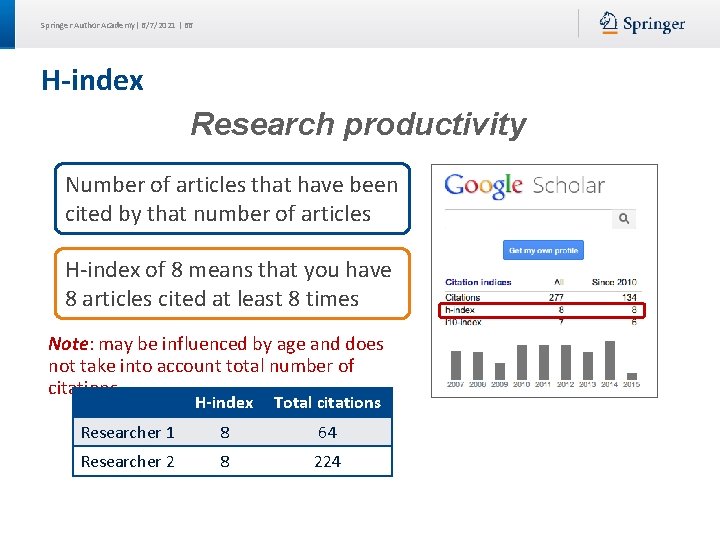
Springer Author Academy| 6/7/2021 | 66 H-index Research productivity Number of articles that have been cited by that number of articles H-index of 8 means that you have 8 articles cited at least 8 times Note: may be influenced by age and does not take into account total number of citations H-index Total citations Researcher 1 8 64 Researcher 2 8 224
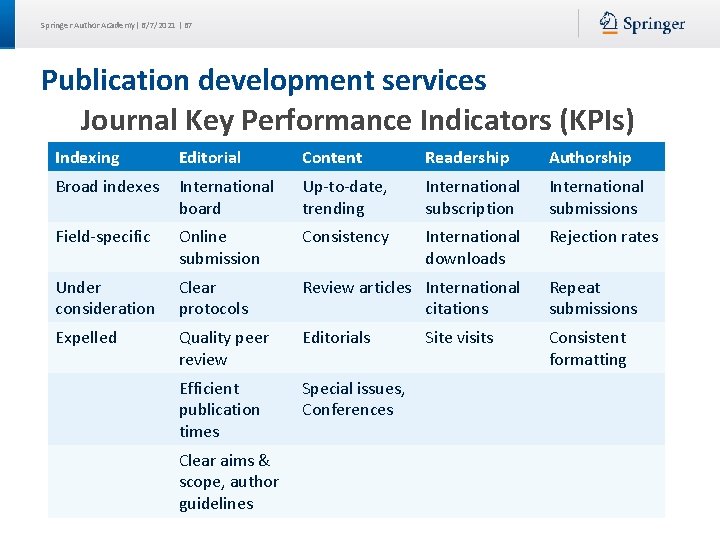
Springer Author Academy| 6/7/2021 | 67 Publication development services Journal Key Performance Indicators (KPIs) Indexing Editorial Content Readership Authorship Broad indexes International board Up-to-date, trending International subscription International submissions Field-specific Online submission Consistency International downloads Rejection rates Under consideration Clear protocols Review articles International citations Repeat submissions Expelled Quality peer review Editorials Consistent formatting Efficient publication times Special issues, Conferences Clear aims & scope, author guidelines Site visits
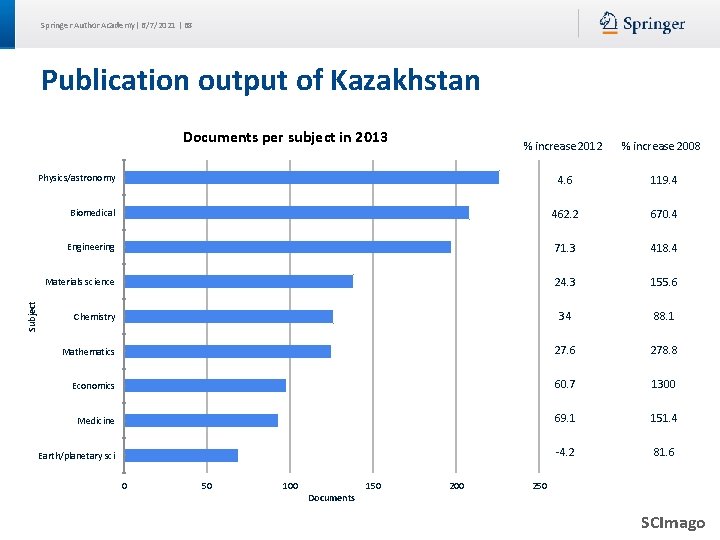
Springer Author Academy| 6/7/2021 | 68 Publication output of Kazakhstan Documents per subject in 2013 % increase 2012 % increase 2008 4. 6 119. 4 Biomedical 462. 2 670. 4 Engineering 71. 3 418. 4 Materials science 24. 3 155. 6 34 88. 1 Mathematics 27. 6 278. 8 Economics 60. 7 1300 Medicine 69. 1 151. 4 Earth/planetary sci -4. 2 81. 6 Subject Physics/astronomy Chemistry 0 50 100 Documents 150 200 250 SCImago
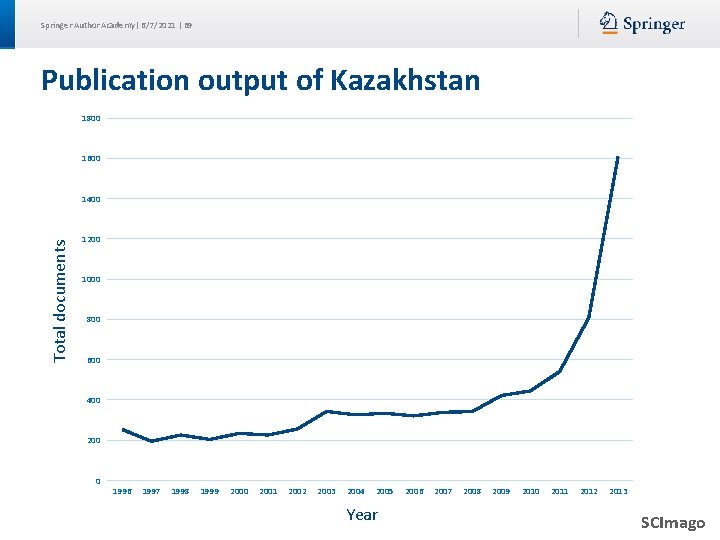
Springer Author Academy| 6/7/2021 | 69 Publication output of Kazakhstan 1800 1600 Total documents 1400 1200 1000 800 600 400 200 0 1996 1997 1998 1999 2000 2001 2002 2003 2004 2005 Year 2006 2007 2008 2009 2010 2011 2012 2013 SCImago
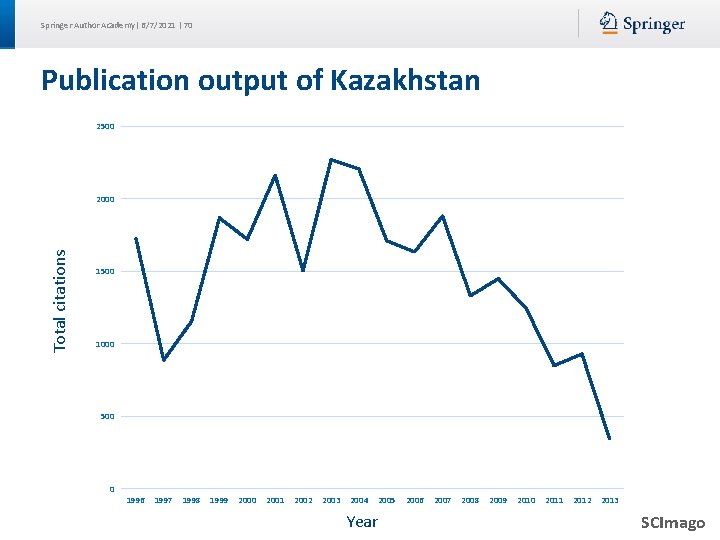
Springer Author Academy| 6/7/2021 | 70 Publication output of Kazakhstan 2500 Total citations 2000 1500 1000 500 0 1996 1997 1998 1999 2000 2001 2002 2003 2004 2005 Year 2006 2007 2008 2009 2010 2011 2012 2013 SCImago
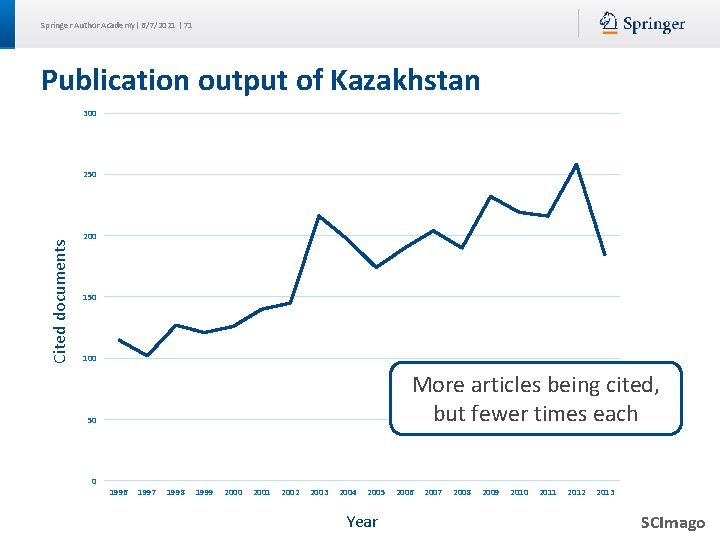
Springer Author Academy| 6/7/2021 | 71 Publication output of Kazakhstan 300 Cited documents 250 200 150 100 More articles being cited, but fewer times each 50 0 1996 1997 1998 1999 2000 2001 2002 2003 2004 2005 Year 2006 2007 2008 2009 2010 2011 2012 2013 SCImago
- Slides: 69