
Publication and Research Dr Vu Thi Thanh Nha

Publication and Research Dr. Vu Thi Thanh Nha The Faculty of English, The University of Languages and International Studies

• 2002 -2009: Department of Foreign Languages, USSH, VNU • 2009 -2010: Vice-Dean, the Faculty of English, University of Languages and International Studies, VNU. • 6/2010 -09/2014: obtained a Ph. D in Education at the University of New South Wales, Australia. • 11/2014: Dean, the Faculty of English, ULIS • Research interests: project-based learning, educational change, ESP, classroom-based research, action research, needs analysis, and English as a Medium of Instruction at tertiary level.
Any questions/wonders that you have about research and publication?
Contents • What is research? • Where can I start the research? • How can I set up a research project? • Do I need a theoretical framework? • How can I get funding for our research? • Should I collaborate in research and publication? • How can I finish writing up the research?
What is research? The difference between “what” and “why” questions: • ‘What’ questions focus on intelligence and for policy making • The ‘why’ questions look for explanations, relationships, comparisons, predictions, generalizations and theories. For example. . . ‘why’ are radiation levels higher in one part of a country? • Research goes beyond description and requires analysis.
What is research? Research refers to a spirited inquiry and systematic investigation that contributes to the knowledge base of a field—knowledge that provides a principled basis for making decisions about policies, plans, and actions. Research has the potential to help members of the TESOL profession improve the conditions, processes, and outcomes of language teaching, learning, and assessment. It can also help the profession address urgent social and political needs around the world and improve the materials used in language teaching, as well as clarify debates and debunk myths. (Coombe et al, 2014)

Annandale (2016)
Retroductive reasoning “We challenge the compartmentalizing tendencies of positivist social science investigation – a logic of scientific discovery followed by a logic of exhaustive empirical testing and explanation – and propose instead one overarching logic of investigation comprising three interlocking moments: • the problematization of empirical phenomena; • the retroductive explanation of these phenomena; • and the persuasion of – and intervention into – the relevant community and practices of scholars and lay- actors. ” (Glynos & Howarth, 2007, p. 19)
Is inductive research really possible?
Is inductive research really possible? Annandale (2016)
Where can I start the research? • Personal experience • The remarkable in the mundane • The mundane in the remarkable • The unexplained (or even, seemingly unexplainable) • The desire for more detail • Request/requirement • Convenient access
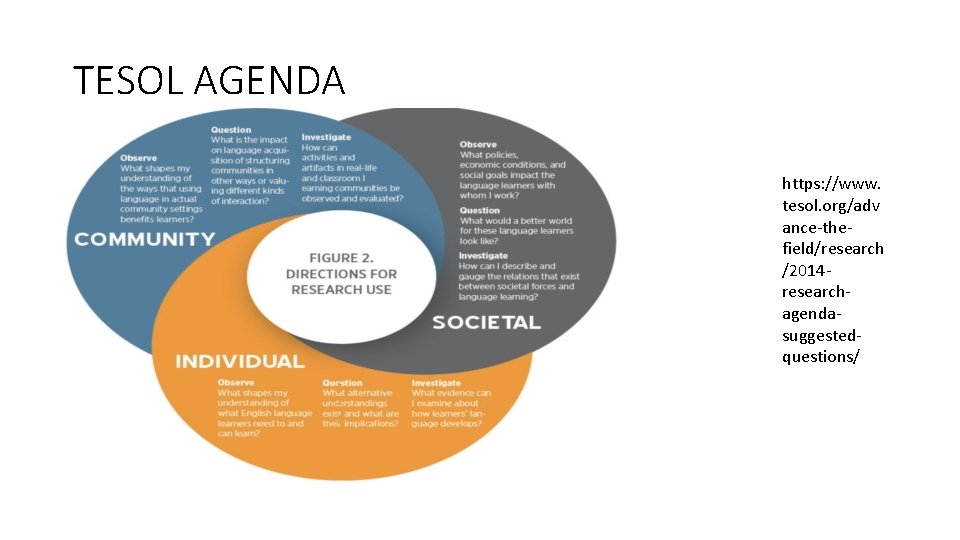
TESOL AGENDA https: //www. tesol. org/adv ance-thefield/research /2014 researchagendasuggestedquestions/
How can I set up a research project? • Write a research question as a complete sentence • Embed the problems/theories in the question • Check the access to data/equipment • Select a theoretical framework

Do I need a theory?
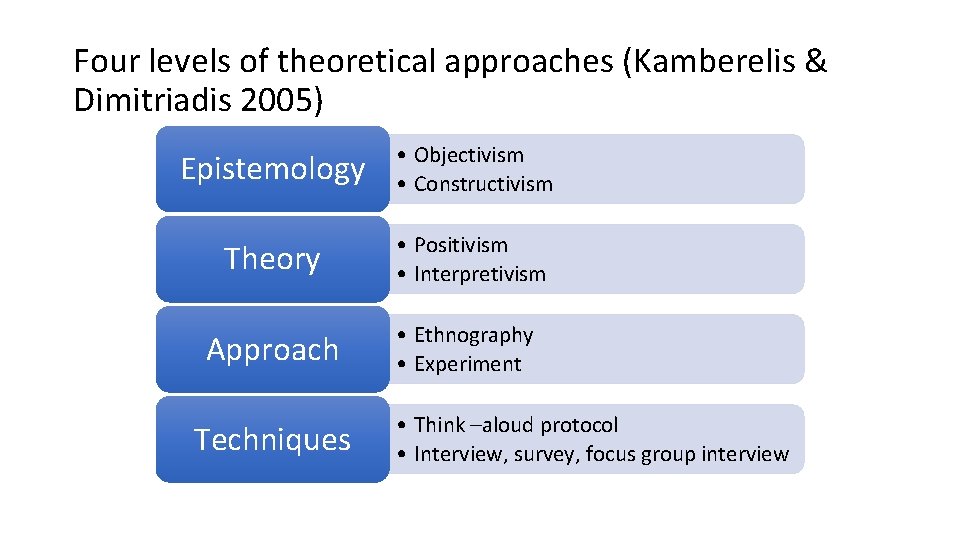
Four levels of theoretical approaches (Kamberelis & Dimitriadis 2005) Epistemology • Objectivism • Constructivism Theory • Positivism • Interpretivism Approach • Ethnography • Experiment Techniques • Think –aloud protocol • Interview, survey, focus group interview
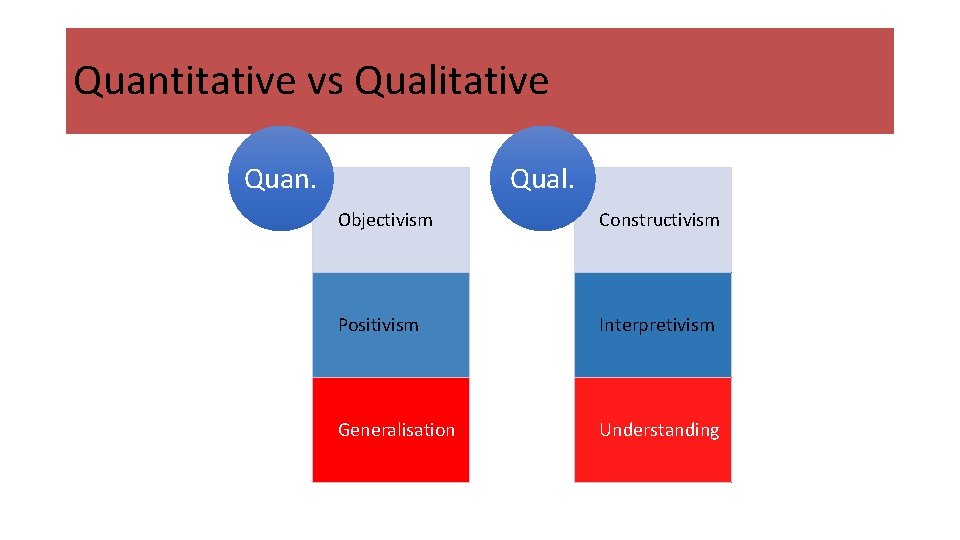
Quantitative vs Qualitative Quan. Qual. Objectivism Constructivism Positivism Interpretivism Generalisation Understanding
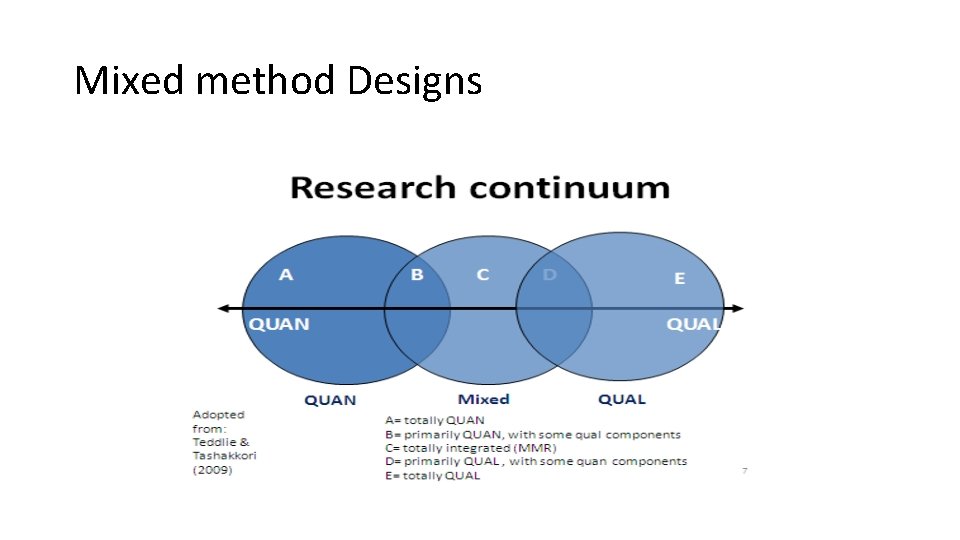
Mixed method Designs
How can I get funding for our research? • Institutional sources • Individual sources • Governmental sources • NGO/international organizations
Should I collaborate in research and publication? • Support in data collection/analysis/writing up • Complementary skills/knowledge • Personal network • “Critical/cross-check perspective”

How can I finish writing up the research?
21 Research genres There a number of research genres: each has a particular main purpose. Some examples are: • describe (this is the genre of Description). • explain (this is the genre of Explanation). • persuade or argue (this is the genre of Argument). • report (this is the genre of Report). Each of these genres has a typical structure and set of language features.
22 Why publish in international peer-reviewed journals in English? Activity B 2 • What do you understand by publishing your research? • What are the reasons for publishing your research work in journals? • What are the reasons for publishing your research work in peer-reviewed, English-language journals? • Why is peer-reviewed so important?
23 Some reasons for publishing • Personal interest in ‘making public’ your research. • Meeting university/faculty/individual key performance indicators. • Establishing and maintaining collaborations and networks. • Developing a reputation in your field or disciplinary area. • Other?
- Slides: 23