
Public Trial Lecture Impact of Energy Saving Mechanisms
Public Trial Lecture Impact of Energy Saving Mechanisms in Optical Access Networks on Network Performance Álvaro Fernández 28. 02. 2017 Norwegian University of Science and Technology
Outline • Introduction and motivation • Background • Energy saving at the client side • Energy saving at the operator side • Summary Norwegian University of Science and Technology 2
Outline • Introduction and motivation • Background • Energy saving at the client side • Energy saving at the operator side • Summary Norwegian University of Science and Technology 3
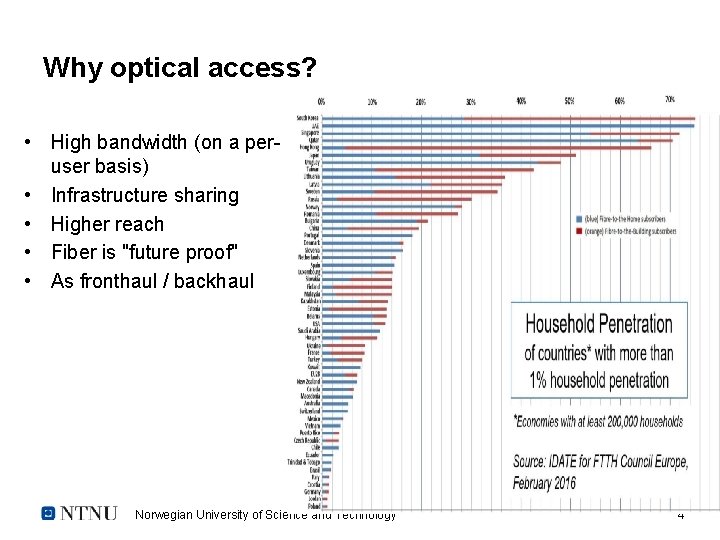
Why optical access? • High bandwidth (on a peruser basis) • Infrastructure sharing • Higher reach • Fiber is "future proof" • As fronthaul / backhaul Norwegian University of Science and Technology 4
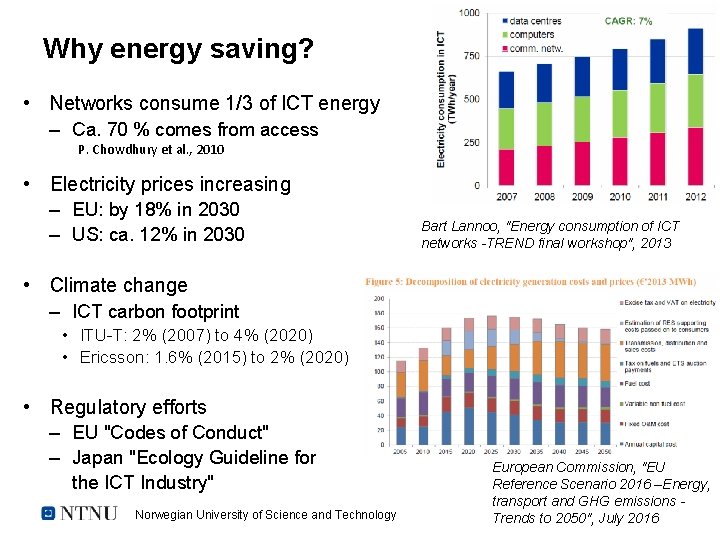
Why energy saving? • Networks consume 1/3 of ICT energy – Ca. 70 % comes from access P. Chowdhury et al. , 2010 • Electricity prices increasing – EU: by 18% in 2030 – US: ca. 12% in 2030 Bart Lannoo, "Energy consumption of ICT networks -TREND final workshop", 2013 • Climate change – ICT carbon footprint • ITU-T: 2% (2007) to 4% (2020) • Ericsson: 1. 6% (2015) to 2% (2020) • Regulatory efforts – EU "Codes of Conduct" – Japan "Ecology Guideline for the ICT Industry" Norwegian University of Science and Technology European Commission, "EU Reference Scenario 2016 –Energy, transport and GHG emissions Trends to 2050", July 2016 5
Outline • Introduction and motivation • Background • Energy saving at the client side • Energy saving at the operator side • Summary Norwegian University of Science and Technology 6
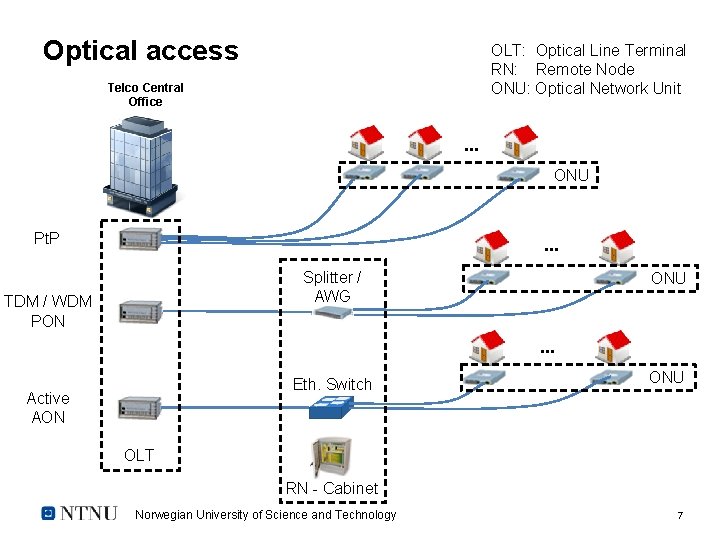
Optical access OLT: Optical Line Terminal RN: Remote Node ONU: Optical Network Unit Telco Central Office . . . ONU Pt. P . . . Splitter / AWG TDM / WDM PON ONU . . . Eth. Switch Active AON ONU OLT RN - Cabinet Norwegian University of Science and Technology 7
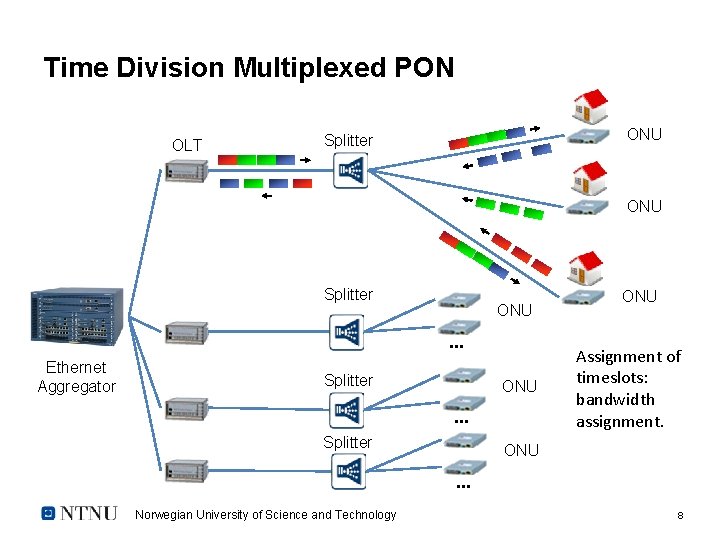
Time Division Multiplexed PON OLT ONU Splitter ONU . . . Ethernet Aggregator Splitter ONU . . . Splitter ONU Assignment of timeslots: bandwidth assignment. ONU . . . Norwegian University of Science and Technology 8
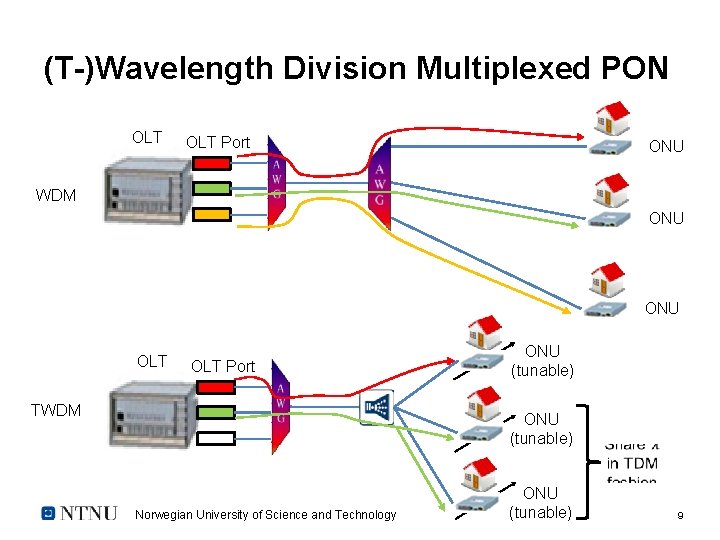
(T-)Wavelength Division Multiplexed PON OLT Port ONU WDM ONU OLT Port TWDM ONU (tunable) Norwegian University of Science and Technology ONU (tunable) 9
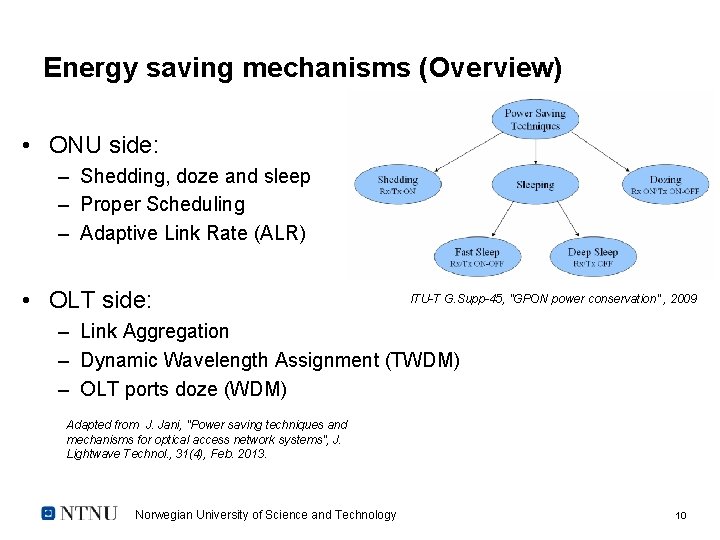
Energy saving mechanisms (Overview) • ONU side: – Shedding, doze and sleep – Proper Scheduling – Adaptive Link Rate (ALR) • OLT side: ITU-T G. Supp-45, "GPON power conservation" , 2009 – Link Aggregation – Dynamic Wavelength Assignment (TWDM) – OLT ports doze (WDM) Adapted from J. Jani, "Power saving techniques and mechanisms for optical access network systems", J. Lightwave Technol. , 31(4), Feb. 2013. Norwegian University of Science and Technology 10
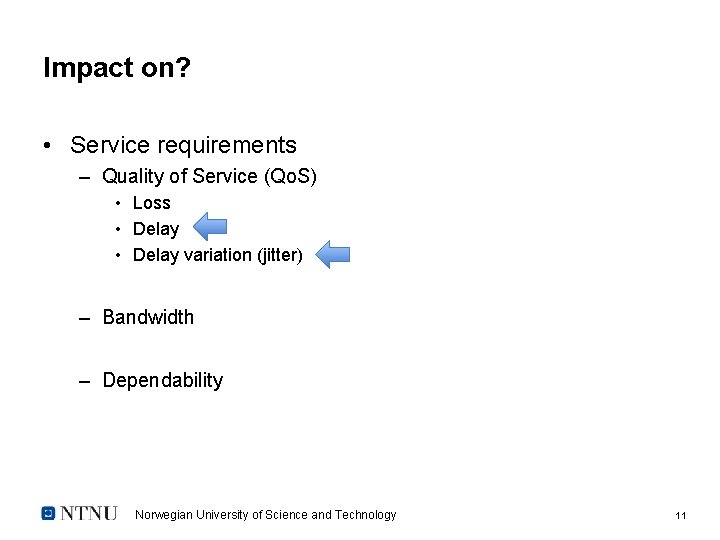
Impact on? • Service requirements – Quality of Service (Qo. S) • Loss • Delay variation (jitter) – Bandwidth – Dependability Norwegian University of Science and Technology 11
Outline • Introduction and motivation • Background • Energy saving at the client side • Energy saving at the operator side • Summary Norwegian University of Science and Technology 12
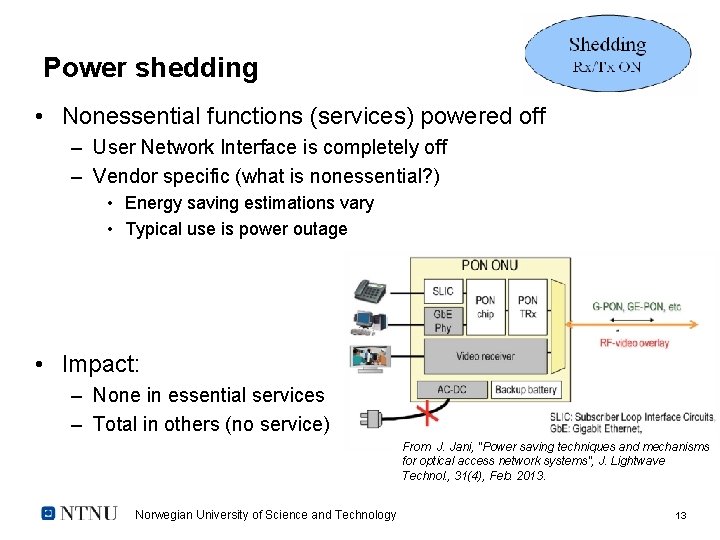
Power shedding • Nonessential functions (services) powered off – User Network Interface is completely off – Vendor specific (what is nonessential? ) • Energy saving estimations vary • Typical use is power outage • Impact: – None in essential services – Total in others (no service) From J. Jani, "Power saving techniques and mechanisms for optical access network systems", J. Lightwave Technol. , 31(4), Feb. 2013. Norwegian University of Science and Technology 13
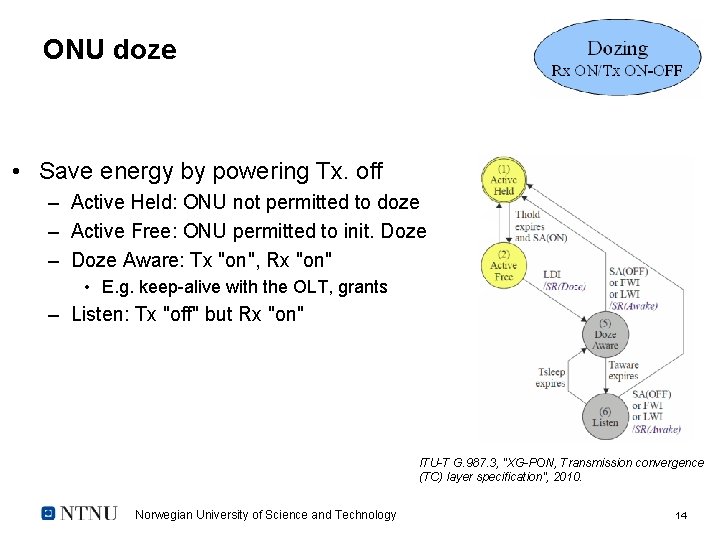
ONU doze • Save energy by powering Tx. off – Active Held: ONU not permitted to doze – Active Free: ONU permitted to init. Doze – Doze Aware: Tx "on", Rx "on" • E. g. keep-alive with the OLT, grants – Listen: Tx "off" but Rx "on" ITU-T G. 987. 3, "XG-PON, Transmission convergence (TC) layer specification", 2010. Norwegian University of Science and Technology 14
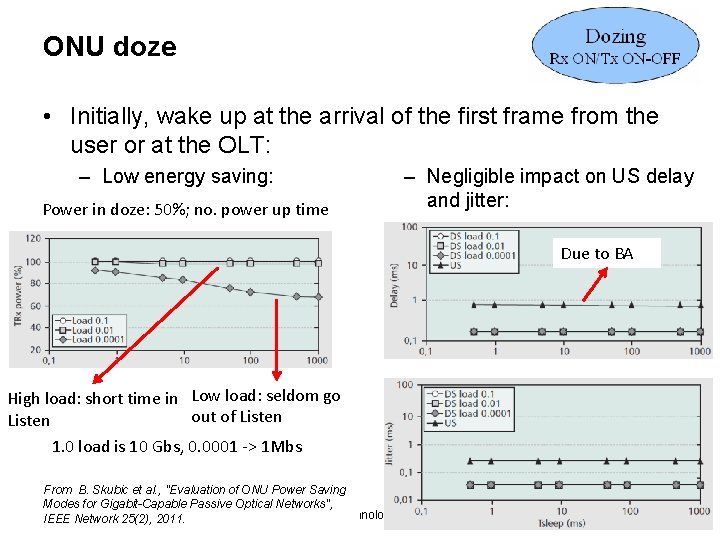
ONU doze • Initially, wake up at the arrival of the first frame from the user or at the OLT: – Low energy saving: Power in doze: 50%; no. power up time – Negligible impact on US delay and jitter: Due to BA High load: short time in Low load: seldom go out of Listen 1. 0 load is 10 Gbs, 0. 0001 -> 1 Mbs From B. Skubic et al. , "Evaluation of ONU Power Saving Modes for Gigabit-Capable Passive Optical Networks", Norwegian IEEE Network 25(2), 2011. University of Science and Technology 15
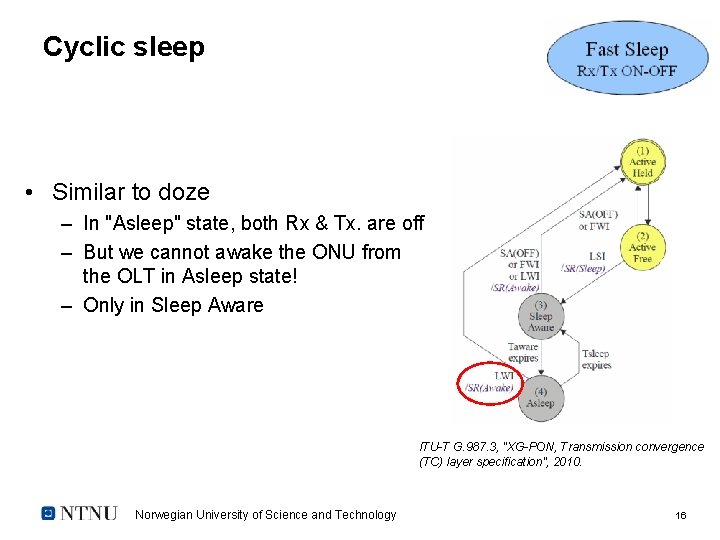
Cyclic sleep • Similar to doze – In "Asleep" state, both Rx & Tx. are off – But we cannot awake the ONU from the OLT in Asleep state! – Only in Sleep Aware ITU-T G. 987. 3, "XG-PON, Transmission convergence (TC) layer specification", 2010. Norwegian University of Science and Technology 16
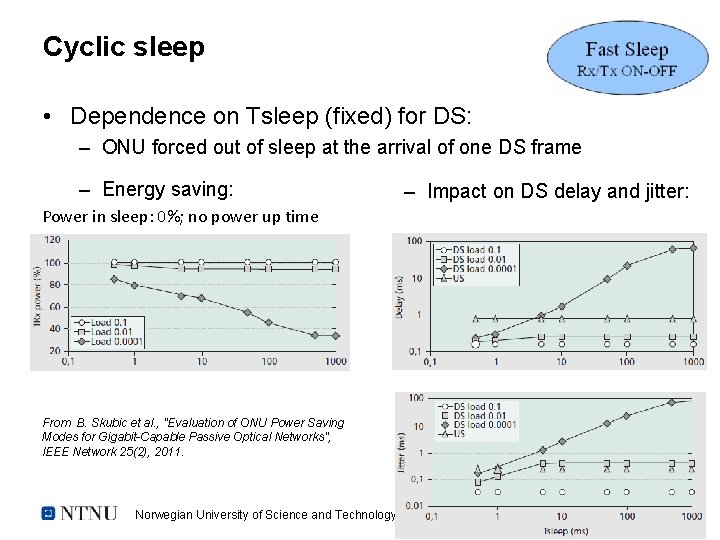
Cyclic sleep • Dependence on Tsleep (fixed) for DS: – ONU forced out of sleep at the arrival of one DS frame – Energy saving: – Impact on DS delay and jitter: Power in sleep: 0%; no power up time From B. Skubic et al. , "Evaluation of ONU Power Saving Modes for Gigabit-Capable Passive Optical Networks", IEEE Network 25(2), 2011. Norwegian University of Science and Technology 17
ONU doze/sleep • When should the ONU be awoken? – Both locally and from the OLT? – Conservative: immediately upon first frame reception • In sleep mode, ONU cannot be awoken from OLT – Rx. is off – Downstream (DS) traffic will suffer delay dependent on Tsleep – How long should we sleep (Tsleep)? • Fixed or variable? – Conservative: fixed Tsleep Norwegian University of Science and Technology 18
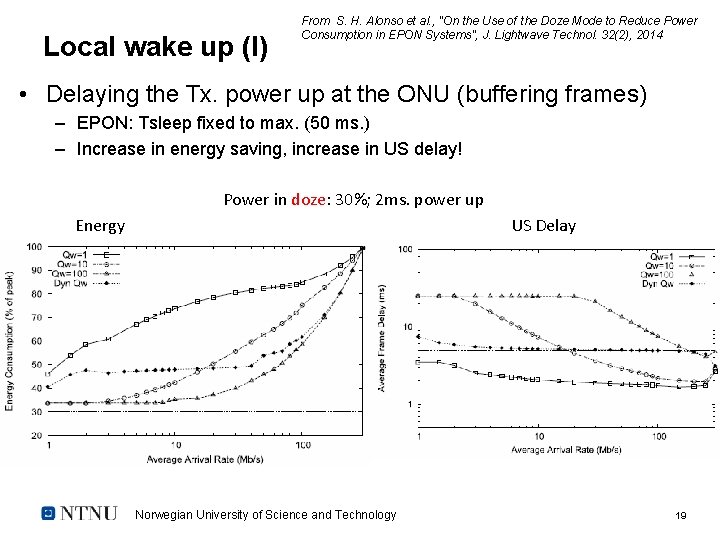
Local wake up (I) From S. H. Alonso et al. , "On the Use of the Doze Mode to Reduce Power Consumption in EPON Systems", J. Lightwave Technol. 32(2), 2014 • Delaying the Tx. power up at the ONU (buffering frames) – EPON: Tsleep fixed to max. (50 ms. ) – Increase in energy saving, increase in US delay! Power in doze: 30%; 2 ms. power up Energy US Delay Norwegian University of Science and Technology 19
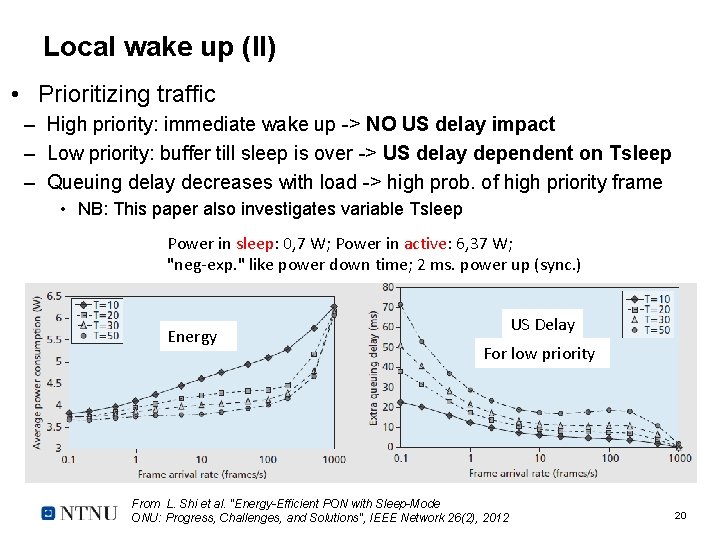
Local wake up (II) • Prioritizing traffic – High priority: immediate wake up -> NO US delay impact – Low priority: buffer till sleep is over -> US delay dependent on Tsleep – Queuing delay decreases with load -> high prob. of high priority frame • NB: This paper also investigates variable Tsleep Power in sleep: 0, 7 W; Power in active: 6, 37 W; "neg-exp. " like power down time; 2 ms. power up (sync. ) Energy US Delay For low priority From L. Shi et al. "Energy-Efficient PON with Sleep-Mode Norwegian University of Science and Technology ONU: Progress, Challenges, and Solutions", IEEE Network 26(2), 2012 20
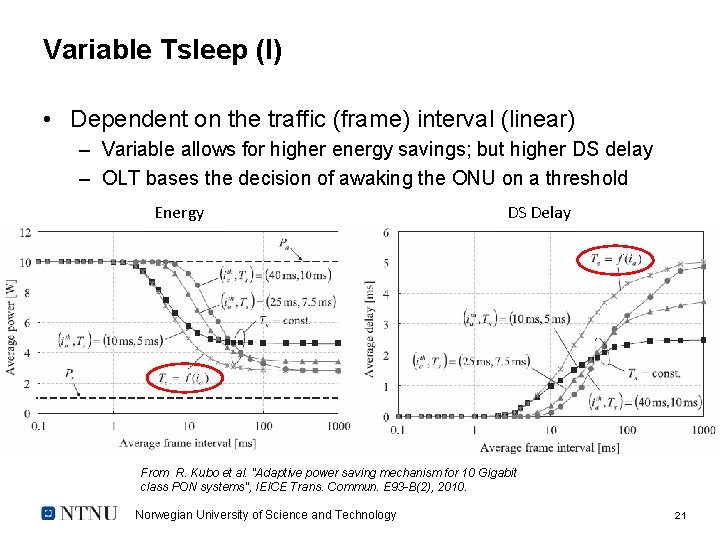
Variable Tsleep (I) • Dependent on the traffic (frame) interval (linear) – Variable allows for higher energy savings; but higher DS delay – OLT bases the decision of awaking the ONU on a threshold Energy DS Delay From R. Kubo et al. "Adaptive power saving mechanism for 10 Gigabit class PON systems", IEICE Trans. Commun. E 93 -B(2), 2010. Norwegian University of Science and Technology 21
Variable Tsleep (II) • Variable Time sleep – Fiammengo et al. explore different methods for predicting interarrival time and the linear dependency of variable Tsleep • For different traffic profiles • Variable time sleep has difficulties with bursty traffic Martina Fiammengo et al. "Experimental Evaluation of Cyclic Sleep with Adaptable Sleep Period Length for PON", ECOC 11, 2011 – Valcarenghi et al. make Tsleep dependent on the services an ONU is subscribed to (delay, jitter) • Queuing theory model L. Valcarenghi et al. "Energy Efficient PONs with Service Delay Guarantees", Sustain. IT 12, 2012 Norwegian University of Science and Technology 22
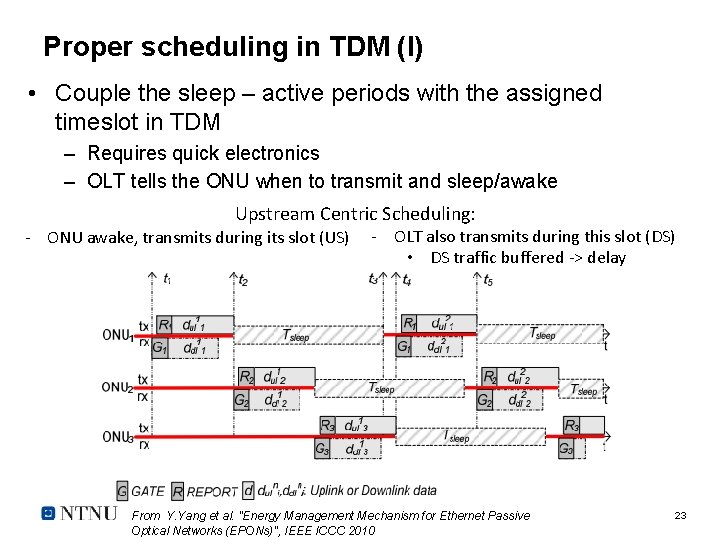
Proper scheduling in TDM (I) • Couple the sleep – active periods with the assigned timeslot in TDM – Requires quick electronics – OLT tells the ONU when to transmit and sleep/awake Upstream Centric Scheduling: - ONU awake, transmits during its slot (US) - OLT also transmits during this slot (DS) • DS traffic buffered -> delay Norwegian University of Science and Technology From Y. Yang et al. "Energy Management Mechanism for Ethernet Passive Optical Networks (EPONs)", IEEE ICCC 2010 23
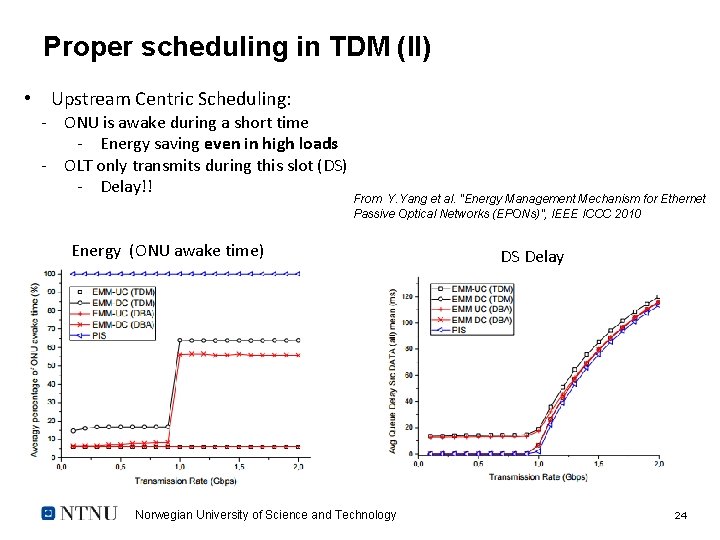
Proper scheduling in TDM (II) • Upstream Centric Scheduling: - ONU is awake during a short time - Energy saving even in high loads - OLT only transmits during this slot (DS) - Delay!! From Y. Yang et al. "Energy Management Mechanism for Ethernet Passive Optical Networks (EPONs)", IEEE ICCC 2010 Energy (ONU awake time) Norwegian University of Science and Technology DS Delay 24
Proper scheduling in TDM (III) • There have been some extensions to UCS idea: – Dhaini et al. • Granted timeslots (and awake/sleep times) have a maximum delay constraint • Gate messages are sent at the same time to all ONUs • Fixes the maximum delay A. R. Dhaini et al. "Toward Green Next-Generation Passive Optical Networks", IEEE Comm. Mag. 49(11) 2011. – D. P. Van et al. • Cycle time (sum of all granted timeslots) can vary, considering – Estimated data rates (US / DS), delay constraints and buffer occupation • Within a cycle, granted timeslots have the same length • Helps with asymmetry in traffic (DS delay) D. P. Van et al. "Experimental evaluation of asleep-aware dynamic bandwidth allocation in a multi-ONU 10 G-EPON testbed", Opt. Switch. and Netw. 14, 2014. Norwegian University of Science and Technology 25
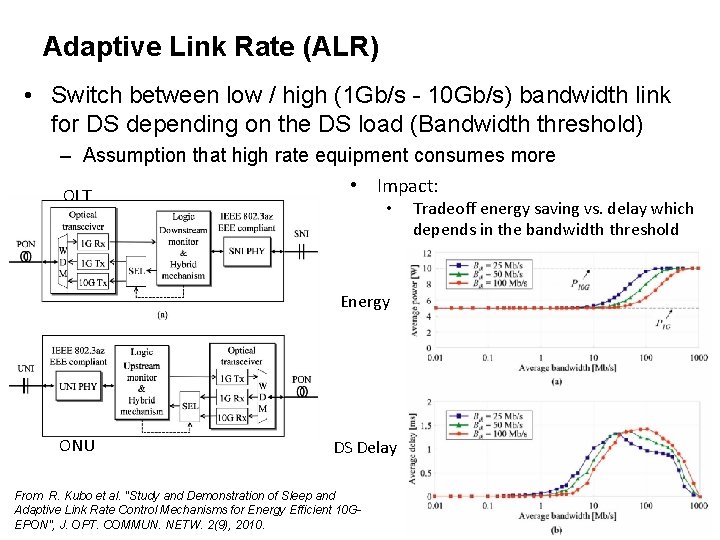
Adaptive Link Rate (ALR) • Switch between low / high (1 Gb/s - 10 Gb/s) bandwidth link for DS depending on the DS load (Bandwidth threshold) – Assumption that high rate equipment consumes more • Impact: OLT • Tradeoff energy saving vs. delay which depends in the bandwidth threshold Energy ONU DS Delay From R. Kubo et al. "Study and Demonstration of Sleep and Adaptive Link Rate Control Mechanisms for Energy Efficient Norwegian University of Science and 10 GTechnology EPON", J. OPT. COMMUN. NETW. 2(9), 2010. 26
Outline • Introduction and motivation • Background • Energy saving at the client side • Energy saving at the operator side • Summary Norwegian University of Science and Technology 27
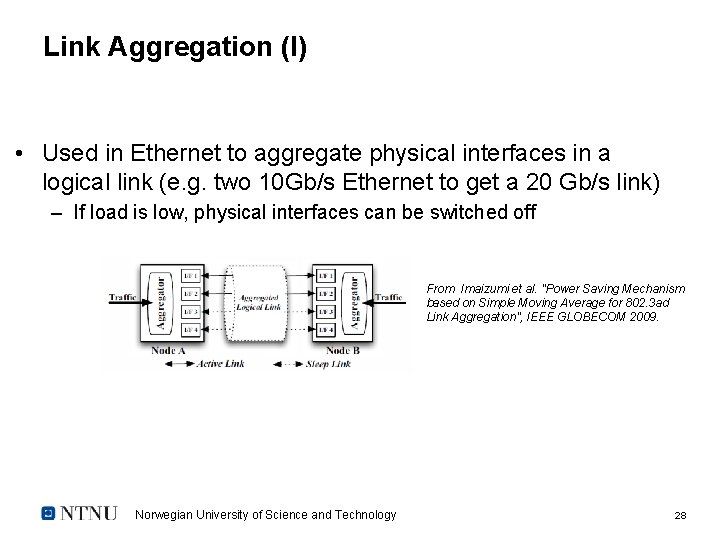
Link Aggregation (I) • Used in Ethernet to aggregate physical interfaces in a logical link (e. g. two 10 Gb/s Ethernet to get a 20 Gb/s link) – If load is low, physical interfaces can be switched off From Imaizumi et al. "Power Saving Mechanism based on Simple Moving Average for 802. 3 ad Link Aggregation", IEEE GLOBECOM 2009. Norwegian University of Science and Technology 28
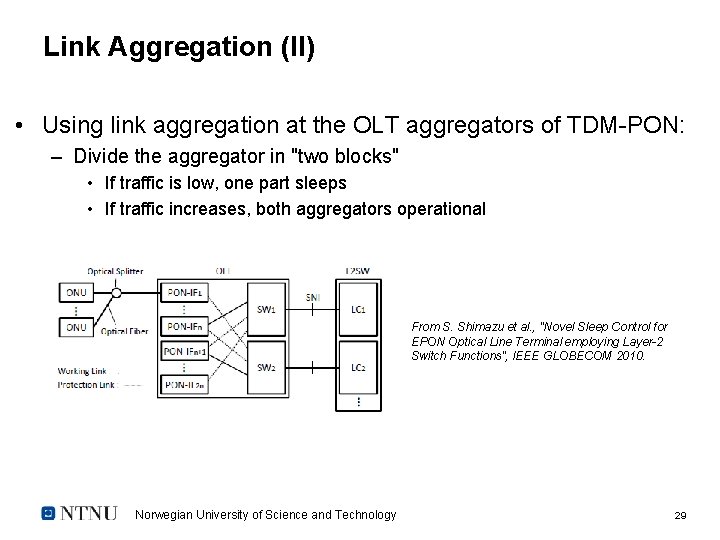
Link Aggregation (II) • Using link aggregation at the OLT aggregators of TDM-PON: – Divide the aggregator in "two blocks" • If traffic is low, one part sleeps • If traffic increases, both aggregators operational From S. Shimazu et al. , "Novel Sleep Control for EPON Optical Line Terminal employing Layer-2 Switch Functions", IEEE GLOBECOM 2010. Norwegian University of Science and Technology 29
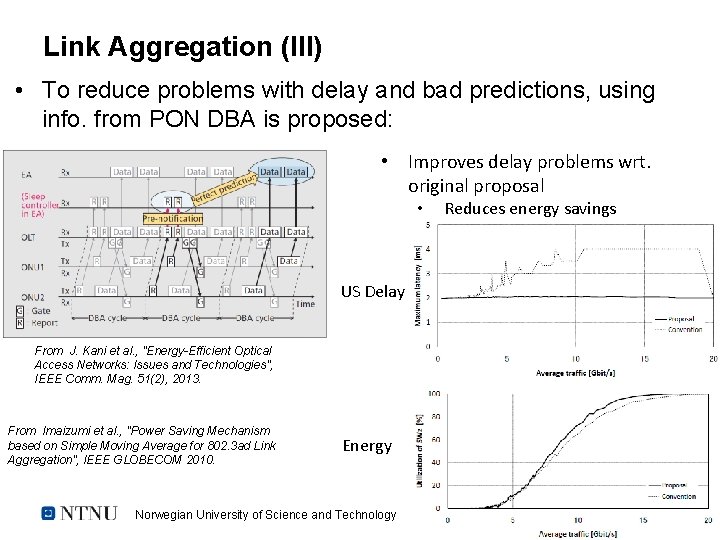
Link Aggregation (III) • To reduce problems with delay and bad predictions, using info. from PON DBA is proposed: • Improves delay problems wrt. original proposal • Reduces energy savings US Delay From J. Kani et al. , "Energy-Efficient Optical Access Networks: Issues and Technologies", IEEE Comm. Mag. 51(2), 2013. From Imaizumi et al. , "Power Saving Mechanism based on Simple Moving Average for 802. 3 ad Link Aggregation", IEEE GLOBECOM 2010. Energy Norwegian University of Science and Technology 30
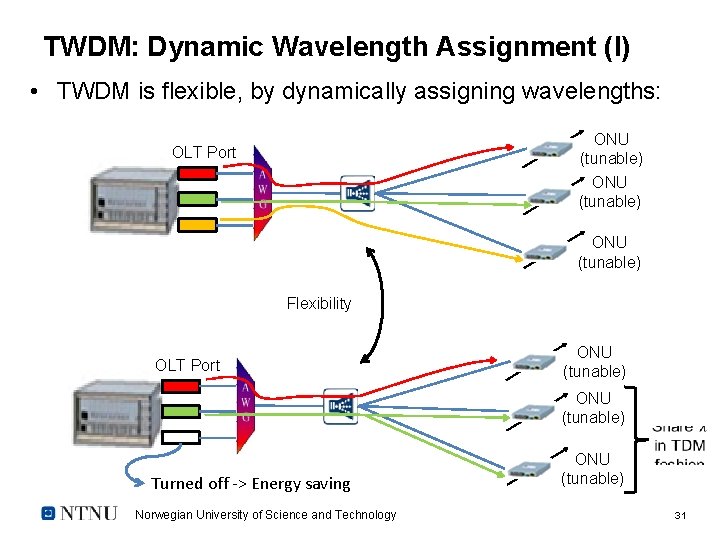
TWDM: Dynamic Wavelength Assignment (I) • TWDM is flexible, by dynamically assigning wavelengths: ONU (tunable) OLT Port ONU (tunable) Flexibility OLT Port ONU (tunable) Turned off -> Energy saving Norwegian University of Science and Technology ONU (tunable) 31
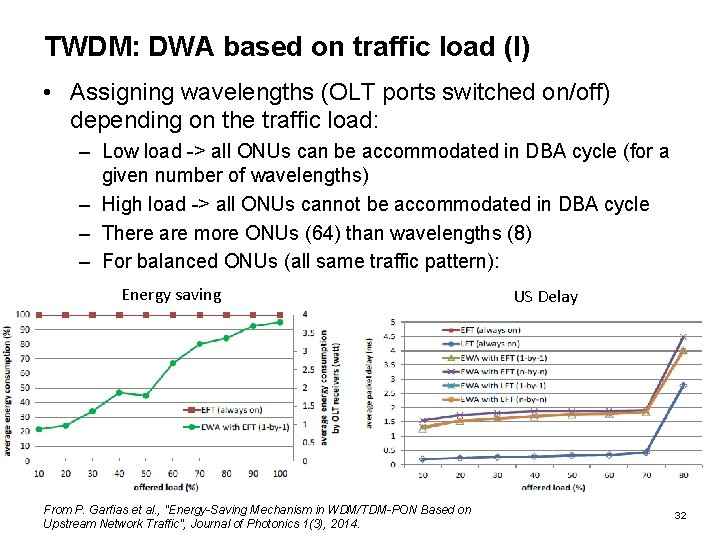
TWDM: DWA based on traffic load (I) • Assigning wavelengths (OLT ports switched on/off) depending on the traffic load: – Low load -> all ONUs can be accommodated in DBA cycle (for a given number of wavelengths) – High load -> all ONUs cannot be accommodated in DBA cycle – There are more ONUs (64) than wavelengths (8) – For balanced ONUs (all same traffic pattern): Energy saving From P. Garfias et. Norwegian al. , "Energy-Saving in WDM/TDM-PON Based on University Mechanism of Science and Technology Upstream Network Traffic", Journal of Photonics 1(3), 2014. US Delay 32
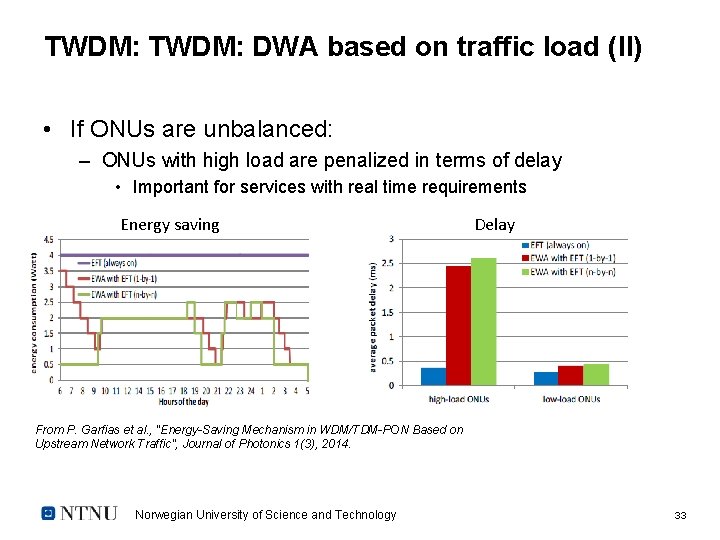
TWDM: DWA based on traffic load (II) • If ONUs are unbalanced: – ONUs with high load are penalized in terms of delay • Important for services with real time requirements Energy saving Delay From P. Garfias et al. , "Energy-Saving Mechanism in WDM/TDM-PON Based on Upstream Network Traffic", Journal of Photonics 1(3), 2014. Norwegian University of Science and Technology 33
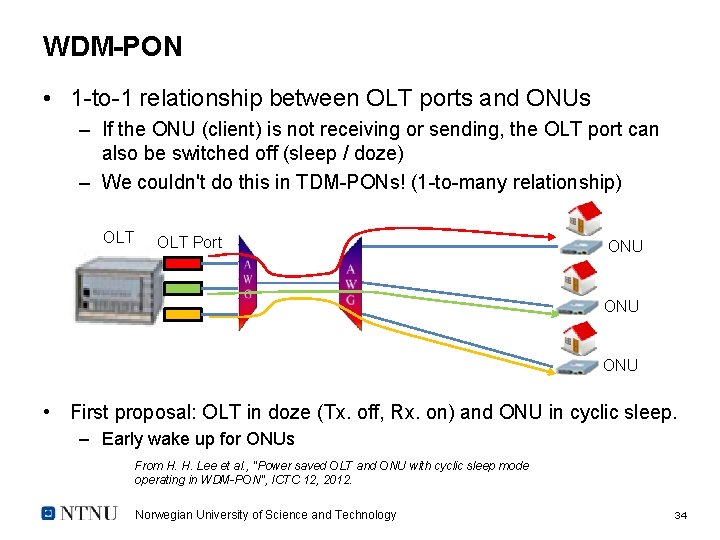
WDM-PON • 1 -to-1 relationship between OLT ports and ONUs – If the ONU (client) is not receiving or sending, the OLT port can also be switched off (sleep / doze) – We couldn't do this in TDM-PONs! (1 -to-many relationship) OLT Port ONU ONU • First proposal: OLT in doze (Tx. off, Rx. on) and ONU in cyclic sleep. – Early wake up for ONUs From H. H. Lee et al. , "Power saved OLT and ONU with cyclic sleep mode operating in WDM-PON", ICTC 12, 2012. Norwegian University of Science and Technology 34
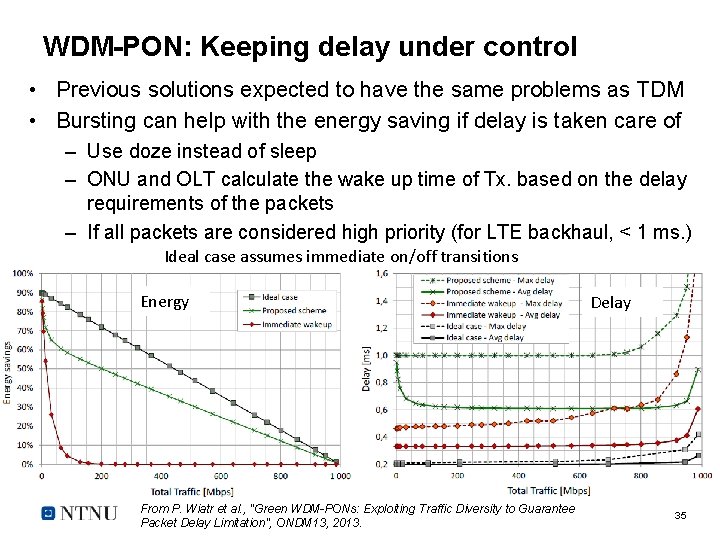
WDM-PON: Keeping delay under control • Previous solutions expected to have the same problems as TDM • Bursting can help with the energy saving if delay is taken care of – Use doze instead of sleep – ONU and OLT calculate the wake up time of Tx. based on the delay requirements of the packets – If all packets are considered high priority (for LTE backhaul, < 1 ms. ) Ideal case assumes immediate on/off transitions Energy From P. Wiatr et al. , "Green WDM-PONs: Exploiting Traffic Diversity to Guarantee Norwegian University of Science and Technology Packet Delay Limitation", ONDM 13, 2013. Delay 35
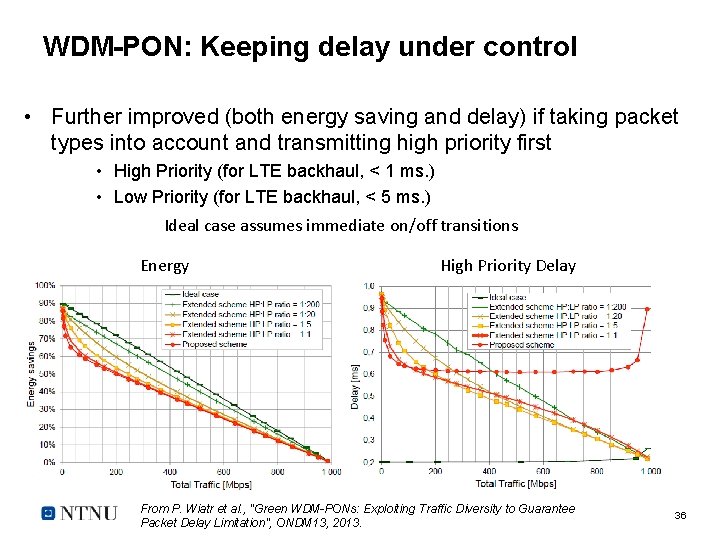
WDM-PON: Keeping delay under control • Further improved (both energy saving and delay) if taking packet types into account and transmitting high priority first • High Priority (for LTE backhaul, < 1 ms. ) • Low Priority (for LTE backhaul, < 5 ms. ) Ideal case assumes immediate on/off transitions Energy High Priority Delay From P. Wiatr et al. , "Green WDM-PONs: Exploiting Traffic Diversity to Guarantee Norwegian University of Science and Technology Packet Delay Limitation", ONDM 13, 2013. 36
Outline • Introduction and motivation • Background • Energy saving at the client side • Energy saving at the operator side • Summary Norwegian University of Science and Technology 37
Summary • Energy saving on OAN has a trade-off with delay (& jitter) – TDM: Doze and sleep are most promising solutions • Trading energy saving vs. delay and jitter – More aggressive energy saving, higher delay – For low loads » As load increases, energy savings and delay decrease (as to normal) • Matching doze/sleep with BA – Improves energy savings and keeps impact on delay low even in high loads – Impact on delay if asymmetric traffic – (T)WDM: energy saving can be applied at the OLT • TWDM: turn OLT ports on/off based on load – Impact on delay can be kept under 2 ms. – Heavy impact on delay if unbalanced ONUs • WDM: use doze mode, OLT & ONU use packet delay req. to wake-up – Can keep delay impact under 1 ms. – Adaptive Link Rate and Link aggregation can also be considered Norwegian University of Science and Technology 38
- Slides: 38