
Public Spending Code PSC Quality Assurance Guidelines Sonya
Public Spending Code (PSC) Quality Assurance Guidelines Sonya Kavanagh Public Spending Code Co-Ordinator Kildare County Council
Background n n n Circular 13/13 updated PSC obligations PSC – Expenditure Planning, Appraisal and Evaluation in the Irish Public Service PSC replaces all previous guidelines, circulars and direction in relation to appraisal and VFM Based on objective of employing good practices at all stages of the Expenditure Life Cycle All public bodies in receipt of public monies must comply
Breaking down the Code n PSC includes 3 specific elements for the Planning Appraisal and Evaluation of expenditure within the public services A. Compliance with requirements at each stage of expenditure life cycle B. Compliance with reporting requirements at each stage of a capital project C. Compliance with Quality Assurance.
Understanding the Code n Some Important points in understanding the PSC Overview of Context of the Code ¨ The PSC relates to both Capital and Current Expenditure ¨ The critical element of the PSC is the compliance with the requirements for Planning, Appraisal and Evaluation requirements ¨ The remainder of the PSC is recording and reporting on activity and compliance
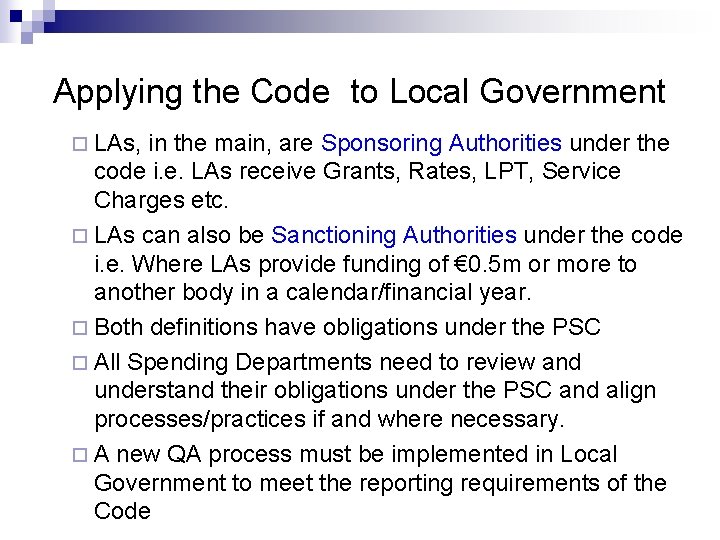
Applying the Code to Local Government ¨ LAs, in the main, are Sponsoring Authorities under the code i. e. LAs receive Grants, Rates, LPT, Service Charges etc. ¨ LAs can also be Sanctioning Authorities under the code i. e. Where LAs provide funding of € 0. 5 m or more to another body in a calendar/financial year. ¨ Both definitions have obligations under the PSC ¨ All Spending Departments need to review and understand their obligations under the PSC and align processes/practices if and where necessary. ¨ A new QA process must be implemented in Local Government to meet the reporting requirements of the Code
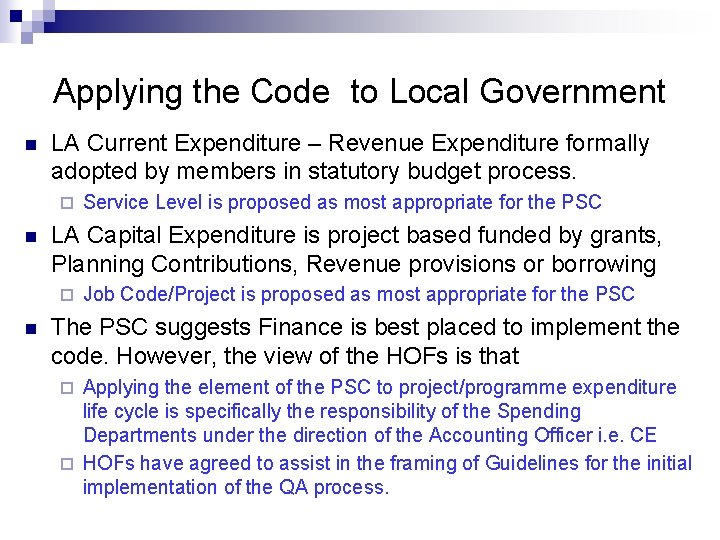
Applying the Code to Local Government n LA Current Expenditure – Revenue Expenditure formally adopted by members in statutory budget process. ¨ n LA Capital Expenditure is project based funded by grants, Planning Contributions, Revenue provisions or borrowing ¨ n Service Level is proposed as most appropriate for the PSC Job Code/Project is proposed as most appropriate for the PSC The PSC suggests Finance is best placed to implement the code. However, the view of the HOFs is that Applying the element of the PSC to project/programme expenditure life cycle is specifically the responsibility of the Spending Departments under the direction of the Accounting Officer i. e. CE ¨ HOFs have agreed to assist in the framing of Guidelines for the initial implementation of the QA process. ¨
Public Spending Code Quality Assurance Requirements Deadline – 30 th September 2015
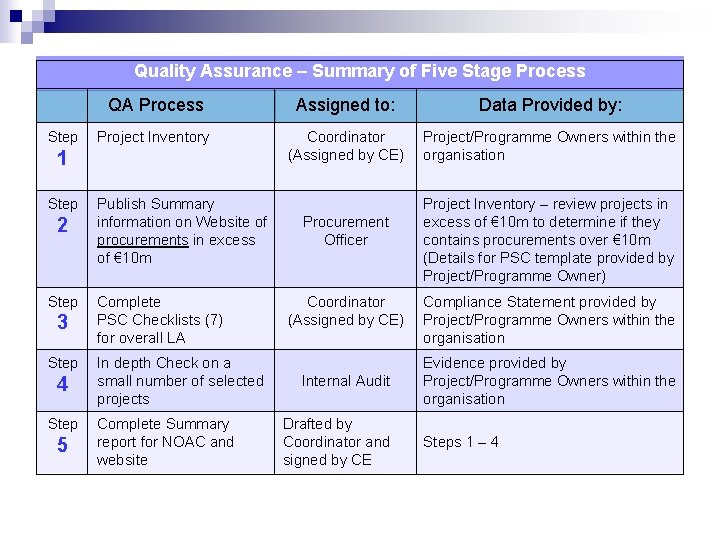
Quality Assurance – Summary of Five Stage Process Step QA Process Assigned to: Data Provided by: Project Inventory Coordinator (Assigned by CE) Project/Programme Owners within the organisation 1 Step 2 Step 3 Step 4 Step 5 Publish Summary information on Website of procurements in excess of € 10 m Complete PSC Checklists (7) for overall LA In depth Check on a small number of selected projects Complete Summary report for NOAC and website Procurement Officer Coordinator (Assigned by CE) Internal Audit Drafted by Coordinator and signed by CE Project Inventory – review projects in excess of € 10 m to determine if they contains procurements over € 10 m (Details for PSC template provided by Project/Programme Owner) Compliance Statement provided by Project/Programme Owners within the organisation Evidence provided by Project/Programme Owners within the organisation Steps 1 – 4
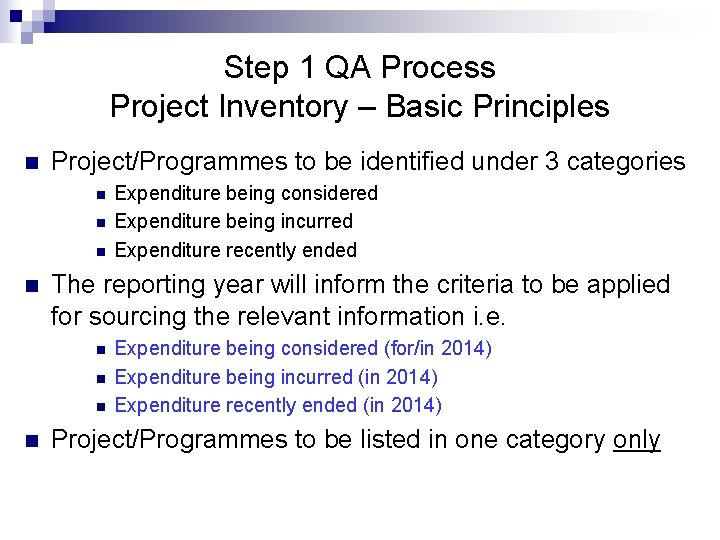
Step 1 QA Process Project Inventory – Basic Principles n Project/Programmes to be identified under 3 categories n n The reporting year will inform the criteria to be applied for sourcing the relevant information i. e. n n Expenditure being considered Expenditure being incurred Expenditure recently ended Expenditure being considered (for/in 2014) Expenditure being incurred (in 2014) Expenditure recently ended (in 2014) Project/Programmes to be listed in one category only
Step 1 - QA Process Kildare County Council’s Draft Project Inventory n The draft Inventory has to be discussed and agreed with the relevant budget holders / project managers.
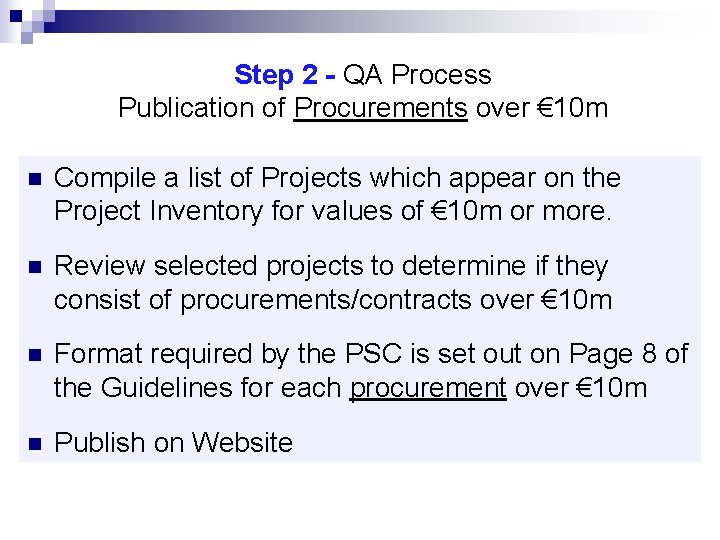
Step 2 - QA Process Publication of Procurements over € 10 m n Compile a list of Projects which appear on the Project Inventory for values of € 10 m or more. n Review selected projects to determine if they consist of procurements/contracts over € 10 m n Format required by the PSC is set out on Page 8 of the Guidelines for each procurement over € 10 m n Publish on Website
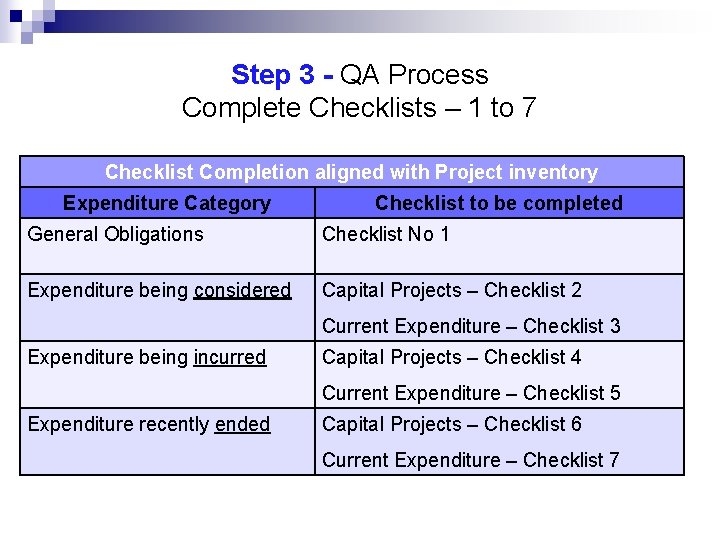
Step 3 - QA Process Complete Checklists – 1 to 7 Checklist Completion aligned with Project inventory Expenditure Category Checklist to be completed General Obligations Checklist No 1 Expenditure being considered Capital Projects – Checklist 2 Current Expenditure – Checklist 3 Expenditure being incurred Capital Projects – Checklist 4 Current Expenditure – Checklist 5 Expenditure recently ended Capital Projects – Checklist 6 Current Expenditure – Checklist 7
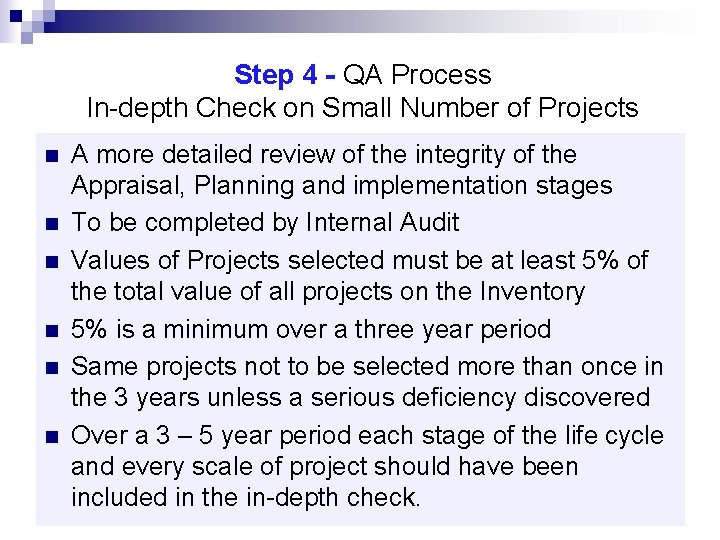
Step 4 - QA Process In-depth Check on Small Number of Projects n n n A more detailed review of the integrity of the Appraisal, Planning and implementation stages To be completed by Internal Audit Values of Projects selected must be at least 5% of the total value of all projects on the Inventory 5% is a minimum over a three year period Same projects not to be selected more than once in the 3 years unless a serious deficiency discovered Over a 3 – 5 year period each stage of the life cycle and every scale of project should have been included in the in-depth check.
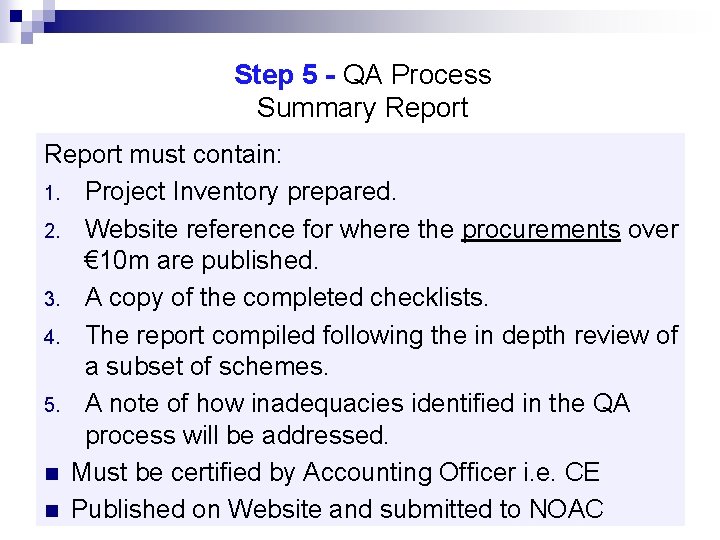
Step 5 - QA Process Summary Report must contain: 1. Project Inventory prepared. 2. Website reference for where the procurements over € 10 m are published. 3. A copy of the completed checklists. 4. The report compiled following the in depth review of a subset of schemes. 5. A note of how inadequacies identified in the QA process will be addressed. n Must be certified by Accounting Officer i. e. CE n Published on Website and submitted to NOAC

Questions? ? Go easy on me!
- Slides: 15